Vocabulaires

Découvrez, apprenez et maîtrisez le vocabulaire anglais

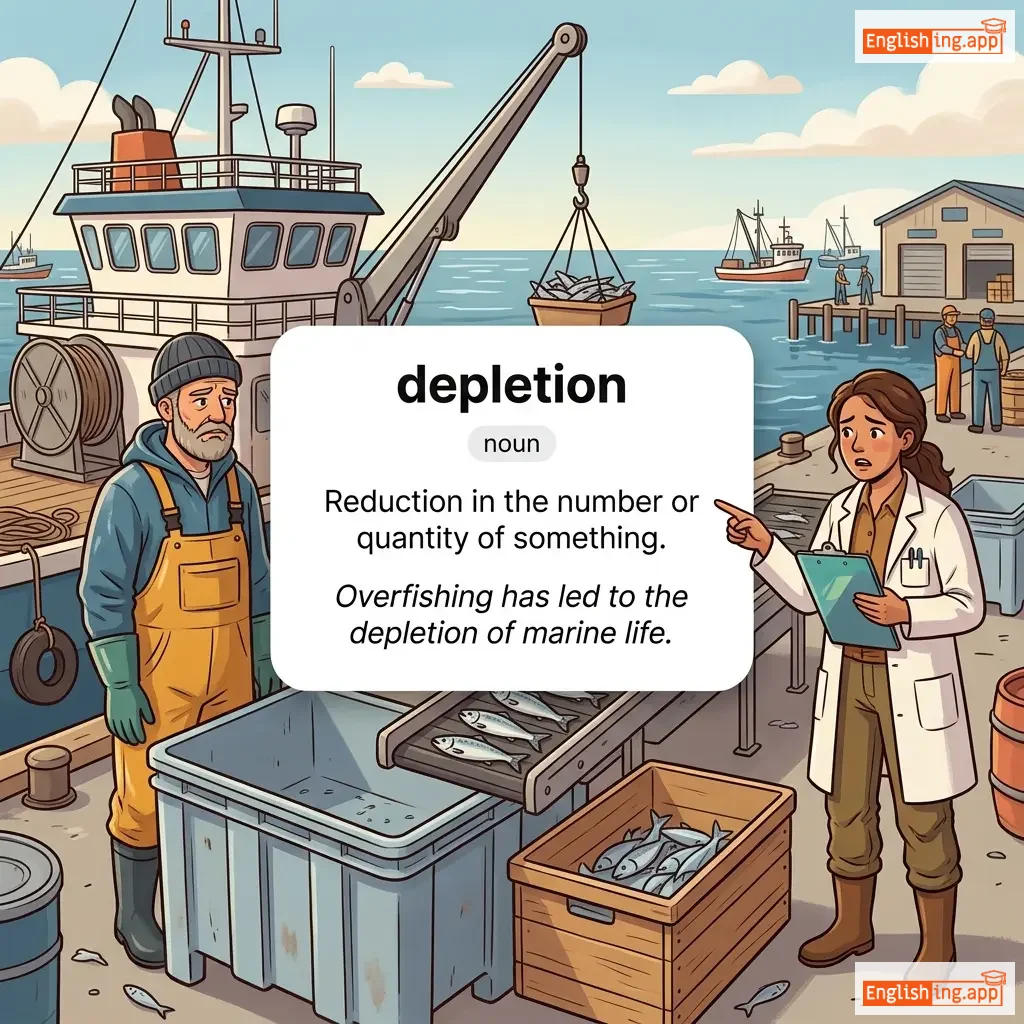
depletion definition card — visual illustration of the meaning
noun
dɪˈpliː.ʃən
épuisement (epuisement)

Reduction in the number or quantity of something.

"Overfishing has led to the depletion of marine life."

"La surpêche a conduit à l'épuisement de la vie marine." (La surpeche a conduit a l'epuisement de la vie marine.)
adjective
/dɪˈplɔːrəbl/
déplorable (déplorable)

deserving strong condemnation; shockingly bad in quality

"The refugees were living in deplorable conditions."

"Les réfugiés vivaient dans des conditions déplorables." (Les réfugiés vivaient dans des conditions déplorables.)
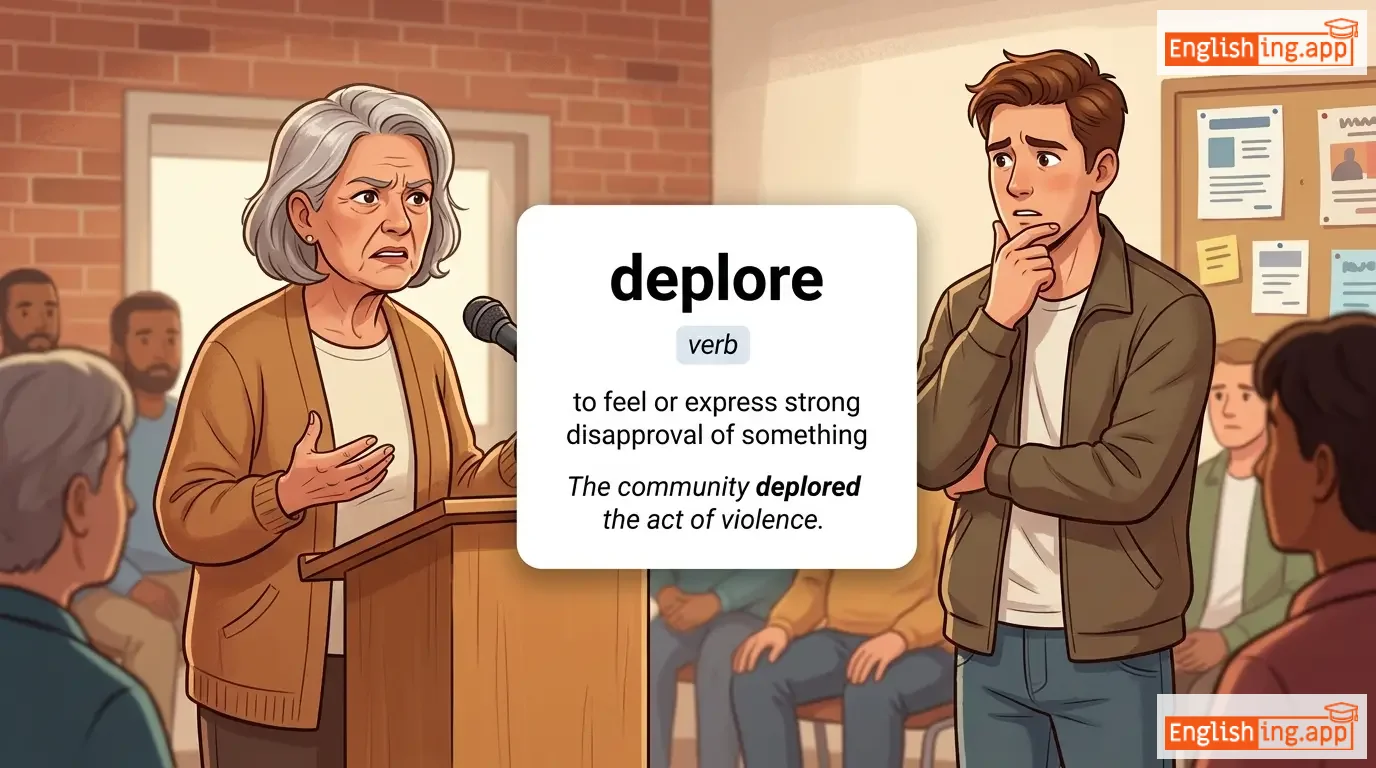
deplore definition card — visual illustration of the meaning
verb
/dɪˈplɔːr/
déplorer (déplorer)

to feel or express strong disapproval of something

"The community deplored the act of violence."

"La communauté a déploré l'acte de violence." (La communauté a déploré l'acte de violence.)
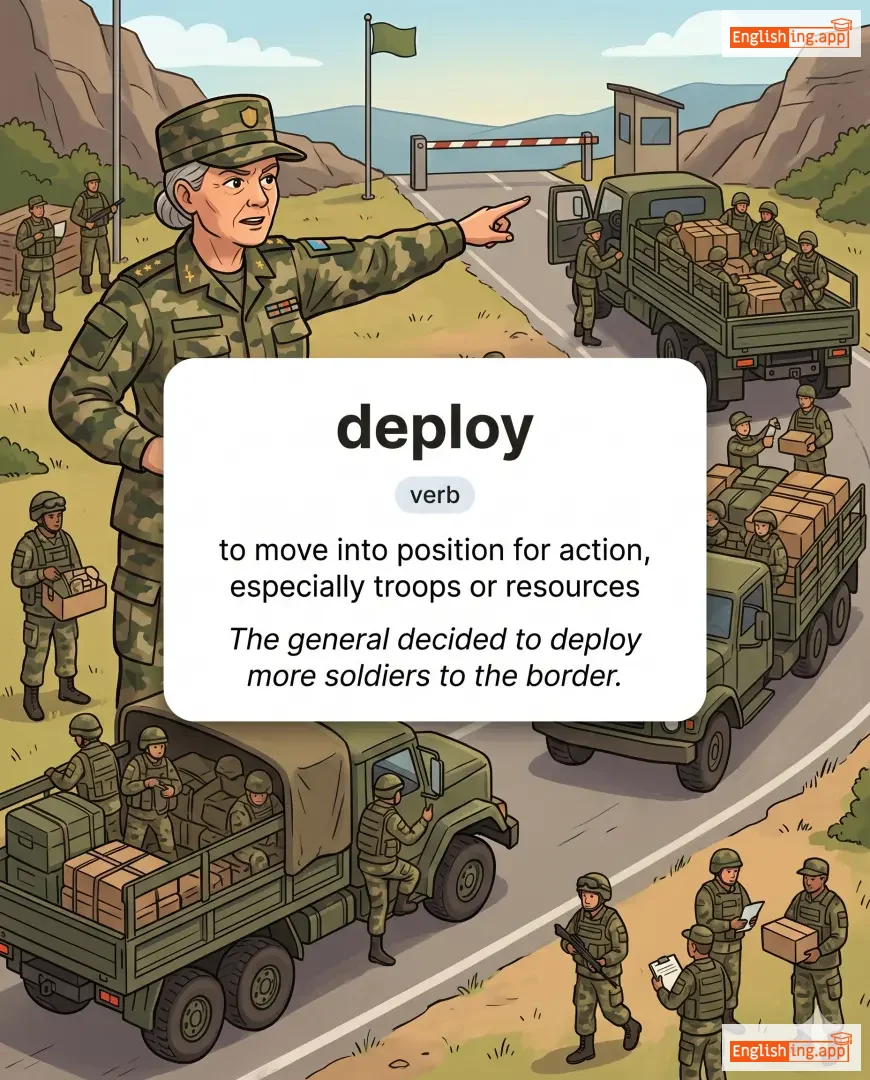
deploy definition card — visual illustration of the meaning
verb
/dɪˈplɔɪ/
déployer (deployer)

to move into position for action, especially troops or resources

"The general decided to deploy more soldiers to the border."

"Le général a décidé de déployer plus de soldats à la frontière." (Le general a decide de deployer plus de soldats a la frontiere.)
deployment definition card — visual illustration of the meaning
noun
/dɪˈplɔɪmənt/
déploiement (deploiement)

the action of moving or positioning something into place for use

"The deployment of the new software was completed successfully."

"Le déploiement du nouveau logiciel a été achevé avec succès." (Le deploiement du nouveau logiciel a ete acheve avec succes.)
noun
/dɪˈpoʊnənt/
témoignage (temoignage)

A person who gives testimony under oath, especially in a written deposition.

"The deponent confirmed the accuracy of the statement during the trial."

"Le témoin a confirmé l'exactitude de la déclaration pendant le procès." (Le temoin a confirme l'exactitude de la declaration pendant le proces.)
verb
/diːˈpɒpjʊˌleɪt/
dépeupler (depeupler)

To reduce the number of people living in a place.

"The war threatened to depopulate the once-thriving town."

"La guerre menaçait de dépeupler la ville autrefois prospère." (La guerre menaçait de dépeupler la ville autrefois prospère.)
verb
/dɪˈpɔːrt/
déporter (déporter)

To expel a foreigner from a country, usually for legal or political reasons.

"The government decided to deport the illegal immigrants."

"Le gouvernement a décidé de déporter les immigrés illégaux." (Le gouvernement a décidé de déporter les immigrés illégaux.)
noun
/ˌdiːpɔːrˈteɪʃən/
déportation (deportation)

The act of expelling a foreigner from a country.

"The deportation of hundreds of workers sparked international criticism."

"La déportation de centaines de travailleurs a suscité des critiques internationales." (La deportation de centaines de travailleurs a suscite des critiques internationales.)
noun
/dɪˈpɔːrtmənt/
comportement (comportement)

A person's behavior or manners, especially in a formal situation.

"Her deportment during the ceremony impressed everyone."

"Son comportement pendant la cérémonie a impressionné tout le monde." (Son comportement pendant la cérémonie a impressionné tout le monde.)
verb
/dɪˈpoʊz/
déposer (deposer)

to remove someone from office or power, especially suddenly and forcefully

"The rebels managed to depose the dictator after years of unrest."

"Les rebelles ont réussi à déposer le dictateur après des années de troubles." (Les rebelles ont réussi à déposer le dictateur après des années de troubles.)
noun/verb
/dɪˈpɑːzɪt/
dépôt, acompte (depot, acompte)

to place money in a bank account, or a sum paid in advance as security; a layer of material left naturally

"She deposited $500 into her savings account."

"Elle a déposé 500 $ sur son compte d'épargne." (Elle a déposé 500 $ sur son compte d'épargne.)
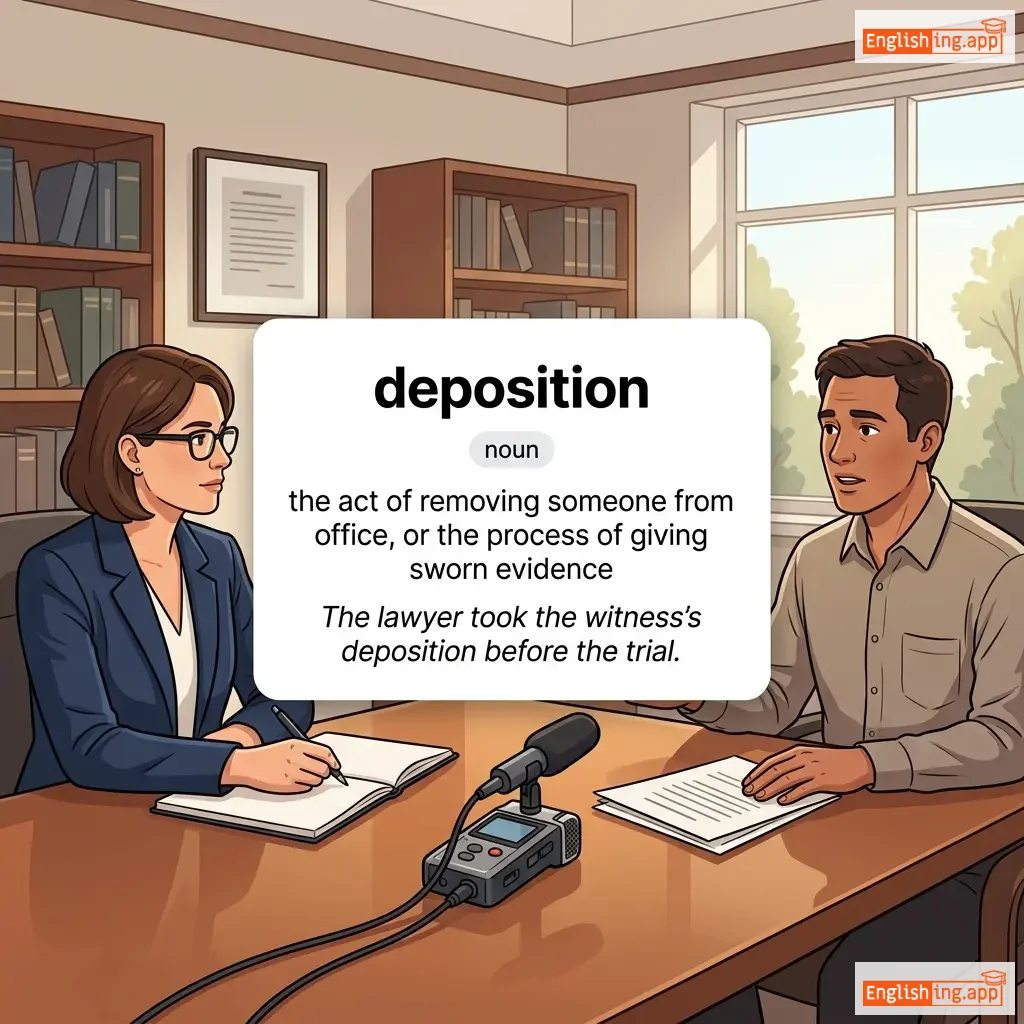
deposition definition card — visual illustration of the meaning
noun
/ˌdepəˈzɪʃən/
déposition, déclaration (deposition, declaration)

the act of removing someone from office, or the process of giving sworn evidence

"The lawyer took the witness’s deposition before the trial."

"L'avocat a pris la déposition du témoin avant le procès." (L'avocat a pris la deposition du temoin avant le proces.)
noun
/dɪˈpɑːzɪtər/
dépôtiste (depotiste)

a person who places money in a bank or financial institution

"The bank provides insurance to protect depositors’ funds."

"La banque fournit une assurance pour protéger les fonds des déposants." (La banque fournit une assurance pour protéger les fonds des déposants.)
noun
/dɪˈpɑːzətɔːri/
dépôt, entrepôt (depot, entrepot)

a place where things are stored or deposited, especially financial assets

"The national depository safeguards all government bonds."

"Le dépôt national protège tous les bons du gouvernement." (Le depot national protege tous les bons du gouvernement.)
verb
/dɪˈpreɪv/
pervertir (pervertir)

to corrupt morally; to make someone immoral or wicked

"The novel was criticized for attempting to deprave the minds of young readers."

"Le roman a été critiqué pour avoir tenté de pervertir l'esprit des jeunes lecteurs." (Le roman a été critiqué pour avoir tenté de pervertir l'esprit des jeunes lecteurs.)
adjective
/dɪˈpreɪvd/
dépravé (deprave)

morally corrupt or wicked

"The film depicts the life of a depraved criminal."

"Le film décrit la vie d'un criminel dépravé." (Le film decrit la vie d'un criminel deprave.)
noun
/dɪˈprævɪti/
dégrégation morale (degregation morale)

moral corruption; wickedness

"The film portrays the moral depravity of a corrupt society."

"Le film dépeint la dégradation morale d'une société corrompue." (Le film depeint la degration morale d'une societe corrompue.)
verb
/ˈdɛprɪˌkeɪt/
déprécier (deprecier)

to express disapproval of something

"The teacher deprecated the use of slang in academic essays."

"Le professeur a déprécié l'utilisation de l'argot dans les essais académiques." (Le professeur a déprécié l'utilisation de l'argot dans les essais académiques.)
adjective
/ˈdɛprɪkətɔːri/
désobligeant (desobligeant)

expressing disapproval or belittling

"He gave a deprecatory remark about their performance."

"Il a fait une remarque désobligeante sur leur performance." (Il a fait une remarque désobligeante sur leur performance.)
verb
/dɪˈpriːʃieɪt/
déprécier (deprecié)

to reduce in value over time

"Cars tend to depreciate quickly in their first few years."

"Les voitures ont tendance à se déprécier rapidement dans leurs premières années." (Les voitures ont tendance à se déprécier rapidement dans leurs premières années.)
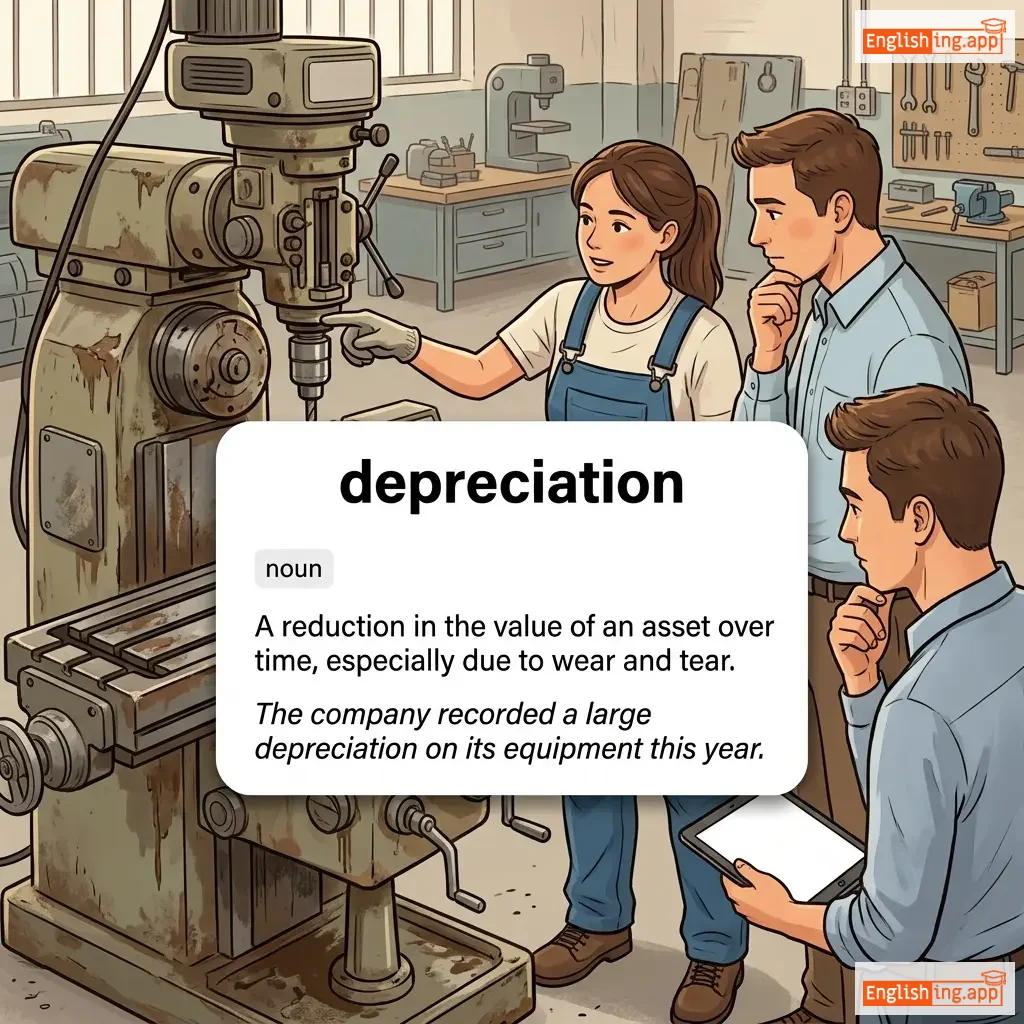
depreciation definition card — visual illustration of the meaning
noun
/dɪˌpriːʃiˈeɪʃən/
dépréciation (depreciation)

A reduction in the value of an asset over time, especially due to wear and tear.

"The company recorded a large depreciation on its equipment this year."

"L'entreprise a enregistré une grande dépréciation de son équipement cette année." (L'entreprise a enregistre une grande depreciation de son equipement cette annee.)
noun
/ˌdɛprɪˈdeɪʃən/
pillage (pillage)

An act of attacking or plundering; damage caused by such acts.

"The villagers feared the depredation of wild animals at night."

"Les villageois craignaient le pillage des animaux sauvages la nuit." (Les villageois craignaient le pillage des animaux sauvages la nuit.)
verb
/dɪˈprɛs/
déprimer (deprimer)

To make someone feel sad or without hope; to reduce the level or strength of something.

"The gloomy weather tends to depress people."

"Le temps morose a tendance à déprimer les gens." (Le temps morose a tendance à déprimer les gens.)
noun
/dɪˈprɛsənt/
dépresseur (depresor)

A drug that reduces functional or nervous activity in the body.

"Alcohol acts as a depressant on the central nervous system."

"L'alcool agit comme un dépresseur sur le système nerveux central." (L'alcool agit comme un dépresseur sur le système nerveux central.)
adjective
/dɪˈprɛst/
déprimé (deprime)

Feeling very sad and without hope; in a state of unhappiness.

"She felt depressed after losing her job."

"Elle s'est sentie déprimée après avoir perdu son emploi." (Elle s'est sentie déprimée après avoir perdu son emploi.)
noun
/dɪˈprɛʃən/
dépression (depression)

A state of severe sadness or hopelessness; also a prolonged downturn in economic activity.

"She has been battling depression for several months."

"Elle lutte contre la dépression depuis plusieurs mois." (Elle lutte contre la depression depuis plusieurs mois.)
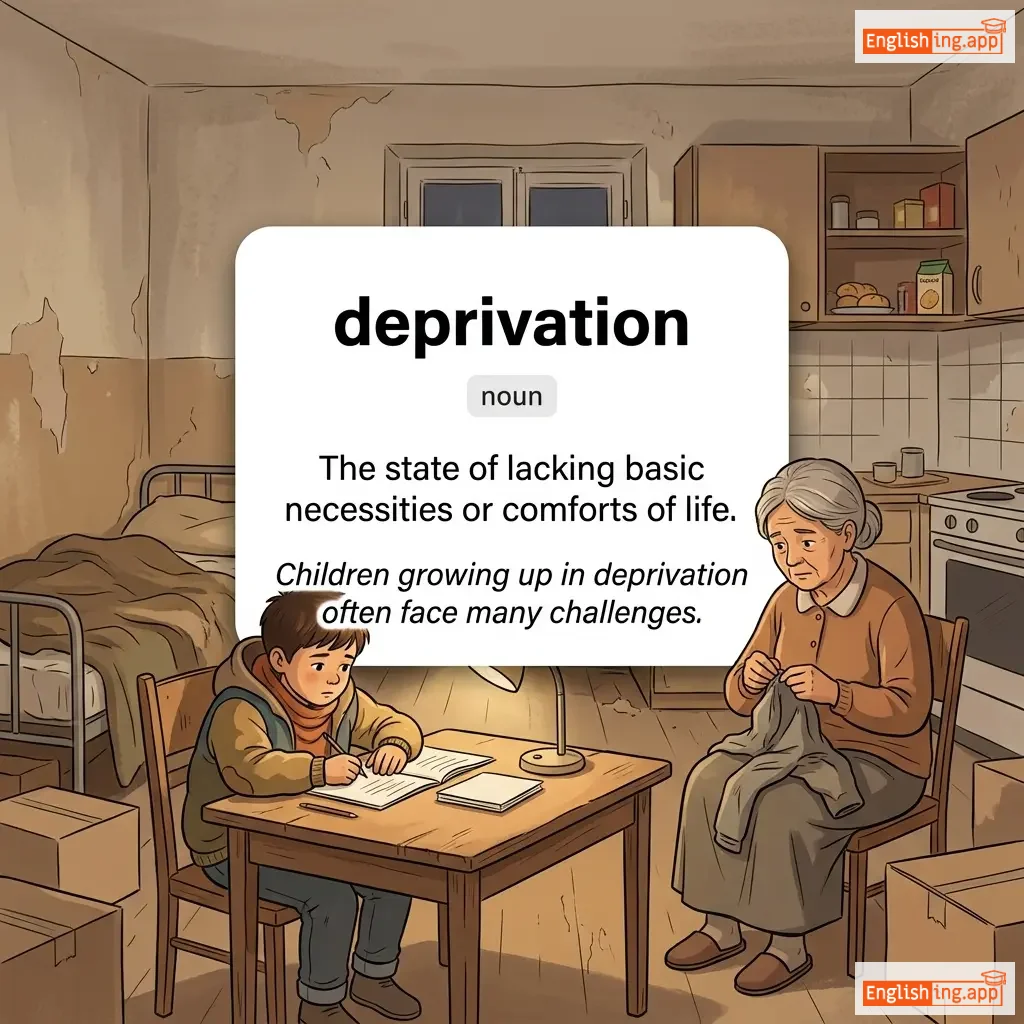
deprivation definition card — visual illustration of the meaning
noun
/ˌdɛprɪˈveɪʃən/
privation (privation)

The state of lacking basic necessities or comforts of life.

"Children growing up in deprivation often face many challenges."

"Les enfants grandissant dans la privation font souvent face à de nombreux défis." (Les enfants grandissant dans la privation font souvent face a de nombreux defis.)
verb
/dɪˈpraɪv/
privé (pree-vay)

to take something away from someone, or prevent them from having it

"The new law may deprive people of their rights."

"La nouvelle loi pourrait priver les gens de leurs droits." (La nu-velle loi pou-rait pri-ver les gens de leurs droits.)
noun
/dɛpθ/
profondeur (profondeur)

The distance from the top to the bottom of something; the intensity or complexity of a subject.

"The diver measured the depth of the ocean trench."

"Le plongeur a mesuré la profondeur de la fosse océanique." (Le plongeur a mesuré la profondeur de la fosse océanique.)
verb
/ˈdɛpjʊˌtaɪz/
nommer comme adjoint (nommer comme adjoint)

To appoint someone as a deputy; to act as a substitute or representative.

"The sheriff decided to deputize several locals to help maintain order."

"Le shérif a décidé de désigner plusieurs habitants pour aider à maintenir l'ordre." (Le shérif a décidé de désigner plusieurs habitants pour aider à maintenir l'ordre.)
noun
/ˈdɛpjʊti/
substitut (substitut)

A person appointed as a substitute with power to act.

"The deputy will lead the meeting in the manager’s absence."

"Le substitut dirigera la réunion en l'absence du manager." (Le substitut dirigera la réunion en l'absence du manager.)
verb
/dɪˈræsɪˌneɪt/
déraciner (deraciner)

To uproot something completely; to displace people from their native environment or culture.

"The conflict deracinated many families from their homeland."

"Le conflit a déraciné de nombreuses familles de leur terre natale." (Le conflit a déraciné de nombreuses familles de leur terre natale.)
adjective
/dɪˈreɪndʒd/
fou (fou)

mentally disturbed or insane; behaving irrationally

"The deranged man shouted nonsense in the street."

"L'homme fou a crié des absurdités dans la rue." (L'homme fou a crié des absurdités dans la rue.)
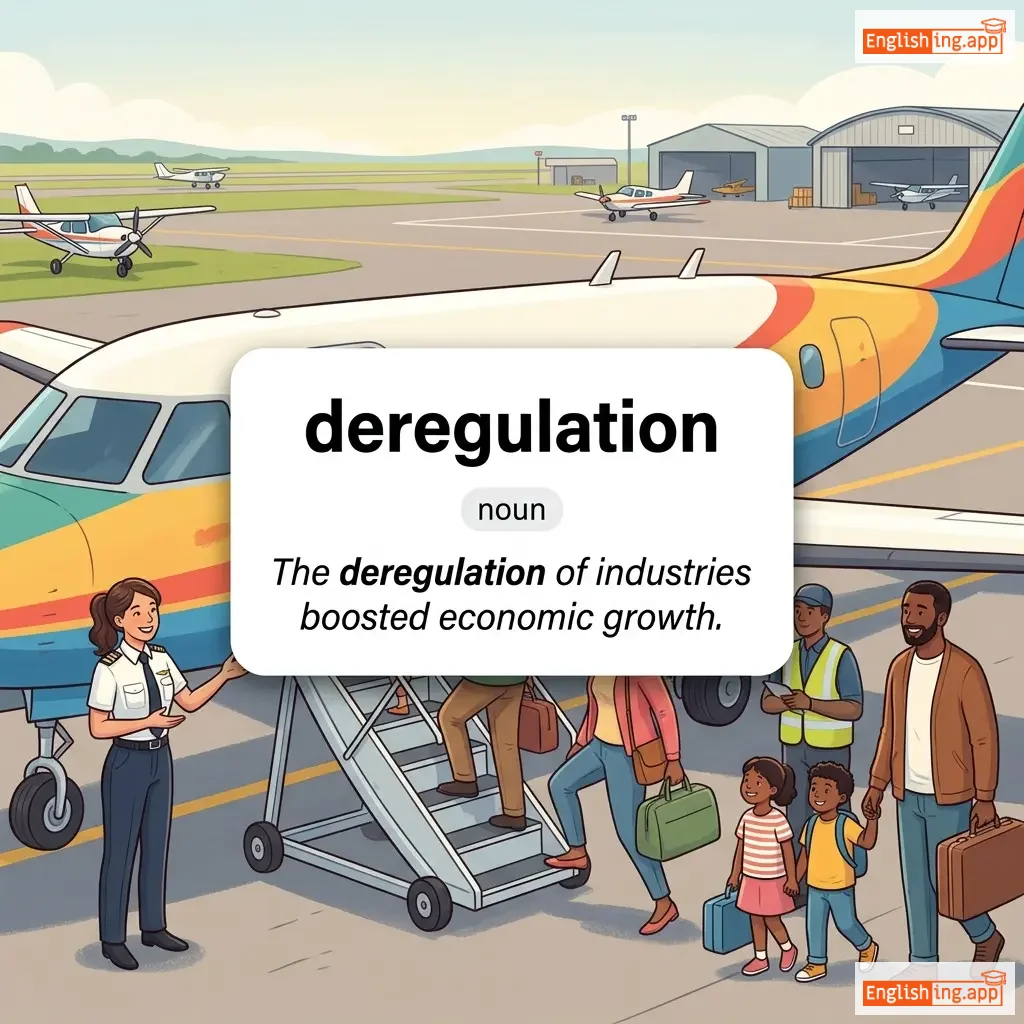
deregulation definition card — visual illustration of the meaning
noun
/ˌdiː.rɛɡ.jʊˈleɪ.ʃən/
dérégulation (deregulation)

The removal or reduction of government regulations and controls, often involving liberalization, free market policies, or privatization.

"The deregulation of industries boosted economic growth."

"La dérégulation des industries a stimulé la croissance économique." (La deregulation des industries a stimule la croissance economique.)
adjective, noun
/ˈdɛrəlɪkt/
abandonné (abandonné)

in poor condition due to neglect or disuse; a homeless or neglected person

"The old factory stood derelict for decades."

"L'ancienne usine est restée abandonnée pendant des décennies." (L'ancienne usine est restée abandonnée pendant des décennies.)
noun
/ˌdɛrɪˈlɪkʃən/
négligence (negligence)

the state of being abandoned; neglect of duty

"The officer was charged with dereliction of duty."

"L'officier a été accusé de négligence dans l'accomplissement de son devoir." (L'officier a été accusé de négligence dans l'accomplissement de son devoir.)
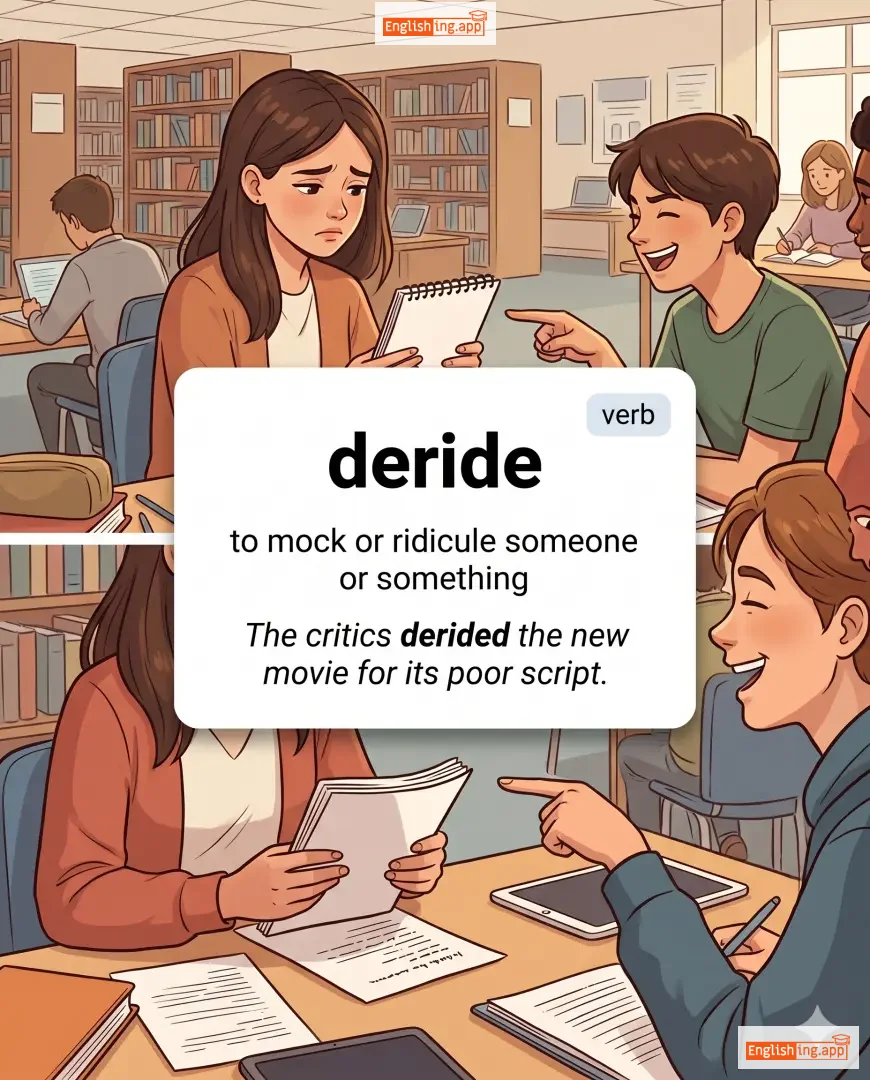
deride definition card — visual illustration of the meaning
verb
/dɪˈraɪd/
ridiculiser (ridiculiser)

to mock or ridicule someone or something

"The critics derided the new movie for its poor script."

"Les critiques ont ridiculisé le nouveau film pour son mauvais scénario." (Les critiques ont ridiculisé le nouveau film pour son mauvais scénario.)
adjective
/dɪˈrɪzəbl/
ridiculisable (ridiculisable)

deserving ridicule or mockery

"His excuse was so weak that it was plainly derisible."

"Son excuse était si faible qu'elle était manifestement ridiculisable." (Son excuse était si faible qu'elle était manifestement ridiculisable.)
noun
/dɪˈrɪʒən/
mépris (mepri)

Contemptuous ridicule or mockery.

"His ideas were greeted with derision by the audience."

"Ses idées ont été accueillies avec mépris par le public." (Ses idees ont ete accueillees avec mepris par le public.)
adjective
/dɪˈraɪsɪv/
méprisant (meprizant)

Expressing contempt or ridicule.

"She gave a derisive laugh at his attempt to sing."

"Elle a donné un rire méprisant face à sa tentative de chanter." (Elle a donne un rire meprisant face a sa tentative de chanter.)
noun
/ˌdɛrɪˈveɪʃən/
dérivation (derivation)

The origin or development of something from a source.

"The derivation of the word comes from Latin."

"La dérivation du mot vient du latin." (La derivation du mot vient du latin.)
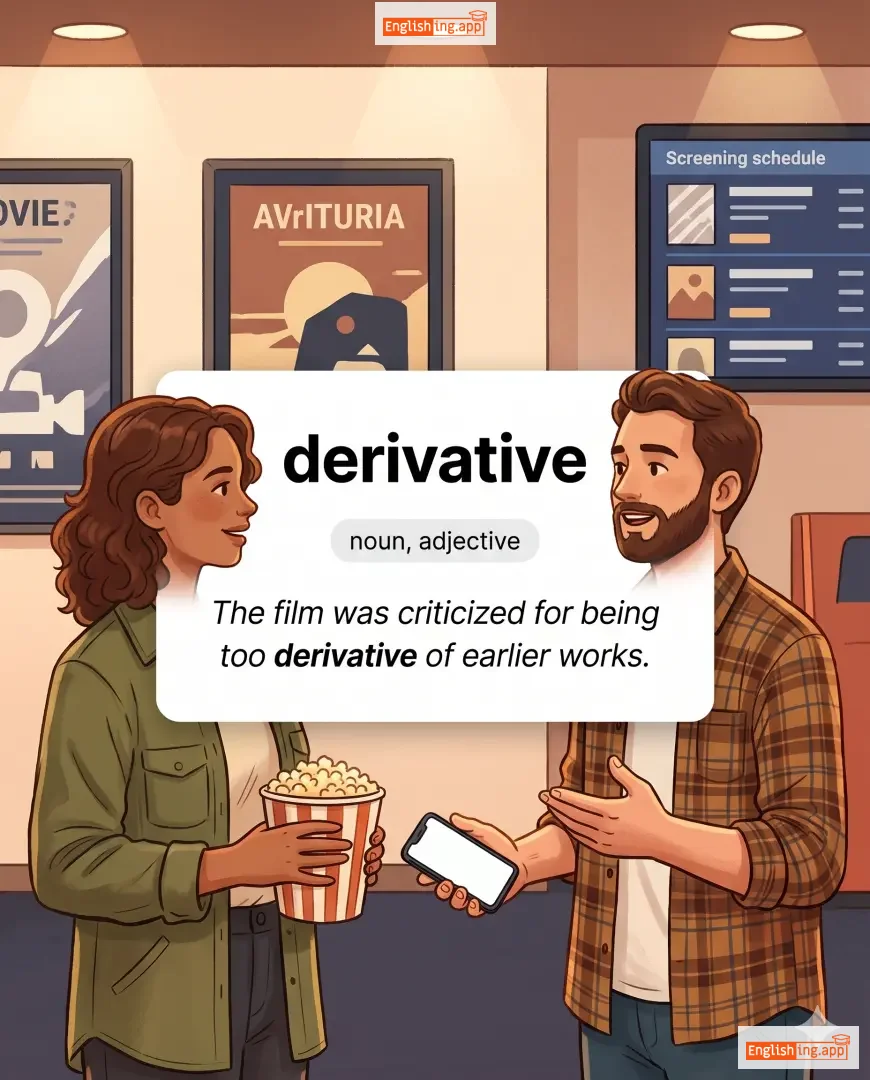
derivative definition card — visual illustration of the meaning
noun, adjective
/dɪˈrɪvətɪv/
dérivé (derive)

Something that is based on another source; in math, a measure of how a function changes.

"The film was criticized for being too derivative of earlier works."

"Le film a été critiqué pour être trop dérivé des œuvres précédentes." (Le film a été critiqué pour être trop dérivé des œuvres précédentes.)
verb
/dɪˈraɪv/
dériver (deriver)

To obtain something from a source.

"Many English words derive from Latin."

"beaucoup de mots anglais dérivent du latin." (beaucoup de mots anglais dérivent du latin.)
adjective
/dɪˈraɪvd/
dérivé (derive)

Developed or obtained from something else; not original.

"The word is derived from Latin."

"Le mot est dérivé du latin." (Le mot est dérivé du latin.)
noun
/ˌdɜːrməˈtɑːlədʒɪst/
dermatologue (dermatologue)

A doctor who specializes in the treatment of skin diseases.

"She consulted a dermatologist for her skin allergy."

"Elle a consulté un dermatologue pour son allergie à la peau." (Elle a consulte un dermatologue pour son allergie a la peau.)
noun
/ˌdɜːrməˈtɑːlədʒi/
dermatologie (dermatologie)

The branch of medicine concerned with the skin and its diseases.

"He studied dermatology at medical school."

"Il a étudié la dermatologie à l'école de médecine." (Il a étudié la dermatologie à l'école de médecine.)
adjective
/dɪˈrɒɡətɪv/
dérogatoire (derogatoire)

Expressing a low opinion or showing lack of respect.

"He made a derogative remark about her work."

"Il a fait une remarque dérogatoire sur son travail." (Il a fait une remarque dérogatoire sur son travail.)
adjective
/dɪˈrɒɡətɔːri/
dérogatoire (derogatoire)

Showing a critical or disrespectful attitude.

"The article contained derogatory comments about the politician."

"L'article contenait des commentaires dérogatoires à propos du politicien." (L'article contenait des commentaires dérogatoires a propos du politicien.)
noun
/ˈdɛrɪk/
tour de forage (tour de forage)

A framework or tower used for supporting a crane, especially for oil drilling or lifting heavy loads.

"The workers assembled a derrick at the oil drilling site."

"Les ouvriers ont assemblé une tour de forage sur le site de forage de pétrole." (Les ouvriers ont assemblé une tour de forage sur le site de forage de pétrole.)