Vocabulaires

Découvrez, apprenez et maîtrisez le vocabulaire anglais

verb
/dɪˈsɛkt/
disséquer (diseké)

to cut apart an animal, plant, or other organism to study its internal parts; to analyze something in detail

"In biology class, students had to dissect a frog to learn about its anatomy."

"En cours de biologie, les étudiants ont dû disséquer une grenouille pour apprendre son anatomie." (En cours de biologie, les étudiants ont dû disséquer une grenouille pour apprendre son anatomie.)
noun
/daɪˈsɛkʃən/
dissection (disekshon)

the act of cutting apart or analyzing something in detail, especially a body or structure

"The dissection of the specimen revealed important details about its structure."

"La dissection de l'échantillon a révélé des détails importants sur sa structure." (La dissection de l'échantillon a révélé des détails importants sur sa structure.)
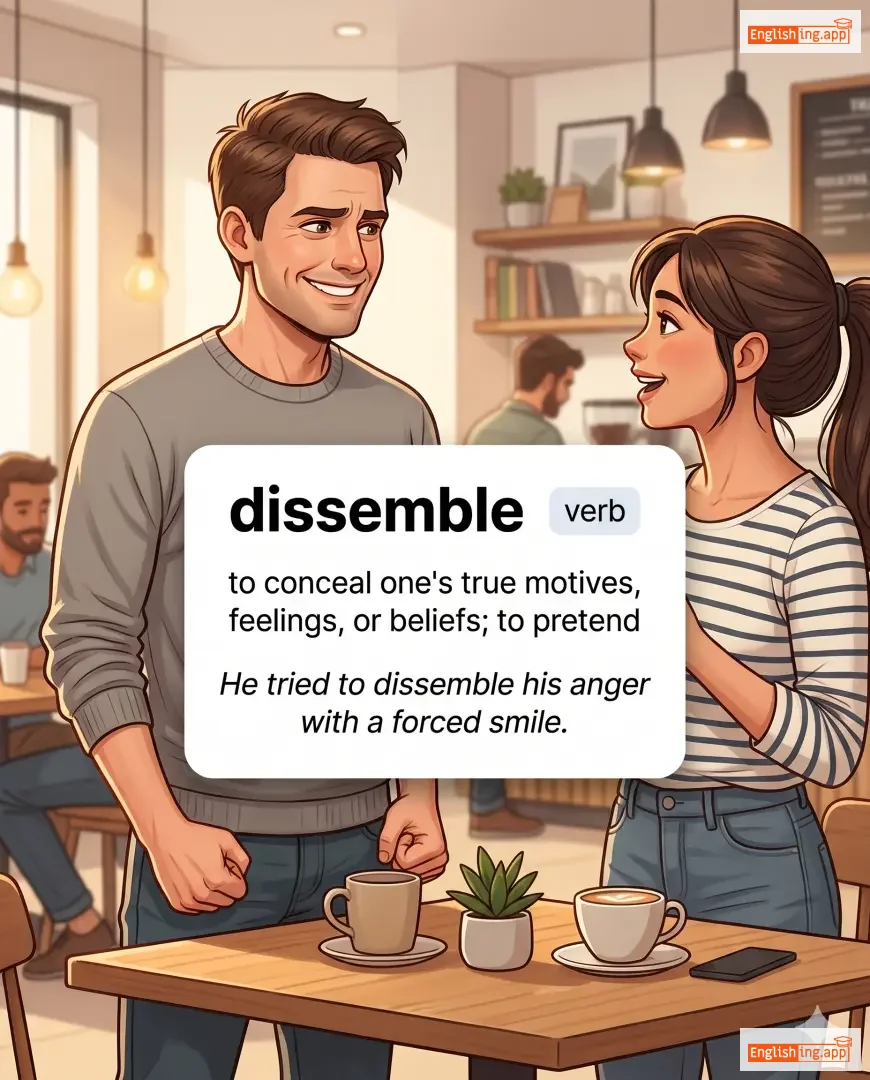
dissemble definition card — visual illustration of the meaning
verb
/dɪˈsɛmbəl/
dissimuler (dissimuler)

to conceal one's true motives, feelings, or beliefs; to pretend

"He tried to dissemble his anger with a forced smile."

"Il a essayé de dissimuler sa colère avec un sourire forcé." (Il a essayé de dissimuler sa colère avec un sourire forcé.)
noun
/dɪˈsɛmbələr/
hypocrite (hypocrite)

a person who conceals their real feelings or intentions; a hypocrite or pretender

"The politician was accused of being a dissembler who never revealed his true plans."

"Le politicien a été accusé d'être un hypocrite qui n'a jamais révélé ses vrais projets." (Le politicien a été accusé d'etre un hypocrite qui n'a jamais révélé ses vrais projets.)
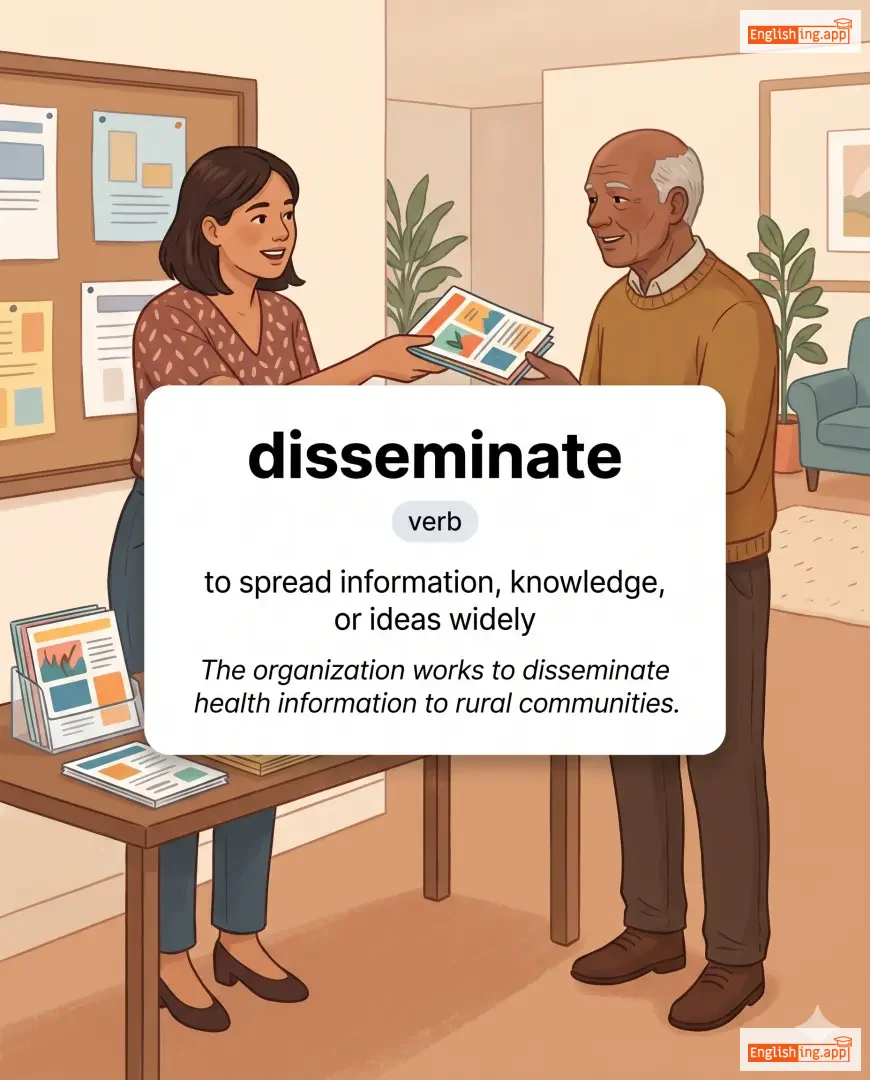
disseminate definition card — visual illustration of the meaning
verb
/dɪˈsɛmɪˌneɪt/
diffuser (diffuser)

to spread information, knowledge, or ideas widely

"The organization works to disseminate health information to rural communities."

"L'organisation travaille à diffuser des informations sanitaires dans les communautés rurales." (L'organisation travaille à diffuser des informations sanitaires dans les communautés rurales.)
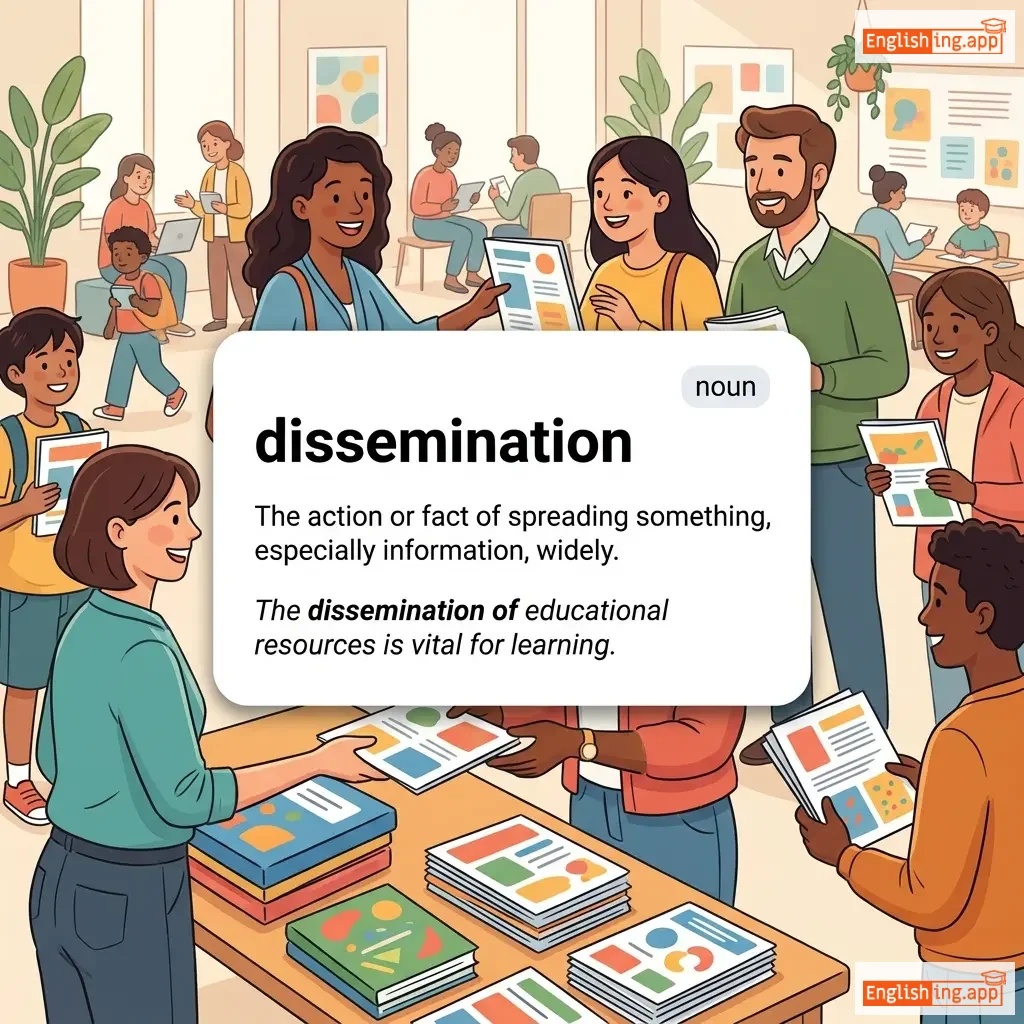
dissemination definition card — visual illustration of the meaning
noun
dɪˌsɛm.ɪˈneɪ.ʃən
diffusion (diffusion)

The action or fact of spreading something, especially information, widely.

"The dissemination of educational resources is vital for learning."

"La diffusion des ressources éducatives est essentielle pour l'apprentissage." (La diffusion des ressources éducatives est essentielle pour l'apprentissage.)
noun
/dɪˈsɛnʃən/
dissension (dissension)

Strong disagreement or difference of opinion, especially leading to discord within a group.

"The meeting ended in dissension among the committee members."

"La réunion s'est terminée par une dissension parmi les membres du comité." (La reunion s'est terminee par une dissension parmi les membres du comite.)
verb
/dɪˈsɛnt/
désapprouver (désapprouver)

To hold or express opinions that are different from those officially accepted.

"Several members dissented from the majority decision."

"Plusieurs membres ont exprimé un désaccord avec la décision majoritaire." (Plusieurs membres ont exprimé un désaccord avec la décision majoritaire.)
adjective
/dɪˈsɛnʃənt/
dissident (dissident)

Expressing or holding opinions that are opposed to the majority or official view.

"Only a few dissentient voices were heard during the debate."

"Seules quelques voix dissidentes ont été entendues lors du débat." (Seules quelques voix dissidentes ont été entendues lors du débat.)
adjective
/dɪˈsɛnʃəs/
diviseur (diviseur)

Causing or likely to cause disagreement and conflict.

"His dissentious remarks divided the group further."

"Ses remarques divisives ont encore plus divisé le groupe." (Ses remarques divisives ont encore plus divisé le groupe.)
noun
/ˌdɪsərˈteɪʃən/
thèse (thèse)

A long piece of writing on a particular subject, usually written for a university degree.

"She spent two years writing her doctoral dissertation."

"Elle a passé deux ans à rédiger sa thèse doctorale." (Elle a passé deux ans à rédiger sa thèse doctorale.)
noun
/dɪsˈsɜːrvɪs/
dommage (domaj)

A harmful action; something that does damage rather than help.

"Spreading false information is a disservice to the community."

"Diffuser de fausses informations est un dommage pour la communauté." (Diffuser de fausses informations est un dommage pour la communaute.)
verb
/dɪˈsɛvər/
séparer (separer)

To separate or cut apart.

"The treaty sought to dissever the two hostile regions."

"Le traité a cherché à séparer les deux régions hostiles." (Le traite a cherche a separer les deux regions hostiles.)
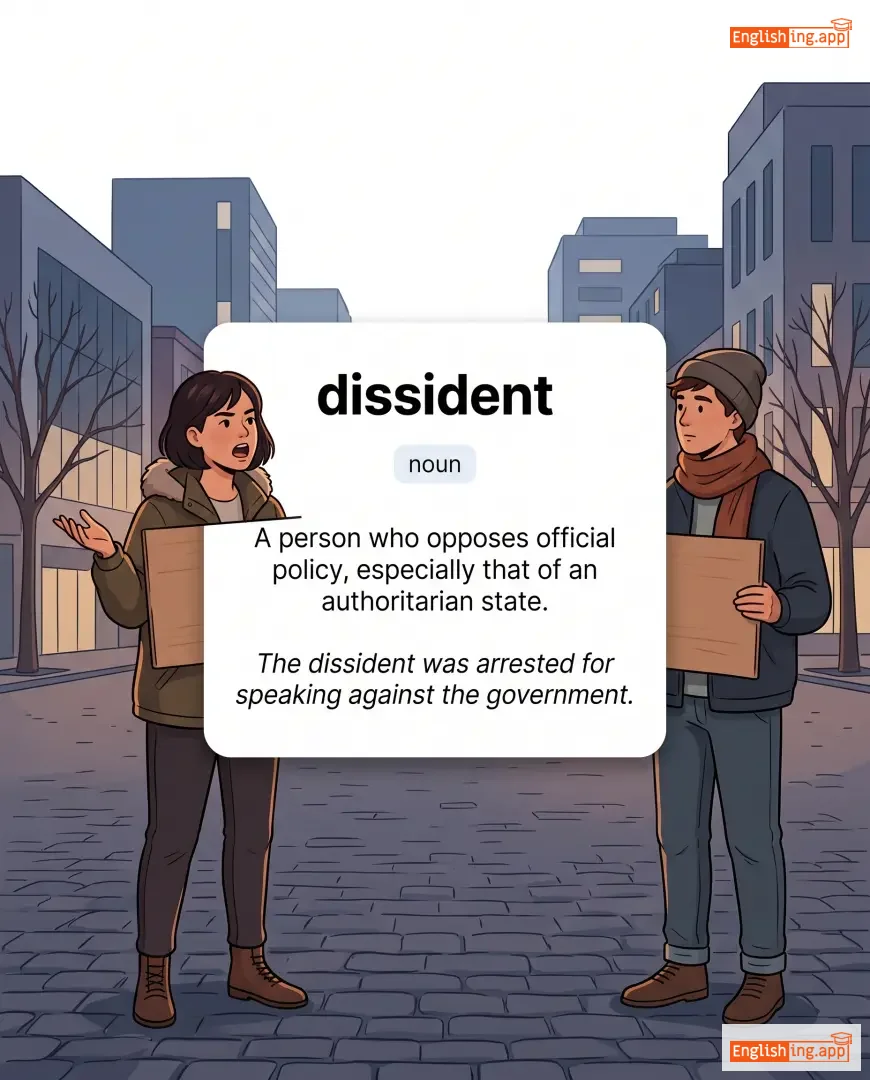
dissident definition card — visual illustration of the meaning
noun
/ˈdɪsɪdənt/
dissident (dissident)

A person who opposes official policy, especially that of an authoritarian state.

"The dissident was arrested for speaking against the government."

"Le dissident a été arrêté pour avoir parlé contre le gouvernement." (Le dissident a ete arrete pour avoir parle contre le gouvernement.)
adjective
/dɪsˈsɪmɪlər/
différent (different)

Not alike; different.

"Though they are twins, their personalities are dissimilar."

"Bien qu'ils soient jumeaux, leurs personnalités sont différentes." (Byan kil swat jumo, leur personnalite son different.)
verb
/dɪˈsɪmjʊˌleɪt/
dissimuler (dissimuler)

To disguise or conceal one's true feelings or intentions.

"He tried to dissimulate his fear with a smile."

"Il a essayé de dissimuler sa peur avec un sourire." (Il a essayé de dissimuler sa peur avec un sourire.)
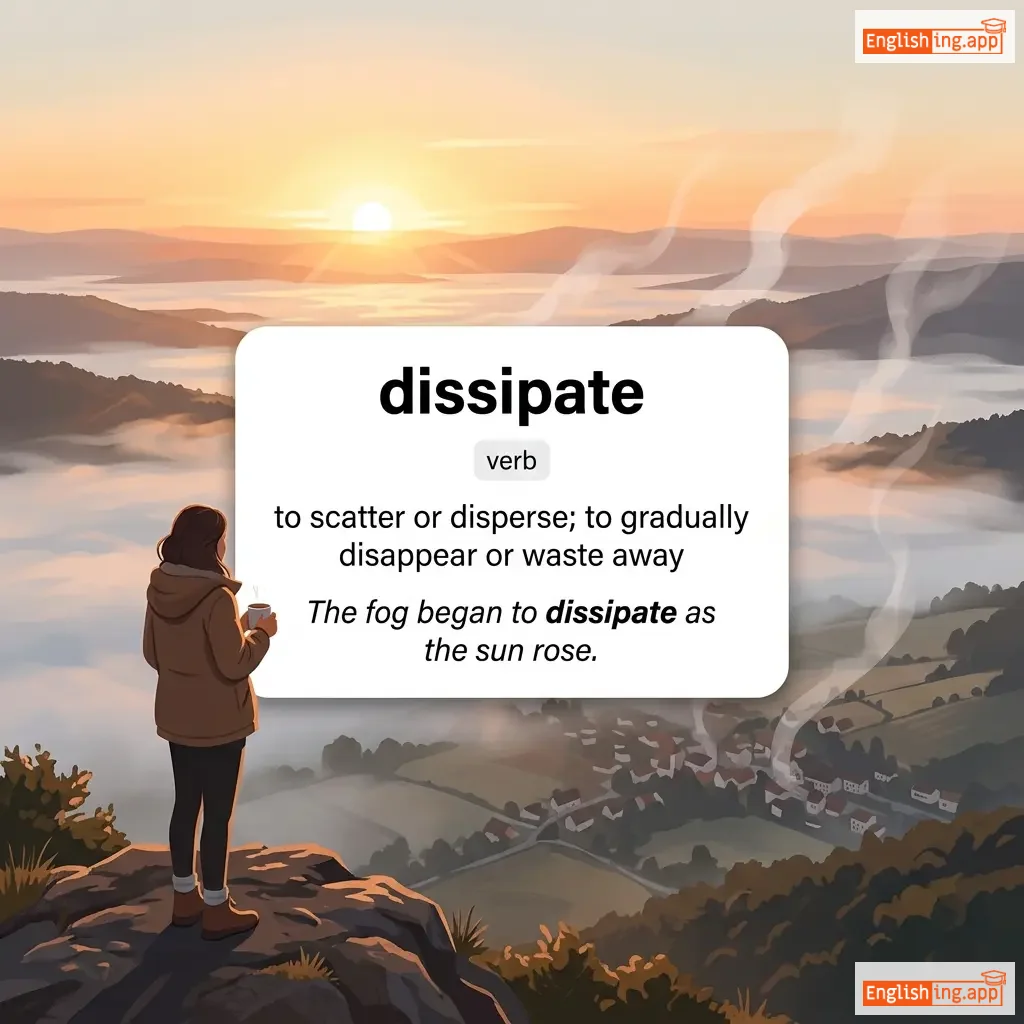
dissipate definition card — visual illustration of the meaning
verb
/ˈdɪsɪpeɪt/
disparaître (disparaître)

to scatter or disperse; to gradually disappear or waste away

"The fog began to dissipate as the sun rose."

"Le brouillard a commencé à disparaître lorsque le soleil est apparu." (Le brouillard a commencé à disparaître lorsque le soleil est apparu.)
noun
/ˌdɪsɪˈpeɪʃən/
dissipation (dissipation)

the process of disappearing or wasting; excessive indulgence in pleasure

"The dissipation of his fortune left him in poverty."

"La dissipation de sa fortune l'a laissé dans la pauvreté." (La dissipation de sa fortune l'a laissé dans la pauvreté.)
adjective
/ˈdɪsəluːt/
dissolu (dissolu)

lacking moral restraint; indulging excessively in sensual pleasures

"He led a dissolute life filled with parties and gambling."

"Il a mené une vie dissolue remplie de fêtes et de jeux d'argent." (Il a mene une vie dissolue remplie de fetes et de jeux d'argent.)
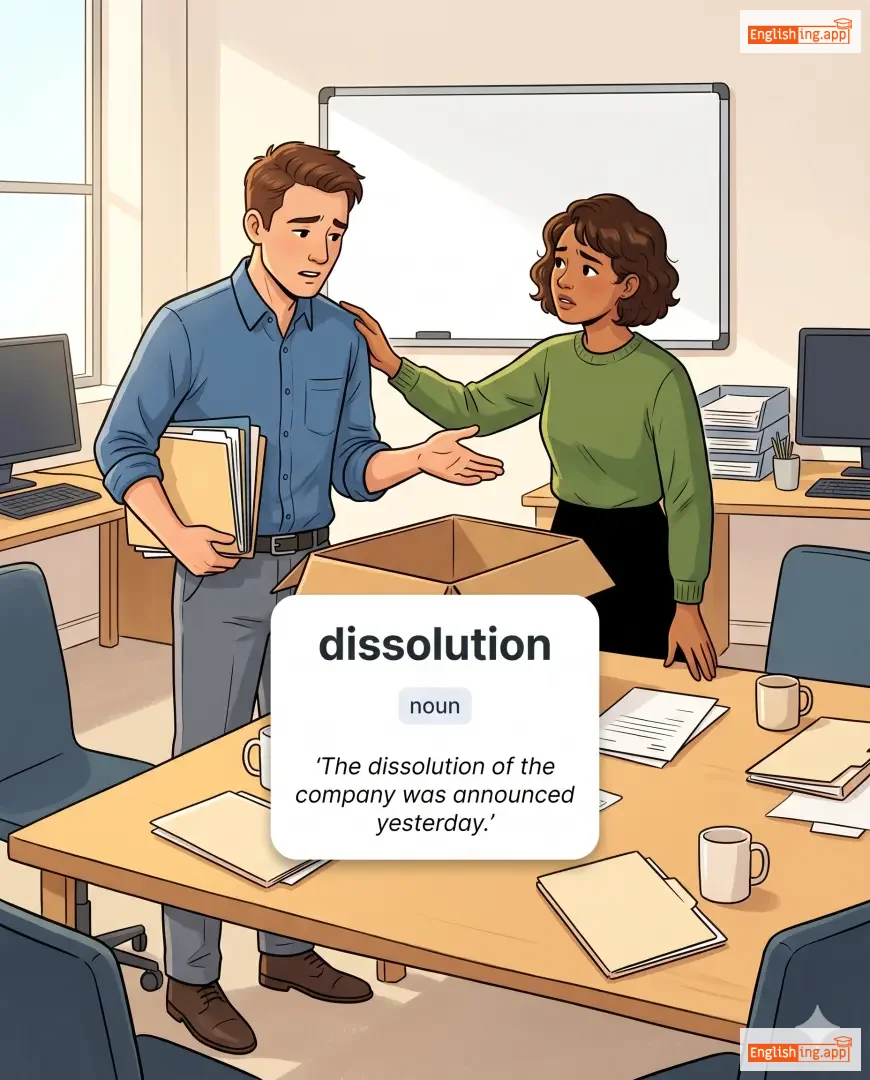
dissolution definition card — visual illustration of the meaning
noun
/ˌdɪsəˈluːʃən/
dissolution (dissolution)

the act of formally ending or breaking apart something, such as an organization or marriage

"The dissolution of the company was announced yesterday."

"La dissolution de l'entreprise a été annoncée hier." (La dissolution de l'entreprise a ete annoncee hier.)
verb
/dɪˈzɒlv/
dissoudre (dissoudre)

to melt or become liquid; to officially end or break up an agreement or organization

"The sugar will dissolve quickly in hot tea."

"Le sucre va se dissoudre rapidement dans le thé chaud." (Le sucre va se dissoudre rapidement dans le the chaud.)
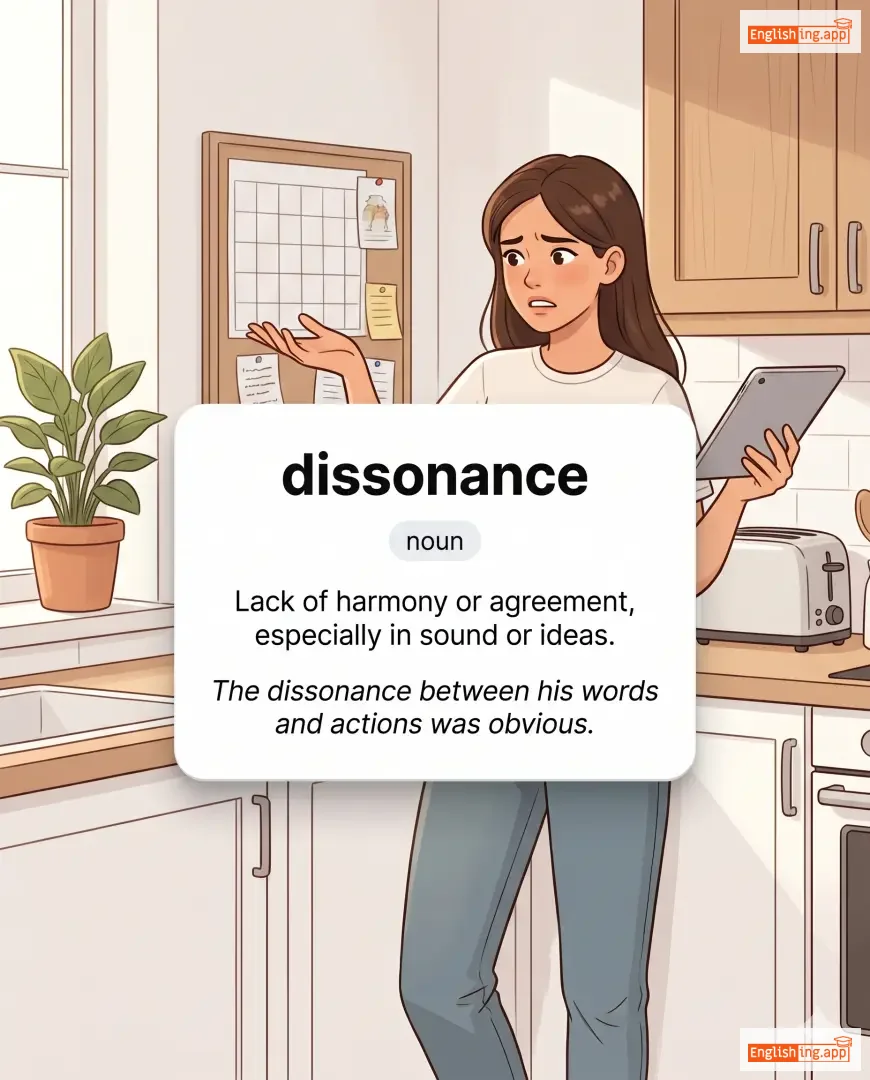
dissonance definition card — visual illustration of the meaning
noun
/ˈdɪsənəns/
dissonance (dissonance)

Lack of harmony or agreement, especially in sound or ideas.

"The dissonance between his words and actions was obvious."

"La dissonance entre ses paroles et ses actions était évidente." (La dissonance entre ses paroles et ses actions était évidente.)
adjective
/ˈdɪsənənt/
dissonant (dissonant)

Harsh and lacking harmony; conflicting.

"The orchestra produced a dissonant sound during rehearsal."

"L'orchestre a produit un son dissonant pendant la répétition." (L'orchestre a produit un son dissonant pendant la répétition.)
verb
/dɪˈsweɪd/
dissuader (dissuader)

To persuade someone not to do something.

"She tried to dissuade him from quitting his job."

"Elle a essayé de le dissuader de quitter son travail." (Elle a essayé de le dissuader de quitter son travail.)
noun
/dɪˈsweɪʒən/
dissuasion (dissuasion)

The act of persuading someone not to take a course of action.

"Her dissuasion prevented him from making a bad investment."

"Sa dissuasion l'a empêché de faire un mauvais investissement." (Sa dissuasion l'a empêché de faire un mauvais investissement.)
noun/adjective
/ˈdɪstæf/
lié aux femmes, côté maternel (lie aux femmes, coter maternel)

Relating to women or the maternal side of a family; also a tool for spinning thread.

"She came from the distaff side of a noble family."

"Elle venait du côté maternel d'une famille noble." (Elle venait du côté maternel d'une famille noble.)
verb
/dɪsˈteɪn/
mépriser (mepriser)

to treat with scorn or contempt (archaic form of disdain)

"He would never distain those who had less fortune than him."

"Il ne méprisait jamais ceux qui avaient moins de fortune que lui." (Il ne meprisait jamais ceux qui avaient moins de fortune que lui.)
adjective
/ˈdɪstəl/
distal (distal)

situated away from the center of the body or from the point of attachment

"The doctor examined the distal end of the patient’s arm."

"Le médecin a examiné l'extrémité distale du bras du patient." (Le medecin a examine l'extremite distale du bras du patient.)
noun
/ˈdɪstəns/
distance (distance)

The amount of space between two points or places.

"The distance between Dhaka and Chittagong is about 250 kilometers."

"La distance entre Dhaka et Chittagong est d'environ 250 kilomètres." (La distance entre Dhaka et Chittagong est d'environ 250 kilomètres.)
adjective
/ˈdɪstənt/
éloigné (eloigne)

far away in space or time

"They could see the distant mountains from their home."

"Ils pouvaient voir les montagnes lointaines depuis leur maison." (Ils pouvaient voir les montagnes lointaines depuis leur maison.)
noun
/dɪsˈtɛmpər/
maladie virale affectant les animaux, en particulier les chiens (maladie virale affectant les animaux, en particulier les chiens)

a viral disease affecting animals, especially dogs; also refers to a state of disorder

"The dog was diagnosed with distemper and needed immediate care."

"Le chien a été diagnostiqué avec la distemper et avait besoin de soins immédiats." (Le chien a été diagnostiqué avec la distemper et avait besoin de soins immédiats.)
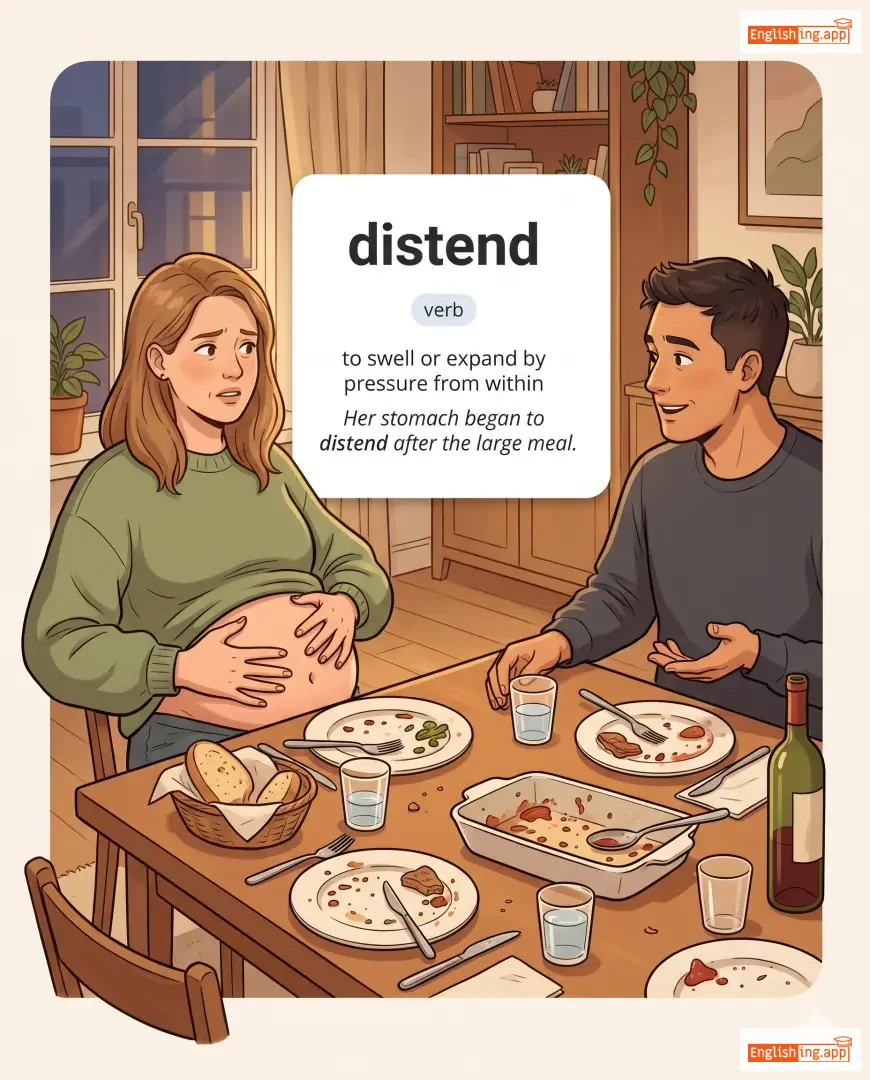
distend definition card — visual illustration of the meaning
verb
/dɪsˈtɛnd/
gonfler (gonfler)

to swell or expand by pressure from within

"Her stomach began to distend after the large meal."

"Son ventre a commencé à se distendre après le grand repas." (Son ventre a commence a se distendre apres le grand repas.)
adjective
/dɪˈstɛnsəbl̩/
distensible (distensible)

Capable of being stretched or expanded.

"The stomach is a distensible organ that can expand after eating."

"L'estomac est un organe distensible qui peut se dilater après avoir mangé." (L'estomac est un organe distensible qui peut se dilater après avoir mangé.)
noun
/dɪˈstɛnʃən/
distension (distension)

The state of being swollen due to internal pressure.

"The patient complained of abdominal pain and distention."

"Le patient s'est plaint de douleurs abdominales et de distension." (Le patient s'est plaint de douleurs abdominales et de distension.)
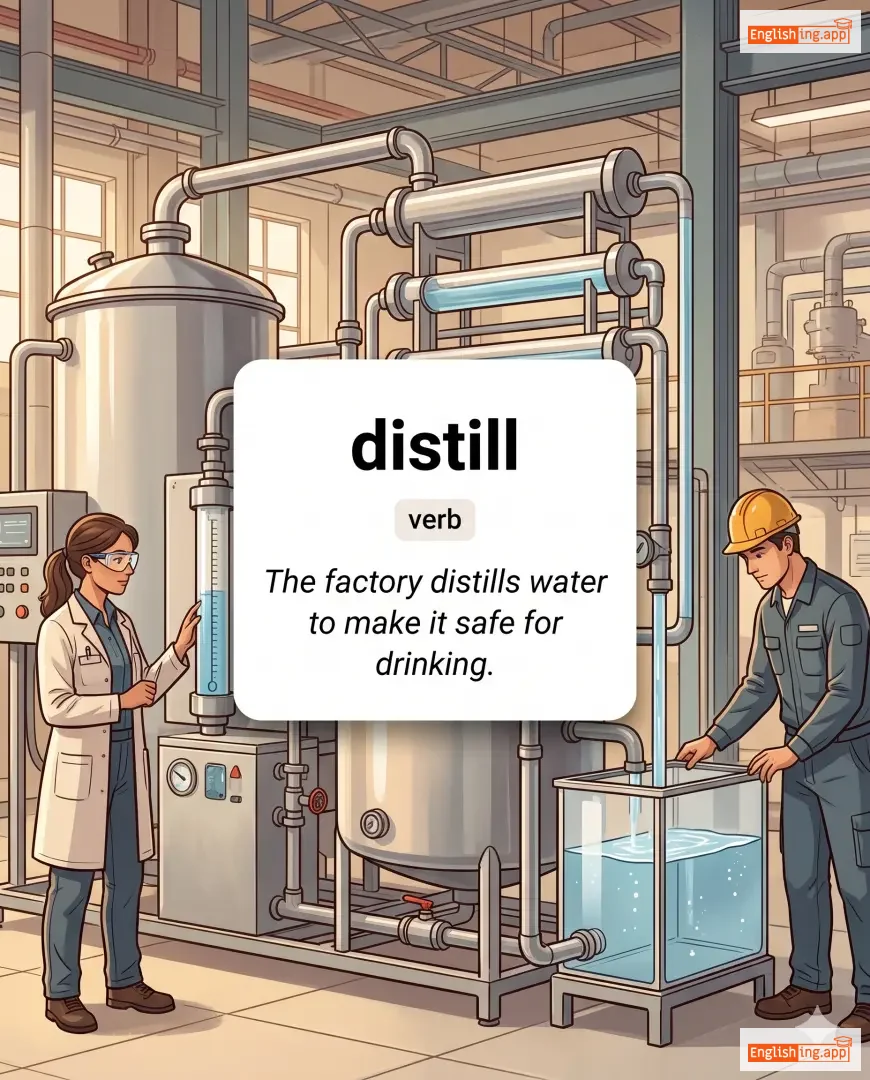
distill definition card — visual illustration of the meaning
verb
/dɪˈstɪl/
distiller (distiller)

To purify a liquid by heating and cooling; to extract the essential meaning or most important aspects.

"The factory distills water to make it safe for drinking."

"L'usine distille de l'eau pour la rendre sûre à boire." (L'usine distille de l'eau pour la rendre sûre à boire.)
noun
/ˌdɪstɪˈleɪʃən/
distillation (distillation)

The process of purifying a liquid by heating and cooling; the extraction of the essential meaning.

"Distillation is commonly used to produce alcoholic beverages."

"La distillation est couramment utilisée pour produire des boissons alcoolisées." (La distillation est couramment utilisee pour produire des boissons alcoolisees.)
noun
/dɪˈstɪlər/
distillateur (distillateur)

A person or company that makes alcoholic drinks or purified liquids by distillation.

"The distiller introduced a new brand of whiskey last year."

"Le distillateur a lancé une nouvelle marque de whisky l'année dernière." (Le distillateur a lancé une nouvelle marque de whisky l'année dernière.)
adjective
/dɪˈstɪŋkt/
distinct (distinct)

clearly different or separate from others of its kind

"The twins have distinct personalities."

"Les jumeaux ont des personnalités distinctes." (Les jumeaux ont des personnalités distinctes.)
noun
/dɪˈstɪŋkʃən/
distinction (dihstinkshun)

a difference or contrast between similar things or people; excellence that sets someone apart

"She graduated with distinction from the university."

"Elle a obtenu son diplôme avec distinction à l'université." (Elle a obtenu son diplome avec distinction a l universite.)
adjective
/dɪˈstɪŋktɪv/
distinctif (distinctif)

having a quality or characteristic that makes something different and easily noticed

"The restaurant is known for its distinctive flavors."

"Le restaurant est connu pour ses saveurs distinctives." (Le restaurant est connu pour ses saveurs distinctives.)
verb
/dɪˈstɪŋɡwɪʃ/
distinguer (distinguer)

to recognize or show the differences between two or more things; to set apart as different

"It can be difficult to distinguish between truth and rumor."

"Il peut être difficile de distinguer la vérité de la rumeur." (Il peut être difficile de distinguer la vérité de la rumeur.)
adjective
/dɪˈstɪŋɡwɪʃt/
distingué; honoré; célèbre; ayant une apparence ou une attitude digne (distingue; honore; celebre)

notable; honored; famous; having a dignified appearance or manner

"He is a distinguished professor at the university."

"Il est un professeur distingué à l'université." (Il est un professeur distingué à l'université.)
verb
/dɪˈstɔːrt/
distordre (distordre)

to twist or change the shape, appearance, or meaning of something so it is not true or accurate

"The mirror distorted her reflection."

"Le miroir a distordu son reflet." (Le miroir a distordu son reflet.)
noun
/dɪˈstɔːrʃən/
distorsion, déformation (distorsion, deformation)

the action of twisting, changing, or misrepresenting the shape, sound, or truth of something

"There was a distortion in the radio signal."

"Il y avait une distorsion dans le signal radio." (Il y avait une distorsion dans le signal radio.)
verb
/dɪˈstrækt/
distracter (distracter)

to take someone's attention away from what they are doing or focusing on

"The loud noise distracted her during the exam."

"Le bruit fort l'a distrait pendant l'examen." (Le bruit fort l'a distrait pendant l'examen.)
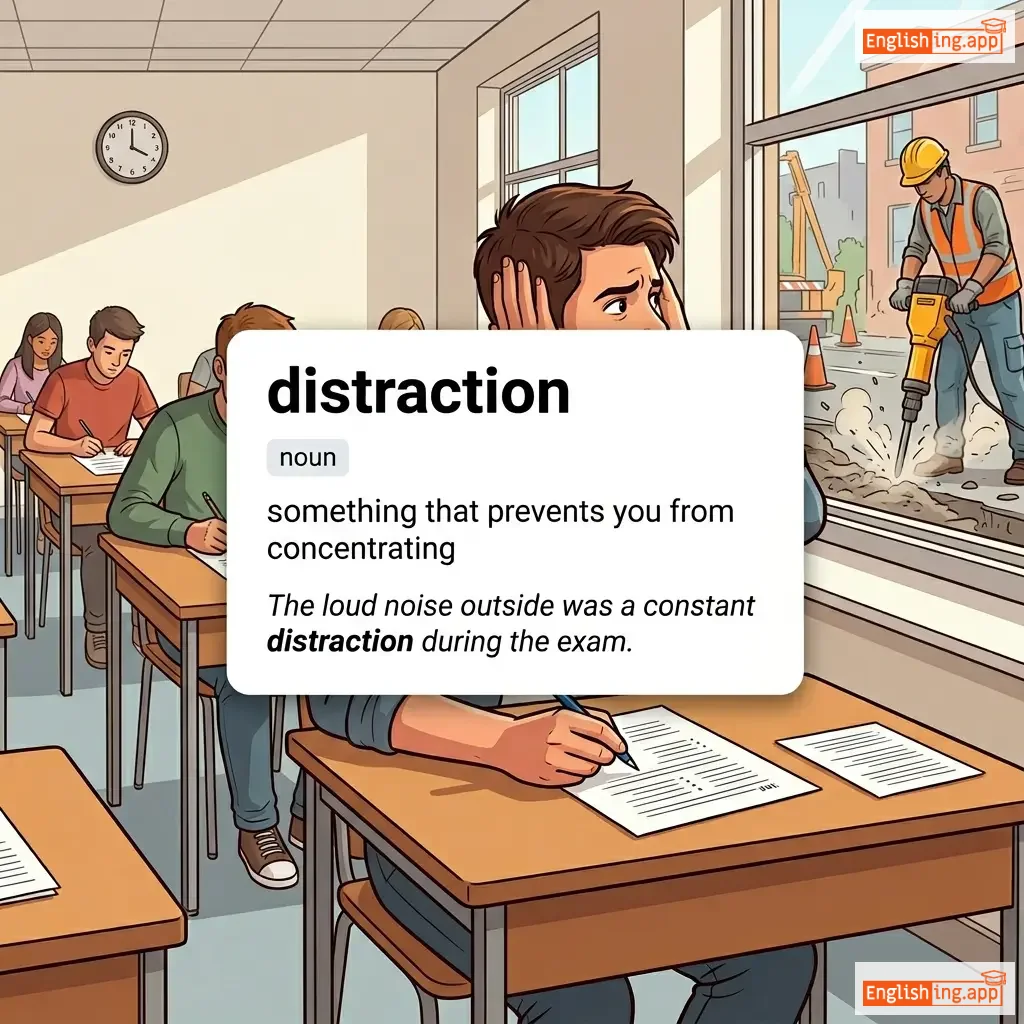
distraction definition card — visual illustration of the meaning
noun
/dɪˈstrækʃən/
distraction (distraction)

something that prevents you from concentrating

"The loud noise outside was a constant distraction during the exam."

"Le bruit fort dehors était une distraction constante pendant l'examen." (Le bruit fort dehors était une distraction constante pendant l'examen.)
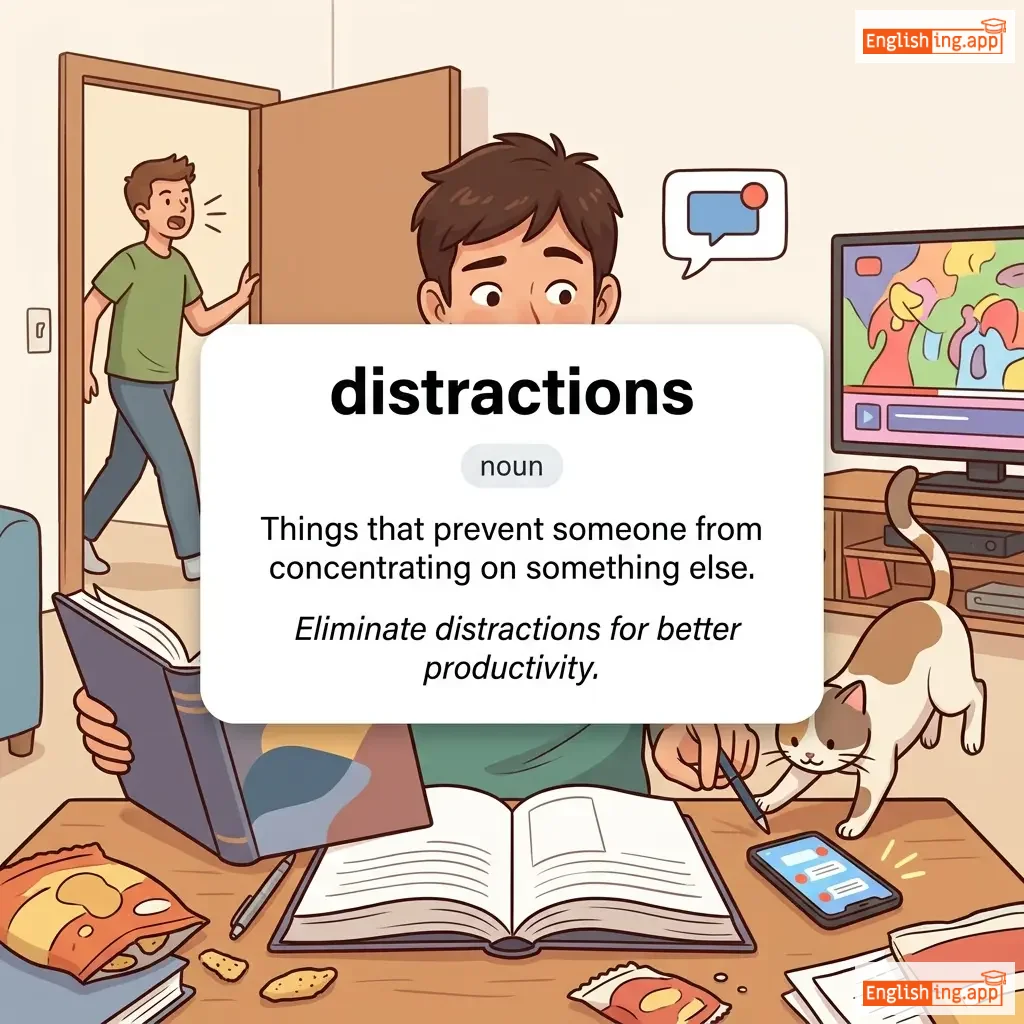
distractions definition card — visual illustration of the meaning
noun
/dɪˈstrækʃənz/
distractions (distractions)

Things that prevent someone from concentrating on something else.

"Eliminate distractions for better productivity."

"Éliminez les distractions pour améliorer la productivité." (Éliminez les distractions pour améliorer la productivité.)
verb
/dɪˈstreɪn/
saisir (saisir)

to seize someone's property in order to obtain payment of rent or other money owed

"The landlord distrained the tenant's furniture for unpaid rent."

"Le propriétaire a saisi les meubles du locataire pour loyer impayé." (Le propriétaire a saisi les meubles du locataire pour loyer impayé.)
noun
/dɪˈstreɪnər/
saisie de biens (saisie de biens)

a person, usually a landlord, who seizes another's property for unpaid debt or rent

"The distrainor took possession of the tenant's car until the debt was cleared."

"Le distrainor a pris possession de la voiture du locataire jusqu'à ce que la dette soit réglée." (Le distrainor a pris possession de la voiture du locataire jusqu'à ce que la dette soit réglée.)
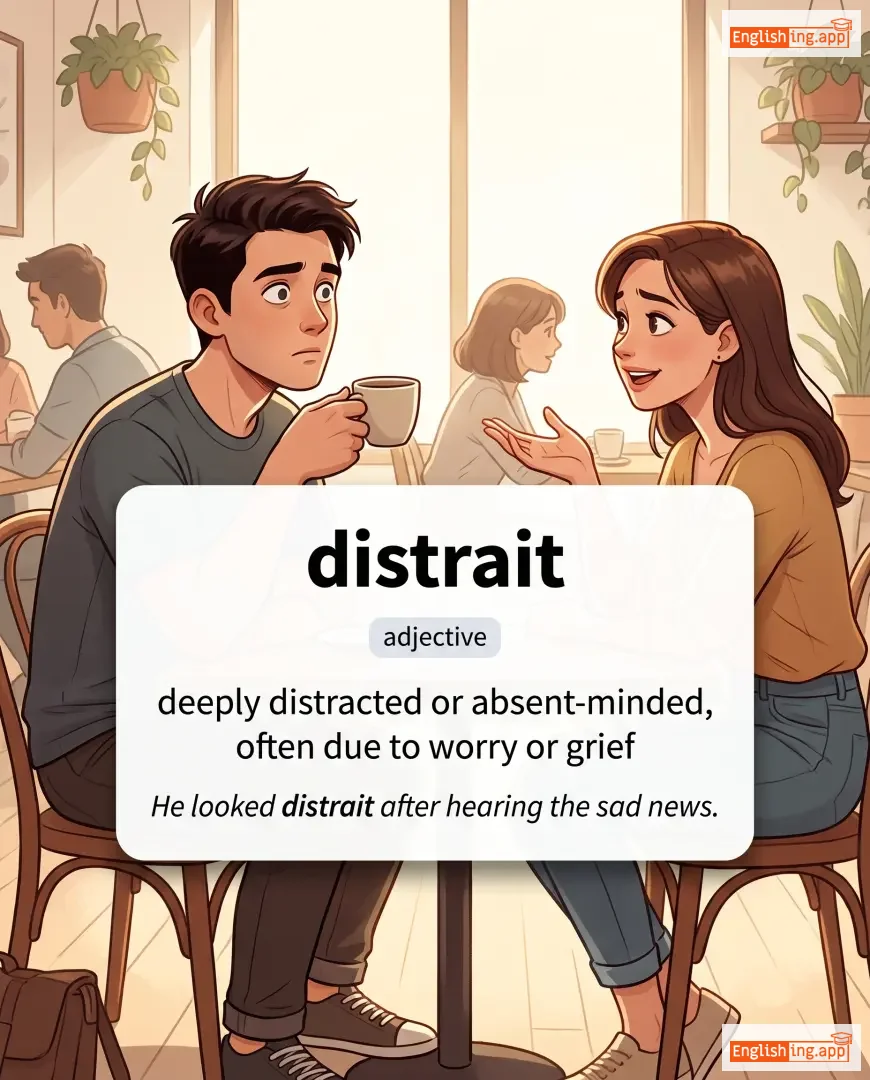
distrait definition card — visual illustration of the meaning
adjective
/dɪˈstreɪ/
distrait (distrait)

deeply distracted or absent-minded, often due to worry or grief

"He looked distrait after hearing the sad news."

"Il avait l'air distrait après avoir entendu les mauvaises nouvelles." (Il avait l'air distrait apres avoir entendu les mauvaises nouvelles.)