Vocabulaires

Découvrez, apprenez et maîtrisez le vocabulaire anglais

noun
/ˈdɛvɪlri/
diablerie (diablerie)

Wicked or cruel behavior; mischievous actions.

"The children were full of devilry on Halloween night."

"Les enfants étaient pleins de diablerie lors de la nuit d'Halloween." (Les enfants étaient pleins de diablerie lors de la nuit d'Halloween.)
noun
/ˈdɛvɪltrɪ/
mauvais tours (mauvais tours)

Cruel or malicious behavior; mischief with an evil aspect.

"The villain’s deviltry terrified the townsfolk."

"Les mauvais tours du méchant ont terrifié les habitants du village." (Les mauvais tours du méchant ont terrifié les habitants du village.)
adjective
/ˈdiːviəs/
sournois (sournois)

Skillful at using underhanded tactics to achieve goals; not straightforward.

"He used a devious plan to gain control of the company."

"Il a utilisé un plan sournois pour prendre le contrôle de l'entreprise." (Il a utilisé un plan sournois pour prendre le contrôle de l'entreprise.)
verb
/dɪˈvaɪz/
concevoir (concevoir)

To plan or invent something carefully.

"The engineers devised a new method to reduce costs."

"Les ingénieurs ont conçu une nouvelle méthode pour réduire les coûts." (Les ingénieurs ont conçu une nouvelle méthode pour réduire les coûts.)
adjective
/dɪˈvɔɪd/
vide (vide)

Completely lacking or without something.

"His speech was devoid of any real emotion."

"Son discours était vide de toute émotion réelle." (Son discours était vide de toute émotion réelle.)
verb
/dɪˈvɒlv/
déléguer (deleguer)

To pass power, responsibility, or duties to another person or group.

"The responsibility will devolve on the new manager."

"La responsabilité sera transférée au nouveau responsable." (La responsabilité sera transférée au nouveau responsable.)
verb
/dɪˈvoʊt/
consacrer (consacrer)

to give time, effort, or resources to something

"She devotes much of her time to helping the poor."

"Elle consacre une grande partie de son temps à aider les pauvres." (Elle consacre une grande partie de son temps à aider les pauvres.)
adjective
/dɪˈvoʊtɪd/
dévoué (devoe)

Very loving, loyal, or dedicated.

"She is a devoted mother who always puts her children first."

"Elle est une mère dévouée qui met toujours ses enfants en premier." (Elle est une mère dévouée qui met toujours ses enfants en premier.)
noun
/ˌdɛvəˈtiː/
dévoué (devoue)

A person who is very enthusiastic about or strongly dedicated to something or someone.

"He is a great devotee of classical music."

"Il est un grand dévoué de la musique classique." (Il est un grand devoue de la musique classique)
noun
/dɪˈvoʊ.ʃən/
dévotion; fidélité; enthousiasme (devotion, fidelite, enthousiasme)

love, loyalty, or enthusiasm for a person, activity, or cause

"Her devotion to helping others made her a beloved figure in the community."

"Sa dévotion à aider les autres a fait d'elle une figure bien-aimée dans la communauté." (Sa devotion a aider les autres a fait d'elle une figure bien-aimee dans la communaute.)
adjective
/dɪˈvaʊt/
dévoué (devoue)

Deeply religious or sincere.

"He is a devout believer who prays every day."

"Il est un croyant dévoué qui prie chaque jour." (Il est un croyant devoue qui prie chaque jour.)
noun
/djuː/
rosée (rosee)

Tiny drops of water that form on cool surfaces at night from condensation.

"The grass was wet with morning dew."

"L'herbe était mouillée de la rosée du matin." (L'herbe était mouillée de la rosee du matin.)
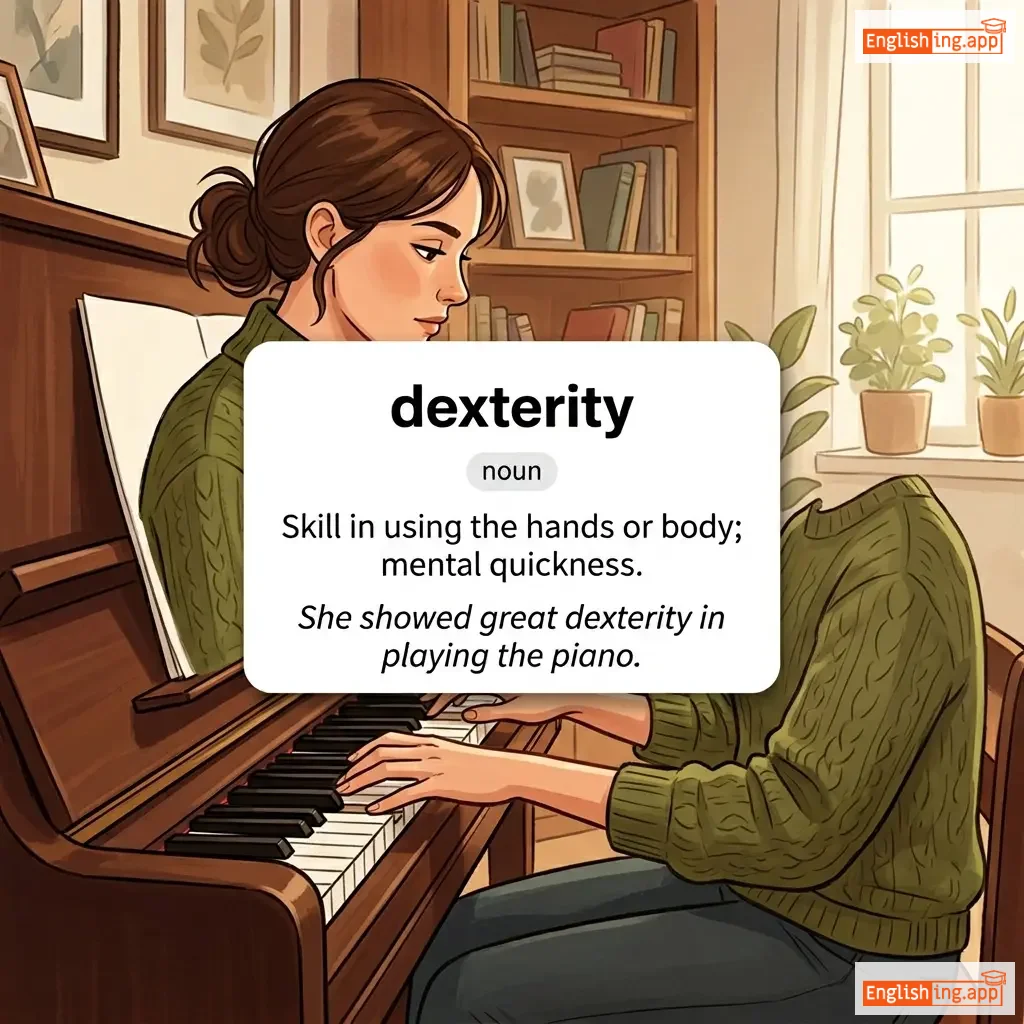
dexterity definition card — visual illustration of the meaning
noun
/dɛkˈstɛrɪti/
dextérité (dexterite)

Skill in using the hands or body; mental quickness.

"She showed great dexterity in playing the piano."

"Elle a montré une grande dextérité en jouant du piano." (Elle a montré une grande dextérité en jouant du piano.)
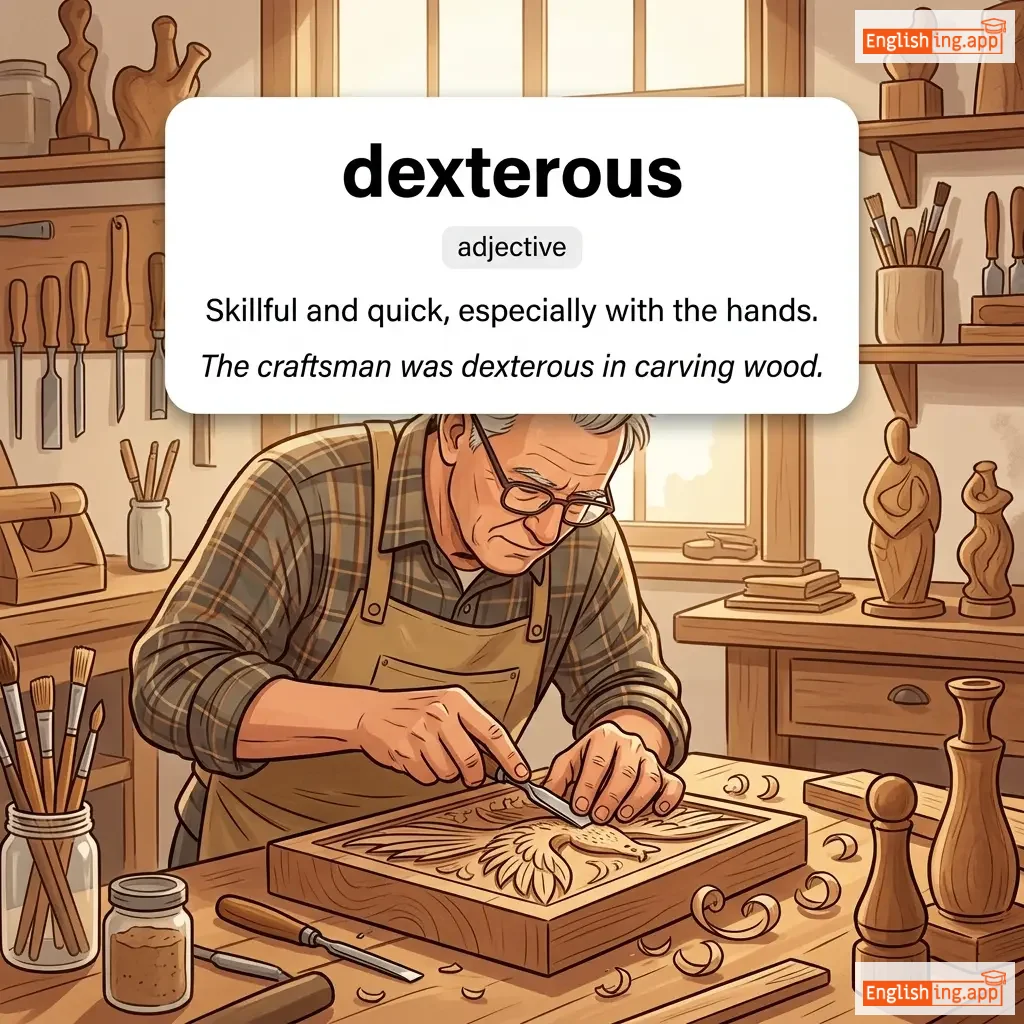
dexterous definition card — visual illustration of the meaning
adjective
/ˈdɛkstrəs/
habile (habile)

Skillful and quick, especially with the hands.

"The craftsman was dexterous in carving wood."

"L'artisan était habile à sculpter le bois." (L'artisan était habile à sculpter le bois.)
👳‍♂️

Dhuti (douti)

noun
/ˈduːti/
dhuti (dhuti)

a traditional Indian garment for men consisting of a piece of unstitched cloth worn around the waist and legs

"The elderly man wore a white dhuti during the religious ceremony."

"L'homme âgé portait un dhuti blanc lors de la cérémonie religieuse." (L'homme âgé portait un dhuti blanc lors de la cérémonie religieuse.)
noun
/ˌdaɪəˈbiːtiːz/
bonheur (bonheur)

a medical condition in which the body cannot properly control the level of sugar in the blood

"He was diagnosed with type 2 diabetes last year."

"Elle n'a pas pu cacher son bonheur lorsqu'elle a reçu le prix." (Elle n'a pas pu cacher son bonheur lorsqu'elle a reçu le prix.)
adjective
/ˌdaɪəˈbɒlɪk/
diabolique (diabolique)

Extremely evil or cruel; characteristic of the devil.

"The villain devised a diabolic scheme."

"Le méchant a imaginé un plan diabolique." (Le mechant a imagine un plan diabolique.)
adjective
/ˌdaɪəˈbɒlɪkəl/
diabolique (diabolique)

Wicked, cruel, or outrageously bad; resembling the devil.

"The dictator’s diabolical rule brought misery to the nation."

"Le régime diabolique du dictateur a apporté la misère à la nation." (Le regime diabolique du dictateur a apporte la misere a la nation.)
adjective
/ˌdaɪəˈkrɪtɪkəl/
diacritique (diacritique)

Relating to a mark added to a letter to indicate a different pronunciation or stress.

"The word résumé has diacritical marks that change its meaning from resume."

"Le mot 'résumé' a des marques diacritiques qui changent sa signification de 'resume'." (Le mot 'résumé' a des marques diacritiques qui changent sa signification de 'resume'.)
noun
/ˈdaɪəˌdɛm/
diadème (diademe)

A crown or headband worn as a symbol of royalty or authority.

"The queen wore a glittering diadem at the coronation."

"La reine portait une diadème étincelante lors du couronnement." (La reine portait une diadème étincelante lors du couronnement.)
verb
/ˌdaɪəɡˈnoʊz/
diagnostiquer (diagnostiquer)

To identify a disease, condition, or problem by examining symptoms.

"The doctor diagnosed him with pneumonia."

"Le médecin l'a diagnostiqué avec une pneumonie." (Le médecin l'a diagnostiqué avec une pneumonie.)
noun
/ˌdaɪəɡˈnoʊsɪs/
diagnostic (deeahnyosteek)

The identification of a disease, condition, or problem through examination of symptoms.

"The diagnosis confirmed that she had diabetes."

"Le diagnostic a confirmé qu'elle avait le diabète." (Le diagnostic a confirme qu elle avait le diabete)
noun
/ˈdaɪəɡræm/
diagramme (diagramme)

a simplified drawing that shows the structure, relationship, or process of something

"The teacher explained the system using a clear diagram."

"L’enseignant a expliqué le système à l’aide d’un diagramme clair." (L enseignant a explique le systeme a l aide d un diagramme clair)
noun
/ˈdaɪəˌlɛkt/
dialecte (dialecte)

A particular form of a language spoken in a specific region or by a specific group.

"He speaks a dialect of Bengali that is common in rural areas."

"Il parle un dialecte du bengali qui est courant dans les zones rurales." (Il parle un dialecte du bengali qui est courant dans les zones rurales.)
noun
/ˌdaɪəˈlɛktɪk/
dialectique (dialectique)

A method of argument or reasoning by dialogue, especially as a means of investigating truth.

"The philosopher used dialectic to challenge his students' assumptions."

"Le philosophe a utilisé la dialectique pour remettre en question les hypothèses de ses étudiants." (Le philosophe a utilise la dialectique pour remettre en question les hypotheses de ses etudiants.)
adjective
/ˌdaɪəˈlɛktɪkəl/
dialectique (dialectique)

Relating to the logical discussion of ideas and opinions.

"She took a dialectical approach to solve the complex issue."

"Elle a adopté une approche dialectique pour résoudre la question complexe." (Elle a adopte une approche dialectique pour resoudre la question complexe.)
noun
/ˌdaɪələˈtɪʃən/
dialecticien (dialecticien)

A person skilled in dialectic or logical argument.

"Socrates is often considered the greatest dialectician in history."

"Socrate est souvent considéré comme le plus grand dialecticien de l'histoire." (Socrate est souvent considere comme le plus grand dialecticien de l'histoire.)
noun
/ˈdaɪəlɔːɡ/
dialogue (dialogue)

A conversation between two or more people, or a discussion aimed at reaching understanding.

"The two countries engaged in a dialogue to resolve their differences."

"Les deux pays ont engagé un dialogue pour résoudre leurs différends." (Les deux pays ont engage un dialogue pour resoudre leurs differends.)
noun
/ˈdaɪəmənd/
diamant (diamant)

a precious hard stone, usually clear and colorless, valued as a gemstone

"She wore a beautiful diamond necklace at the party."

"Elle portait un magnifique collier en diamant à la fête." (Elle portait un magnifique collier en diamant à la fête.)
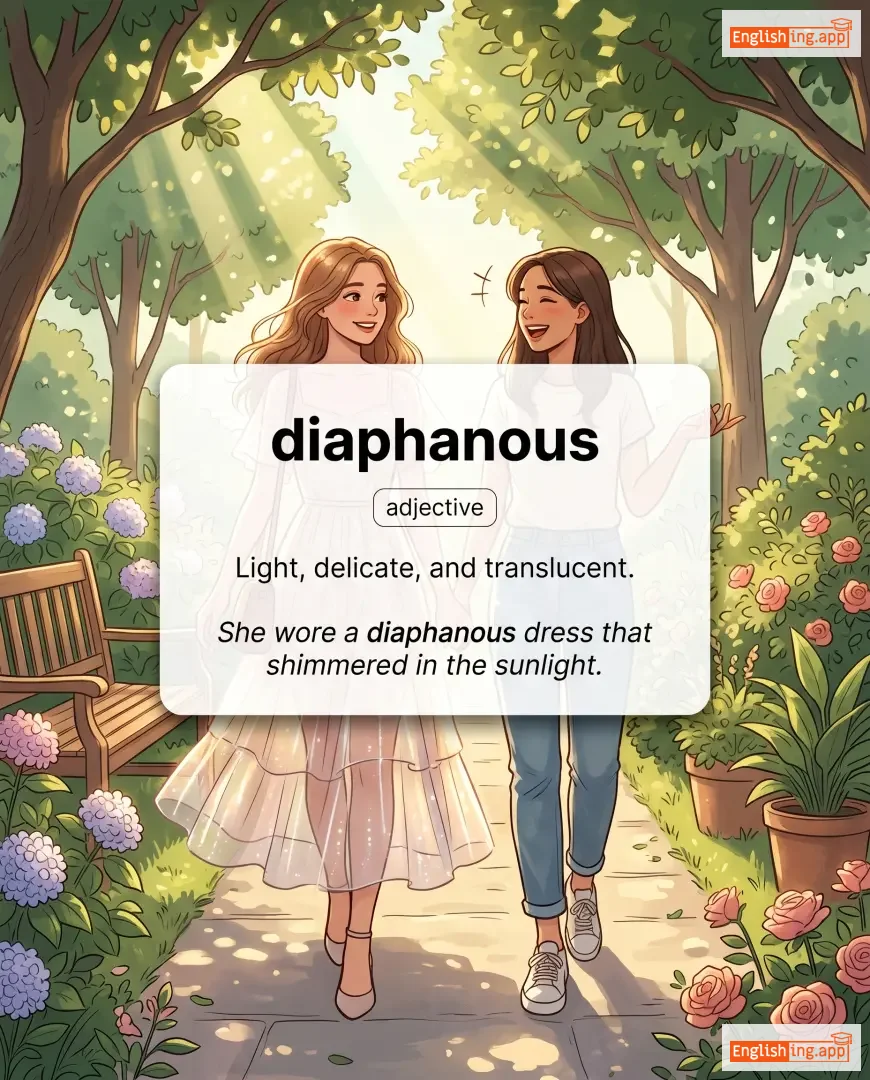
diaphanous definition card — visual illustration of the meaning
adjective
/daɪˈæfənəs/
diaphane (diaphane)

Light, delicate, and translucent.

"She wore a diaphanous dress that shimmered in the sunlight."

"Elle portait une robe diaphane qui scintillait sous la lumière du soleil." (Elle portait une robe diaphane qui scintillait sous la lumière du soleil.)
noun
/ˈdaɪəri/
journal (journal)

a book in which one keeps a daily record of events and experiences

"She wrote about her day in her diary before going to bed."

"Elle a écrit sur sa journée dans son journal avant de se coucher." (Elle a écrit sur sa journée dans son journal avant de se coucher.)
adjective
/ˌdaɪəˈtɒmɪk/
diatomique (diatomique)

Consisting of two atoms.

"Oxygen is a diatomic molecule."

"L'oxygène est une molécule diatomique." (L'oxygene est une molecul diatomique.)
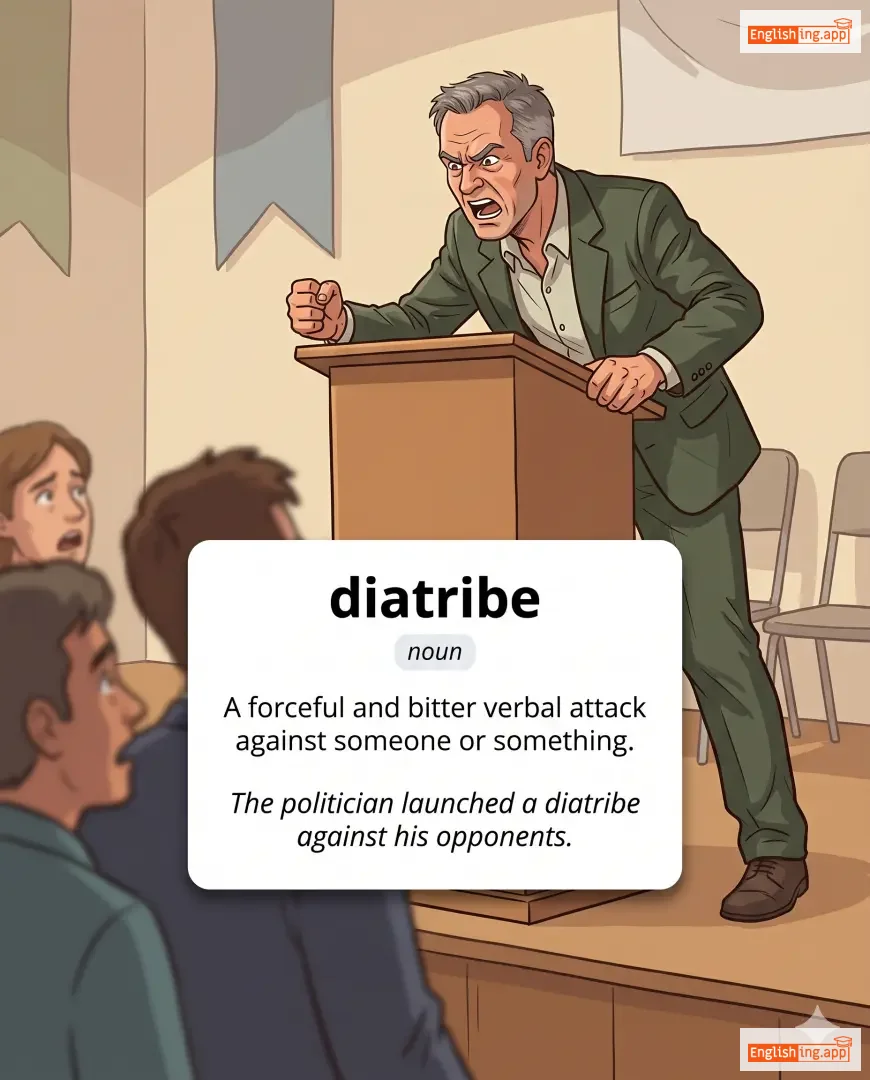
diatribe definition card — visual illustration of the meaning
noun
/ˈdaɪətraɪb/
diatribe (diatribe)

A forceful and bitter verbal attack against someone or something.

"The politician launched a diatribe against his opponents."

"Le politicien a lancé une diatribe contre ses opposants." (Le politicien a lancé une diatribe contre ses opposants.)
adjective
/ˈdaɪ.si/
risqué (riske)

Risky or unpredictable; potentially dangerous.

"Investing in that company looks pretty dicey right now."

"Investir dans cette entreprise semble assez risqué en ce moment." (Investir dans cette entreprise semble assez risqué en ce moment.)
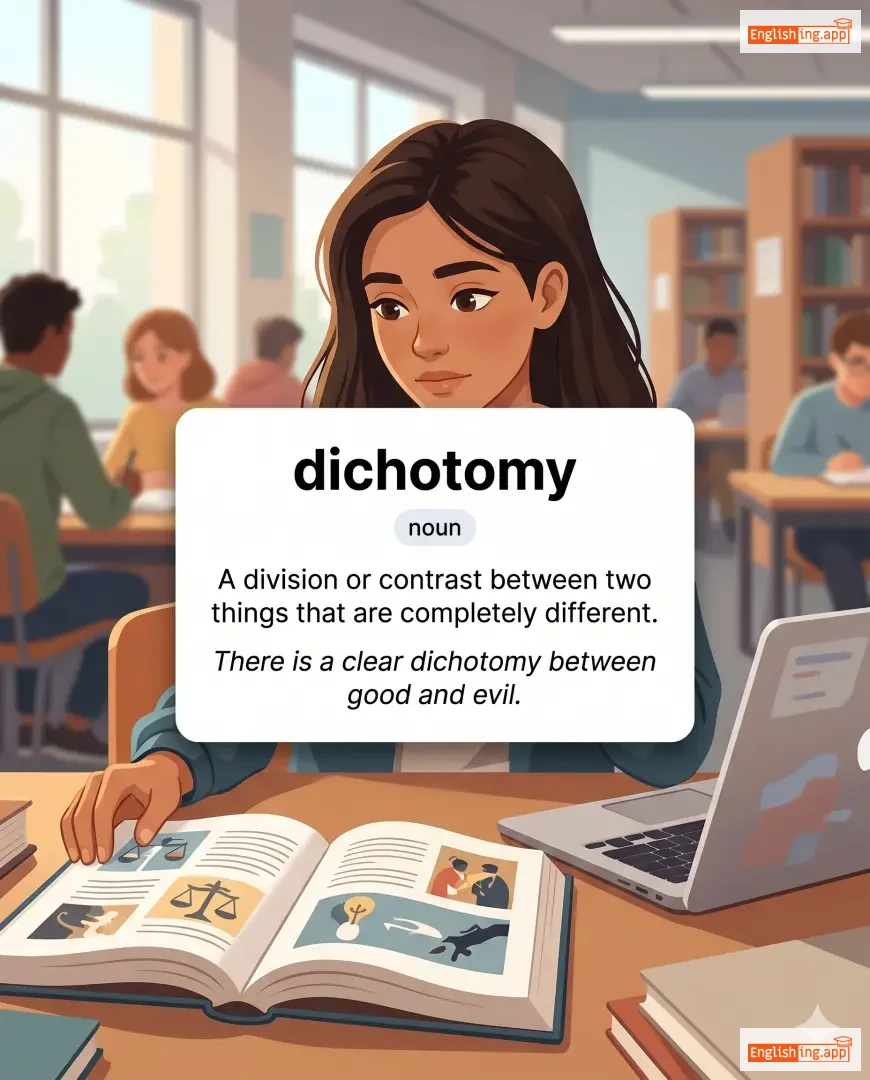
dichotomy definition card — visual illustration of the meaning
noun
/daɪˈkɒtəmi/
dichotomie (dichotomie)

A division or contrast between two things that are completely different.

"There is a clear dichotomy between good and evil."

"Il existe une dichotomie claire entre le bien et le mal." (Il existe une dichotomie claire entre le bien et le mal.)
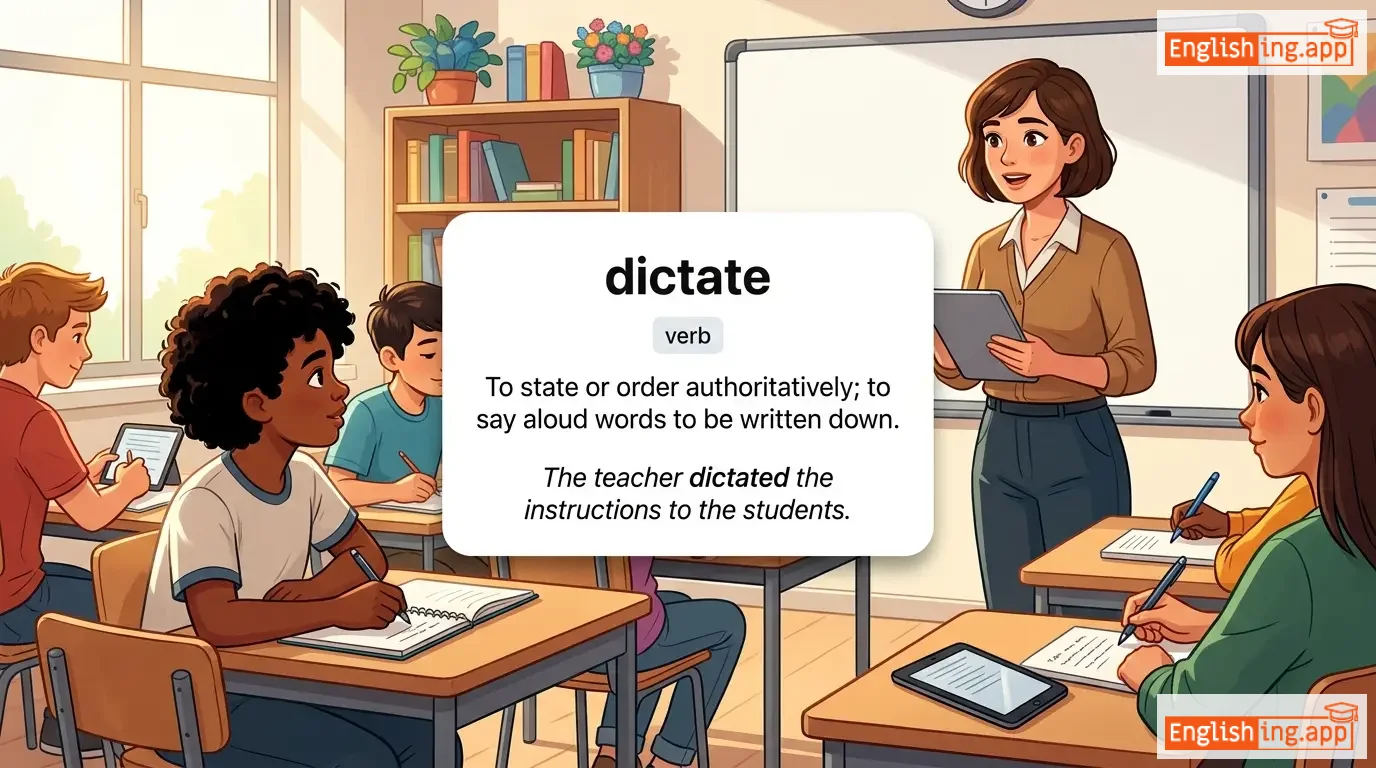
dictate definition card — visual illustration of the meaning
verb
/dɪkˈteɪt/
dicter (dicter)

To state or order authoritatively; to say aloud words to be written down.

"The teacher dictated the instructions to the students."

"Le professeur a dicté les instructions aux élèves." (Le professeur a dicté les instructions aux élèves.)
noun
/dɪkˈteɪtə/
dictateur (dictateur)

a ruler with total power over a country, typically one who has obtained control by force

"The dictator ruled the country with an iron fist."

"Le dictateur dirigeait le pays d'une main de fer." (Le dictateur dirigeait le pays d'une main de fer.)
adjective
/ˌdɪktəˈtɔːriəl/
dictatorial (dictatorial)

Having or showing a tendency to tell people what to do in an autocratic way.

"His dictatorial style made him unpopular among colleagues."

"Son style dictatorial le rendait impopulaire parmi ses collègues." (Son style dictatorial le rendait impopulaire parmi ses collegues.)
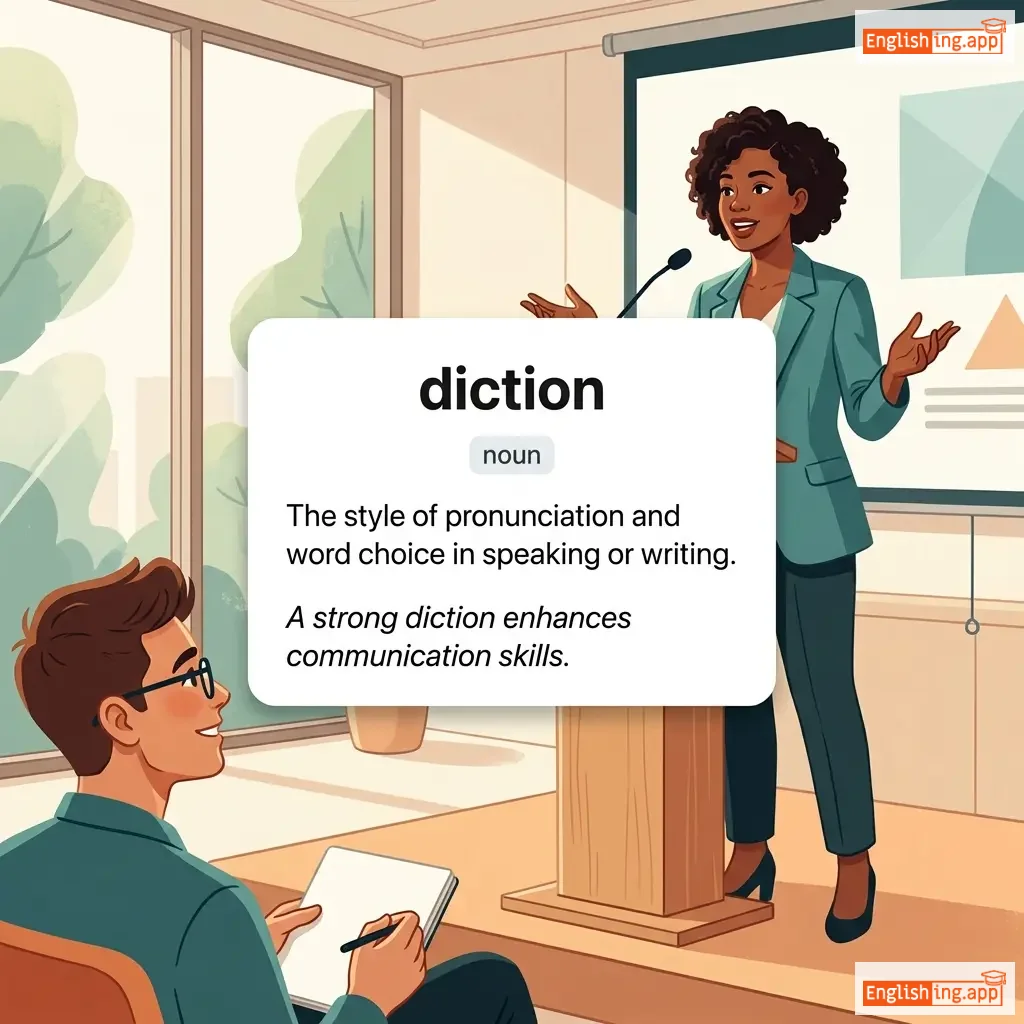
diction definition card — visual illustration of the meaning
noun
ˈdɪk.ʃən
prononciation et choix des mots (prononciation et choix des mots)

The style of pronunciation and word choice in speaking or writing.

"A strong diction enhances communication skills."

"Une forte diction améliore les compétences en communication." (Une forte diction ameliore les competences en communication.)
noun
/ˈdɪkʃəˌnɛri/
dictionnaire (dictionnaire)

A reference book or electronic resource containing words, usually arranged alphabetically, with information about their meanings, pronunciations, etymologies, and usage.

"I looked up the word in the dictionary to understand its meaning."

"J'ai consulté le mot dans le dictionnaire pour en comprendre le sens." (J'ai consulte le mot dans le dictionnaire pour en comprendre le sens.)
noun
/ˈdɪktəm/
dicton (dicton)

A formal pronouncement, authoritative statement, or maxim.

"The judge’s dictum clarified the principle of equality before the law."

"Le dictum du juge a clarifié le principe de l'égalité devant la loi." (Le dictum du juge a clarifie le principe de l'egalite devant la loi.)
adjective
/daɪˈdæktɪk/
didactique (didactique)

Intended to teach, often with a moral lesson.

"The novel is not just entertaining but also didactic in nature."

"Le roman n'est pas seulement divertissant, mais aussi didactique par nature." (Le roman n'est pas seulement divertissant, mais aussi didactique par nature.)
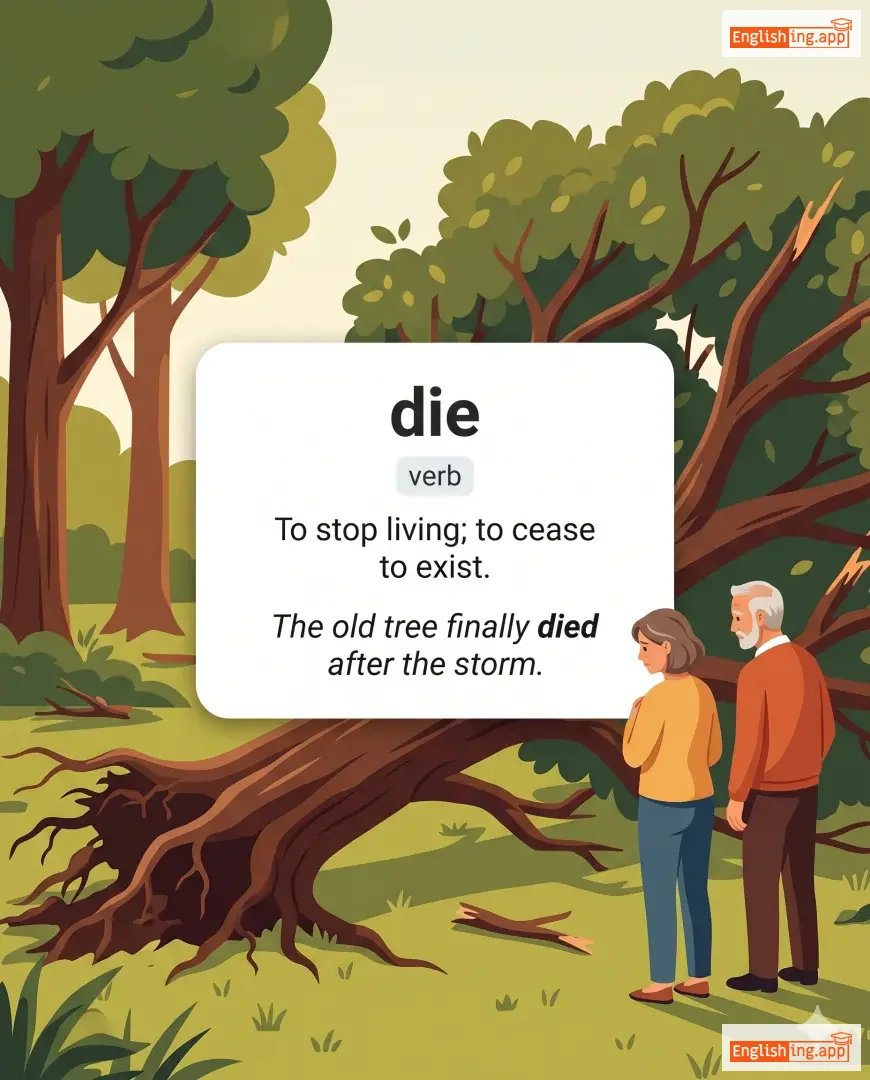
die definition card — visual illustration of the meaning
verb
/daɪ/
mourir (mourir)

To stop living; to cease to exist.

"The old tree finally died after the storm."

"L'arbre vieux est finalement mort après la tempête." (L'arbre vieux est finalement mort après la tempête.)
noun
/ˈdaɪhɑːrd/
fanatique (daihard)

A person who strongly resists change and remains loyal to a belief or cause.

"He is a diehard fan of classic rock music."

"Il est un fanatique inconditionnel du rock classique." (Il est un dai hard fan du rock classique.)
noun
/ˈdaɪət/
régime (regime)

the kinds of food that a person usually eats

"He follows a strict vegetarian diet."

"Il suit un régime végétarien strict." (Il suit un régime végétarien strict.)
verb
/ˈdɪfər/
différer (differer)

to be unlike or distinct from something else

"Opinions differ on this issue."

"Les opinions diffèrent sur cette question." (Les opinions diffèrent sur cette question.)
noun
/ˈdɪfərəns/
différence (difference)

A point or way in which things are not the same.

"There is a big difference between theory and practice."

"Il y a une grande différence entre la théorie et la pratique." (Il y a une grande différence entre la théorie et la pratique.)
adjective
/ˈdɪf.ər.ənt/
différent (differan)

Not the same as another; distinct or unlike.

"Her opinion was completely different from mine."

"Son opinion était complètement différente de la mienne." (Son opinion était complètement différente de la mienne.)
noun
/ˌdɪfəˈrɛnʃə/
caractéristique distincte (caracteristique distincte)

A distinguishing characteristic that sets one thing apart from another.

"The differentia of humans is their ability to reason abstractly."

"La caractéristique distincte des humains est leur capacité à raisonner de manière abstraite." (La caracteristique distincte des humains est leur capacite a raisonner de maniere abstraite.)
adjective
/ˌdɪfəˈrɛnʃəl/
différentiel (differentiel)

Relating to or showing a difference; involving a distinction.

"There is a differential treatment between the two groups."

"Il existe un traitement différentiel entre les deux groupes." (Il existe un traitement différentiel entre les deux groupes.)