Vocabulaires

Découvrez, apprenez et maîtrisez le vocabulaire anglais

noun, verb
/klɒt/
caillot (caillot)

a thick mass of coagulated liquid, especially blood; to form such a mass.

"The doctor removed a blood clot from the patient."

"Le médecin a retiré un caillot de sang du patient." (Le médecin a retiré un caillot de sang du patient.)
noun
/klɒθ/
tissu (tissu)

fabric or material made by weaving or knitting fibers

"The table was covered with a white cloth."

"La table était couverte d'un tissu blanc." (La table était couverte d'un tissu blanc.)
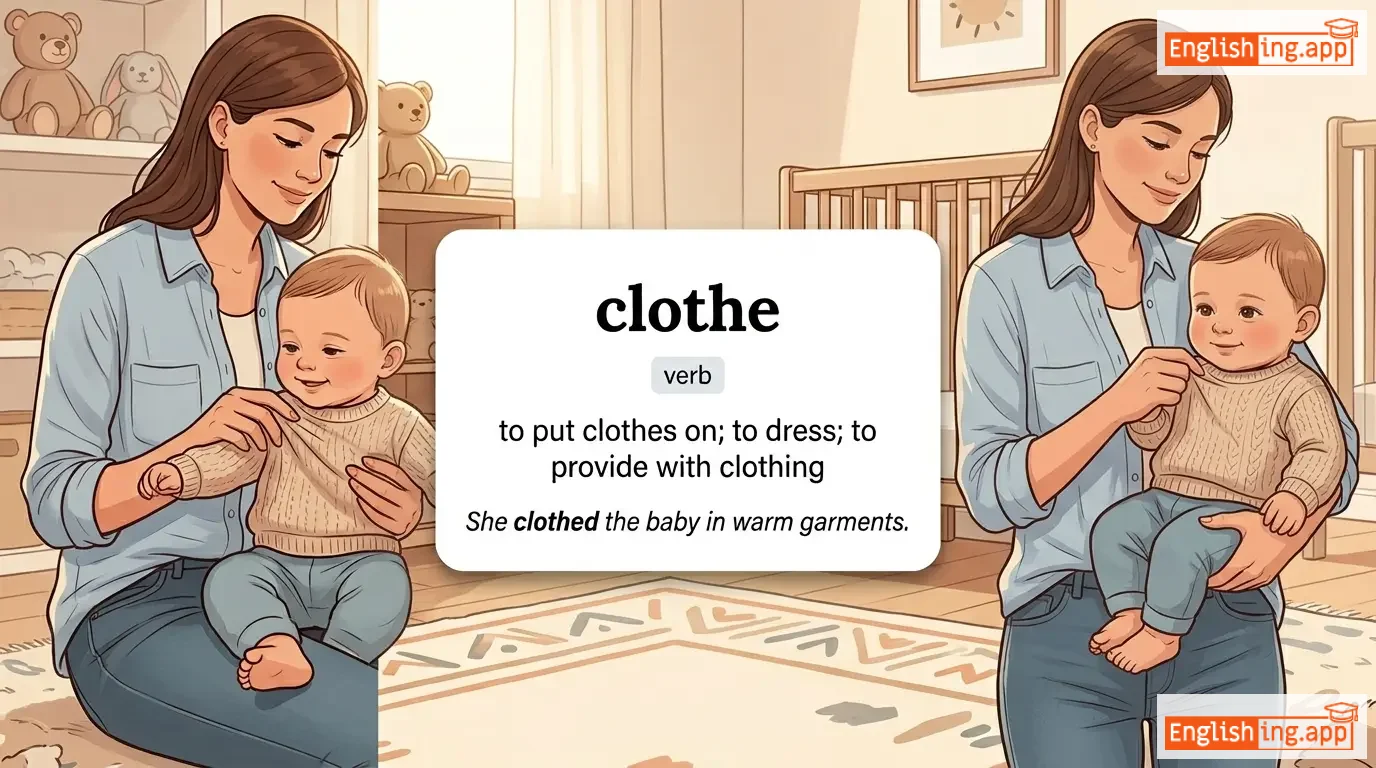
clothe definition card — visual illustration of the meaning
verb
/kloʊð/
habiller (habiller)

to put clothes on; to dress; to provide with clothing

"She clothed the baby in warm garments."

"Elle a habillé le bébé avec des vêtements chauds." (Elle a habillé le bébé avec des vêtements chauds.)
noun
/kloʊðz/
vêtements (vetements)

garments worn on the body

"She bought new clothes for the party."

"Elle a acheté de nouveaux vêtements pour la fête." (Elle a achete de nouveaux vetements pour la fete.)
noun
/kloʊðz ˈaɪərn/
fer à repasser (fer a repasser)

An electric appliance used to remove wrinkles from clothes by applying heat and pressure

"I need to use the clothes iron to make my shirt look neat for the meeting."

"J'ai besoin d'utiliser le fer à repasser pour rendre ma chemise nette pour la réunion." (J'ai besoin d'utiliser le fer a repasser pour rendre ma chemise nette pour la reunion.)
noun
/ˈkloʊðiər/
marchand de vêtements (marchand de vetements)

a person or company that makes, sells, or deals in clothes.

"The town’s clothier displayed fine suits in his shop window."

"Le marchand de vêtements de la ville a exposé de beaux costumes dans la vitrine de son magasin." (Le marchand de vêtements de la ville a exposé de beaux costumes dans la vitrine de son magasin.)
noun
/ˈkloʊðɪŋ/
vêtements (vetements)

items worn to cover the body; apparel collectively

"Warm clothing is essential in winter."

"Les vêtements chauds sont essentiels en hiver." (Les vêtements chauds sont essentiels en hiver.)
noun
/ˈkloʊtʃər/
procédure de cloture (procedure de cloture)

a procedure for ending a debate and taking a vote.

"The Senate invoked cloture to end the lengthy debate."

"Le Sénat a invoqué la clôture pour mettre fin au débat long." (Le Senat a invoque la cloture pour mettre fin au debat long.)
noun, verb
/klaʊd/
nuage (nuage)

a visible mass of condensed water vapor in the sky; to make something less clear

"Dark clouds gathered before the storm."

"Des nuages sombres se sont rassemblés avant la tempête." (Des nuages sombres se sont rassemblés avant la tempête.)
noun
/ˈklaʊdˌbɜːrst/
averse soudaine et intense (averse soudaine et intense)

a sudden and very heavy rainfall

"The picnic was ruined by a sudden cloudburst."

"Le pique-nique a été gâché par une averse soudaine et intense." (Le pique-nique a été gâché par une averse soudaine et intense.)
noun
/klaʊt/
influence (influence)

influence or power, especially in politics or business

"The businessman has a lot of political clout."

"L'homme d'affaires a beaucoup d'influence politique." (L'homme d'affaires a beaucoup d'influence politique.)
noun
/kloʊv/
clou de girofle (clou de girofle)

aromatic flower buds of a tree in the family Myrtaceae, used as a spice

"She added a few cloves to the mulled wine for extra flavor."

"Elle a ajouté quelques clous de girofle au vin chaud pour plus de saveur." (Elle a ajouté quelques clous de girofle au vin chaud pour plus de saveur.)
noun
/klaʊn/
clown (clown)

a comic entertainer who wears funny clothes and makeup

"The clown made the children laugh with his tricks."

"Le clown a fait rire les enfants avec ses astuces." (Le clown a fait rire les enfants avec ses astuces.)
adjective
/ˈklɔɪ.ɪŋ/
écoeurant (ecoeurant)

too sweet, rich, or sentimental, making it unpleasant

"The dessert was so cloying that I couldn't finish it."

"Le dessert était tellement écoeurant que je n'ai pas pu le finir." (Le dessert était tellement écoeurant que je n'ai pas pu le finir.)
noun
/klʌb/
club (club)

an organization of people with a common interest; also a place for social gatherings or entertainment

"He joined the local tennis club to meet new people."

"Il a rejoint le club de tennis local pour rencontrer de nouvelles personnes." (Il a rejoint le club de tennis local pour rencontrer de nouvelles personnes.)
noun
/kluː/
indice (indice)

a piece of evidence or information used in the detection of a crime or solving a puzzle

"The detective found a clue near the window."

"Le détective a trouvé un indice près de la fenêtre." (Le detective a trouve un indice pres de la fenetre.)
adjective
/ˈklʌm.zi/
maladroit (maladroit)

awkward in movement or lacking skill

"He is so clumsy that he drops things all the time."

"Il est tellement maladroit qu'il laisse toujours tomber des choses." (Il est tellement maladroit qu'il laisse toujours tomber des choses.)
noun
/ˈklʌstər/
grappe (grappe)

a group of similar things or people positioned close together

"The grapes grew in a tight cluster."

"Les raisins ont poussé en une grappe serrée." (Les raisins ont poussé en une grappe serrée.)
noun
/ˌkovuːɪɡˈzɪs.təns/
coexistence (coexistence)

the state of existing together at the same time or in the same place; peaceful cohabitation

"The peaceful co-existence of different cultures makes this city unique."

"La coexistence pacifique de différentes cultures rend cette ville unique." (La coexistence pacifique de différentes cultures rend cette ville unique.)
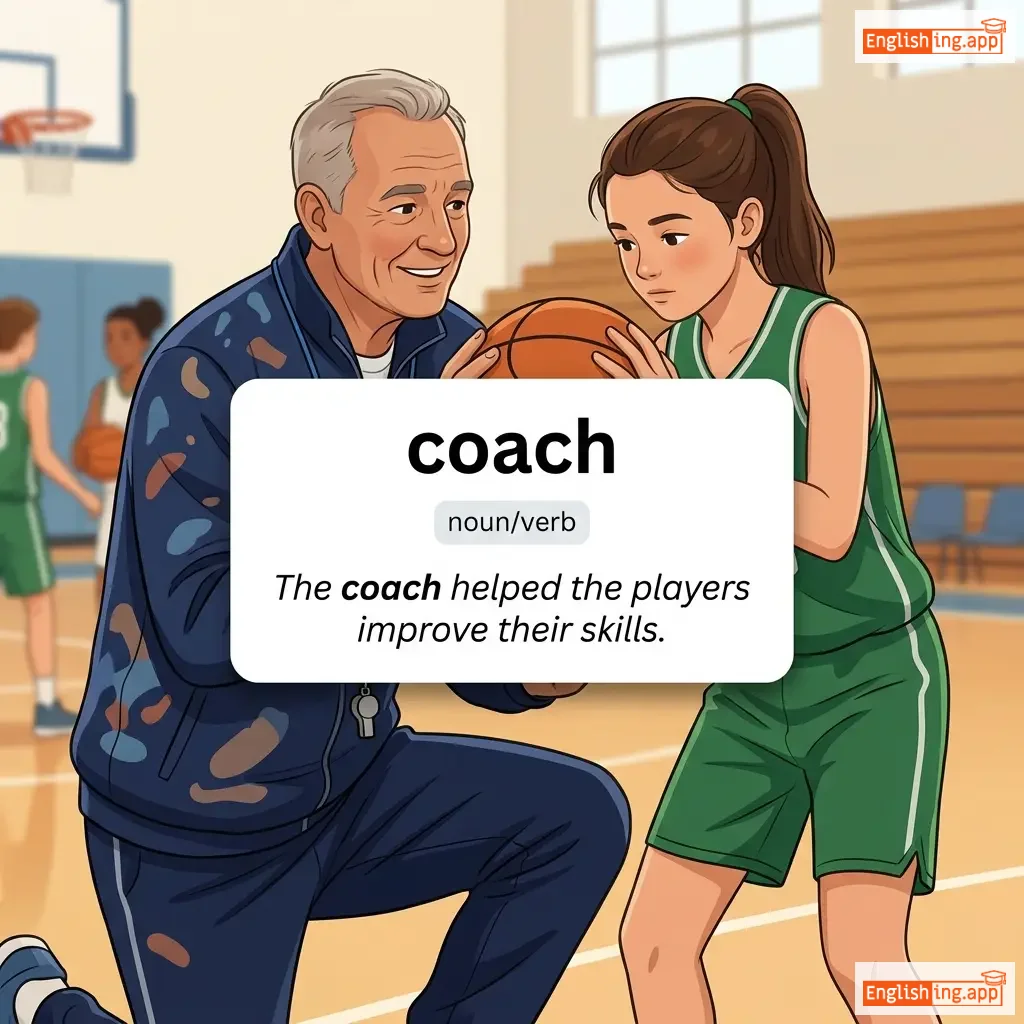
coach definition card — visual illustration of the meaning
noun/verb
/koʊtʃ/
entraîneur (entraîneur)

a person who trains or instructs others in a sport or skill; or to give training to someone

"The coach helped the players improve their skills."

"L'entraîneur a aidé les joueurs à améliorer leurs compétences." (L'entraîneur a aidé les joueurs à améliorer leurs compétences.)
🚗👨‍💼

Coachman (kɔʃmɑ̃)

noun
/ˈkoʊtʃ.mən/
cocher (cocher)

a person who drives a horse-drawn carriage or coach

"The coachman skillfully guided the horses through the busy streets."

"Le cocher a habilement guidé les chevaux à travers les rues bondées." (Le cocher a habilement guidé les chevaux à travers les rues bondées.)
noun
/koʊˈædʒətər/
adjoint (adjoint)

a person who helps or assists another, especially in a religious or official capacity

"The bishop appointed a coadjutor to assist him with his duties."

"L'évêque a nommé un adjoint pour l'aider dans ses devoirs." (L'eveque a nomme un adjoint pour l'aider dans ses devoirs.)
noun
/koʊˈæɡjələnt/
coagulant (coagulant)

a substance that causes blood or another liquid to clot

"The doctor applied a coagulant to stop the bleeding quickly."

"Le médecin a appliqué un coagulant pour arrêter rapidement le saignement." (Le medecin a applique un coagulant pour arreter rapidement le saignement.)
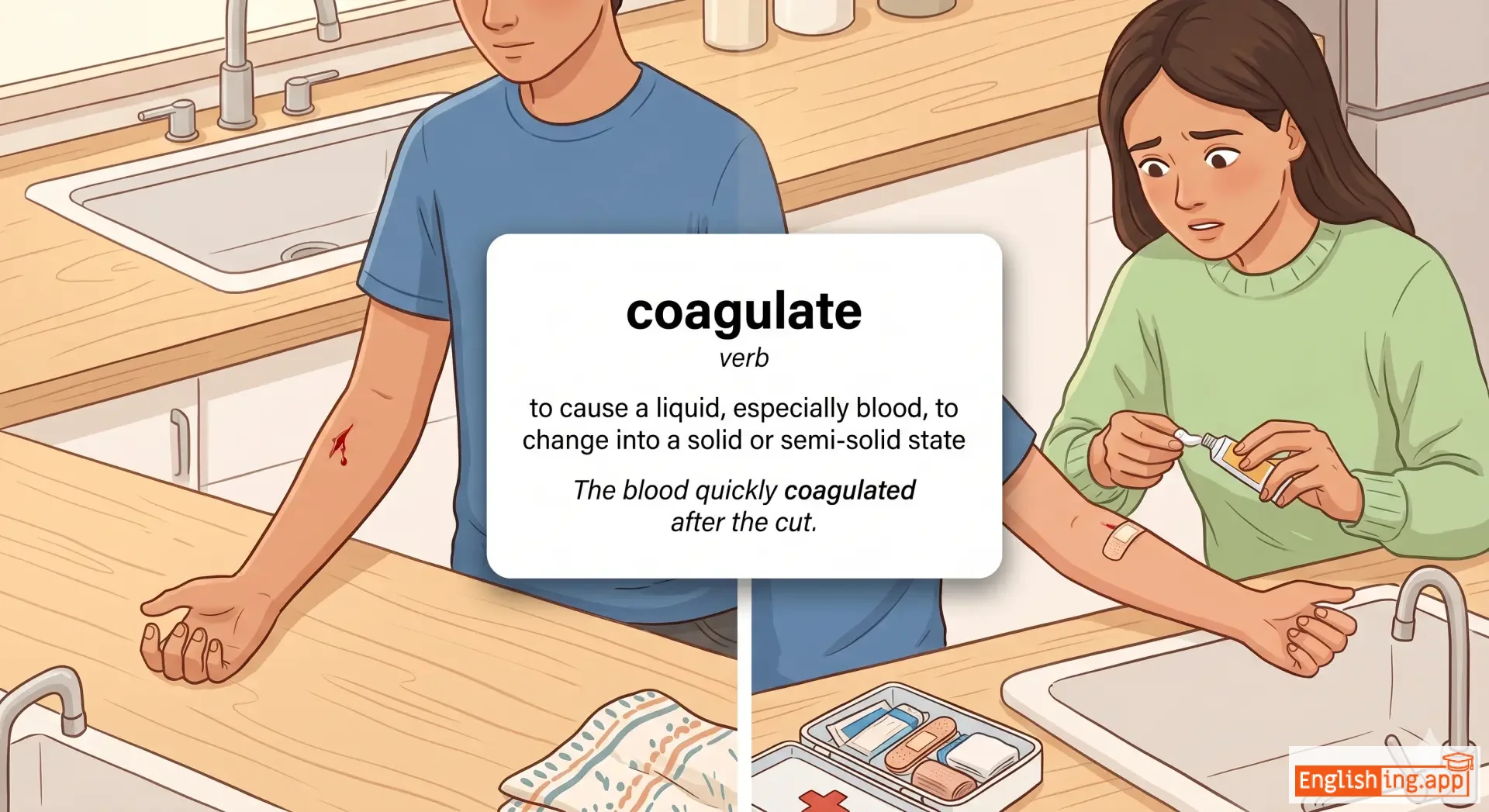
coagulate definition card — visual illustration of the meaning
verb
/koʊˈæɡjəˌleɪt/
coaguler (coaguler)

to cause a liquid, especially blood, to change into a solid or semi-solid state

"The blood quickly coagulated after the cut."

"Le sang s'est coagulé rapidement après la coupure." (Le sang s'est coagulé rapidement après la coupure.)
noun
/koʊl/
charbon (charbon)

a black or dark brown rock used as fuel, formed from decomposed plant matter

"The factory still uses coal as its main source of energy."

"L'usine utilise toujours du charbon comme source principale d'énergie." (L'usine utilise toujours du charbon comme source principale d'energie.)
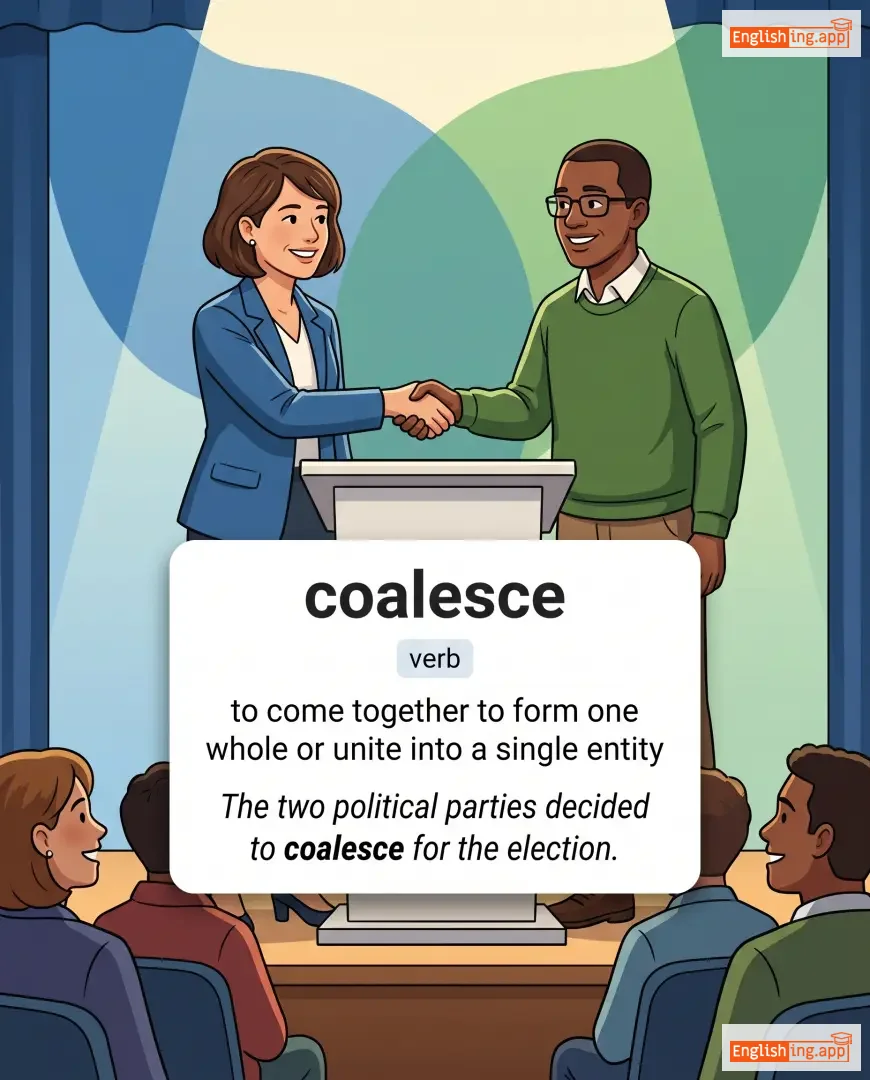
coalesce definition card — visual illustration of the meaning
verb
/ˌkoʊəˈlɛs/
se coaliser (se coaliser)

to come together to form one whole or unite into a single entity

"The two political parties decided to coalesce for the election."

"Les deux partis politiques ont décidé de se coaliser pour les élections." (Les deux partis politiques ont décidé de se coaliser pour les élections.)
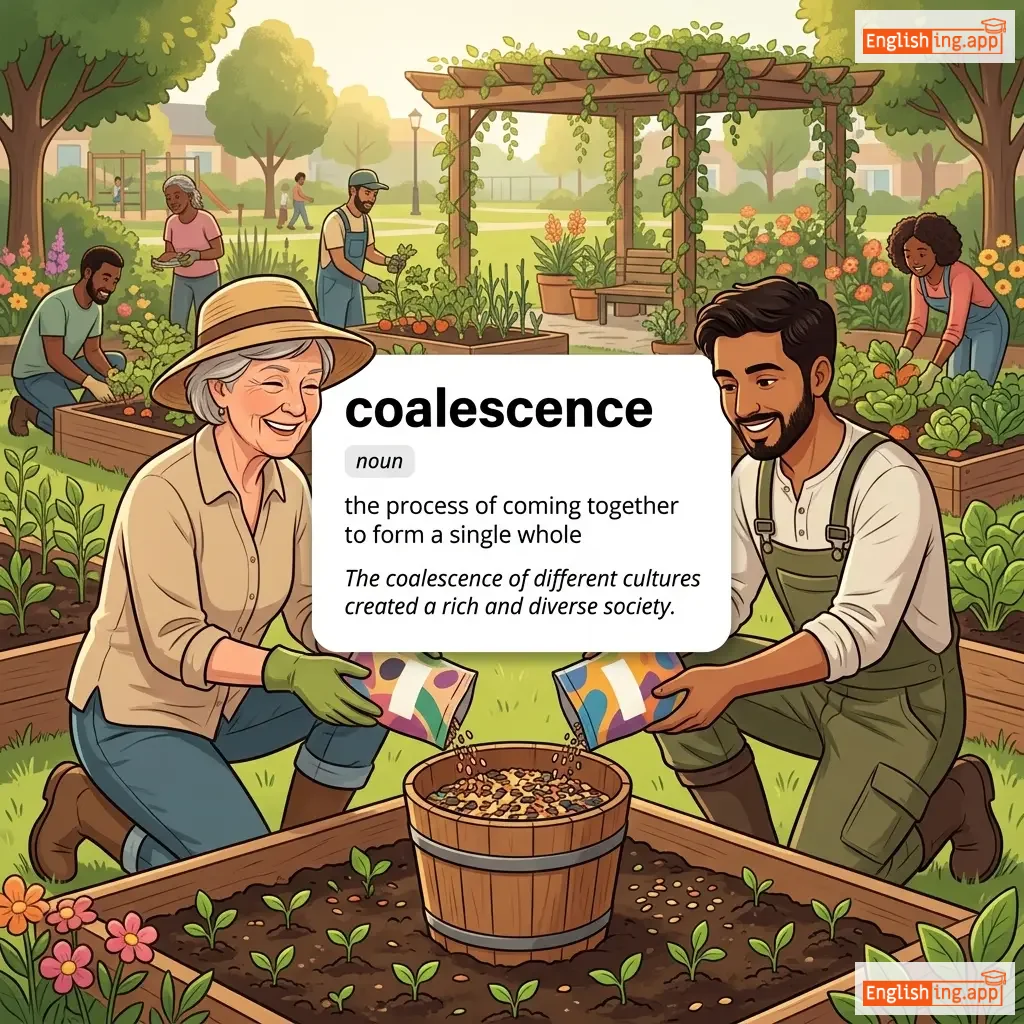
coalescence definition card — visual illustration of the meaning
noun
/ˌkoʊəˈlɛsəns/
fusion (fusion)

the process of coming together to form a single whole

"The coalescence of different cultures created a rich and diverse society."

"La fusion de différentes cultures a créé une société riche et diversifiée." (La fusion de differentes cultures a cree une societe riche et diversifiee.)
noun
/ˌkoʊəˈlɪʃən/
coalition (coalition)

a temporary alliance of distinct parties, persons, or states for joint action

"Several parties formed a coalition to pass the new law."

"Plusieurs partis ont formé une coalition pour faire adopter la nouvelle loi." (Plusieurs partis ont formé une coalition pour faire adopter la nouvelle loi.)
adjective
/kɔːrs/
rugueux, grossier (rugueux, grossier)

Rough in texture or manner; not smooth or refined.

"The fabric felt coarse to the touch."

"Le tissu était rugueux au toucher." (Le tissu était rugueux au toucher.)
noun, verb
/koʊst/
côte (cote)

noun: the land along the edge of the sea; verb: to move easily without effort or power

"They walked along the coast enjoying the sea breeze."

"Ils marchaient le long de la côte en profitant de la brise marine." (Ils marchaient le long de la cote en profitant de la brise marine.)
adjective
/ˈkəʊstəl/
côtier (kotier)

relating to or near a coast or shoreline

"They built a resort in a coastal area."

"Ils ont construit un complexe dans une zone côtière." (Ils ont construit un complexe dans une zone côtière.)
noun/verb
/koʊt/
bonheur (bonheur)

an outer garment worn outdoors, or a layer covering something

"She wore a red coat to keep warm in the winter."

"Elle ne pouvait pas cacher son bonheur lorsqu'elle a reçu le prix." (Elle ne pouvait pas cacher son bonheur lorsqu'elle a reçu le prix.)
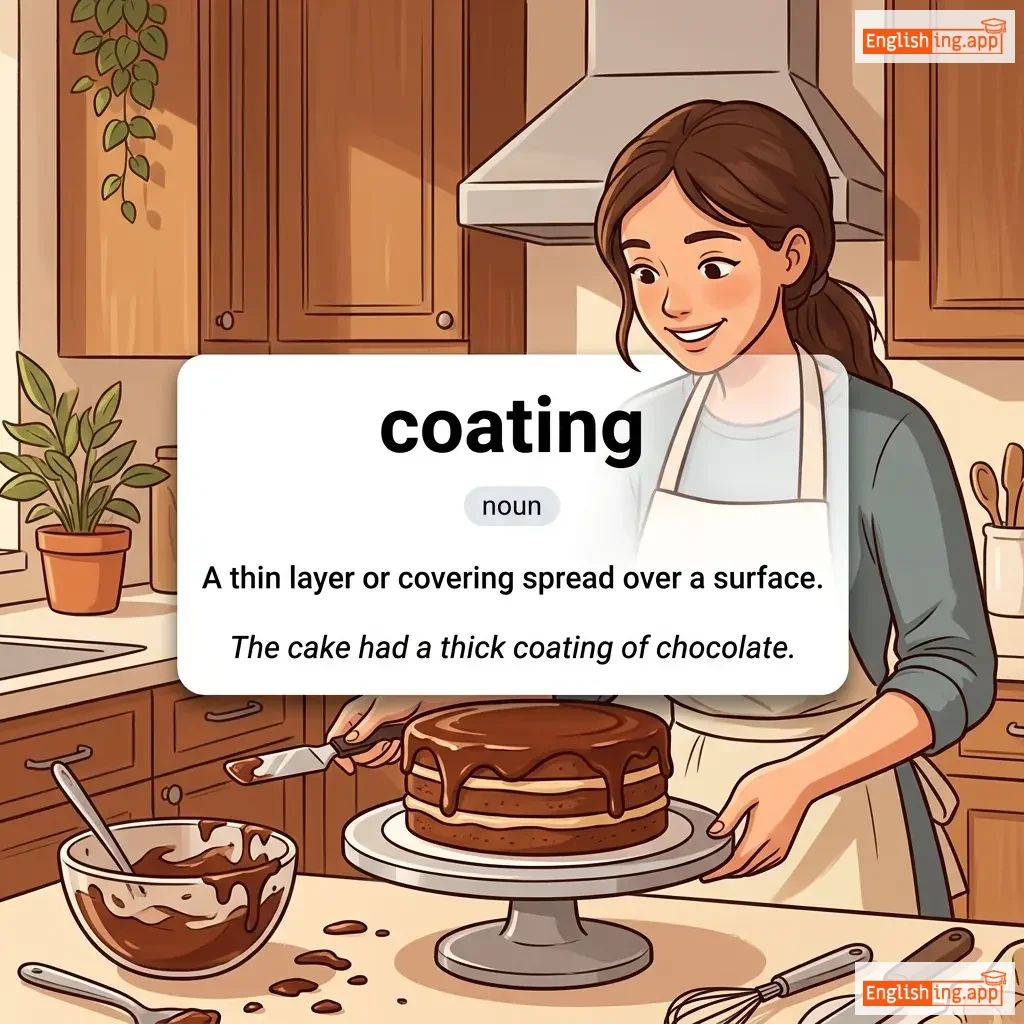
coating definition card — visual illustration of the meaning
noun
/ˈkoʊ.tɪŋ/
revêtement (revetement)

A thin layer or covering spread over a surface.

"The cake had a thick coating of chocolate."

"Le gâteau avait une épaisse couche de chocolat." (Le gâteau avait une épaisse couche de chocolat.)
verb
/koʊks/
persuader (persuader)

to persuade someone gently or gradually to do something

"She managed to coax the cat out of the tree with some food."

"Elle a réussi à convaincre le chat de descendre de l'arbre avec un peu de nourriture." (Elle a réussi à convaincre le chat de descendre de l'arbre avec un peu de nourriture.)
noun
/ˈkɒb.lər/
cordonnier (cordonnier)

a person who repairs shoes and other leather goods

"The cobbler fixed my broken shoes perfectly."

"Le cordonnier a réparé mes chaussures cassées parfaitement." (Le cordonnier a repare mes chaussures cassees parfaitement.)
noun
/ˈkoʊ.brə/
cobra (cobra)

a venomous snake with a hood that can be spread when threatened

"The cobra raised its hood and hissed at the intruder."

"Le cobra a levé sa capuche et a sifflé à l'intrus." (Le cobra a leve sa capuche et a siffle a l'intrus)
noun
/kəˈkeɪn/
cocaïne (drogue) (cocaine)

a powerful and addictive illegal drug made from coca leaves

"He was arrested for possessing cocaine."

"Il a été arrêté pour possession de cocaïne." (Il a ete arrete pour possession de cocaine.)
noun
/kɒk/
coq (coq)

an adult male chicken

"The cock crowed loudly at dawn to wake everyone up."

"Le coq a chanté fort au lever du soleil pour réveiller tout le monde." (Le coq a chante fort au lever du soleil pour reveiller tout le monde.)
noun
/kɒˈkeɪd/
rosette en ruban (rosette en ruban)

a rosette or knot of ribbon, usually worn on a hat as a badge of office or party

"The soldier wore a red cockade on his cap."

"Le soldat portait une rosette en ruban rouge sur son chapeau." (Le soldat portait une rosette en ruban rouge sur son chapeau.)
noun
/ˌkɒk.əˈtuː/
cacato (kakato)

a large parrot with a prominent crest that can be raised or lowered

"The white cockatoo raised its beautiful crest."

"Le cacato blanc a levé sa belle crête." (Le kakato blanc a leve sa belle crete.)
noun
/ˈkɒk.roʊtʃ/
cafard (cafard)

a flat brown insect that is commonly found in kitchens and other warm places

"A cockroach ran across the kitchen floor quickly."

"Un cafard a couru rapidement sur le sol de la cuisine." (Un cafard a couru rapidement sur le sol de la cuisine.)
noun
/ˈkɒkskoʊm/
fleur de crête de coq (fleur de crete de coq)

a tropical plant with bright, velvety flowers that resemble a rooster's comb

"The bright red cockscomb flowers added vibrant color to the garden bed."

"Les fleurs rouges de crête de coq ont ajouté une couleur vibrante au parterre de jardin." (Les fleurs rouges de crête de coq ont ajouté une couleur vibrante au parterre de jardin)
noun
/ˈkɒkˌteɪl/
cocktail (cocktail)

a mixed drink typically containing alcohol and other ingredients.

"She ordered a cocktail at the bar."

"Elle a commandé un cocktail au bar." (Elle a commande un cocktail au bar.)
noun
/ˈkoʊkənʌt/
noix de coco (nwa duh koh koh)

a large brown seed with hard shell containing white flesh and coconut water

"We drank coconut water directly from the coconut."

"Nous avons bu de l'eau de coco directement à partir du coco." (Nous avons bu de l eau de coco directement a partir du coco)
noun
/kɒd fɪʃ/
morue (morue)

A large marine fish with white flesh, commonly used for food

"The fisherman caught a large cod fish in the North Atlantic."

"Le pêcheur a attrapé une grande morue dans l'Atlantique Nord." (le pesher a attrape un grand morue dan latlantik nord)
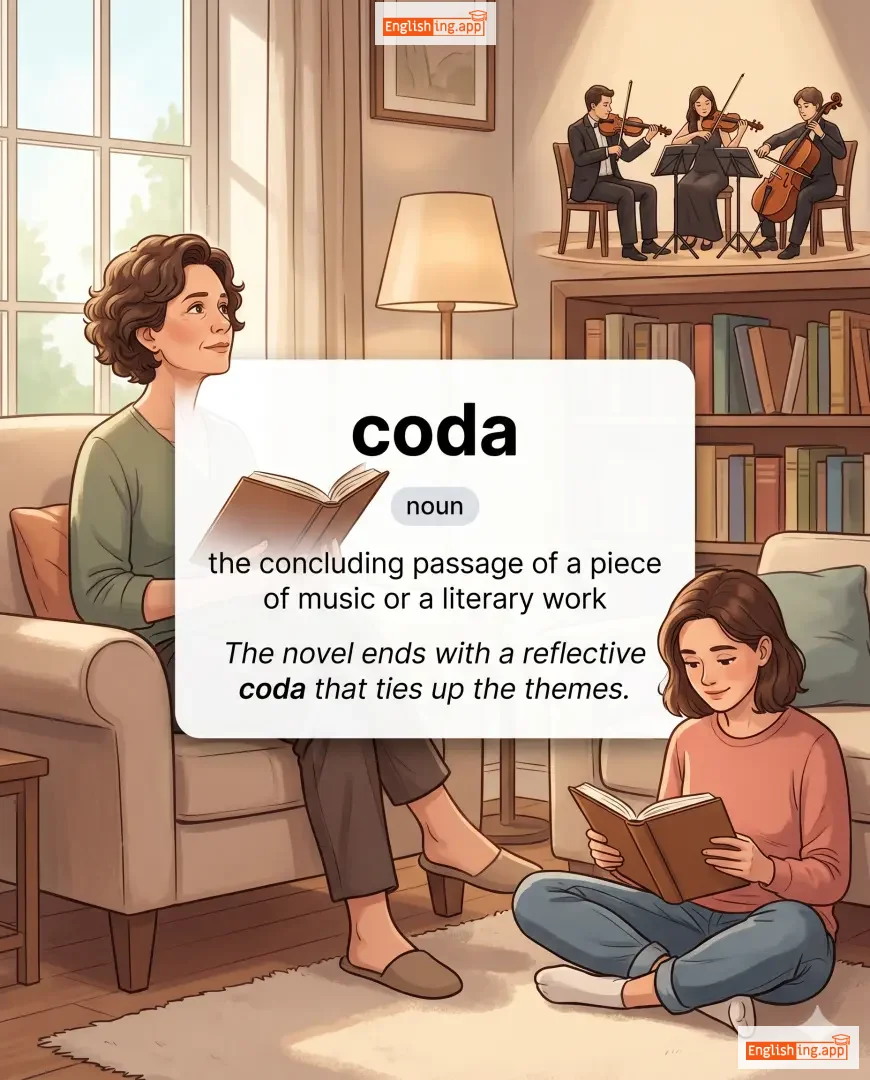
coda definition card — visual illustration of the meaning
noun
/ˈkoʊdə/
coda (coda)

the concluding passage of a piece of music or a literary work

"The novel ends with a reflective coda that ties up the themes."

"Le roman se termine par une coda réfléchie qui relie les thèmes." (Le roman se termine par une coda réfléchie qui relie les thèmes.)
verb
/ˈkɒd.l̩/
choyer de manière excessive (choyer de maniere excessive)

to treat someone with excessive care or kindness, often in a way that is overprotective

"Parents should support their children without coddling them."

"Les parents devraient soutenir leurs enfants sans les dorloter." (Les parents devraient soutenir leurs enfants sans les dorloter.)
noun/verb
/koʊd/
code (code)

a system of words, letters, or symbols used to represent information or instructions

"He wrote a code to solve the problem on the computer."

"Il a écrit un code pour résoudre le problème sur l'ordinateur." (Il a écrit un code pour résoudre le problème sur l'ordinateur.)
noun
/ˈkɒd.ɪ.sɪl/
codicille (codicille)

a legal document that makes changes or additions to an existing will

"He added a codicil to his will to include his granddaughter."

"Il a ajouté un codicille à son testament pour inclure sa petite-fille." (Il a ajouté un codicille à son testament pour inclure sa petite-fille.)
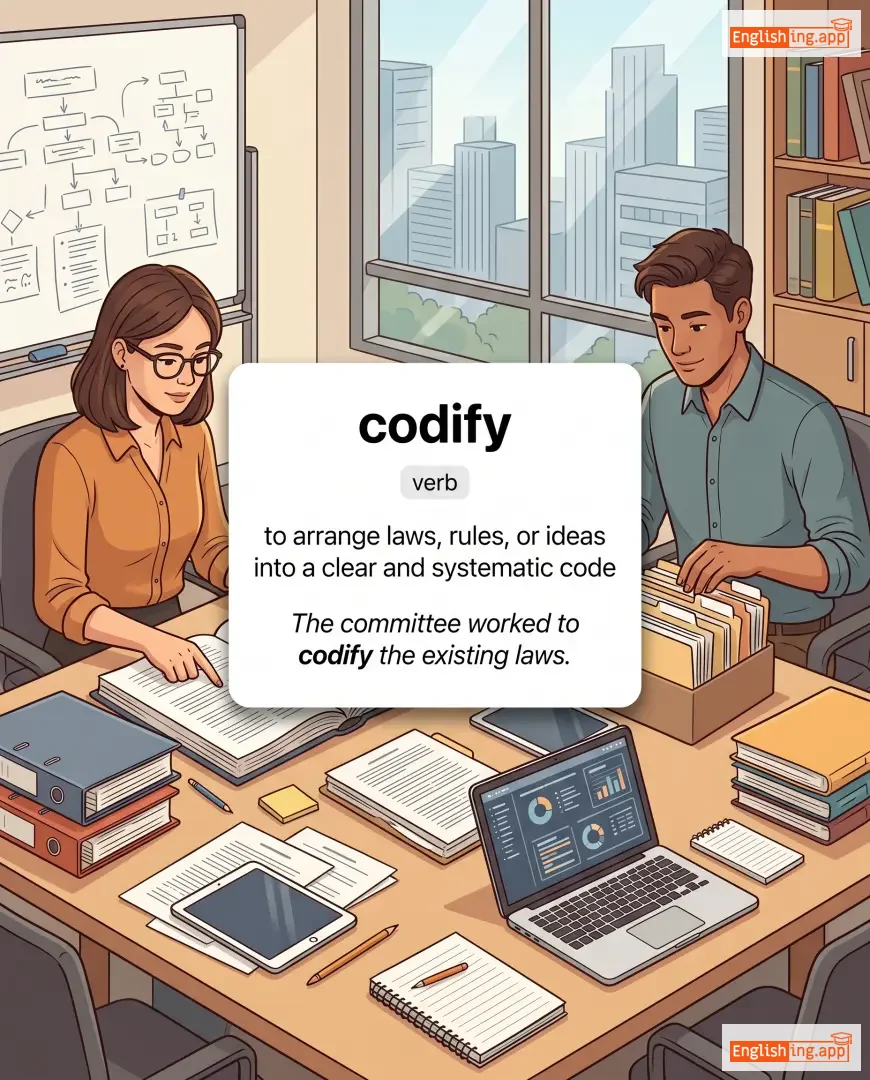
codify definition card — visual illustration of the meaning
verb
/ˈkəʊ.dɪ.faɪ/
codifier (codifier)

to arrange laws, rules, or ideas into a clear and systematic code

"The committee worked to codify the existing laws."

"Le comité a travaillé pour codifier les lois existantes." (Le comité a travaillé pour codifier les lois existantes.)