Vocabulaires

Découvrez, apprenez et maîtrisez le vocabulaire anglais

noun
/ˈbɒdi/
corps (kor)

the physical structure of a person or animal

"Exercise helps keep the body healthy."

"L'exercice aide à garder le corps en bonne santé." (L'exercice aide à garder le corps en bonne santé.)
noun
/ˈbɒdiɡɑːrd/
garde du corps (garde du corps)

a person employed to protect someone from harm

"The celebrity arrived with her bodyguard."

"La célébrité est arrivée avec son garde du corps." (La célébrité est arrivée avec son garde du corps.)
noun
/bɒɡ/
marais (marais)

an area of wet, spongy ground; a swamp or marsh

"The hikers got stuck in a bog."

"Les randonneurs se sont retrouvés coincés dans un marais." (Les randonneurs se sont retrouves coincés dans un marais.)
verb
/ˈbɒɡəl/
sidérer (siderer)

to overwhelm or confuse; to be astonished or puzzled by something

"The complexity of the puzzle boggled his mind."

"La complexité du puzzle a sidéré son esprit." (La complexité du puzzle a sidéré son esprit.)
adjective
/ˈboʊɡəs/
faux (faux)

false, fake, or not genuine

"The police arrested him for using a bogus ID card."

"La police l'a arrêté pour avoir utilisé une fausse carte d'identité." (La police l'a arrêté pour avoir utilisé une fausse carte d'identité.)
adjective
/boʊˈhiːmiən/
bohémien (bohemien)

unconventional, artistic, and free-spirited in lifestyle or appearance

"She decorated her apartment in a bohemian style with colorful fabrics."

"Elle a décoré son appartement dans un style bohémien avec des tissus colorés." (Elle a decoré son appartement dans un style bohémien avec des tissus colorés.)
verb
/bɔɪl/
bouillir (bouillir)

to heat a liquid until it starts to bubble and turn into vapor.

"Please boil some water for tea."

"S'il vous plaît, faites bouillir de l'eau pour le thé." (S'il vous plaît, faites bouillir de l'eau pour le thé.)
adjective
/bɔɪld/
bouilli (bouilli)

cooked in boiling water

"She served boiled eggs for breakfast."

"Elle a servi des œufs bouillis pour le petit déjeuner." (Elle a servi des œufs bouillis pour le petit déjeuner.)
adjective
/ˈbɔɪstərəs/
bruyant (bruyant)

noisy, energetic, and cheerful; rowdy

"The children were boisterous during the birthday party."

"Les enfants étaient bruyants pendant la fête d'anniversaire." (Les enfants étaient bruyants pendant la fête d'anniversaire.)
adjective
/boʊld/
audacieux (audacieux)

showing courage, confidence, or willingness to take risks

"She made a bold decision to start her own business."

"Elle a pris la décision audacieuse de lancer son propre entreprise." (Elle a pris la decision audacieuse de lancer son propre entreprise.)
adverb
/ˈbəʊld.li/
audacieusement; sans peur (audacieusement; sans peur)

in a confident and brave way; without fear

"She boldly stepped forward to face the challenge."

"Elle s'avança courageusement pour relever le défi." (Elle s'avança courageusement pour relever le défi.)
noun
/ˈboʊld.nəs/
audace; courage (audace, courage)

willingness to take risks; confidence and courage in behavior

"Her boldness in confronting the problem impressed everyone."

"Son audace à affronter le problème a impressionné tout le monde." (Son audace a affronter le probleme a impressionne tout le monde.)
noun
/boʊl/
tronc d'arbre (tronc d'arbre)

the trunk of a tree

"The bole of the tree was thick and strong."

"Le tronc de l'arbre était épais et solide." (Le tronc de l'arbre etait epais et solide.)
noun
/bəˈlɛəroʊ/
boléro (une danse espagnole ou une veste courte ouverte à l'avant) (bolero)

A Spanish dance in slow triple time, or a short jacket open at the front.

"The dancers performed a passionate bolero at the festival."

"Les danseurs ont exécuté un boléro passionné lors du festival." (Les danseurs ont exécuté un boléro passionné lors du festival.)
noun
/boʊl/
capsule arrondie de graines (comme celles de coton ou de lin) (bol)

The rounded seed capsule of plants such as cotton or flax.

"The farmer examined the cotton boll to check its quality."

"L'agriculteur a examiné le bol de coton pour vérifier sa qualité." (L'agriculteur a examine le bol de coton pour verifier sa qualite.)
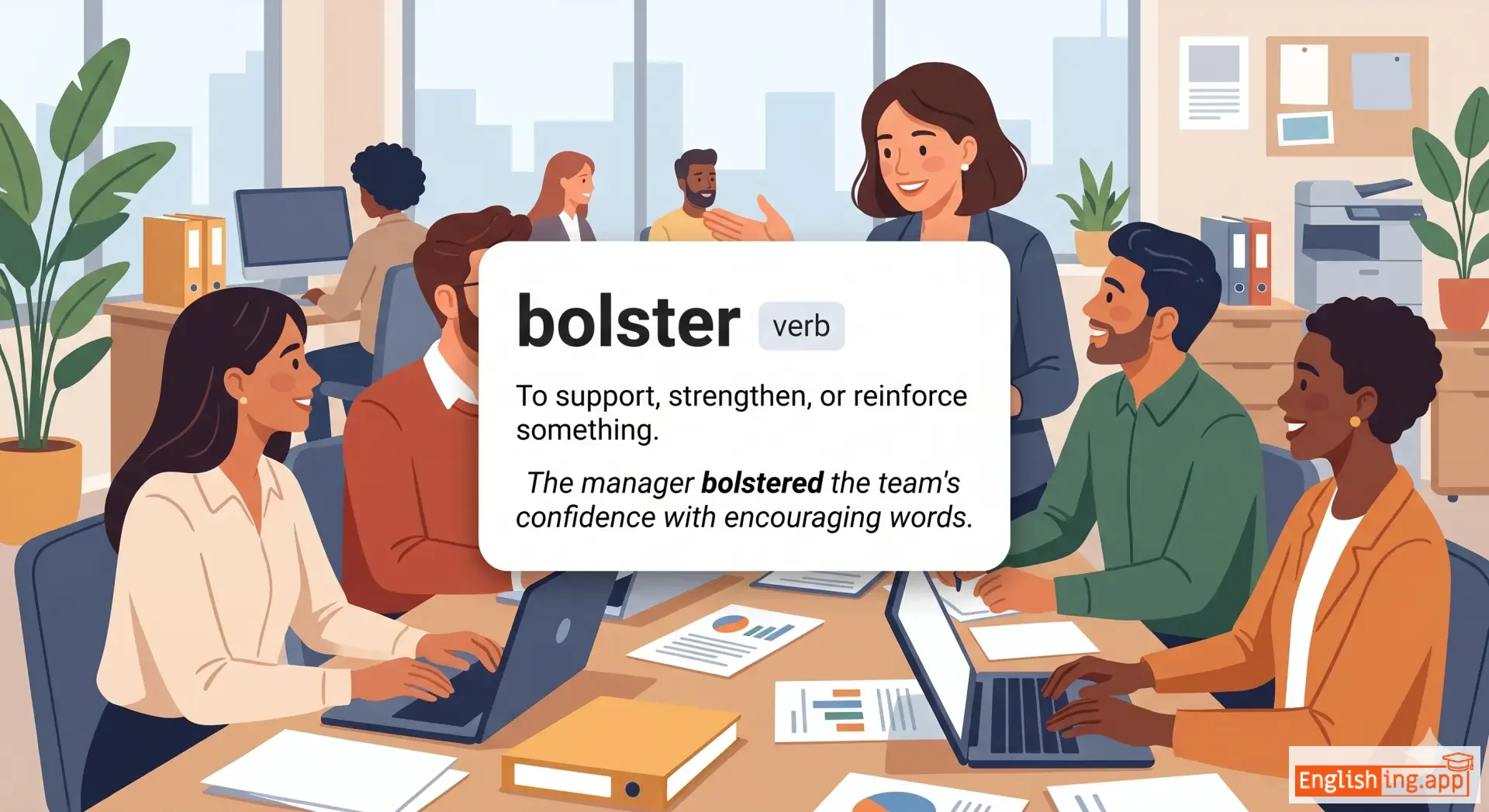
bolster definition card — visual illustration of the meaning
verb
/ˈboʊlstər/
renforcer, soutenir (bolster)

To support, strengthen, or reinforce something.

"The manager bolstered the team's confidence with encouraging words."

"Le gestionnaire a renforcé la confiance de l'équipe avec des mots encourageants." (Le gestionnaire a renforcé la confiance de l'équipe avec des mots encourageants.)
verb
/boʊlt/
courir soudainement; fixer quelque chose avec un boulon (bolt)

To move suddenly and quickly; also to fasten something with a bolt.

"The horse bolted from the stable after hearing a loud noise."

"Le cheval s'est précipité hors de l'écurie après avoir entendu un bruit fort." (Le cheval s'est precipité hors de l'ecurie apres avoir entendu un bruit fort.)
noun/verb
/bɑːm/
bombe (bombe)

A weapon that explodes; also to attack with bombs or to fail badly.

"The city was bombed heavily during the war."

"La ville a été bombardée fortement pendant la guerre." (La ville a été bombardée fortement pendant la guerre.)
verb
/bɒmˈbɑːrd/
bombarder (bombarder)

to attack continuously with bombs, questions, or other forces

"Reporters bombarded the minister with difficult questions."

"Les journalistes ont bombardé le ministre avec des questions difficiles." (Les journalistes ont bombardé le ministre avec des questions difficiles.)
noun
/ˌbɒmbərˈdɪər/
bombardier (bombardier)

a member of a bomber crew responsible for releasing bombs

"The bombardier released the bombs with precision."

"Le bombardier a largué les bombes avec précision." (Le bombardier a largue les bombes avec precision.)
noun
/bɒmˈbɑːrdmənt/
bombardement (bombardement)

a continuous attack with bombs or other projectiles

"The city endured a heavy bombardment during the war."

"La ville a enduré un bombardement intense pendant la guerre." (La ville a enduré un bombardement intense pendant la guerre.)
noun
/ˈbɒmbæst/
langage pompeux (langage pompeux)

speech or writing that is overly pompous and inflated

"His campaign speech was full of bombast but lacked real substance."

"Son discours de campagne était rempli de bombast mais manquait de véritable substance." (Son discours de campagne était rempli de bombast mais manquait de véritable substance.)
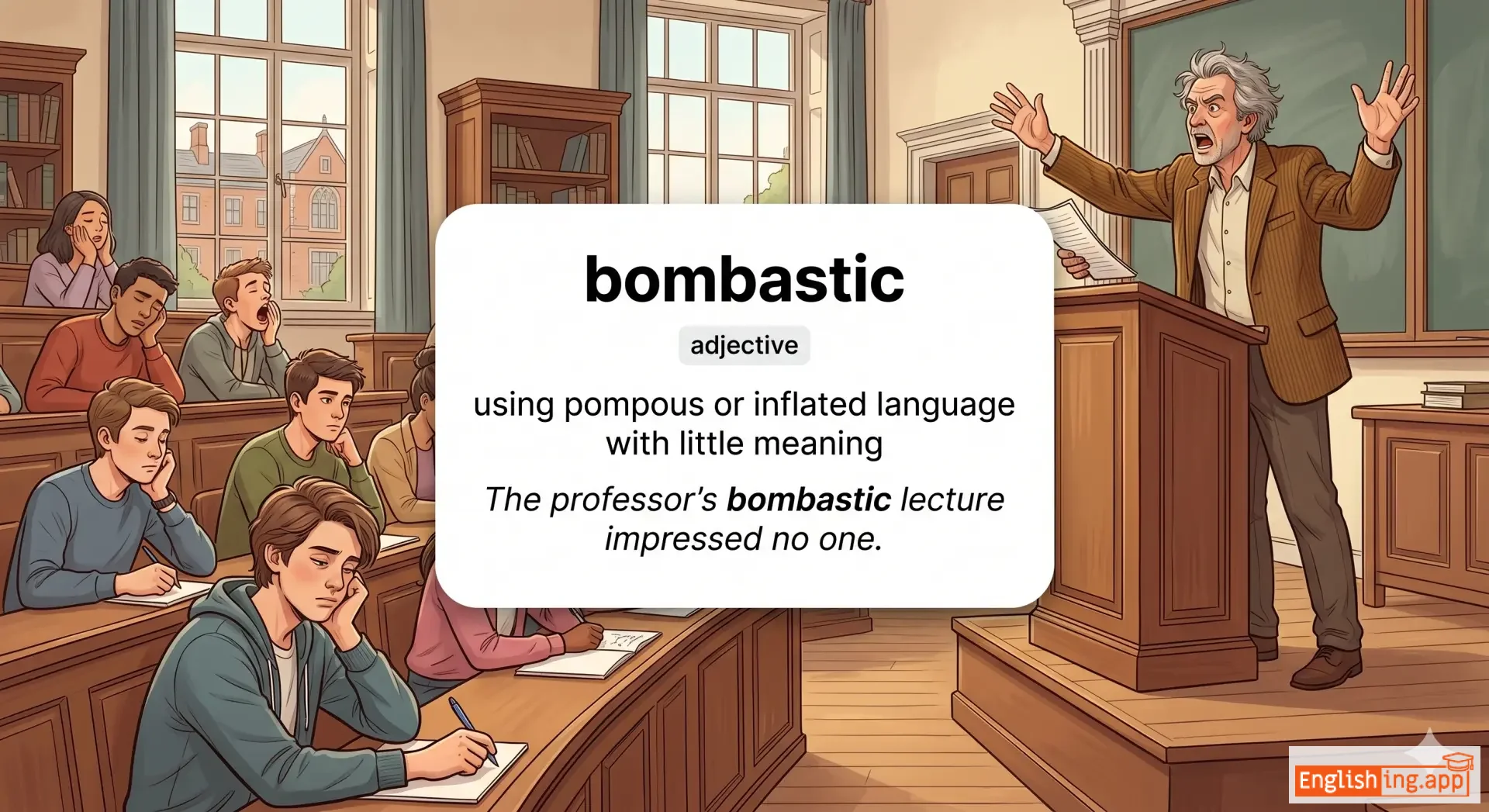
bombastic definition card — visual illustration of the meaning
adjective
/bɒmˈbæstɪk/
pompeux (pompeux)

using pompous or inflated language with little meaning

"The professor’s bombastic lecture impressed no one."

"Le discours pompeux du professeur n'a impressionné personne." (Le discours pompeux du professeur n'a impressionné personne.)
noun
/bɒmˈbeɪ dʌk/
poisson Bombay (poisson bombay)

a type of lizardfish found in coastal waters, commonly eaten dried and salted in South Asia

"Bombay duck is a popular delicacy when dried and fried."

"Le poisson Bombay est un mets populaire lorsqu'il est séché et frit." (le poisson bombay e un me populaire lorsquil e seche e fri)
noun
/ˈbɒmər/
bombardier (bombardier)

military aircraft designed to drop bombs on targets

"The bomber squadron flew over the city at dawn."

"L’escadron de bombardiers a survolé la ville à l’aube." (lescadron de bombardiers a survole la ville a laube.)
noun
/ˈbɒmɪŋ/
bombardement (bombardement)

an attack using bombs or explosives

"The city was devastated by the bombing."

"La ville a été dévastée par le bombardement." (La ville a été dévastée par le bombardement.)
adjective
/ˌboʊnəˈfaɪdi/
authentique; légitime; véritable (authentique; legitime; veritable)

genuine; authentic; legitimate

"She is a bonafide expert in her field."

"Elle est une véritable experte dans son domaine." (Elle est une veritable experte dans son domaine.)
noun
/bəˈnæn.zə/
une situation ou un événement qui entraîne une augmentation soudaine de la richesse, de la chance ou des bénéfices (une situation ou un evenement qui entraine une augmentation soudaine de la richesse, de la chance ou des benefices)

a situation or event that creates a sudden increase in wealth, good fortune, or profits

"The oil discovery was a bonanza for the small country."

"La découverte de pétrole a été une bonanza pour le petit pays." (La decouverte de petrole a ete une bonanza pour le petit pays.)
noun
/bɒnd/
lien (lien)

a connection or relationship between people or things

"The sisters share a close bond."

"Les sœurs partagent un lien étroit." (Les soeurs partagent un lien etroit.)
noun
/ˈbɑn.dɪdʒ/
esclavage; captivité (esclavage, captivité)

the state of being a slave; the state of being under the control of a force or influence

"The people fought to escape from the bondage of oppression."

"Les gens se sont battus pour échapper à l'esclavage de l'oppression." (Les gens se sont battus pour échapper à l'esclavage de l'oppression.)
noun
/boʊn/
os (os)

the hard parts of a skeleton that form the structure of the body

"The dog buried a bone in the garden."

"Le chien a enterré un os dans le jardin." (Le chien a enterré un os dans le jardin.)
noun
/ˈbɒnəmi/
bonhomie (bonhomie)

Cheerful friendliness and geniality.

"The meeting was filled with laughter and bonhomie."

"La réunion était pleine de rires et de bonhomie." (La reunion etait pleine de rires et de bonhomie.)
adjective
/ˈbɒni/
joli; charmant; joyeux (joli; charmant; joyeux)

cheerful; pretty; attractive

"The bonny child played happily in the garden."

"L'enfant joli a joué joyeusement dans le jardin." (L'enfant joli a joué joyeusement dans le jardin.)
noun
/ˈbəʊnəs/
prime (prime)

an extra payment or reward given in addition to what is usual or expected.

"Employees received a year-end bonus for their hard work."

"Les employés ont reçu une prime de fin d'année pour leur travail acharné." (Les employés ont reçu une prime de fin d'année pour leur travail acharné.)
verb/noun
/buː/
cri de désapprobation/son de mise en garde (cri de desapprobation/son de mise en garde)

To show disapproval by shouting 'boo'; or a sound made to surprise or scare.

"The audience began to boo the bad performance."

"Le public a commencé à huer la mauvaise performance." (le public a commence a huer la mauvaise performance.)
noun
/buːb/
idiot; sein (familier) (idiot; sein)

a foolish or clumsy person; an informal and sometimes rude term for a woman's breast

"He felt like a complete boob after forgetting the meeting."

"Il s'est senti comme un idiot complet après avoir oublié la réunion." (il sest senti comme un idiot complet apres avoir oublie la reunion)
noun
/ˈbuːbi/
idiot (idiot)

a foolish or gullible person; a silly individual

"He felt like a booby after making such a simple mistake."

"Il s'est senti idiot après avoir fait une erreur si simple." (Il sest senti idiot apres avoir fait une erreur si simple)
noun, verb
/bʊk/
livre / réserver (livre / réserver)

A set of written, printed, or blank pages fastened together; to arrange for someone to have a seat, room, or ticket in advance.

"I booked a table at the restaurant for dinner."

"J'ai réservé une table au restaurant pour le dîner." (J'ai réservé une table au restaurant pour le dîner.)
noun
/bʊk ˈbaɪn.dər/
reliure (reliure)

a person whose job is to fasten the pages of books together and put covers on them

"The old book binder carefully restored the antique manuscript."

"Le vieux relieur a soigneusement restauré le manuscrit ancien." (Le vieux relieur a soigneusement restore le manuscrit ancien.)
noun
/bʊk ˈsel.ər/
libraire (libraire)

a person who sells books, especially as a business

"The book seller recommended a great novel for my summer reading."

"Le libraire a recommandé un excellent roman pour ma lecture d'été." (Le libraire a recommandé un excellent roman pour ma lecture d'été.)
noun
/ˈbʊkɪŋ/
réservation (reservation)

the act of reserving accommodations, tickets, etc.

"I made a booking for a hotel room in advance."

"J'ai fait une réservation pour une chambre d'hôtel à l'avance." (J'ai fait une réservation pour une chambre d'hôtel à l'avance.)
adjective
/ˈbʊkɪʃ/
amoureux des livres (amoureux des livres)

Spending much time reading or studying; scholarly but lacking practical experience.

"He was too bookish to enjoy outdoor activities."

"Il était trop amoureux des livres pour apprécier les activités en plein air." (Il était trop amoureux des livres pour apprécier les activités en plein air.)
noun
/ˈbʊkʃɒp/
librairie (librairie)

a retail store where books are sold

"She spent an hour browsing in the small bookshop."

"Elle a passé une heure à parcourir la petite librairie." (elle a passe une heure a parcourir la petite librairie)
noun
/ˈbʊkstɔːr/
librairie (librairie)

a shop where books are sold

"She spent an entire afternoon browsing in the bookstore."

"Elle a passé tout l’après-midi à la librairie." (elle a passe tout lapres midi a la librairie)
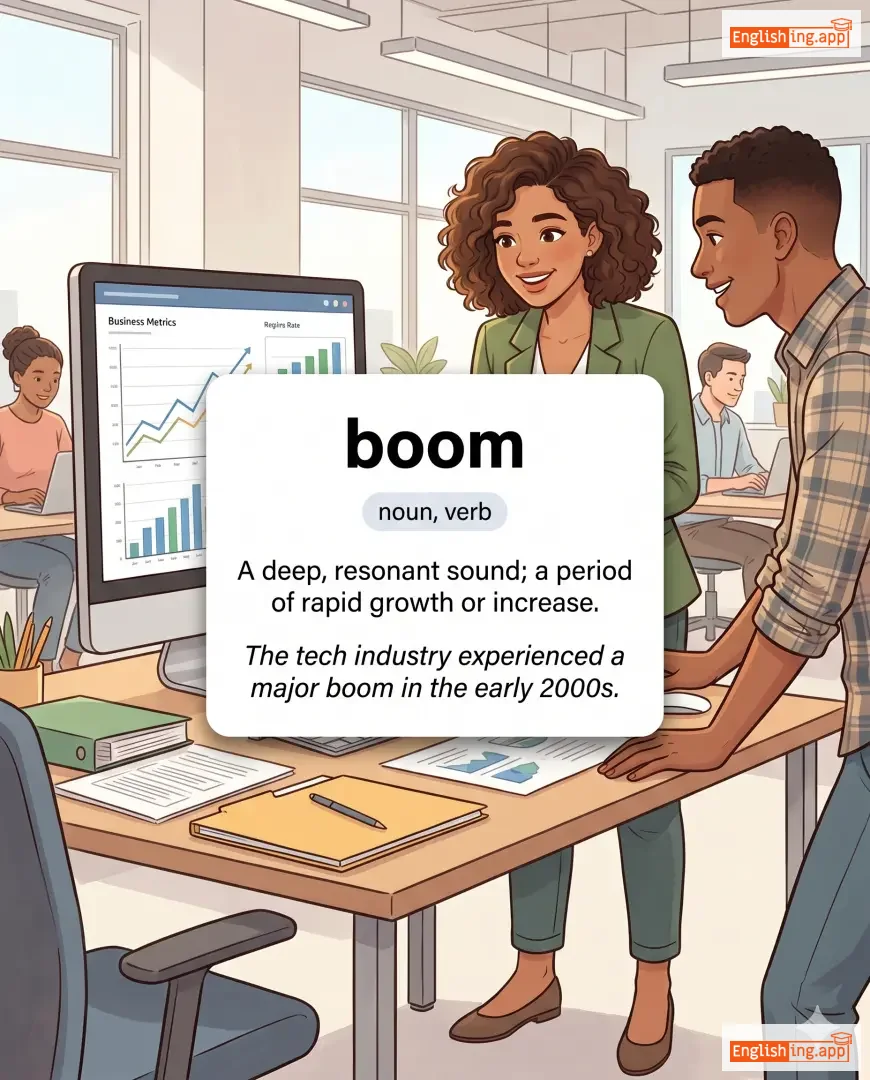
boom definition card — visual illustration of the meaning
noun, verb
/buːm/
essor, croissance rapide (essor, croissance rapide)

A deep, resonant sound; a period of rapid growth or increase.

"The tech industry experienced a major boom in the early 2000s."

"L'industrie technologique a connu un grand boom au début des années 2000." (L'industrie technologique a connu un grand boom au debut des annees 2000.)
noun
/buːn/
bénédiction (benediction)

A thing that is helpful or beneficial.

"The internet is a boon to modern education."

"Internet est une bénédiction pour l'éducation moderne." (internet est une benediction pour l'education moderne.)
noun
/bʊər/
rustre (rustre)

A rude, insensitive, or ill-mannered person.

"He was such a boor at the dinner table."

"Il était un rustre à la table du dîner." (Il était un rustre à la table du dîner.)
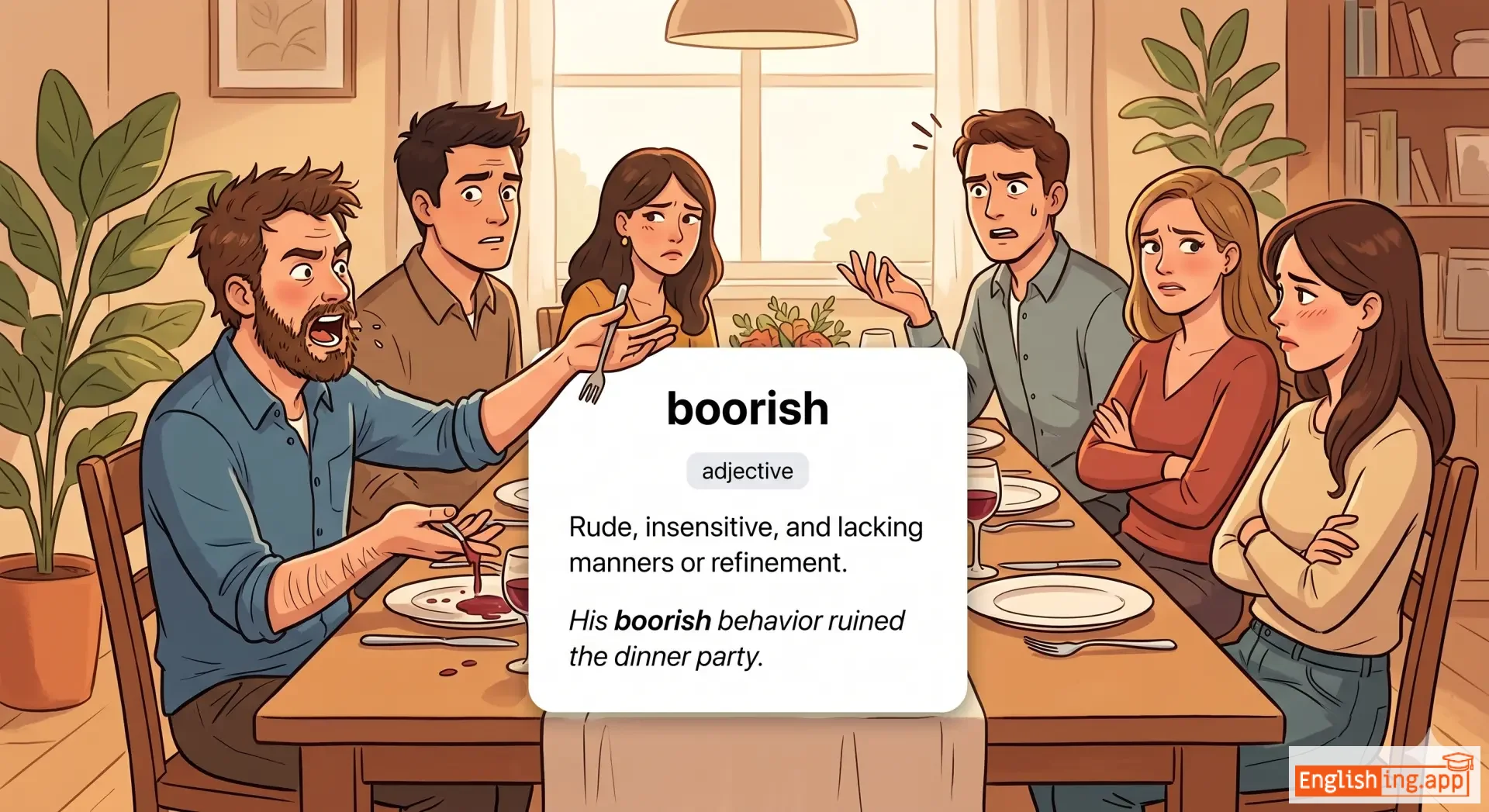
boorish definition card — visual illustration of the meaning
adjective
/ˈbʊərɪʃ/
rude (rude)

Rude, insensitive, and lacking manners or refinement.

"His boorish behavior ruined the dinner party."

"Son comportement rude a ruiné la fête du dîner." (Son comportement rude a ruiné la fête du dîner.)
verb
/buːst/
augmenter (augmenter)

To increase, improve, or raise something.

"The company launched a campaign to boost sales."

"L'entreprise a lancé une campagne pour augmenter les ventes." (L'entreprise a lancé une campagne pour augmenter les ventes.)
noun, verb
/buːt/
botte (botte)

A type of shoe that covers the ankle or higher; to start up a computer system.

"He put on his boots before going hiking."

"Il a mis ses bottes avant de partir en randonnée." (Il a mis ses bottes avant de partir en randonnée.)