Vocabulaires

Découvrez, apprenez et maîtrisez le vocabulaire anglais

adjective
/əˈkjuː.zəˌtɔːr.i/
accusateur (accusateur)

Suggesting blame or indicating someone has done wrong.

"He gave her an accusatory glance."

"Il lui lança un regard accusateur." (Il lui lança un regard accusateur.)
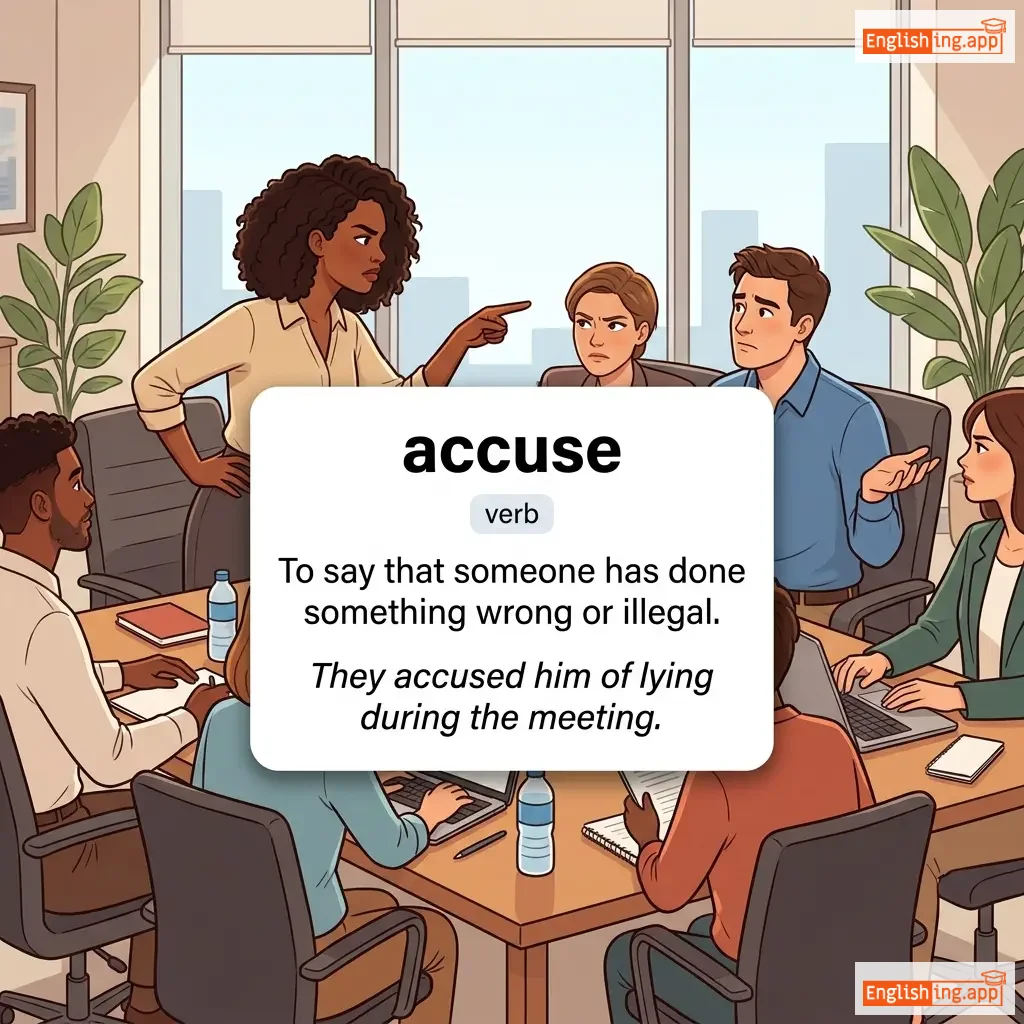
accuse definition card — visual illustration of the meaning
verb
/əˈkjuːz/
accuser (akuze)

To say that someone has done something wrong or illegal.

"They accused him of lying during the meeting."

"Ils l'ont accusé de mentir lors de la réunion." (Ils l'ont accusé de mentir lors de la réunion.)
noun
/əˈkjuːzd/
accusé (accuse)

a person who has been charged with a crime

"The accused pleaded not guilty in court."

"L'accusé a plaidé non coupable devant le tribunal." (L'accusé a plaidé non coupable devant le tribunal.)
verb
/əˈkʌstəm/
accoutumer (accoutumer)

to make someone familiar with something through regular experience or use

"It took him a while to accustom himself to the new environment."

"Il lui a fallu un moment pour s'adapter au nouvel environnement." (Il lui a fallu un moment pour s'adapter au nouvel environnement.)
adjective
/eɪˈsɛfələs/
sans tête (sans tete)

having no leader or head; headless

"The acephalous group soon fell into disorganization."

"Le groupe sans tête tomba bientôt dans la désorganisation." (Le groupe sans tete tomba bientot dans la desorganisation.)
adjective
/əˈsɜːrbɪk/
acerbe (acerbe)

sharp, harsh, or bitter in tone or taste

"His acerbic comments offended many people in the meeting."

"Ses commentaires acerbes ont offensé de nombreuses personnes lors de la réunion." (Ses commentaires acerbes ont offensé de nombreuses personnes lors de la réunion.)
noun
/əˈsɜːrbəti/
acerbité (acerbite)

bitterness or sharpness of tone, manner, or taste

"The acerbity of his remarks left everyone silent."

"L'acerbité de ses remarques a laissé tout le monde en silence." (L'acerbité de ses remarques a laissé tout le monde en silence.)
noun
/ˈæsɪˌteɪt/
acétate (acetate)

a salt or ester of acetic acid; a synthetic material used in textiles and film

"The company produces acetate fibers for clothing."

"L'entreprise produit des fibres d'acétate pour les vêtements." (L'entreprise produit des fibres d'acétate pour les vêtements.)
adjective
/əˈsiːtɪk/
acétique (acetique)

relating to or containing acetic acid; sour or vinegary in taste or smell

"The acetic smell of vinegar filled the kitchen."

"L'odeur acétique du vinaigre a rempli la cuisine." (L'odeur acetique du vinaigre a rempli la cuisine.)
verb
/eɪk/
douleur (douleur)

to suffer a continuous dull pain

"Her back ached after sitting for so long."

"Elle avait mal au dos après être restée assise si longtemps." (Elle avait mal au dos après être restée assise si longtemps.)
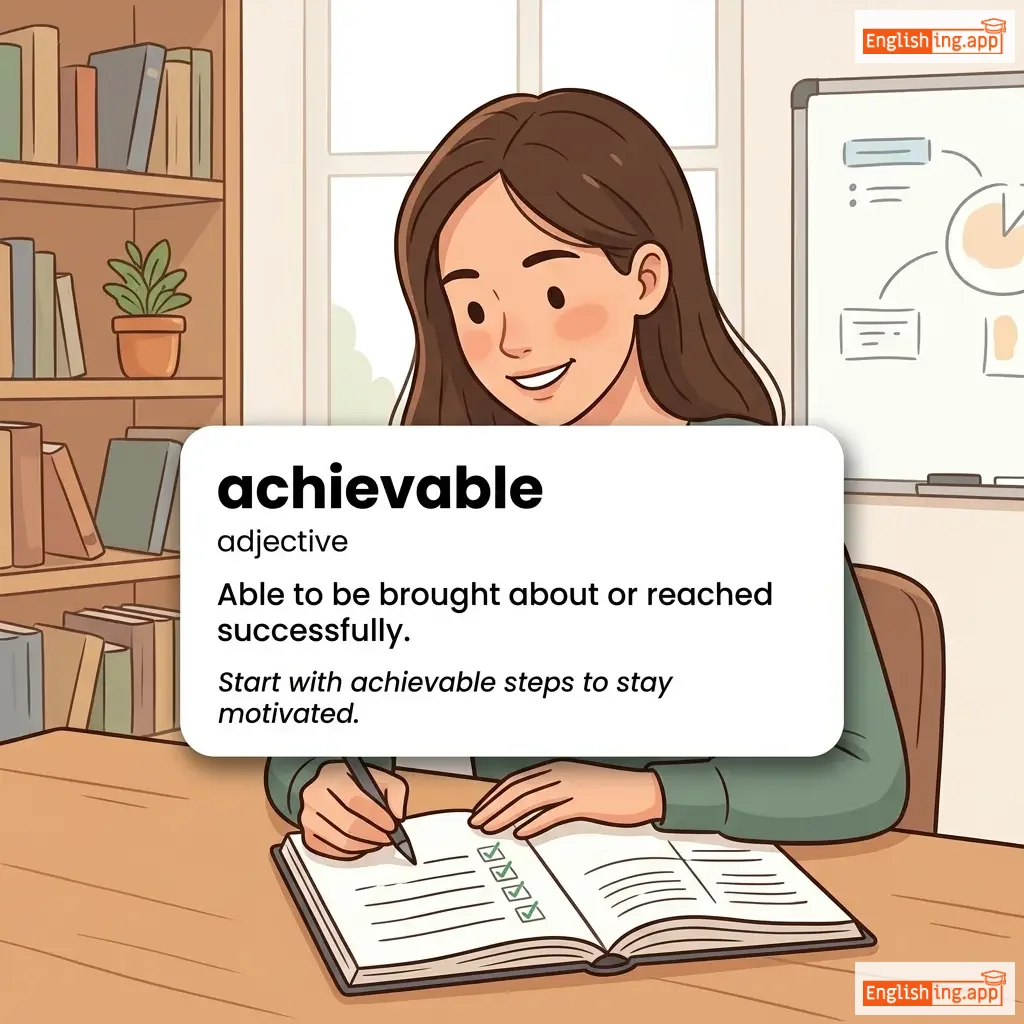
achievable definition card — visual illustration of the meaning
adjective
/əˈtʃiːvəbl/
réalisable (realisable)

Able to be brought about or reached successfully.

"Start with achievable steps to stay motivated."

"Commencez par des étapes réalisables pour rester motivé." (Commencez par des étapes réalisables pour rester motivé.)
verb
/əˈtʃiːv/
réaliser (realiser)

to successfully bring about or reach a desired goal or result

"She worked hard to achieve her dream of becoming a doctor."

"Elle a travaillé dur pour réaliser son rêve de devenir médecin." (Elle a travaille dur pour realiser son reve de devenir medecin.)
noun
/əˈtʃiːvmənt/
réalisation (realisation)

Something that has been successfully completed or accomplished through effort or skill.

"Graduating from university was her greatest achievement."

"Obtenir son diplôme universitaire a été sa plus grande réalisation." (Obtenir son diplôme universitaire a été sa plus grande réalisation.)
adjective
/əˈkɪliən/
achillien (achilian)

like or characteristic of Achilles; strong but vulnerable

"His achillean pride made him blind to danger."

"Sa fierté achillienne le rendait aveugle au danger." (Sa fierté achillienne le rendait aveugle au danger.)
adjective
/ˌækrəˈmætɪk/
achromatique (achromatique)

without color; free from color

"The designer chose an achromatic palette of black, white, and gray."

"Le designer a choisi une palette achromatique de noir, blanc et gris." (Le designer a choisi une palette achromatique de noir, blanc et gris.)
noun
/ˈæsɪd/
acide (asid)

a chemical substance that reacts with bases and has a sour taste

"Lemons contain citric acid."

"Les citrons contiennent de l'acide citrique." (Les citrons contiennent de l'acide citrique.)
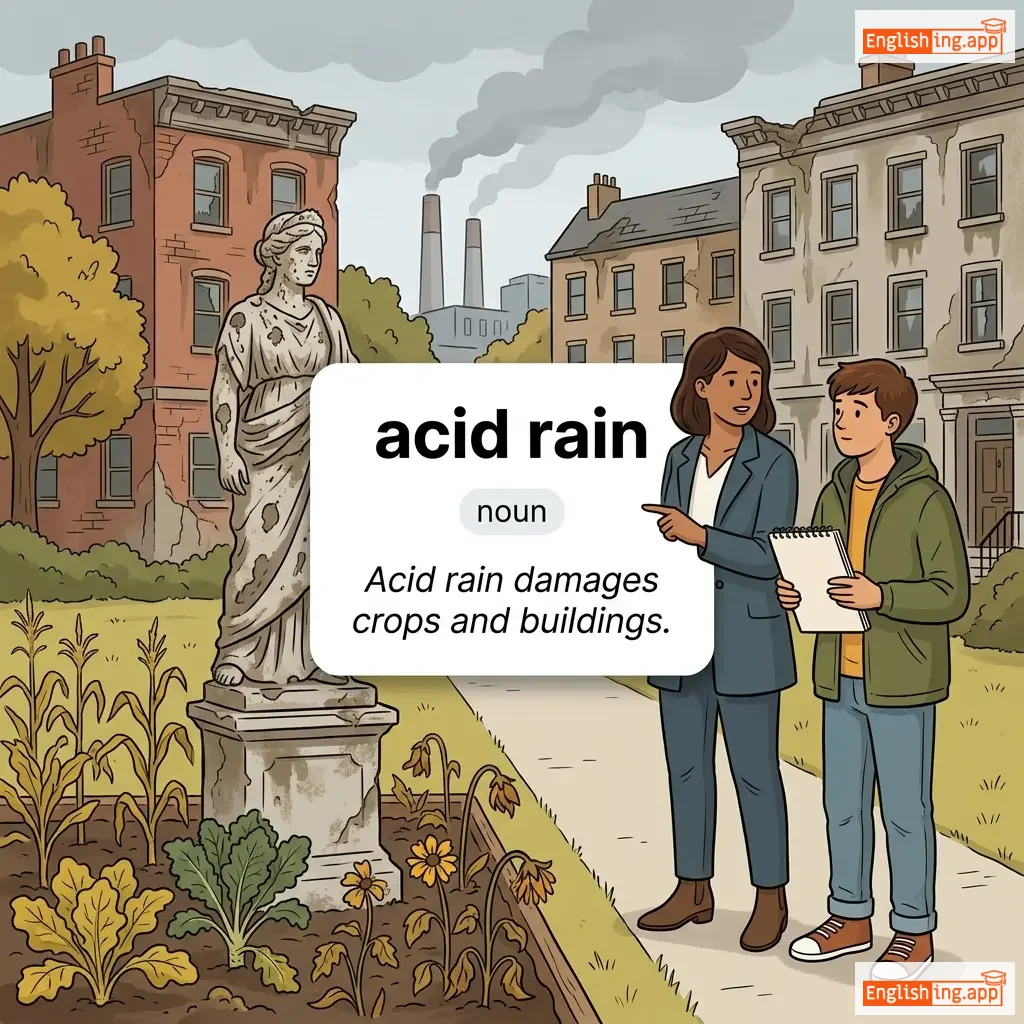
acid rain definition card — visual illustration of the meaning
noun
ˈæsɪd reɪn
pluie acide (pluie acide)

Rainfall made acidic by atmospheric pollution, especially from industrial emissions.

"Acid rain damages crops and buildings."

"La pluie acide endommage les cultures et les bâtiments." (La pluie acide endommage les cultures et les batiments.)
adjective
/əˈsɪdɪk/
acide (acide)

containing acid; having a sour taste; sharp or biting in tone

"The lemon has an acidic taste that makes your mouth pucker."

"Le citron a un goût acide." (le citron a un gout acide)
verb
/əˈsɪdɪfaɪ/
acidifier (acidifier)

to make something acidic or more acidic

"Farmers worry that pollution will acidify the soil."

"Les agriculteurs craignent que la pollution acidifie le sol." (Les agriculteurs craignent que la pollution acidifie le sol.)
noun
/əˈsɪdɪti/
acidité (acidite)

the quality or degree of being acidic; the amount of acid present in a substance

"The acidity of the soil affects how well crops grow."

"L’acidité du sol influence la croissance des cultures." (L acidite du sol influence la croissance des cultures)
adjective
/əˈsɪdjʊləs/
légèrement acide ou amer (legerement acide ou amer)

slightly sour or sharp in taste or manner

"The critic wrote an acidulous review of the movie."

"Le critique a écrit une critique acide du film." (Le critique a ecrit une critique acide du film.)
verb
/əkˈnɒlɪdʒ/
reconnaître (reconnaitre)

to accept, admit, or recognize the truth or existence of something

"She refused to acknowledge her mistake."

"Elle a refusé de reconnaître son erreur." (Elle a refusé de reconnaître son erreur.)
noun
/əkˈnɒlɪdʒmənt/
reconnaissance (reconnaissance)

the act of recognizing or accepting something as true or valid; an expression of gratitude or recognition

"She received an acknowledgement for her contribution to the project."

"Elle a reçu une reconnaissance pour sa contribution au projet." (elle a recu une reconnaissance pour sa contribution au projet)
noun
/əkˈnɒlɪdʒmənt/
reconnaissance (reconnaissance)

the act of accepting, admitting, or recognizing something

"He received an acknowledgment of his application."

"Il a reçu une reconnaissance pour sa candidature." (Il a reçu une reconnaissance pour sa candidature.)
noun
/ˈækmi/
acmé (akme)

the highest point of achievement or excellence

"Winning the award was the acme of his career."

"Gagner le prix a été l'acmé de sa carrière." (Gagner le prix a été l'acmé de sa carrière.)
noun
/ˈækni/
acné (acne)

a skin condition in which pores become inflamed and clogged, causing pimples and spots

"Regular cleansing and a balanced diet can help reduce acne."

"Un nettoyage régulier et une alimentation équilibrée peuvent aider à réduire l'acné." (Un nettoyage régulier et une alimentation équilibrée peuvent aider à réduire l'acné.)
noun
/ˈækəlaɪt/
acolyte (akolite)

a follower or assistant, especially in a religious service or as a devoted supporter of a leader

"The senator arrived with a small group of acolytes who handled the press."

"Le sénateur est arrivé avec un petit groupe d'acolytes qui s'occupaient de la presse." (Le senateur est arrive avec un petit groupe dacolytes qui soccupaient de la presse)
adjective
/əˈkuːstɪk/
acoustique (akoustik)

relating to sound or the sense of hearing; not amplified by electrical means

"We recorded an acoustic version of the song in a quiet room."

"Nous avons enregistré une version acoustique de la chanson dans une pièce calme."
noun
/əˈkuːstɪks/
acoustique (acoustique)

the science of sound, or the properties of a space that affect how sound is heard

"The hall’s excellent acoustics made the orchestra sound rich and clear."

"L'acoustique exceptionnelle de la salle a permis à l'orchestre de sonner riche et clair." (L'acoustique exceptionnelle de la salle a permis à l'orchestre de sonner riche et clair.)
verb
/əˈkweɪnt/
familiariser (familiariser)

to make someone familiar with something; to inform or introduce

"Please acquaint yourself with the safety guidelines before operating the machine."

"Veuillez vous familiariser avec les consignes de sécurité avant d'utiliser la machine." (Veuillez vous familiariser avec les consignes de sécurité avant d'utiliser la machine.)
verb
/ˌækwiˈɛs/
accepter sans protester (accepter sans protester)

to accept something reluctantly but without protest

"She decided to acquiesce to her parents’ wishes."

"Elle a décidé d'accepter sans protester les souhaits de ses parents." (Elle a décidé d'accepter sans protester les souhaits de ses parents.)
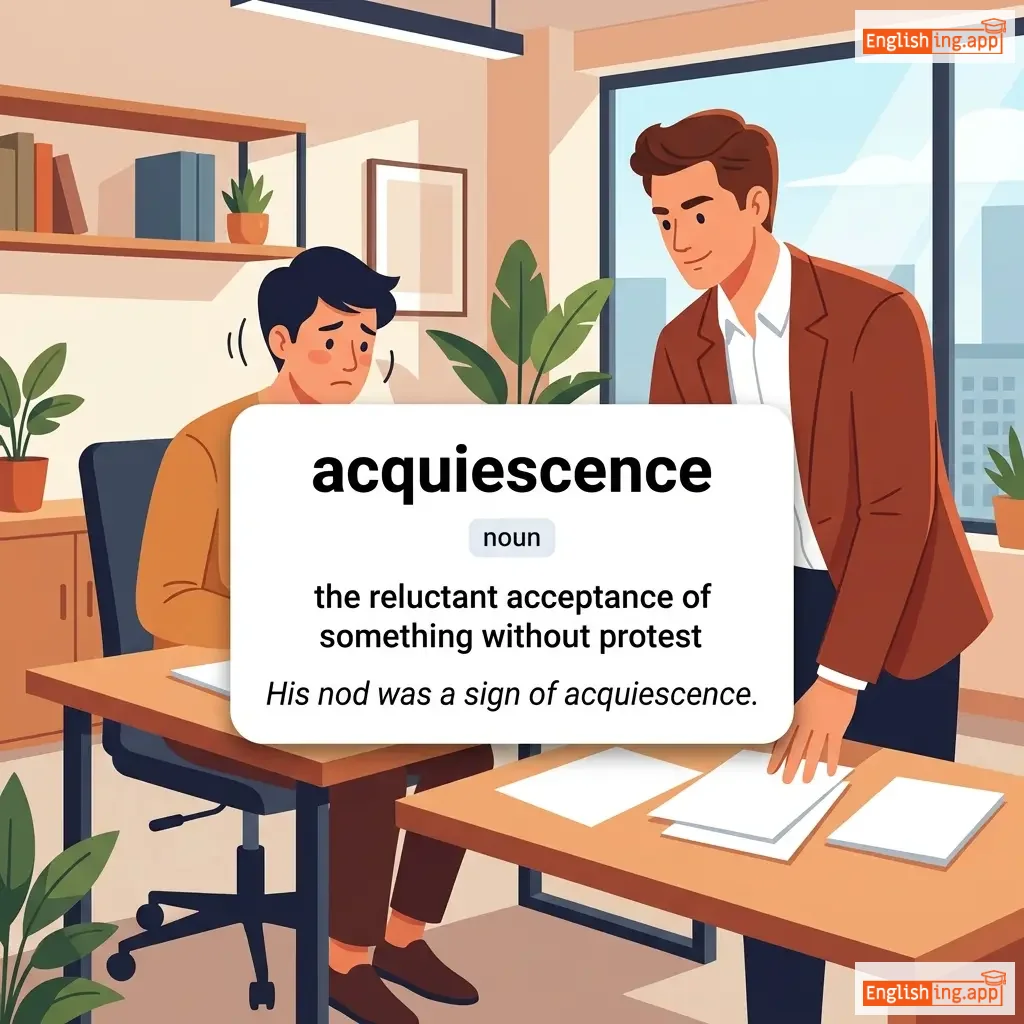
acquiescence definition card — visual illustration of the meaning
noun
/ˌækwiˈɛsəns/
acceptation tacite (acceptation tacite)

the reluctant acceptance of something without protest

"His nod was a sign of acquiescence."

"Son hochement de tête était un signe d'acceptation tacite." (Son hochement de tete etait un signe d'acceptation tacite.)
adjective
/ˌækwiˈɛsənt/
soumis (soumis)

ready to accept something without protest, or to do what someone else wants

"He gave an acquiescent smile and agreed to the plan."

"Il a souri d'un sourire soumis et a accepté le plan." (Il a souri d'un sourire soumis et a accepté le plan.)
acquire definition card — visual illustration of the meaning
verb
/əˈkwaɪər/
acquérir (acquerir)

to obtain or gain possession of something

"She managed to acquire a rare painting at the auction."

"Elle a réussi à acquérir un tableau rare lors de l'enchère." (Elle a reussi a acquérir un tableau rare lors de l'enchère.)
noun
/əˈkwaɪərmənt/
acquisition; accomplissement (acquisition; accomplissement)

the act of acquiring something; something that has been acquired, especially a skill or possession

"Language proficiency is an important acquirement for global careers."

"La maîtrise des langues est une acquisition importante pour les carrières mondiales." (La maitrise des langues est une acquisition importante pour les carrieres mondiales)
Acquisition definition card — visual illustration of the meaning
noun
/ˌækwɪˈzɪʃən/
acquisition (akkeezisyon)

the act of obtaining or gaining something, often knowledge, skills, or property

"The company announced the acquisition of a smaller competitor."

"La société a annoncé l'acquisition d'un concurrent plus petit." (LaSocieteAAnnonceLacquisitionDUnConcurrentPlusPetit)
adjective
/əˈkwɪzətɪv/

excessively interested in acquiring money or material things

"The acquisitive businessman bought every piece of land he could find."

verb
/əˈkwɪt/
acquitter (acquitter)

to free someone from a criminal charge by a verdict of not guilty

"The court decided to acquit the defendant of all charges."

"Le tribunal a décidé d'acquitter le défendeur de toutes les charges." (Le tribunal a décidé d'acquitter le défendeur de toutes les charges.)
noun
/əˈkwɪtl/

a judgment that a person is not guilty of the crime with which they have been charged

"The acquittal of the accused shocked the public."

noun
/əˈkwɪtəns/
quittance (quittance)

a written receipt acknowledging payment or discharge of a debt

"He demanded an acquittance after paying the loan."

"Il a exigé une quittance après avoir payé le prêt." (Il a exige une quittance apres avoir payé le pret.)
noun
/ˈeɪkər/
acre (aker)

a unit of land area equal to 4,840 square yards (about 4,047 square meters)

"The farmer owns five acres of fertile land."

"Le fermier possède cinq acres de terre fertile." (Le fermier possede cinq acres de terre fertile.)
noun
/ˈeɪ.kər.ɪdʒ/
hectare (hectare)

An area of land measured in acres.

"The farmer owns a large acreage of fertile land."

"L'agriculteur possède une grande hectare de terre fertile." (L'agriculteur possède une grande hectare de terre fertile.)
adjective
/ˈæk.rɪd/
âcre (acre)

Having a strong, unpleasantly sharp taste or smell.

"The acrid smoke from the fire made it hard to breathe."

"La fumée âcre du feu rendait la respiration difficile." (La fumee acre du feu rendait la respiration difficile.)
adjective
/ˌæk.rɪˈmoʊ.ni.əs/
amer et en colère (amer et en colere)

Bitter and angry, often involving harsh words.

"The debate turned acrimonious after the controversial remark."

"Le débat est devenu acrimonieux après le commentaire controversé." (Le debat est devenu acrimonieux apres le commentaire controversé.)
noun
/ˈæk.rɪ.moʊ.ni/
acrimonie (akreemonie)

Bitterness and anger, especially in speech or behavior.

"The divorce was filled with acrimony and disputes."

"Le divorce était rempli d'acrimonie et de disputes." (Le divorce etait rempli dacrimonie et de disputes.)
noun
/ˌæk.rəˈfoʊ.bi.ə/
peur des hauteurs (peur des hauteurs)

An extreme or irrational fear of heights.

"Her acrophobia prevented her from climbing the tall building."

"Son acrophobie l'a empêchée de monter dans le grand bâtiment." (Son acrophobie l'a empêchée de monter dans le grand bâtiment.)
preposition/adverb
/əˈkrɒs/
à travers (a travers)

From one side to the other side of something.

"He ran across the street to catch the bus."

"Il a couru à travers la rue pour attraper le bus." (Il a couru a travers la rue pour attraper le bus.)
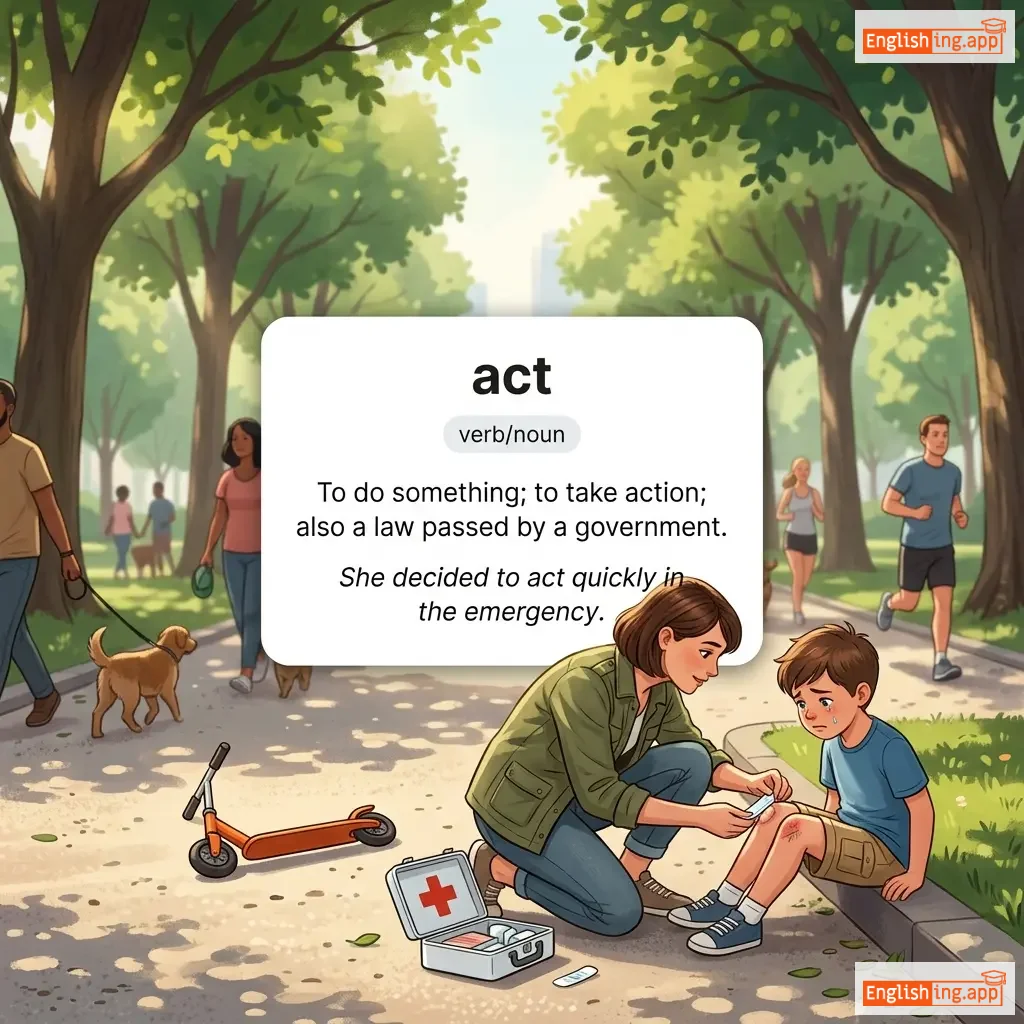
act definition card — visual illustration of the meaning
verb/noun
/ækt/
action / loi (action / loi)

To do something; to take action; also a law passed by a government.

"She decided to act quickly in the emergency."

"Elle a décidé d'agir rapidement en cas d'urgence." (Elle a décidé d'agir rapidement en cas d'urgence.)
noun, adjective, gerund
/ˈæk.tɪŋ/
jeu d’acteur (jeu dacteur)

the art or profession of performing in plays, films, or television; temporary performance of duties; the process of performing an action

"She is studying acting to become a professional actress."

"Elle étudie le jeu d’acteur pour devenir professionnelle." (elle etudie le jeu dacteur pour devenir professionnelle)
noun
/ˈækʃən/
action (action)

The process of doing something, typically to achieve a goal.

"The government took immediate action to control inflation."

"Le gouvernement a pris des mesures immédiates pour contrôler l'inflation." (Le gouvernement a pris des mesures immediates pour controler l'inflation.)