Vocabulaires

Découvrez, apprenez et maîtrisez le vocabulaire anglais

noun
/ˈɑːrmi/
armée (armee)

a large organized military force trained for war

"The army protected the border from attack."

"L'armée a protégé la frontière contre l'attaque." (L'armee a protege la frontiere contre l'attaque.)
noun
/əˈroʊmə/
arôme (arome)

A pleasant, distinctive smell.

"The aroma of freshly baked bread filled the kitchen."

"L'arôme du pain fraîchement cuit remplissait la cuisine." (L'arome du pain fraichement cuit remplissait la cuisine.)
adjective
/ˌærəˈmætɪk/
aromatique (aromatique)

Having a pleasant and distinctive smell.

"The chef used aromatic herbs to flavor the dish."

"Le chef a utilisé des herbes aromatiques pour donner de la saveur au plat." (Le chef a utilisé des herbes aromatiques pour donner de la saveur au plat.)
adverb, preposition
/əˈraʊnd/
autour (autour)

situated on every side; in a circular way; approximately

"There are many restaurants around the park."

"Il y a de nombreux restaurants autour du parc." (Il y a de nombreux restaurants autour du parc.)
verb
/əˈreɪn/
inculper (inculper)

to formally accuse someone in a court of law and ask them to respond to the charges

"The suspect was arraigned before the judge this morning."

"Le suspect a été inculpé devant le juge ce matin." (Le suspect a été inculpé devant le juge ce matin.)
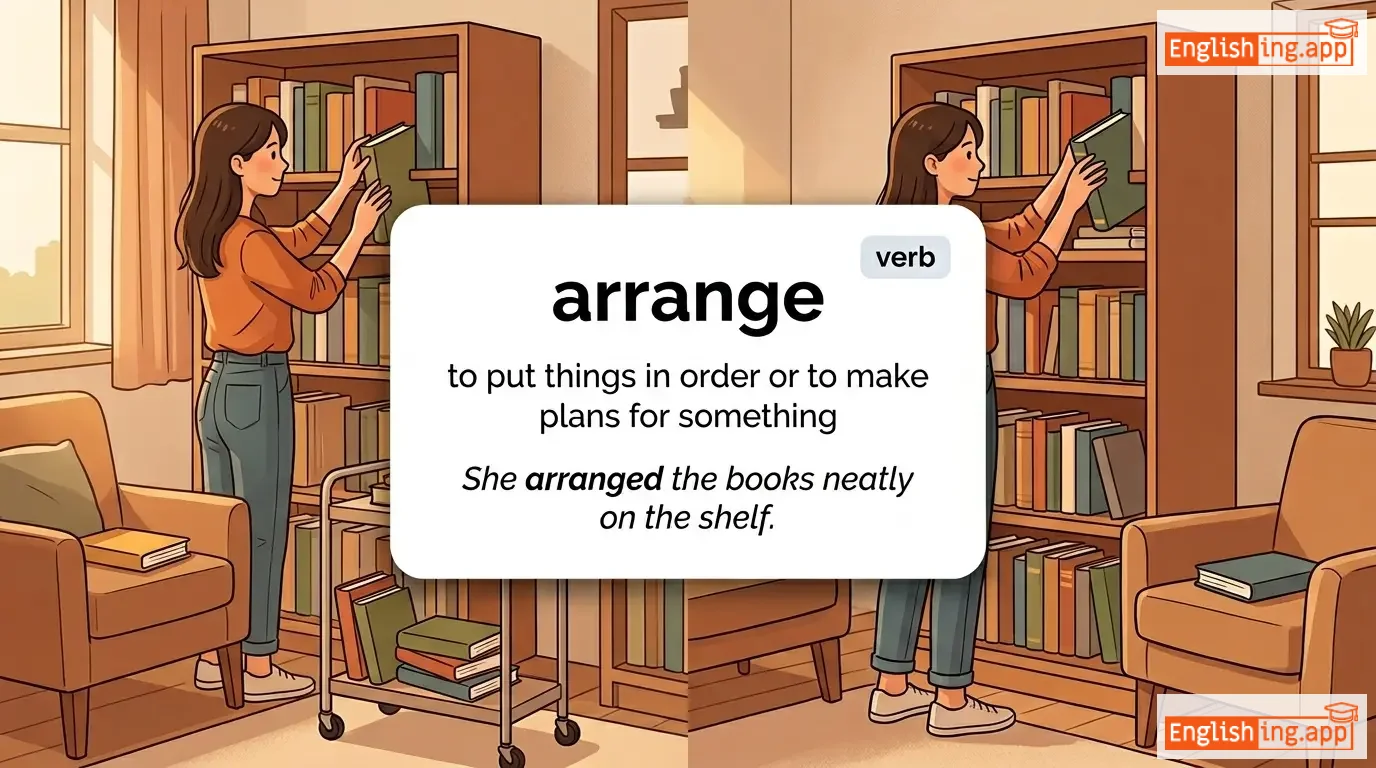
arrange definition card — visual illustration of the meaning
verb
/əˈreɪndʒ/
arranger, organiser (arranger, organiser)

to put things in order or to make plans for something

"She arranged the books neatly on the shelf."

"Elle a arrangé les livres proprement sur l'étagère." (Elle a arrangé les livres proprement sur l'étagère.)
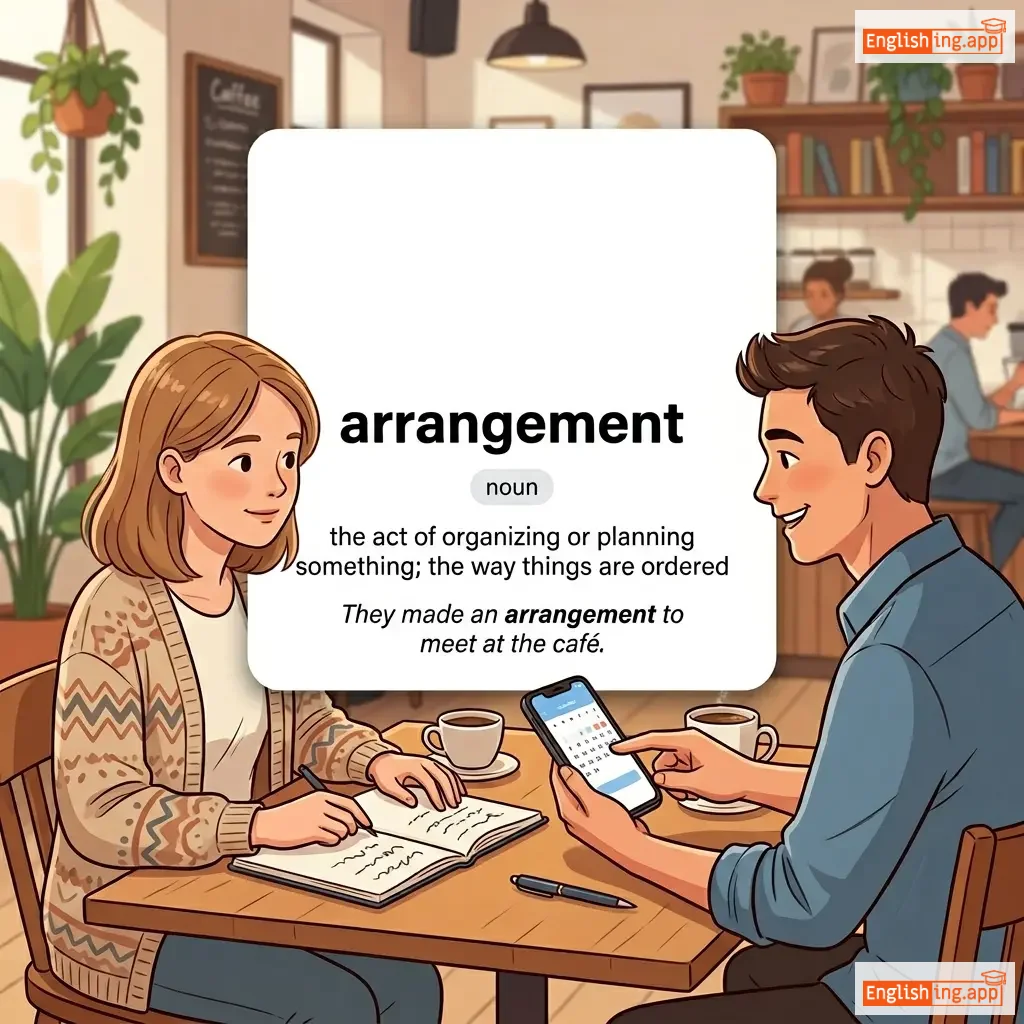
arrangement definition card — visual illustration of the meaning
noun
/əˈreɪndʒmənt/
arrangement, disposition (arrangement, disposition)

the act of organizing or planning something; the way things are ordered

"They made an arrangement to meet at the café."

"Ils ont fait un arrangement pour se rencontrer au café." (Ils ont fait un arrangement pour se rencontrer au café.)
adjective
/ˈærənt/
complet, absolu (complet, absolu)

complete or utter (used negatively, e.g., 'arrant nonsense')

"His excuse was arrant nonsense."

"Son excuse était des bêtises complètes." (Son excuse était des bêtises complètes.)
noun
/əˈreɪ/
série, exposition (serie, exposition)

an impressive display or arrangement of things

"The shop displayed an array of colorful dresses."

"Le magasin a présenté une exposition impressionnante de robes colorées." (Le magasin a presente une exposition impressionnante de robes colorees.)
noun
/əˈrɪə/
arriéré (arrie-re)

A debt or payment that is overdue and unpaid.

"He was sued for an arrear of rent."

"Il a été poursuivi pour un arriéré de loyer." (Il a été poursuivi pour un arriéré de loyer.)
noun
/əˈrɪəz/
arriérés (arrieeres)

Money that is owed and should have been paid earlier.

"She was months in arrears with her electricity bill."

"Elle était en retard de plusieurs mois pour sa facture d'électricité." (Elle était en retard de plusieurs mois pour sa facture d'électricité.)
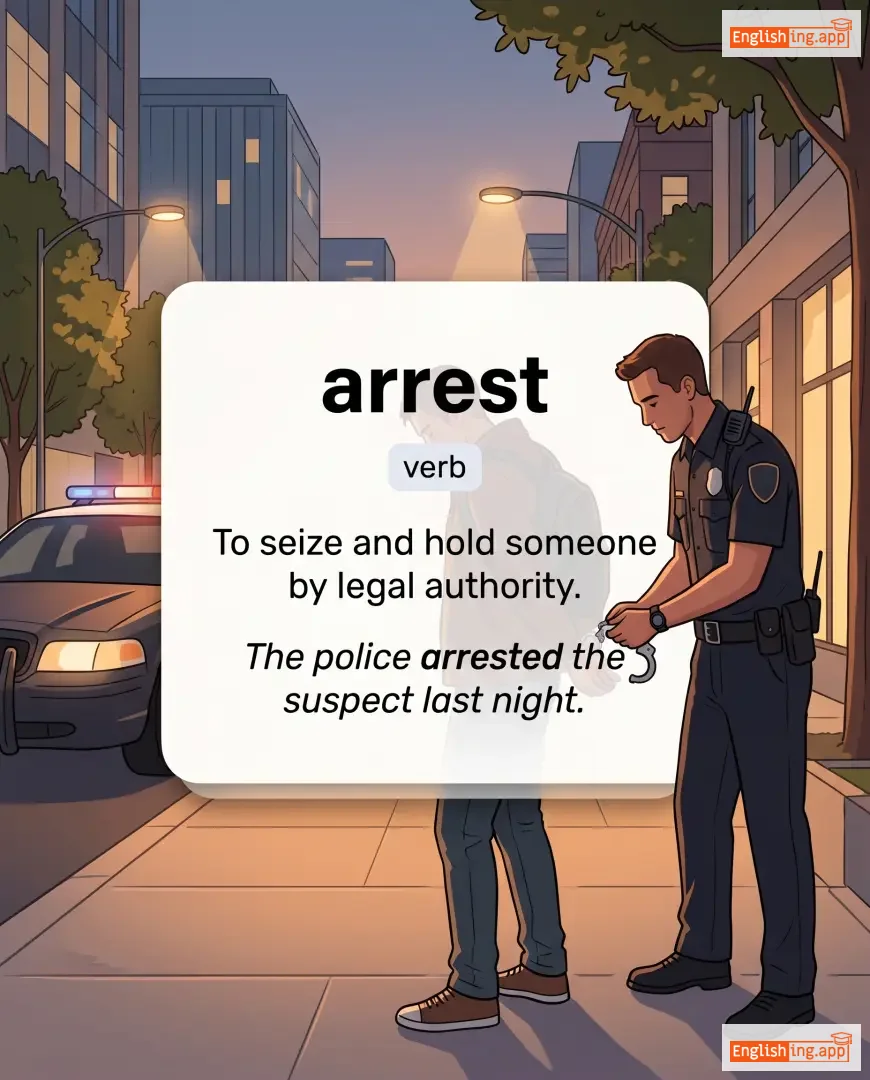
arrest definition card — visual illustration of the meaning
verb
/əˈrɛst/
arrêter (arreter)

To seize and hold someone by legal authority.

"The police arrested the suspect last night."

"La police a arrêté le suspect hier soir." (La police a arrêté le suspect hier soir.)
adjective
/əˈrɛstɪŋ/
impressionnant (impressionnant)

Attracting attention in a striking or impressive way.

"The actress gave an arresting performance."

"L'actrice a donné une performance impressionnante." (L'actrice a donne une performance impressionnante.)
adjective
/eɪˈrɪðmɪk/
arythmique (arythmique)

Lacking a regular rhythm or beat.

"The patient had an arrhythmic heartbeat."

"Le patient avait un battement de cœur arythmique." (Le patient avait un battement de coeur arythmique.)
noun
/əˈraɪvəl/
arrivée (arrivee)

The act of coming to a place, especially at the end of a journey.

"The train's arrival was delayed by two hours."

"L'arrivée du train a été retardée de deux heures." (L'arrivée du train a été retardée de deux heures.)
arrive definition card — visual illustration of the meaning
verb
/əˈraɪv/
arriver (arriver)

to reach a place, especially at the end of a journey

"She will arrive at the airport in the evening."

"Elle arrivera à l'aéroport dans la soirée." (Elle arrivera à l'aéroport dans la soirée.)
noun
/ˌæriˈviːst/
nouveau riche (nouveau riche)

A person who has recently gained wealth or status but is considered arrogant or socially unsophisticated.

"The business world is full of ambitious arrivistes."

"Le monde des affaires est rempli d’arrivistes ambitieux." (Le monde des affaires est rempli d’arrivistes ambitieux.)
noun
/ˈærəɡəns/
arrogance (arrogans)

The quality of being overly proud and having a sense of superiority.

"His arrogance made him unpopular among his colleagues."

"Son arrogance le rendait impopulaire parmi ses collègues." (Son arrogans le rendait impopulaire parmi ses collègues.)
adjective
/ˈærəɡənt/
arrogant (arrogant)

Having an exaggerated sense of one's own importance or abilities.

"The arrogant manager dismissed the workers' complaints."

"Le manager arrogant a rejeté les plaintes des travailleurs." (Le manager arrogant a rejete les plaintes des travailleurs.)
verb
/ˈærəˌɡeɪt/
revendiquer injustement (revendiquer injustement)

To claim or take something without justification.

"The dictator arrogated all powers to himself."

"Le dictateur a revendiqué tous les pouvoirs pour lui-même de manière injuste." (Le dictateur a revendiqué tous les pouvoirs pour lui-même de manière injuste.)
noun
/ˈæroʊ/
flèche (fleche)

a thin, straight weapon with a pointed tip, shot from a bow

"The hunter shot an arrow at the target."

"Le chasseur a tiré une flèche sur la cible." (Le chasseur a tiré une flèche sur la cible.)
noun
/əˈrɔɪ.oʊ/
ruisseau sec (ruisseau sec)

A dry creek or stream bed that temporarily fills with water after heavy rain.

"After the storm, the arroyo quickly filled with rushing water."

"Après la tempête, le ruisseau s'est rapidement rempli d'eau." (Apres la tempete, le ruisseau s'est rapidement rempli d'eau.)
noun
/ˈɑːr.sən.əl/
arsenal (arsenal)

A collection or storage place for weapons and military equipment.

"The army kept its weapons in a secure arsenal."

"L'armée a gardé ses armes dans un arsenal sécurisé." (L'armee a garde ses armes dans un arsenal securise.)
noun
/ɑːrt/
art (art)

the expression or application of human creative skill and imagination

"She studied art at the university."

"Elle a étudié l'art à l'université." (Elle a étudié l'art à l'université.)
noun
/ˈɑːr.tər.i/
artère (artère)

A blood vessel that carries blood away from the heart; also a main route or channel of communication or transport.

"The doctor explained how arteries supply blood to the body."

"Le médecin a expliqué comment les artères alimentent le corps en sang." (Le médecin a expliqué comment les artères alimentent le corps en sang.)
adjective
/ˈɑːrt.fəl/
habile (habile)

Skillful, clever, or crafty, often in a cunning way.

"She gave an artful reply that avoided the real issue."

"Elle a donné une réponse habile qui a évité le véritable problème." (Elle a donné une réponse habile qui a évité le véritable problème.)
adjective
/ɑːrˈθʊr.i.ən/
relatif à Arthur (relatif a Arthur)

Relating to the legendary King Arthur and the stories surrounding him.

"The novel is set in an Arthurian world of knights and castles."

"Le roman se déroule dans un monde arthurien de chevaliers et de châteaux." (Le roman se déroule dans un monde arthurien de chevaliers et de châteaux.)
noun
/ˈɑːrtɪkl/
article (article)

a piece of writing included in a newspaper, magazine, or journal

"He wrote an article about climate change."

"Il a écrit un article sur le changement climatique." (Il a écrit un article sur le changement climatique.)
verb/adjective
/ɑːrˈtɪkjʊlət/
articuler (articuler)

to express thoughts or ideas clearly; having the ability to speak fluently and clearly

"She was able to articulate her ideas during the meeting."

"Elle a pu articuler ses idées pendant la réunion." (Elle a pu articuler ses idées pendant la réunion.)
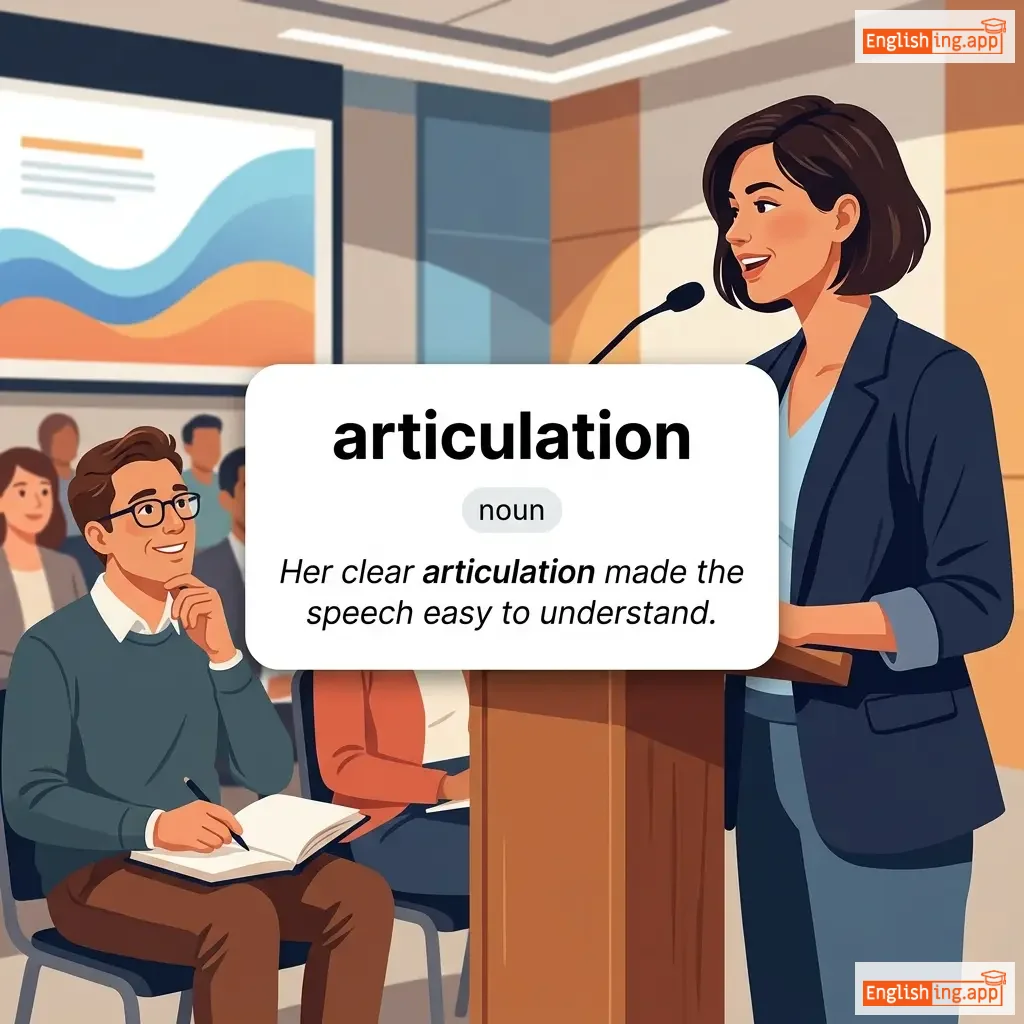
articulation definition card — visual illustration of the meaning
noun
/ɑːrˌtɪkjʊˈleɪʃən/
articulation claire (articulation claire)

the act of expressing something clearly in speech or the way in which words are pronounced

"Her clear articulation made the speech easy to understand."

"Sa claire articulation a rendu le discours facile à comprendre." (Sa claire articulation a rendu le discours facile à comprendre.)
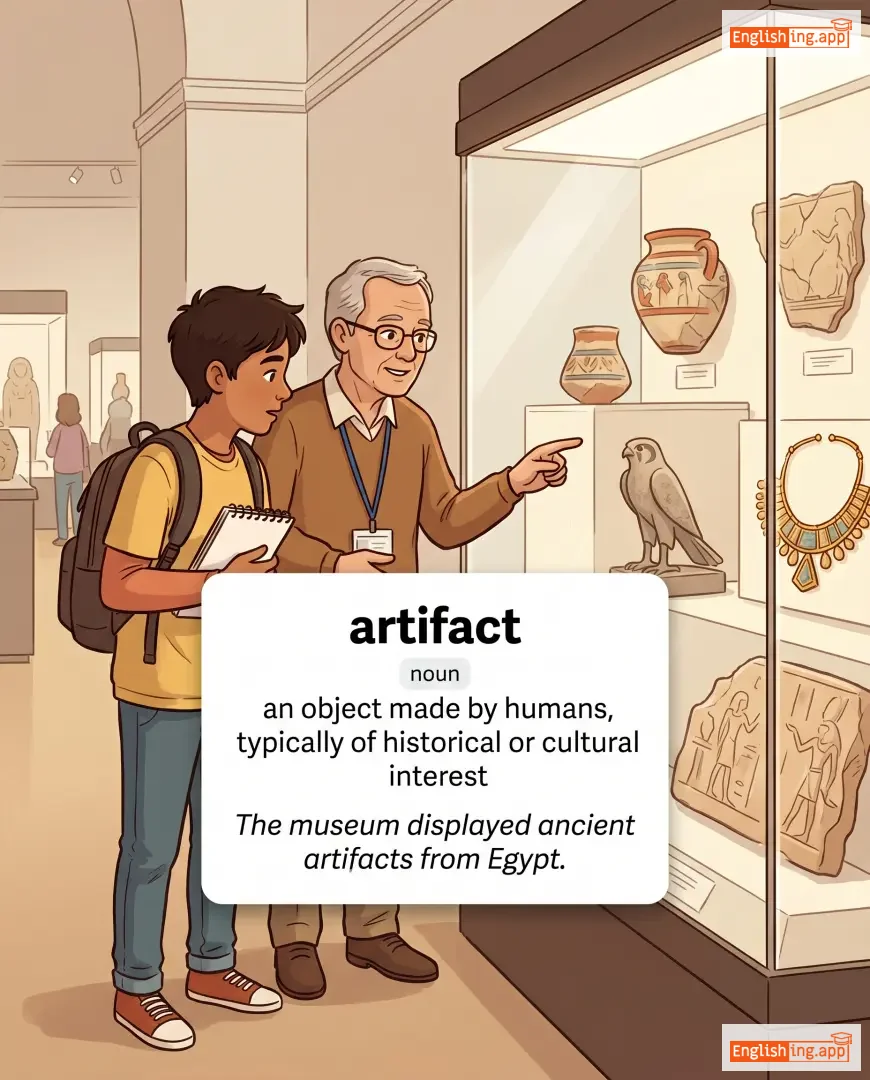
artifact definition card — visual illustration of the meaning
noun
/ˈɑːrtɪˌfækt/
artefact (artefact)

an object made by humans, typically of historical or cultural interest

"The museum displayed ancient artifacts from Egypt."

"Le musée a exposé des artefacts anciens d'Égypte." (Le musee a expose des artefacts anciens d'Egypte.)
noun (plural)
/ˈɑːrtɪˌfæks/
artefacts (artefacts)

objects made by humans, often of historical or cultural importance

"Archaeologists discovered valuable artifacts in the ruins."

"Les archéologues ont découvert des artefacts précieux dans les ruines." (Les archéologues ont découvert des artefacts précieux dans les ruines.)
noun
/ˈɑːrtɪfɪs/
artifice (artifice)

clever or cunning devices or tricks used to deceive others

"The politician's charm was nothing but artifice."

"Le charme du politicien n'était rien d'autre qu'un artifice." (Le charme du politicien n'etait rien d'autre qu'un artifice.)
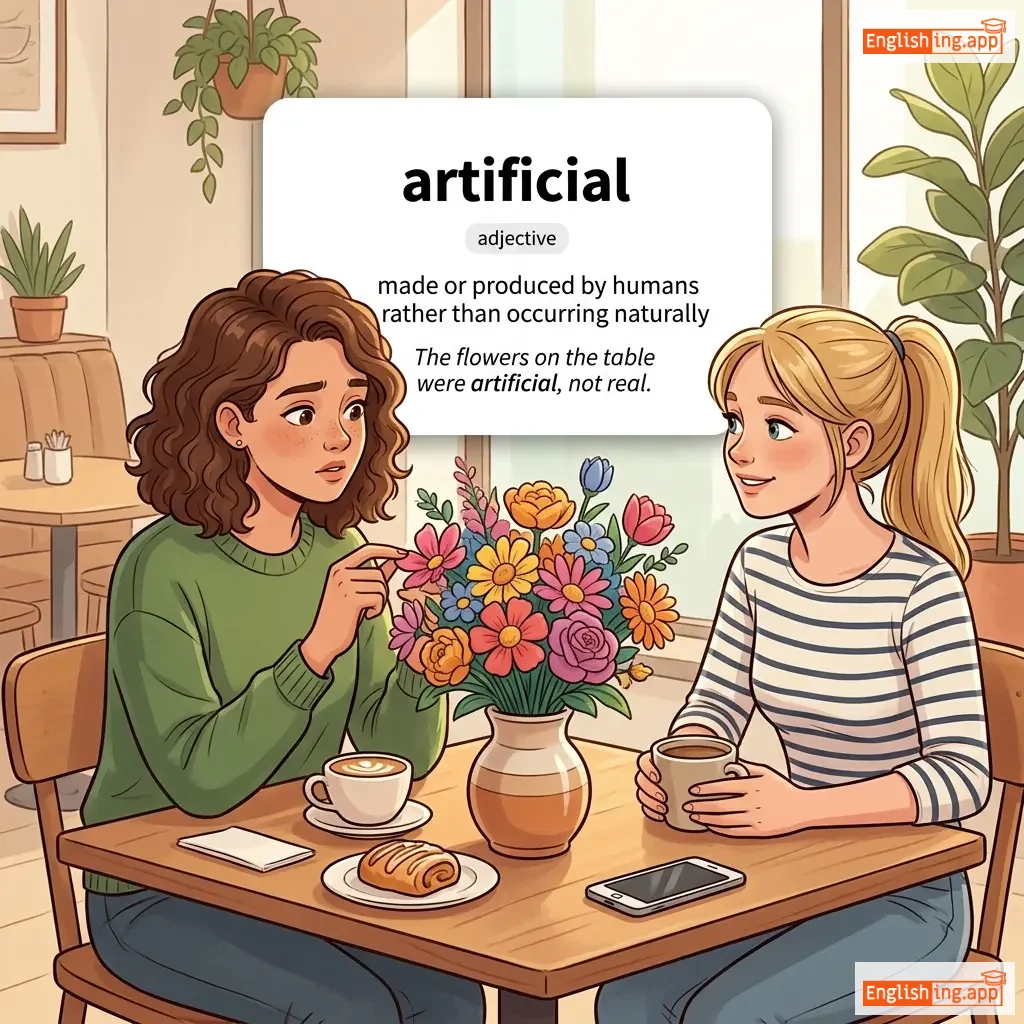
artificial definition card — visual illustration of the meaning
adjective
/ˌɑːrtɪˈfɪʃəl/
artificiel (artificiel)

made or produced by humans rather than occurring naturally

"The flowers on the table were artificial, not real."

"Les fleurs sur la table étaient artificielles, pas réelles." (Les fleurs sur la table étaient artificielles, pas réelles.)
artificial intelligence definition card — visual illustration of the meaning
noun
ˌɑː.tɪˈfɪʃ.əl ɪnˈtɛl.ɪ.dʒəns
intelligence artificielle (intelligence artificielle)

The simulation of human intelligence in machines that are programmed to think and learn.

"Artificial intelligence is reshaping modern industries."

"L'intelligence artificielle transforme les industries modernes." (L'intelligence artificielle transforme les industries modernes.)
adverb
/ˌɑːrtɪˈfɪʃəli/
artificiellement; (artificiellement)

by artificial means; not naturally; in a fake manner

"The lake was artificially created for irrigation purposes."

"Le lac a été créé artificiellement pour des fins d'irrigation." (Le lac a été créé artificiellement pour des fins d'irrigation.)
noun
/ˈɑːrtɪzən/
artisan (artisan)

a skilled craftsperson who makes things by hand

"The artisan crafted a beautiful wooden chair."

"L'artisan a fabriqué une belle chaise en bois." (L'artisan a fabriqué une belle chaise en bois.)
noun
/ˈɑːr.tɪ.zən/
artisan (artisan)

a skilled craftsperson who makes things by hand

"The artisan created a beautiful wooden sculpture."

"L'artisan a créé une belle sculpture en bois." (L'artisan a cree une belle sculpture en bois.)
👩‍🎨

Artist (artiste)

noun
/ˈɑːrtɪst/
artiste (artiste)

a person who creates art, especially paintings or drawings

"The artist painted a beautiful landscape."

"L'artiste a peint un beau paysage." (L'artiste a peint un beau paysage.)
adjective
/ɑːrˈtɪstɪk/
artistique (artistique)

having or revealing natural creative skill

"She has an artistic sense of design."

"Elle a un sens artistique du design." (Elle a un sens artistique du design.)
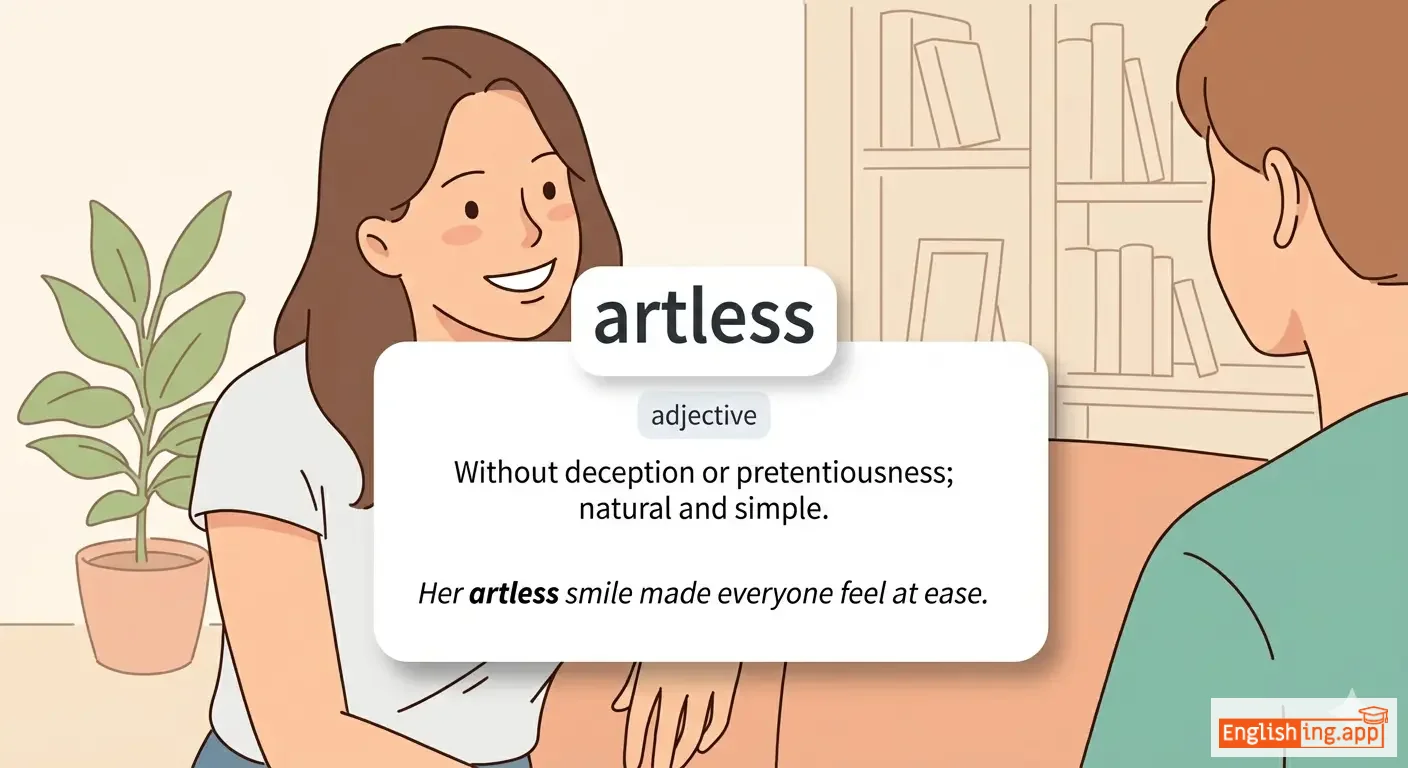
artless definition card — visual illustration of the meaning
adjective
/ˈɑːrtləs/
naturel, simple (naturel, simple)

Without deception or pretentiousness; natural and simple.

"Her artless smile made everyone feel at ease."

"Son sourire naturel a mis tout le monde à l'aise." (son sourire naturel a mis tout le monde a l'aise.)
noun
/ˈɑːrtləsnəs/
simplicité, naturel (simplicité, naturel)

The quality of being natural and simple without deceit or pretension.

"Her artlessness made her beloved by all."

"Son artlessness la rendait aimée de tous." (Son artlessness la rendait aimée de tous.)
noun
/ˈɑːrtwɜːrk/
œuvre d'art (oeuvre d'art)

a piece of art, such as a painting, sculpture, or drawing

"The gallery displayed an impressive artwork by a local artist."

"La galerie a exposé une impressionnante œuvre d'art d'un artiste local." (La galerie a exposé une impressionnante œuvre d'art d'un artiste local.)
noun
/ˈeə.rəm/
arum (arum)

a plant with large arrow-shaped leaves and a white spathe, also known as taro

"Arum leaves are commonly used in Bengali cuisine for cooking."

"Les feuilles d'Arum sont couramment utilisées dans la cuisine indienne pour la cuisson." (Les feuilles d'Arum sont couramment utilisees dans la cuisine indienne pour la cuisson.)
conjunction, adverb, preposition
/æz/
comme (comme)

used to compare, to indicate the role or function of something, or to introduce clauses of time or reason

"She works as a teacher."

"Elle travaille comme enseignante." (Elle travaille comme enseignante.)
adverb
/æz ˈjuː.ʒu.əl/
comme d'habitude (comme d'habitude)

in the way that is normal or typical; customarily

"As usual, he arrived late to the meeting."

"Comme d'habitude, il est arrivé en retard à la réunion." (Comme d'habitude, il est arrive en retard a la reunion.)
noun
/ˌæs.əˈfet.ɪ.də/
asafoetida (asafoetida)

a pungent spice derived from the resin of a plant, commonly used in Indian cooking

"A pinch of asafoetida adds a distinctive flavor to the lentil curry."

"Une pincée d'asafoetida ajoute une saveur distinctive au curry de lentilles." (Une pincee d'asafoetida ajoute une saveur distinctive au curry de lentilles.)
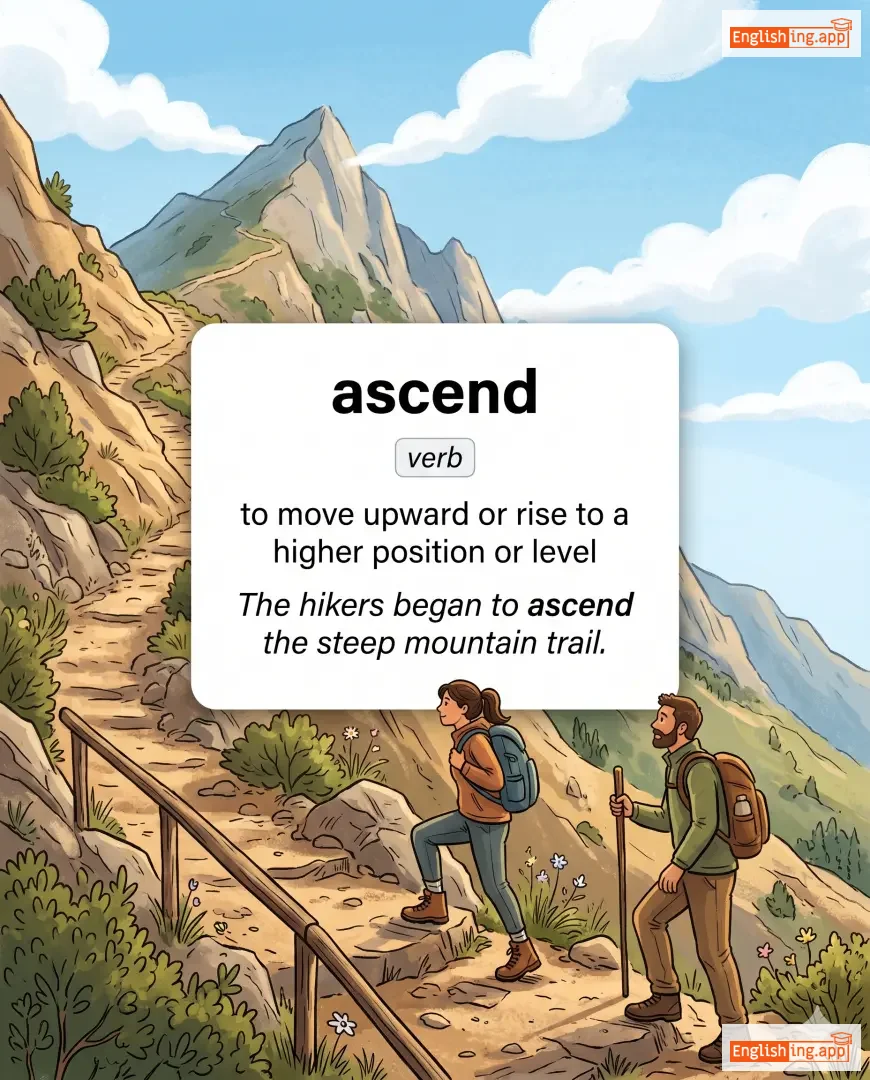
ascend definition card — visual illustration of the meaning
verb
/əˈsɛnd/
ascensionner (ascensionner)

to move upward or rise to a higher position or level

"The hikers began to ascend the steep mountain trail."

"Les randonneurs ont commencé à ascendre le sentier de montagne escarpé." (Les randonneurs ont commence a ascendre le sentier de montagne escarpe.)
noun
/əˈsɛndənsi/
ascendance, domination (ascendance, domination)

A position of power, influence, or control over others.

"The company gained ascendancy in the market through innovation."

"L'entreprise a acquis l'ascendance sur le marché grâce à l'innovation." (L'entreprise a acquis l'ascendance sur le marché grâce à l'innovation.)
adjective
/əˈsɛndənt/
ascendant, dominant (ascendant, dominant)

Rising in power or influence; dominant.

"She is an ascendant leader in the political party."

"Elle est une leader ascendante dans le parti politique." (Elle est une leader ascendante dans le parti politique.)