Vocabularios

Descubra, aprenda y domine el vocabulario en inglés

adjective
/rɪˈlaɪ.ənt/
dependiente (dependiente)

depending on someone or something for support

"The country is too reliant on imported goods."

"El país depende demasiado de los bienes importados." (El pais depende demasiado de los bienes importados.)
noun
/ˈrɛl.ɪk/
reliquia (reliquia)

an object surviving from an earlier time, often of historical or religious interest

"The museum displayed relics from the ancient civilization."

"El museo exhibió reliquias de la antigua civilización." (El museo exhibió reliquias de la antigua civilización.)
noun
/rɪˈliːf/
alivio (rilif)

a feeling of reassurance and comfort after stress or discomfort

"She felt a huge sense of relief after hearing the good news."

"Ella sintió una enorme sensación de alivio después de escuchar las buenas noticias." (Ella sintio una enorme sensacion de alivio despues de escuchar las buenas noticias.)
noun
/rɪˈliːf treɪn/
tren de alivio (tren de alivio)

a train that carries emergency supplies and aid to disaster-affected areas

"The relief train arrived with food and medical supplies for the flood victims."

"el tren de alivio llegó con alimentos y suministros médicos para las víctimas de la inundación." (el tren de alivio llegó con alimentos y suministros médicos para las víctimas de la inundación.)
verb
/rɪˈliːv/
aliviar (aliviar)

to make pain, distress, or difficulty less severe or serious

"The medicine helped relieve his headache."

"La medicina ayudó a aliviar su dolor de cabeza." (La medicina ayudo a aliviar su dolor de cabeza.)
adjective
/rɪˈliːvd/
aliviado (aliviado)

feeling happy and less worried after something stressful has been removed or resolved

"She felt relieved after hearing the good news."

"Se sintió aliviada después de escuchar la buena noticia." (Se sintió aliviada después de escuchar la buena noticia.)
noun
/rɪˈlɪdʒ.ən/
religión (religion)

a system of faith and worship involving belief in a higher power

"Freedom of religion is a fundamental human right."

"La libertad de religión es un derecho humano fundamental." (La libertad de religión es un derecho humano fundamental.)
adjective
/rɪˈlɪdʒəs/
religioso (religioso)

relating to or believing in a religion or faith

"She is a very religious woman who prays every day."

"Ella es una mujer muy religiosa que ora todos los días." (Ella es una mujer muy religiosa que ora todos los días.)
relinquish definition card — visual illustration of the meaning
verb
/rɪˈlɪŋkwɪʃ/
renunciar (renunciar)

to give up or let go of something voluntarily

"He had to relinquish control of the company after the merger."

"Tuvo que renunciar al control de la empresa después de la fusión." (Tuvo que renunciar al control de la empresa despues de la fusion.)
noun
/ˈrɛlɪkwɛri/
relicario (relicario)

a container for holy relics

"The ancient reliquary was decorated with gold and precious stones."

"El antiguo relicario estaba decorado con oro y piedras preciosas." (El antiguo relicario estaba decorado con oro y piedras preciosas.)
verb/noun
/ˈrɛlɪʃ/
disfrutar / condimento (disfrutar / condimento)

to greatly enjoy; also a condiment or sauce

"She relished the opportunity to travel abroad."

"Ella disfrutó mucho de la oportunidad de viajar al extranjero." (Ella disfruto mucho de la oportunidad de viajar al extranjero.)
noun
/rɪˈlʌktəns/
reticencia (reticencia)

unwillingness or hesitation to do something

"His reluctance to speak made the meeting awkward."

"Su reticencia para hablar hizo que la reunión fuera incómoda." (Su reticencia para hablar hizo que la reunion fuera incomoda.)
adjective
/rɪˈlʌktənt/
reacio (reacio)

unwilling or hesitant to do something

"She was reluctant to speak in front of the large audience."

"Ella estaba reacia a hablar frente al gran público." (Ella estaba reacia a hablar frente al gran público.)
adverb
/rɪˈlʌk.tənt.li/
de mala gana (de mala gana)

in an unwilling manner; with hesitation or resistance

"She reluctantly agreed to help with the project."

"Ella aceptó ayudar con el proyecto de mala gana." (Ella aceptó ayudar con el proyecto de mala gana.)
verb
/rɪˈlaɪ/
confiar (confiar)

to depend on with confidence

"You can always rely on her to help you out."

"Siempre puedes confiar en ella para que te ayude." (Siempre puedes confiar en ella para que te ayude.)
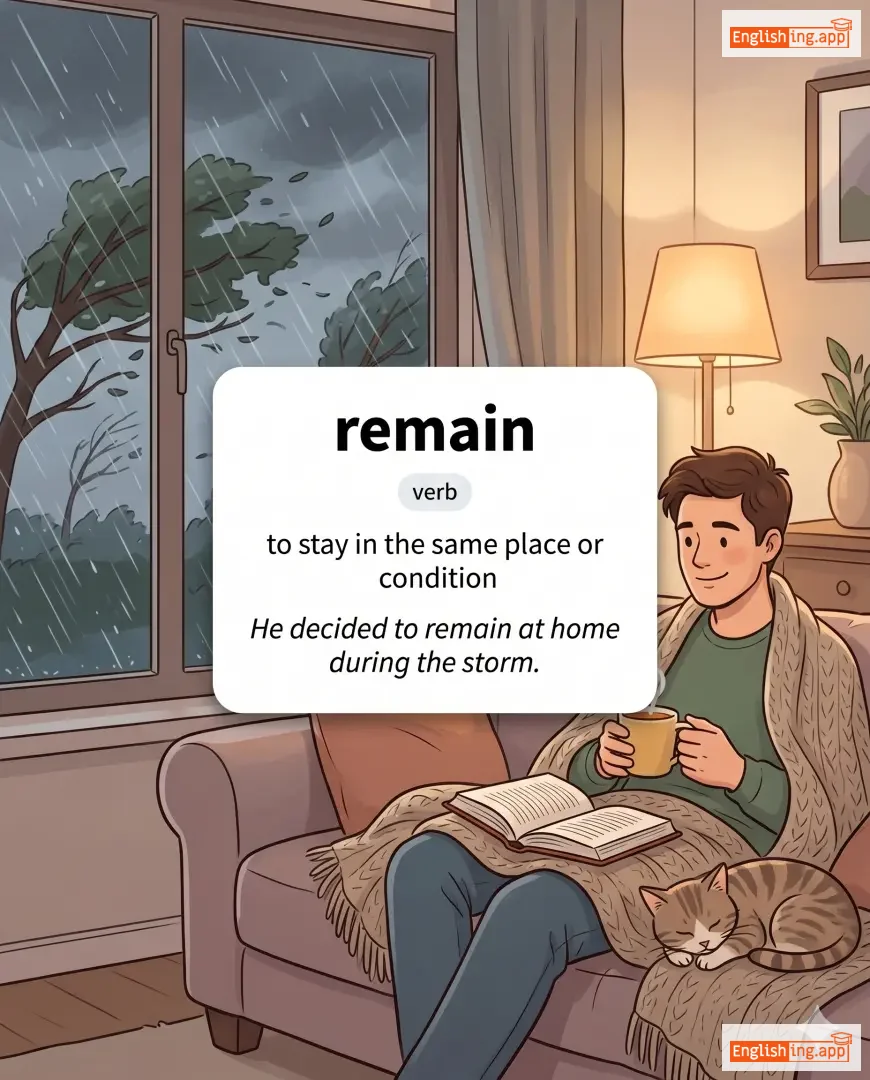
remain definition card — visual illustration of the meaning
verb
/rɪˈmeɪn/
permanecer (permanecer)

to stay in the same place or condition

"He decided to remain at home during the storm."

"Él decidió permanecer en casa durante la tormenta." (El decidio permanecer en casa durante la tormenta.)
noun
/rɪˈmeɪndər/
resto (resto)

the part that is left after the main part is gone or used

"He ate most of the cake and left the remainder on the plate."

"Él comió la mayoría del pastel y dejó el resto en el plato." (Él comió la mayoría del pastel y dejó el resto en el plato.)
adjective
/rɪˈmeɪnɪŋ/
restante (restante)

still existing or left after others are gone or dealt with

"There were only a few remaining tickets for the concert."

"Quedaban solo unos pocos boletos para el concierto." (Quedaban solo unos pocos boletos para el concierto.)
noun
/rɪˈmeɪnz/
restos (restos)

the parts, pieces, or substances that are left after the rest has been used or removed

"The remains of the meal were left on the table."

"Los restos de la comida quedaron en la mesa." (Los restos de la comida quedaron en la mesa.)
noun/verb
/rɪˈmɑːrk/
comentario (komentario)

something that is said; a comment

"She made a remark about the weather."

"Ella hizo un comentario sobre el clima." (Eya iso un komentario sobre el klima.)
adjective
/rɪˈmɑːrkəbl/
notable (notable)

worthy of attention; striking

"Her remarkable performance impressed everyone."

"Su actuación notable impresionó a todos." (Su actuacion notable impresiono a todos.)
adverb
/rɪˈmɑːrkəbli/
de manera asombrosa (de manera asombrosa)

in a way that is worthy of attention or notice; surprisingly

"She did remarkably well in the competition."

"Ella lo hizo de manera asombrosa en la competencia." (Ella lo hizo de manera asombrosa en la competencia.)
adjective
/rɪˈmiːdiəbl/
remediable (remediable)

capable of being corrected or cured

"The mistake was serious but still remediable."

"El error fue grave pero aún remediable." (El error fue grave pero aún remediable.)
adjective
/rɪˈmiːdiəl/
correctivo (correctivo)

intended to correct or improve a situation, especially related to learning or health

"The school offers remedial classes in mathematics."

"La escuela ofrece clases de apoyo en matemáticas." (La escuela ofrece clases de apoyo en matematicas.)
noun
/ˈrɛmɪdi/
remedio (remedio)

a treatment or solution for a problem or illness

"The doctor prescribed a remedy for the cough."

"El doctor recetó un remedio para la tos." (El doctor receto un remedio para la tos.)
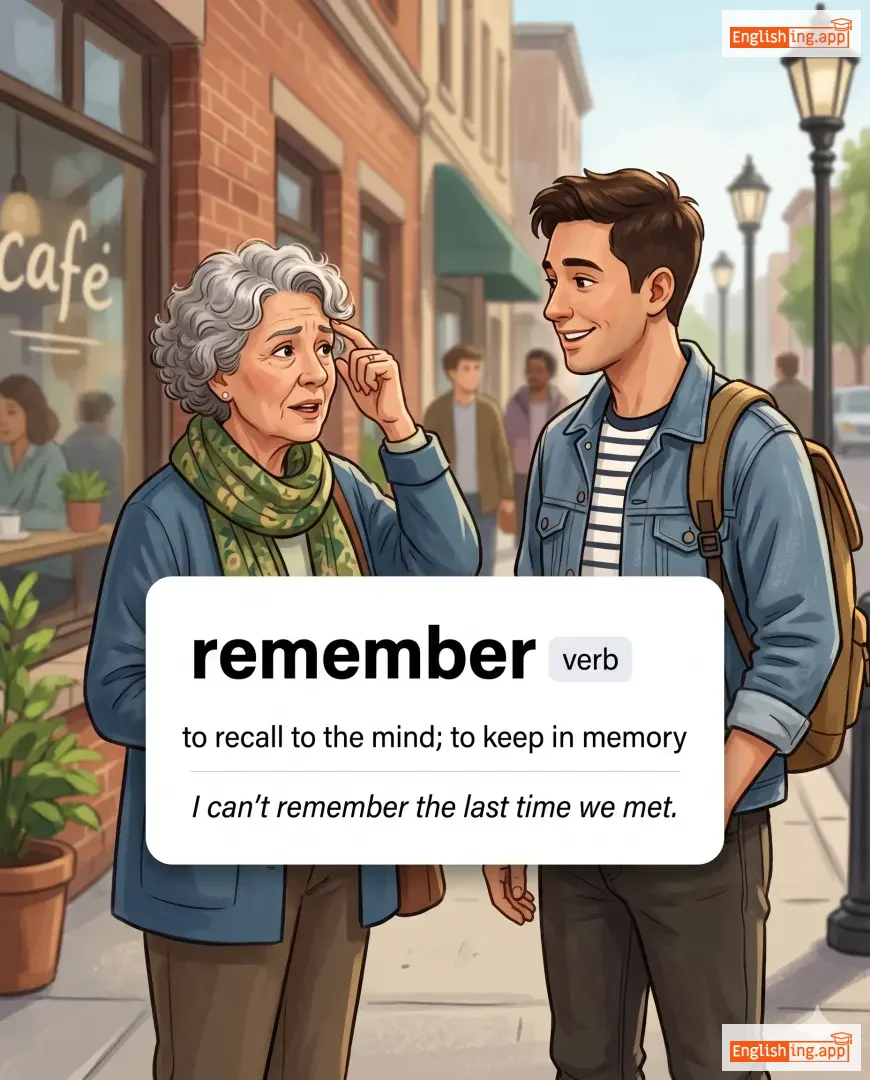
remember definition card — visual illustration of the meaning
verb
/rɪˈmɛmbər/
recordar (recordar)

to recall to the mind; to keep in memory

"I can't remember the last time we met."

"No puedo recordar la última vez que nos encontramos." (No puedo recordar la última vez que nos encontramos.)
noun
/rɪˈmɛmbrəns/
recuerdo (recuerdo)

the act of remembering or honoring someone or something

"A service was held in remembrance of the fallen soldiers."

"Se celebró un servicio en recuerdo de los soldados caídos." (Se celebró un servicio en recuerdo de los soldados caídos.)
verb
/rɪˈmaɪnd/
recordar (recordar)

to cause someone to remember something

"Please remind me to call her tomorrow."

"Por favor, recuérdame llamar a ella mañana." (Por favor, recuérdame llamar a ella mañana.)
noun
/rɪˈmaɪndər/
recordatorio (recordatorio)

something that helps you remember a fact, event, or action that you need to do or recall

"He set a reminder to call his mother on her birthday."

"Él configuró un recordatorio para llamar a su madre en su cumpleaños." (El configuró un recordatorio para llamar a su madre en su cumpleaños.)
noun
/ˌrɛmɪˈnɪsəns/
rememoración (rememoracion)

a story or memory about past events

"He shared a reminiscence of his childhood days in the village."

"Él compartió una rememoración de sus días de infancia en el pueblo." (El compartió una rememoración de sus días de infancia en el pueblo.)
adjective
/ˌrɛmɪˈnɪsənt/
rememorativo (rememorativo)

Tending to remind one of something; suggestive of something in the past.

"The smell of rain is reminiscent of my childhood in the village."

"El olor a lluvia es rememorativo de mi infancia en el pueblo." (El olor a lluvia es rememorativo de mi infancia en el pueblo.)
adjective
/rɪˈmɪs/
negligente (negligente)

Negligent in performing a duty or responsibility.

"The manager was remiss in not checking the financial reports carefully."

"El gerente fue negligente al no revisar cuidadosamente los informes financieros." (El gerente fue negligente al no revisar cuidadosamente los informes financieros.)
noun
/rɪˈmɪʃən/
remisión (rimishun)

A temporary or permanent decrease or disappearance of disease symptoms; forgiveness of sins or debts.

"The patient’s cancer is in remission after the treatment."

"El cáncer del paciente está en remisión después del tratamiento." (El cancer del paciente esta en remission despues del tratamiento)
verb
/rɪˈmɪt/
enviar dinero / perdonar (enviar dinero / perdonar)

To send money in payment or as a gift; to cancel or refrain from exacting a debt or punishment.

"He promised to remit the payment by the end of the week."

"Él prometió remitir el pago antes del final de la semana." (Él prometió remitir el pago antes del final de la semana.)
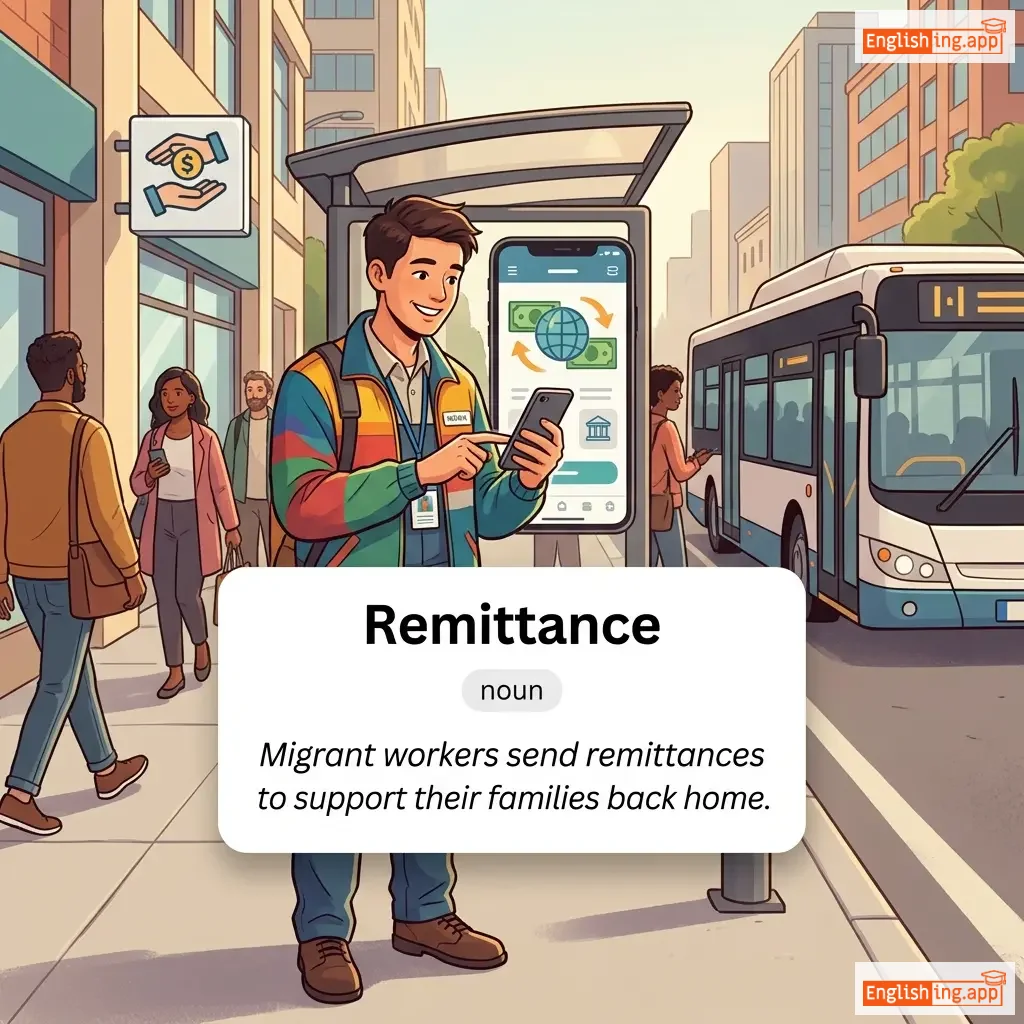
Remittance definition card — visual illustration of the meaning
noun
/rɪˈmɪtəns/
remesa / transferencia de dinero (remesa / transferencia de dinero)

A sum of money sent, especially by mail or electronic transfer, as payment or gift.

"Migrant workers send remittances to support their families back home."

"Los trabajadores migrantes envían remesas para apoyar a sus familias en su país de origen." (Los trabajadores migrantes envían remesas para apoyar a sus familias en su país de origen.)
noun
/ˈrɛmnənt/
resto (resto)

A small remaining part of something that once existed or was larger.

"The old house still had remnants of its former glory."

"La vieja casa todavía tenía restos de su antigua gloria." (La vieja casa todavia tenia restos de su antigua gloria.)
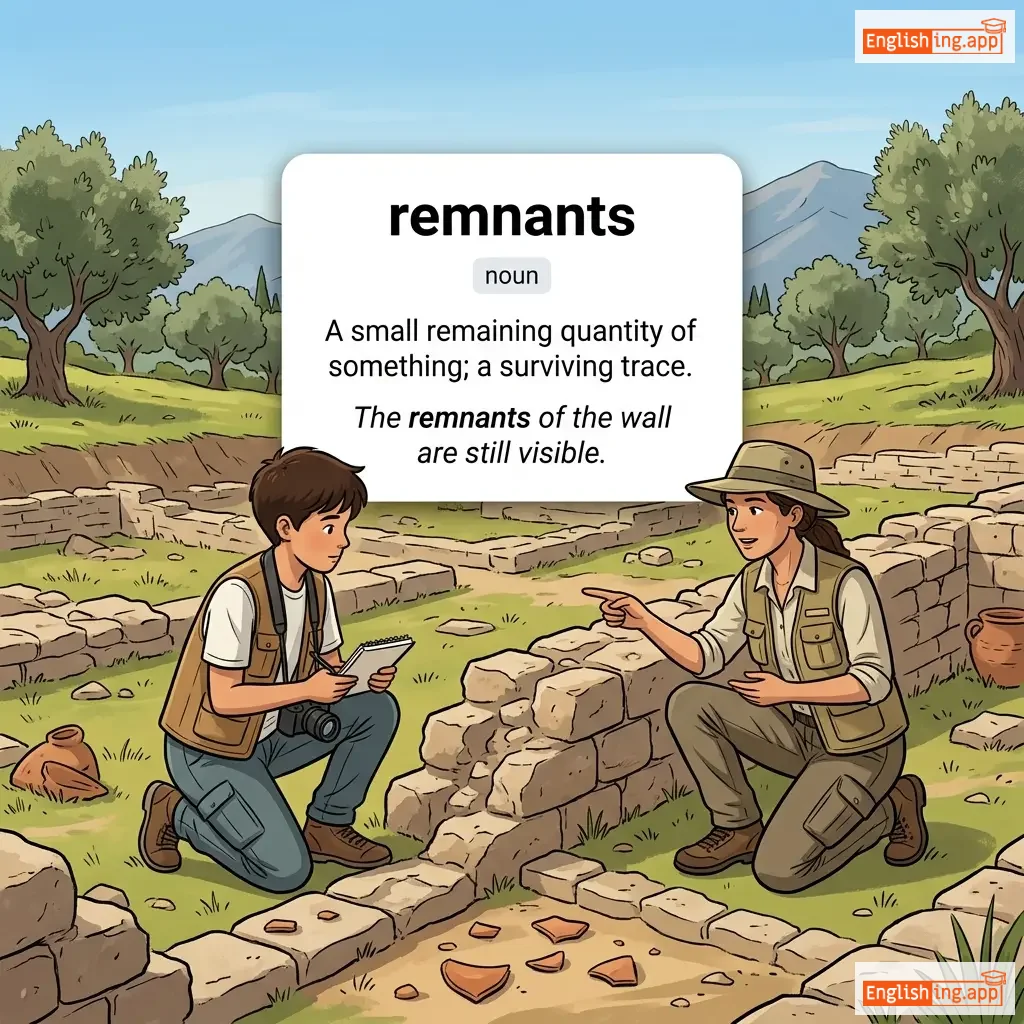
remnants definition card — visual illustration of the meaning
noun
ˈremnənts
restos (restos)

A small remaining quantity of something; a surviving trace.

"The remnants of the wall are still visible."

"Los restos de la pared aún son visibles." (Los restos de la pared aun son visibles.)
verb
/ˌriːˈmɒdəl/
remodelar (remodelar)

To change the structure or form of something, especially a building.

"They decided to remodel their kitchen last summer."

"Ellos decidieron remodelar su cocina el verano pasado." (Ellos decidieron remodelar su cocina el verano pasado.)
noun
/rɪˈmɒnstrəns/
protesta (protesta)

A forceful protest or objection.

"The workers’ remonstrance against unfair treatment was ignored."

"La protesta de los trabajadores contra el trato injusto fue ignorada." (La protesta de los trabajadores contra el trato injusto fue ignorada.)
noun/adjective
/rɪˈmɒnstrənt/
protestante (protestante)

A person who makes a forceful protest (noun); protesting or objecting (adjective).

"He was a remonstrant voice in the assembly."

"Él fue una voz de protesta en la asamblea." (Él fue una voz de protesta en la asamblea.)
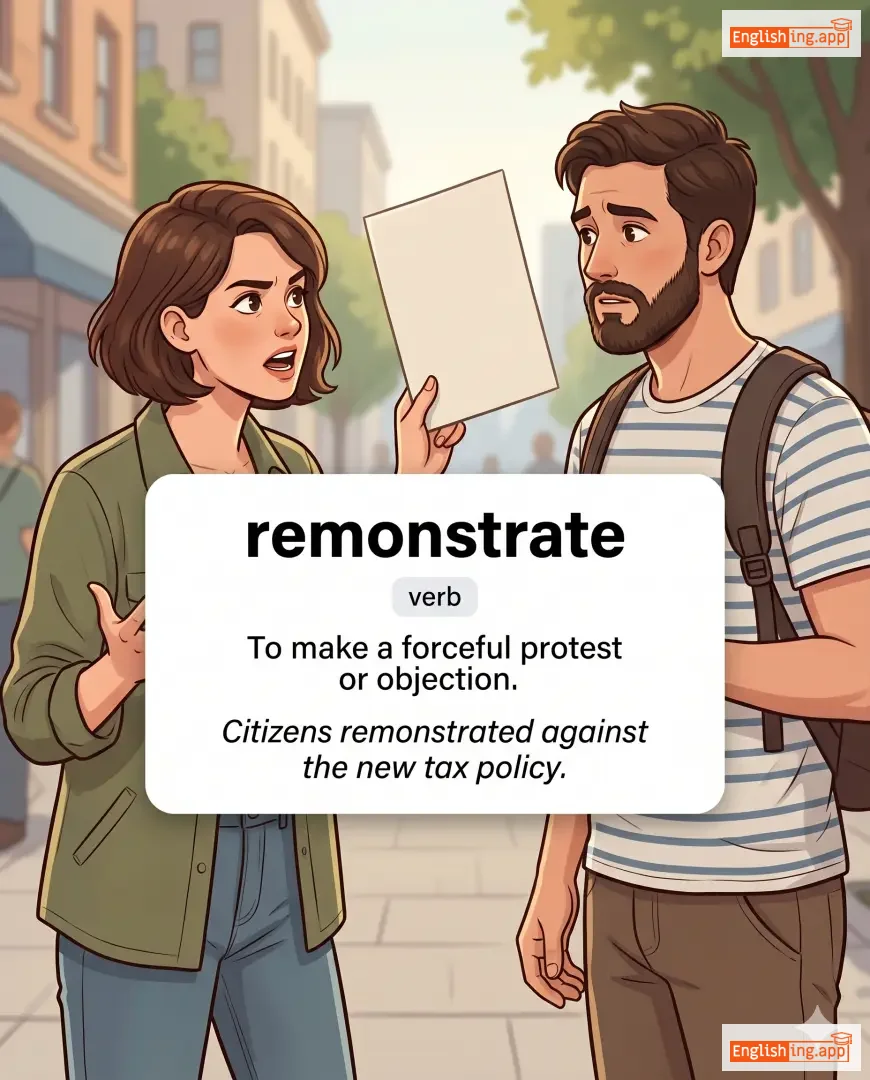
remonstrate definition card — visual illustration of the meaning
verb
/rɪˈmɒnstreɪt/
protestar (protestar)

To make a forceful protest or objection.

"Citizens remonstrated against the new tax policy."

"Los ciudadanos protestaron contra la nueva política fiscal." (Los ciudadanos protestaron contra la nueva política fiscal.)
noun
/rɪˈmɔːrs/
remordimiento (remordimiento)

A deep feeling of regret or guilt for a wrong committed.

"He was filled with remorse after lying to his friend."

"Se llenó de remordimiento después de mentirle a su amigo." (Se llenó de remordimiento después de mentirle a su amigo.)
adjective
/rɪˈmoʊt/
remoto (remoto)

Situated far from the main centers of population; distant.

"They stayed in a remote village during their trip."

"Se quedaron en un pueblo remoto durante su viaje." (Se quedaron en un pueblo remoto durante su viaje.)
adjective
/rɪˈmoʊtɪd/
remotado (remotado)

placed at a distance; made remote

"The system was remoted to a secure location."

"El sistema fue remotado a una ubicación segura." (El sistema fue remotado a una ubicacion segura.)
adjective
/rɪˈmuːvəbəl/
extraíble (extraible)

able to be removed or taken away

"This phone has a removable battery."

"Este teléfono tiene una batería extraíble." (Este teléfono tiene una batería extraíble.)
noun
/rɪˈmuːvəl/
eliminación (eliminacion)

the act of taking something or someone away or out of a place

"The removal of old furniture made the room look spacious."

"La eliminación de los muebles viejos hizo que la habitación pareciera más espaciosa." (La eliminacion de los muebles viejos hizo que la habitacion pareciera mas espaciosa.)
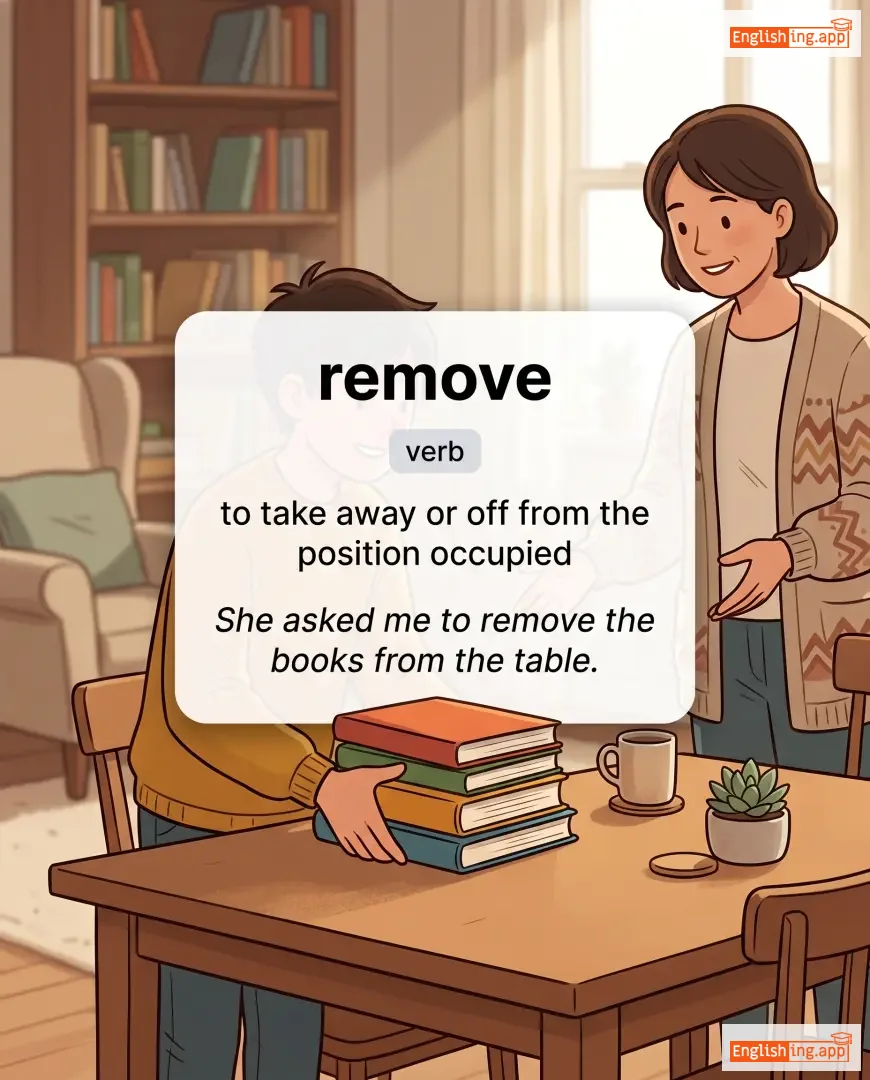
remove definition card — visual illustration of the meaning
verb
/rɪˈmuːv/
quitar (quitar)

to take away or off from the position occupied

"She asked me to remove the books from the table."

"Ella me pidió que quitara los libros de la mesa." (Ella me pidió que quitara los libros de la mesa.)
verb
/rɪˈmjuːnəreɪt/
remunerar (remunerar)

To pay someone for services or work done.

"The company will remunerate employees fairly for their overtime."

"La empresa remunerará a los empleados de manera justa por su tiempo extra." (La empresa remunerará a los empleados de manera justa por su tiempo extra.)
noun
/rɪˌmjuːnəˈreɪʃən/
remuneración (remuneracion)

Money paid for work or a service.

"The remuneration for this job is quite generous."

"La remuneración por este trabajo es bastante generosa." (La remuneracion por este trabajo es bastante generosa.)
adjective
/rɪˈmjuːnərətɪv/
remunerativo (remunerativo)

Financially rewarding or profitable.

"He chose a remunerative career in medicine."

"Eligió una carrera remunerada en medicina." (Eligió una carrera remunerada en medicina.)