Vocabularios

Descubra, aprenda y domine el vocabulario en inglés

noun
/ˈpɛnəlti/
penalización (penalizacion)

A punishment imposed for breaking a law, rule, or contract.

"He had to pay a heavy penalty for breaking the traffic rules."

"Tuvo que pagar una pesada penalización por romper las reglas de tráfico." (Tuvo que pagar una pesada penalizacion por romper las reglas de trafico.)
noun
/ˈpɛnəns/
felicidad (felicidad)

Voluntary self-punishment as an expression of repentance for wrongdoing.

"He fasted for a week as a penance for his mistakes."

"No pudo ocultar su felicidad cuando recibió el premio." (No pudo ocultar su felicidad cuando recibió el premio.)
penchant definition card — visual illustration of the meaning
noun
/ˈpɒ̃ʃɒ̃/
inclinación (inclinacion)

a strong or habitual liking for something or tendency to do something

"She has a penchant for collecting rare books."

"Ella tiene una inclinación por coleccionar libros raros." (Ella tiene una inclinacion por coleccionar libros raros.)
noun
/ˈpɛnsəl/
lápiz (lapiz)

an instrument for writing or drawing, typically made of wood with a graphite core

"He drew a picture with a pencil."

"Él dibujó una imagen con un lápiz." (El dibujo una imagen con un lapiz.)
noun
/ˈpɛndənt/
colgante (colgante)

a piece of jewelry that hangs from a chain worn around the neck

"She wore a silver pendant around her neck."

"Ella llevaba un colgante de plata alrededor del cuello." (Ella llevaba un colgante de plata alrededor del cuello.)
adjective
/ˈpɛndənt/
colgante (colgante)

hanging down or suspended

"The pendent branches touched the ground."

"Las ramas colgantes tocaron el suelo." (Las ramas colgantes tocaron el suelo.)
adjective
/ˈpɛndɪŋ/
pendiente (pendiente)

awaiting decision or settlement

"The case is still pending in court."

"El caso aún está pendiente en el tribunal." (El caso aun esta pendiente en el tribunal.)
adjective
/ˈpɛndjʊləs/
felicidad (felicidad)

hanging down loosely; drooping

"The pendulous fruit weighed down the branch."

"Ella no pudo ocultar su felicidad cuando recibió el premio." (Ella no pudo ocultar su felicidad cuando recibió el premio.)
noun
/ˈpɛndjələm/
péndulo (pendulo)

A weight suspended from a pivot so that it swings freely, often used to regulate clocks.

"The pendulum swung back and forth inside the clock."

"El péndulo oscilaba hacia adelante y hacia atrás dentro del reloj." (El pendulo oscilaba hacia adelante y hacia atrás dentro del reloj.)
adjective
/ˈpɛnɪtrəbl/
penetrable (penetrable)

Capable of being passed through or entered.

"The thin wall was easily penetrable."

"La delgada pared era fácilmente penetrable." (La delgada pared era facilmente penetrable.)
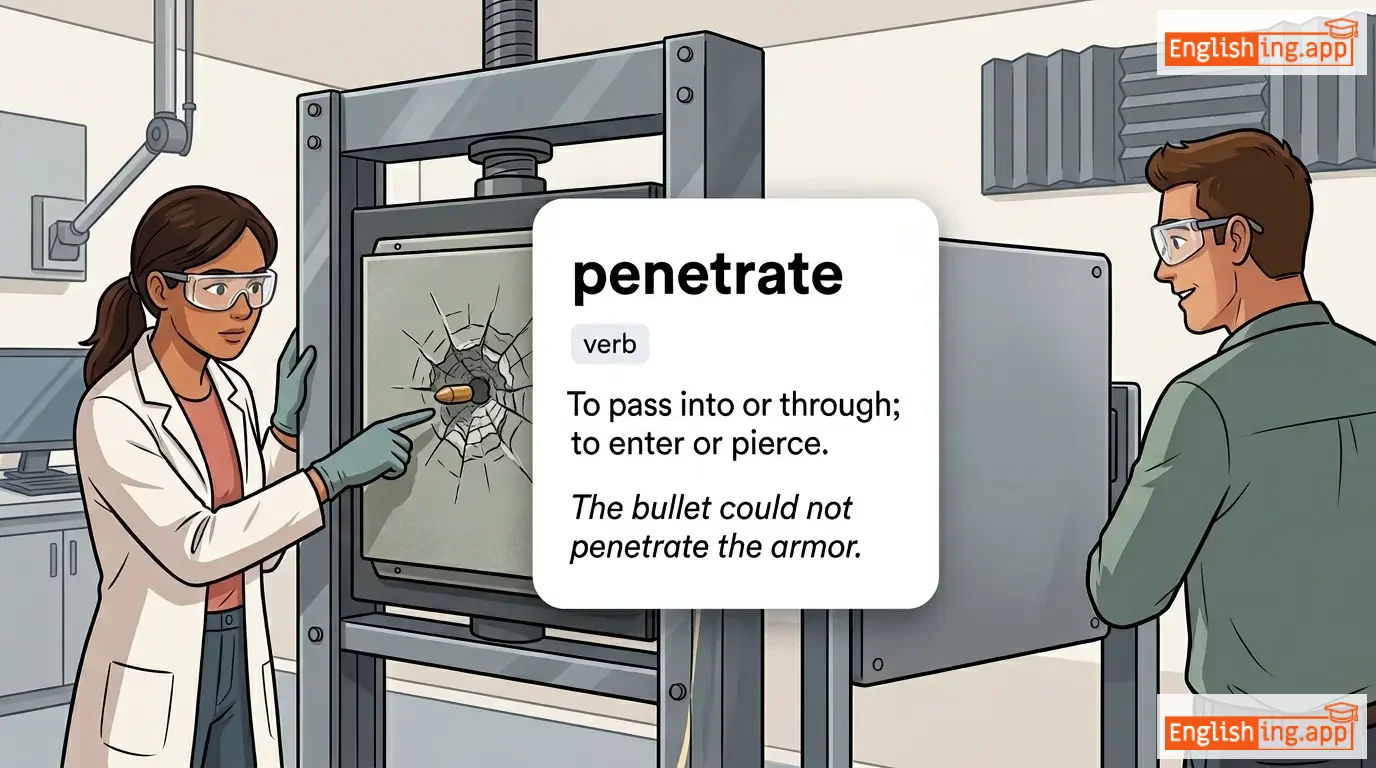
penetrate definition card — visual illustration of the meaning
verb
/ˈpɛnɪtreɪt/
penetrar (penetrar)

To pass into or through; to enter or pierce.

"The bullet could not penetrate the armor."

"La bala no pudo penetrar la armadura." (La bala no pudo penetrar la armadura.)
noun
/ˌpɛnɪˈtreɪʃən/
penetración (penetracion)

The act of piercing or entering into something.

"The company's market penetration grew rapidly."

"La penetración en el mercado de la empresa creció rápidamente." (La penetracion en el mercado de la empresa crecio rapidamente.)
noun
/pəˈnɪn.sjə.lə/
península (peninsula)

a piece of land that is almost completely surrounded by water but connected to the mainland

"The Korean Peninsula is located in East Asia."

"La península de Corea está ubicada en el este de Asia." (La peninsula de Corea esta ubicada en el este de Asia.)
adjective
/pəˈnɪnsjələr/
peninsular (peninsular)

Relating to or resembling a peninsula.

"The peninsular region is surrounded by water on three sides."

"La región peninsular está rodeada de agua por tres lados." (La region peninsular esta rodeada de agua por tres lados.)
noun
/ˈpɛnɪtəns/
penitencia (penitensia)

The action or feeling of showing sorrow and regret for having done wrong.

"His eyes were full of penitence after realizing his mistake."

"Sus ojos estaban llenos de penitencia después de darse cuenta de su error." (Sus ojos estaban llenos de penitencia despues de darse cuenta de su error.)
adjective
/ˈpɛnɪtənt/
arrepentido (arrepentido)

Feeling or showing sorrow and regret for having done wrong.

"She was penitent after shouting at her friend."

"Ella estaba arrepentida después de gritarle a su amiga." (Ella estaba arrepentida después de gritarle a su amiga.)
adjective
/ˌpɛnɪˈtɛnʃəl/
penitente (penitente)

Relating to or expressing penitence or penance.

"The priest delivered a penitential sermon on forgiveness."

"El sacerdote dio un sermón penitente sobre el perdón." (El sacerdote dio un sermón penitente sobre el perdón.)
noun
/ˈpɛnənt/
banderín (banderin)

A tapering flag used for signaling or as an emblem of victory or achievement.

"The team raised the championship pennant proudly."

"El equipo levantó con orgullo el banderín del campeonato." (El equipo levantó con orgullo el banderín del campeonato.)
adjective
/ˈpɛneɪt/
como una pluma (como una pluma)

Having parts or structures arranged like a feather; feather-shaped.

"The fern has a pennate leaf structure."

"La estructura de la hoja del helecho es como una pluma." (La estructura de la hoja del helecho es como una pluma.)
adjective
/ˈpen.ɪ.ləs/
sin dinero; extremadamente pobre; completamente sin fondos (sin dinero; extremadamente pobre; completamente sin fondos)

having no money; extremely poor; completely without funds

"After losing his job, he became penniless."

"Después de perder su trabajo, se quedó sin dinero." (Después de perder su trabajo, se quedó sin dinero.)
noun
/ˈpɛni/
penique (penique)

a small coin of low value; a very small amount of money

"He found a penny on the sidewalk and smiled."

"Encontró un penique en la acera y sonrió." (encontro un penique en la acera y sonrio)
noun
/pɪˈnɒlədʒi/
penología (penologia)

The study of prison management and criminal rehabilitation.

"He decided to specialize in penology to help improve the prison system."

"Decidió especializarse en penología para ayudar a mejorar el sistema penitenciario." (Decidio especializarse en penologia para ayudar a mejorar el sistema penitenciario.)
noun
/ˈpɛnʃən/
pensión (pension)

A regular payment made during a person's retirement from an investment fund or employer.

"After 30 years of service, he received a monthly pension."

"Después de 30 años de servicio, recibió una pensión mensual." (Despues de 30 anos de servicio, recibio una pension mensual.)
adjective
/ˈpɛnsɪv/
pensativo/a (pensativo)

Engaged in deep or serious thought.

"She looked pensive as she stared out of the window."

"Ella parecía pensativa mientras miraba por la ventana." (Ella parecia pensativa mientras miraba por la ventana.)
adjective
/ˈpent ʌp/
reprimido; restringido; confinado (reprimido; restringido; confinado)

suppressed; restrained; confined

"He had pent-up anger that finally exploded."

"Él tenía ira reprimida que finalmente explotó." (Él tenía ira reprimida que finalmente explotó.)
noun
/ˈpɛntæd/
grupo de cinco (grupo de cinco)

A group or set of five things.

"The committee was divided into a pentad of working groups."

"El comité se dividió en un grupo de cinco equipos de trabajo." (El comité se dividió en un grupo de cinco equipos de trabajo.)
noun
/ˈpɛntəɡən/
pentágono (pentagono)

A plane figure with five straight sides and five angles; also refers to the US Department of Defense building.

"The Pentagon is one of the most iconic government buildings in the United States."

"El Pentágono es uno de los edificios gubernamentales más icónicos de los Estados Unidos." (El Pentagono es uno de los edificios gubernamentales mas iconicos de los Estados Unidos.)
noun
/ˈpɛntəˌɡræm/
pentagrama (pentagrama)

A five-pointed star often used as a symbol in magic, mysticism, or religion.

"The wizard drew a pentagram on the floor as part of the ritual."

"El mago dibujó un pentagrama en el suelo como parte del ritual." (El mago dibujo un pentagrama en el suelo como parte del ritual.)
noun
/ˌpɛntəˈhiːdrən/
pentaedro (pentaedro)

A solid geometric figure with five faces.

"In geometry class, the teacher explained the structure of a pentahedron."

"En la clase de geometría, el maestro explicó la estructura de un pentaedro." (En la clase de geometria, el maestro explico la estructura de un pentaedro.)
noun
/pɛnˈtæmɪtər/
pentámetro (pentametro)

A line of verse consisting of five metrical feet.

"Shakespeare often wrote his plays in iambic pentameter."

"Shakespeare a menudo escribía sus obras en pentámetro yámbico." (Shakespeare a menudo escribía sus obras en pentámetro yámbico.)
noun
/pɛnˈtæθlɒn/
pentatlón (pentatlon)

An athletic contest featuring five different events.

"She trained hard to compete in the modern pentathlon."

"Ella entrenó duro para competir en el pentatlón moderno." (Ella entrenó duro para competir en el pentatlón moderno.)
adjective
/ˌpɛntəˈveɪlənt/
pentavalente (pentavalente)

Having a valence of five, especially in chemistry.

"Phosphorus can exist in a pentavalent state."

"El fósforo puede existir en un estado pentavalente." (El fosforo puede existir en un estado pentavalente.)
adjective
/pəˈnʌltɪmət/
penúltimo (penultimo)

second to the last in a sequence or series

"She finished the penultimate chapter before going to sleep."

"Ella terminó el penúltimo capítulo antes de irse a dormir." (Ella termino el penultimo capitulo antes de irse a dormir.)
noun
/pəˈnʌmbrə/
sombra parcial (sombra parcial)

a partially shaded area around the shadow of an object, especially during an eclipse

"The moon’s penumbra created a dim shadow over the Earth."

"La penumbra de la luna creó una sombra tenue sobre la Tierra." (La penumbra de la luna creo una sombra tenue sobre la Tierra.)
adjective
/pəˈnjʊəriəs/
extremadamente pobre (extremadamente pobre)

extremely poor; poverty-stricken; miserly

"The penurious family struggled to buy food."

"La familia extremadamente pobre luchaba por comprar comida." (La familia extremadamente pobre luchaba por comprar comida.)
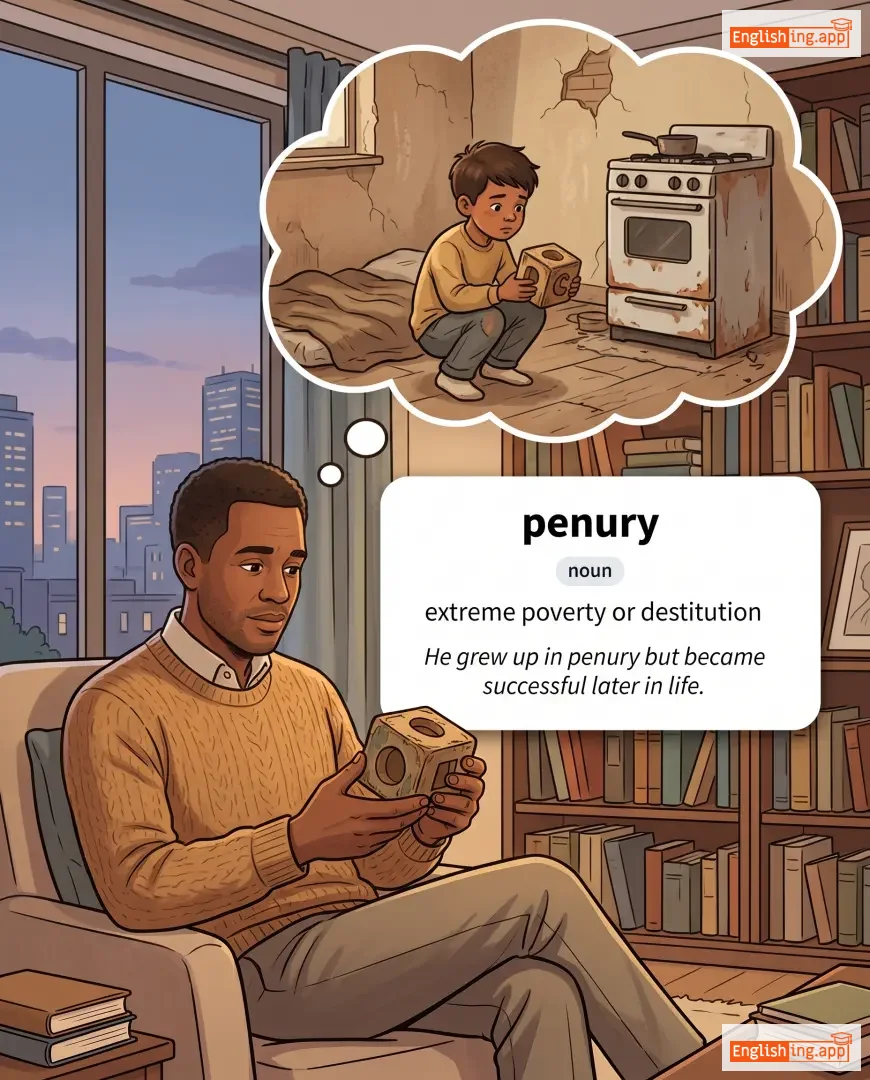
penury definition card — visual illustration of the meaning
noun
/ˈpɛnjʊri/
pobreza extrema (pobreza extrema)

extreme poverty or destitution

"He grew up in penury but became successful later in life."

"Él creció en la penuria, pero se hizo exitoso más tarde en la vida." (Él creció en la penuria, pero se hizo exitoso más tarde en la vida.)
noun
/ˈpiːɒn/
peón (peon)

a low-ranking worker, often performing menial tasks

"The office peon delivered the files to each department."

"El peón de la oficina entregó los archivos a cada departamento." (El peón de la oficina entregó los archivos a cada departamento.)
noun
/ˈpiːpl/
gente (gente)

a group of human beings collectively

"The people in the town gathered for the festival."

"La gente en el pueblo se reunió para el festival." (La gente en el pueblo se reunió para el festival.)
noun
/ˈpɛpər/
pimienta (pimienta)

a pungent spice obtained from pepper plants, used to flavor food

"I like to add pepper to my soup."

"Me gusta añadir pimienta a mi sopa." (Me gusta añadir pimienta a mi sopa.)
preposition
/pɜːr/
por (por)

for each, according to

"The tickets are priced at $20 per person."

"Los boletos están valorados en $20 por persona." (Los boletos estan valorados en 20 dolares por persona.)
noun
/pɜːr bɔɪld raɪs/
arroz precocido (arroz precocido)

Rice that has been partially boiled in the husk before milling; parboiled rice

"Per boiled rice retains more nutrients than regular white rice."

"El arroz precocido retiene más nutrientes que el arroz blanco regular." (El arroz precocido retiene más nutrientes que el arroz blanco regular.)
adverb
/pɜːr ˈseɪ/
por sí mismo (por si mismo)

By or in itself; intrinsically.

"The idea is not bad per se, but it needs improvement."

"La idea no es mala por sí mismo, pero necesita mejora." (La idea no es mala por si mismo, pero necesita mejora.)
verb
/pəˈræmbjʊˌleɪt/
pasear (pasear)

To walk through or travel around, especially for leisure.

"They perambulated the old town, enjoying the sights."

"Ellos paseaban por la ciudad antigua, disfrutando de las vistas." (Ellos paseaban por la ciudad antigua, disfrutando de las vistas.)
noun
/pəˈræm.bjə.leɪ.tər/
cochecito de bebé (perambulator)

a four-wheeled carriage for a baby; baby stroller or pram

"She pushed the perambulator through the park while the baby slept peacefully."

"Ella empujaba el perambulator por el parque mientras el bebé dormía tranquilamente." (Ella empujaba el perambulator por el parque mientras el bebé dormía tranquilamente.)
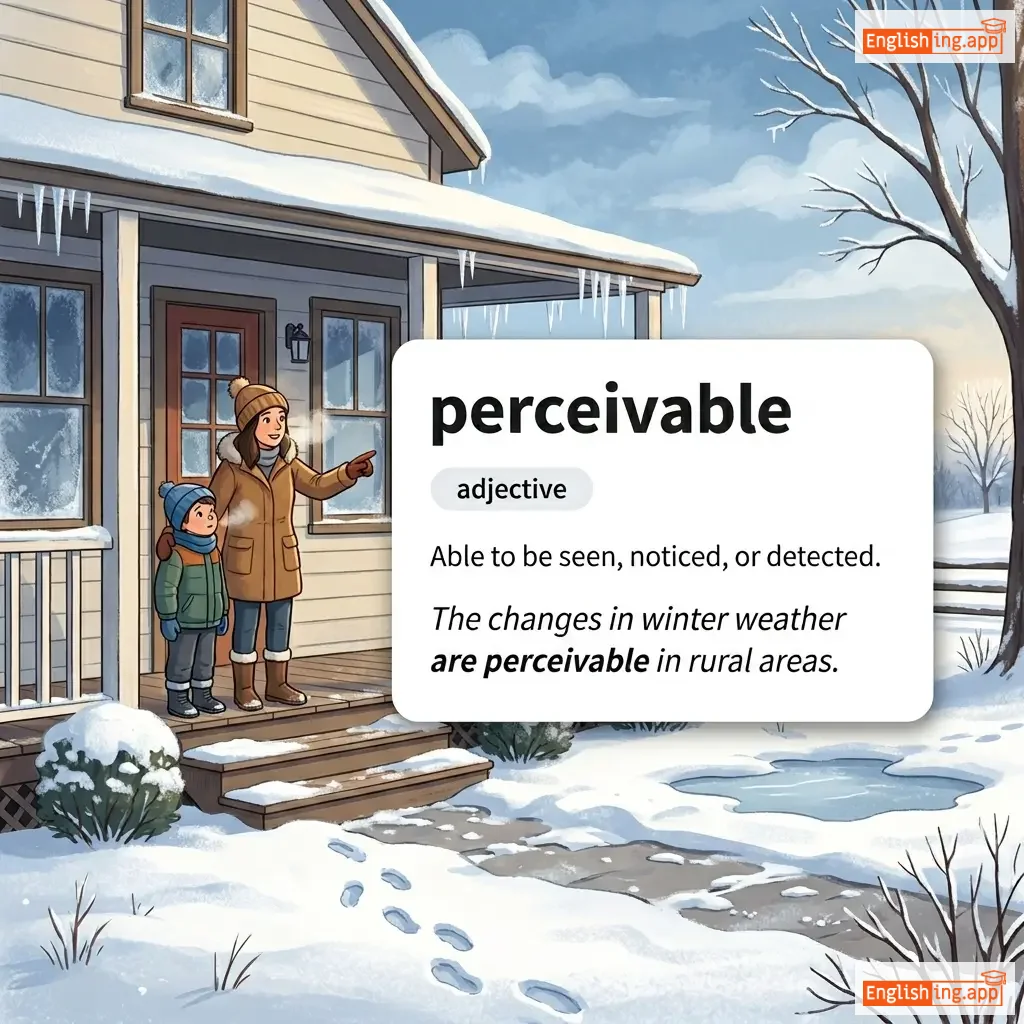
perceivable definition card — visual illustration of the meaning
adjective
পারসিভেবল
perceptible (perceptible)

Able to be seen, noticed, or detected.

"The changes in winter weather are perceivable in rural areas."

"Los cambios en el clima invernal son perceptibles en las áreas rurales." (Los cambios en el clima invernal son perceptibles en las áreas rurales.)
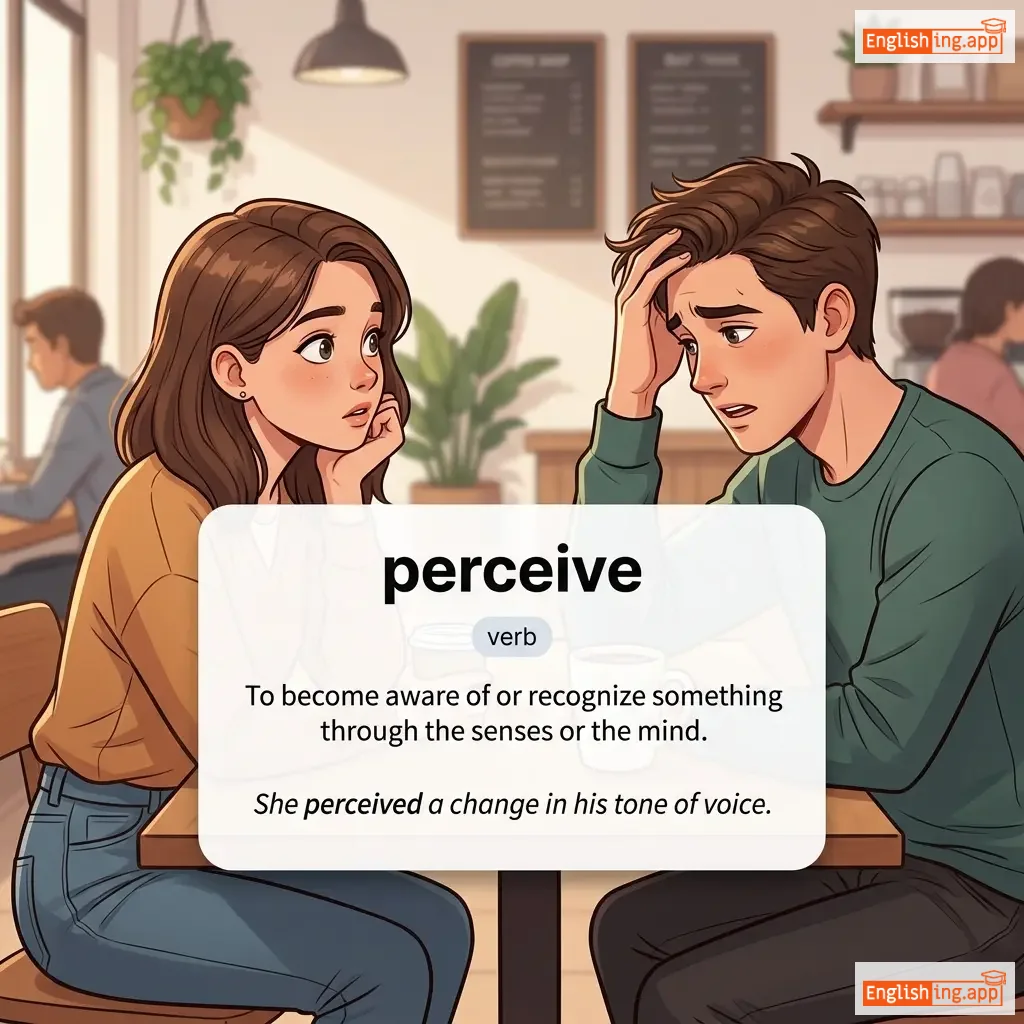
perceive definition card — visual illustration of the meaning
verb
/pərˈsiːv/
percibir (per-see-beer)

To become aware of or recognize something through the senses or the mind.

"She perceived a change in his tone of voice."

"Ella percibió un cambio en su tono de voz." (Eh-yah per-see-bee-oh oon kahm-bio en soo toh-noh deh vohs.)
👁️

perceived

verb
/pərˈsiːvd/
felicidad (felicidad)

to become aware of something through the senses or the mind; to understand or interpret

"She perceived a hint of sadness in his voice."

"No pudo esconder su felicidad cuando recibió el premio." (No pudo esconder su felicidad cuando recibió el premio.)
noun; adverb
/pərˈsɛnt/
por ciento (por ciento)

a proportion out of one hundred; by each hundred

"Sales increased by ten percent this year."

"Las ventas aumentaron un diez por ciento este año." (Las ventas aumentaron un diez por ciento este ano)
noun
/pərˈsɛntɪdʒ/
porcentaje (porcentaje)

a proportion or share in relation to a whole

"The percentage of students who passed the exam was high."

"El porcentaje de estudiantes que aprobaron el examen fue alto." (El porcentaje de estudiantes que aprobaron el examen fue alto.)
adjective
/pərˈsɛptəbl̩/
perceptible (perceptible)

Able to be noticed or recognized by the senses or the mind.

"There was a perceptible change in the atmosphere."

"Hubo un cambio perceptible en la atmósfera." (Hubo un cambio perceptible en la atmósfera.)