Vocabularios

Descubra, aprenda y domine el vocabulario en inglés

noun
/ˈnoʊzˌɡeɪ/
ramillete de flores (ramillete de flores)

a small bunch of flowers, typically given as a gift or carried for decoration

"She carried a nosegay of fresh roses to the ceremony."

"Ella llevaba un ramillete de rosas frescas a la ceremonia." (Ella llevaba un ramillete de rosas frescas a la ceremonia.)
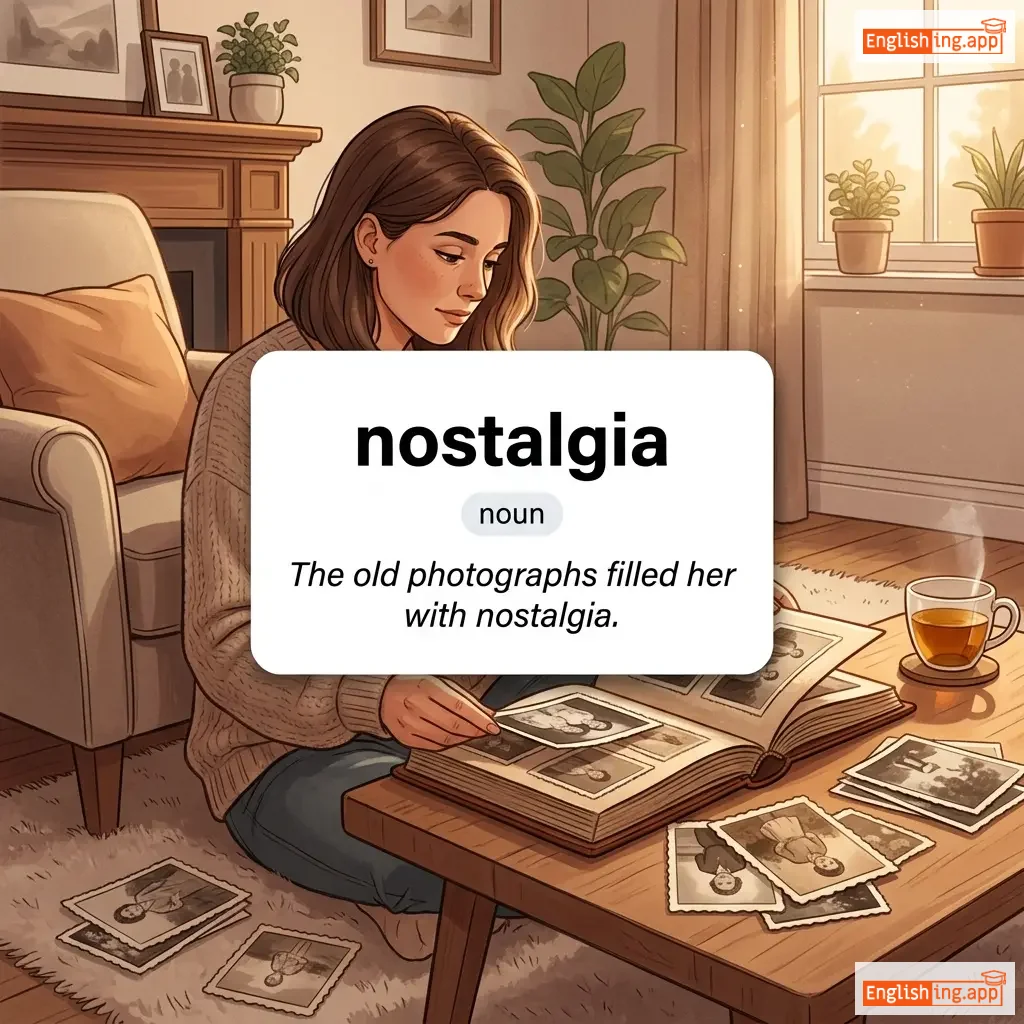
nostalgia definition card — visual illustration of the meaning
noun
/nəˈstældʒə/
nostalgia (nostalgia)

a sentimental longing for the past, often for a period or place with happy memories

"The old photographs filled her with nostalgia."

"Las viejas fotografías la llenaron de nostalgia." (Las viejas fotografias la llenaron de nostalgia.)
noun
/ˈnɒs.trɪl/
fosa nasal (fosa nasal)

either of the two openings in the nose through which air passes

"The doctor checked each nostril for any blockage."

"El doctor revisó cada fosa nasal en busca de cualquier obstrucción." (El doctor revisó cada fosa nasal en busca de cualquier obstrucción.)
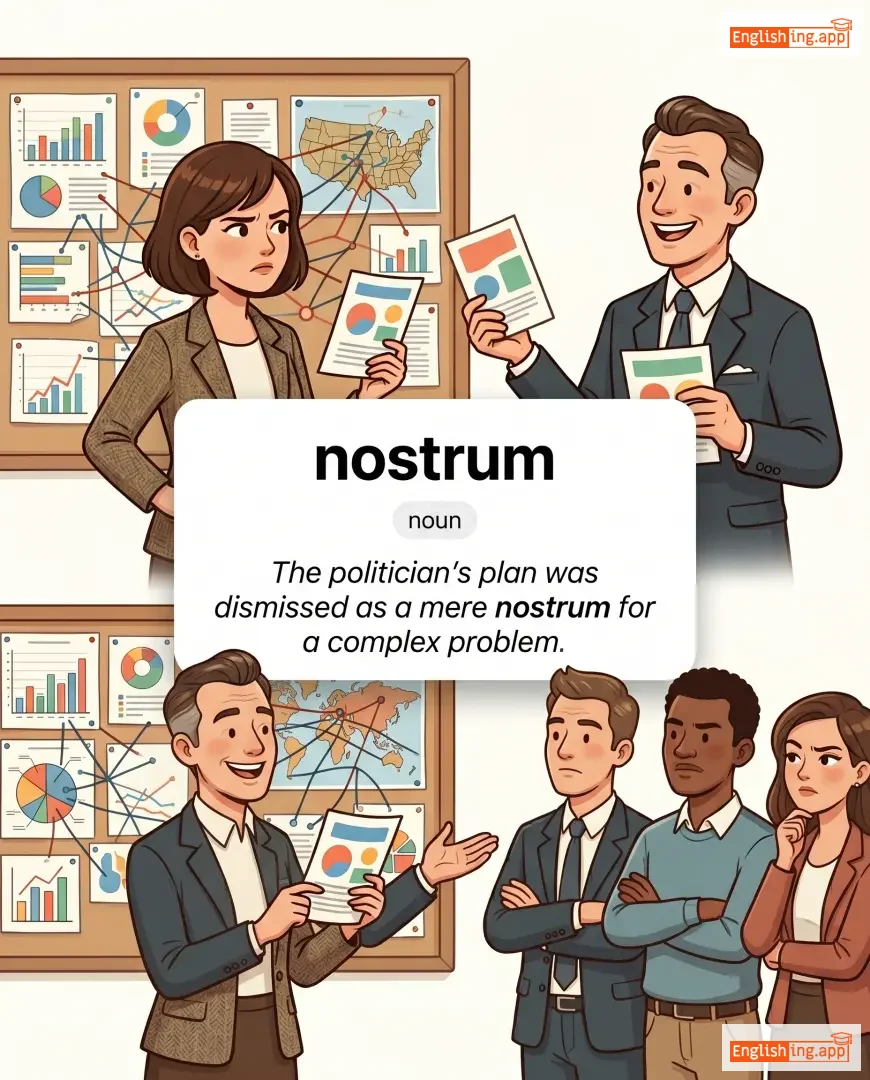
nostrum definition card — visual illustration of the meaning
noun
/ˈnɑːstrəm/
medicina ineficaz (medicina ineficaz)

a medicine or remedy, especially one that is not considered effective; a questionable solution

"The politician’s plan was dismissed as a mere nostrum for a complex problem."

"El plan del político fue desestimado como un simple remedio para un problema complejo." (El plan del político fue desestimado como un simple remedio para un problema complejo.)
adverb
/nɒt/
no (no)

used to make a word or phrase negative

"I do not like spicy food."

"No me gusta la comida picante." (No me gusta la comida picante.)
adjective
/ˈnoʊtəbl/
notable (notable)

worthy of attention or notice; remarkable

"She made a notable contribution to the project."

"Ella hizo una contribución notable al proyecto." (Ella hizo una contribución notable al proyecto.)
adverb
/ˈnoʊtəbli/
notablemente (notablemente)

used to indicate something worthy of attention or significant

"She is notably talented in painting."

"Ella es notablemente talentosa en la pintura." (Ella es notablemente talentosa en la pintura.)
noun
/noʊˈteɪʃən/
notación (notacion)

A system of symbols or signs used to represent information, especially in mathematics or music.

"The teacher explained the notation used in the algebra equations."

"El profesor explicó la notación utilizada en las ecuaciones algebraicas." (El profesor explico la notacion utilizada en las ecuaciones algebraicas.)
noun
/nɑːtʃ/
muesca (muesca)

A small cut or groove on the edge or surface of something; a level or degree of achievement.

"He carved a notch on the stick to mark the days."

"Hizo una muesca en el palo para marcar los días." (Hizo una muesca en el palo para marcar los días.)
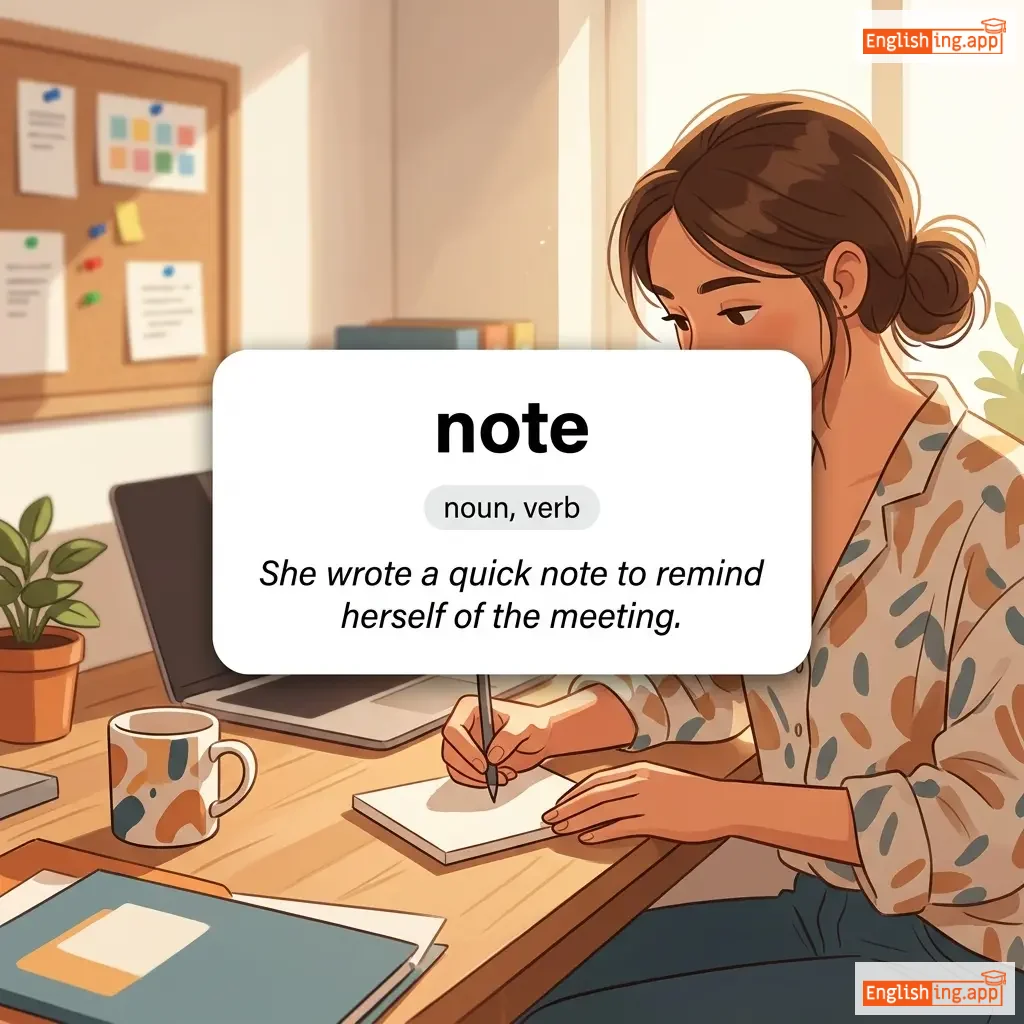
note definition card — visual illustration of the meaning
noun, verb
/noʊt/
nota (nota)

a brief record of facts, topics, or thoughts written down; to observe or remark upon something

"She wrote a quick note to remind herself of the meeting."

"Ella escribió una nota rápida para recordarse de la reunión." (Ella escribió una nota rápida para recordarse de la reunión.)
noun
/ˈnoʊtbʊk/

a small book with blank or ruled pages for writing notes; also a portable computer

"She opened her notebook to jot down some ideas."

adjective, verb
/ˈnoʊtɪd/
reconocido (reconocido)

well known or famous; written down or observed

"He is a noted author in the field of history."

"Él es un autor reconocido en el campo de la historia." (Él es un autor reconocido en el campo de la historia.)
pronoun
/ˈnʌθɪŋ/
nada (nada)

not anything; no thing

"She has nothing to worry about."

"Ella no tiene nada de qué preocuparse." (Ella no tiene nada de qué preocuparse.)
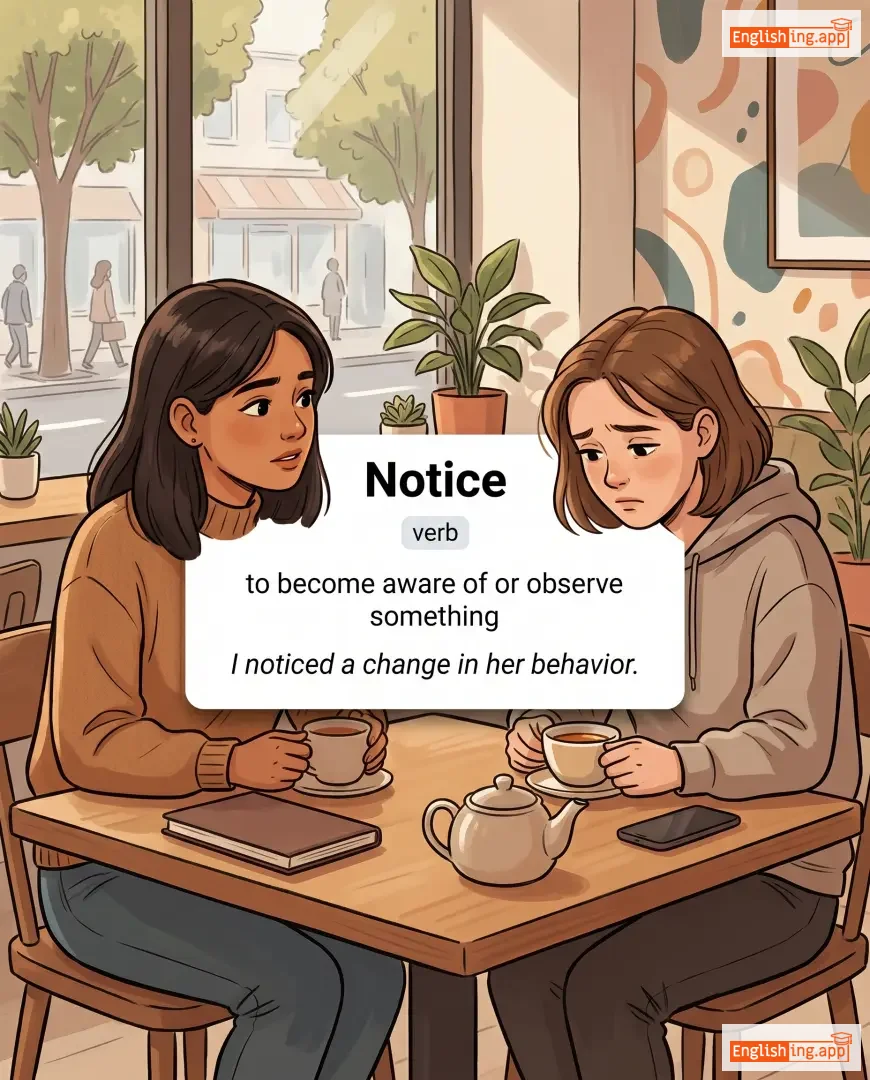
Notice definition card — visual illustration of the meaning
noun
/ˈnoʊtɪs/
aviso (aviso)

a written or printed announcement or notification

"He gave me a notice about the meeting."

"Me dio un aviso sobre la reunión." (Me dio un aviso sobre la reunión.)
adjective
/ˈnoʊtɪsəbl/
notable (notable)

Easily seen, observed, or recognized.

"There was a noticeable improvement in her performance."

"Hubo una mejora notable en su desempeño." (Hubo una mejora notable en su desempeño.)
noun
/ˌnəʊtɪfɪˈkeɪʃən/
notificación (notificacion)

an official or formal notice or message informing someone of something; an alert delivered by a system or device

"You will receive a notification when your application is approved."

"Recibirás una notificación cuando se apruebe tu solicitud." (recibiras una notificacion cuando se apruebe tu solicitud)
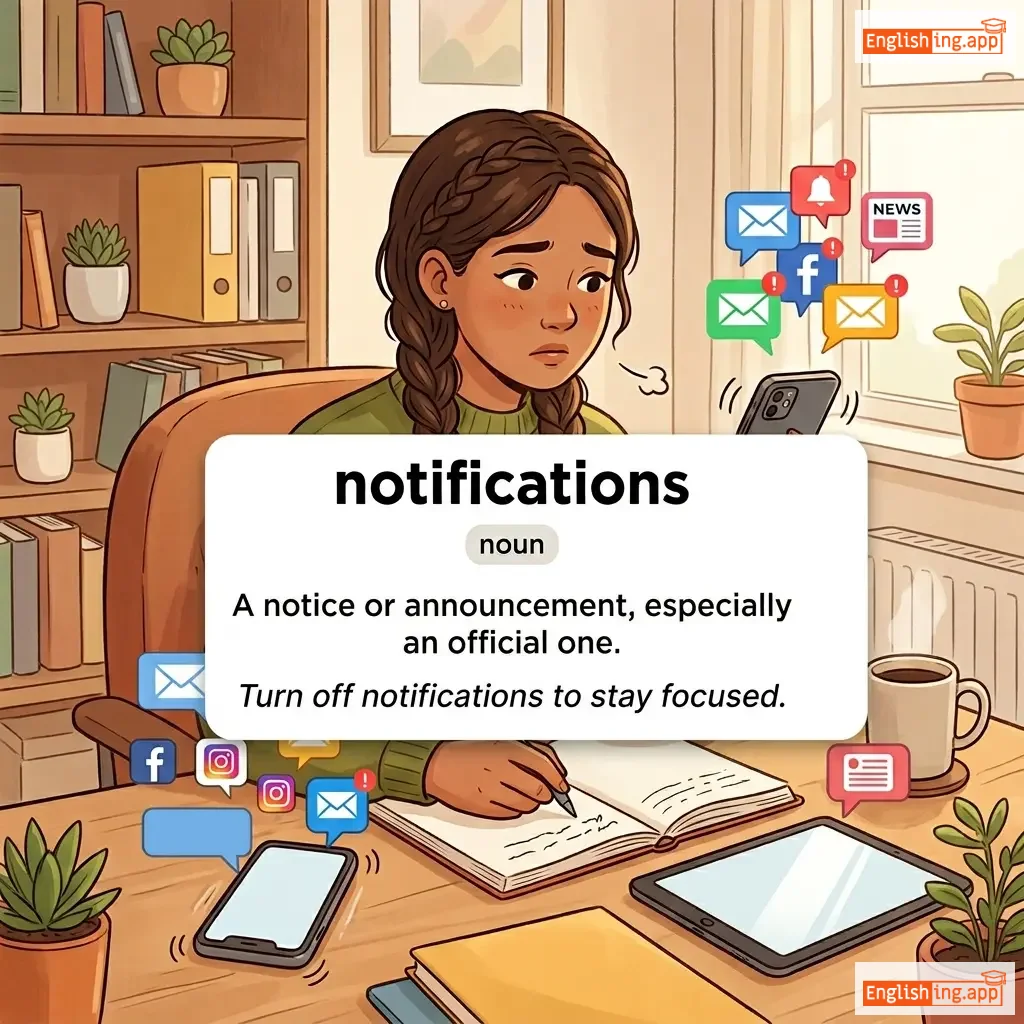
notifications definition card — visual illustration of the meaning
noun
/ˌnoʊtɪfɪˈkeɪʃənz/
notificaciones (notificaciones)

A notice or announcement, especially an official one.

"Turn off notifications to stay focused."

"Apaga las notificaciones para mantenerte enfocado." (Apaga las notificaciones para mantenerte enfocado.)
verb
/ˈnoʊtɪfaɪ/
notificar (notificar)

to inform someone officially about something

"The manager will notify the staff about the schedule change."

"El gerente notificará al personal sobre el cambio de horario." (El gerente notificará al personal sobre el cambio de horario.)
noun
/ˈnoʊʃən/
noción (nosion)

An idea, belief, or concept about something.

"He had a vague notion of what she wanted."

"Él tenía una vaga noción de lo que ella quería." (El tenia una vaga nosion de lo que ella queria.)
noun
/ˌnoʊtəˈraɪəti/
notoriedad (notoriedad)

The state of being famous or well-known for something bad.

"The criminal gained notoriety for his daring escapes."

"El criminal ganó notoriedad por sus audaces escapatorias." (El criminal ganó notoriedad por sus audaces escapatorias.)
adjective
/nəˈtɔːriəs/
notorio (notorio)

Famous or well-known for something bad or undesirable

"The area is notorious for its high crime rate."

"La zona es notoria por su alta tasa de criminalidad." (La zona es notoria por su alta tasa de criminalidad.)
preposition/adverb/conjunction
/ˌnɒtwɪθˈstændɪŋ/
a pesar de (a pesar de)

In spite of; despite

"Notwithstanding the challenges, the team completed the project."

"A pesar de los desafíos, el equipo completó el proyecto." (A pesar de los desafíos, el equipo completó el proyecto.)
verb
/ˈnʌrɪʃ/
nutrir (nutrir)

To provide with food or other substances necessary for growth, health, and good condition

"Good books nourish the mind."

"Los buenos libros nutren la mente." (Los buenos libros nutren la mente.)
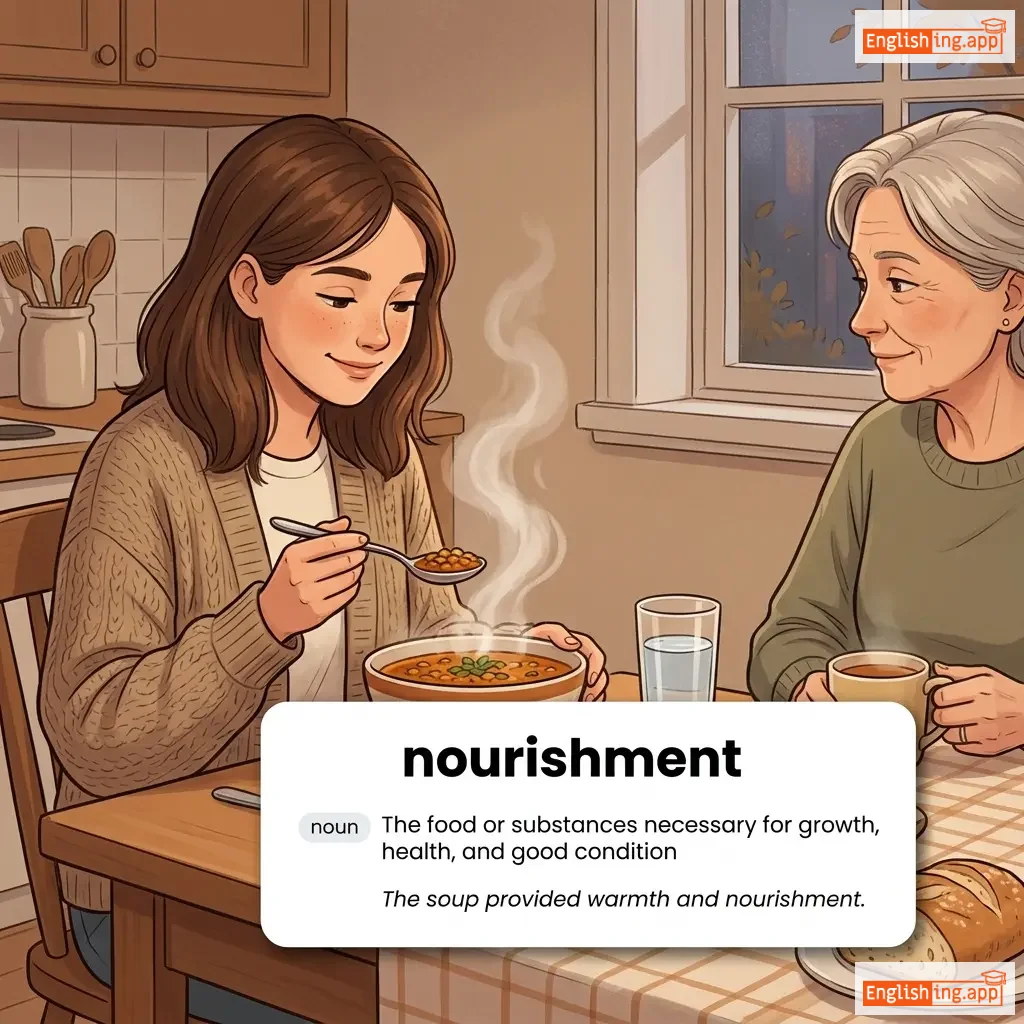
nourishment definition card — visual illustration of the meaning
noun
/ˈnʌrɪʃmənt/
nutrición (nutricion)

The food or substances necessary for growth, health, and good condition

"The soup provided warmth and nourishment."

"La sopa proporcionó calor y nutrición." (La sopa proporcionó calor y nutrición.)
noun
/ˈnoʊvə/
nova (una estrella que muestra un aumento repentino de brillo y luego vuelve lentamente a su estado original) (nova)

A star showing a sudden large increase in brightness and then slowly returning to its original state

"Astronomers observed a bright nova in the sky."

"Los astrónomos observaron una nova brillante en el cielo." (Los astrónomos observaron una nova brillante en el cielo.)
noun/adjective
/ˈnɒvəl/
novela / nuevo (novela / nuevo)

A long fictional narrative; also something new or unusual.

"She spent the weekend reading a historical novel."

"Ella pasó el fin de semana leyendo una novela histórica." (Ella paso el fin de semana leyendo una novela historica.)
noun
/ˈnɒvəlɪst/
novelista (novelista)

a person who writes novels

"The novelist spent years writing his new book."

"El novelista pasó años escribiendo su nuevo libro." (El novelista pasó años escribiendo su nuevo libro.)
noun
/ˌnɒvəˈlɛt/
novelito (novelito)

A short novel or long short story.

"The author published a novellette as a preview of her upcoming series."

"El autor publicó un novelito como adelanto de su próxima serie." (El autor publicó un novelito como adelanto de su próxima serie.)
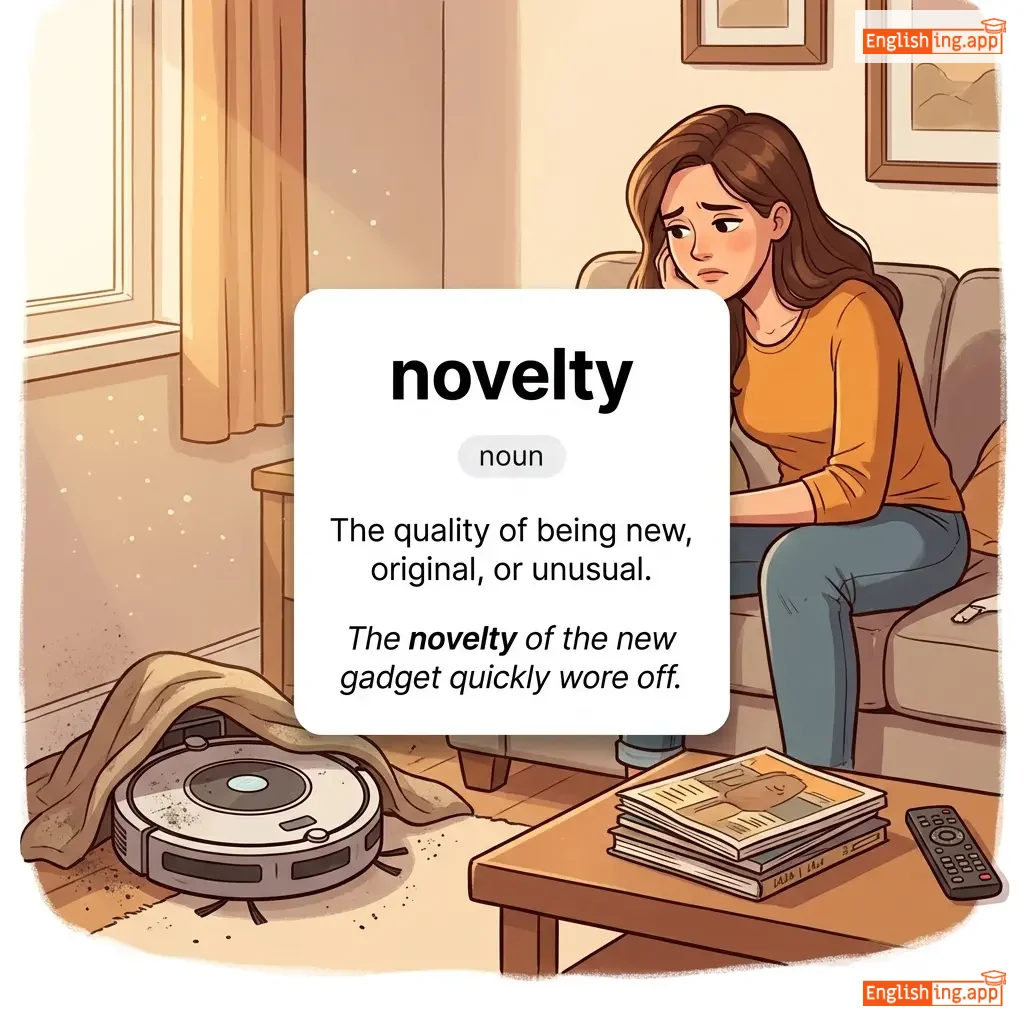
novelty definition card — visual illustration of the meaning
noun
/ˈnɒvəlti/
novedad (novedad)

The quality of being new, original, or unusual.

"The novelty of the new gadget quickly wore off."

"La novedad del nuevo gadget se desvaneció rápidamente." (La novedad del nuevo gadget se desvaneció rápidamente.)
noun
/noʊˈvɛmbər/
noviembre (noviembre)

the eleventh month of the year in the Gregorian calendar

"November is often cool and quiet before winter begins."

"Noviembre suele ser fresco y tranquilo antes de que empiece el invierno." (noviembre suele ser fresco y tranquilo antes de que empiece el invierno)
noun
/ˈnɒvɪs/
novato (novato)

A person new to or inexperienced in a field or activity.

"He is still a novice at playing the guitar."

"Todavía es un novato tocando la guitarra." (Todavía es un novato tocando la guitarra.)
adverb
/naʊ/
ahora (ahora)

at the present moment or time

"I am studying now."

"Estoy estudiando ahora." (Estoy estudiando ahora.)
adverb
/ˈnaʊədeɪz/
Hoy en día; en la actualidad (hoy en dia)

at the present time; in these times

"Now-a-days, people prefer online shopping."

"Hoy en día, la gente prefiere las compras en línea." (Hoy en dia, la gente prefiere las compras en linea.)
adverb
/ˈnaʊədeɪz/
hoy en día (hoy en dia)

At the present time; in contrast with the past.

"Nowadays, many people prefer shopping online."

"Hoy en día, muchas personas prefieren comprar en línea." (Hoy en día, muchas personas prefieren comprar en línea.)
adverb
/ˈnoʊˌwɛr/
en ninguna parte (en ninguna parte)

in or to no place; not anywhere

"The missing keys were nowhere to be found."

"Las llaves perdidas no estaban en ninguna parte." (Las llaves perdidas no estaban en ninguna parte.)
adjective
/ˈnɑːkʃəs/
nocivo (nocivo)

harmful, poisonous, or very unpleasant

"The factory released noxious fumes into the air."

"La fábrica liberó vapores nocivos al aire." (La fábrica liberó vapores nocivos al aire.)
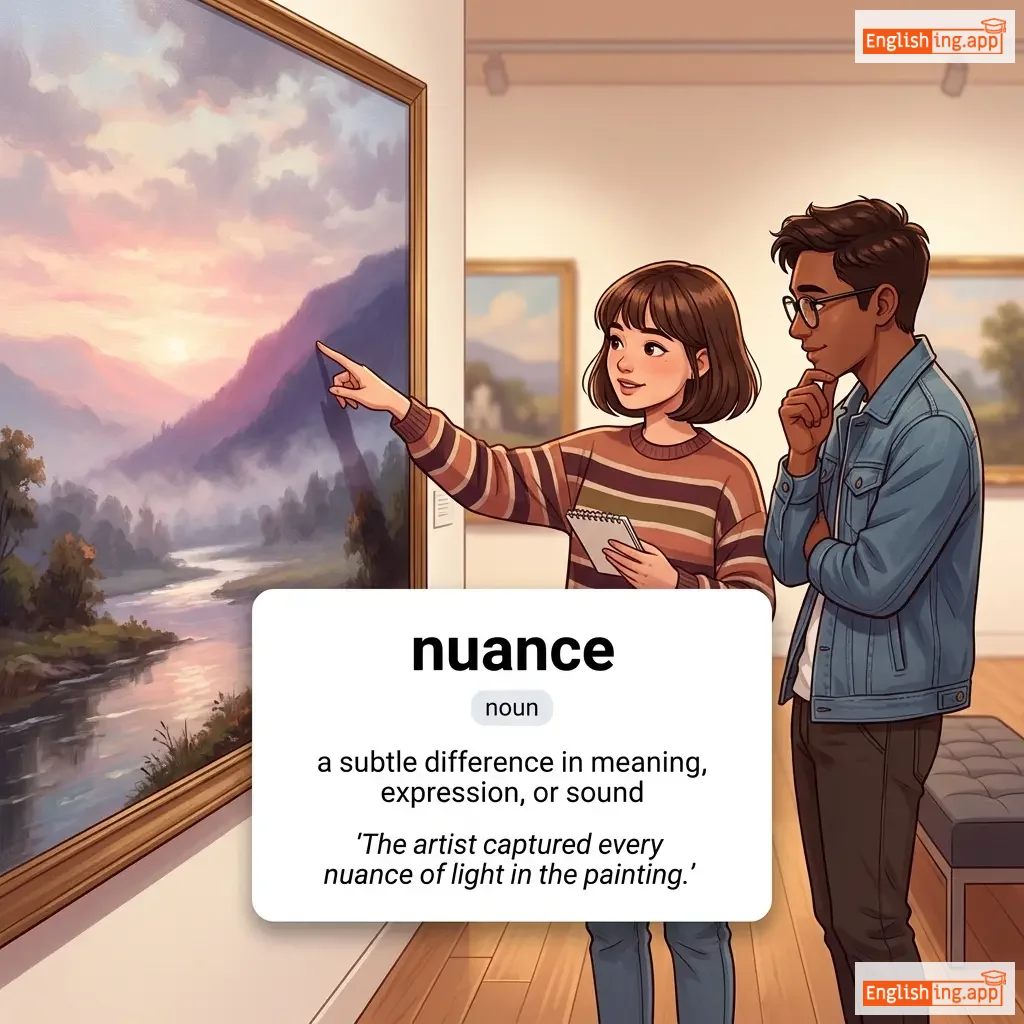
nuance definition card — visual illustration of the meaning
noun
/ˈnuːˌɑːns/
matiz (matiz)

a subtle difference in meaning, expression, or sound

"The artist captured every nuance of light in the painting."

"El artista capturó cada matiz de luz en la pintura." (El artista capturo cada matiz de luz en la pintura.)
adjective
ˈnuː.ɑːnst
matizado (matizado)

Characterized by subtle shades of meaning or expression; having or characterized by subtle and often appealingly complex qualities.

"His argument was nuanced and well-structured."

"Su argumento fue matizado y bien estructurado." (Su argumento fue matizado y bien estructurado.)
adjective
/ˈnjuːbaɪl/
nublia (nubila)

of a young woman, sexually mature and suitable for marriage

"The village was celebrating the festival with its nubile maidens dancing."

"El pueblo estaba celebrando el festival con sus nubias bailando." (El pueblo estaba celebrando el festival con sus nubias bailando.)
adjective
/ˈnuːkliər/
nuclear (nuclear)

relating to the nucleus of an atom or to nuclear energy

"The country is developing nuclear energy."

"El país está desarrollando energía nuclear." (El pais esta desarrollando energia nuclear.)
verb
/ˈnuːkliˌeɪt/
nuclear (nuclear)

to form into a nucleus or bring together into a central part

"The droplets began to nucleate around tiny particles in the air."

"Las gotas comenzaron a nuclearse alrededor de pequeñas partículas en el aire." (Las gotas comenzaron a nuclearse alrededor de pequeñas partículas en el aire.)
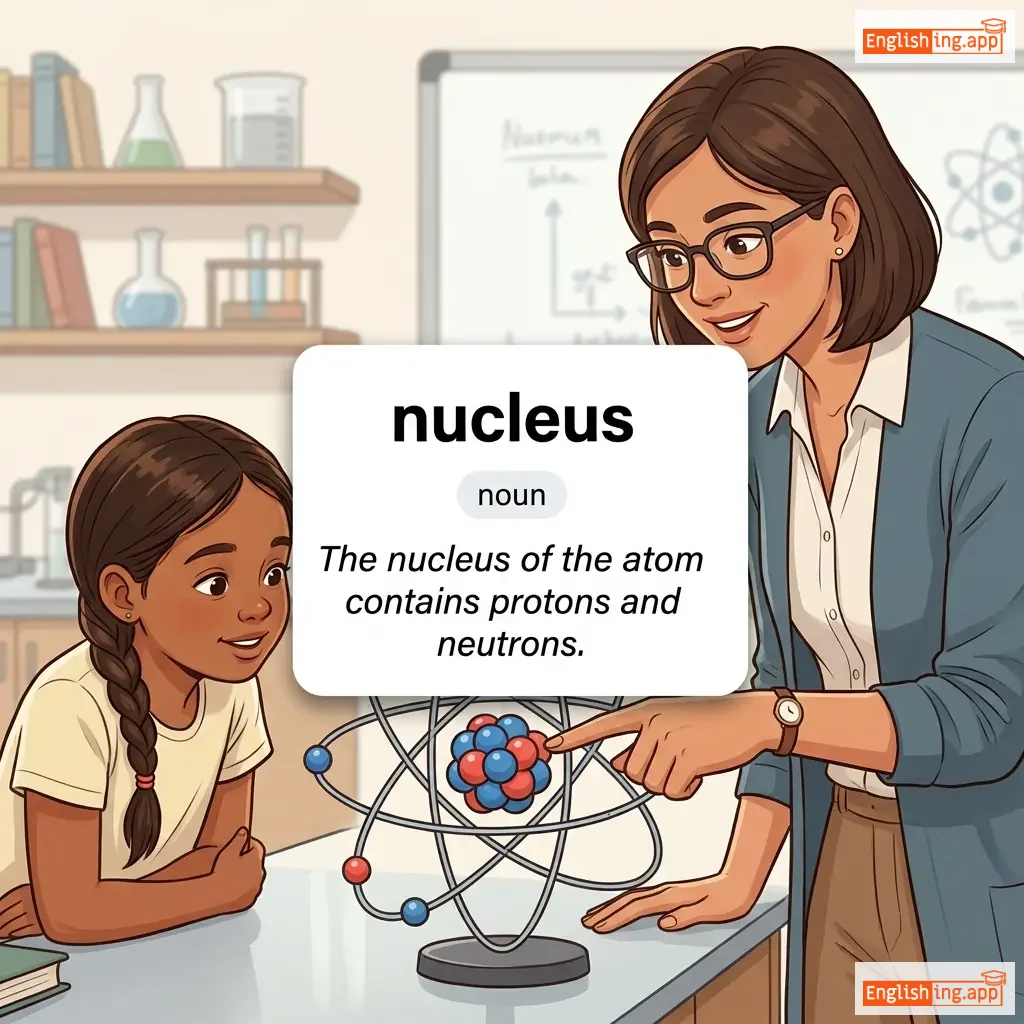
nucleus definition card — visual illustration of the meaning
noun
/ˈnjuː.kli.əs/
núcleo (nucleo)

The central and most important part of something, forming the basis for its activity and growth; in biology, the central part of a cell.

"The nucleus of the atom contains protons and neutrons."

"El núcleo del átomo contiene protones y neutrones." (El nucleo del atomo contiene protones y neutrones.)
adjective
/nuːd/
desnudo (desnudo)

Wearing no clothes; naked.

"The artist painted a nude model."

"El artista pintó un modelo desnudo." (El artista pintó un modelo desnudo.)
verb
/nʌdʒ/
empujón con el codo (empushon kon el kodo)

To push someone gently, usually with your elbow, in order to attract attention.

"She nudged him to be quiet during the meeting."

"Ella lo empujó suavemente para que estuviera en silencio durante la reunión." (Ella lo empujó suavemente para ke estuviera en silencio durante la reunión.)
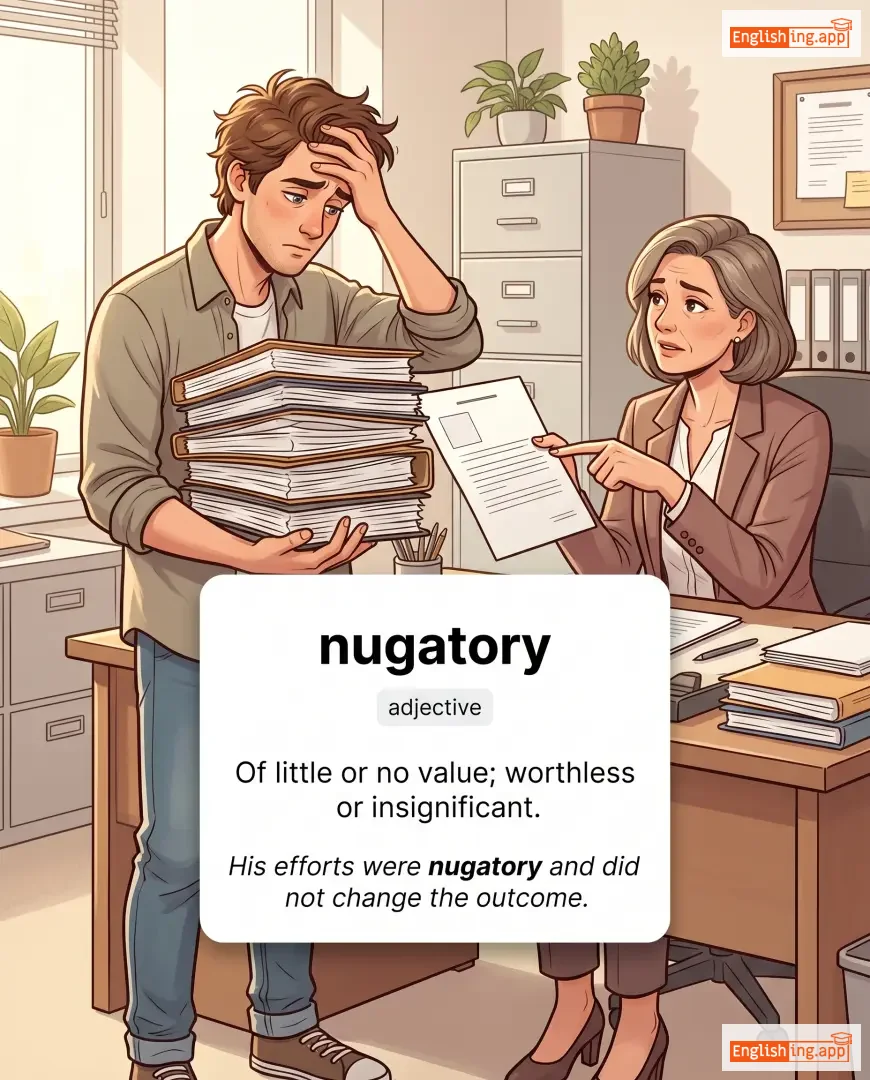
nugatory definition card — visual illustration of the meaning
adjective
/ˈnjuː.ɡə.tɔːr.i/
inútil (inutil)

Of little or no value; worthless or insignificant.

"His efforts were nugatory and did not change the outcome."

"Sus esfuerzos fueron inútiles y no cambiaron el resultado." (Sus esfuerzos fueron inutiles y no cambiaron el resultado.)
noun
/ˈnjuː.səns/
molestia (molestia)

A person, thing, or situation that causes inconvenience or annoyance.

"The loud construction noise was a nuisance to the neighbors."

"El fuerte ruido de la construcción fue una molestia para los vecinos." (El fuerte ruido de la construccion fue una molestia para los vecinos.)
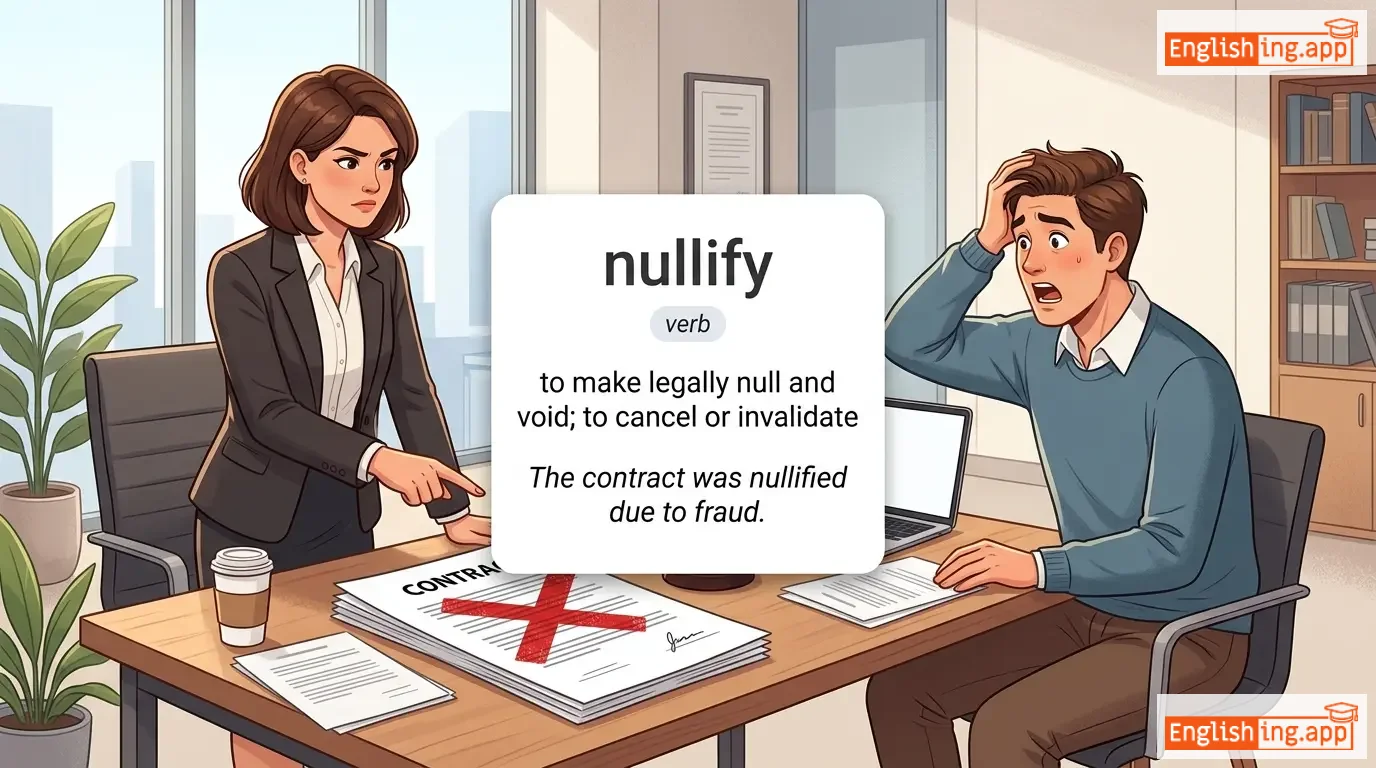
nullify definition card — visual illustration of the meaning
verb
/ˈnʌlɪfaɪ/
anular (anular)

to make legally null and void; to cancel or invalidate

"The contract was nullified due to fraud."

"El contrato fue anulado debido al fraude." (El contrato fue anulado debido al fraude.)
noun
/ˈnʌmbər/
número (numero)

a mathematical value used to count, measure, or label

"She gave me her phone number."

"Ella me dio su número de teléfono." (Ella me dio su numero de telefono.)
adjective
/ˈnjuː.mər.ə.bəl/
contable; numerable (contable; numerable)

capable of being counted; countable

"The stars in the sky are not numerable."

"Las estrellas en el cielo no son numerables." (Las estrellas en el cielo no son numerables.)
noun
/ˌnjuːməˈreɪʃən/
numeración (numeracion)

the action or process of counting or assigning numbers

"The teacher explained the basics of numeration to the students."

"El maestro explicó los conceptos básicos de la numeración a los estudiantes." (El maestro explico los conceptos basicos de la numeracion a los estudiantes.)