Vocabularios

Descubra, aprenda y domine el vocabulario en inglés

verb
/mæʃ/
machacar (machacar)

to crush or mix food into a soft mass, usually by pressing or beating

"She mashed the potatoes before serving dinner."

"ella machó las papas antes de servir la cena." (ella machó las papas antes de servir la cena.)
noun
/mæsk/
máscara (mascara)

A covering for the face to protect, disguise, or entertain.

"He wore a mask at the costume party."

"Él llevaba una máscara en la fiesta de disfraces." (Él llevaba una máscara en la fiesta de disfraces.)
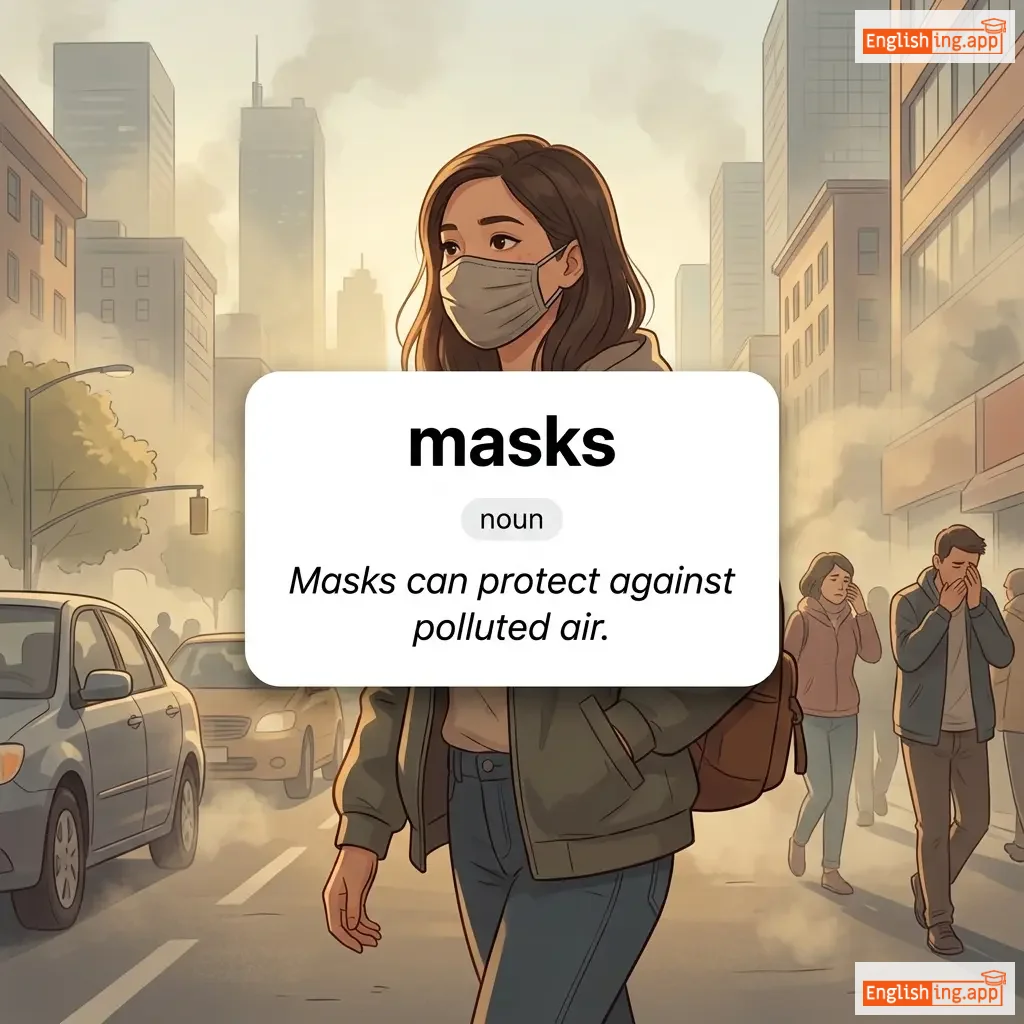
masks definition card — visual illustration of the meaning
noun
/mɑːsks/
máscara (mascara)

Coverings for all or part of the face, worn as a disguise, for protection, or for medical reasons.

"Masks can protect against polluted air."

"Las máscaras pueden proteger contra el aire contaminado." (Las máscaras pueden proteger contra el aire contaminado.)
noun
/ˈmæsəkɪst/
masoquista (masoquista)

a person who derives pleasure from their own pain or humiliation

"He was called a masochist for enjoying tough challenges."

"Lo llamaron masoquista por disfrutar de desafíos difíciles." (Lo llamaron masoquista por disfrutar de desafíos difíciles.)
noun
/ˈmeɪsən/
albañil (albañil)

a person skilled in building with stone, brick, or concrete

"The mason carefully laid the bricks for the new house."

"El albañil colocó cuidadosamente los ladrillos para la nueva casa." (El albanyil coloco cuidadosamente los ladrillos para la nueva casa.)
noun
/ˌmæskəˈreɪd/
fiesta donde la gente usa máscaras y disfraces (fiesta donde la gente usa mascaras y disfraces)

a party or gathering where people wear masks and costumes; a false outward show

"The charity event was held as a grand masquerade."

"El evento benéfico se celebró como un gran masquerade." (El evento benefico se celebro como un gran masquerade.)
noun
/mæs/
masa (masa)

a large body of matter with no specific shape; a large number of people or things

"A huge mass of people gathered in the square."

"Una enorme masa de personas se reunió en la plaza." (Una enorme masa de personas se reunió en la plaza.)
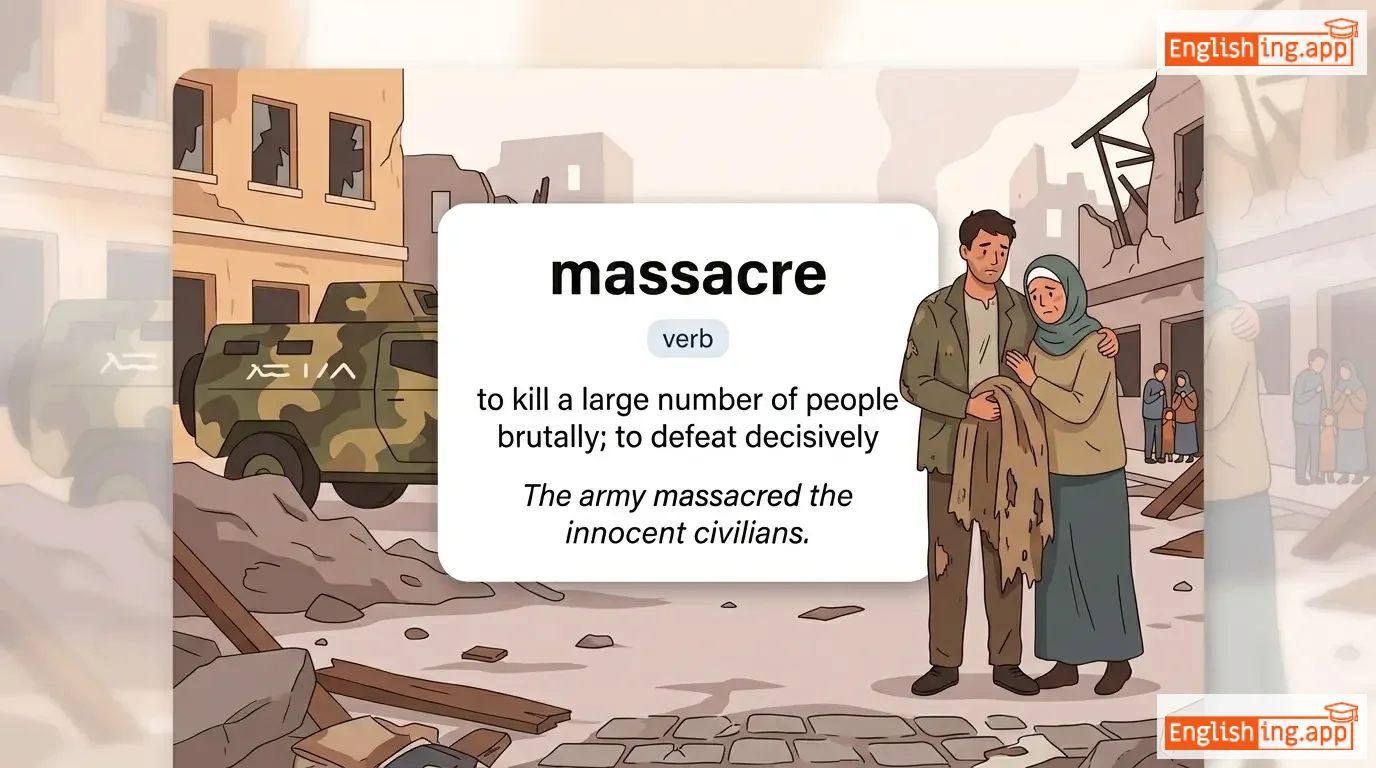
massacre definition card — visual illustration of the meaning
noun
/ˈmæsəkər/
masacre (masacre)

the killing of a large number of people, usually in a violent way

"The massacre resulted in the deaths of hundreds of civilians."

"La masacre resultó en la muerte de cientos de civiles." (La masacre resultó en la muerte de cientos de civiles.)
verb
/məˈsɑːʒ/
masajear (masajear)

to rub and press muscles to relieve pain or tension; to manipulate information

"The therapist will massage your back to reduce muscle tension."

"El terapeuta masajeará tu espalda para reducir la tensión muscular." (El terapeuta masajeará tu espalda para reducir la tensión muscular.)
adjective
/ˈmæsɪv/
enorme (enorme)

extremely large, heavy, or solid in size or degree

"The company made a massive investment in renewable energy."

"La empresa hizo una enorme inversión en energía renovable." (La empresa hizo una enorme inversión en energía renovable.)
noun, verb
/ˈmɑːstər/
maestro (maestro)

A person with great skill or control in a subject or activity; to gain full command over something.

"She mastered the art of cooking Italian dishes."

"Ella dominó el arte de cocinar platos italianos." (Ella dominó el arte de cocinar platos italianos.)
noun
/ˈmæstərˌpiːs/
obra maestra (obra maestra)

a work of outstanding artistry, skill, or workmanship

"The Mona Lisa is considered Leonardo da Vinci’s masterpiece."

"La Mona Lisa es considerada la obra maestra de Leonardo da Vinci." (La Mona Lisa es considerada la obra maestra de Leonardo da Vinci.)
noun
/ˈmæstəri/
maestría (maestria)

comprehensive knowledge or skill in a subject or accomplishment

"She has achieved mastery in classical dance."

"Ella ha alcanzado maestría en danza clásica." (Ella ha alcanzado maestria en danza clasica.)
verb
/ˈmæstɪkeɪt/
masticar (masticar)

to chew food thoroughly before swallowing

"He slowly masticated the bread before swallowing."

"Él masticó lentamente el pan antes de tragarlo." (El masticó lentamente el pan antes de tragarlo.)
noun
/mæt/
alfombra (alfombra)

a piece of fabric material placed on a floor or surface for wiping feet or protection

"She placed a new mat at the entrance of the house."

"Ella colocó una nueva alfombra en la entrada de la casa." (Ella colocó una nueva alfombra en la entrada de la casa.)
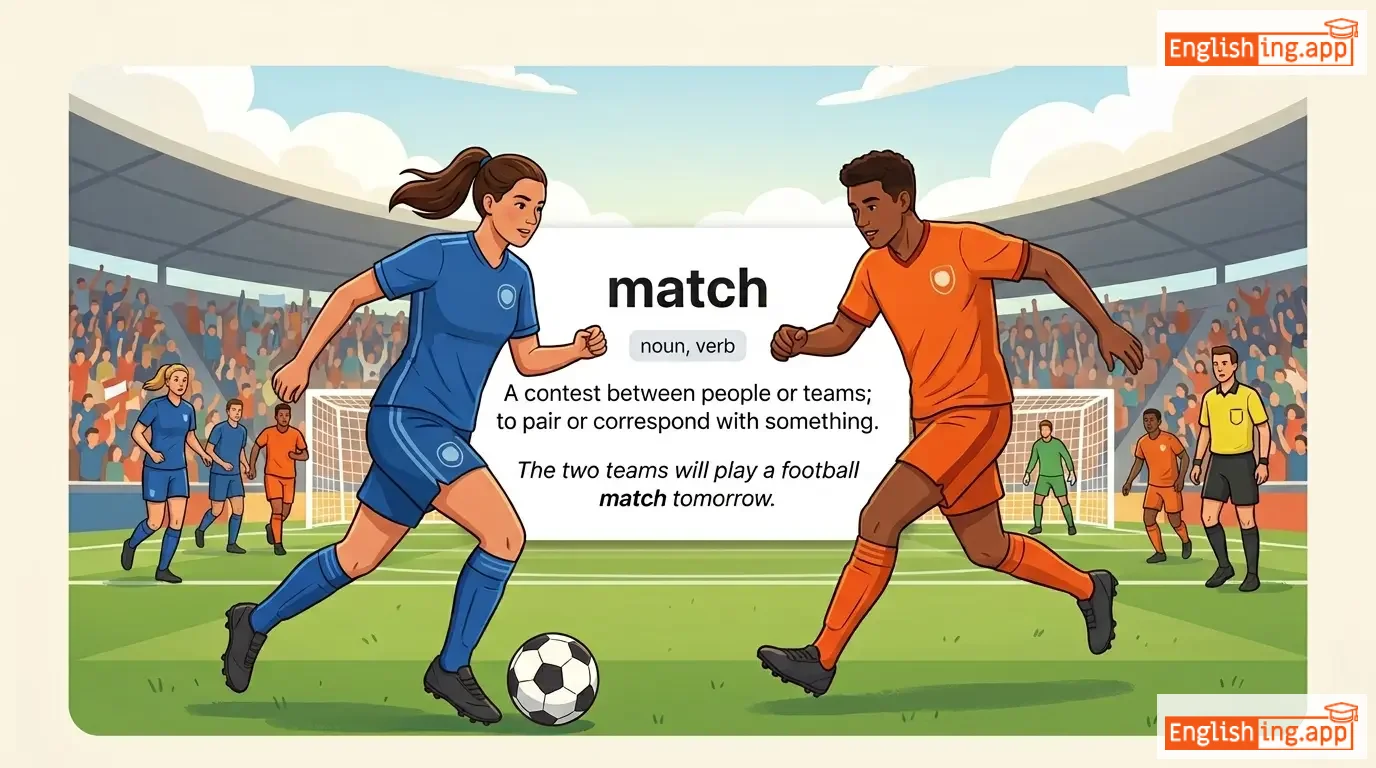
match definition card — visual illustration of the meaning
noun, verb
/mætʃ/
partido / competencia (partido / competencia)

A contest between people or teams; to pair or correspond with something.

"The two teams will play a football match tomorrow."

"Los dos equipos jugarán un partido de fútbol mañana." (Los dos equipos jugarán un partido de fútbol mañana.)
noun
/meɪt/
amigo, compañero (amigo, companero)

a friend or companion; a partner in marriage or reproduction

"He went fishing with his old school mate."

"Fue a pescar con su viejo compañero de escuela." (Fue a pescar con su viejo companero de escuela.)
noun, adjective
/məˈtɪəriəl/
material (material)

The substance or matter from which something is made; relating to physical things rather than ideas or emotions.

"The builder brought all the necessary material for the construction."

"El constructor trajo todo el material necesario para la construcción." (El constructor trajo todo el material necesario para la construcción.)
noun
/məˈtɪəriəlɪzəm/
materialismo (materialismo)

A tendency to consider material possessions and physical comfort as more important than spiritual or moral values.

"The novel criticizes society's growing materialism."

"La novela critica el creciente materialismo de la sociedad." (La novela critica el creciente materialismo de la sociedad.)
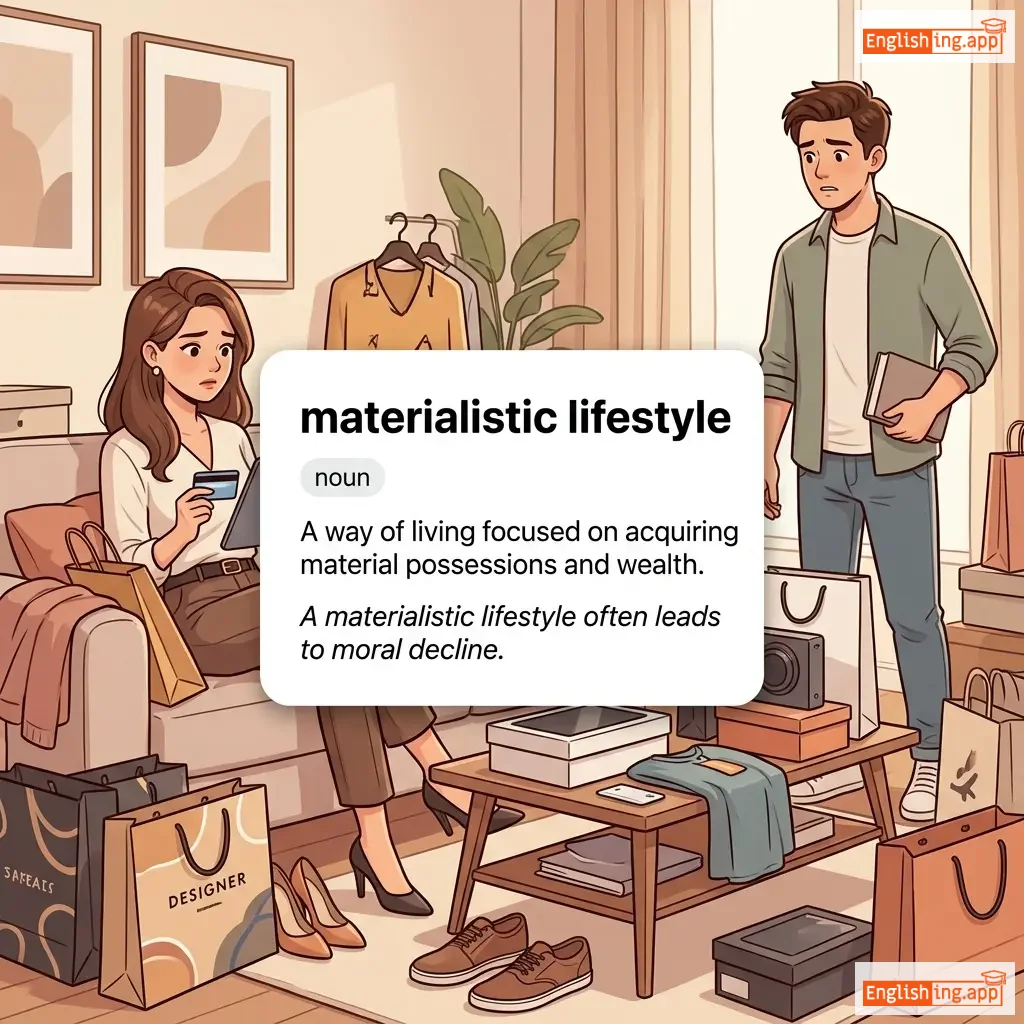
materialistic lifestyle definition card — visual illustration of the meaning
noun
məˌtɪərɪəˈlɪstɪk ˈlaɪfstaɪl
estilo de vida materialista (estilo de vida materialista)

A way of living focused on acquiring material possessions and wealth.

"A materialistic lifestyle often leads to moral decline."

"Un estilo de vida materialista a menudo lleva al declive moral." (Un estilo de vida materialista a menudo lleva al declive moral.)
verb
/məˈtɪərɪəlaɪz/
materializarse (materializarse)

To become real or actual; to appear suddenly or in a physical form.

"The opportunity he had been waiting for finally materialized."

"La oportunidad que había estado esperando finalmente se materializó." (La oportunidad que había estado esperando finalmente se materializó.)
adjective
/məˈtɜːnəl/
maternal (maternal)

Relating to a mother; showing motherly qualities such as care and protection.

"She showed great maternal affection toward the child."

"Ella mostró gran afecto maternal hacia el niño." (Ella mostró gran afecto maternal hacia el niño.)
noun
/məˈtɜːrnəti/
maternidad (maternidad)

The state of being a mother; motherhood

"The hospital has an excellent maternity ward for new mothers."

"El hospital tiene una excelente sala de maternidad para nuevas madres." (El hospital tiene una excelente sala de maternidad para nuevas madres.)
noun
/mæθ/
matemáticas (matematicas)

The study of numbers, quantities, and shapes, also called mathematics.

"She is very good at math."

"Ella es muy buena en matemáticas." (Ella es muy buena en matematicas.)
adjective
/ˌmæθəˈmætɪkəl/
matemático (matematiko)

relating to mathematics or the use of mathematics

"The mathematical equation was difficult to solve."

"La ecuación matemática era difícil de resolver." (La ecuacion matematica era dificil de resolver.)
adverb
/ˌmæθəˈmætɪkli/
matemáticamente (matematicamente)

in a way that relates to mathematics; using numbers, formulas, or logical calculation

"The problem can be solved mathematically rather than by guesswork."

"El problema puede resolverse matemáticamente en lugar de adivinar." (El problema puede resolverse matematicamente en lugar de adivinar)
noun
/ˌmæθəˈmætɪks/
matemáticas (matematicas)

the abstract science of number, quantity, and space; the study of numbers and their operations

"Mathematics helps us understand patterns in nature and the universe."

"Las matemáticas nos ayudan a entender los patrones en la naturaleza y el universo." (Las matematicas nos ayudan a entender los patrones en la naturaleza y el universo.)
noun
/ˈmætɪneɪ/
función de la tarde (funcion de la tarde)

A performance, especially a play or movie, that takes place in the afternoon.

"We bought tickets for the Sunday afternoon matinee."

"Compramos entradas para la función de la tarde del domingo." (Compramos entradas para la funcion de la tarde del domingo.)
👩‍👩‍👧‍👦

matriarch (matriark)

noun
/ˈmeɪ.triˌɑːrk/
matriarca (matriark)

A woman who is the head of a family or community.

"The matriarch of the family made all important decisions."

"La matriarca de la familia tomó todas las decisiones importantes." (La matriarca de la familia tomo todas las decisiones importantes.)
noun
/ˈmætrɪˌsaɪd/
matricidio (matricidio)

The act of killing one's own mother.

"The crime of matricide shocked the entire town."

"El crimen de matricidio sorprendió a toda la ciudad." (El krimen de matricidio sorprendió a toda la ciudad.)
verb
/məˈtrɪkjʊˌleɪt/
matricularse (matricularse)

To enroll as a student in a college or university.

"She matriculated at Oxford University last year."

"Ella se matriculó en la Universidad de Oxford el año pasado." (Ella se matriculó en la Universidad de Oxford el año pasado.)
noun
/ˈmætrəˌmoʊni/
matrimonio (matrimonio)

The state of being married; marriage.

"They entered into matrimony after years of friendship."

"Entraron en el matrimonio después de años de amistad." (Entraron en el matrimonio después de años de amistad.)
noun
/ˈmeɪ.trɪks/
matriz, estructura (matriz, estructura)

An environment or structure in which something develops; also a mathematical array of numbers.

"The cultural matrix shaped his worldview."

"La matriz cultural moldeó su visión del mundo." (La matriz cultural moldeó su visión del mundo.)
noun, verb
/ˈmætər/
asunto / importancia (asunto / importancia)

A subject or situation under consideration; to be important.

"It doesn’t matter what others think."

"No importa lo que piensen los demás." (No importa lo que piensen los demas.)
noun/verb
/ˈmætərz/
asuntos / importar (asuntos / importar)

important topics, concerns, or issues; as a verb, to be of importance or significance

"What she thinks really matters to me."

"Lo que ella piensa realmente importa para mí." (Lo que ella piensa realmente importa para mí.)
noun
/ˈmætrəs/
colchón (colchon)

A large pad used as a bed or part of a bed, typically filled with soft material for sleeping on.

"She bought a new mattress for better sleep comfort."

"Compró un colchón nuevo para mayor comodidad al dormir." (Compró un colchón nuevo para mayor comodidad al dormir.)
adjective
/məˈtjʊr/
maduro (maduro)

fully developed or grown, especially emotionally or intellectually

"She has become a mature and confident leader."

"Ella se ha convertido en una líder madura y segura de sí misma." (Ella se ha convertido en una lider madura y segura de si misma.)
noun
/məˈtʃʊrəti/
madurez (maturreza)

The state of being mature; full development physically or emotionally

"With age comes wisdom and emotional maturity."

"Con la edad llega la sabiduría y la madurez emocional." (Con la edad llega la sabiduria y la madurez emocional.)
adjective
/ˈmɔːdlɪn/
excesivamente sentimental (excesivamente sentimental)

Overly sentimental, often tearfully or weakly emotional.

"He became maudlin after a few drinks."

"Se volvió demasiado sentimental después de unas copas." (Se volvió demasiado sentimental después de unas copas.)
verb
/mɔːl/
mutilar (mutilar)

To wound or injure someone by scratching or tearing; to handle roughly.

"The bear mauled the camper in the forest."

"El oso mutiló al campista en el bosque." (El oso mutiló al campista en el bosque.)
verb
/ˈmɔːndər/
hablar sin sentido (hablar sin sentido)

To speak or move aimlessly and incoherently.

"He maundered on about his old memories."

"Él habló sin sentido sobre sus viejos recuerdos." (Él habló sin sentido sobre sus viejos recuerdos.)
noun
/ˌmɔːzəˈliːəm/
mausoleo (mausoleo)

A large stately building that houses a tomb or several tombs.

"The king was buried in a grand mausoleum."

"El rey fue enterrado en un gran mausoleo." (El rey fue enterrado en un gran mausoleo.)
adjective
/moʊv/
morado claro (morado claro)

a pale purple color with a grayish or bluish tinge

"She wore a beautiful mauve dress to the party."

"Ella llevaba un hermoso vestido morado claro en la fiesta." (Ella llevaba un hermoso vestido morado claro en la fiesta.)
🧑‍🏫

maven (méiven)

noun
/ˈmeɪvən/
experto (experto)

an expert or connoisseur in a particular field

"He is a tech maven who always knows the latest trends."

"Él es un experto en tecnología que siempre sabe las últimas tendencias." (Él es un experto en tecnología que siempre sabe las últimas tendencias.)
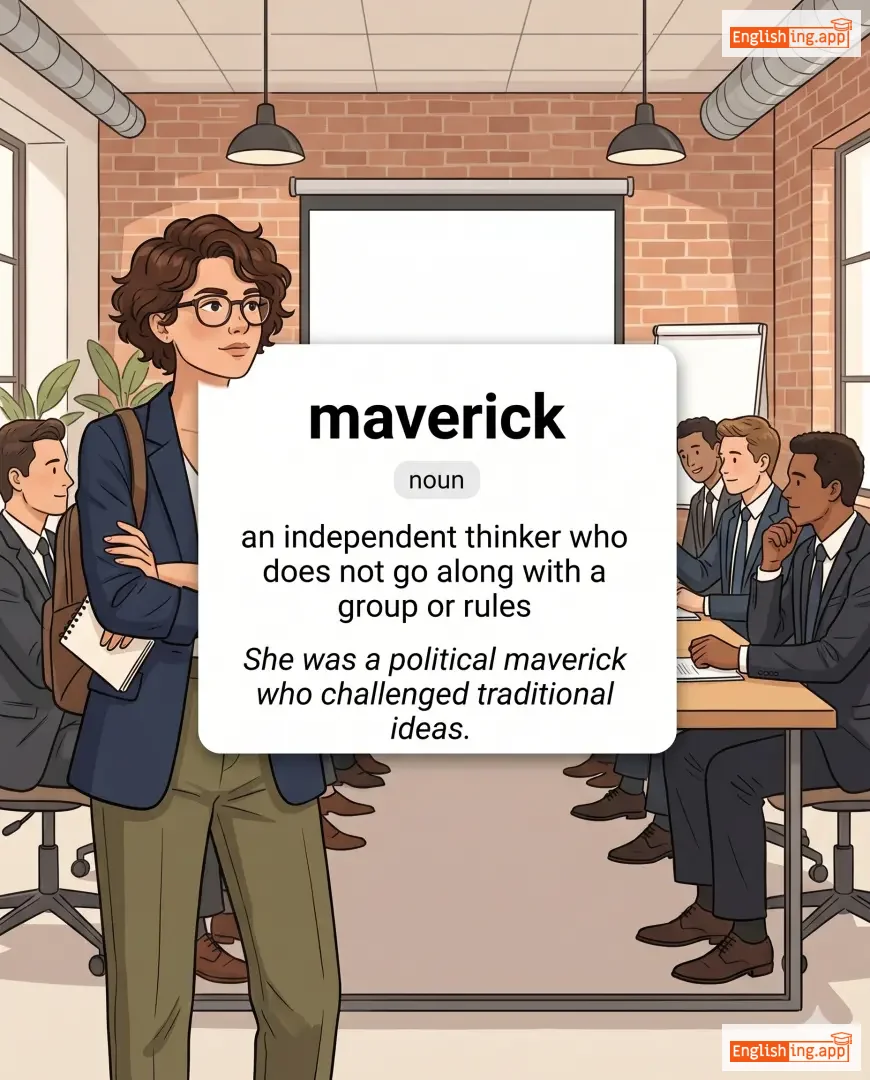
maverick definition card — visual illustration of the meaning
noun
/ˈmævərɪk/
inconformista (inconformista)

an independent thinker who does not go along with a group or rules

"She was a political maverick who challenged traditional ideas."

"Ella era una maverick política que desafiaba las ideas tradicionales." (Ella era una maverick política que desafiaba las ideas tradicionales.)
adjective
/ˈmɔːkɪʃ/
excesivamente sentimental (excesivamente sentimental)

excessively sentimental, often to the point of being sickly

"The movie was criticized for its mawkish sentimentality."

"La película fue criticada por su sentimentalismo empalagoso." (La película fue criticada por su sentimentalismo empalagoso.)
noun
/ˈmæksɪm/
máxima (maxima)

a short, well-known statement expressing a general truth or rule of conduct

"Honesty is a timeless maxim valued in every culture."

"La honestidad es una máxima atemporal valorada en todas las culturas." (La honestidad es una maxima atemporal valorada en todas las culturas.)
verb
/ˈmæk.sɪ.maɪz/
maximizar (maximizar)

to increase something as much as possible

"The company aims to maximize its profits this year."

"La empresa tiene como objetivo maximizar sus ganancias este año." (La empresa tiene como objetivo maximizar sus ganancias este año.)
noun/adjective
/ˈmæksɪməm/
máximo (maximo)

the greatest or highest amount, value, or degree possible

"She scored the maximum marks in the exam."

"Ella sacó la máxima puntuación en el examen." (Ella saco la maxima puntuacion en el examen.)
modal verb, noun
/meɪ/
puede ser / mes de mayo (puede ser / mes de mayo)

Used to express possibility, permission, or uncertainty; also the name of the fifth month of the year.

"You may leave early if you finish your work."

"Puedes irte temprano si terminas tu trabajo." (Puedes irte temprano si terminas tu trabajo.)