Vocabularios

Descubra, aprenda y domine el vocabulario en inglés

noun
/mæn əv wɔːr/
buque de guerra (buque de guerra)

a warship; a naval vessel equipped with weapons for warfare

"The man of war sailed across the ocean to defend the coast."

"El buque de guerra cruzó el océano para defender la costa." (El buque de guerra cruzó el océano para defender la costa.)
noun
/ˈmænˌiː.tər/
hombre-devorador (hombre-devorador)

An animal that kills and eats humans; informally, a woman who is very assertive in relationships.

"The tiger became a notorious man-eater in the village."

"El tigre se convirtió en un hombre-devorador famoso en el pueblo." (El tigre se convirtió en un hombre-devorador famoso en el pueblo.)
noun
/ˈmænˌtræp/
trampa para hombres (trampa para hombres)

A trap designed to catch or injure humans; informally, a woman considered dangerously attractive.

"The old castle had a man-trap at the entrance."

"El viejo castillo tenía una trampa para hombres en la entrada." (El viejo castillo tenia una trampa para hombres en la entrada.)
noun/verb
/ˈmæn.ə.kəl/
grillete (grillete)

A metal shackle for fastening someone's hands or ankles; also to restrain with such shackles.

"The prisoner was manacled before being taken to court."

"El prisionero fue maniatado antes de ser llevado al tribunal." (El prisionero fue maniatado antes de ser llevado al tribunal.)
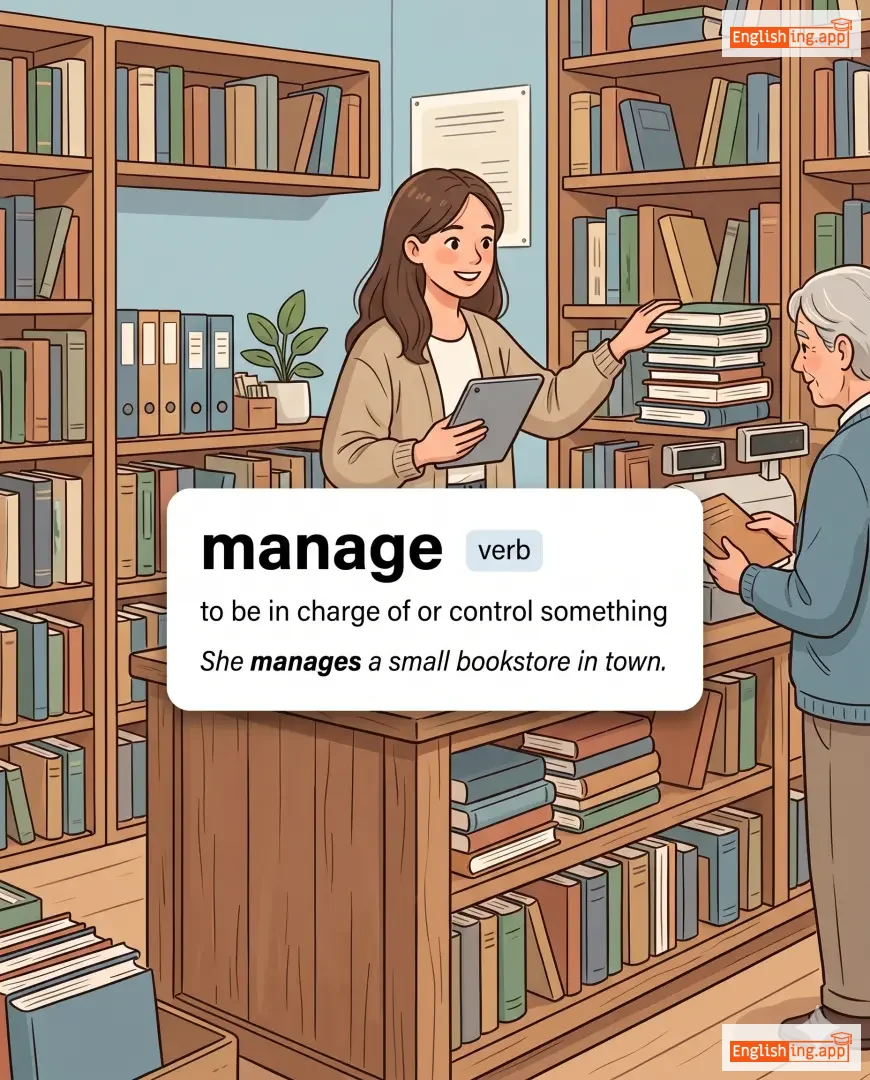
manage definition card — visual illustration of the meaning
verb
/ˈmænɪdʒ/
manejar (manejar)

to be in charge of or control something

"She manages a small bookstore in town."

"Ella maneja una pequeña librería en la ciudad." (Ella maneja una pequeña librería en la ciudad.)
adjective
/ˈmænɪdʒəbəl/
manejable; controlable (manejable; controlable)

able to be controlled or dealt with; feasible

"The workload is manageable if we plan properly."

"La carga de trabajo es manejable si planificamos adecuadamente." (La carga de trabajo es manejable si planificamos adecuadamente.)
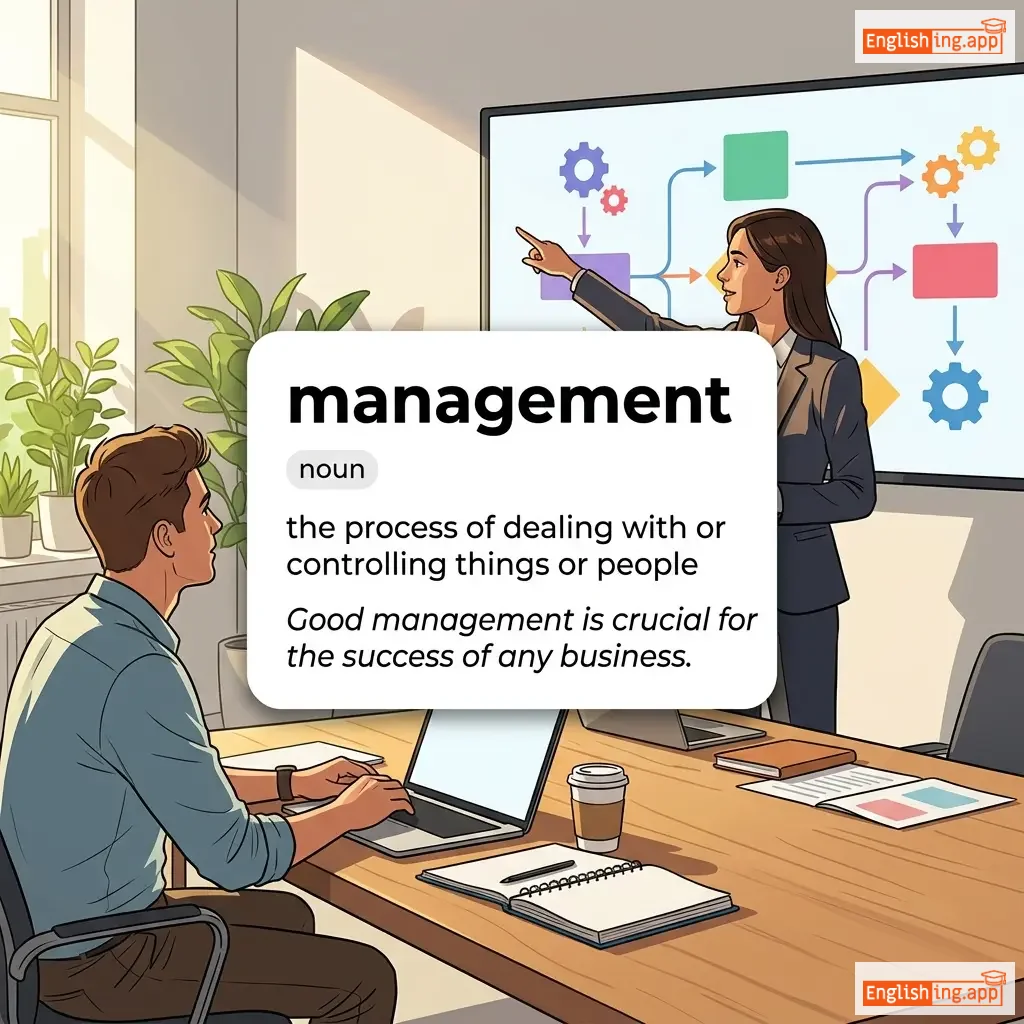
management definition card — visual illustration of the meaning
noun
/ˈmænɪdʒmənt/
gestión (gestion)

the process of dealing with or controlling things or people

"Good management is crucial for the success of any business."

"La buena gestión es crucial para el éxito de cualquier negocio." (La buena gestion es crucial para el exito de cualquier negocio.)
noun
/ˈmænɪdʒər/
gerente (gerente)

a person responsible for controlling or administering an organization or group of staff

"The manager approved the new project plan."

"El gerente aprobó el nuevo plan de proyecto." (El gerente aprobó el nuevo plan de proyecto.)
noun, verb
/ˈmæn.deɪt/
mandato (mandato)

an official order or command; to give someone authority to act in a certain way

"The government issued a mandate to reduce carbon emissions."

"El gobierno emitió un mandato para reducir las emisiones de carbono." (El gobierno emitió un mandato para reducir las emisiones de carbono.)
adjective
/ˈmæn.dəˌtɔːr.i/
obligatorio (obligatorio)

required by law or rules; compulsory

"Wearing seat belts is mandatory in most countries."

"El uso del cinturón de seguridad es obligatorio en la mayoría de los países." (El uso del cinturon de seguridad es obligatorio en la mayoria de los paises.)
noun
/meɪn/
melena (melena)

the long hair growing on the neck of a horse, lion, or other animal

"The lion shook its thick mane proudly."

"El león sacudió su espesa melena con orgullo." (El leon sacudio su espesa melena con orgullo.)
noun, verb
/məˈnuː.vər/
maniobra / hábil (maniobra / habil)

a planned or skillful movement or action; to move skillfully or carefully

"The pilot maneuvered the plane through the storm."

"El piloto maniobró el avión a través de la tormenta." (El piloto maniobro el avion a traves de la tormenta.)
noun
/meɪndʒ/
sarna (sar-na)

a skin disease in animals caused by parasitic mites, leading to hair loss and sores

"The stray dog was suffering from mange."

"El perro callejero estaba sufriendo de sarna." (El perro callejero estaba sufriendo de sarna.)
verb
/ˈmæŋɡəl/
destrozar (destrozar)

to severely damage or mutilate something, often by tearing or crushing

"The car was mangled in the accident."

"El coche fue destrozado en el accidente." (El coche fue destrozado en el accidente.)
noun
/ˈmæŋ.ɡoʊ/
mango (mango)

a tropical fruit with yellow-orange skin and sweet juicy flesh

"The mango is known as the king of fruits."

"El mango es conocido como el rey de las frutas." (El mango es conocido como el rey de las frutas.)
noun
/ˈmæŋɡoʊ fɪʃ/
pez barramundi (pez barramundi)

A popular white fish also known as barramundi or Asian sea bass

"Mango fish is prized for its delicate flavor and tender texture."

"El pez barramundi es apreciado por su sabor delicado y su textura tierna." (El pez barramundi es apreciado por su sabor delicado y su textura tierna)
noun
/mæŋˈɡoʊ.li.ə/
magnolia (magnolia)

a type of flowering tree with large, fragrant pink or white flowers

"The beautiful magnolia tree bloomed in spring with pink flowers."

"El hermoso árbol de magnolia floreció en primavera con flores rosas." (El hermoso arbol de magnolia florecio en primavera con flores rosas)
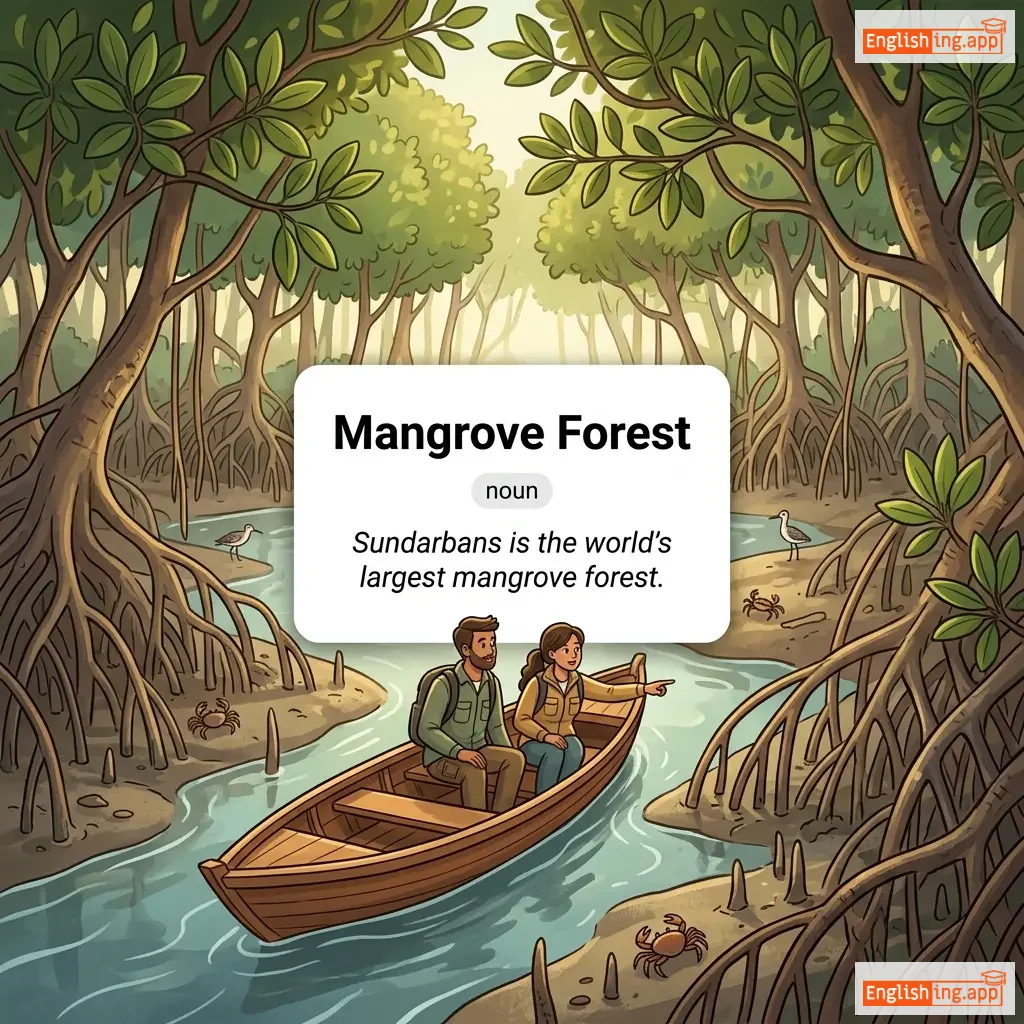
Mangrove Forest definition card — visual illustration of the meaning
noun
ˈmæŋɡroʊv ˈfɒrɪst
bosque de manglares (bosque de manglares)

A coastal forest ecosystem characterized by salt-tolerant trees and shrubs that grow in intertidal zones.

"Sundarbans is the world's largest mangrove forest."

"Sundarbans es el mayor bosque de manglares del mundo." (Sundarbans es el mayor bosque de manglares del mundo.)
adjective
/ˈmeɪndʒi/
sucio y desgastado (sucio y desgastado)

in poor condition, shabby, dirty, or affected by mange

"The stray dog looked mangy and weak."

"El perro callejero se veía sucio y débil." (El perro callejero se veia sucio y debil.)
noun
/ˈmeɪniə/
manía (mania)

an extreme enthusiasm or obsession; a mental illness marked by excitement

"There was a mania for collecting rare stamps."

"Había una manía por coleccionar sellos raros." (Había una manía por coleccionar sellos raros.)
noun
/ˈmeɪniæk/
maniaco (maniaco)

a person who behaves in a wildly foolish, dangerous, or violent way

"The driver was speeding like a maniac."

"El conductor estaba conduciendo como un maníaco." (El conductor estaba conduciendo como un maníaco.)
adjective
/məˈnaɪəkəl/
maniaco (maniako)

behaving like a maniac; showing excessive enthusiasm or madness

"He gave a maniacal laugh during the movie."

"Él dio una risa maniaca durante la película." (El dio una risa maniaka durante la pelicula.)
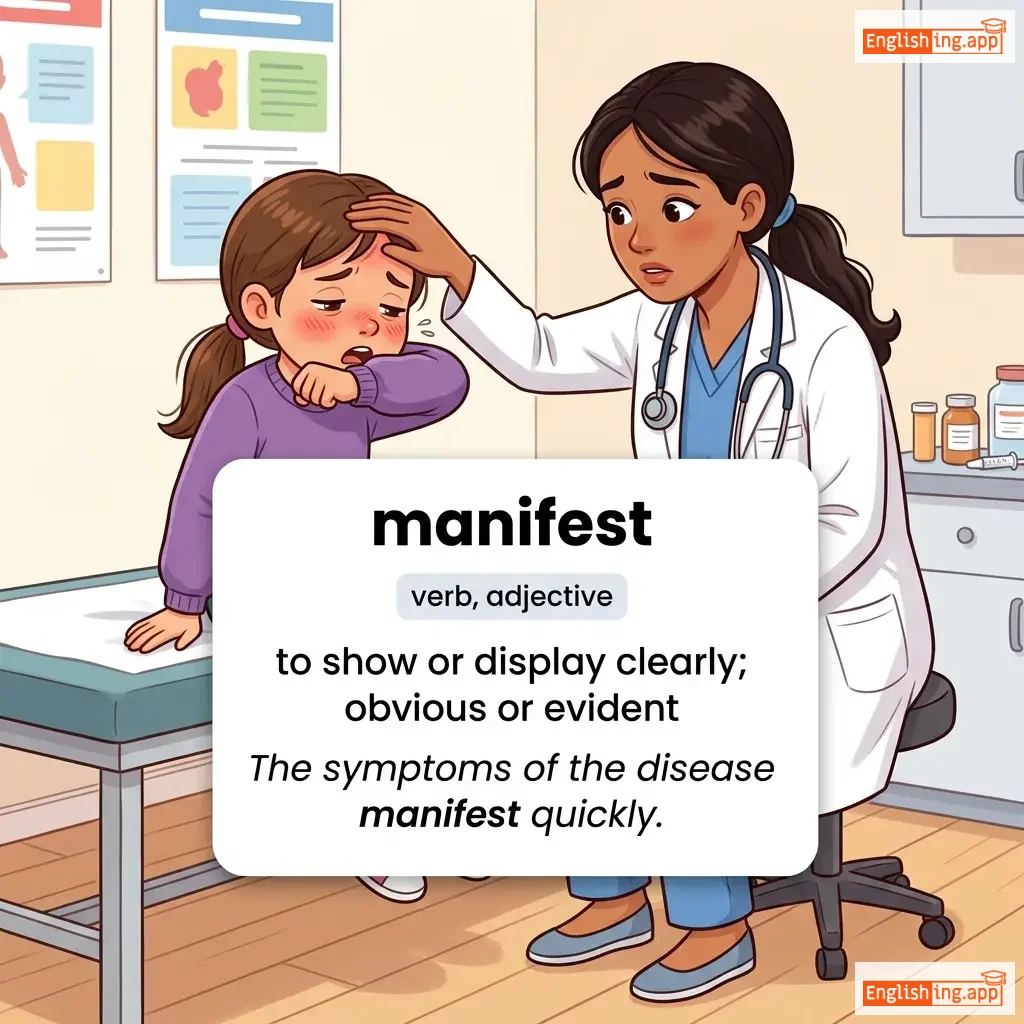
manifest definition card — visual illustration of the meaning
verb, adjective
/ˈmænɪˌfɛst/
manifestar (manifestar)

to show or display clearly; obvious or evident

"The symptoms of the disease manifest quickly."

"Los síntomas de la enfermedad se manifiestan rápidamente." (Los sintomas de la enfermedad se manifiestan rapidamente.)
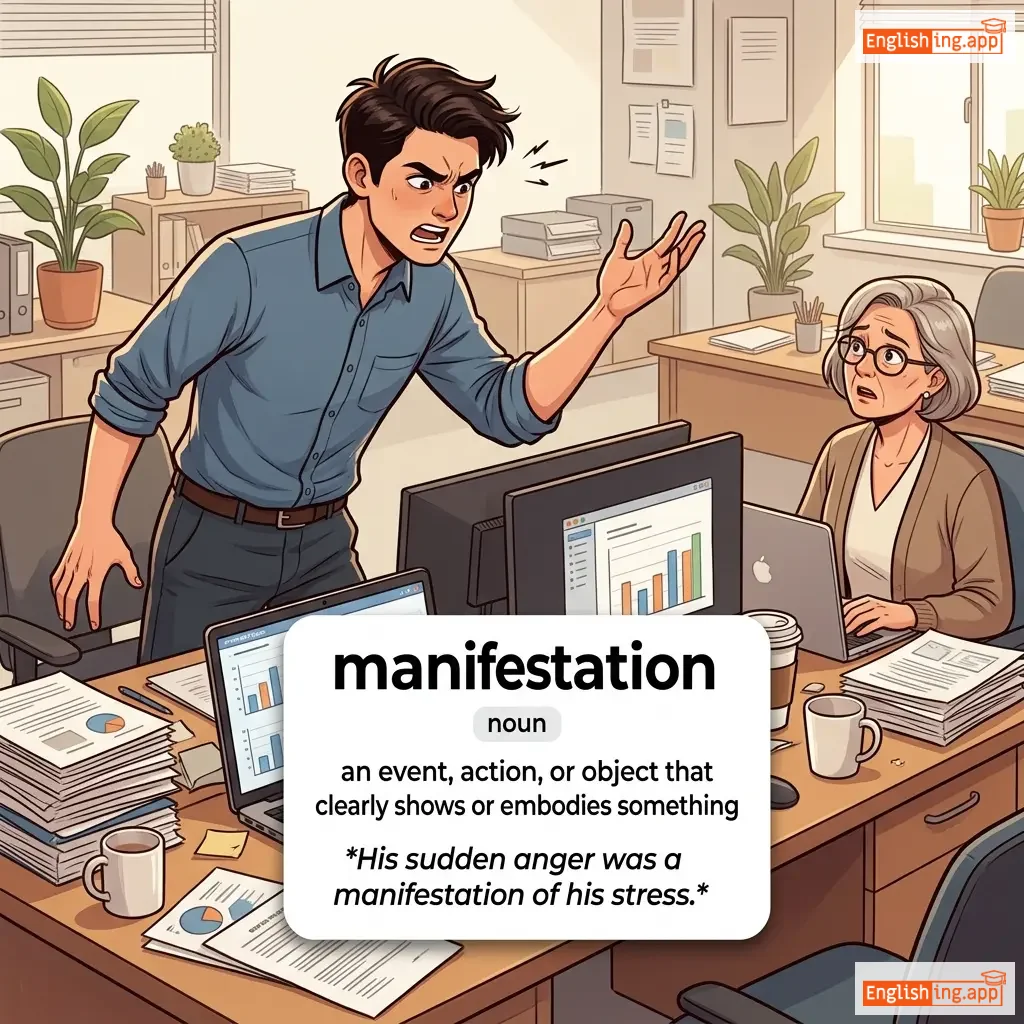
manifestation definition card — visual illustration of the meaning
noun
/ˌmænɪfɛˈsteɪʃən/
manifestación (manifestacion)

an event, action, or object that clearly shows or embodies something

"His sudden anger was a manifestation of his stress."

"Su ira repentina fue una manifestación de su estrés." (Su ira repentina fue una manifestacion de su estres.)
noun
/ˌmænɪˈfɛstoʊ/
manifiesto (manifiesto)

a public declaration of policy and aims, especially by a political party

"The party released its manifesto before the election."

"El partido publicó su manifiesto antes de las elecciones." (El partido publico su manifiesto antes de las elecciones.)
adjective, noun
/ˈmænɪˌfoʊld/
diverso (diverso)

many and various; having many different forms

"The benefits of exercise are manifold."

"Los beneficios del ejercicio son diversos." (Los beneficios del ejercicio son diversos.)
verb
/məˈnɪpjəˌleɪt/
manipular (manipular)

to control or influence someone or something cleverly or unfairly

"He tried to manipulate the results in his favor."

"Él intentó manipular los resultados a su favor." (Él intentó manipular los resultados a su favor.)
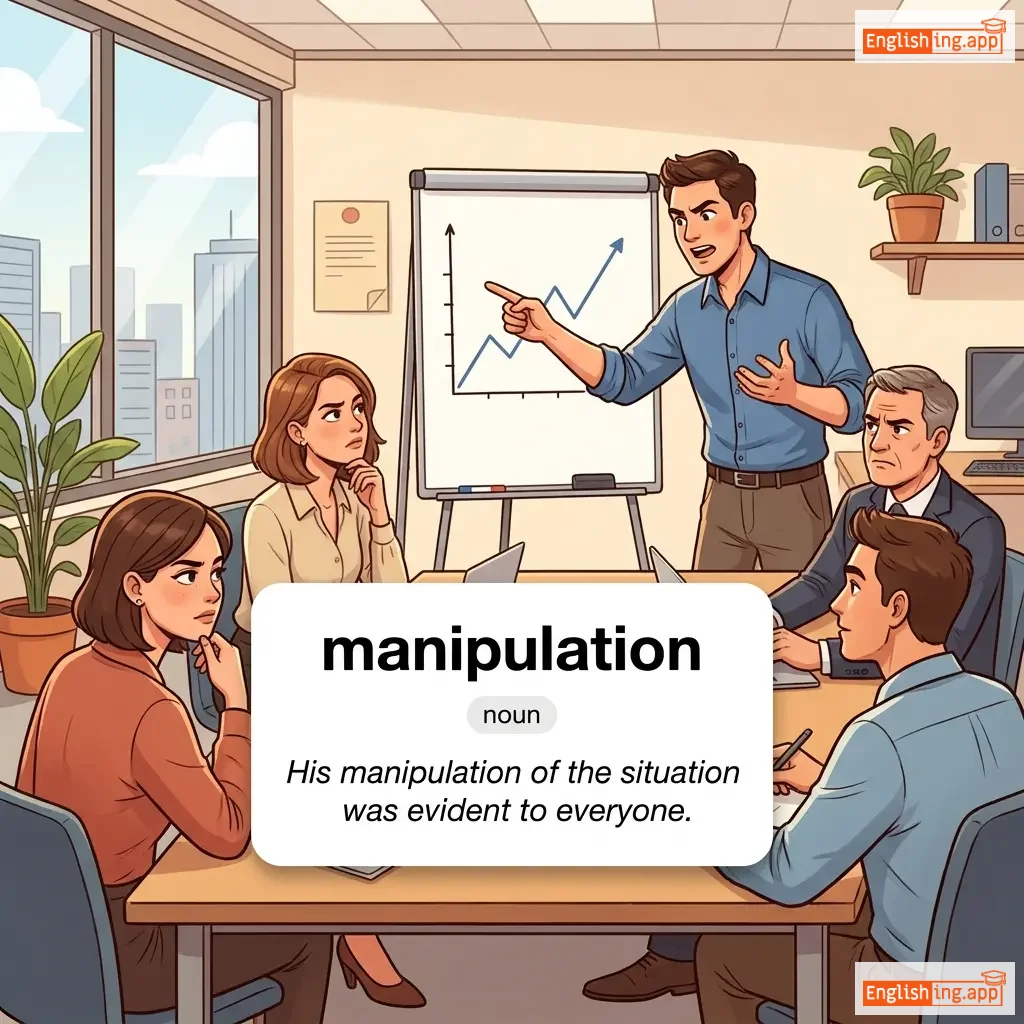
manipulation definition card — visual illustration of the meaning
noun
/məˌnɪpjʊˈleɪʃən/
manipulación (manipulacion)

the action of controlling or influencing something or someone cleverly or unfairly

"His manipulation of the situation was evident to everyone."

"Su manipulación de la situación era evidente para todos." (Su manipulacion de la situacion era evidente para todos.)
adjective
/ˈmæn.laɪk/
masculino (masculino)

Having qualities or characteristics traditionally associated with a man; manly.

"His manlike courage impressed everyone in the village."

"Su valentía masculina impresionó a todos en el pueblo." (Su valentía masculina impresionó a todos en el pueblo.)
noun
/ˈmæn.li.nəs/
virilidad (virilidad)

The quality of being manly; courage, strength, and honor associated with men.

"His manliness was admired by his peers."

"Su virilidad fue admirada por sus compañeros." (Su virilidad fue admirada por sus compañeros.)
adjective
/ˈmæn.li/
viril; valiente; audaz (manli)

having qualities traditionally associated with men; brave; courageous

"He showed manly courage during the crisis."

"Mostró coraje viril durante la crisis." (Mostró coraje viril durante la crisis.)
adjective
/ˌmænˈmeɪd/
hecho por el hombre (hecho por el hombre)

something created or built by humans rather than occurring naturally

"This lake is manmade, not natural."

"Este lago es hecho por el hombre, no natural." (Este lago es hecho por el hombre, no natural.)
noun
/ˈmænɪkɪn/
maniquí (maniki)

a life-sized model of a human figure used by shops to display clothes

"The mannequin in the shop window was dressed in a red gown."

"El maniquí en la ventana de la tienda estaba vestido con un vestido rojo." (El maniquí en la ventana de la tienda estaba vestido con un vestido rojo.)
noun
/ˈmænər/
modo / manera (modo / manera)

a way in which something is done or happens

"He spoke in a polite manner."

"Él habló de manera educada." (Él habló de manera educada.)
adjective
/ˈmæn.əd/
afectado / artificial (afectado / artificial)

Having or showing a particular manner, especially an artificial or affected one.

"The actor’s performance was too mannered to feel natural."

"La actuación del actor fue demasiado afectada para sentirse natural." (La actuacion del actor fue demasiado afectada para sentirse natural.)
noun
/ˈmæn.əˌrɪz.əm/
manera habitual (manera habitual)

A habitual way of speaking or behaving; a distinctive personal trait.

"One of his funny mannerisms is scratching his head when he’s nervous."

"Una de sus manías divertidas es rascarse la cabeza cuando está nervioso." (Una de sus manías divertidas es rascarse la cabeza cuando está nervioso.)
verb
/məˈnuː.vər/
maniobrar (maniobrar)

To move skillfully or carefully; to guide or manipulate into a desired position.

"The driver skillfully manoeuvered the car through the narrow street."

"El conductor maniobró hábilmente el coche por la calle estrecha." (El conductor maniobro habilemente el coche por la calle estrecha.)
noun
/ˈmænər/
mansión (mansión)

A large country house with lands; the main house of an estate.

"The old manor stood proudly on the hill for centuries."

"La vieja mansión se erguía orgullosa sobre la colina durante siglos." (La vieja mansión se erguía orgullosa sobre la colina durante siglos.)
noun
/ˈmænʃən/
felicidad (felicidad)

a large, impressive house

"The billionaire lives in a luxurious mansion overlooking the ocean."

"Ella no pudo ocultar su felicidad cuando recibió el premio." (Ella no pudo ocultar su felicidad cuando recibió el premio.)
noun
/ˈmæntl̩/
repisa sobre la chimenea (repisa sobre la chimenea)

A shelf above a fireplace, often used for decoration.

"She placed family photos on the mantel above the fireplace."

"Ella colocó fotos familiares sobre la repisa encima de la chimenea." (Ella colocó fotos familiares sobre la repisa encima de la chimenea.)
noun
/ˈmæntl̩/
capa, responsabilidad (capa, responsabilidad)

A cloak or covering; also the layer of the earth between the crust and the core.

"The leader assumed the mantle of responsibility."

"El líder asumió el manto de responsabilidad." (El lider asumió el manto de responsabilidad.)
noun
/ˈmænjuəl/
manual (manual)

a handbook or guide that provides instructions on how to do or operate something

"You should read the user manual before setting up the device."

"Debes leer el manual del usuario antes de configurar el dispositivo." (Debes leer el manual del usuario antes de configurar el dispositivo.)
adverb
/ˈmæn.ju.ə.li/
a mano; mediante esfuerzo físico; (a mano; mediante esfuerzo fisico)

by hand; using physical effort rather than machines

"The data was entered manually into the system."

"Los datos se introdujeron manualmente en el sistema." (Los datos se introdujeron manualmente en el sistema.)
manufacture definition card — visual illustration of the meaning
verb
/ˌmænɪˈfæktʃər/
fabricar (fabricar)

to make something in large quantities using machinery

"The company manufactures high-quality electronics."

"La empresa fabrica productos electrónicos de alta calidad." (La empresa fabrica productos electrónicos de alta calidad.)
noun
/ˌmænjəˈfæktʃərər/
fabricante (fabricante)

A person or company that makes goods in large quantities.

"The manufacturer produces cars for the global market."

"El fabricante produce autos para el mercado global." (El fabricante produce autos para el mercado global.)
noun
/ˌmænjəˈfæktʃərɪŋ/
fabricación (fabricacion)

the process of making products on a large scale using machinery

"The country is investing heavily in the manufacturing sector."

"El país está invirtiendo fuertemente en el sector de la fabricación." (El pais esta invirtiendo fuertemente en el sector de la fabricacion.)
noun
/ˌmænjəˈmɪʃən/
emancipación de los esclavos (emansipasion de los esklavos)

The act of a slave owner freeing their slaves.

"The manumission of the slaves marked a turning point in history."

"La emancipación de los esclavos marcó un punto de inflexión en la historia." (La emancipación de los esclavos marcó un punto de inflexión en la historia.)
verb
/ˌmæn.juˈmɪt/
liberar de la esclavitud (liberar de la esclavitud)

to release from slavery or servitude; to set free

"The landowner decided to manumit his slaves."

"El terrateniente decidió liberar a sus esclavos." (El terrateniente decidió liberar a sus esclavos.)
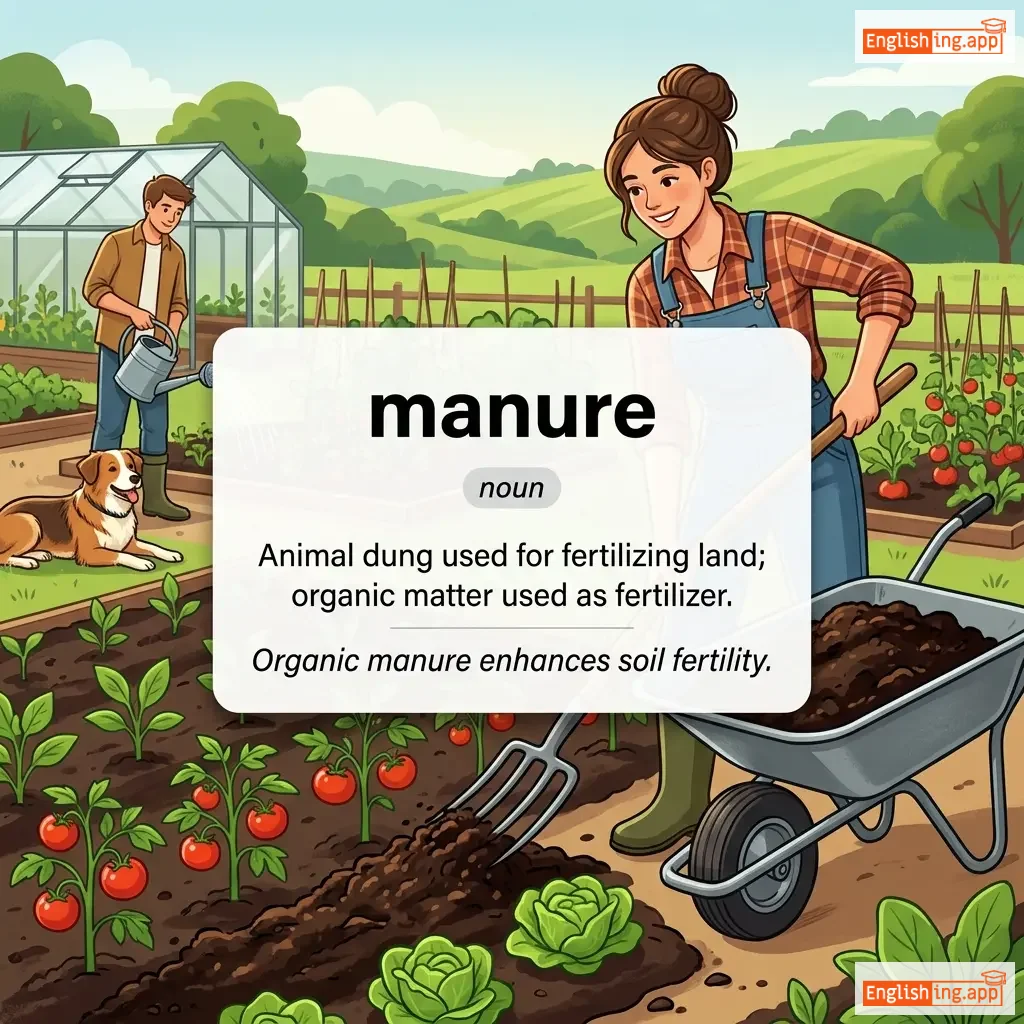
manure definition card — visual illustration of the meaning
noun
məˈnjʊər
estiércol, abono orgánico (estiércol, abono orgánico)

Animal dung used for fertilizing land; organic matter used as fertilizer.

"Organic manure enhances soil fertility."

"El estiércol orgánico mejora la fertilidad del suelo." (El estiércol orgánico mejora la fertilidad del suelo.)
noun
/ˈmæn.juˌskrɪpt/
manuscrito (manuscrito)

a handwritten or typed document, especially a writer’s draft before publication

"The author submitted her manuscript to the publisher."

"La autora presentó su manuscrito al editor." (La autora presento su manuscrito al editor.)