Vocabularios

Descubra, aprenda y domine el vocabulario en inglés

noun
/lɪm/
miembro (miembro)

an arm or leg of a person or animal; a large branch of a tree

"He broke a limb while climbing the tree."

"Se rompió un miembro mientras trepaba al árbol." (Se rompió un miembro mientras trepaba al árbol.)
adjective
/ˈlɪmbər/
flexible y ágil (flexible y agil)

Flexible and agile in body or movement.

"Dancers need to stay limber to perform well."

"Los bailarines deben mantenerse flexibles para rendir bien." (Los bailarines deben mantenerse flexibles para rendir bien.)
noun
/ˈlɪmboʊ/
incertidumbre, estado de suspensión (incertidumbre, estado de suspension)

A state of uncertainty or neglect; an intermediate or transitional state.

"The project was left in limbo after the funding was withdrawn."

"El proyecto fue dejado en incertidumbre después de que se retiró la financiación." (El proyecto fue dejado en incertidumbre despues de que se retiro la financiacion.)
noun
/laɪm/
limón (limon)

a small green citrus fruit with acidic juice

"Add a slice of lime to your drink."

"Añade una rodaja de limón a tu bebida." (Anade una rodaja de limon a tu bebida.)
noun
/ˈlaɪm.stoʊn/
piedra caliza (piedra caliza)

a hard sedimentary rock, composed mainly of calcium carbonate or dolomite, used as building material and in the making of cement

"The ancient building was made of limestone blocks."

"El antiguo edificio estaba hecho de bloques de piedra caliza" (El antiguo edificio estaba hecho de bloques de piedra caliza)
noun
/ˈlaɪm.laɪt/
el centro de atención pública; una luz brillante producida al calentar un cilindro de cal (laimlait)

the focus of public attention; a bright light produced by heating a cylinder of lime

"The celebrity enjoyed being in the limelight."

"La celebridad disfrutó estar en el centro de atención." (la celebridad disfruto estar en el centro de atencion)
noun
/ˈlɪmərɪk/
un poema humorístico de cinco versos (un poema humoristico de cinco versos)

a humorous five-line poem with a specific rhythm and rhyme scheme (AABBA).

"She recited a funny limerick at the party."

"Ella recitó un limerick gracioso en la fiesta." (Ella recito un limerick gracioso en la fiesta.)
noun, verb
/ˈlɪmɪt/
límite (limite)

A point or level beyond which something does not or may not extend; to restrict.

"You should limit the amount of sugar you eat."

"Debes limitar la cantidad de azúcar que comes." (Debes limitar la cantidad de azúcar que comes.)
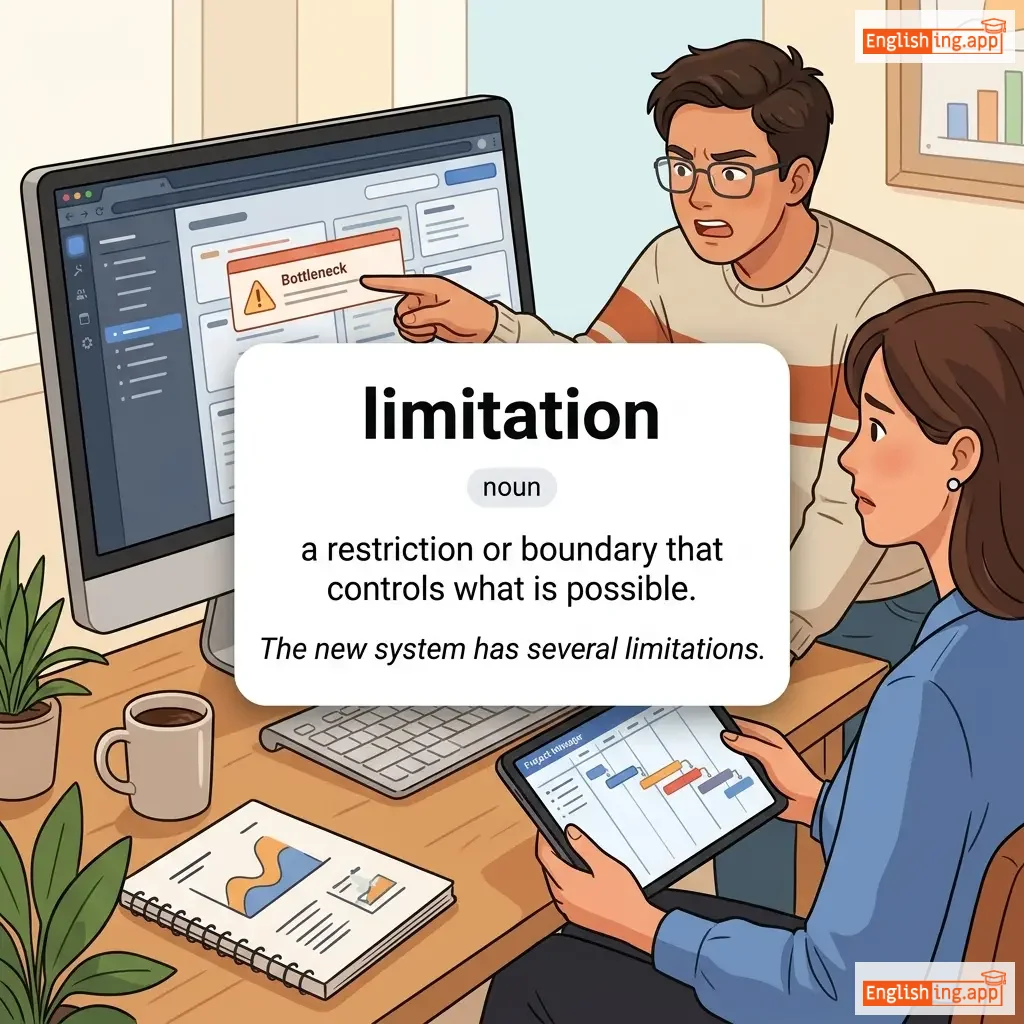
limitation definition card — visual illustration of the meaning
noun
/ˌlɪmɪˈteɪʃən/
limitación (limitacion)

a restriction or boundary that controls what is possible.

"The new system has several limitations."

"El nuevo sistema tiene varias limitaciones." (El nuevo sistema tiene varias limitaciones.)
adjective
/ˈlɪmɪtɪd/
limitado (limitado)

Restricted in size, amount, or extent; not great in number or ability.

"Tickets for the concert are limited."

"Las entradas para el concierto son limitadas." (Las entradas para el concierto son limitadas.)
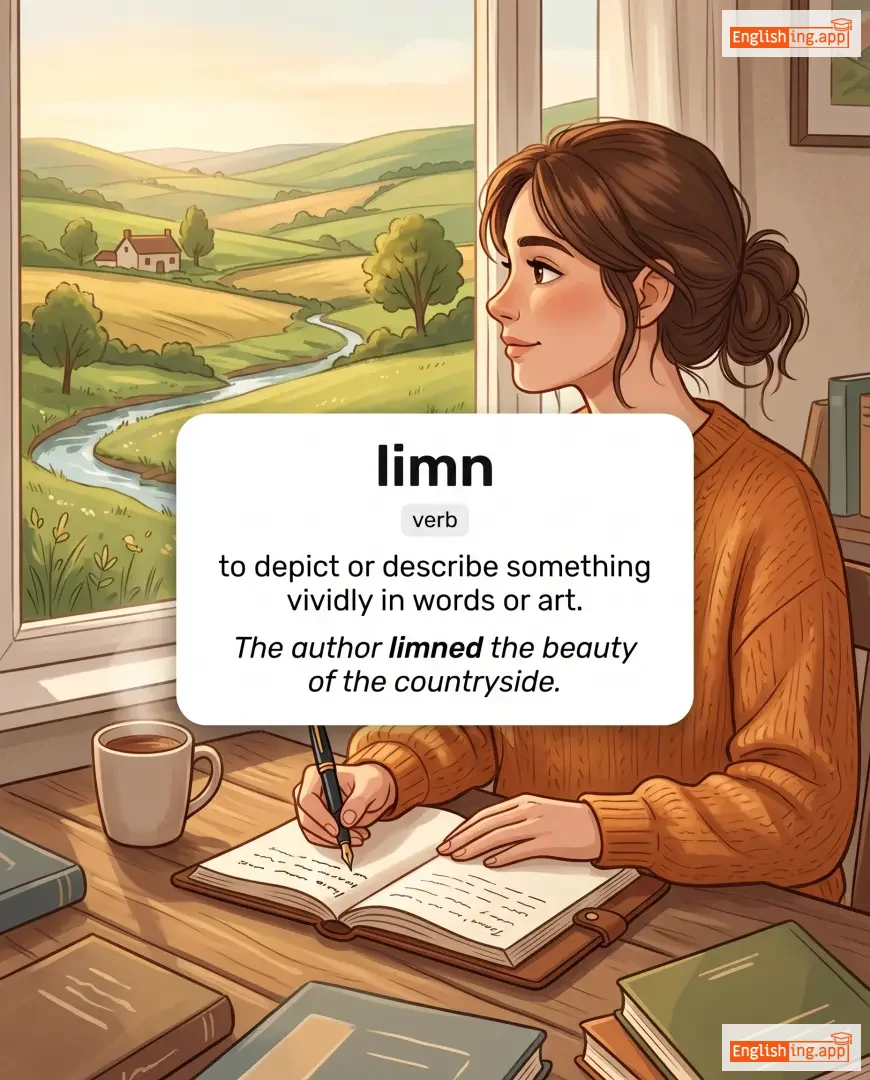
limn definition card — visual illustration of the meaning
verb
/lɪm/
describir / delinear (describir / delinear)

to depict or describe something vividly in words or art.

"The author limned the beauty of the countryside."

"El autor describió vívidamente la belleza del campo." (El autor describió vívidamente la belleza del campo.)
noun
/ˈlɪməˌziːn/
un coche grande y lujoso conducido por un chófer (un coche grande y lujoso conducido por un chofer)

a large, luxurious car driven by a chauffeur.

"The bride arrived in a white limousine."

"La novia llegó en una limusina blanca." (La novia llego en una limusina blanca.)
verb, adjective, noun
/lɪmp/
cojear / débil (cojear / debil)

to walk with difficulty, often due to injury or weakness; lacking strength or firmness.

"He limped after injuring his ankle."

"Él cojeó después de lastimarse el tobillo." (El cojear después de lastimarse el tobillo.)
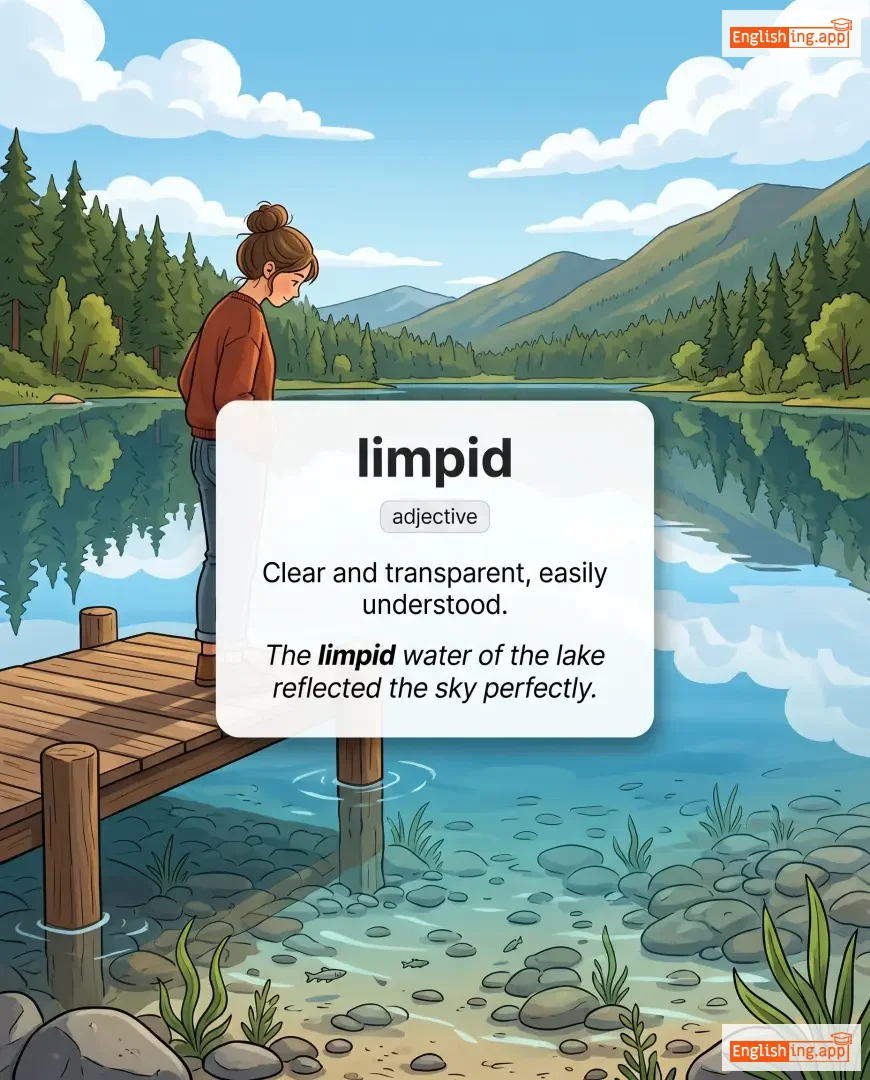
limpid definition card — visual illustration of the meaning
adjective
/ˈlɪmpɪd/
transparente (transparente)

Clear and transparent, easily understood.

"The limpid water of the lake reflected the sky perfectly."

"El agua transparente del lago reflejaba el cielo perfectamente." (El agua transparente del lago reflejaba el cielo perfectamente.)
noun, verb
/laɪn/
línea (linea)

A long narrow mark or band; a row of people or things; to cover the inside surface of something.

"People waited in a long line outside the theater."

"La gente esperó en una larga línea fuera del teatro." (La gente espero en una larga linea fuera del teatro.)
noun; verb
/ˈlaɪnʌp/
alineación; formar en fila (alineacion; formar en fila)

a group or arrangement of people or things in a line; to arrange people or things in a row or planned order

"The coach announced the team line-up before the match."

"El entrenador anunció la alineación antes del partido." (El entrenador anuncio la alineacion antes del partido)
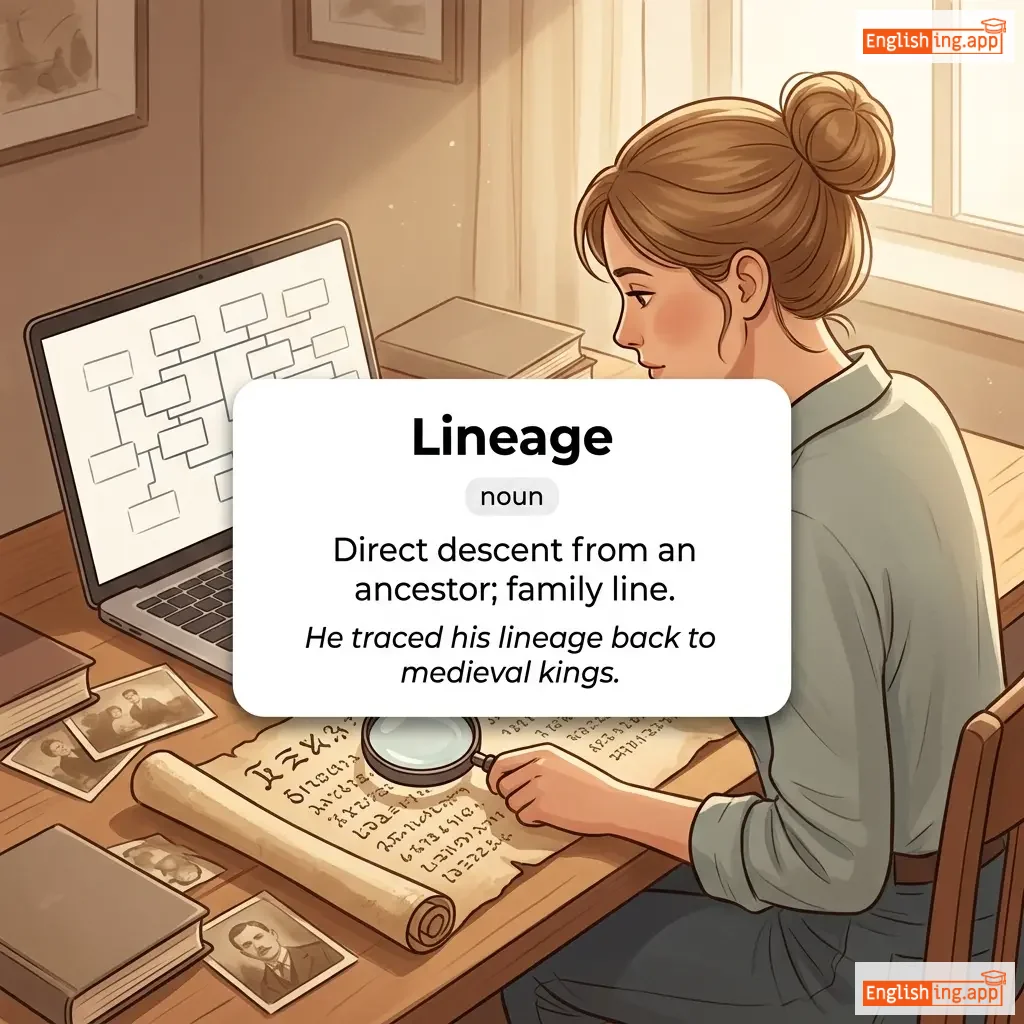
Lineage definition card — visual illustration of the meaning
noun
/ˈlɪniɪdʒ/
linaje (linaje)

Direct descent from an ancestor; family line.

"He traced his lineage back to medieval kings."

"Él rastreó su linaje hasta los reyes medievales." (Él rastreó su linaje hasta los reyes medievales.)
noun
/ˈlɪniəmənt/
rasgo (rasgo)

A distinctive feature or characteristic, especially of the face.

"Her delicate lineaments revealed her noble birth."

"Sus delicados rasgos revelaron su noble nacimiento." (Sus delicados rasgos revelaron su noble nacimiento.)
noun (plural)
/ˈlɪniəmənts/
rasgos del rostro (rasgos del rostro)

The features or distinctive characteristics of the face or body.

"The lineaments of his face were sharp and stern."

"Los rasgos de su rostro eran agudos y severos." (Los rasgos de su rostro eran agudos y severos.)
adjective
/ˈlɪniər/
lineal (lineal)

Arranged in or extending along a straight line.

"The artist used linear perspective in his drawings."

"El artista utilizó la perspectiva lineal en sus dibujos." (El artista utilizó la perspectiva lineal en sus dibujos.)
noun
/ˈlɪn.ən/
ropa de lino (ropa de lino)

A strong cloth made from the fibers of the flax plant, or items made from this cloth such as sheets or clothing.

"She bought new linen curtains for the living room."

"Ella compró nuevas cortinas de lino para la sala de estar." (Ella compró nuevas cortinas de lino para la sala de estar.)
noun
/ˈlaɪ.nər/
barco de pasajeros (barco de pasajeros)

A large ship used for transporting people or goods regularly, or a material used as a lining inside something.

"The luxury liner docked at the port yesterday."

"El lujoso transatlántico atracó en el puerto ayer." (El lujoso transatlantico atraco en el puerto ayer.)
noun
/ˈlaɪnˌʌp/
alineación (alineacion)

a group of people or things arranged in a sequence

"The event featured a star-studded lineup of musicians."

"El evento presentó una alineación de músicos llenos de estrellas." (El evento presento una alineacion de musicos llenos de estrellas.)
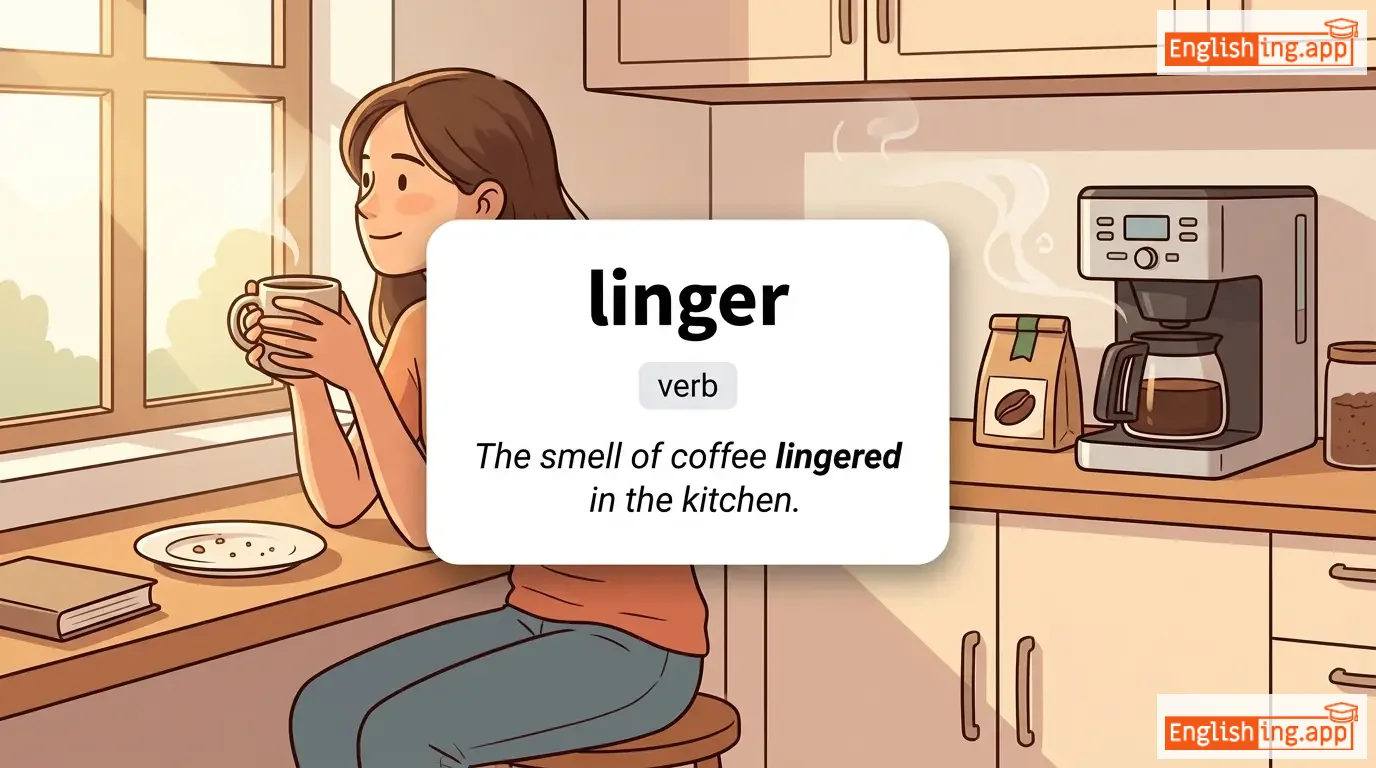
linger definition card — visual illustration of the meaning
verb
/ˈlɪŋ.ɡər/
quedarse más tiempo (quedarse mas tiempo)

To stay in a place longer than necessary, often because of unwillingness to leave.

"The smell of coffee lingered in the kitchen."

"El olor del café permaneció en la cocina por mucho tiempo." (El olor del cafe permanecio en la cocina por mucho tiempo.)
noun
/ˈlɪŋ.ɡoʊ/
jerga especializada (jerga especializada)

Specialized or informal language used by a particular group that is often difficult for outsiders to understand.

"The manual was written in technical lingo that confused the new employees."

"El manual estaba escrito en jerga técnica que confundió a los nuevos empleados." (El manual estaba escrito en jerga técnica que confundió a los nuevos empleados.)
noun
/ˈlɪŋ.ɡwə/
lengua (lengua)

A language, especially one used for communication among people.

"English has become a global lingua for business and science."

"El inglés se ha convertido en una lengua global para los negocios y la ciencia." (El ingles se ha convertido en una lengua global para los negocios y la ciencia.)
adjective
/ˈlɪŋɡwəl/
relacionado con la lengua (relacionado con la lengua)

Relating to the tongue or speech.

"The dentist examined the patient's lingual surface of the teeth."

"El dentista examinó la superficie lingual de los dientes del paciente." (El dentista examinó la superficie lingual de los dientes del paciente.)
noun
/ˈlɪŋɡwɪst/
lingüista (linguista)

A person skilled in foreign languages or in the scientific study of language.

"She is a linguist who speaks six languages fluently."

"Ella es una lingüista que habla seis idiomas con fluidez." (Ella es una lingüista que habla seis idiomas con fluidez.)
linguistic definition card — visual illustration of the meaning
adjective
/lɪŋˈɡwɪstɪk/
lingüístico (linguistico)

Relating to language or the scientific study of language.

"The study focused on the linguistic diversity of the region."

"El estudio se centró en la diversidad lingüística de la región." (El estudio se centró en la diversidad lingüística de la región.)
noun
/lɪŋˈɡwɪstɪks/
lingüística (linguistica)

The scientific study of language and its structure.

"She decided to major in linguistics at university."

"Decidió especializarse en lingüística en la universidad." (Decidió especializarse en lingüística en la universidad.)
noun
/ˈlɪnəmənt/
linimento / loción (linimento / locion)

A liquid or lotion applied to the skin to relieve pain or stiffness.

"He rubbed liniment on his sore muscles after the workout."

"Se frotó el linimento en sus músculos doloridos después del entrenamiento." (Se frotó el linimento en sus músculos doloridos después del entrenamiento.)
noun, verb
/lɪŋk/
enlace (enlace)

a connection between two things; to connect or associate

"The article includes a link to the official website."

"El artículo incluye un enlace al sitio web oficial." (El articulo incluye un enlace al sitio web oficial.)
noun
/lɪˈnoʊ.li.əm/
linóleo (linoleo)

a durable, washable floor covering made from solidified linseed oil, wood flour, or cork dust on a canvas backing

"They decided to cover the kitchen floor with linoleum."

"Decidieron cubrir el piso de la cocina con linóleo." (Decidieron cubrir el piso de la cocina con linoleo)
noun
/lɪnt/
pelusa (pelusa)

small soft fibers that come off cloth, often found in dryers or on clothes

"There was lint all over his black shirt after the wash."

"Había pelusa por toda su camisa negra después del lavado." (Habia pelusa por toda su camisa negra despues del lavado.)
noun
/ˈlaɪən/
león (leon)

a large wild animal of the cat family that lives in Africa and Asia, known as the king of the jungle

"The lion roared loudly in the distance."

"El león rugió fuertemente a lo lejos." (El leon rugio fuertemente a lo lejos.)
noun
/ˈlaɪ.ə.nəs/
leona (leona)

an adult female lion

"The fierce lioness protected her cubs from danger."

"La feroz leona protegió a sus cachorros del peligro." (La feroz leona protegió a sus cachorros del peligro.)
verb
/ˈlaɪ.ə.naɪz/
idolatrar (idolatrar)

to treat someone as a celebrity or give a lot of public attention

"The press began to lionize the young scientist after his discovery."

"La prensa comenzó a lionizar al joven científico después de su descubrimiento." (La prensa comenzo a lionizar al joven cientifico despues de su descubrimiento.)
noun
/lɪp/
labio (labio)

either of the two soft edges of the mouth

"She smiled and bit her lower lip nervously."

"Ella sonrió y mordió su labio inferior con nerviosismo." (Ella sonrió y mordió su labio inferior con nerviosismo.)
lipogenesis definition card — visual illustration of the meaning
noun
/ˌlaɪ.pəˈdʒen.ɪ.sɪs/
lipogénesis (lipogenesis)

The metabolic process of fat synthesis where excess carbohydrates are converted into fatty acids and stored as triglycerides.

"Excess carbohydrate intake promotes lipogenesis and fat storage."

"El consumo excesivo de carbohidratos promueve la lipogénesis y el almacenamiento de grasa." (El consumo excesivo de carbohidratos promueve la lipogenesis y el almacenamiento de grasa.)
noun
/ˌlɪk.wəˈfeɪ.ʃənt/
líquido (liquefacient)

a substance that causes something to become liquid

"The chemist explained how the liquefacient worked in the experiment."

"El químico explicó cómo funcionaba el líquido en el experimento." (El quimico explico como funcionaba el liquido en el experimento.)
verb
/ˈlɪk.wɪ.faɪ/
licuar (liquify)

to make or become liquid

"The heat will liquefy the butter in a few minutes."

"El calor liquefará la mantequilla en unos minutos." (El calor liquefará la mantequilla en unos minutos.)
noun
/lɪˈkjʊər/
licor dulce (licor dulce)

A strong, sweet alcoholic drink flavored with fruits, herbs, or spices.

"She served a small glass of cherry liqueur after dinner."

"Ella sirvió un pequeño vaso de licor de cereza después de la cena." (Ella sirvió un pequeño vaso de licor de cereza después de la cena.)
noun
/ˈlɪkwɪd/
líquido (liqwid)

a substance that flows freely but is of constant volume, having a consistency like water or oil.

"Water is a clear liquid that is essential for life."

"El agua es un líquido claro que es esencial para la vida." (El agua es un liquido claro que es esencial para la vida.)
verb
/ˈlɪkwɪdeɪt/
liquidar (liquidar)

To sell assets in order to pay off debts; to close a business and convert assets into cash.

"The company decided to liquidate its assets to pay creditors."

"La empresa decidió liquidar sus activos para pagar a los acreedores." (La empresa decidió liquidar sus activos para pagar a los acreedores.)
liquidity definition card — visual illustration of the meaning
noun
/lɪkˈwɪd.ə.ti/
liquidez (liquidez)

The availability of liquid assets to a market or company.

"A business must maintain liquidity to cover expenses."

"Un negocio debe mantener liquidez para cubrir gastos." (Un negocio debe mantener liquidez para cubrir gastos.)
noun
/ˈlɪkər/
licor (likor)

Alcoholic drinks, especially strong distilled ones such as whiskey or vodka.

"The shop sells both beer and hard liquor."

"La tienda vende cerveza y licor." (La tienda vende cerveza y licor)
adjective
/ˈlɪsəm/
delgada, flexible y elegante en movimiento (delgada, flexible y elegante en movimiento)

Thin, supple, and graceful in movement.

"The dancer moved with a lissome elegance."

"La bailarina se movió con una elegancia lísoma." (La bailarina se movió con una elegancia lísoma.)
noun, verb
/lɪst/
lista (lista)

A series of names, items, or tasks written or printed together; also, to record or register items in such a way.

"She wrote a shopping list before going to the market."

"Ella escribió una lista de compras antes de ir al mercado." (Ella escribió una lista de compras antes de ir al mercado.)
listen definition card — visual illustration of the meaning
verb
/ˈlɪs.ən/
escuchar (es-kuchar)

to pay attention to sound

"She loves to listen to classical music in the evenings."

"A ella le encanta escuchar música clásica por la tarde." (A ella le encanta escuchar música clásica por la tarde.)
noun
/ˈlɪsənər/
oyente (oyente)

a person who listens or pays attention to something, especially to a speaker or sound.

"She is a good listener who always understands others' problems."

"Ella es una buena oyente que siempre entiende los problemas de los demás." (Ella es una buena oyente que siempre entiende los problemas de los demás.)