Vocabularios

Descubra, aprenda y domine el vocabulario en inglés

noun
/ˈhɛksəˌɡɒn/
hexágono (hexagono)

A six-sided polygon.

"A honeycomb cell is shaped like a hexagon."

"Una célula de panal tiene forma de hexágono." (Una célula de panal tiene forma de hexágono.)
adjective
/hɛkˈsæŋɡjələr/
hexagonal (hexagonal)

Having six angles or corners.

"The artist designed a hexangular frame for the mirror."

"El artista diseñó un marco hexagonal para el espejo." (El artista disenó un marco hexagonal para el espejo.)
noun
/ˈhɛksəˌpɒd/
hexápodo (hexapodo)

An insect or other organism with six legs.

"The scientist observed a hexapod crawling on the leaf."

"El científico observó un hexápodo arrastrándose sobre la hoja." (El científico observó un hexápodo arrastrándose sobre la hoja.)
interjection
/heɪ/
¡Hey! (hey)

used to attract attention, express surprise, or greet someone

"Hey, how are you doing today?"

"¡Hey, cómo estás hoy?" (¡Hey, cómo estás hoy?)
noun
/ˈheɪ.deɪ/
el apogeo; la época dorada; el mejor momento (el apogeo; la epoca dorada; el mejor momento)

the period of a person's or thing's greatest success, popularity, or vigor; prime time

"During her heyday as a singer, she performed in sold-out concerts around the world."

"Durante su apogeo como cantante, ella actuaba en conciertos agotados alrededor del mundo." (Durante su apogeo como cantante, ella actuaba en conciertos agotados alrededor del mundo.)
noun
/ˈheɪˌdeɪ/
apogeo (apogeo)

The period of greatest success, popularity, or power.

"In its heyday, the company dominated the market."

"En su apogeo, la empresa dominaba el mercado." (En su apogeo, la empresa dominaba el mercado.)
interjection
/haɪ/
hola (hola)

a friendly greeting used when meeting someone

"Hi, it's nice to meet you!"

"¡Hola, es un placer conocerte!" (¡Hola, es un placer conocerte!)
noun
/haɪˈeɪtəs/
hiato (hiato)

A pause or break in continuity of a process or activity.

"The show returned after a long hiatus."

"El show regresó después de un largo hiato." (El show regreso despues de un largo hiato.)
adjective
/haɪˈbɜːrnəl/
invernal (eebernal)

Relating to or occurring in winter.

"The hibernal season is often harsh in the mountains."

"La temporada hibernal suele ser dura en las montañas." (La temporada hibernal suele ser dura en las montanas.)
verb
/ˈhaɪbərˌneɪt/
hibernar (hibernar)

To spend the winter in a dormant state, as some animals do.

"Bears hibernate in caves during the winter."

"Los osos hibernan en cuevas durante el invierno." (Los osos hibernan en cuevas durante el invierno.)
adjective/noun
/haɪˈbɜːrniən/
hiberniano (hiberniano)

Relating to Ireland or the Irish.

"He enjoyed reading about Hibernian culture and history."

"Disfrutó leer sobre la cultura y la historia hiberniana." (Disfruto leer sobre la cultura y la historia hiberniana.)
adjective
/hɪk/
campesino; paleto (campesino; paleto)

unsophisticated person from a rural area; country bumpkin

"He had a hick accent from growing up in a small town."

"Él tenía un acento de campesino por haber crecido en un pueblo pequeño." (Él tenía un acento de campesino por haber crecido en un pueblo pequeño.)
🕵️‍♂️

Hidden (jiden)

adjective
/ˈhɪdən/
oculto (oculto)

kept out of sight; concealed.

"The treasure was hidden under the old tree."

"El tesoro estaba oculto bajo el árbol viejo." (El tesoro estaba oculto bajo el árbol viejo.)
hide definition card — visual illustration of the meaning
verb
/haɪd/
esconder (esconder)

to put something or oneself out of sight; to conceal

"She tried to hide the letter under the pillow."

"ella trató de esconder la carta debajo de la almohada." (ella trato de esconder la carta debajo de la almohada)
noun
/ˈhaɪdəweɪ/
escondite (escondite)

A place used as a retreat or a place to hide.

"The cabin in the woods was their secret hideaway."

"La cabaña en el bosque era su escondite secreto." (La cabaña en el bosque era su escondite secreto.)
adjective
/ˈhaɪd.baʊnd/
retrógrado (retrogrado)

unwilling or unable to change because of tradition or convention

"He is too hidebound to accept new ideas."

"Es demasiado retrógrado para aceptar ideas nuevas." (Es demasiado retrogrado para aceptar ideas nuevas)
adjective
/ˈhɪd.i.əs/
horrible (horrible)

extremely ugly or unpleasant

"The crime was so hideous that it shocked the whole town."

"El crimen fue tan horrible que sorprendió a toda la ciudad." (El crimen fue tan horrible que sorprendió a toda la ciudad.)
verb
/haɪ/
apresurarse (apresurarse)

to go quickly; hasten

"He hied to the station to catch the train."

"Él se apresuró a la estación para tomar el tren." (El se apresuro a la estacion para tomar el tren.)
adjective
/ˌhaɪəˈrɑː.kɪ.kəl/
jerárquico (jerarquico)

arranged in order of rank or authority

"The company has a strict hierarchical structure."

"La empresa tiene una estructura jerárquica estricta." (La empresa tiene una estructura jerárquica estricta.)
noun
/ˈhaɪəˌrɑːrki/
jerarquía (jerarquia)

A system in which people or things are arranged in levels of importance or authority.

"The corporate hierarchy determines who makes the final decision."

"La jerarquía corporativa determina quién toma la decisión final." (La jerarquia corporativa determina kien toma la desicion final.)
noun
/ˈhaɪərəˌɡlɪf/
jeroglífico (jeroglifico)

A picture or symbol used in ancient writing systems, especially Egyptian writing.

"The walls of the temple were covered in hieroglyphs."

"Las paredes del templo estaban cubiertas con jeroglíficos." (Las paredes del templo estaban cubiertas con jeroglificos.)
adjective/noun
/ˌhaɪərəˈɡlɪfɪk/
jeroglífico (jeroglifico)

Relating to or written in hieroglyphs; symbols or writing that is difficult to understand.

"The archaeologists studied the hieroglyphic inscriptions carefully."

"Los arqueólogos estudiaron las inscripciones jeroglíficas cuidadosamente." (Los arqueologos estudiaron las inscripciones jeroglificas cuidadosamente.)
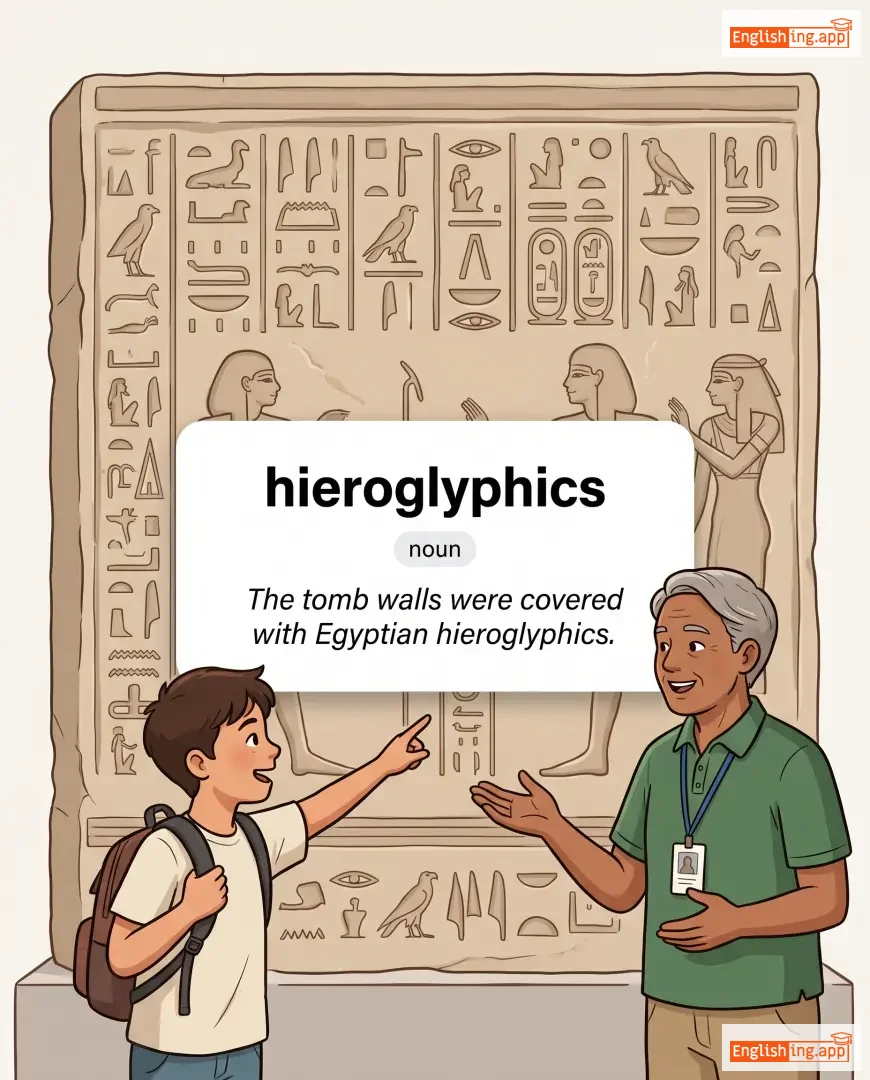
hieroglyphics definition card — visual illustration of the meaning
noun
/ˌhaɪ.roʊˈɡlɪf.ɪks/
jeroglíficos (jeroglifos)

a system of writing using pictures or symbols, used especially by ancient Egyptians

"The tomb walls were covered with Egyptian hieroglyphics."

"Las paredes de la tumba estaban cubiertas con jeroglíficos egipcios." (Las paredes de la tumba estaban cubiertas con jeroglificos egipcios.)
adjective
/haɪ/
alto (alto)

At or to a great height; greater than normal in amount, degree, or intensity.

"The mountain peak is very high."

"El pico de la montaña es muy alto." (El pico de la montaña es muy alto.)
adjective
/ˌhaɪ ˈfloʊn/
pomposo (pomposo)

Using fancy or pretentious language; lofty in style but often overblown.

"The politician gave a high-flown speech full of promises."

"El político dio un discurso pomposo lleno de promesas." (El politico dio un discurso pomposo lleno de promesas.)
adjective
/ˈhaɪˌprəʊfaɪl/
de alto perfil (de alto perfil)

having a lot of attention or public notice

"The CEO attended a high-profile conference in New York."

"El CEO asistió a una conferencia de alto perfil en Nueva York." (El CEO asistió a una conferencia de alto perfil en Nueva York.)
adjective
/ˌhaɪ ˈtɛk/
alta tecnología (alta tecnologia)

using or involving advanced technology.

"The company produces high-tech medical devices."

"La empresa produce dispositivos médicos de alta tecnología." (La empresa produce dispositivos médicos de alta tecnología.)
adjective
/ˈhaɪˌbraʊ/
intelectualmente superior (intelectualmente superior)

intellectually superior or cultured; often describing art, literature, or activities appealing to intellectual tastes

"The museum is known for its highbrow exhibitions."

"El museo es conocido por sus exposiciones de alto nivel." (El museo es conocido por sus exposiciones de alto nivel.)
verb
/ˈhaɪˌlaɪt/
destacar (destacar)

to emphasize or make something stand out

"The teacher highlighted the most important points in the text."

"El maestro destacó los puntos más importantes en el texto." (El maestro destacó los puntos más importantes en el texto.)
adverb
/ˈhaɪli/
altamente (altamente)

to a great degree; very

"She is highly respected in her field."

"Ella es altamente respetada en su campo." (Ella es altamente respetada en su campo.)
noun
/ˈhaɪ.nəs/
Grandeza; título real (grandeza, titulo real)

a title given to a person of royal rank; the quality or state of being high or elevated

"Your Highness, the royal carriage is ready to take you to the state banquet this evening."

"Su Grandeza, el carruaje real está listo para llevarlo al banquete estatal esta noche." (Su Grandeza, el carruaje real esta listo para llevarlo al banquete estatal esta noche.)
noun
/ˈhaɪ.weɪ/
autopista (autopista)

A main road, especially one connecting major towns or cities.

"The highway was blocked due to an accident."

"La autopista estaba bloqueada debido a un accidente." (La autopista estaba bloqueada debido a un accidente.)
hijack definition card — visual illustration of the meaning
verb
/ˈhaɪdʒæk/
secuestro de aeronave (secuestro de aeronave)

to take control of a vehicle or situation illegally or by force

"The criminals attempted to hijack the airplane."

"Los criminales intentaron secuestrar el avión." (Los criminales intentaron secuestrar el avión.)
verb/noun
/haɪk/
caminar / aumento (caminar / aumento)

To take a long walk in the countryside or mountains; also to increase suddenly (prices, rates, etc.).

"We decided to hike in the hills this weekend."

"Decidimos hacer una caminata en las colinas este fin de semana." (Decidimos hacer una caminata en las colinas este fin de semana.)
adjective
/hɪˈlɛəriəs/
extremadamente divertido (extremadamente divertido)

Extremely funny or amusing.

"The comedian told a hilarious story that had everyone laughing."

"El comediante contó una historia extremadamente divertida que hizo reír a todos." (El comediante conto una historia extremadamente divertida que hizo reir a todos.)
noun
/hɪˈlærɪti/
hilaridad (hilaridad)

Extreme amusement, especially when expressed by laughter.

"The movie caused great hilarity among the audience."

"La película causó una gran hilaridad entre el público." (La pelicula causo una gran hilaridad entre el publico.)
noun
/hɪl/
colina (colina)

A naturally raised area of land, smaller than a mountain.

"We climbed the hill to see the sunset."

"Subimos la colina para ver la puesta de sol." (Subimos la colina para ver la puesta de sol.)
noun
/ˈhɪlək/
colina (colina)

A small hill or mound.

"The children climbed up the grassy hillock to watch the sunset."

"Los niños subieron a la colina cubierta de hierba para ver la puesta de sol." (Los ninos subieron a la colina cubierta de hierba para ver la puesta de sol.)
adjective
/ˈhɪli/
montañoso (montañoso)

having many hills; characterized by hills or slopes

"The village is located in a beautiful hilly region."

"El pueblo está situado en una región montañosa." (El pueblo esta situado en una region montanosa)
noun
/ˈhɪl.sə fɪʃ/
pez hilsa (pez hilsa)

a popular fish species found in South Asian rivers, especially prized in Bengali cuisine

"Hilsa fish is considered a delicacy in Bengali culture."

"El pez hilsa se considera una delicadeza en la cultura bengalí." (El pez hilsa se considera una delicadeza en la cultura bengalí.)
pronoun
/hɪm/
lo (lo)

Used to refer to a male person or animal already mentioned.

"I saw him at the park yesterday."

"Lo vi en el parque ayer." (Lo vi en el parque ayer.)
🙋‍♂️

himself (himself)

pronoun
/hɪmˈself/
él mismo (el mismo)

Used to emphasize that a male person does something by his own effort.

"He fixed the car himself."

"Él arregló el coche él mismo." (Él arregló el coche él mismo.)
🦌♀️

Hind (haind)

noun
/haɪnd/
cierva (cierva)

a female deer, especially a red deer

"The hind protected her fawn from predators."

"La cierva protegió a su cría de los depredadores." (La cierva protegió a su cría de los depredadores.)
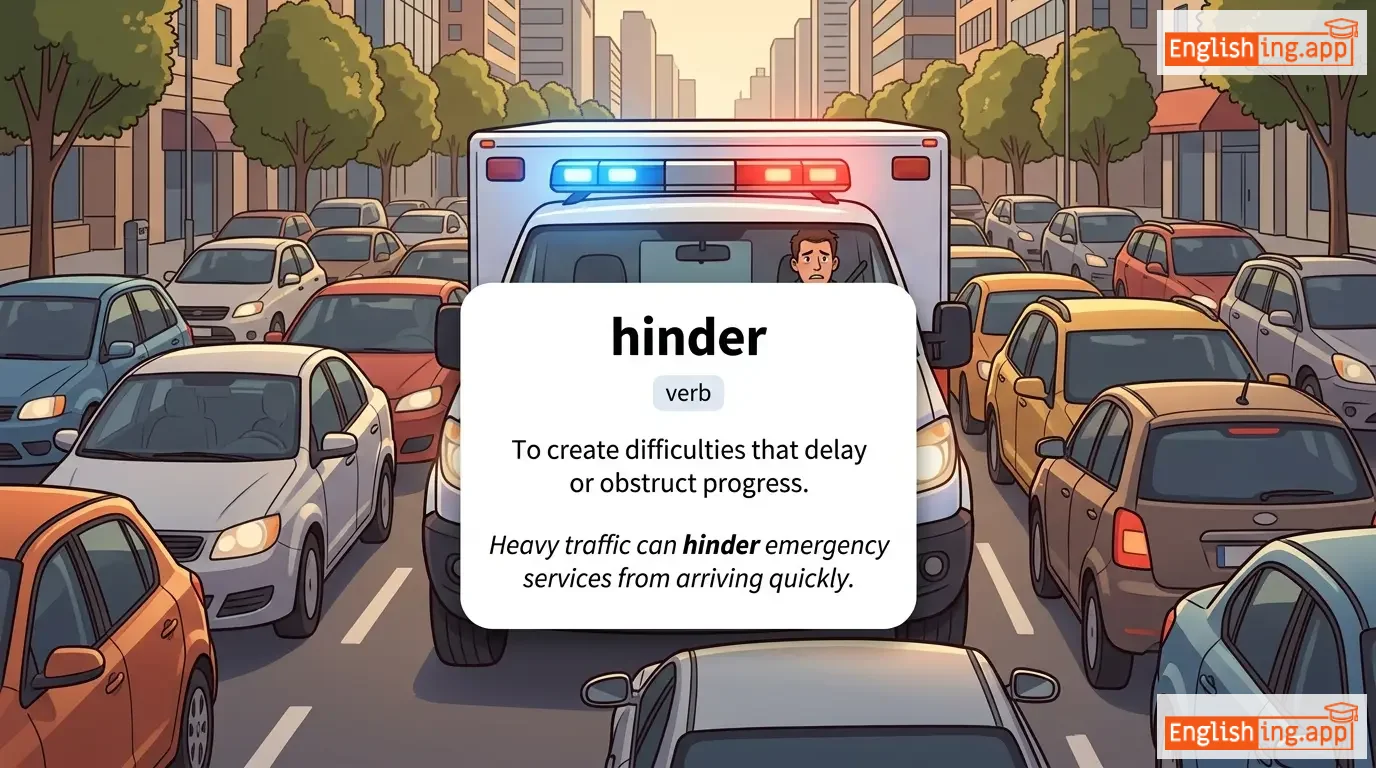
hinder definition card — visual illustration of the meaning
verb
/ˈhɪndər/
dificultar (dificultar)

To create difficulties that delay or obstruct progress.

"Heavy traffic can hinder emergency services from arriving quickly."

"El tráfico pesado puede dificultar que los servicios de emergencia lleguen rápidamente." (El trafico pesado puede dificultar que los servicios de emergencia lleguen rapidamente.)
adjective
/ˈhaɪndmoʊst/
más trasero (mas trasero)

Farthest back; last in position.

"The hindmost car in the convoy broke down first."

"El coche más trasero en el convoy se rompió primero." (El coche mas trasero en el convoy se rompió primero.)
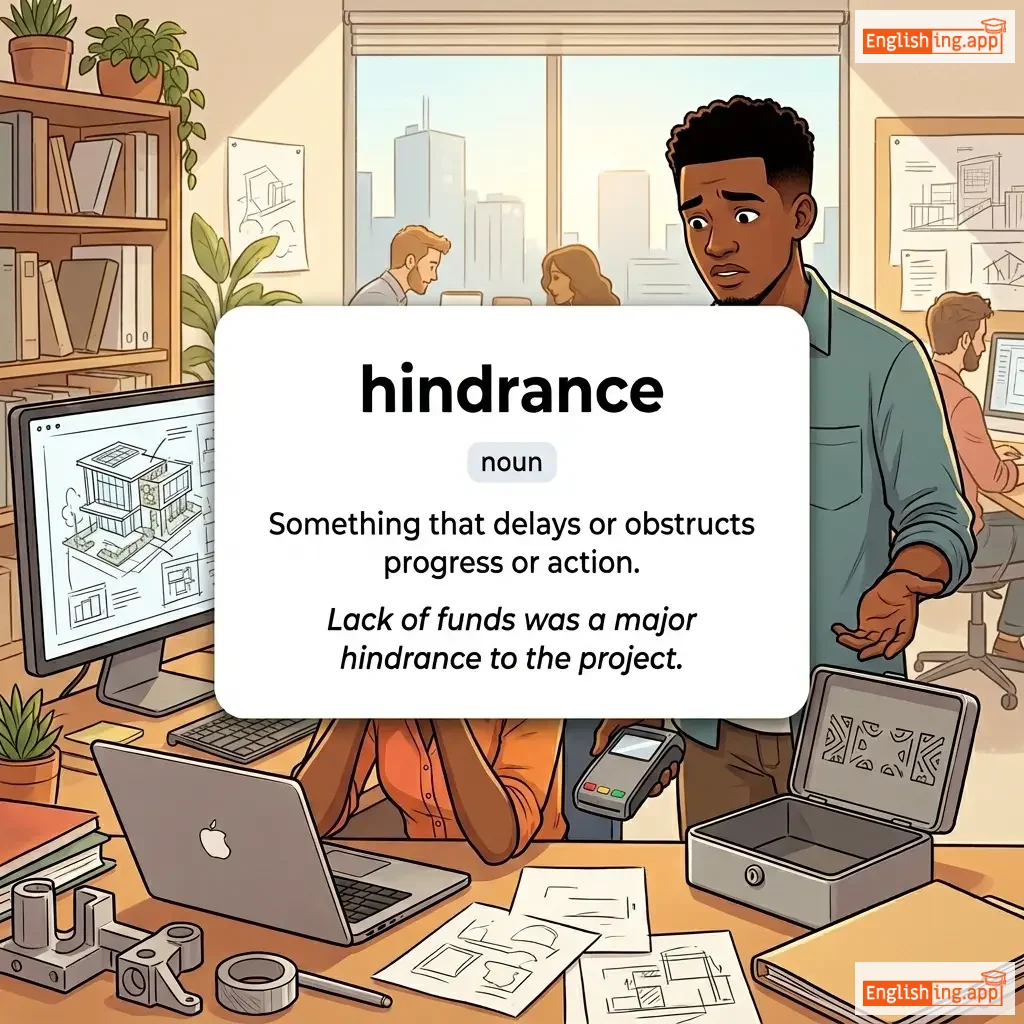
hindrance definition card — visual illustration of the meaning
noun
/ˈhɪndrəns/
obstáculo (hindrance)

Something that delays or obstructs progress or action.

"Lack of funds was a major hindrance to the project."

"La falta de fondos fue un obstáculo importante para el proyecto." (La falta de fondos fue un obstaculo importante para el proyecto)
noun
/ˈhaɪndsaɪt/
perspectiva retroactiva (perspectiva retroactiva)

Understanding of a situation only after it has happened.

"With the benefit of hindsight, we realized the decision was a mistake."

"Con la ventaja de la perspectiva retroactiva, nos dimos cuenta de que la decisión fue un error." (Con la ventaja de la perspectiva retroactiva, nos dimos cuenta de que la decision fue un error.)
noun/verb
/hɪnt/
pista (pista)

a small piece of advice or suggestion; to suggest something indirectly

"She gave me a hint about the surprise party."

"Ella me dio una pista sobre la fiesta sorpresa." (Ella me dio una pista sobre la fiesta sorpresa.)
noun
/ˈhɪntərlænd/
tierras interiores (tierras interiores)

The remote or less developed areas away from the coast or a city.

"The farmers came from the rural hinterland to sell their produce in the city."

"Los agricultores vinieron de las tierras interiores rurales para vender sus productos en la ciudad." (Los agricultores vinieron de las tierras interiores rurales para vender sus productos en la ciudad.)
noun (plural)
/ˈhɪntərlændz/
zonas remotas (zonas remotas)

Plural of hinterland; remote or less developed regions.

"Explorers traveled deep into the hinterlands of the country."

"Los exploradores viajaron profundamente a las zonas remotas del país." (Los exploradores viajaron profundamente a las zonas remotas del país.)