Vocabularios

Descubra, aprenda y domine el vocabulario en inglés

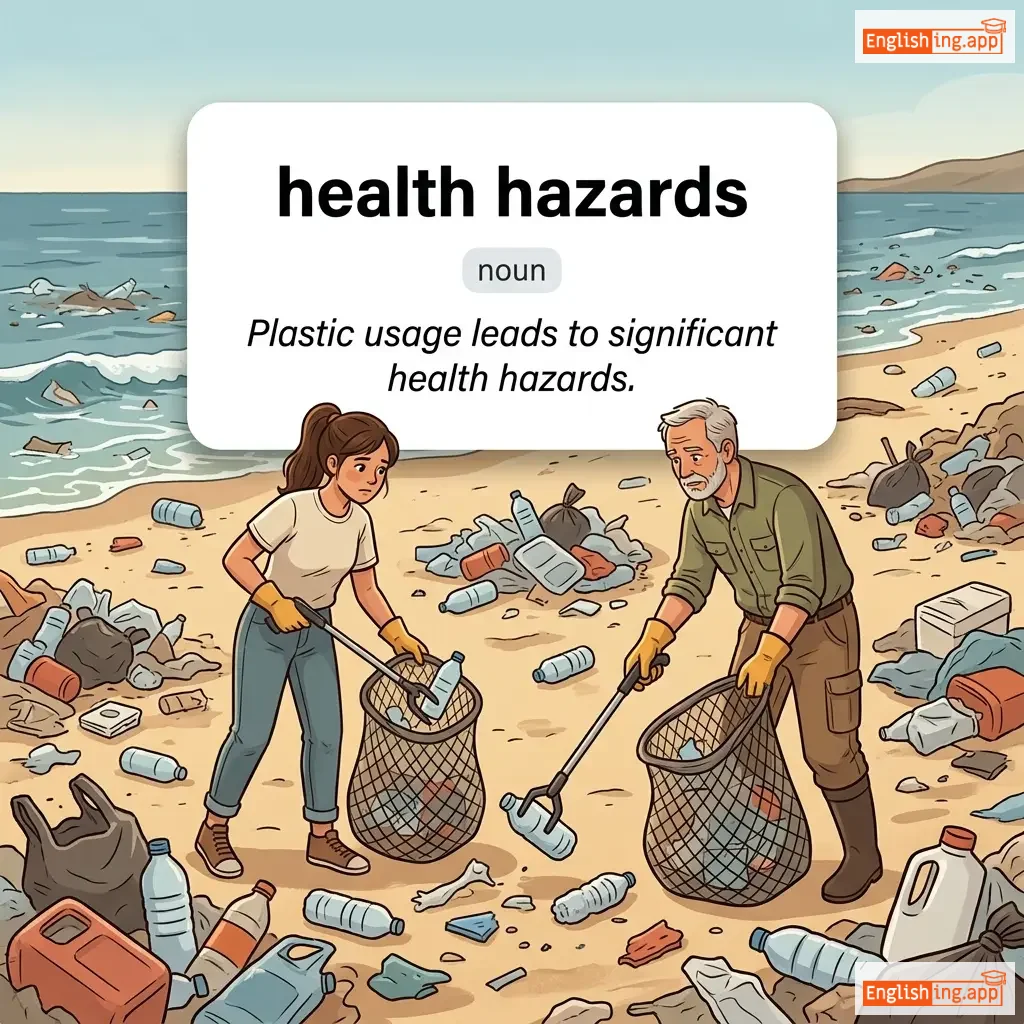
health hazards definition card — visual illustration of the meaning
noun
helθ ˈhæzərdz
riesgos para la salud (riesgos para la salud)

Risks or dangers to physical health and well-being that can cause illness or injury.

"Plastic usage leads to significant health hazards."

"El uso de plástico conduce a riesgos significativos para la salud." (El uso de plástico conduce a riesgos significativos para la salud.)
noun
/ˈhɛlθˌkɛər/
felicidad (felicidad)

the organized provision of medical services to maintain or improve health

"Access to quality health-care is essential for every citizen."

"Ella no pudo ocultar su felicidad cuando recibió el premio." (Ella no pudo ocultar su felicidad cuando recibió el premio.)
noun
/ˈhɛlθˌkɛər/
atención sanitaria (atencion sanitaria)

the organized provision of medical care to people

"The country invested heavily in healthcare to improve public health."

"El país invirtió considerablemente en atención sanitaria para mejorar la salud pública." (El pais invirtio considerablemente en atencion sanitaria para mejorar la salud publica.)
adjective
/ˈhɛlθfəl/
saludable (saludable)

Promoting good health; beneficial to health.

"A healthful diet includes fresh fruits and vegetables."

"Una dieta saludable incluye frutas y verduras frescas." (Una dieta saludable incluye frutas y verduras frescas.)
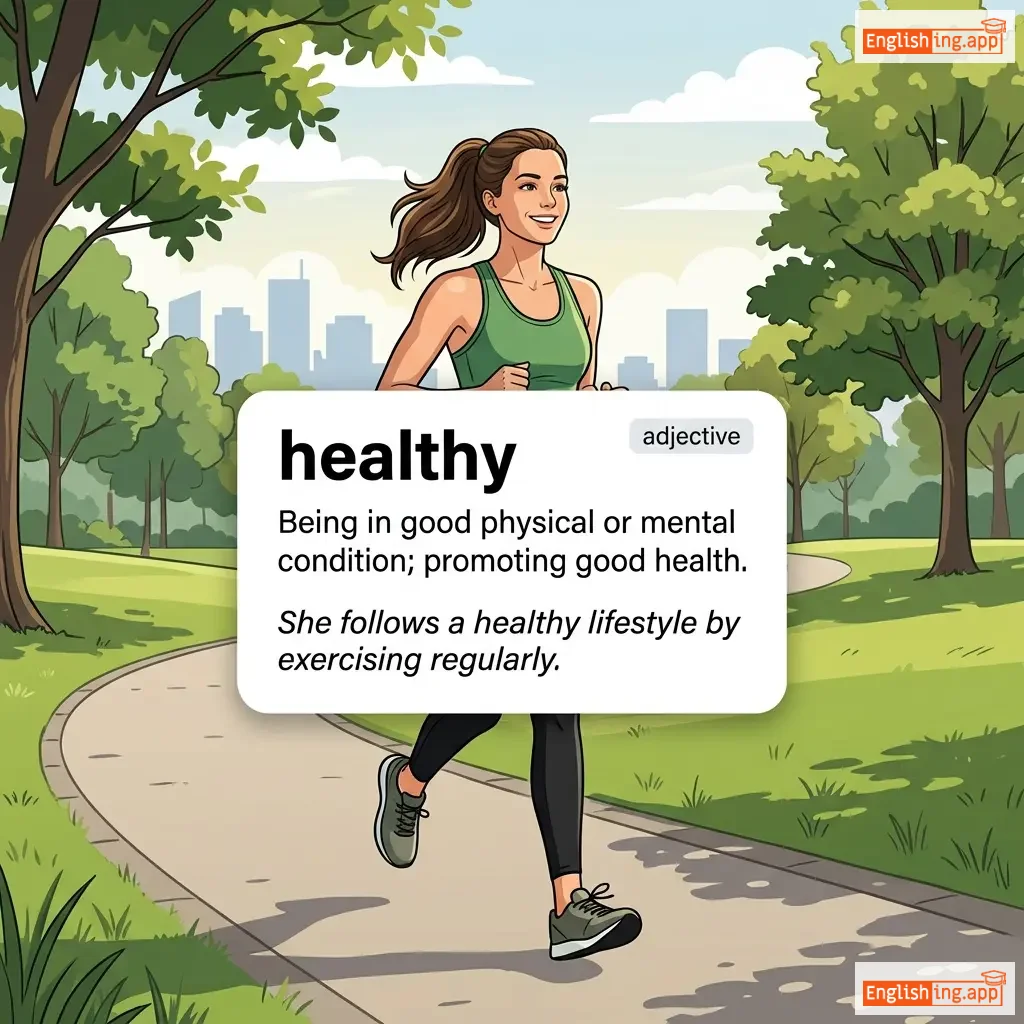
healthy definition card — visual illustration of the meaning
adjective
/ˈhɛlθi/
felicidad (felicidad)

Being in good physical or mental condition; promoting good health.

"She follows a healthy lifestyle by exercising regularly."

"Ella no pudo ocultar su felicidad cuando recibió el premio." (Ella no pudo ocultar su felicidad cuando recibió el premio.)
verb
/hɪr/
oír (oir)

To perceive sound with the ear.

"I can hear birds singing outside."

"Puedo oír los pájaros cantando afuera." (Puedo oir los pajaros cantando afuera.)
noun
/ˈhɪərɪŋ/
audiencia / audición (audiencia / audicion)

the ability to perceive sounds or an official meeting to listen to arguments or evidence

"The judge scheduled a hearing for next week."

"El juez programó una audiencia para la próxima semana." (El juez programo una audiencia para la proxima semana.)
verb
/ˈhɑːrkən/
escuchar atentamente (escuchar atentamente)

To listen attentively; to give heed.

"He would hearken to his mentor’s advice before making decisions."

"Él escucharía atentamente los consejos de su mentor antes de tomar decisiones." (Él escucharía atentamente los consejos de su mentor antes de tomar decisiones.)
noun
/ˈhɪərseɪ/
rumor (rumor)

Information received from other people that cannot be substantiated; rumor.

"The decision was based on hearsay, not evidence."

"La decisión se basó en rumores, no en evidencia." (La decision se baso en rumores, no en evidencia.)
noun
/hɜːrs/
carro fúnebre; (carro funebre)

a vehicle for conveying the coffin at a funeral; a funeral car

"The black hearse slowly made its way to the cemetery, followed by a procession of mourners."

"El carro fúnebre negro se dirigió lentamente al cementerio, seguido por una procesión de dolientes." (El carro funebre negro se dirigió lentamente al cementerio, seguido por una procesión de dolientes.)
noun
/hɑːrt/
corazón (corazon)

the organ that pumps blood through the body; also the center of emotions

"Her heart was beating fast with excitement."

"Su corazón latía rápidamente con emoción." (Su corazon latia rapidamente con emocion.)
heartbeat definition card — visual illustration of the meaning
noun
/ˈhɑːt.biːt/
latido del corazón (latido del corazon)

A pulsation of the heart, especially as perceptible to the touch or audible with a stethoscope.

"Rubbing the eyes helps normalize the heartbeat."

"Frotarse los ojos ayuda a normalizar el latido del corazón." (Frotarse los ojos ayuda a normalizar el latido del corazon.)
adjective
/ˈhɑːrtˌbreɪkɪŋ/
desgarrador; devastador; conmovedor (desgarrador; devastador; conmovedor)

causing overwhelming distress; very sad or disappointing

"The documentary showed heartbreaking scenes of children in poverty."

"El documental mostró escenas desgarradoras de niños en la pobreza." (El documental mostró escenas desgarradoras de niños en la pobreza.)
verb
/ˈhɑːrtən/
dar ánimo (dar animo)

To give courage, confidence, or hope.

"The teacher’s encouragement heartened the students."

"El aliento del maestro dio ánimo a los estudiantes." (El aliento del maestro dio animo a los estudiantes.)
adverb
/ˈhɑr.tɪ.li/
cordialmente; de todo corazón (cordialmen-te; de to-do co-ra-zón)

in a sincere and enthusiastic manner; wholeheartedly

"She heartily welcomed her guests to the party."

"Ella dio una cordial bienvenida a sus invitados a la fiesta." (E-ya dio u-na cor-dial bien-ve-ni-da a sus in-vi-ta-dos a la fies-ta.)
adjective
/ˈhɑːrtˌrɛndɪŋ/
desgarrador (desgarrador)

Causing great sadness or distress; very moving emotionally.

"The documentary showed heartrending scenes of war victims."

"El documental mostró escenas desgarradoras de las víctimas de la guerra." (El documental mostró escenas desgarradoras de las víctimas de la guerra.)
adjective
/ˈhɑːrti/
entusiasta y amigable; sustancial y nutritivo (entusiasta y amigable; sustancial y nutritivo)

enthusiastic and friendly; substantial and nourishing

"He gave us a hearty welcome when we arrived at his home."

"Nos dio una cálida bienvenida cuando llegamos a su casa." (Nos dio una calida bienvenida cuando llegamos a su casa.)
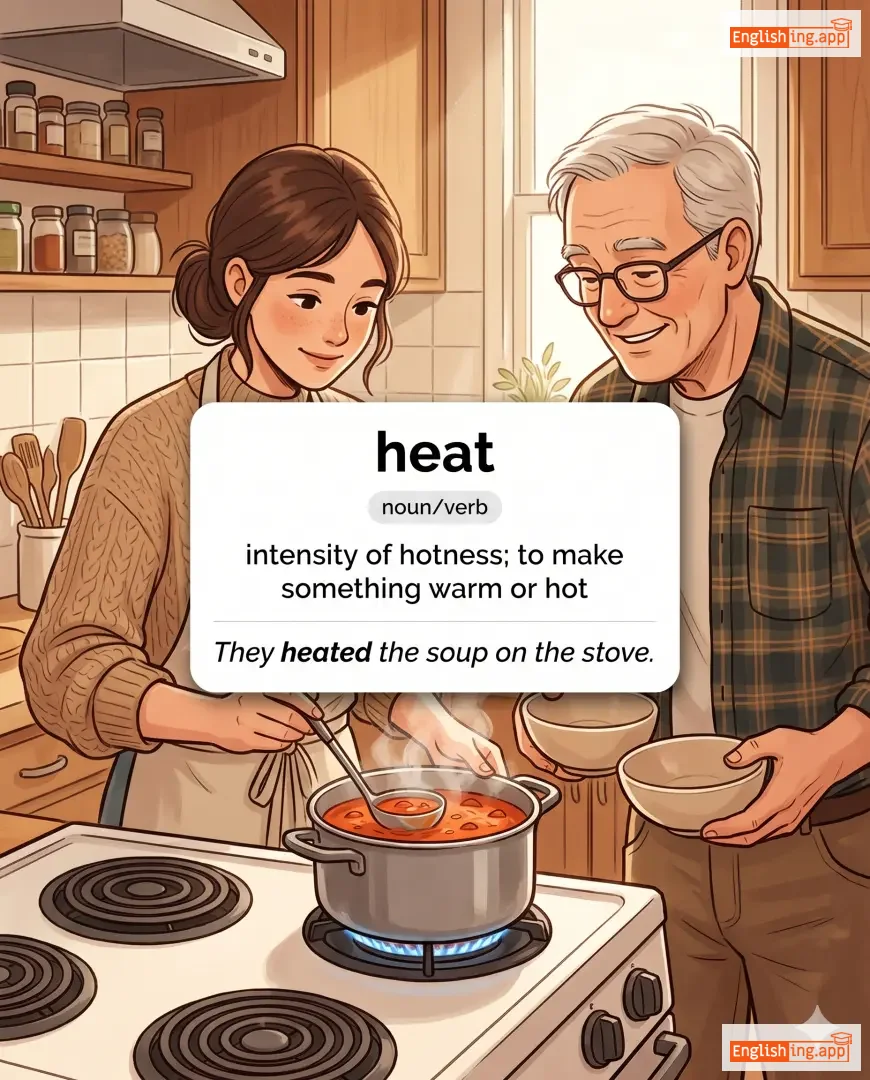
heat definition card — visual illustration of the meaning
noun/verb
/hiːt/
calor / calorífica (calor / calorifica)

intensity of hotness; to make something warm or hot

"They heated the soup on the stove."

"Ellos calentaron la sopa en la estufa." (Ellos calentaron la sopa en la estufa.)
adjective
/ˈhiːðənɪʃ/
bárbaro (barbaro)

Lacking culture or religion; barbaric or uncivilized.

"They considered the ancient tribe’s rituals heathenish."

"Ellos consideraron los rituales de la antigua tribu como paganos." (Ellos consideraron los rituales de la antigua tribu como paganos.)
noun
/ˈhɛvən/
cielo (sielo)

the place believed to be the home of God and the afterlife of the good; a state of extreme happiness

"They believe that good people go to heaven after death."

"Ellos creen que las personas buenas van al cielo después de la muerte." (Ellos creen que las personas buenas van al cielo después de la muerte.)
adjective
/ˈhevənli/
celestial; divino; placentero (celestial; divino; placentero)

relating to heaven; extremely pleasant or beautiful

"The chocolate cake had a heavenly taste that melted in my mouth."

"El pastel de chocolate tenía un sabor celestial que se derretía en mi boca." (El pastel de chocolate tenía un sabor celestial que se derretía en mi boca.)
adverb
/ˈhɛvɪli/
pesadamente / mucho (pesadamente / mucho)

to a great degree; with a lot of weight, intensity, or force

"It rained heavily all night."

"Llovió pesadamente toda la noche." (Llovió pesadamente toda la noche.)
adjective
/ˈhɛvi/
pesado (pesado)

having great weight; difficult to lift or move

"The box was too heavy for her to carry alone."

"La caja era demasiado pesada para que ella la llevara sola." (La caja era demasiado pesada para que ella la llevara sola.)
noun
/ˈhɛklər/
interrumpidor (interrumpidor)

A person who interrupts a speaker with rude or aggressive comments.

"The politician remained calm despite the heckler shouting from the crowd."

"El político se mantuvo tranquilo a pesar del interrumpidor gritando desde la multitud." (El político se mantuvo tranquilo a pesar del interrumpidor gritando desde la multitud.)
adjective
/ˈhek.tɪk/
agitado; frenético; lleno de actividad (agitado; frenetico; lleno de actividad)

very busy and full of activity; frantic; characterized by intense activity or excitement

"My schedule has been hectic lately with back-to-back meetings."

"Mi horario ha estado agitado últimamente con reuniones seguidas." (Mi horario ha estado agitado últimamente con reuniones seguidas.)
verb
/ˈhɛktər/
hablar con amenazas (hablar con amenazas)

To talk to someone in a bullying or intimidating way.

"The manager hectored the staff into working overtime."

"El gerente amenazó al personal para que trabajara horas extras." (El gerente amenazó al personal para que trabajara horas extras.)
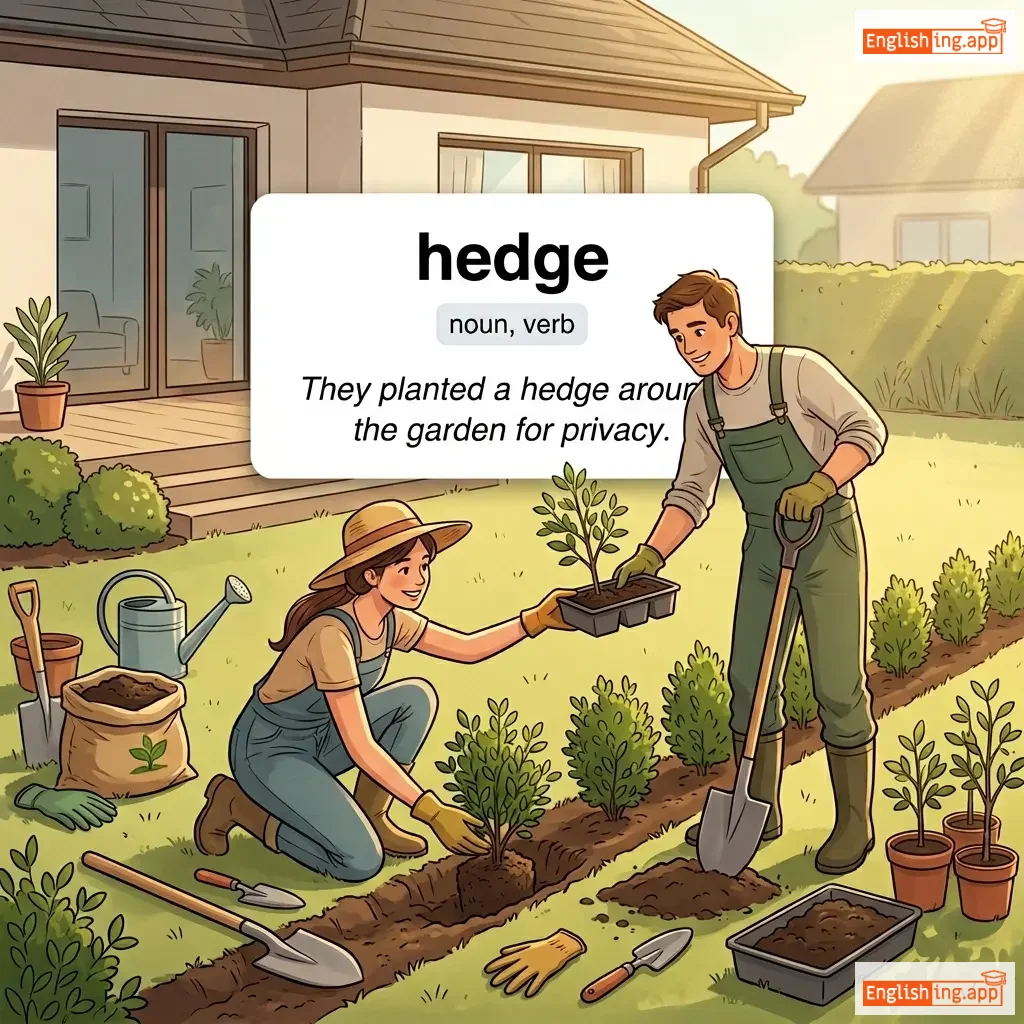
hedge definition card — visual illustration of the meaning
noun, verb
/hɛdʒ/
seto (seto)

A fence or boundary formed by closely planted shrubs; also, to limit or qualify a statement.

"They planted a hedge around the garden for privacy."

"Plantaron un seto alrededor del jardín para privacidad." (Plantaron un seto alrededor del jardín para privacidad.)
noun
/ˈhedʒhɒɡ/
erizo (erizo)

a small mammal with a spiny coat that can roll into a ball for defense

"The hedgehog rolled into a ball when it felt threatened."

"El erizo se enrolló en una bola cuando se sintió amenazado." (El erizo se enrolló en una bola cuando se sintió amenazado.)
noun
/ˈhiːdəˌnɪzəm/
hedonismo (hedonismo)

The pursuit of pleasure and self-indulgence as the highest goal.

"The lifestyle of the rich is often criticized as pure hedonism."

"El estilo de vida de los ricos a menudo se critica como puro hedonismo." (El estilo de vida de los ricos a menudo se critica como puro hedonismo.)
noun
/ˈhiːdənɪst/
hedonista (hedonista)

A person who believes that the pursuit of pleasure is the most important thing in life.

"She was called a hedonist because she always prioritized enjoyment over duty."

"La llamaron hedonista porque siempre priorizaba el disfrute sobre el deber." (La llamaron hedonista porque siempre priorizaba el disfrute sobre el deber.)
verb
/hiːd/
prestar atención (prestar atencion)

to pay attention to; to take notice of

"You should heed the teacher's advice."

"Debes hacer caso al consejo del maestro." (Debes hacer caso al consejo del maestro.)
adjective
/ˈhiːdləs/
despreocupado (despreocupado)

showing a reckless lack of care or attention

"He drove with heedless disregard for the rules."

"Condujo con desprecio por las reglas." (Condujo con desprecio por las reglas.)
noun
/hiːl/
talón (talon)

the back part of the human foot below the ankle

"Her shoe was rubbing against her heel."

"Su zapato le frotaba el talón." (Su zapato le frotaba el talón.)
noun
/hɪˈdʒɛməni/ or /ˈhɛdʒəmoʊni/
hegemonía (hegemonia)

leadership or dominance, especially by one state or group over others

"The empire maintained its hegemony over neighboring states."

"El imperio mantuvo su hegemonía sobre los estados vecinos." (El imperio mantuvo su hegemonia sobre los estados vecinos.)
🚶‍♂️

hegira (hejira)

noun
/ˈhɛdʒɪrə/ or /hɪˈdʒaɪrə/
emigración, huida (emigracion, huida)

a journey, especially when undertaken to escape from a dangerous or undesirable situation

"The refugees began their hegira across the desert."

"Los refugiados comenzaron su emigración a través del desierto." (Los refugiados comenzaron su emigracion a traves del desierto.)
noun
/ˈhɛfər/
vaquilla (vaquilla)

a young cow that has not borne a calf

"The farmer raised a heifer for dairy production."

"El granjero crió una vaquilla para la producción de lácteos." (El granjero crió una vaquilla para la producción de lácteos.)
noun
/haɪt/
altura (altura)

the measurement of someone or something from base to top

"The height of the tower impressed the visitors."

"La altura de la torre impresionó a los visitantes." (La altura de la torre impresionó a los visitantes.)
verb
/ˈhaɪtən/
aumentar (aumentar)

to make or become greater in intensity or degree

"The announcement served to heighten the excitement in the room."

"El anuncio sirvió para aumentar la emoción en la habitación." (El anuncio sirvió para aumentar la emoción en la habitación.)
adjective
/ˈheɪ.nəs/
horrible (horrible)

extremely wicked, deeply offensive, or shockingly evil

"The dictator was condemned for his heinous crimes against humanity."

"El dictador fue condenado por sus horribles crímenes contra la humanidad." (El dictador fue condenado por sus horribles crímenes contra la humanidad.)
noun
/er/
heredero (heredero)

a person legally entitled to the property or rank of another on that person's death

"The young prince was the rightful heir to the throne and would become king someday."

"El joven príncipe era el heredero legítimo al trono y algún día sería rey." (El joven príncipe era el heredero legítimo al trono y algún día sería rey.)
noun
/ˈɛər.luːm/
herencia (herencia)

a valuable object that has belonged to a family for several generations

"The ring is a family heirloom passed down from her grandmother."

"El anillo es una herencia familiar que ha sido transmitida por su abuela." (El anillo es una herencia familiar que ha sido transmitida por su abuela.)
noun
/ˈhɛlɪˌkɒptər/
helicóptero (helicoptero)

an aircraft with rotating blades that can take off and land vertically

"The helicopter landed safely on the hospital roof."

"El helicóptero aterrizó de manera segura en el techo del hospital." (El helicóptero aterrizó de manera segura en el techo del hospital.)
noun
/hɛl/
infierno (infierno)

a place or state of great suffering and torment, often in religious belief

"He feared that his sins would send him to hell."

"Él temía que sus pecados lo enviaran al infierno." (El temía que sus pecados lo enviaran al infierno.)
interjection
/həˈloʊ/
hola (hola)

a greeting or expression used when meeting someone or starting a conversation

"She answered the phone with a cheerful hello."

"Ella respondió al teléfono con un alegre hola." (Ella respondio al telefono con un alegre hola.)
noun
/hɛlm/
liderazgo, timón (liderazgo, timon)

a position of leadership or the steering apparatus of a ship

"After years of service, she finally took the helm of the company."

"Después de años de servicio, finalmente asumió el liderazgo de la empresa." (Despues de anos de servicio, finalmente asumió el liderazgo de la empresa.)
noun
/ˈhɛl.mət/
casco (casco)

a hard protective hat worn to protect the head

"The rider put on his helmet before starting the motorcycle."

"El jinete se puso el casco antes de comenzar a conducir la motocicleta." (El jinete se puso el casco antes de comenzar a conducir la motocicleta.)
noun
/ˈhelmz.mən/
timón; patrón de barco (timón; patrón de barco)

a person who steers a ship or boat; the person at the helm of a vessel

"The experienced helmsman skillfully guided the yacht through the narrow channel during the storm."

"El experimentado timonel guió hábilmente el yate a través del estrecho canal durante la tormenta." (El experimentado timonel guió hábilmente el yate a través del estrecho canal durante la tormenta.)
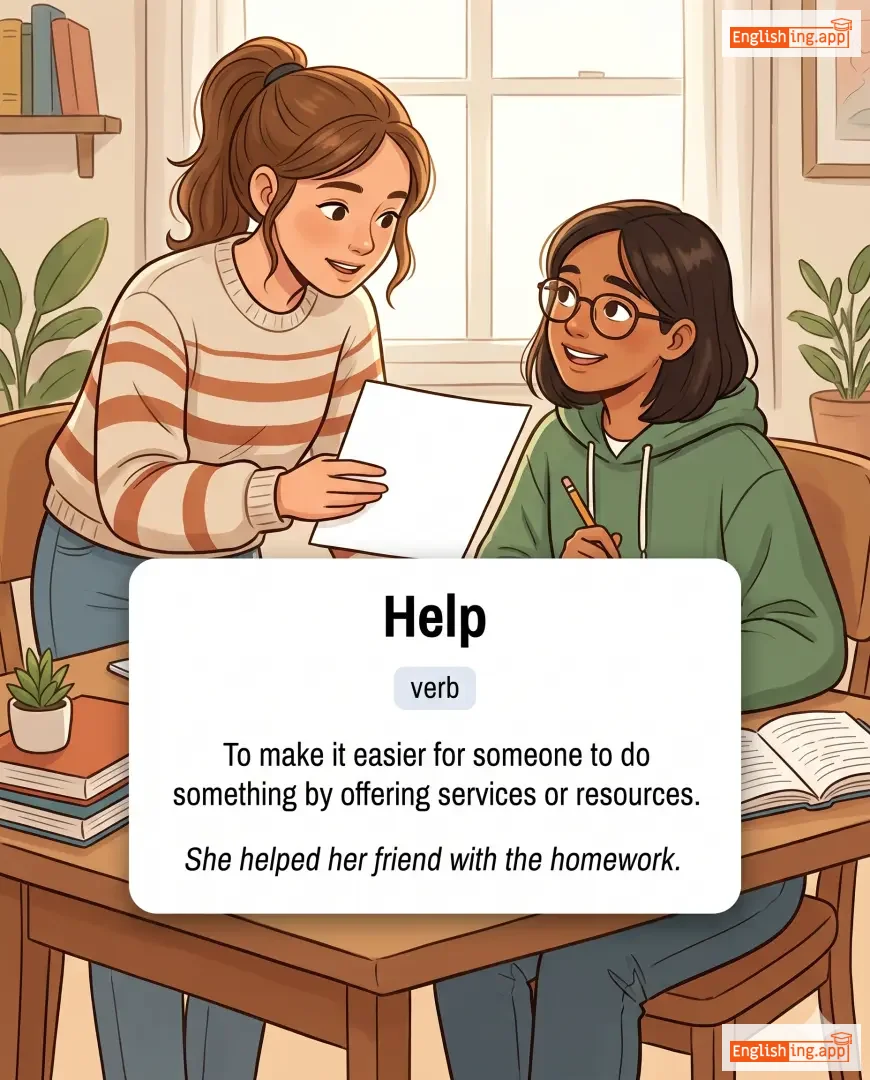
Help definition card — visual illustration of the meaning
verb
/hɛlp/
ayudar (ayudar)

To make it easier for someone to do something by offering services or resources.

"She helped her friend with the homework."

"Ella ayudó a su amiga con la tarea." (Ella ayudo a su amiga con la tarea.)
adjective
/ˈhɛlpfəl/
útil (util)

giving help or being useful

"The guide was very helpful during our trip."

"El guía fue muy útil durante nuestro viaje." (El guia fue muy util durante nuestro viaje.)
adjective
/ˈhelp.ləs/
desamparado; impotente; vulnerable (desamparado; impotente; vulnerable)

unable to defend oneself or act without help; powerless; vulnerable

"The child felt helpless when lost in the crowded market."

"El niño se sintió desamparado cuando se perdió en el mercado abarrotado." (El niño se sintió desamparado cuando se perdió en el mercado abarrotado.)