Vocabularios

Descubra, aprenda y domine el vocabulario en inglés

noun
/ˌfiː.ɑːnˈseɪ/
prometido (prometido)

a man who is engaged to be married

"Sarah introduced her fiance to her parents during the family dinner."

"Sara presentó a su prometido a sus padres durante la cena familiar." (Sara presento a su prometido a sus padres durante la cena familiar.)
noun
/ˌfiː.ɑːnˈseɪ/
prometida (prometida)

a woman who is engaged to be married

"John bought a beautiful engagement ring for his fiancee."

"John compró un hermoso anillo de compromiso para su prometida." (John compro un hermoso anillo de compromiso para su prometida.)
noun
/fiˈæs.koʊ/
fracaso total (fracaso total)

a complete failure, especially a ludicrous or humiliating one

"The event turned into a complete fiasco due to poor planning."

"El evento se convirtió en un fracaso total debido a una mala planificación." (El evento se convirtió en un fracaso total debido a una mala planificación.)
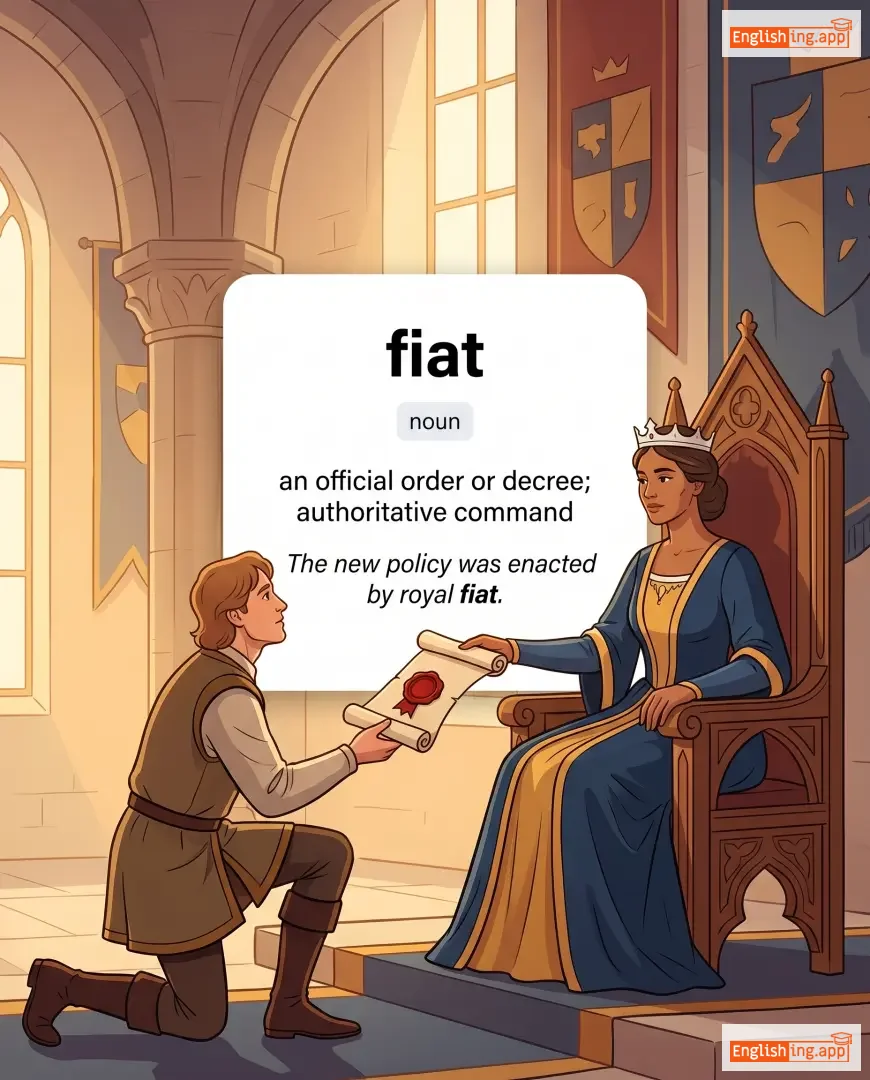
fiat definition card — visual illustration of the meaning
noun
/ˈfiːæt/
decreto, mandato (decreto, mandato)

an official order or decree; authoritative command

"The new policy was enacted by royal fiat."

"La nueva política fue implementada por un decreto real." (La nueva política fue implementada por un decreto real.)
noun
/ˈfaɪbər/
fibra (fibra)

a thread or filament from which a textile is formed; dietary substance from plants that aids digestion

"Fruits and vegetables are high in fiber."

"Las frutas y verduras son ricas en fibra." (Las frutas y verduras son ricas en fibra.)
noun
/ˈfaɪ.bər/
fibra (fibra)

A thread or filament from which a vegetable tissue, mineral substance, or textile is formed; dietary material that aids digestion.

"Eating foods rich in fibre can improve your digestion."

"Comer alimentos ricos en fibra puede mejorar tu digestión." (Comer alimentos ricos en fibra puede mejorar tu digestión.)
adjective
/ˈfɪkəl/
inconstante, voluble (inconstante, voluble)

changing frequently in loyalty, interest, or affection

"She is so fickle that she changes her mind every hour."

"Ella es tan inconstante que cambia de opinión cada hora." (Ella es tan inconstante que cambia de opinión cada hora.)
noun
/ˈfɪkʃən/
ficción (ficcion)

Literature created from the imagination, not presented as fact.

"She enjoys reading science fiction novels."

"A ella le gusta leer novelas de ciencia ficción." (A ella le gusta leer novelas de ciencia ficcion.)
adjective
/fɪkˈtɪʃəs/
ficticio, falso (ficticio, falso)

not real or true; imaginary or fabricated

"The story he told was entirely fictitious."

"La historia que contó era completamente ficticia." (La historia que contó era completamente ficticia.)
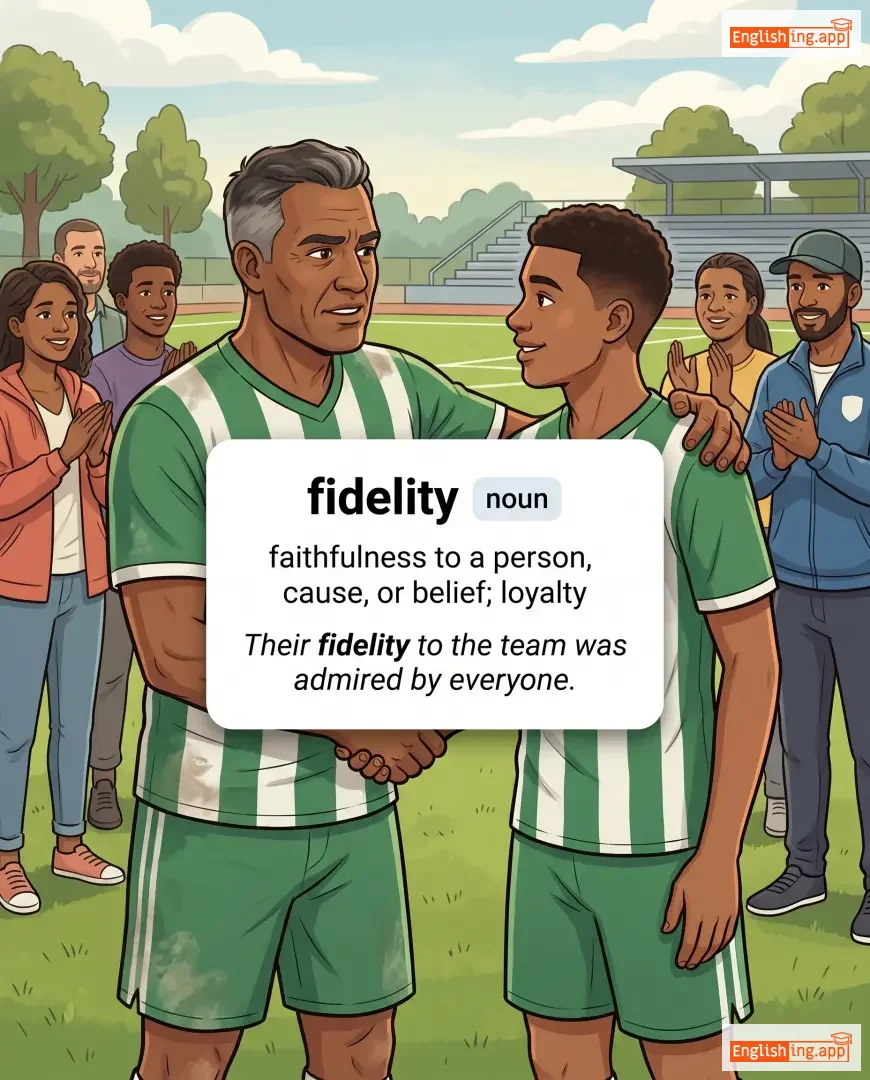
fidelity definition card — visual illustration of the meaning
noun
/fɪˈdelɪti/
fidelidad, lealtad (fidelidad, lealtad)

faithfulness to a person, cause, or belief; loyalty

"Their fidelity to the team was admired by everyone."

"Su fidelidad al equipo fue admirada por todos." (Su fidelidad al equipo fue admirada por todos.)
verb
/ˈfɪdʒɪt/
moverse inquieto, estar inquieto (moverse inquieto, estar inquieto)

to make small movements, especially because of nervousness or impatience

"The child began to fidget during the long lecture."

"El niño empezó a moverse durante la larga conferencia." (El niño empezo a moverse durante la larga conferencia.)
adjective
/fɪˈdjuːʃəl/
fiducial, de referencia (fidusial, de referencia)

based on trust or confidence; serving as a standard of reference

"The fiducial point on the map ensures accurate measurements."

"El punto fiducial en el mapa asegura mediciones precisas." (El punto fidusial en el mapa asegura mediciones precisas.)
fiduciary definition card — visual illustration of the meaning
noun
/fɪˈduːʃieri/
fiduciario, trustee (fiduciario, trustee)

a person who holds assets in trust for someone else; related to trust and responsibility

"The lawyer acted as a fiduciary for his client’s estate."

"El abogado actuó como fiduciario para la propiedad de su cliente." (El abogado actuó como fiduciario para la propiedad de su cliente.)
noun
/fiːf/
un terreno de tierra otorgado bajo el sistema feudal; un dominio o área de control (un terreno de tierra otorgado bajo el sistema feudal; un dominio o área de control)

an estate of land held under the feudal system; a domain or area of control

"The knight was granted a fief by the lord for his service."

"El caballero recibió un feudo del señor por su servicio." (El caballero recibió un feudo del señor por su servicio.)
noun
/fiːld/
campo (campo)

an area of open land, often used for farming, sports, or scientific study

"The children played football in the field."

"Los niños jugaron al fútbol en el campo." (Los ninos jugaron al futbol en el campo.)
noun
/fiːnd/
demonio, persona malvada (demonio, persona malvada)

an evil spirit or demon; a wicked or cruel person; someone obsessed with a particular thing

"He is a real fiend when it comes to solving puzzles."

"Él es un verdadero demonio cuando se trata de resolver rompecabezas." (El es un verdadero demonio cuando se trata de resolver rompecabezas.)
adjective
/fɪəs/
feroz, intenso (feroz, intenso)

showing strong, intense, or aggressive feelings; powerful and violent

"The fierce storm damaged several houses in the village."

"La feroz tormenta dañó varias casas en el pueblo." (La feroz tormenta dañó varias casas en el pueblo.)
adjective
/ˈfaɪə.ri/
ardiente; apasionado; temperamental (ardiente; apasionado; temperamental)

burning; passionate; hot-tempered; showing strong emotion

"She has a fiery temper that flares up quickly."

"Ella tiene un temperamento ardiente que se enciende rápidamente." (Ella tiene un temperamento ardiente que se enciende rápidamente.)
1️⃣5️⃣

fifteen (fifteen)

number
/ˌfɪfˈtiːn/
quince (kinth)

the number 15

"There are fifteen students in the class."

"Hay quince estudiantes en la clase." (Hay kinse estudiantes en la clase.)
adjective
/fɪfθ/
quinto (keen-to)

constituting number five in a sequence

"She lives on the fifth floor of the building."

"Ella vive en el quinto piso del edificio." (Ella vive en el quinto piso del edificio.)
5️⃣0️⃣

fifty (fifty)

number
/ˈfɪfti/
cincuenta (sinkuenta)

the number 50

"The stadium can hold fifty thousand people."

"El estadio puede albergar cincuenta mil personas." (El estadio puede albergar sinkuenta mil personas.)
noun
/fɪɡ/
higo (higo)

a soft sweet fruit with many small seeds, eaten fresh or dried

"Fresh figs are delicious when eaten with honey."

"Los higos frescos son deliciosos cuando se comen con miel." (Los higos frescos son deliciosos cuando se comen con miel)
verb
/faɪt/
luchar (luchar)

to take part in a violent struggle or to try hard to achieve something

"They had to fight for their rights."

"Ellos tuvieron que luchar por sus derechos." (Ellos tuvieron que luchar por sus derechos.)
noun
/ˈfaɪtər/
luchador (luchador)

a person who fights, especially in combat or sports like boxing

"The fighter won the championship after a tough battle."

"El luchador ganó el campeonato después de una dura batalla." (El luchador ganó el campeonato después de una dura batalla.)
noun/verb
/ˈfaɪtɪŋ/
lucha (lucha)

the act of engaging in a physical or verbal conflict

"The soldiers were fighting bravely on the battlefield."

"Los soldados luchaban valientemente en el campo de batalla." (Los soldados luchaban valientemente en el campo de batalla.)
noun
/ˈfɪɡmənt/
invención, imaginación (invensyon, imaheenasyon)

something invented or imaginary; a fabrication of the mind

"The story of the haunted house is just a figment of her imagination."

"La historia de la casa embrujada es solo un producto de su imaginación." (La historia de la casa embrujada es solo un producto de su imaginacion.)
adjective
/ˈfɪɡərətɪv/
figurado (figurado)

not literal; using figures of speech or symbolic representation

"She used figurative language to describe her feelings."

"Ella usó lenguaje figurado para describir sus sentimientos." (Ella uso lenguaje figurado para describir sus sentimientos.)
noun
/ˈfɪɡjər/
número, forma, persona importante (numero, forma, persona importante)

a number, shape, or person of importance; also a representation in drawing or sculpture

"The report included several important figures."

"El informe incluía varias figuras importantes." (El informe incluía varias figuras importantes.)
noun
/ˈfɪɡjərˌhɛd/
cabeza simbólica (cabeza simbolica)

a nominal leader with no real power; a symbolic head

"The king was merely a figurehead with no real authority."

"El rey era simplemente un líder simbólico sin poder real." (El rey era simplemente un lider simbolico sin poder real.)
noun
/ˌfɪɡjʊˈriːn/
pequeña figura decorativa (pequena figura decorativa)

a small ornamental statue or model of a human or animal

"She bought a porcelain figurine of a dancing ballerina."

"Ella compró una figura de porcelana de una bailarina de ballet." (Ella compro una figura de porcelana de una bailarina de ballet.)
🕵️‍♂️

filch (fílch)

verb
/fɪltʃ/
robar (robar)

to steal something in a sneaky or petty way

"He tried to filch a candy bar from the shop."

"Él intentó robar una barra de caramelo de la tienda." (El intento robar una barra de caramelo de la tienda.)
noun/verb
/faɪl/
archivo (archivo)

a collection of documents stored together; or to submit an official document

"She saved the report in a new file on her computer."

"Ella guardó el informe en un nuevo archivo en su computadora." (Ella guardó el informe en un nuevo archivo en su computadora.)
👨‍👩‍👧

filial (fɪlial)

adjective
/ˈfɪliəl/
relacionado con un hijo o hija; mostrar respeto o afecto hacia los padres (relacionado con un hijo o hija; mostrar respeto o afecto hacia los padres)

relating to a son or daughter; showing respect or affection toward parents

"He showed filial respect by caring for his aging parents."

"Él mostró respeto filial cuidando a sus padres ancianos." (Él mostró respeto filial cuidando a sus padres ancianos.)
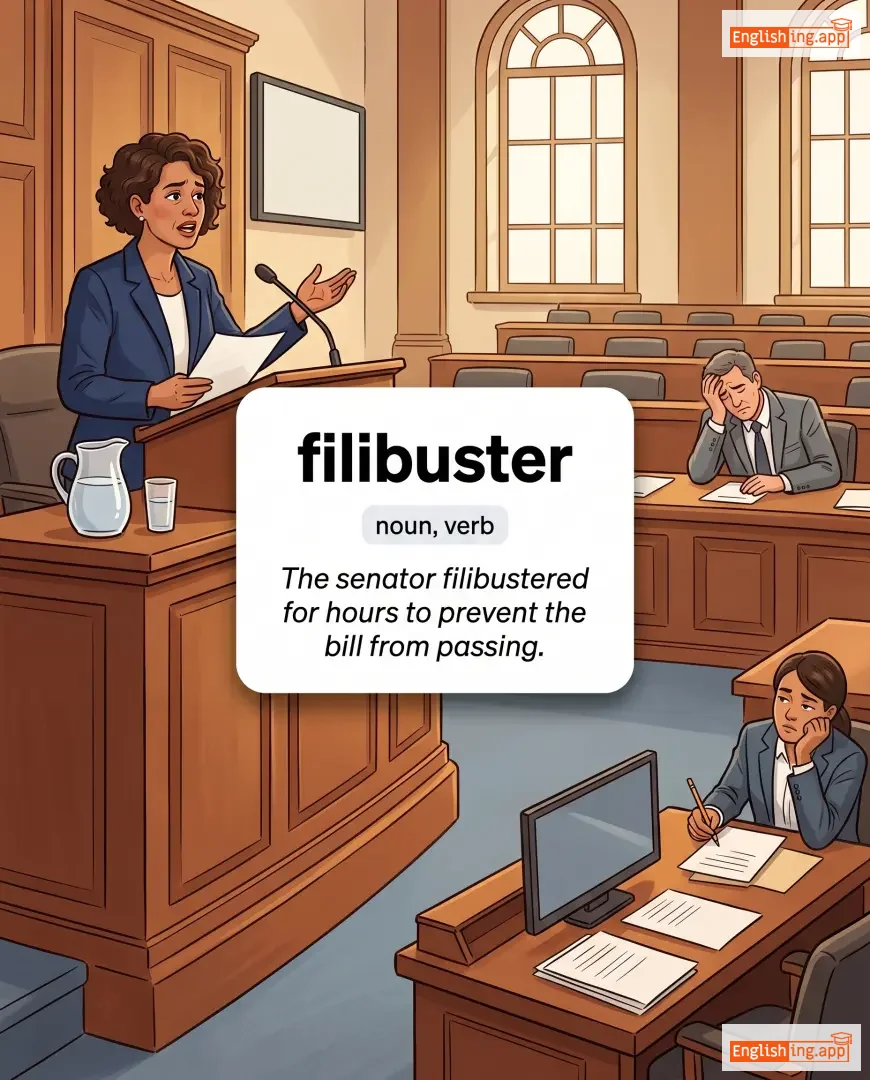
filibuster definition card — visual illustration of the meaning
noun, verb
/ˈfɪlɪˌbʌstər/
una táctica de retrasar la acción legislativa mediante discursos prolongados; usar tal táctica (una tactica de retrasar la accion legislativa mediante discursos prolongados; usar tal tactica)

a tactic of delaying legislative action by prolonged speech; to use such a tactic

"The senator filibustered for hours to prevent the bill from passing."

"El senador filibusteó durante horas para evitar que se aprobara el proyecto de ley." (El senador filibusteo durante horas para evitar que se aprobara el proyecto de ley.)
noun
/ˈfɪlɪɡri/
trabajo ornamental delicado, generalmente de oro o plata (trabajo ornamental delicado, generalmente de oro o plata)

delicate ornamental work of fine wire, usually of gold or silver

"The necklace was decorated with intricate gold filigree."

"El collar estaba decorado con intrincados filigríes de oro." (El collar estaba decorado con intrincados filigríes de oro.)
noun, verb
/ˈfaɪlɪŋ/
presentación de documentos; organización de papeles (presentacion de documentos; organizacion de papeles)

the act of submitting documents; the process of organizing papers

"The lawyer handled the filing of all court documents."

"El abogado manejó la presentación de todos los documentos judiciales." (El abogado manejo la presentacion de todos los documentos judiciales.)
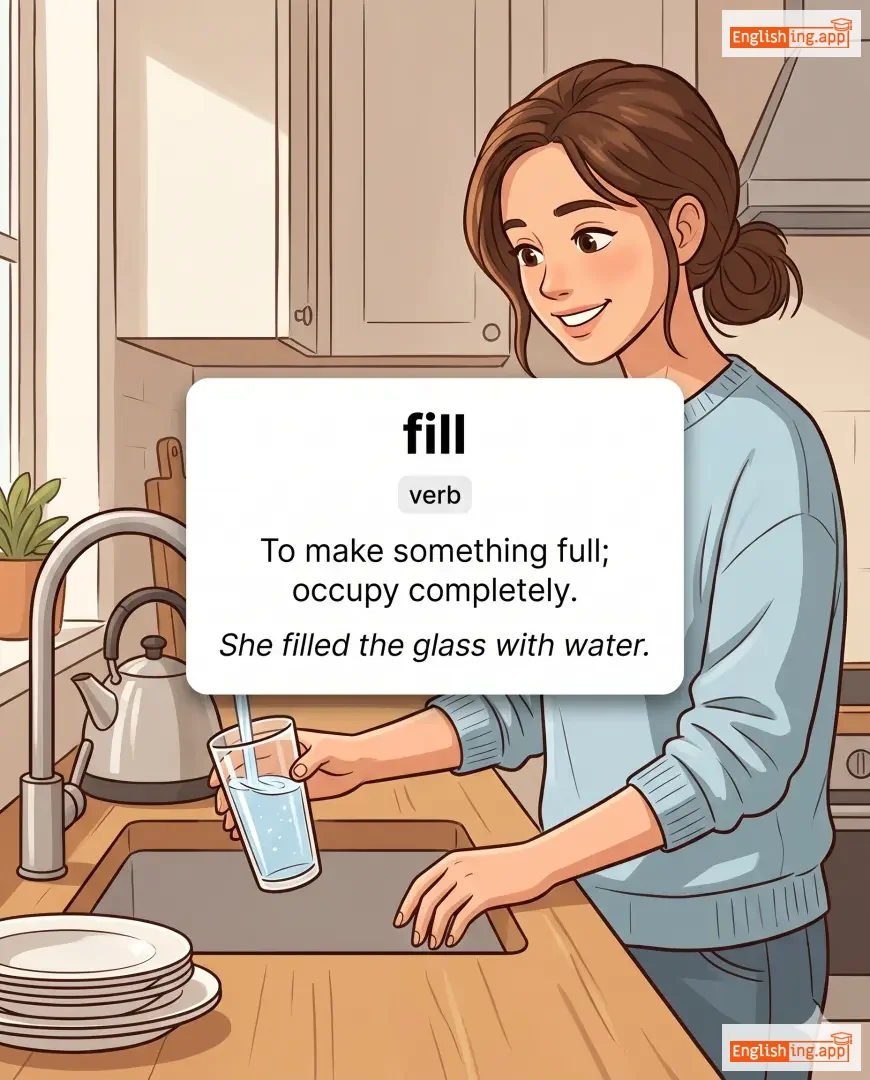
fill definition card — visual illustration of the meaning
verb
/fɪl/
llenar (llenar)

To make something full; occupy completely.

"She filled the glass with water."

"Ella llenó el vaso con agua." (Ella llenó el vaso con agua.)
noun
/ˈfɪli/
yegua joven (yegua joven)

a young female horse

"The filly ran swiftly across the meadow."

"La potra corrió rápidamente por el campo." (La potra corrio rapidamente por el campo.)
noun/verb
/fɪlm/
película (pelicula)

a motion picture or movie; or to record on camera

"They watched a film together on the weekend."

"Ellos vieron una película juntos el fin de semana." (Ellos vieron una pelicula juntos el fin de semana.)
noun
/fɪlm ˈæktər/
actor de cine (actor de cine)

A person who performs roles in movies or films.

"The film actor received widespread acclaim for his performance."

"El actor de cine recibió elogios generalizados por su actuación." (El actor de cine recibio elogios generalizados por su actuacion)
noun
/ˈfɪlmˌmeɪkər/
cineasta (cineasta)

A person who directs or produces films

"The film-maker received an award for his latest documentary."

"El cineasta recibió un premio por su último documental." (El cineasta recibio un premio por su ultimo documental.)
noun
/ˈfɪlmˌmeɪkər/
cineasta (cineasta)

a person who makes films, typically as a profession

"He is a well-known filmmaker in the industry."

"Es un cineasta muy conocido en la industria." (Es un cineasta muy conocido en la industria.)
verb
/ˈfɪltər/
filtrar (filtrar)

to pass a substance through a device to remove unwanted material or to selectively pass certain items

"She used a coffee filter to separate the grounds from the liquid."

"Ella usó un filtro de café para separar los posos del líquido." (Ella usó un filtro de café para separar los posos del líquido.)
noun
/fɪlθ/
suciedad (suciedad)

dirty or disgusting matter; moral corruption

"The streets were full of filth after the storm."

"Las calles estaban llenas de suciedad después de la tormenta." (Las calles estaban llenas de suciedad despues de la tormenta.)
verb
/fɪˈneɪɡəl/
obtener algo con astucia o engaño (obtener algo con astucia o engano)

to obtain something by cleverness or trickery

"He finagled a free ticket by pretending to be a VIP guest."

"Él consiguió un boleto gratis pretendiendo ser un invitado VIP." (El consiguió un boleto gratis pretendiendo ser un invitado VIP.)
adjective/noun
/ˈfaɪnəl/
final (final)

coming at the end; the last part of something

"The final exam will be held next week."

"El examen final se llevará a cabo la próxima semana." (El examen final se llevara a cabo la proxima semana.)
noun
/fɪˈnɑːleɪ/
final (final)

the last part or conclusion of a performance, event, or series

"The concert ended with a spectacular finale."

"El concierto terminó con un espectacular final." (El concierto termino con un espectacular final.)
noun
/faɪˈnælɪti/
finalidad (finalidad)

the quality of being final or irreversible; a sense of conclusiveness

"The judge's decision gave the case a sense of finality."

"La decisión del juez le dio al caso una sensación de finalidad." (La desicion del juez le dio al caso una sensacion de finalidad.)
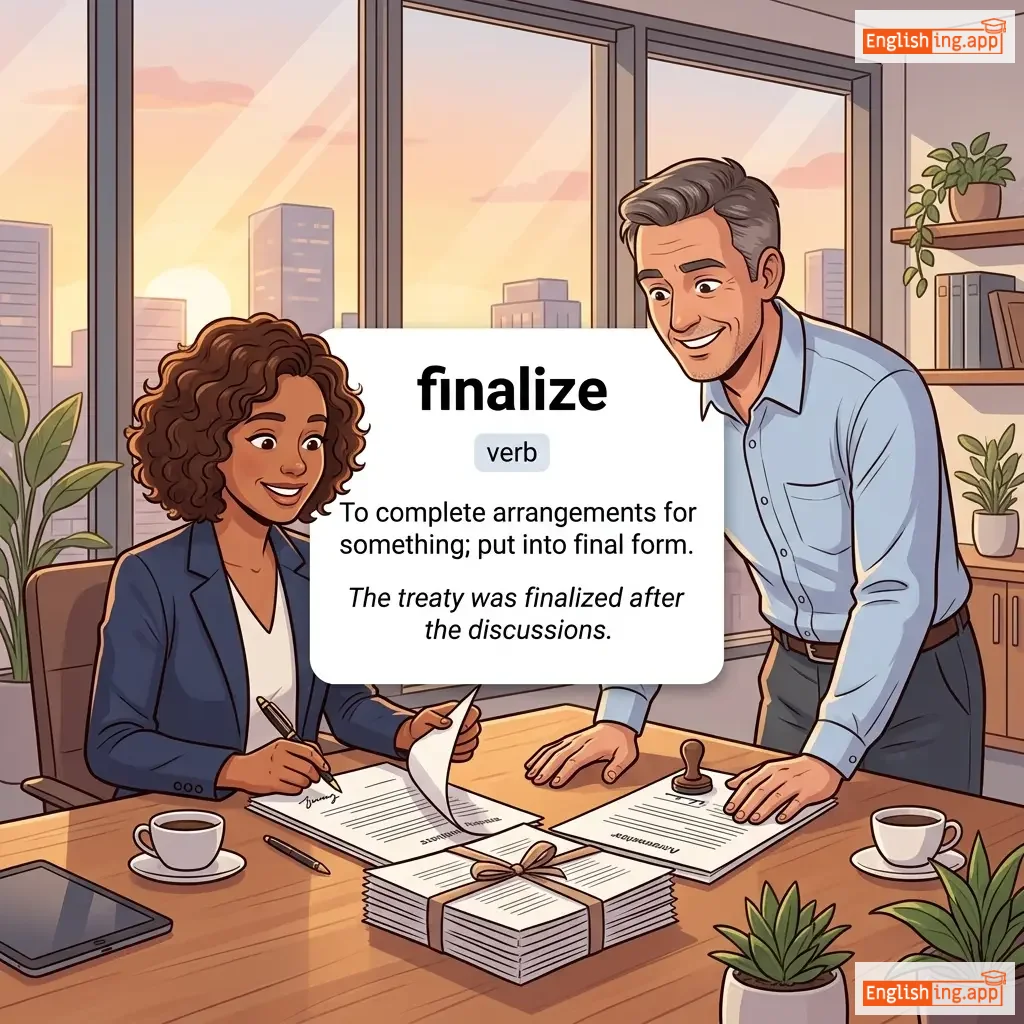
finalize definition card — visual illustration of the meaning
verb
ˈfaɪ.nəl.aɪz
finalizar (finalizar)

To complete arrangements for something; put into final form.

"The treaty was finalized after the discussions."

"El tratado fue finalizado después de las discusiones." (El tratado fue finalizado después de las discusiones.)
adverb
/ˈfaɪnəli/
finalmente (finalmente)

after a long time; at the end; ultimately

"After years of hard work, she finally achieved her dream."

"Después de años de trabajo duro, finalmente logró su sueño." (Despuès de años de trabajo duro, finalmente logró su sueño.)