Vocabularios

Descubra, aprenda y domine el vocabulario en inglés

adjective
/fɔːls/
falso (falso)

not true or correct; intended to deceive

"He was accused of giving false information."

"Él fue acusado de dar información falsa." (Él fue acusado de dar información falsa.)
noun
/ˈfɔːlshʊd/
mentira (mentira)

the state of being untrue or a lie

"He was punished for spreading falsehoods about his colleague."

"Fue castigado por difundir mentiras sobre su colega." (Fue castigado por difundir mentiras sobre su colega.)
verb
/ˈfɔːlsɪfaɪ/
falsificar (falsificar)

to make something false or to misrepresent

"He tried to falsify the documents to avoid taxes."

"Él trató de falsificar los documentos para evitar impuestos." (Él trató de falsificar los documentos para evitar impuestos.)
verb
/ˈfɔːltər/
vacilar o perder fuerza o impulso (vacilar o perder fuerza o impulso)

to hesitate or lose strength or momentum

"Her voice faltered as she delivered the speech."

"Su voz vaciló mientras pronunciaba el discurso." (Su voz vaciló mientras pronunciaba el discurso.)
noun
/feɪm/
fama (fama)

the state of being known or recognized by many people

"She achieved worldwide fame for her acting."

"Ella alcanzó fama mundial por su actuación." (Ella alcanzo fama mundial por su actuacion.)
adjective
/fəˈmɪliər/
familiar (familiar)

Well known or easily recognized from previous experience.

"The town looked familiar to me after so many years."

"El pueblo me parecía familiar después de tantos años." (El pueblo me parecia familiar despues de tantos años.)
👨‍👩‍👧‍👦

family (fámili)

noun
/ˈfæməli/
familia (familia)

A group consisting of parents and their children, or all the descendants of a common ancestor.

"She spends most of her weekends with her family."

"Ella pasa la mayoría de sus fines de semana con su familia." (Ella pasa la mayoría de sus fines de semana con su familia.)
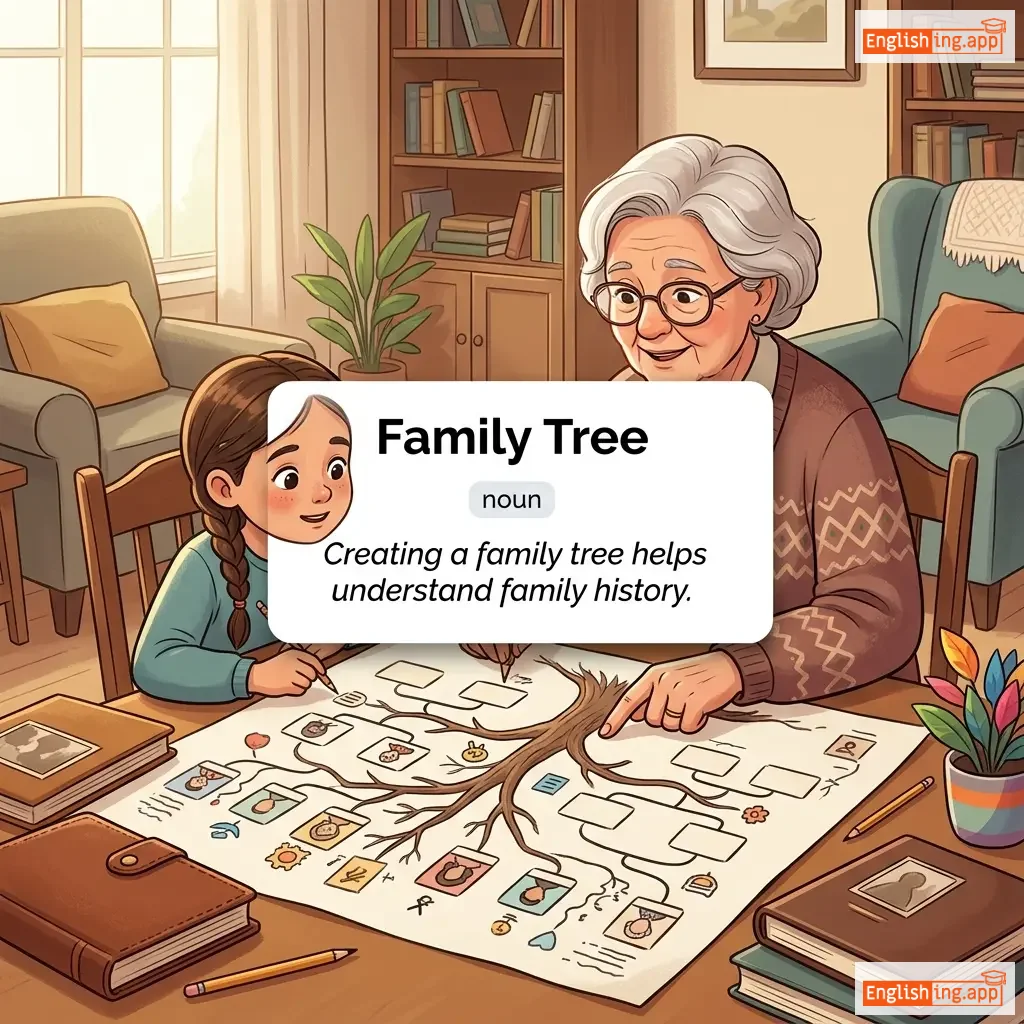
Family Tree definition card — visual illustration of the meaning
noun
ˈfæmɪli triː
Árbol genealógico (arbol genealogico)

A diagram showing the relationships between people in several generations of a family.

"Creating a family tree helps understand family history."

"Crear un árbol genealógico ayuda a entender la historia familiar." (Crear un arbol genealogico ayuda a entender la historia familiar.)
noun
/ˈfæm.ɪn/
hambruna (hambruna)

extreme scarcity of food; a period when food is extremely scarce

"The severe drought led to widespread famine in the region."

"La grave sequía provocó una hambruna generalizada en la región." (La grave sequía provocó una hambruna generalizada en la región.)
verb
/ˈfæmɪʃ/
morirse de hambre (morirse de hambre)

to suffer or cause to suffer from extreme hunger

"The stranded hikers began to famish after several days without food."

"Los excursionistas varados comenzaron a morirse de hambre después de varios días sin comida." (Los excursionistas varados comenzaron a morirse de hambre después de varios días sin comida.)
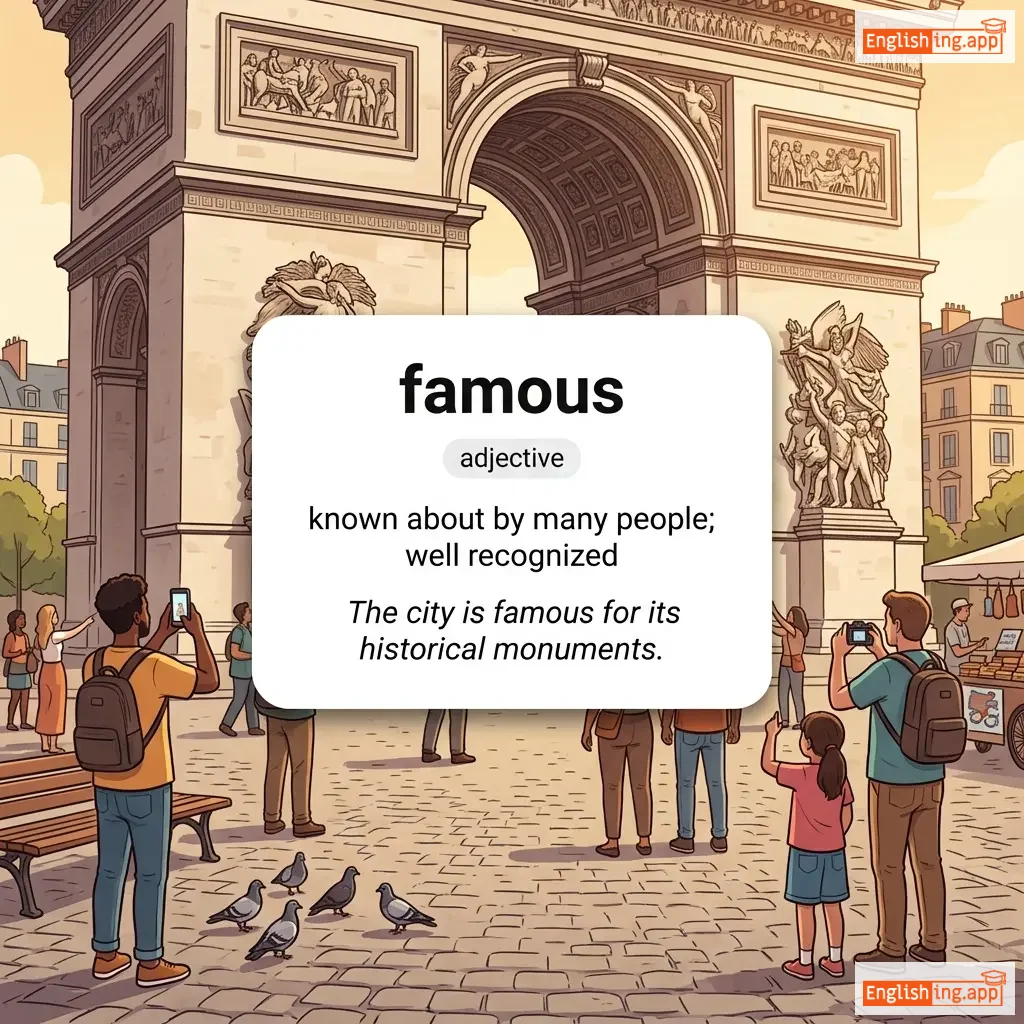
famous definition card — visual illustration of the meaning
adjective
/ˈfeɪməs/
famoso (famoso)

known about by many people; well recognized

"The city is famous for its historical monuments."

"La ciudad es famosa por sus monumentos históricos." (La ciudad es famosa por sus monumentos históricos.)
noun
/fæn/
felicidad (felicidad)

a device with rotating blades that creates a current of air; also a person who admires or supports someone or something

"The fan kept the room cool during the hot summer day."

"Ella no pudo ocultar su felicidad cuando recibió el premio." (Ella no pudo ocultar su felicidad cuando recibió el premio.)
noun
/fəˈnætɪk/
fanático (fanatico)

a person with extreme and uncritical enthusiasm for a cause or belief

"He is a football fanatic, never missing a match of his favorite team."

"Él es un fanático del fútbol, nunca se pierde un partido de su equipo favorito." (El es un fanatico del futbol, nunca se pierde un partido de su equipo favorito.)
adjective
/fəˈnætɪkəl/
fanático (fanatico)

showing extreme enthusiasm or obsession

"She has a fanatical interest in collecting vintage stamps."

"Ella tiene un interés fanático en coleccionar sellos antiguos." (Ella tiene un interes fanatico en coleccionar sellos antiguos.)
noun
/fəˈnætɪsɪzəm/
fanatismo (fanatismo)

the quality of being fanatical; extreme zeal or obsession

"Religious fanaticism can lead to intolerance and conflict."

"El fanatismo religioso puede llevar a la intolerancia y al conflicto." (El fanatismo religioso puede llevar a la intolerancia y al conflicto.)
adjective
/ˈfænsiːd/
imaginado, deseado (imaginado, deseado)

imagined, desired, or believed without evidence

"He is a fancied suitor in the eyes of the young lady."

"Él es un pretendiente imaginado a los ojos de la joven." (Él es un pretendiente imaginado a los ojos de la joven.)
noun
/ˈfænsiər/
aficionado (aficionado)

a person who has a special interest in a particular thing or activity, especially animals or hobbies

"He is a fancier of rare birds."

"Él es un aficionado a las aves raras." (Él es un aficionado a las aves raras.)
adjective
/ˈfæn.sɪ.fəl/
fantasioso, irreal (fantasioso, irreal)

overimaginative, unrealistic, or whimsical

"The story was too fanciful to be true."

"La historia era demasiado fantasiosa para ser cierta." (La historia era demasiado fantasiosa para ser cierta.)
adjective
/ˈfæn.sɪ.ləs/
sin imaginación, común (sin imaginacion, comun)

without imagination or creativity; plain or ordinary

"His drawings were simple and fanciless."

"Sus dibujos eran simples y sin imaginación." (Sus dibujos eran simples y sin imaginacion.)
verb
/ˈfæn.si/
imaginar, desear, gustar (imaginar, desear, gustar)

to imagine, desire, or like something; to have a liking for

"She fancies a cup of tea in the morning."

"Ella quiere una taza de té por la mañana." (Ella quiere una taza de té por la mañana.)
noun
/ˈfæn.feər/
gran pompa, publicidad (gran pompa, publicidad)

a short ceremonial tune or display of publicity to attract attention

"The new product was launched with much fanfare."

"El nuevo producto fue lanzado con gran pompa." (El nuevo producto fue lanzado con gran pompa.)
adjective
/fænˈtæstɪk/
fantástico (fantastico)

extraordinary, extremely good or impressive

"The concert last night was absolutely fantastic."

"El concierto de anoche fue absolutamente fantástico." (El concierto de anoche fue absolutamente fantastico.)
noun
/ˈfæntəsi/
fantasía (fantasia)

a creation of the imagination, especially something improbable or impossible

"She has a vivid fantasy about traveling to space."

"Ella tiene una vívida fantasía sobre viajar al espacio." (Ella tiene una vivida fantasia sobre viajar al espacio.)
adverb
/fɑːr/
lejos (lejos)

at, to, or by a great distance

"The school is far from my house."

"La escuela está lejos de mi casa." (La escuela está lejos de mi casa.)
adjective
/ˌfɑːrˈfɛtʃt/
increíble (increible)

unlikely to happen or be true; improbable

"His explanation for being late was a bit far-fetched."

"Su explicación por llegar tarde era un poco increíble." (Su explicacion por llegar tarde era un poco increible.)
noun
/fɑːrs/
farsa (farsa)

a comic dramatic work using buffoonery and horseplay, or a ridiculous situation

"The meeting turned into a complete farce with everyone arguing."

"La reunión se convirtió en una farsa completa con todos discutiendo." (La reunion se convirtio en una farsa completa con todos discutiendo.)
noun
/fɛər/
tarifa (tarifa)

the money paid for a journey on public transport; also food or treatment provided

"The bus fare to the city center is five dollars."

"La tarifa del autobús al centro de la ciudad es de cinco dólares." (La tarifa del autobús al centro de la ciudad es de cinco dólares.)
noun
/ˌfer.ˈwel/
despedida (despedida)

an act of parting or of marking someone's departure

"The company organized a farewell party for the retiring manager."

"La empresa organizó una fiesta de despedida para el gerente que se retiraba." (La empresa organizó una fiesta de despedida para el gerente que se retiraba.)
adjective
/ˌfɑːrˈfetʃt/
improbable o poco probable (improbable o poco probable)

unlikely to happen or be true; improbable

"His explanation for being late sounded farfetched."

"Su explicación para llegar tarde sonaba inverosímil." (Su explicación para llegar tarde sonaba inverosímil.)
noun
/fɑːrm/
granja (granja)

an area of land used for growing crops and raising animals

"They live on a farm with many animals."

"Ellos viven en una granja con muchos animales." (Ellos viven en una granja con muchos animales.)
👨‍🌾

Farmer (fármer)

noun
/ˈfɑːrmər/
granjero (granjero)

a person who owns or manages a farm

"The farmer works hard to grow crops."

"El granjero trabaja duro para cultivar los cultivos." (El granjero trabaja duro para cultivar los cultivos.)
noun
/ˈfɑː.mɪŋ/
agricultura (agricultura)

the activity or business of growing crops and raising animals for food or other products

"Farming requires both hard work and knowledge about the land."

"La agricultura requiere tanto trabajo duro como conocimiento sobre la tierra." (La agricultura requiere tanto trabajo duro como conocimiento sobre la tierra.)
verb
/ˈfæs.ɪ.neɪt/
fascinar (fascinar)

to attract and hold the attention of someone; to charm or captivate

"The magician's performance fascinated the audience."

"La actuación del mago fascinó al público." (La actuacion del mago fascino al publico.)
adjective
/ˈfæsɪneɪtɪŋ/
fascinante (fascinante)

extremely interesting or charming

"The history of ancient Egypt is truly fascinating."

"La historia del antiguo Egipto es verdaderamente fascinante." (La historia del antiguo Egipto es verdaderamente fascinante.)
noun
/ˌfæs.ɪˈneɪ.ʃən/
fascinación; atracción; asombro (fascinacion, atraccion, asombro)

the power to fascinate someone; the state of being intensely interested

"Her fascination with ancient history led her to become an archaeologist."

"Su fascinación por la historia antigua la llevó a convertirse en arqueóloga." (Su fascinacion por la historia antigua la llevo a convertirse en arqueologa.)
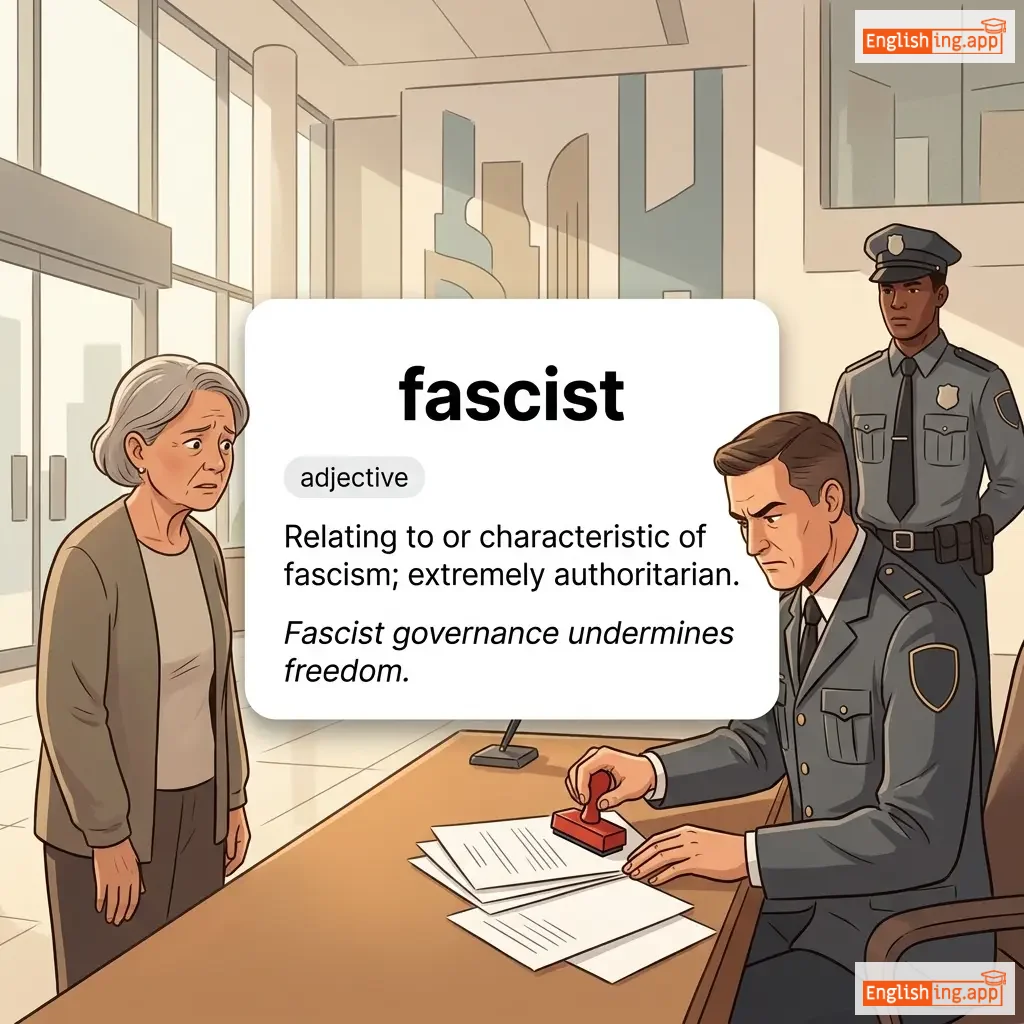
fascist definition card — visual illustration of the meaning
adjective
ˈfæʃ.ɪst
fascista (fascista)

Relating to or characteristic of fascism; extremely authoritarian.

"Fascist governance undermines freedom."

"El gobierno fascista socava la libertad." (El gobierno fascista socava la libertad.)
noun
/ˈfæʃ.ən/
moda (moda)

a popular or accepted style of clothing, behavior, or way of doing something

"She always keeps up with the latest fashion."

"Ella siempre sigue la última moda." (Ella siempre sigue la última moda.)
adjective
/ˈfæʃənəbəl/
a la moda (a la moda)

Following the latest styles or trends in clothing, behavior, or ideas

"She always wears fashionable clothes to every party."

"Ella siempre usa ropa fashionables en cada fiesta." (Ella siempre usa ropa fashionables en cada fiesta.)
adjective, adverb
/fæst/
rápido, firmemente fijo (rapido, firmemente fijo)

moving or capable of moving at high speed; firm or securely fixed

"He drives very fast on the highway."

"Él conduce muy rápido por la carretera." (El conduce muy rapido por la carretera.)
verb
/ˈfæsən/
abrochar (abrochar)

To attach or secure something firmly in place

"Please fasten your seatbelt before the plane takes off."

"Por favor, abroche su cinturón antes de que despegue el avión." (Por favor, abroche su cinturón antes de que despegue el avión.)
adjective, adverb
/ˈfæstər/
más rápido (mas rapido)

moving or able to move quickly; more quickly than usual

"This car is faster than the old one."

"Este coche es más rápido que el viejo." (Este coche es mas rapido que el viejo.)
adjective
/ˈfæstɪst/
más rápido (mas rapido)

moving or capable of moving at the highest speed

"Usain Bolt is the fastest runner in the world."

"Usain Bolt es el corredor más rápido del mundo." (Usain Bolt es el corredor mas rapido del mundo.)
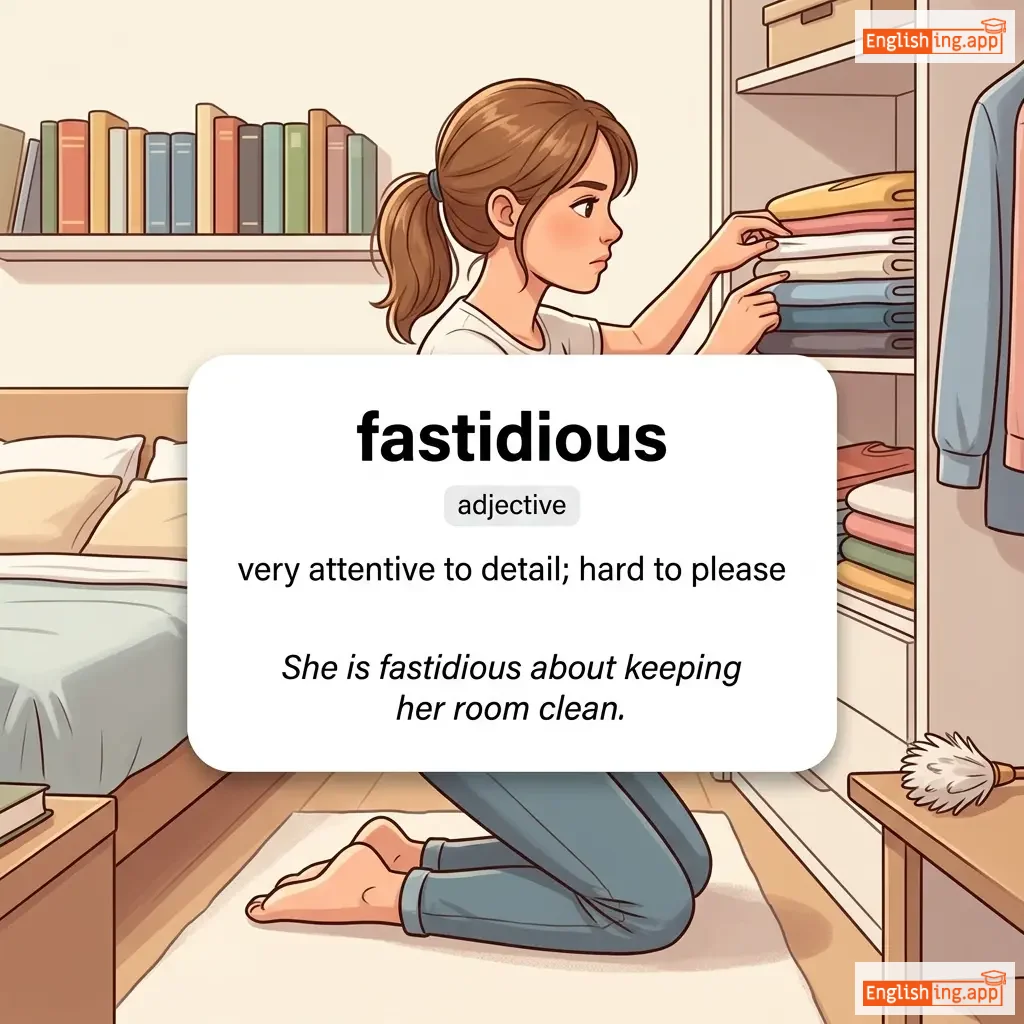
fastidious definition card — visual illustration of the meaning
adjective
/fæˈstɪdiəs/
meticuloso, exigente (meticuloso, exigente)

very attentive to detail; hard to please

"She is fastidious about keeping her room clean."

"Ella es meticulosa en mantener su habitación limpia." (Ella es meticulosa en mantener su habitacion limpia.)
adjective, noun
/fæt/
gordo (gordo)

having a lot of excess flesh; a natural oily substance in animal bodies

"Eating too much fast food can make you fat."

"Comer demasiada comida rápida puede hacerte gordo." (Comer demasiada comida rápida puede hacerte gordo.)
adjective
/ˈfeɪtl/
fatal (fatal)

causing death; leading to disaster

"The accident proved fatal for the driver."

"El accidente resultó fatal para el conductor." (El accidente resultó fatal para el conductor.)
noun
/ˈfeɪ.tə.lɪ.zəm/
fatalismo (fatalismo)

the belief that all events are predetermined and inevitable

"He embraced fatalism, believing that nothing he did could change his destiny."

"Él abrazó el fatalismo, creyendo que nada de lo que hiciera podría cambiar su destino." (Él abrazó el fatalismo, creyendo que nada de lo que hiciera podría cambiar su destino.)
noun
/fəˈtæləti/
fatalidad (fatalidad)

An occurrence of death by accident, disaster, or violence.

"The accident resulted in one fatality."

"El accidente resultó en una fatalidad." (El accidente resultó en una fatalidad.)
adverb
/ˈfeɪ.təl.i/
fatalmente (fatalmente)

in a way that causes death; with deadly consequences; critically

"The accident fatally injured two passengers."

"El accidente hirió fatalmente a dos pasajeros." (El accidente hirió fatalmente a dos pasajeros.)
noun
/feɪt/
destino (destino)

the development of events beyond a person's control, regarded as determined by a supernatural power

"She believed it was her fate to become a teacher."

"Ella creía que su destino era convertirse en profesora." (Ella creía que su destino era convertirse en profesora.)
adjective
/ˈfeɪt.fəl/
decisivo o fatal (decisivo o fatal)

having significant or disastrous consequences

"Their fateful decision changed the course of history."

"Su decisión decisiva cambió el curso de la historia." (Su desición decisiva cambió el curso de la historia.)