Vocabularios

Descubra, aprenda y domine el vocabulario en inglés

noun
/ˈkɒnfɪdænt/
confidente (confidente)

A person with whom one shares a secret or private matter, trusting them not to repeat it.

"She found a true confidant in her childhood friend."

"Ella encontró un verdadero confidente en su amigo de la infancia." (Ella encontró un verdadero confidente en su amigo de la infancia.)
noun
/ˌkɒnfɪˈdɑːnt/
amiga de confianza (amiga de confianza)

A woman with whom one shares a secret or private matter, trusting her not to repeat it.

"The queen’s maid became her most trusted confidante."

"La criada de la reina se convirtió en su confidente más confiable." (La criada de la reina se convirtió en su confidente más confiable.)
verb
/kənˈfaɪd/
confiar (konfiar)

To tell someone about a secret or private matter while trusting them not to repeat it.

"He confided his worries to his best friend."

"Él confió sus preocupaciones a su mejor amigo." (Él confió sus preocupaciones a su mejor amigo.)
noun
/ˈkɒnfɪdəns/
confianza (confianza)

The feeling or belief that one can rely on someone or something; firm trust or self-assurance.

"She spoke with great confidence during the meeting."

"Ella habló con gran confianza durante la reunión." (Ella habló con gran confianza durante la reunión.)
adjective
/ˈkɒnfɪdənt/
seguro de sí mismo (seguro de si mismo)

feeling or showing certainty about something; having self-assurance

"She was confident about her ability to succeed."

"Ella estaba segura de su capacidad para tener éxito." (Ella estaba segura de su capacidad para tener éxito.)
adjective
/ˌkɒnfɪˈdɛnʃl/
confidencial (confidencial)

intended to be kept secret or private

"The lawyer shared confidential documents with her client."

"El abogado compartió documentos confidenciales con su cliente." (El abogado compartió documentos confidenciales con su cliente.)
confidentiality definition card — visual illustration of the meaning
noun
ˌkɒn.fɪ.den.ʃiˈæl.ɪ.ti
confidencialidad (konfiden-syal-i-dad)

The state of keeping or being kept secret or private

"Confidentiality is crucial in data security."

"La confidencialidad es crucial en la seguridad de datos." (La confidencialidad es crucial en la seguridad de datos.)
adverb
/ˌkɒnfɪˈdenʃəli/
de manera confidencial (de manera confidencial)

in a confidential manner; secretly; privately

"The information was shared confidentially between the two managers."

"La información fue compartida confidencialmente entre los dos gerentes." (La informacion fue compartida confidencialmente entre los dos gerentes.)
noun
/kənˌfɪɡəˈreɪʃən/
configuración (configuracion)

an arrangement of parts or elements in a particular form or structure

"The configuration of the system needs to be adjusted for better performance."

"La configuración del sistema debe ajustarse para un mejor rendimiento." (La configuracion del sistema debe ajustarse para un mejor rendimiento.)
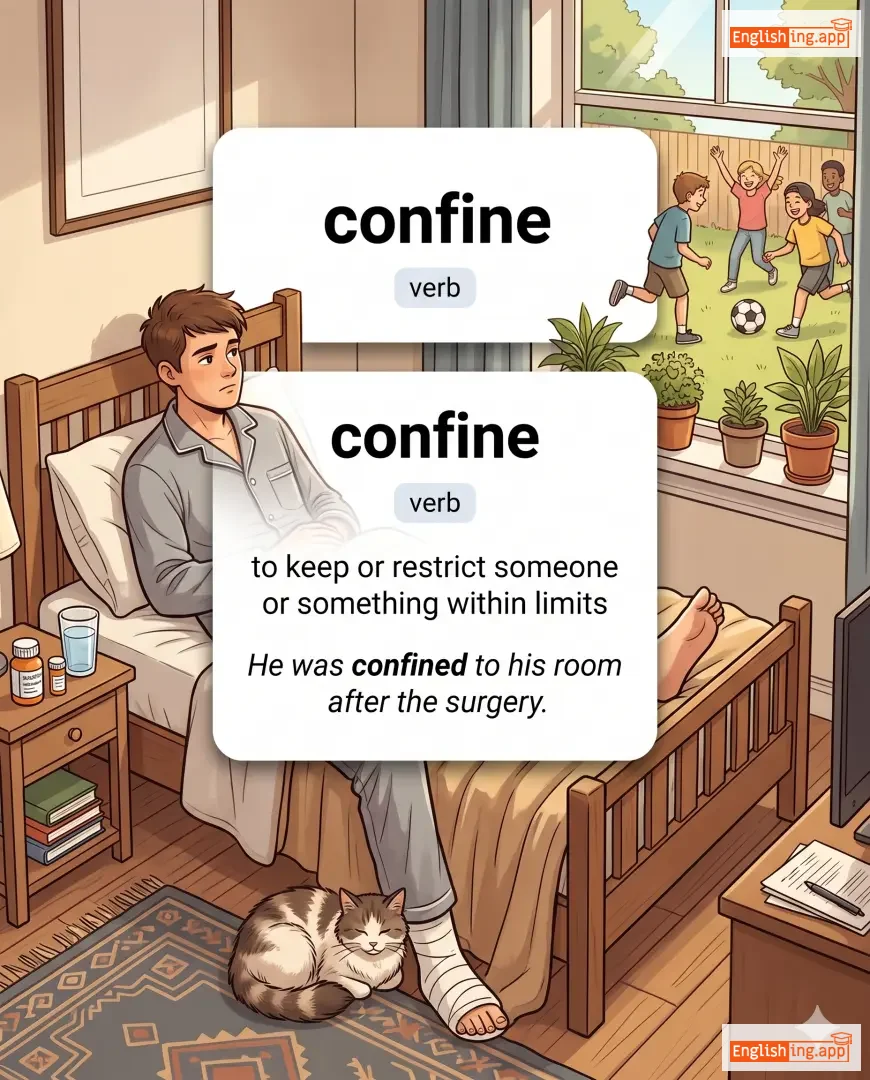
confine definition card — visual illustration of the meaning
verb
/kənˈfaɪn/
confinar (confinar)

to keep or restrict someone or something within limits

"He was confined to his room after the surgery."

"Fue confinado a su habitación después de la cirugía." (Fue confinado a su habitacion despues de la cirugia.)
noun
/kənˈfaɪnmənt/
confinamiento (confinamiento)

the state of being confined or restricted

"The prisoner endured years of confinement."

"El prisionero soportó años de confinamiento." (El prisionero soportó años de confinamiento.)
verb
/kənˈfɜːrm/
confirmar (confirmar)

to establish the truth, accuracy, or validity of something

"The hotel will confirm your reservation by email."

"El hotel confirmará tu reserva por correo electrónico." (El hotel confirmará tu reserva por correo electrónico.)
noun
/kənˌfɜːˈmeɪʃən/
confirmación (confirmacion)

the action of confirming something or the state of being confirmed

"She received a confirmation email for her appointment."

"Recibió un correo electrónico de confirmación para su cita." (Recibió un correo electrónico de confirmación para su cita.)
verb
/ˈkɒnfɪskeɪt/
confiscar (kon-fis-kar)

to take something away officially, often as a punishment

"The teacher confiscated the student's phone during class."

"La profesora confiscó el teléfono del estudiante durante la clase." (La profesora kon-fis-kó el te-le-fó-no del es-tu-dian-te du-ran-te la cla-se.)
noun
/ˌkɒnfləˈɡreɪʃən/
error ortográfico (de 'conflagration') (error ortografico (de 'conflagration'))

This is a common misspelling of 'conflagration', which means a large, destructive fire.

"The term 'conflagaration' is often incorrectly used instead of 'conflagration'."

"El término 'conflagaration' se usa a menudo incorrectamente en lugar de 'conflagration'." (El termino 'conflagaration' se usa a menudo incorrectamente en lugar de 'conflagration'.)
noun
/ˌkɒnfləˈɡreɪʃən/
gran incendio destructor (gran incendio destructor)

A large, destructive fire that destroys a great deal of land or property.

"The forest was devastated by a massive conflagration that lasted for days."

"El bosque fue devastado por un enorme incendio que duró varios días." (El bosque fue devastado por un enorme incendio que duró varios días.)
verb
/kənˈfleɪt/
fusionar / combinar (fusionar / combinar)

To combine two or more things, often confusingly, into one.

"The article tends to conflate facts with opinions."

"El artículo tiende a fusionar los hechos con las opiniones." (El artículo tiende a fusionar los hechos con las opiniones.)
noun
/ˈkɒnflɪkt/
conflicto (conflicto)

A serious disagreement or argument, often a prolonged one.

"The two countries are trying to resolve the conflict through negotiations."

"Los dos países están tratando de resolver el conflicto a través de negociaciones." (Los dos países están tratando de resolver el conflicto a través de negociaciones.)
conflict resolution definition card — visual illustration of the meaning
noun
/ˈkɒn.flɪkt ˌrez.əˈluː.ʃən/
resolución de conflictos (resolucion de conflictos)

The process of finding peaceful solutions to disputes or disagreements between parties.

"Conflict resolution is vital for global peace."

"La resolución de conflictos es vital para la paz global." (La resolucion de conflictos es vital para la paz global.)
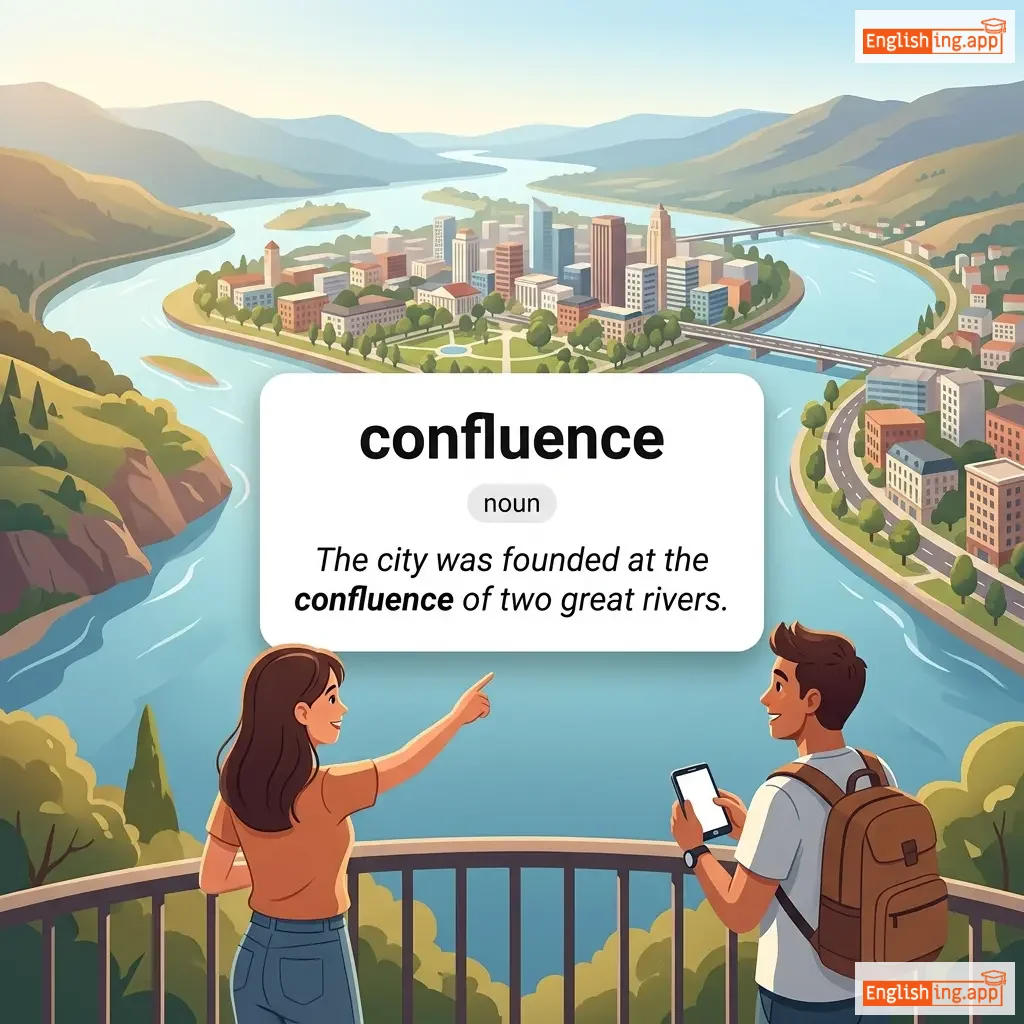
confluence definition card — visual illustration of the meaning
noun
/ˈkɒnfluəns/
confluencia (konfluensia)

The junction of two rivers; also a situation where people or things come together.

"The city was founded at the confluence of two great rivers."

"La ciudad fue fundada en la confluencia de dos grandes ríos." (La ciudad fue fundada en la konfluensia de dos grandes rios.)
adjective
/ˈkɒnfluənt/
confluente (confluente)

Flowing together or merging; coming together at one point.

"The confluent streams formed a mighty river."

"Los ríos convergentes formaron un gran río." (Los rios convergentes formaron un gran rio.)
verb
/kənˈfɔːrm/
ajustarse (ajustarse)

To comply with rules, standards, or laws.

"Students must conform to the school regulations."

"Los estudiantes deben ajustarse a las regulaciones escolares." (Los estudiantes deben ajustarse a las regulaciones escolares.)
adjective
/kənˈfɔːrməbl/
conformable (conformable)

Capable of being adapted or consistent with something; compliant.

"His actions were conformable to the rules of the institution."

"Sus acciones fueron conformables a las reglas de la institución." (sus acciones fueron conformables a las reglas de la institucion.)
noun
/kənˈfɔːrməns/
conformidad (conformidad)

The act of conforming to a rule, standard, or law.

"The product was tested for conformance with safety standards."

"El producto fue probado para su conformidad con los estándares de seguridad." (El producto fue probado para su conformidad con los estándares de seguridad.)
noun
/ˌkɑːnfɔːrˈmeɪʃən/
conformación (conformacion)

The shape, structure, or arrangement of something.

"The scientist studied the molecular conformation of the protein."

"El científico estudió la conformación molecular de la proteína." (El cientifico estudió la conformacion molecular de la proteina.)
noun
/kənˈfɔːrmɪst/
conformista (conformista)

A person who uncritically conforms to established practices or standards.

"She was labeled a conformist for always following the crowd."

"Ella fue etiquetada como conformista por siempre seguir a la multitud." (ella fue etiquetada como conformista por siempre seguir a la multitud.)
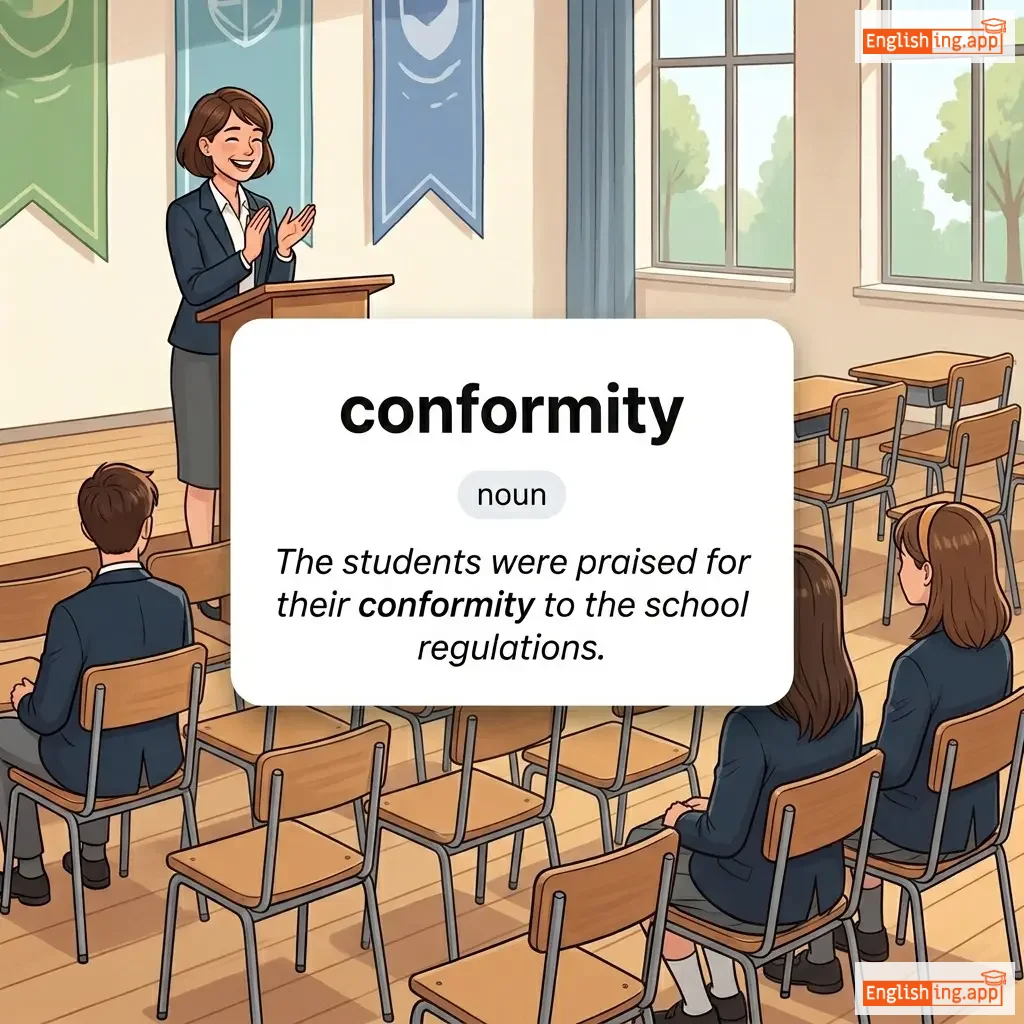
conformity definition card — visual illustration of the meaning
noun
/kənˈfɔːrməti/
conformidad (conformidad)

Compliance with standards, rules, or laws; behavior in accordance with social norms.

"The students were praised for their conformity to the school regulations."

"Los estudiantes fueron elogiados por su conformidad con las reglas de la escuela." (Los estudiantes fueron elogiados por su conformidad con las reglas de la escuela.)
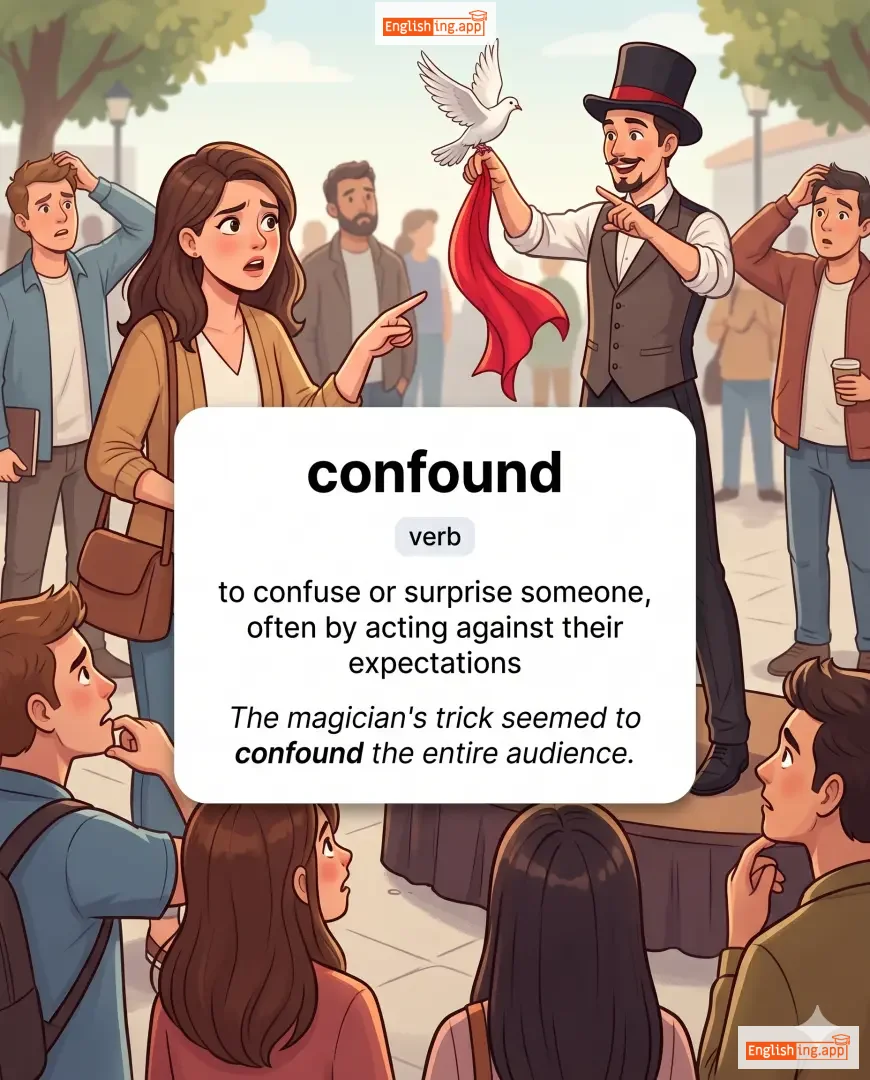
confound definition card — visual illustration of the meaning
verb
/kənˈfaʊnd/
desconcertar (desconcertar)

to confuse or surprise someone, often by acting against their expectations

"The magician's trick seemed to confound the entire audience."

"El truco del mago parecía desconcertar a toda la audiencia." (El truco del mago parecía desconcertar a toda la audiencia.)
verb
/kənˈfrʌnt/
enfrentar (enfrentar)

to face someone or something directly, especially in a challenge or conflict

"She had to confront her fears before making the speech."

"Ella tuvo que enfrentar sus miedos antes de dar el discurso." (Ella tuvo que enfrentar sus miedos antes de dar el discurso.)
noun
/ˌkɒnfrʌnˈteɪʃən/
confrontación (confrontacion)

A hostile or argumentative meeting or situation between opposing parties.

"The protest led to a confrontation with the police."

"La protesta llevó a una confrontación con la policía." (La protesta llevo a una confrontacion con la policia.)
verb
/kənˈfjuːz/
confundir (konfundir)

To make someone unable to think clearly; to bewilder.

"The complex instructions confused the students."

"Las instrucciones complejas confundieron a los estudiantes." (Las instrucciones complejas confundieron a los estudiantes.)
adjective
/kənˈfjuːzd/
confundido (confundido)

unable to think clearly; uncertain or puzzled

"She felt confused by the complicated instructions."

"Se sintió confundida por las instrucciones complicadas." (se sintio confundida por las instrucciones complicadas)
adjective
/kənˈfjuːzɪŋ/
confuso (confuso)

causing someone to be unable to think clearly or understand; difficult to comprehend

"The instructions were confusing and hard to follow."

"Las instrucciones eran confusas y difíciles de seguir." (Las instrucciones eran confusas y dificiles de seguir)
noun
/kənˈfjuːʒən/
confusión (confusion)

a state of being bewildered or unclear in one’s mind

"The sudden change in schedule caused a lot of confusion."

"El cambio repentino en el horario causó mucha confusión." (El cambio repentino en el horario causó mucha confusión.)
verb
/kənˈdʒiːl/
congelarse (congelarse)

to become thick or solid, especially from cooling

"The soup began to congeal after being left on the table."

"La sopa comenzó a congelarse después de haber sido dejada sobre la mesa." (La sopa comenzo a congelarse despues de haber sido dejada sobre la mesa.)
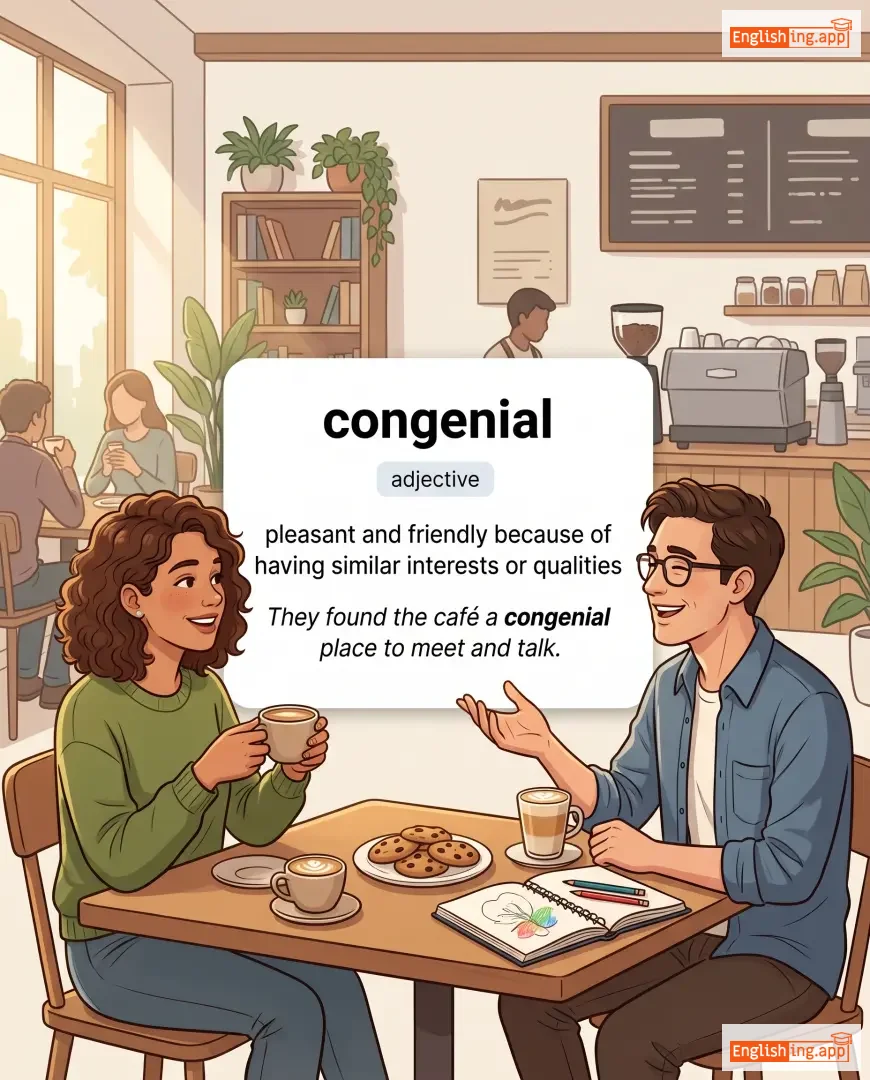
congenial definition card — visual illustration of the meaning
adjective
/kənˈdʒiːniəl/
amistoso (amistoso)

pleasant and friendly because of having similar interests or qualities

"They found the café a congenial place to meet and talk."

"Encontraron el café un lugar amistoso para reunirse y charlar." (Encontraron el café un lugar amistoso para reunirse y charlar.)
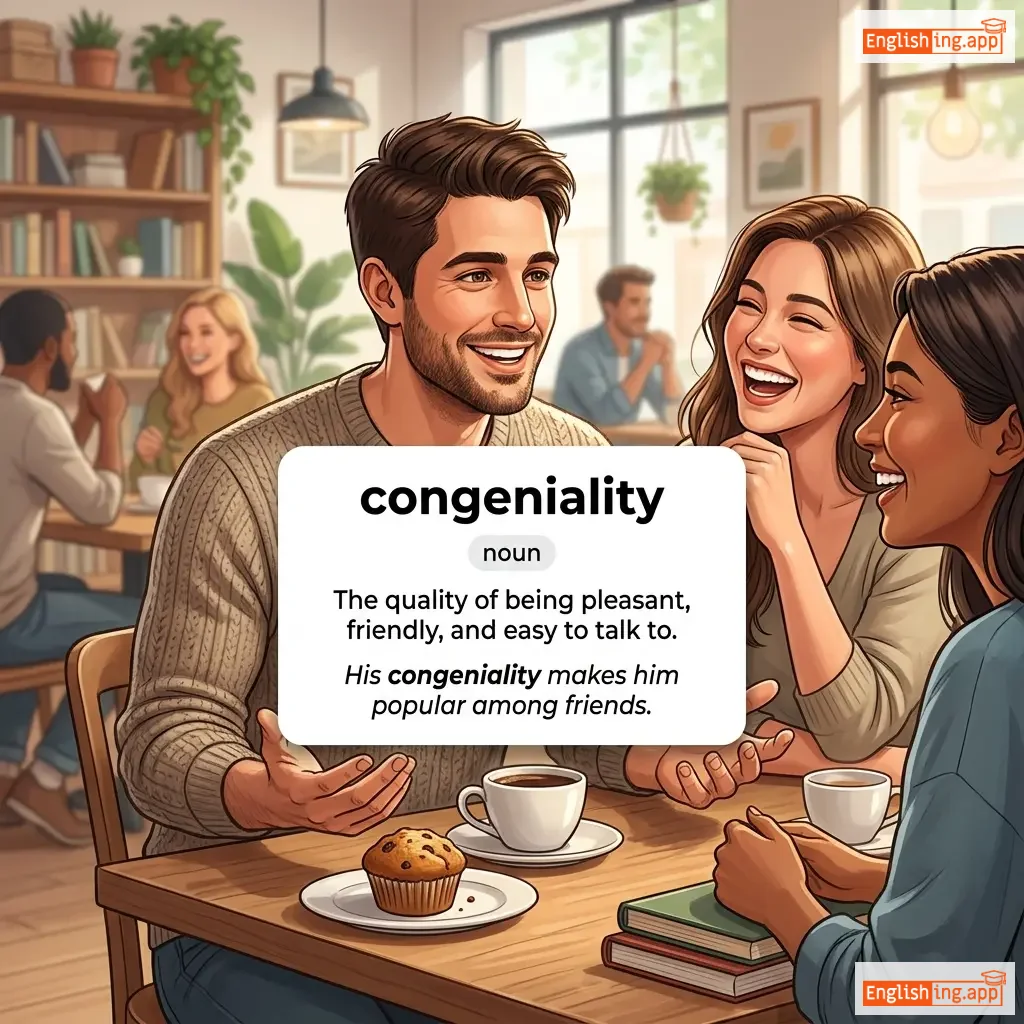
congeniality definition card — visual illustration of the meaning
noun
/kənˌdʒiː.niˈæl.ə.t̬i/
afabilidad (afabilidad)

The quality of being pleasant, friendly, and easy to talk to.

"His congeniality makes him popular among friends."

"Su afabilidad lo hace popular entre sus amigos." (Su afabilidad lo hace popular entre sus amigos.)
adjective
/kənˈdʒenɪtl/
congénito (congenito)

existing from birth, usually describing a disease or condition

"The child was born with a congenital heart defect."

"El niño nació con un defecto congénito en el corazón." (El niño nació con un defecto congénito en el corazón.)
verb
/kənˈdʒɛst/
congestionar (congestionar)

To block or overcrowd a space, making movement or flow difficult.

"Heavy traffic can congest the city streets during rush hour."

"El tráfico pesado puede congestionarse las calles de la ciudad durante la hora punta." (El tráfico pesado puede congestionarse las calles de la ciudad durante la hora punta.)
adjective
/kənˈdʒɛstɪd/
congestionado (congestionado)

Blocked up with too much traffic or crowding.

"The road was congested during rush hour."

"La carretera estaba congestionada durante la hora punta." (La carretera estaba congestionada durante la hora punta.)
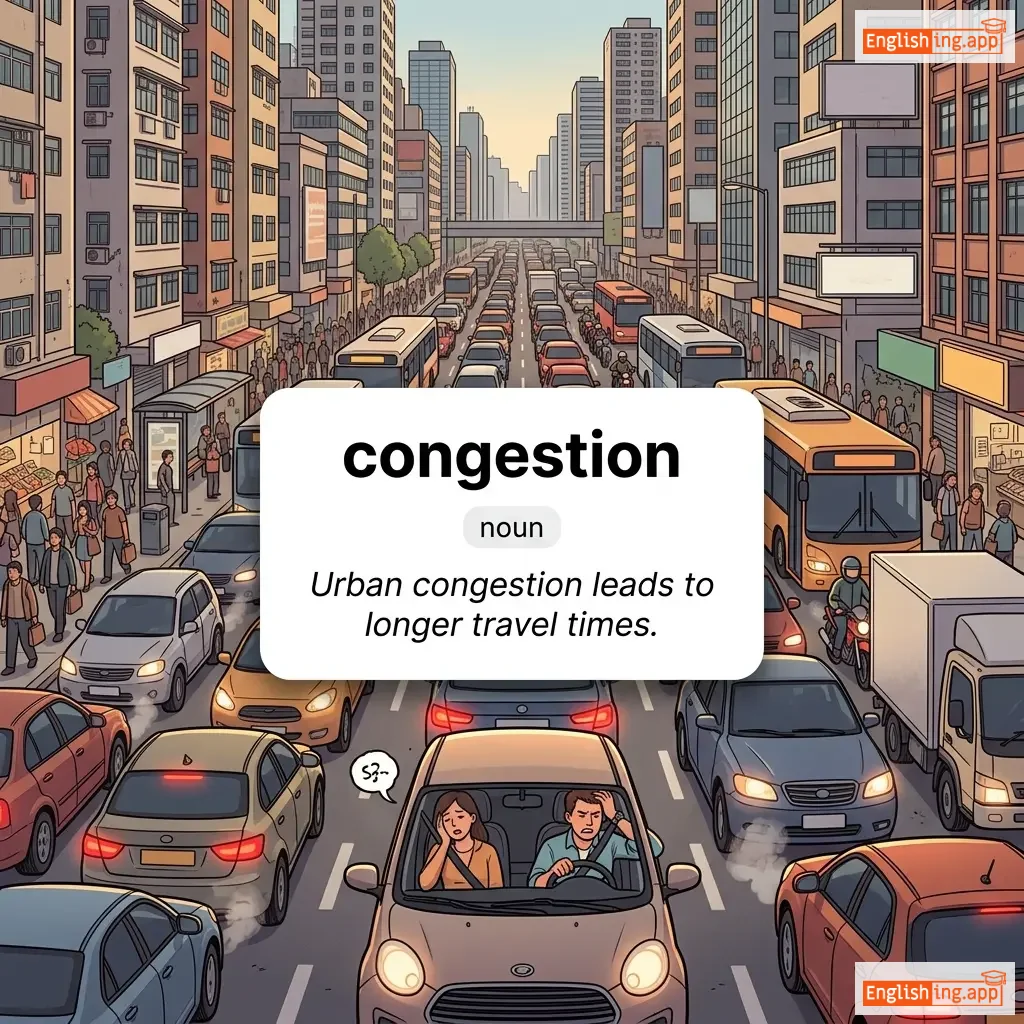
congestion definition card — visual illustration of the meaning
noun
/kənˈdʒes.tʃən/
tráfico o hacinamiento excesivo (trafico o hacinamiento excesivo)

Traffic jam or overcrowded condition in roads or areas where there is excessive presence of vehicles or people.

"Urban congestion leads to longer travel times."

"La congestión urbana lleva a tiempos de viaje más largos." (La congestion urbana lleva a tiempos de viaje mas largos.)
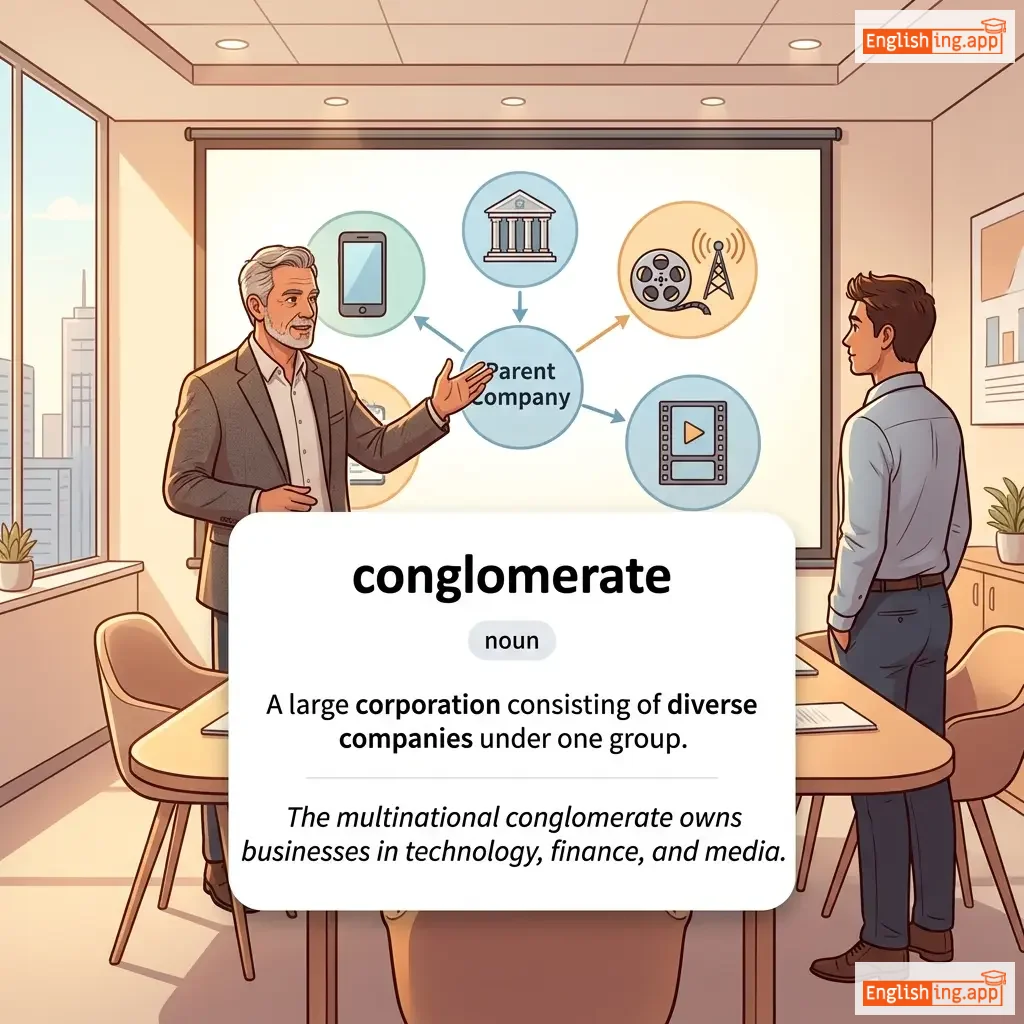
conglomerate definition card — visual illustration of the meaning
noun
/kənˈɡlɒmərət/
un gran grupo de empresas diversas (un gran grupo de empresas diversas)

A large corporation consisting of diverse companies under one group.

"The multinational conglomerate owns businesses in technology, finance, and media."

"El conglomerado multinacional posee empresas en tecnología, finanzas y medios." (El conglomerado multinacional posee empresas en tecnología, finanzas y medios.)
noun
/kənˌɡlɒməˈreɪʃən/
conglomerado (conglomerado)

A collection or mixture of different things grouped together.

"The market is a conglomeration of small shops and food stalls."

"El mercado es un conglomerado de pequeñas tiendas y puestos de comida." (El mercado es un conglomerado de pequeñas tiendas y puestos de comida.)
verb
/kənˈɡrætʃʊleɪt/
felicitar (felicitar)

to praise someone for an achievement or for a special occasion

"I want to congratulate you on your promotion."

"Quiero felicitarte por tu ascenso." (Quiero felicitarte por tu ascenso.)
noun
/kənˌɡrætʃəˈleɪʃən/
felicitación (felicitacion)

an expression of praise or joy for someone’s achievement or good fortune

"She sent a congratulation to her friend on winning the award."

"Envió una felicitación a su amiga por ganar el premio." (envio una felicitacion a su amiga por ganar el premio)
noun
/kənˌɡrætʃ.əˈleɪ.ʃənz/
felicitaciones (felicitaciones)

words expressing praise for an achievement or good wishes on a special occasion

"Congratulations on your promotion! You really deserved this success."

"¡Felicitaciones por tu ascenso! Realmente te merecías este éxito." (¡Felicitaciones por tu ascenso! Realmente te merecías este éxito.)
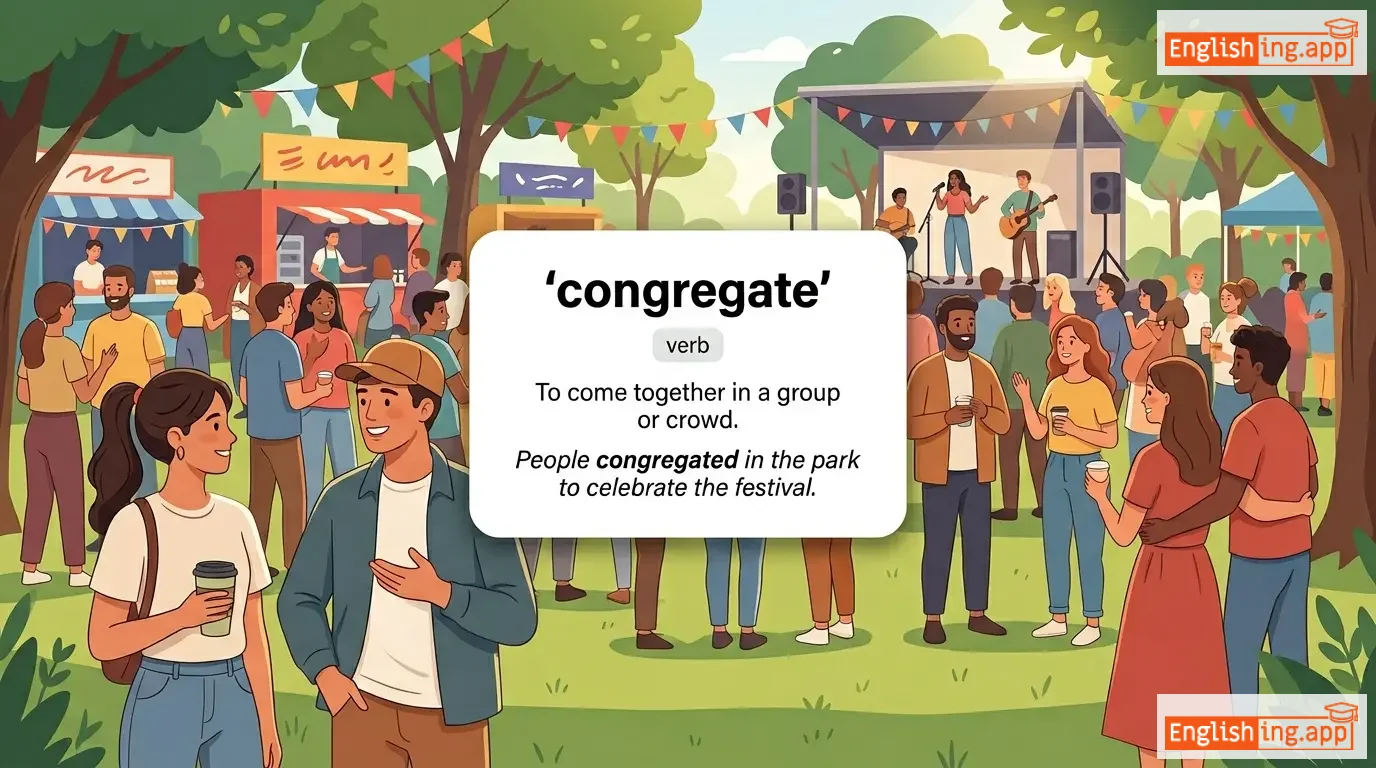
congregate definition card — visual illustration of the meaning
verb
/ˈkɒŋɡrɪˌɡeɪt/
congregarse (congregarse)

To come together in a group or crowd.

"People congregated in the park to celebrate the festival."

"La gente se congregó en el parque para celebrar el festival." (La gente se congregó en el parque para celebrar el festival.)
noun
/ˌkɒŋɡrɪˈɡeɪʃən/
congregación (congregacion)

a group of people assembled for religious worship or a common purpose

"The congregation gathered to hear the sermon."

"La congregación se reunió para escuchar el sermón." (La congregacion se reunio para escuchar el sermon.)
noun
/ˈkɒŋɡrɛs/
congreso (congreso)

a formal meeting or assembly, especially of representatives for discussion

"The international congress on climate change will be held next year."

"El congreso internacional sobre el cambio climático se llevará a cabo el próximo año." (El congreso internacional sobre el cambio climatico se llevara a cabo el proximo año.)
adjective
/kənˈɡrɛʃənl/
congresista (congresista)

relating to a congress, especially the US Congress

"The bill received strong congressional support."

"El proyecto de ley recibió un fuerte apoyo congresista." (El proyecto de ley recibió un fuerte apoyo congresista.)