Vocabulaires

Découvrez, apprenez et maîtrisez le vocabulaire anglais

preposition
/wɪð/
avec (avec)

indicating the person or thing that is accompanying or involved with someone or something else

"She went to the market with her friend."

"Elle est allée au marché avec son amie." (Elle est allee au marche avec son amie.)
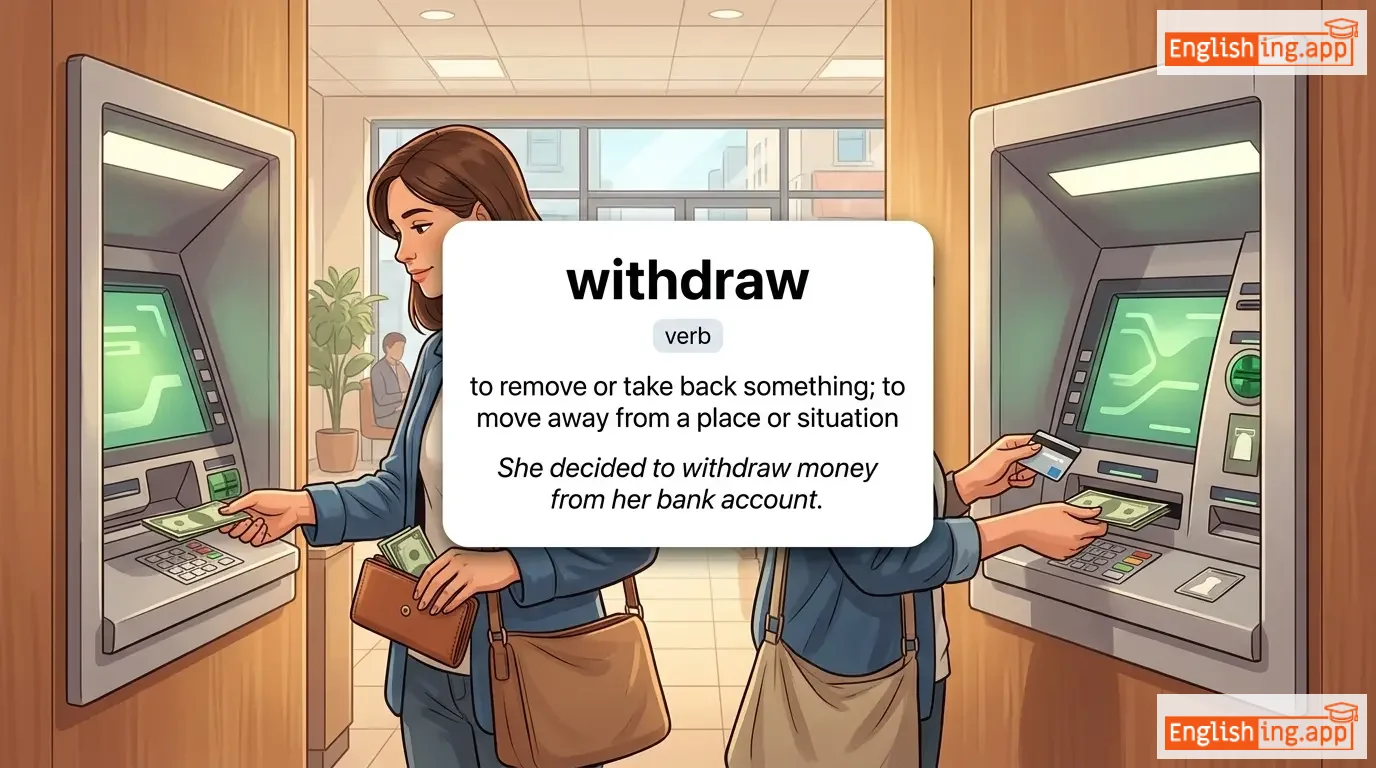
withdraw definition card — visual illustration of the meaning
verb
/wɪðˈdrɔː/
retirer (retirer)

to remove or take back something; to move away from a place or situation

"She decided to withdraw money from her bank account."

"Elle a décidé de retirer de l'argent de son compte bancaire." (Elle a decide de retirer de largent de son compte bancaire.)
noun
/wɪðˈdrɔːəl/
retrait (retrait)

the act of taking something back or removing oneself from a situation

"He made a withdrawal of $500 from his bank account."

"Il a effectué un retrait de 500 $ de son compte bancaire." (Il a effectue un retrait de 500 dollars de son compte bancaire.)
adjective
/wɪðˈdrɔːn/
réservé (reserve)

quiet and shy; not wanting to talk to others

"After the incident, he became withdrawn and avoided his friends."

"Après l'incident, il est devenu réservé et a évité ses amis." (Apres l'incident, il est devenu reserve et a evite ses amis.)
verb
/ˈwɪð.ər/
se faner (se faner)

to dry up and die, typically used for plants

"The flowers will wither without enough water."

"Les fleurs se faneront sans assez d'eau." (Les fleurs se faneront sans assez d'eau.)
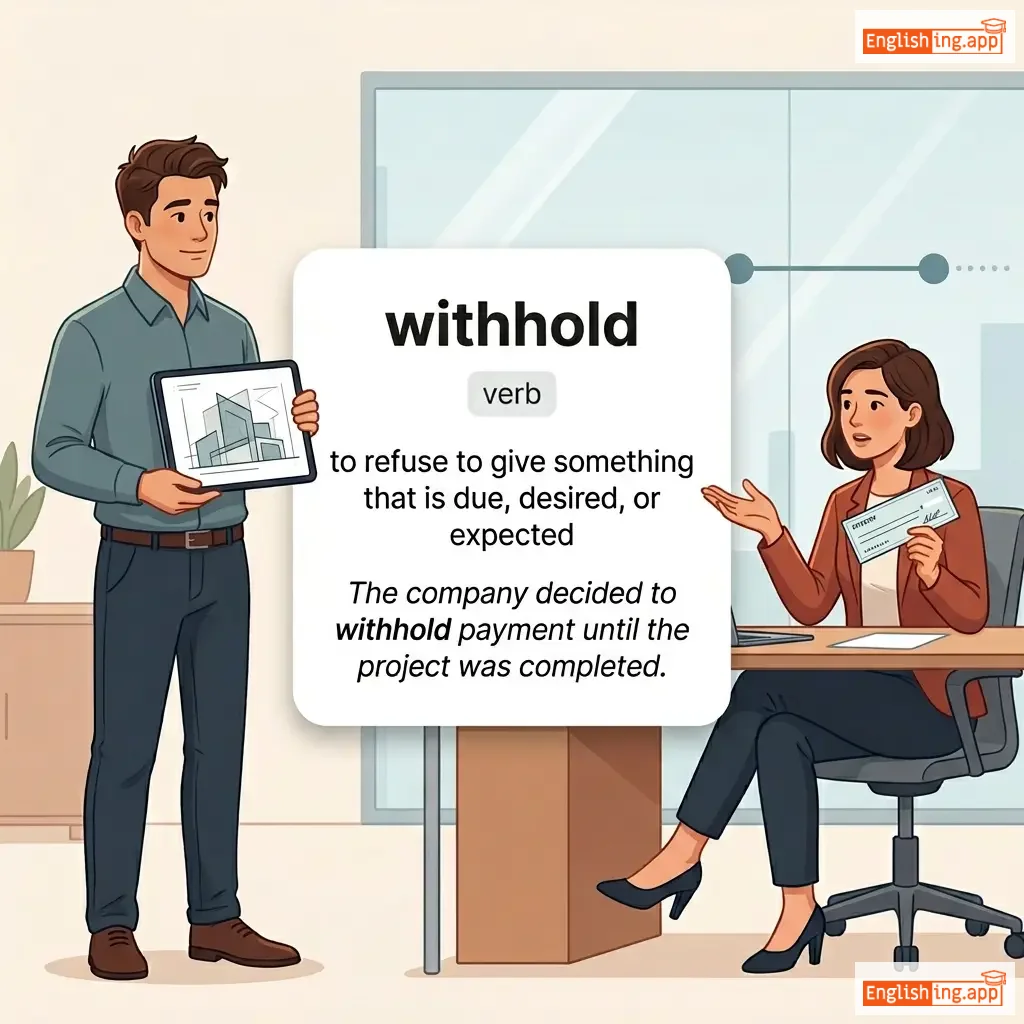
withhold definition card — visual illustration of the meaning
verb
/wɪðˈhoʊld/
retenir (re-te-neer)

to refuse to give something that is due, desired, or expected

"The company decided to withhold payment until the project was completed."

"L'entreprise a décidé de retenir le paiement jusqu'à ce que le projet soit terminé." (L'en-tre-pri-se a dé-ci-dé de re-te-nir le pai-e-ment jus-qu'à ce que le pro-jet soit ter-mi-né.)
preposition
/wɪðˈɪn/
à l'intérieur (a l'interieur)

inside the limits of something, or as part of a particular space or time

"The keys are within the drawer."

"Les clés sont à l'intérieur du tiroir." (Les clés sont à l'intérieur du tiroir.)
preposition
/wɪðˈaʊt/
sans (sans)

in the absence of, or not having something

"He left without saying goodbye."

"Il est parti sans dire au revoir." (Il est parti sans dire au revoir.)
verb
/wɪðˈstænd/
résister / supporter (résister / supporter)

to resist or endure something without being harmed

"This building can withstand strong earthquakes."

"Ce bâtiment peut résister à de forts tremblements de terre." (Ce bâtiment peut résister à de forts tremblements de terre.)
adjective
/ˈwɪtləs/
bête (bete)

lacking intelligence or good sense

"It was a witless decision to leave the door unlocked."

"C'était une décision stupide de laisser la porte déverrouillée." (C'etait une decision stupide de laisser la porte deverrouillee.)
noun
/ˈwɪtlɪŋ/
imbécile / faux sage (imbécile / faux sage)

a person who has little wit or pretends to be witty

"He acted like a witling among scholars."

"Il a agi comme un imbécile parmi les érudits." (Il a agi comme un imbécile parmi les érudits.)
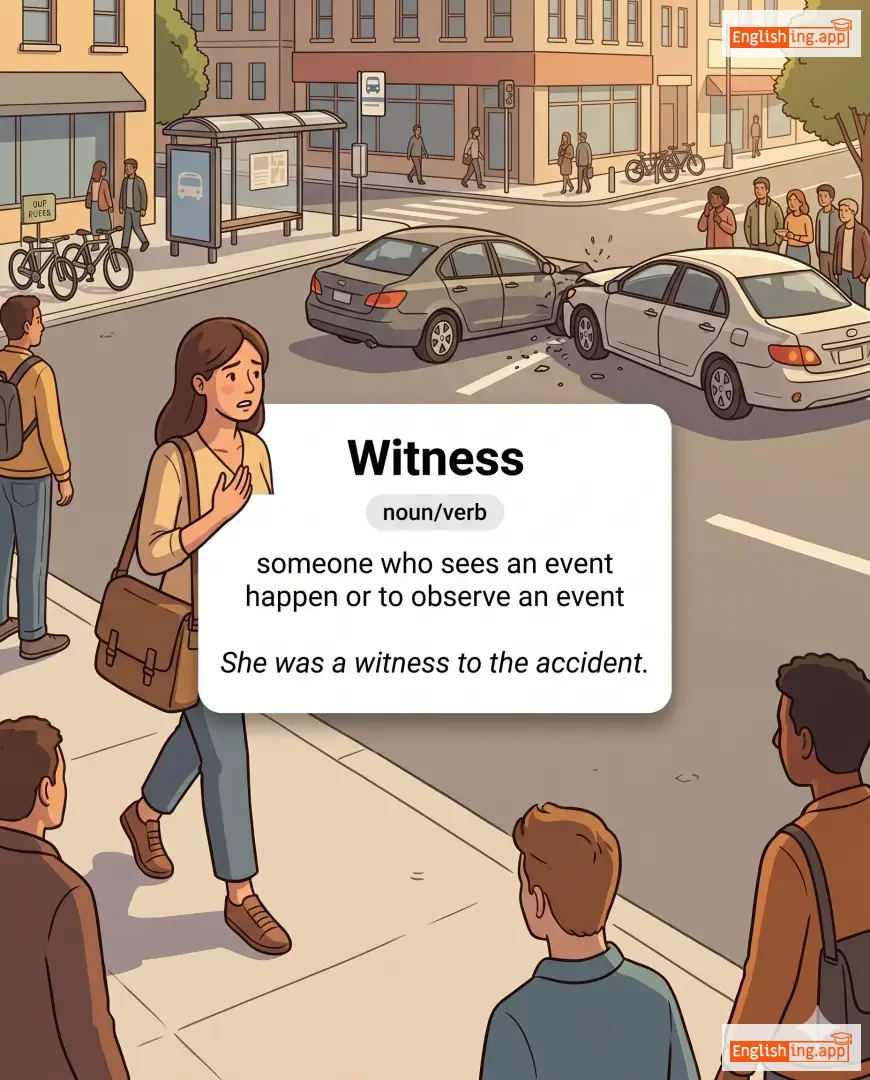
Witness definition card — visual illustration of the meaning
noun/verb
/ˈwɪtnɪs/
témoin (temoin)

someone who sees an event happen or to observe an event

"She was a witness to the accident."

"Elle était témoin de l'accident." (Elle était témoin de l'accident.)
noun
/ˈwɪtɪˌsɪzəm/
réplique spirituelle / plaisanterie (réplique spirituelle / plaisanterie)

a clever or funny remark

"Her witticism made everyone laugh during the meeting."

"Sa réplique spirituelle a fait rire tout le monde pendant la réunion." (Sa réplique spirituelle a fait rire tout le monde pendant la réunion.)
adverb
/ˈwɪtɪŋli/
délibérément (deliberement)

Consciously and intentionally; on purpose.

"He wittingly withheld information from the police."

"Il a délibérément retenu des informations à la police." (Il a deliberement retenu des informations a la police.)
adjective
/ˈwɪt.i/
spirituel; amusant (spirituel; amusant)

having or showing quick intelligence; amusing in a clever way

"Her witty response to the critic's question impressed the entire audience."

"Sa réponse spirituelle à la question du critique a impressionné toute l'audience." (Sa réponse spirituelle à la question du critique a impressionné toute l'audience.)
🧙‍♂️

Wizard (wizaʁd)

noun
/ˈwɪzərd/
magicien (magicien)

a man who is supposed to have magical powers; a person who is very skilled in a particular area

"The wizard performed amazing magic tricks."

"Le magicien a réalisé des tours de magie impressionnants." (Le magicien a réalisé des tours de magie impressionnants.)
noun
/ˈwɪzərdri/
magie habile (magie habile)

The art or practice of magic; great skill or expertise in something.

"The programmer's wizardry amazed everyone in the room."

"La sorcellerie du programmeur a étonné tout le monde dans la salle." (La sorcellerie du programmeur a étonné tout le monde dans la salle.)
verb
/ˈwɪzn/
se faner (se faner)

To become dry, shrunken, and wrinkled.

"The flowers began to wizen after days without water."

"Les fleurs ont commencé à se faner après plusieurs jours sans eau." (Les fleurs ont commencé à se faner après plusieurs jours sans eau.)
adjective
/ˈwɪzn feɪst/
visage ridé et fané (visage ridé et fané)

Having a dry, wrinkled, and withered face.

"A wizen-faced old man sat quietly in the corner."

"Un vieil homme au visage ridé et fané était assis tranquillement dans le coin." (Un vieil homme au visage ridé et fané était assis tranquillement dans le coin.)
adjective
/ˈwɪznd/
ridé (ride)

Shriveled, wrinkled, or withered, often due to age.

"The wizened tree stood in the field for centuries."

"L'arbre ridé est resté dans le champ pendant des siècles." (L'arbre ridé est resté dans le champ pendant des siècles.)
verb
/ˈwɒb.l̩/
vaciller (vaciller)

to move unsteadily from side to side; to shake or tremble slightly

"The table began to wobble when he leaned on it."

"La table a commencé à vaciller lorsqu'il s'est penché dessus." (La table a commence a vaciller lorsqu'il s'est penche dessus.)
noun
/woʊ/
chagrin (chagrin)

great sorrow, distress, or trouble

"Her heart was filled with woe after hearing the sad news."

"Son cœur était rempli de chagrin après avoir entendu la triste nouvelle." (Son coeur etait rempli de chagrin apres avoir entendu la triste nouvelle.)
adjective
/ˈwoʊ.fəl/
lamentable (lamentable)

full of woe; very sad or miserable; also used to mean very bad or deplorable

"He gave me a woeful look when he lost the match."

"Il m'a lancé un regard lamentable quand il a perdu le match." (Il m'a lancé un regard lamentable quand il a perdu le match.)
noun
/woʊz/
soucis (soucis)

great sorrow or distress; troubles

"The company faced financial woes after the market crash."

"L'entreprise a fait face à des difficultés financières après l'effondrement du marché." (L'entreprise a fait face à des difficultés financières après l'effondrement du marché.)
noun
/wʊlf/
loup (loup)

a wild carnivorous animal related to the dog, living and hunting in packs

"The wolf howled loudly under the full moon."

"Le loup a hurlé bruyamment sous la pleine lune." (Le loup a hurle bruyamment sous la pleine lune.)
noun
/ˈwɪmən/
femme (femme)

an adult human female

"The woman at the counter helped me."

"La femme au comptoir m'a aidé." (La femme au comptoir m'a aidé.)
noun
/ˈwʌndər/
merveille (merveille)

a feeling of amazement and admiration, caused by something beautiful, remarkable, or unfamiliar

"The view from the mountain was a true wonder."

"La vue depuis la montagne était une véritable merveille." (La vue depuis la montagne était une véritable merveille.)
adjective
/ˈwʌndərfəl/
merveilleux (merveilleux)

extremely good or impressive

"She had a wonderful time at the party."

"Elle a passé un merveilleux moment à la fête." (Elle a passé un merveilleux moment à la fête.)
adjective
/ˈwɒŋki/
instable; peu fiable; qui ne fonctionne pas correctement (wonki)

unstable; unreliable; not working properly

"The old chair was wonky and wobbled every time someone sat on it."

"La vieille chaise était instable et tanguait chaque fois que quelqu'un s'y asseyait." (La vieille chaise était instable et tanguait chaque fois que quelqu'un s'y asseyait)
adjective
/woʊnt/ or /wɔːnt/
habitué (habitué)

accustomed or used to doing something

"She rose early, as she was wont to do."

"Elle se leva tôt, comme elle en avait l'habitude." (Elle se leva tôt, comme elle en avait l'habitude.)
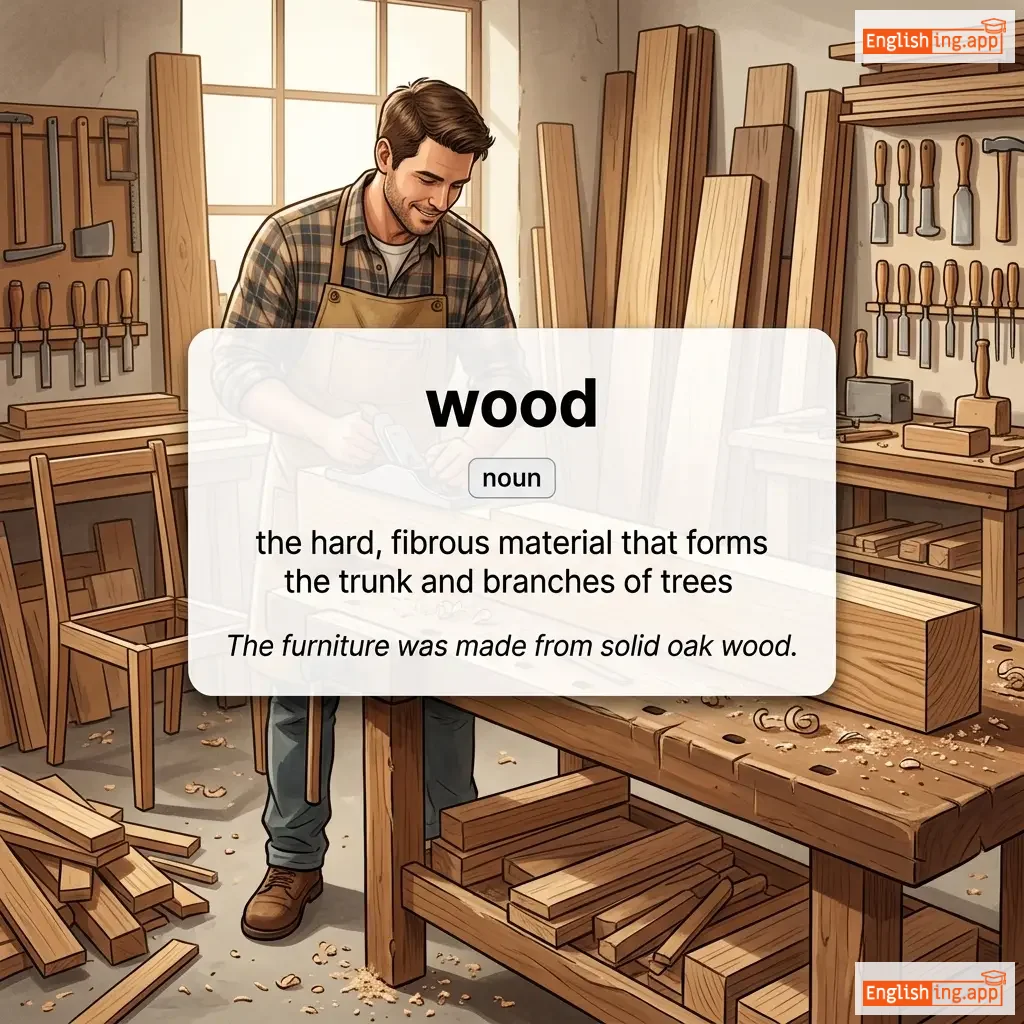
wood definition card — visual illustration of the meaning
noun
/wʊd/
bois (bois)

the hard, fibrous material that forms the trunk and branches of trees

"The furniture was made from solid oak wood."

"Les meubles étaient faits de bois de chêne massif." (Les meubles etaient faits de bois de chene massif.)
noun
/wʊd ˈæp.əl/
pomme de bois (pomme de bois)

a hard-shelled tropical fruit with aromatic pulp used in beverages and medicine

"The wood apple has a hard shell but sweet pulp inside."

"La pomme de bois a une coque dure mais une pulpe douce à l'intérieur" (La pomme de bois a une coque dure mais une pulpe douce à l'intérieur)
adjective
/ˈwʊdən/
en bois (an bwa)

made of wood

"The house had beautiful wooden floors."

"La maison avait de beaux planchers en bois." (La maison avait de beaux planchers en bois.)
noun
/ˈwʊd.ən ˈsæn.dəl/
sandale en bois (sandale en bois)

a type of footwear made of wood, typically worn as traditional shoes

"She wore wooden sandals to the traditional ceremony."

"Elle portait des sandales en bois lors de la cérémonie traditionnelle." (Elle portait des sandales en bois lors de la cérémonie traditionnelle.)
noun
/ˈwʊd.pek.ər/
pic-vert (pic-vert)

a bird that pecks at tree bark to find insects and create nesting holes

"The woodpecker hammered against the oak tree."

"Le pic-vert a frappé contre le chêne." (Le pic-vert a frappe contre le chene)
noun
/ˈwʊlən dres/
robe en laine (robe en laine)

a dress made from wool fabric, typically worn in cold weather

"She wore a warm woolen dress during the winter months."

"Elle portait une robe en laine chaude pendant les mois d'hiver." (Elle portait une robe en laine chaude pendant les mois d'hiver.)
noun
/wɜːrd/
mot (mo)

a single distinct meaningful element of speech or writing

"He looked up the word in the dictionary."

"Il a cherché le mot dans le dictionnaire." (Il a cherché le mot dans le dictionnaire.)
noun
/wɜːrd fɔːrˈmeɪʃən/
formation des mots (formation des mots)

the process by which new words are created or existing words are modified in a language

"Word formation helps learners understand how new vocabulary develops in English."

"La formation des mots est importante en linguistique." (la formation des mots est importante en linguistique)
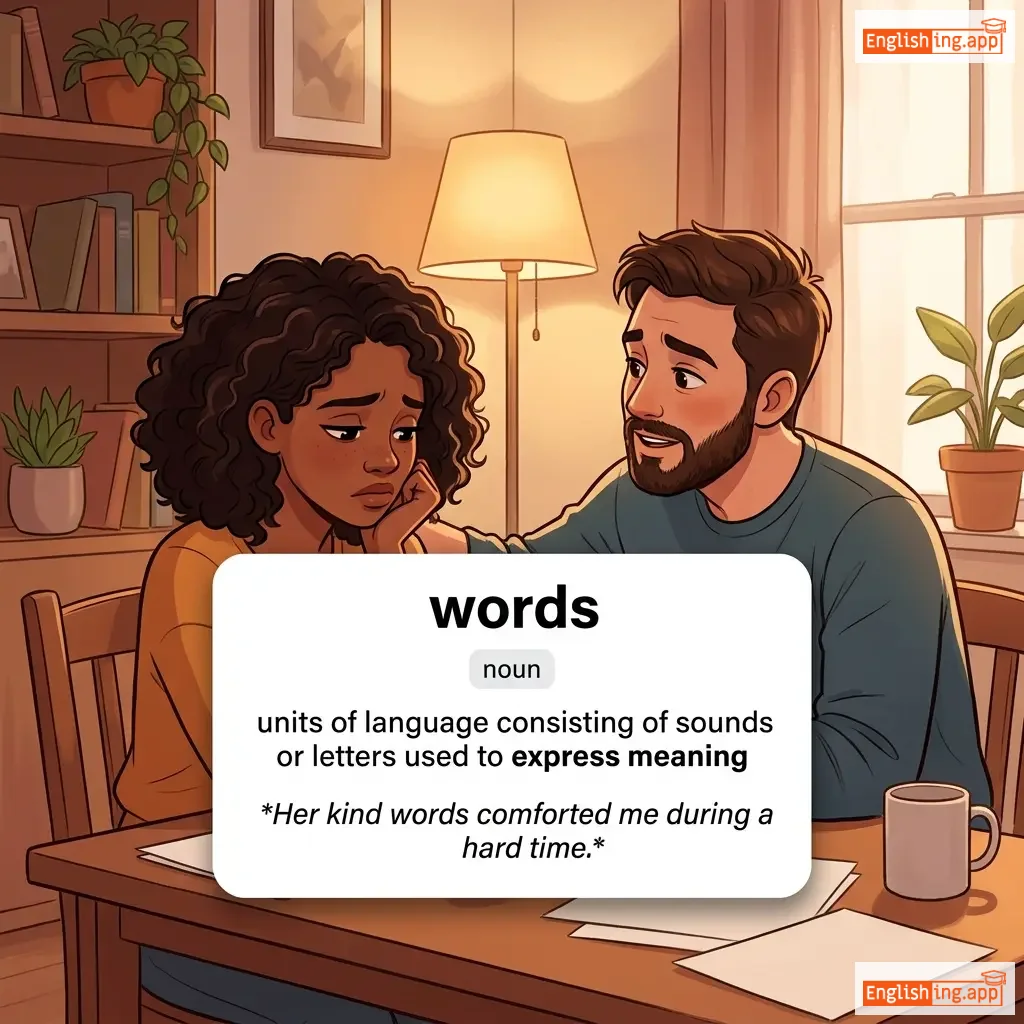
words definition card — visual illustration of the meaning
noun
/wɜːdz/
mots (mots)

units of language consisting of sounds or letters used to express meaning

"Her kind words comforted me during a hard time."

"Ses mots gentils m'ont réconforté pendant une période difficile." (Ses mots gentils m'ont réconforté pendant une période difficile.)
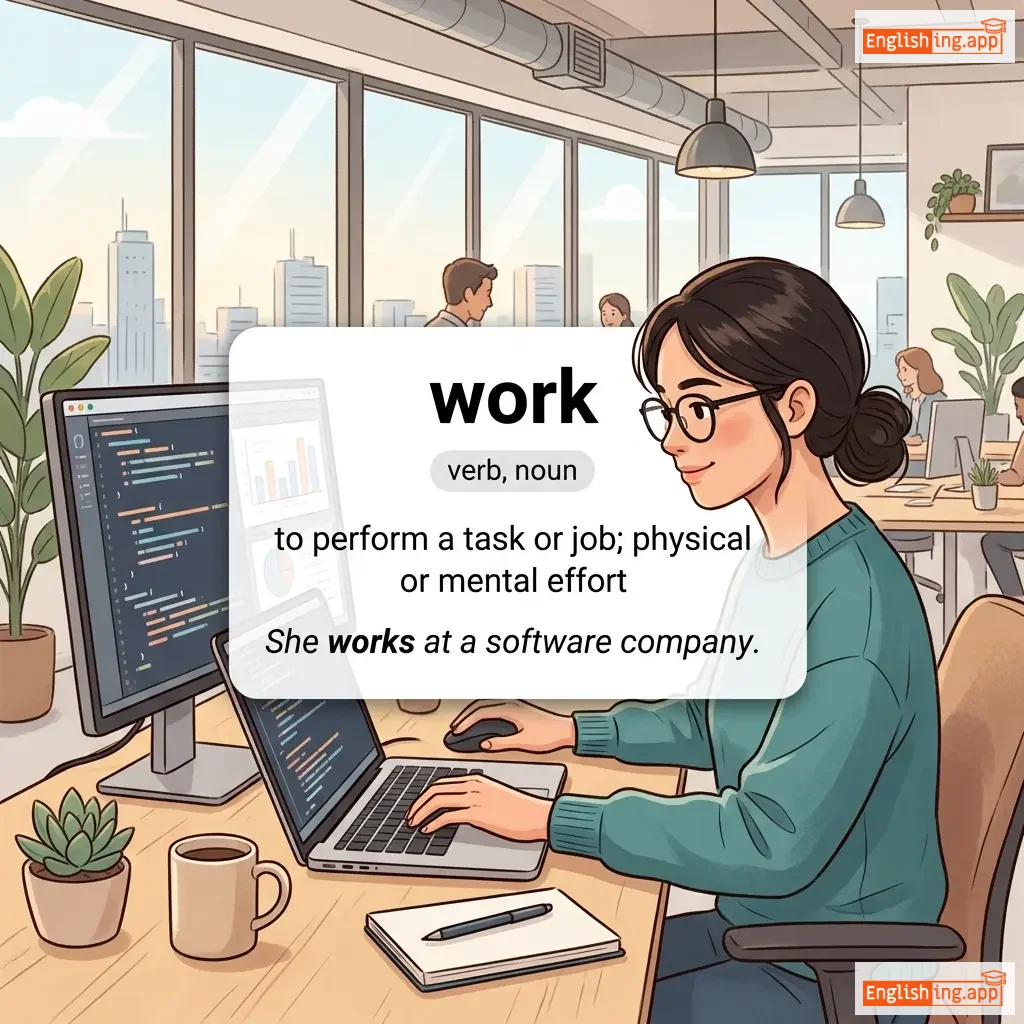
work definition card — visual illustration of the meaning
verb, noun
/wɜːrk/
travail (travai)

to perform a task or job; physical or mental effort

"She works at a software company."

"Elle travaille dans une entreprise de logiciels." (Elle travaille dans une entreprise de logiciels.)
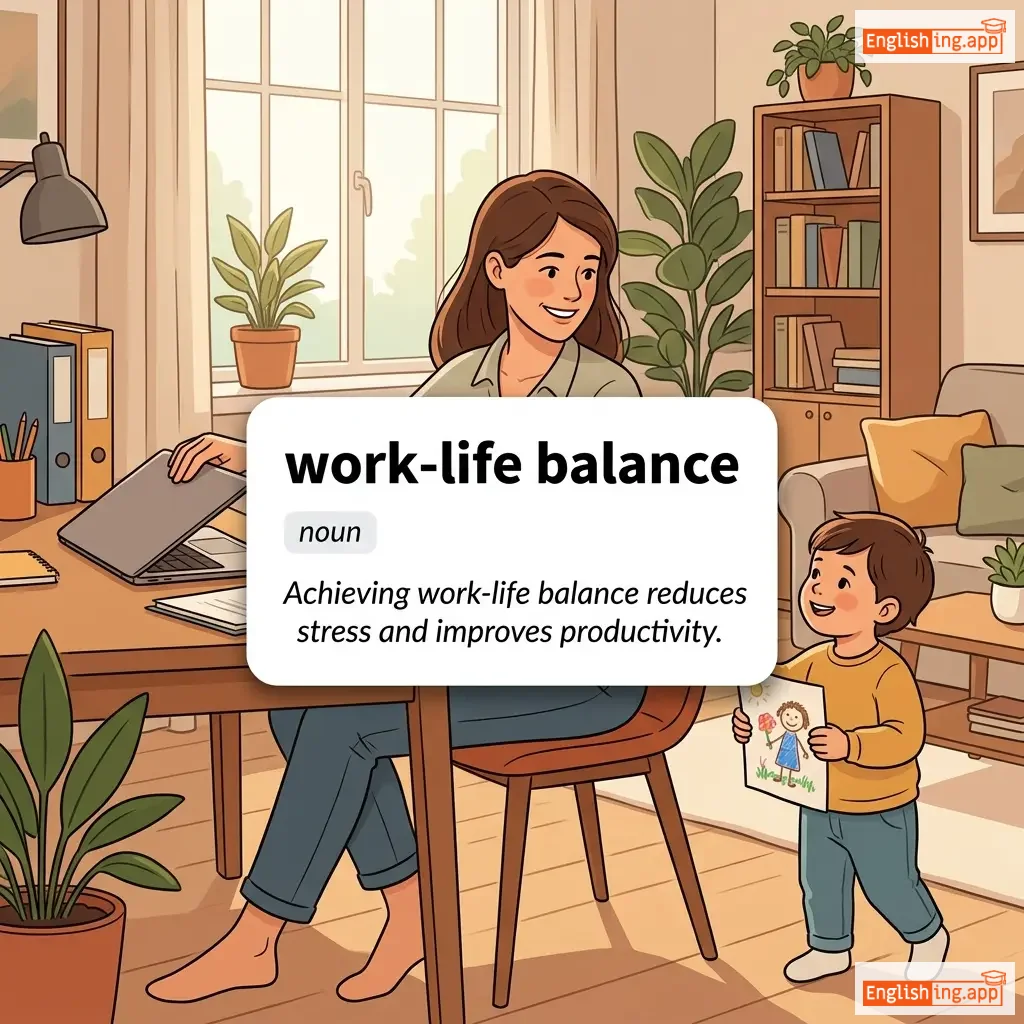
work-life balance definition card — visual illustration of the meaning
noun
/ˈwɜːrk laɪf ˈbæl.əns/
équilibre travail-vie (equilibre travail-vie)

The equilibrium between personal and professional life, ensuring neither dominates at the expense of the other.

"Achieving work-life balance reduces stress and improves productivity."

"Atteindre un équilibre travail-vie réduit le stress et améliore la productivité." (Atteindre un équilibre travail-vie réduit le stress et améliore la productivité.)
adjective
/ˈwɜːrkəbəl/
réalisable; praticable (realizable; praticable)

capable of being done or put into effect; practical

"We need a workable solution to solve this problem quickly."

"Nous avons besoin d'une solution réalisable pour résoudre ce problème rapidement." (Nous avons besoin d'une solution réalisable pour résoudre ce problème rapidement.)
noun
/ˈwɜːrkər/
travailleur (travailleur)

a person who is employed to perform tasks or duties

"The workers were busy building the bridge."

"Les travailleurs étaient occupés à construire le pont." (Les travailleurs étaient occupés à construire le pont.)
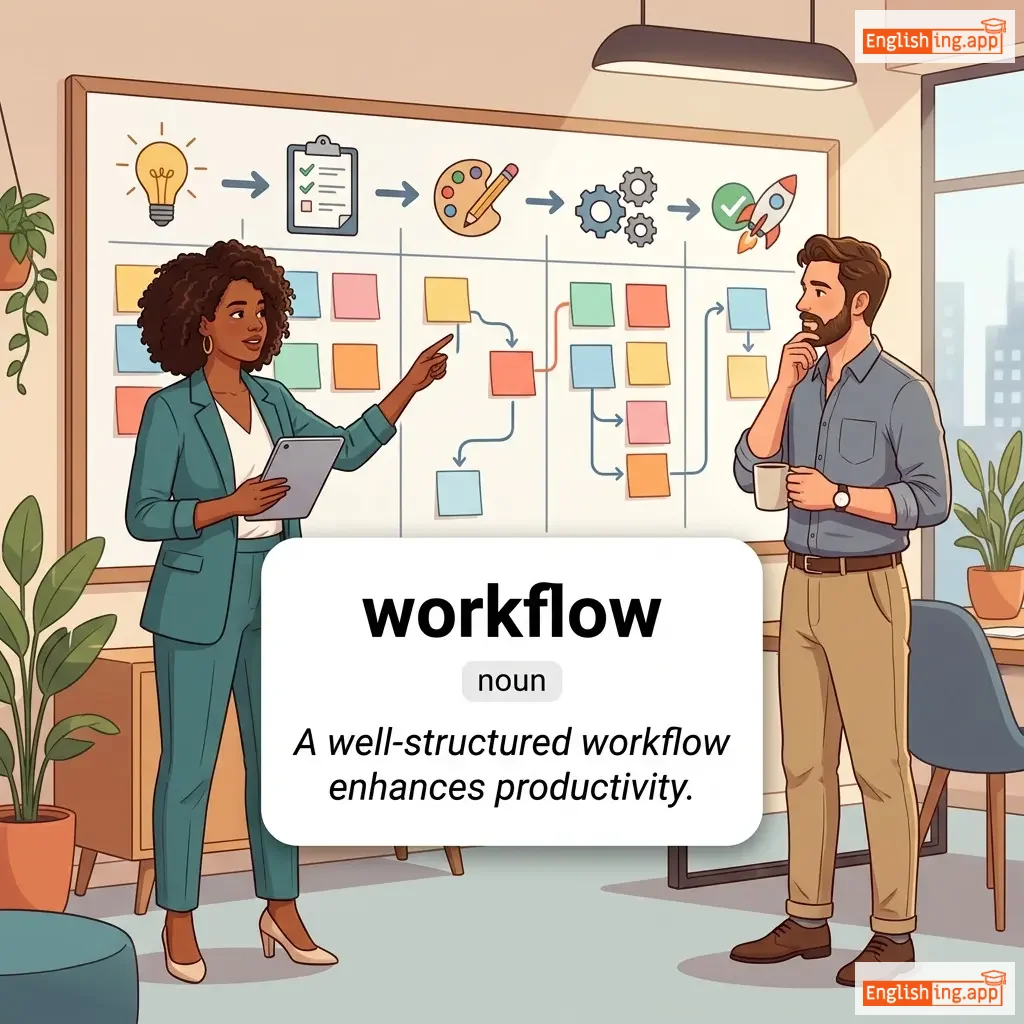
workflow definition card — visual illustration of the meaning
noun
/ˈwɜːk.fləʊ/
flux de travail, séquence de processus (flux de travail, séquence de processus)

The sequence of processes through which a piece of work passes from initiation to completion.

"A well-structured workflow enhances productivity."

"Un flux de travail bien structuré améliore la productivité." (Un flux de travail bien structuré améliore la productivité.)
noun
/ˈwɜːrkˌfɔːrs/
main-d'œuvre (main-d'œuvre)

the people engaged in or available for work

"The company is looking to expand its workforce by 20%."

"L'entreprise cherche à augmenter sa main-d'œuvre de 20%." (L'entreprise cherche à augmenter sa main-d'œuvre de 20%.)
adjective
/ˈwɜːrkɪŋ/
travaillant (travaillant)

engaged in physical or mental effort to achieve a goal or task

"She is working on her project right now."

"Elle travaille sur son projet en ce moment." (Elle travaille sur son projet en ce moment.)
noun
/ˈwɜːrkɪŋ mæn/
ouvrier (ouvrier)

a man engaged in manual labor or industrial work, often considered as part of the working class

"The working-man fought hard for better wages and conditions."

"L'ouvrier a travaillé dur pour de meilleurs salaires et conditions." (L'ouvrier a travaillé dur pour de meilleurs salaires et conditions.)
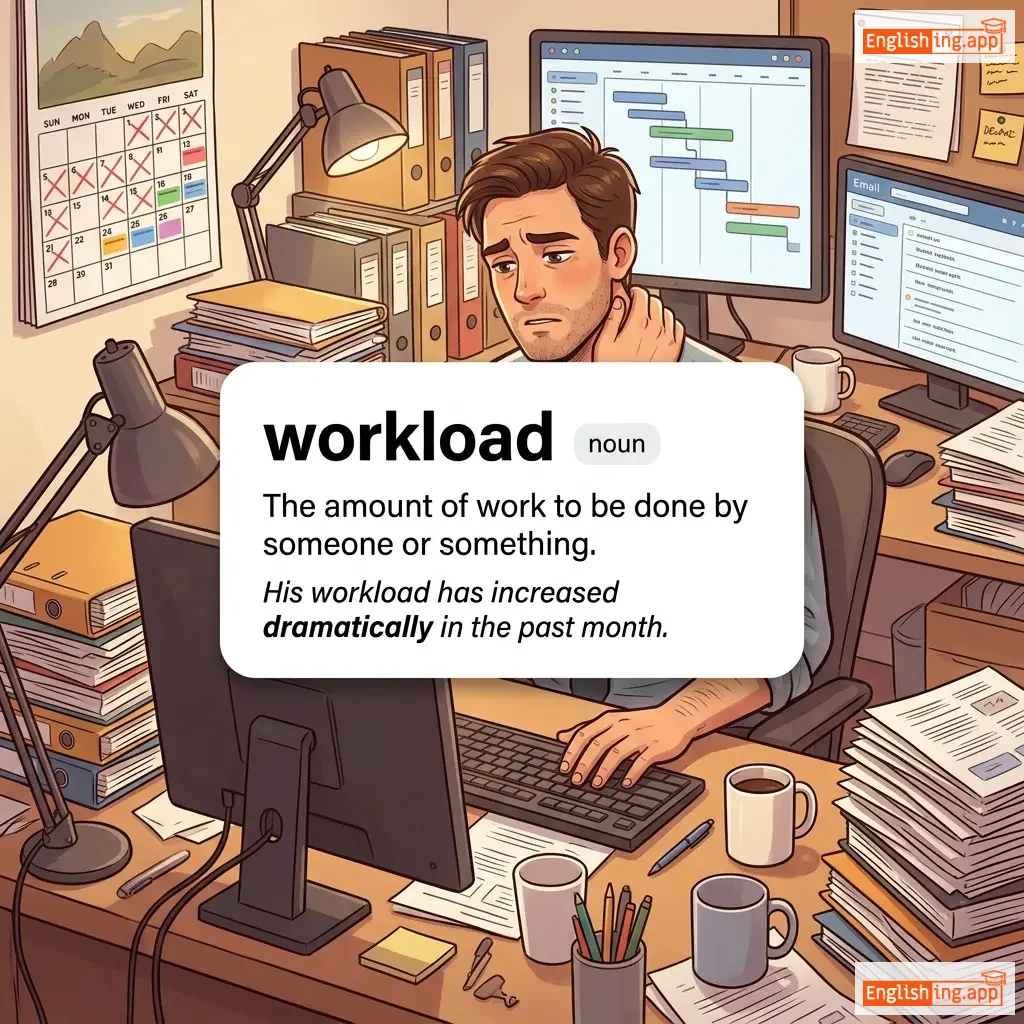
workload definition card — visual illustration of the meaning
noun
ˈwɜːrkˌləʊd
charge de travail (charge de travail)

The amount of work to be done by someone or something.

"His workload has increased dramatically in the past month."

"Sa charge de travail a considérablement augmenté au cours du dernier mois." (Sa charge de travail a considérablement augmenté au cours du dernier mois.)
adjective
/ˈwɜːkmənˌlaɪk/
professionnel (professionnel)

Showing efficient, competent, and practical skill, but without flair or creativity.

"The carpenter delivered a workmanlike performance on the project."

"Le charpentier a livré une performance de travail sur le projet." (Le charpentier a livré une performance de travail sur le projet.)
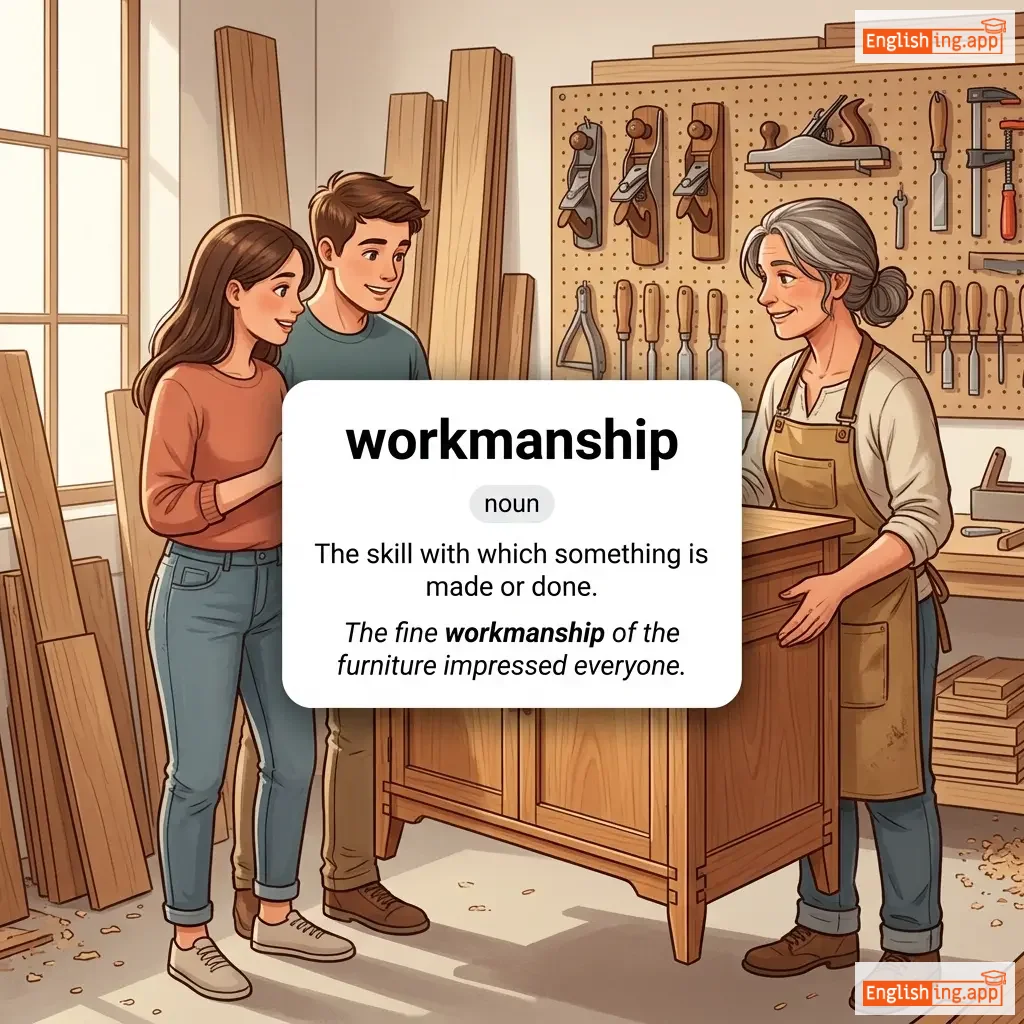
workmanship definition card — visual illustration of the meaning
noun
/ˈwɜːkmənˌʃɪp/
qualité de fabrication (qualité de fabrication)

The skill with which something is made or done.

"The fine workmanship of the furniture impressed everyone."

"La qualité de fabrication soignée des meubles a impressionné tout le monde." (La qualité de fabrication soignée des meubles a impressionné tout le monde.)