Vocabulaires

Découvrez, apprenez et maîtrisez le vocabulaire anglais

adjective
/ˌjuːnɪˈlætərəl/
unilatéral (unilateral)

Involving or affecting only one side or party without the agreement of others.

"The country took unilateral action without consulting its allies."

"Le pays a pris une décision unilatérale sans consulter ses alliés." (Le pays a pri une decision unilateral san consulter ses allies)
adjective
/ˌʌnɪˈmædʒənəbəl/
inimaginable (inimaginable)

impossible to conceive; beyond imagination

"The scale of destruction was unimaginable until we saw it firsthand."

"L'échelle de la destruction était inimaginable jusqu'à ce que nous le voyions de nos propres yeux." (L'echelle de la destruction etait inimaginable jusqu'a ce que nous le voyions de nos propres yeux.)
adjective
/ˌʌnɪmˈpiːtʃəbl/
irréprochable (irreprochable)

Not able to be doubted, questioned, or criticized; completely trustworthy.

"She is known for her unimpeachable honesty."

"Elle est connue pour son honnêteté irréprochable." (Elle est connue pour son honnêteté irréprochable.)
noun
/ʌnɪmˈpɔːrtəns/
insignifiance (insignifiance)

the state or quality of being insignificant or not important

"He dismissed the issue with a sense of unimportance."

"Il a rejeté la question avec un sentiment de non-importance." (Il a rejete la question avec un sentiment de non-importance)
adjective
/ˌʌnɪmˈpɔːrtənt/
sans importance (sans importance)

not having much value, significance, or influence

"The detail seemed unimportant compared to the main issue."

"Le détail semblait sans importance par rapport au problème principal." (Le detail semblait sans importance par rapport au probleme principal)
adjective
/ˌʌnɪnˈfɔːrmd/
mal informé (mal informe)

lacking knowledge or awareness about a particular subject; not educated or informed

"The decision was made by an uninformed committee."

"La décision a été prise par un comité mal informé." (la decision a ete prise par un comite mal informe)
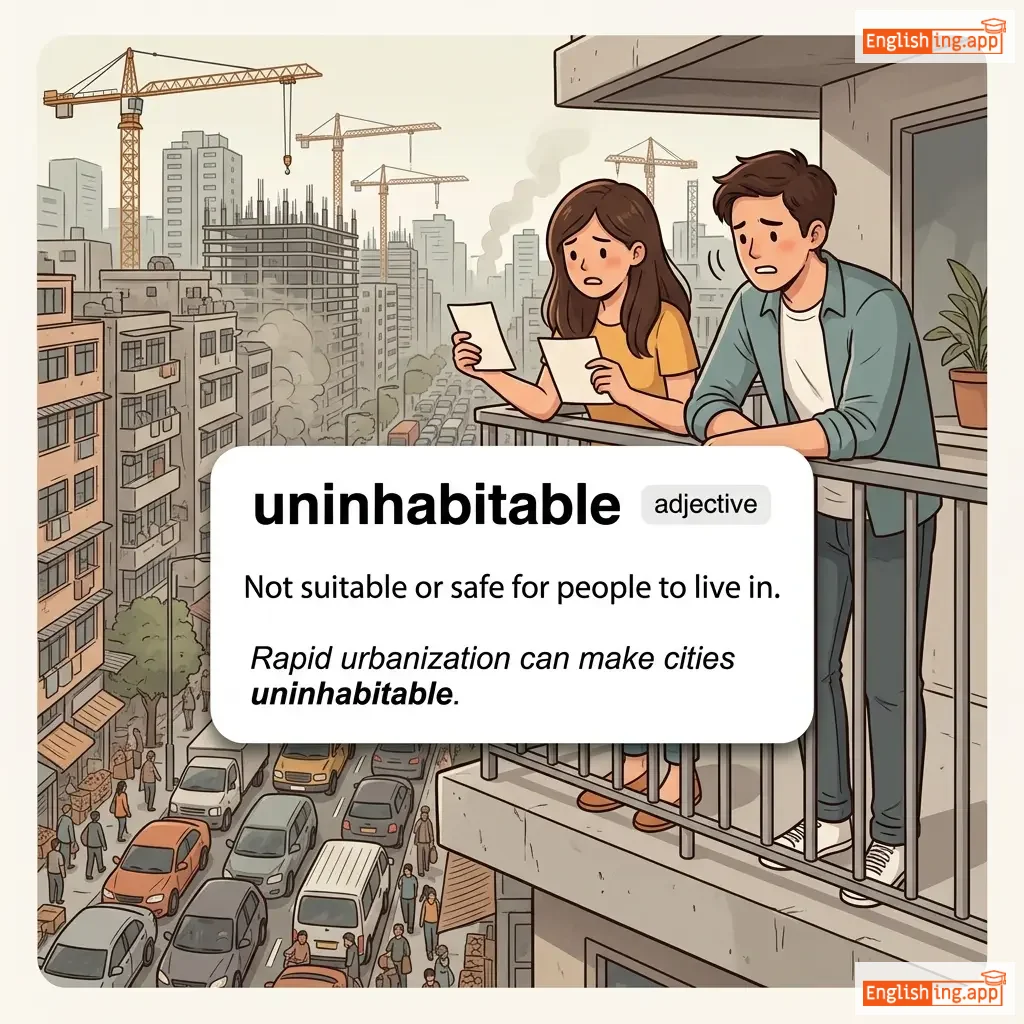
uninhabitable definition card — visual illustration of the meaning
adjective
ʌnɪnˈhæbɪtəbəl
inhabitable (inhabitable)

Not suitable or safe for people to live in.

"Rapid urbanization can make cities uninhabitable."

"L'urbanisation rapide peut rendre les villes inhabitables." (L'urbanisation rapide peut rendre les villes inhabitables.)
adjective
/ˌʌnɪnˈhɪbɪtɪd/
désinhibé (desinhibe)

Not restrained or restricted; free in behavior or expression.

"She gave an uninhibited laugh at the joke."

"Elle a éclaté d'un rire désinhibé à la blague." (Elle a éclaté d'un rire désinhibé à la blague.)
adjective
/ʌnˈɪndʒərd/
intacte (intacte)

Without injury; not physically harmed.

"All the passengers were rescued uninjured."

"Tous les passagers ont été sauvés indemnes." (Tous les passagers ont été sauvés indemnes.)
adjective
/ˌʌnɪnˈtenʃənəl/
involontaire; accidentel (involontaire; accidentel)

not done on purpose; accidental

"The damage to the car was unintentional."

"Les dégâts à la voiture étaient involontaires." (Les dégâts à la voiture étaient involontaires.)
adjective
/ˌʌnˈɪntrəstɪŋ/
ennuyeux (ennuyeux)

not holding attention or curiosity; boring

"The lecture was uninteresting and difficult to stay focused on."

"La conférence était ennuyeuse et difficile à suivre." (La conference etait ennuyeuse et difficile a suivre)
adjective
/ˌʌnˈɪntɪmeɪtɪŋ/
sans indices (sans indices)

Not giving a hint or suggestion; not indicating.

"His unintimating tone gave no clue of his true feelings."

"Son ton sans indices n'a donné aucun indice de ses véritables sentiments." (Son ton sans indices n'a donné aucun indice de ses véritables sentiments.)
noun
/ˈjuːnɪən/
union (union)

the action or fact of joining or being joined with others, especially to form a single unit

"The union of the two companies created a global leader."

"L'union des deux entreprises a créé un leader mondial." (L'union des deux entreprises a cree un leader mondial.)
adjective
/juːˈniːk/
unique (unik)

Being the only one of its kind; unlike anything else.

"Her dress was unique and caught everyone's attention."

"Sa robe était unique et a attiré l'attention de tout le monde." (Sa robe etait unique et a attire l'attention de tout le monde.)
noun
/ˈjuːnɪsən/
à l'unisson (a l'unisson)

Simultaneous performance or utterance of action or speech.

"The choir sang in unison."

"Le chœur a chanté à l'unisson." (Le choeur a chante a l'unisson.)
adjective
/juːˈnɪsənənt/
harmonieux (harmonieux)

Sounding together or in harmony.

"The unisonant voices created a powerful effect."

"Les voix harmonieuses ont créé un effet puissant." (Les voix harmonieuses ont créé un effet puissant.)
noun
/ˈjuːnɪt/
unité (unite)

an individual thing or person regarded as a single and complete entity

"Each unit in the production line is carefully tested."

"Chaque unité de la ligne de production est soigneusement testée." (Chaque unite de la ligne de production est soigneusement testee.)
noun
/ˌjuːnɪˈtɛəriən/
unitaire (unitaire)

A person who believes that God exists as one entity rather than as a Trinity; a member of a religious denomination that emphasizes individual freedom of belief.

"The Unitarian church is known for its inclusive and open-minded approach."

"L'église unitaire est connue pour son approche inclusive et ouverte d'esprit." (L'église unitaire est connue pour son approche inclusive et ouverte d'esprit.)
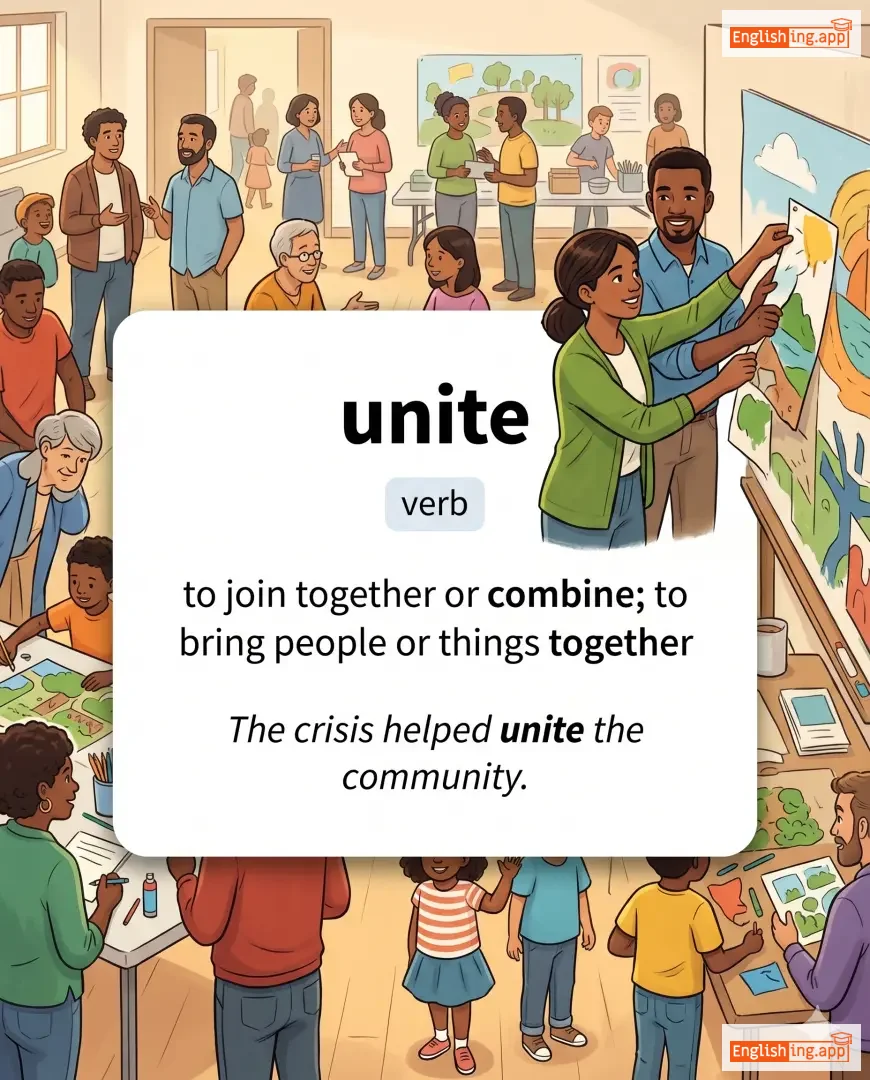
unite definition card — visual illustration of the meaning
verb
/juˈnaɪt/
unir (unir)

to join together or combine; to bring people or things together

"The crisis helped unite the community."

"La crise a aidé à unir la communauté." (La crise a aidé à unir la communauté.)
adjective
/juˈnaɪtɪd/
unis (unis)

joined together or combined as one

"The united team won the championship."

"L'équipe unie a remporté le championnat." (L'équipe unie a remporté le championnat.)
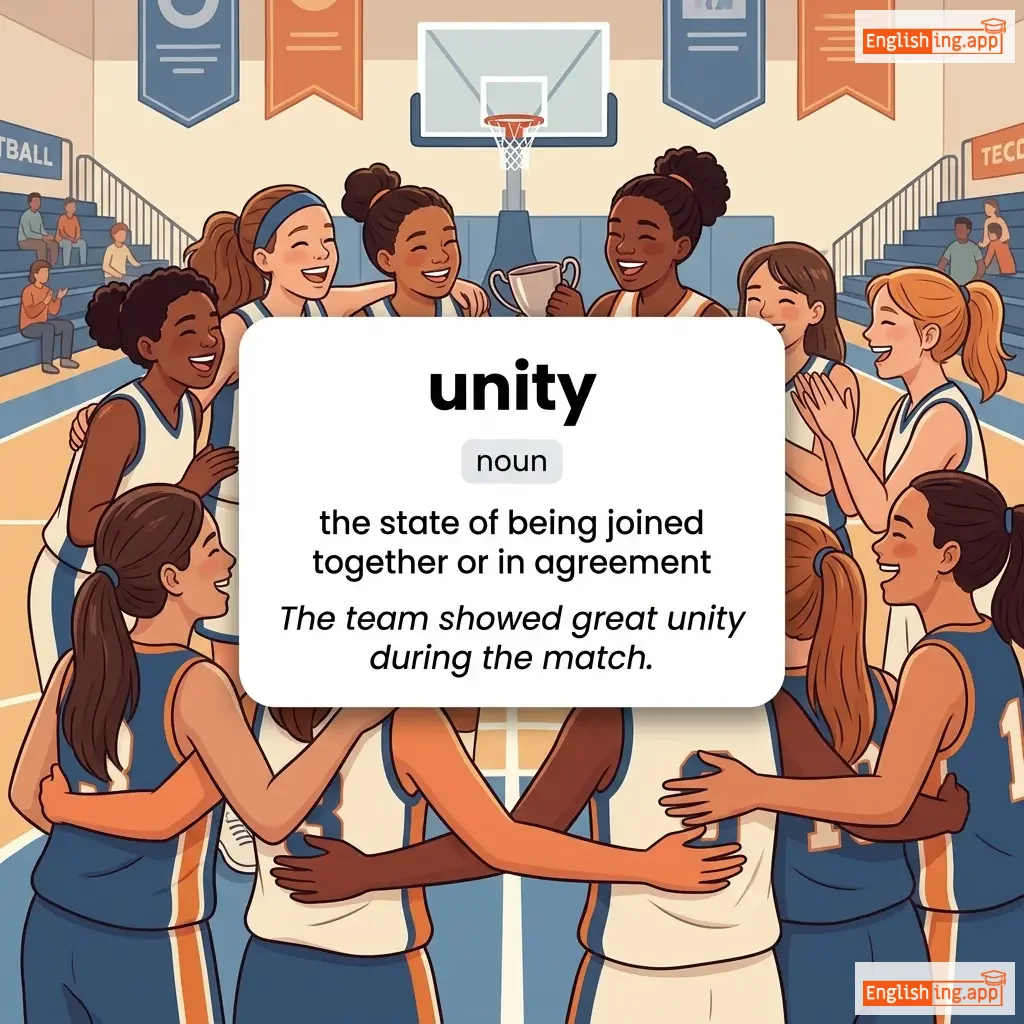
unity definition card — visual illustration of the meaning
🫱🏻‍🫲🏽

unity (yunité)

noun
/ˈjuːnɪti/
unité (unité)

the state of being joined together or in agreement

"The team showed great unity during the match."

"L'équipe a montré une grande unité pendant le match." (L'équipe a montré une grande unité pendant le match.)
noun
/ˈjuːnɪvəˌlɛns/
univalence (univalence)

The state of having a single valence or combining power, especially in chemistry.

"Hydrogen is characterized by its univalence in chemical reactions."

"L'hydrogène est caractérisé par son univalence dans les réactions chimiques." (L'hydrogène est caractérisé par son univalence dans les réactions chimiques.)
adjective
/ˌjuːnɪˈvɜːsəl/
universel (universel)

Relating to or done by all people or things in the world; applicable everywhere or in all cases.

"There is a universal need for love and acceptance."

"Il existe un besoin universel d'amour et d'acceptation." (Il existe un besoin universel d'amour et d'acceptation.)
noun
/ˈjuːnɪvɜːrs/
univers (univers)

the totality of known or supposed objects and phenomena throughout space; the cosmos

"The universe is vast and full of mysteries."

"L'univers est vaste et plein de mystères." (L'univers est vaste et plein de mystères.)
noun
/ˌjuːnɪˈvɜːrsɪti/
université (universite)

an institution of higher education and research, which grants academic degrees

"She is studying law at the university."

"Elle étudie le droit à l'université." (Elle etudie le droit a l'universite.)
adjective
/ʌnˈdʒʌst/
injuste; incorrecte (injuste; incorrecte)

not fair or right; morally wrong

"The punishment was unjust for such a minor offense."

"La punition était injuste pour une infraction mineure." (La punition était injuste pour une infraction mineure.)
adjective
/ʌnˈkɛmpt/
désordonné (desordonne)

Having an untidy or disheveled appearance.

"He looked unkempt after sleeping outdoors all night."

"Il avait l'air désordonné après avoir dormi dehors toute la nuit." (Il avait l'air desordonne apres avoir dormi dehors toute la nuit.)
adjective
/ʌnˈkaɪnd/
cruel; pas gentil (cruel; pas gentil)

cruel; not nice or caring toward others

"It was unkind of him to make fun of her appearance."

"C'était cruel de sa part de se moquer de son apparence." (C'etait cruel de sa part de se moquer de son apparence.)
adverb
/ʌnˈkaɪndli/
cruellement (cruellement)

in a cruel, harsh, or unsympathetic manner

"She spoke unkindly about her colleague during the meeting."

"Elle a parlé cruellement de son collègue pendant la réunion." (elle a parle cruellement de son collegue pendant la reunion)
noun
/ʌnˈkaɪndnəs/
méchanceté (mechancete)

lack of kindness; cruel or inconsiderate behavior

"His unkindness hurt her feelings deeply."

"Sa méchanceté a profondément blessé ses sentiments." (Sa mechancete a profondement blesse ses sentiments)
adjective
/ʌnˈnoʊn/
inconnu (inconnu)

not known or familiar

"The origin of the disease remains unknown."

"L'origine de la maladie reste inconnue." (L'origine de la maladie reste inconnue.)
adjective
/ʌnˈlɔːfəl/
Illégal (illegal)

Not conforming to or permitted by law; illegal.

"The police arrested him for unlawful possession of weapons."

"La police l'a arrêté pour possession illégale d'armes." (La police l'a arrete pour possession ilegale d'armes.)
conjunction
/ʌnˈlɛs/
à moins que (a moins que)

except if

"We won't go unless it stops raining."

"Nous n'irons pas à moins qu'il ne cesse de pleuvoir." (Nous n'irons pas à moins qu'il ne cesse de pleuvoir.)
adjective
/ʌnˈlɛtəd/
analphabète (analphabete)

lacking education or the ability to read and write; illiterate

"The unlettered villagers relied on oral traditions to preserve their history."

"Les villageois analphabètes dépendaient des traditions orales pour préserver leur histoire." (Les villageois analphabetes dependaient des traditions orales pour preserver leur histoire.)
preposition/adjective
/ʌnˈlaɪk/
différent (different)

differing from or not similar to

"Unlike his brother, he enjoys playing soccer."

"Contrairement à son frère, il aime jouer au football." (Contrairement à son frère, il aime jouer au football.)
adjective
/ʌnˈlaɪkli/
improbable (improbable)

not likely to happen or be true

"It is unlikely that he will arrive on time."

"Il est peu probable qu'il arrive à l'heure." (Il est peu probable qu'il arrive à l'heure.)
adjective
/ʌnˈlɪmɪtɪd/
illimité (illimite)

without any limits or restrictions

"The internet plan offers unlimited data for the whole month."

"Le plan Internet offre des données illimitées pendant tout le mois." (Le plan Internet offre des données illimitées pendant tout le mois.)
verb
/ʌnˈlɒk/
déverrouiller (deverrouiller)

to open something that is locked; to make something accessible or available

"She used the key to unlock the door."

"Elle a utilisé la clé pour déverrouiller la porte." (Elle a utilise la cle pour deverrouiller la porte)
adjective
/ʌnˈlʌki/
malchanceux; de mauvaise chance (malchanceux; de mauvaise chance)

having bad luck; unfortunate

"He was unlucky to miss the winning shot."

"Il était malchanceux de manquer le tir gagnant." (Il était malchanceux de manquer le tir gagnant.)
adjective
/ʌnˈmænɪdʒəbəl/
ingérable; hors de contrôle (ingerable; hors de controle)

difficult or impossible to control or handle

"The large class became unmanageable without proper supervision."

"La grande classe est devenue ingérable sans une supervision adéquate." (La grande classe est devenue ingerable sans une supervision adequate.)
adjective
/ʌnˈmærid/
célibataire (celibataire)

Not married; single.

"He is thirty-five and still unmarried."

"Il a trente-cinq ans et il est toujours célibataire." (Il a trente-cinq ans et il est toujours célibataire.)
verb
/ʌnˈmɑːsk/
démasquer (demasquer)

to remove a mask or covering; to reveal the true identity, nature, or intentions of someone or something

"The investigation helped unmask the real culprit behind the crime."

"L’enquête a permis de démasquer le vrai coupable du crime." (Lenquete a permis de demasquer le vrai coupable du crime)
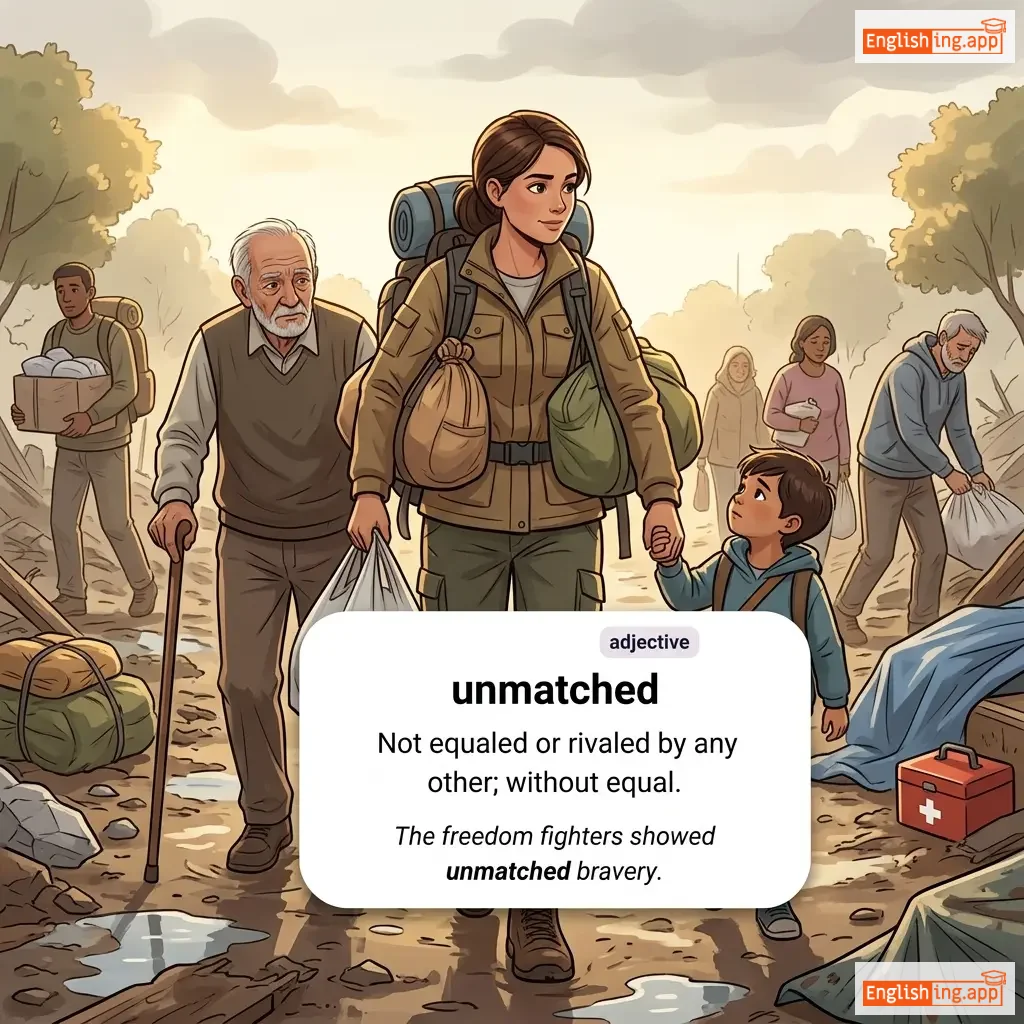
unmatched definition card — visual illustration of the meaning
adjective
ʌnˈmætʃt
incomparable (incomparable)

Not equaled or rivaled by any other; without equal.

"The freedom fighters showed unmatched bravery."

"Les combattants de la liberté ont montré un courage incomparable." (Les combattants de la liberté ont montré un courage incomparable.)
adjective
/ʌnˈmaɪndfəl/
négligent; inattentif; (neglijant; inattentif)

not paying attention; careless; heedless

"She was unmindful of the danger around her."

"Elle ne faisait pas attention au danger autour d'elle." (Elle ne faisait pas attention au danger autour d'elle.)
adjective
/ʌnˈmɪtɪɡeɪtɪd/
complet (komplet)

absolute; not lessened or moderated

"The meeting was an unmitigated disaster."

"La réunion était un désastre complet." (La réunion était un désastre complet.)
adjective
/ʌnˈmɒdɪfaɪd/
non modifié (non modifie)

not changed from its original form or state

"The data was used in its unmodified form for analysis."

"Les données ont été utilisées sous leur forme non modifiée." (les donnees ont ete utilisees sous leur forme non modifiee)
adjective
/ʌnˈnætʃrəl/
antinaturel (antinaturel)

contrary to the usual course of nature; artificial or abnormal

"The bright green color of the drink looked unnatural."

"La couleur verte brillante de la boisson semblait antinaturelle." (La couleur verte brillante de la boisson semblait antinaturelle.)
adverb
/ʌnˈnætʃrəli/
d'une manière anormale (d'une maniere anormale)

in a way that is not natural or normal; excessively or strangely

"He smiled unnaturally, making everyone feel uncomfortable."

"Il a souri d'une manière anormale, mettant tout le monde mal à l'aise." (Il a souri d'une maniere anormale, mettant tout le monde mal a l'aise)
adverb
/ʌnˈnesəserəli/
inutillement (inutillement)

to a greater extent than is needed; without necessity

"Don't worry unnecessarily about the exam."

"Ne t'inquiète pas inutilement pour l'examen." (Ne t'inquiete pas inutilement pour l'examen.)
adjective
/ʌnˈnɛsəsɛri/
inutile (inutile)

not needed or required

"The manager cut all unnecessary expenses to save costs."

"Le manager a réduit toutes les dépenses inutiles pour économiser des coûts." (Le manager a réduit toutes les dépenses inutiles pour économiser des coûts.)