Vocabulaires

Découvrez, apprenez et maîtrisez le vocabulaire anglais

adjective
/ʌnˈbreɪkəbəl/
qui ne peut être brisé ou endommagé ; très fort et durable (ki nu pe otʁe bʁise ozɔndomaʒe ; tʁe fɔʁ e dyʁabl)

not able to be broken or damaged; very strong and durable

"Their friendship formed an unbreakable bond."

"Leur amitié a formé un lien incassable." (leur amitié a formé un lien incassable.)
adjective
/ʌnˈbraɪdld/
déraisonné (deraisonne)

Uncontrolled and unrestrained.

"The protesters showed unbridled enthusiasm for change."

"Les manifestants ont montré un enthousiasme débridé pour le changement." (Les manifestants ont montré un enthousiasme débridé pour le changement.)
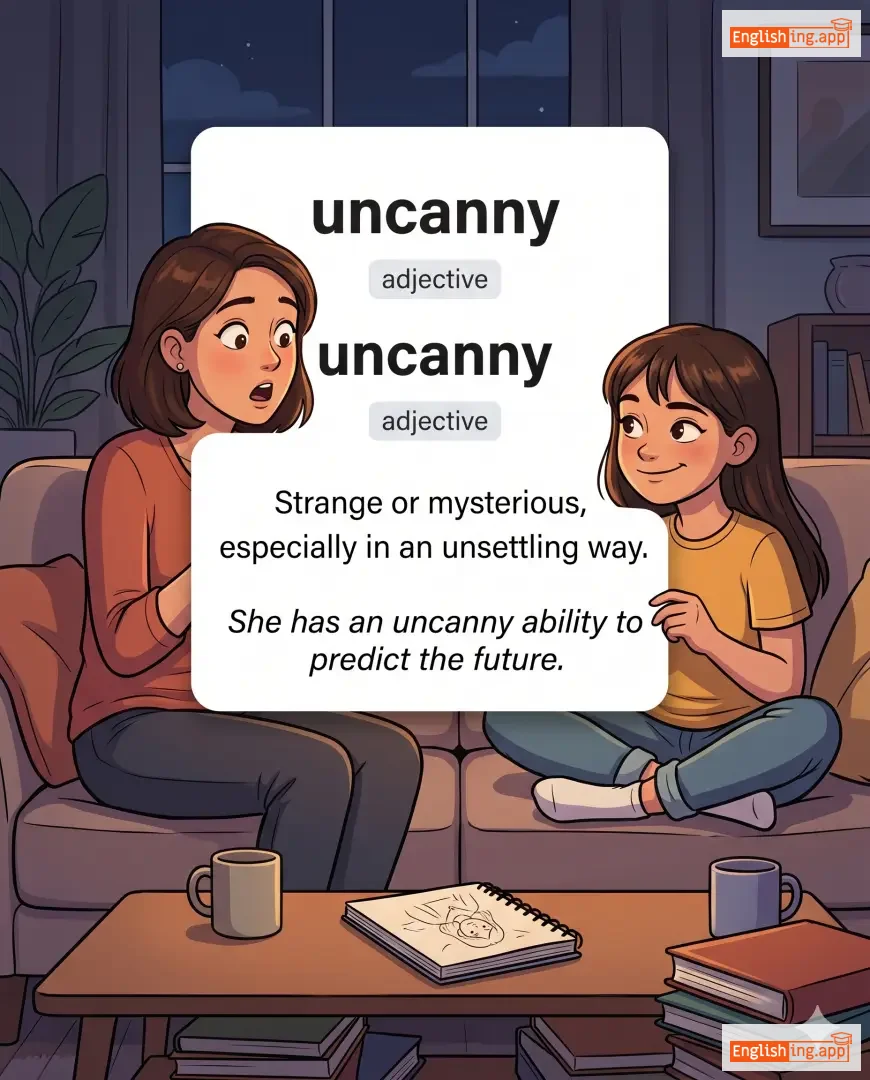
uncanny definition card — visual illustration of the meaning
adjective
/ʌnˈkæni/
étrange (etrange)

Strange or mysterious, especially in an unsettling way.

"She has an uncanny ability to predict the future."

"Elle a une étrange capacité à prédire l'avenir." (Elle a une etrange capacite a predire l'avenir.)
adjective
/ˌʌnsɛrəˈmoʊniəs/
sans cérémonie/rude (sans ceremonie/rude)

Done without formality or courtesy; abrupt or rude.

"He made an unceremonious exit from the party."

"Il a fait une sortie sans cérémonie de la fête." (Il a fait une sortie sans cérémonie de la fête.)
adjective
/ʌnˈsɜːtən/
incertain (incertain)

not sure or confident about something; not clearly known or decided

"She felt uncertain about her future after graduation."

"Elle se sentait incertaine quant à son avenir après l'obtention de son diplôme." (Elle se sentait incertaine quant à son avenir après l'obtention de son diplôme.)
adverb
/ʌnˈsɜːrtənli/
avec incertitude (avec incertitude)

in a way that shows doubt or lack of certainty

"She glanced uncertainly at the complicated instructions."

"Elle a regardé les instructions compliquées avec incertitude." (Elle a regarde les instructions compliquees avec incertitude.)
noun
/ʌnˈsɜːtənti/
incertitude (incertitude)

the state of being unsure or not knowing what will happen

"Economic uncertainty affects business investments."

"L'incertitude économique affecte les investissements commerciaux." (L'incertitude économique affecte les investissements commerciaux.)
adjective
/ʌnˈtʃælɪndʒd/
incontesté; accepté sans opposition; sans rival (incontesté; accepté sans opposition; sans rival)

not disputed or questioned; accepted without opposition; having no rival

"He remained the unchallenged champion for five years."

"Il est resté le champion incontesté pendant cinq ans." (Il est reste le champion inconteste pendant cinq ans.)
adjective
/ʌnˈtʃeɪndʒəbəl/
inchangable; fixe; (inchangable; fixe;)

not able to be changed or altered; fixed and permanent

"The laws of physics are unchangeable principles that govern the universe."

"Les lois de la physique sont des principes inchangables qui gouvernent l'univers." (Les lois de la physique sont des principes inchangables qui gouvernent l'univers.)
adjective
/ʌnˈtʃeɪndʒɪŋ/
inchangé (inchangé)

remaining the same over time; not changing

"Her love for her family was unchanging throughout the years."

"Son amour pour sa famille est resté inchangé au fil des ans." (Son amour pour sa famille est reste inchange au fil des ans.)
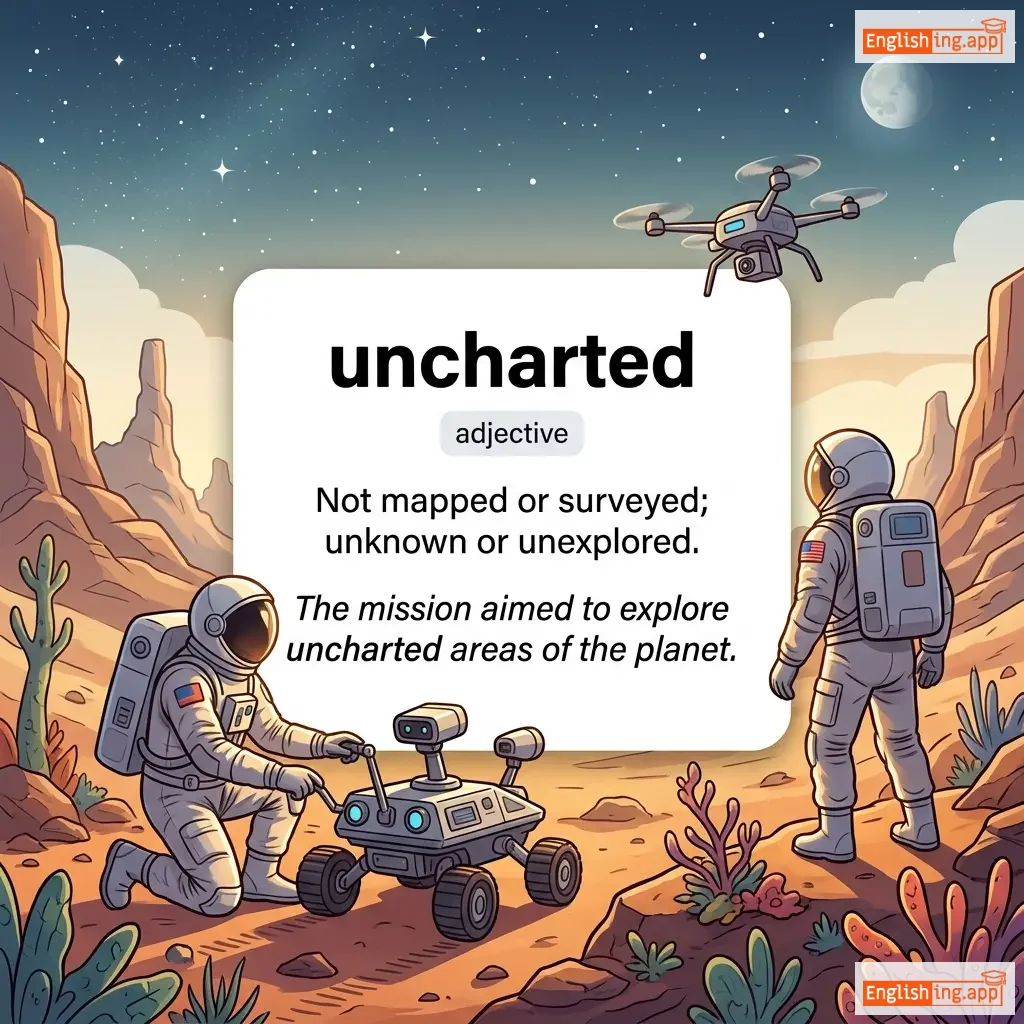
uncharted definition card — visual illustration of the meaning
adjective
ʌnˈtʃɑːtɪd
inexploré (inexplore)

Not mapped or surveyed; unknown or unexplored.

"The mission aimed to explore uncharted areas of the planet."

"La mission visait à explorer des zones inexplorées de la planète." (La mission visait à explorer des zones inexplorées de la planète.)
adjective
/ʌnˈtʃeɪst/
immoral; impur; (immoral; impur;)

not celibate; having engaged in sexual relations; lacking moral purity

"The conservative society considered her behavior unchaste and improper."

"La société conservatrice a jugé son comportement immoral et inapproprié." (La société conservatrice a jugé son comportement immoral et inapproprié.)
adjective
/ʌnˈsɪvəl/
incivil; impoli; (ansivil; impoli)

not polite or courteous; rude and discourteous in behavior

"His uncivil remarks during the meeting offended everyone present."

"Ses remarques inciviles lors de la réunion ont offensé tout le monde présent." (Ses remarques inciviles lors de la réunion ont offensé tout le monde présent.)
adjective
/ʌnˈsɪvəlaɪzd/
non civilisé; sauvage; (non civilisé; sauvage;)

not developed in terms of civilization; lacking social organization and culture; barbarous

"The explorers encountered an uncivilized tribe deep in the Amazon rainforest."

"Les explorateurs ont rencontré une tribu non civilisée au cœur de la forêt amazonienne." (Les explorateurs ont rencontre une tribu non civilisee au coeur de la foret amazonienne.)
adjective
/ʌnˈkleɪmd/
non réclamé; non demandé; abandonné ou sans propriétaire (non reclame; non demande; abandonne ou sans proprietaire)

not claimed by anyone; not demanded or requested; abandoned or ownerless

"The unclaimed luggage was stored in the airport's lost property department."

"Les bagages non réclamés ont été stockés dans le département des objets trouvés de l'aéroport." (Les bagages non reclamés ont été stockés dans le département des objets trouvés de l'aéroport.)
👨‍🦳

uncle (onkel)

noun
/ˈʌŋkəl/
oncle (oncle)

the brother of one's father or mother

"My uncle is visiting us next week."

"Mon oncle nous rendra visite la semaine prochaine." (Mon oncle nous rendra visite la semaine prochaine.)
adjective
/ʌnˈklɪər/
peu clair (peu clair)

not easy to understand; vague or ambiguous

"The instructions were unclear, so I asked for clarification."

"Les instructions étaient peu claires, alors j'ai demandé des clarifications." (Les instructions etaient peu claires, alors j'ai demande des clarifications)
verb
/ʌnˈkloʊð/
déshabiller; enlever les vêtements (deshabiller; enlever les vetements)

to remove clothing from someone or something

"The nurse helped unclothe the patient for the examination."

"L'infirmière a aidé à déshabiller le patient pour l'examen." (L'infirmiere a aide a deshabiller le patient pour l'examen)
noun
/ʌnˈkloʊðɪŋ/
déshabillage (déshabillage)

the act or process of removing clothing

"The child quickly ran inside for unclothing after playing in the mud."

"L'enfant est rapidement allé à l'intérieur pour le déshabillage après avoir joué dans la boue." (L'enfant est rapidement alle a l'interieur pour le deshabillage apres avoir joue dans la boue)
adjective
/ʌnˈkʌmfətəbl/
inconfortable (inconfortable)

causing or feeling physical or emotional discomfort

"He felt uncomfortable during the long meeting."

"Il s'est senti inconfortable pendant la longue réunion." (Il s'est senti inconfortable pendant la longue réunion.)
adjective
/ʌnˈkɒmən/
inhabituel (inhabituel)

rare, unusual, or remarkable

"It is uncommon to see snow in this region."

"Il est rare de voir de la neige dans cette région." (Il est rare de voir de la neige dans cette région.)
adjective
/ʌnˈkɒmprəmaɪzɪŋ/
inflexible (inflexible)

not willing to make concessions; firm and resolute

"She remained uncompromising in her principles."

"Elle est restée inflexible dans ses principes." (Elle est restee inflexible dans ses principes.)
noun
/ʌnkənˈsɜːrn/
désintérêt (desinteret)

lack of worry or interest; indifference

"She showed complete unconcern about the criticism."

"Elle a montré un total désintérêt face à la critique." (Elle a montre un total desinteret face a la critique.)
adjective
/ʌnˌkənˈdɪʃ.ən.əl/
inconditionnel (inconditionnel)

not subject to any conditions; complete and absolute

"She offered her unconditional support to her friend in need."

"Elle a offert son soutien inconditionnel à son ami dans le besoin." (Elle a offert son soutien inconditionnel à son ami dans le besoin.)
adjective
/ʌnˌkənˈfɜːmd/
non confirmé; non vérifié; (non confirmé, non vérifié)

not confirmed as true or definite; not verified or substantiated

"The report remains unconfirmed until we receive official verification."

"Le rapport reste non confirmé jusqu'à ce que nous recevions la vérification officielle." (Le rapport reste non confirmé jusqu'à ce que nous recevions la vérification officielle.)
adjective
/ʌnˈkɒnʃənəbl/
injustifiable (injustifiable)

shockingly unfair or unreasonable

"The company made unconscionable profits from the crisis."

"L'entreprise a réalisé des bénéfices injustifiables pendant la crise." (L'entreprise a réalisé des bénéfices injustifiables pendant la crise.)
adjective
/ʌnˈkɒnʃəs/
inconscient (inconscient)

not awake and aware of surroundings

"He was knocked unconscious by the fall."

"Il est devenu inconscient après la chute." (Il est devenu inconscient après la chute.)
adverb
/ʌnˈkɒnʃəsli/
inconsciemment (inconsciemment)

without being aware of one's actions or surroundings

"She unconsciously tapped her foot to the rhythm of the music."

"Elle tapotait inconsciemment son pied au rythme de la musique." (Elle tapotait inconsciemment son pied au rythme de la musique)
noun
/ʌnˈkɒnʃəsnəs/
inconscience (inconscience)

the state of being unaware of and unable to respond to one's surroundings

"After the accident, he was in a state of unconsciousness for several hours."

"Après l'accident, il était dans un état d'inconscience pendant plusieurs heures." (Apres l'accident, il etait dans un etat d'inconscience pendant plusieurs heures.)
adjective
/ˌʌnkənˈstɪtjuːʃənl/
inconstitutionnel (inconstitutionnel)

not in accordance with a political constitution

"The court ruled that the law was unconstitutional."

"Le tribunal a statué que la loi était inconstitutionnelle." (Le tribunal a statue que la loi etait inconstitutionnelle.)
adjective
/ˌʌnkənˈtroʊld/
incontrôlé (incontrole)

not restrained or managed; lacking control

"The wildfire spread in an uncontrolled manner, causing widespread damage."

"L'incendie de forêt s'est propagé de manière incontrôlée, causant des dommages étendus." (L'incendie de foret s'est propage de maniere incontrolee, causant des dommages etendus)
adjective
/ˌʌnkənˈvɛnʃənl/
non conventionnel (non conventionnel)

not based on or conforming to what is generally done or believed

"Her unconventional approach to teaching inspired her students to think creatively."

"Son approche pédagogique non conventionnelle a inspiré ses élèves à penser de manière créative." (Son approche pedagogique non conventionnelle a inspire ses eleves a penser de maniere creative.)
adverb
/ˌʌnkənˈvɛnʃənəli/
de manière non conventionnelle (de maniere non conventionnelle)

in a way that is not based on or conforming to accepted standards or norms

"She dresses unconventionally, mixing bold colors and patterns that surprise everyone."

"Elle s'habille de manière non conventionnelle, mélangeant des couleurs et des motifs audacieux qui surprennent tout le monde." (Elle s'habille de maniere non conventionnelle, melangeant des couleurs et des motifs audacieux qui surprennent tout le monde.)
adjective
/ˌʌnkənˈvɪnsɪŋ/
invraisemblable (invraisemblable)

failing to persuade or impress; not believable or credible

"His excuse for being late was completely unconvincing."

"Son excuse pour être en retard était complètement invraisemblable." (Son excuse pour etre en retard etait completement invraisemblable.)
adjective
/ʌnˈkʊkt/
cru (cru)

Not cooked; in a raw state.

"Eating uncooked meat can be dangerous."

"Manger de la viande crue peut être dangereux." (Manger de la viande crue peut être dangereux.)
adjective
/ˌʌn.kəʊˈɒp.ər.ə.tɪv/
non coopératif (non cooperatif)

not willing to help or work with others; unhelpful

"The witness was uncooperative and refused to answer questions."

"Le témoin était non coopératif et a refusé de répondre aux questions." (Le temoin etait non cooperatif et a refuse de repondre aux questions.)
adjective
/ˌʌnˈkɔːrdɪneɪtɪd/
désordonné; non coordonné (desordonne; non coordonne)

lacking coordination, not well-organized or clumsy in movement

"His movements were uncoordinated, making him prone to accidents."

"Ses mouvements étaient désordonnés, ce qui le rendait sujet aux accidents." (Ses mouvements etaient desordonnes, ce qui le rendait sujet aux accidents.)
verb
/ʌnˈkɔrk/
déboucher (deboucher)

To remove the cork from a bottle; to open a bottle, especially of wine

"He uncorked the wine and poured a glass for everyone."

"Il a débouché le vin et a servi un verre à tout le monde." (Il a debouche le vin et a servi un verre a tout le monde.)
verb
/ʌnˈkaʊtʃ/
retirer du canapé (usage rare) (retirer du canape)

to remove from a couch or to release from being laid down (rare/archaic usage)

"The surgeon attempted to uncouch the cataract."

"Le chirurgien a tenté d'enlever la cataracte." (Le chirurgien a tente d'enlever la cataracte.)
adjective
/ʌnˈkaʊntəbəl/
innombrable; infini (innombrable; infini)

too many to be counted; innumerable; infinite in quantity

"There are uncountable stars in the night sky."

"Il y a des étoiles innombrables dans le ciel nocturne." (il y a des étoiles innombrables dans le ciel nocturne)
adjective
/ʌnˈkuːθ/
grossier (grossier)

Lacking good manners, refinement, or grace; awkward or rough.

"His uncouth behavior shocked the guests at the party."

"Son comportement grossier a choqué les invités à la fête." (Son comportement grossier a choqué les invités à la fête.)
verb
/ʌnˈkʌvə(r)/
découvrir (de-ku-vrir)

to reveal something that was hidden or secret

"The investigation uncovered new evidence."

"L'enquête a découvert de nouvelles preuves." (L'en-qué-te a dé-cou-vri de nou-velles preu-ves.)
noun
/ˈʌŋkʃən/
unction (unction)

The act of anointing as part of a religious or ceremonial ritual; excessive or insincere flattery.

"The priest performed the holy unction with solemnity."

"Le prêtre a accompli l'unction sacrée avec solennité." (Le pretre a accompli l'unction sacree avec solenite.)
adjective
/ˈʌŋk.tʃu.əs/
flatteur (flatteur)

Excessively flattering or ingratiating; oily in texture.

"His unctuous tone made everyone uncomfortable."

"Son ton flatteur a mis tout le monde mal à l'aise." (Son ton flatteur a mis tout le monde mal à l'aise.)
adjective
/ʌnˈkʌltʃəd/
incivilisé; sans éducation (incivilise; san eduka-syon)

lacking good manners, refinement, or education; uncivilized

"His uncultured behavior embarrassed everyone at the dinner party."

"Son comportement incivilisé a embarrassé tout le monde à la fête." (Son comportement incivilisé a embarrassé tout le monde à la fête.)
adjective
/ʌnˈdɔːntɪd/
Intrépide; courageux; indomptable; (intrepide)

not intimidated or discouraged by difficulty, danger, or disappointment

"Despite the setbacks, she remained undaunted in pursuing her goals."

"Malgré les revers, elle est restée intrépide dans la poursuite de ses objectifs." (Malgré les revers, elle est restée intrépide dans la poursuite de ses objectifs.)
verb
/ˌʌn.dɪˈsiːv/
désillusionner (desillusionner)

To free someone from a misconception or false belief.

"She tried to undeceive him about the false rumors."

"Elle a essayé de le désillusionner au sujet des fausses rumeurs." (Elle a essaye de le desillusionner au sujet des fausses rumeurs.)
adjective
/ˌʌndɪˈsaɪdɪd/
indécis; incertain (indecis; incertain)

not having made a decision; uncertain

"She was undecided about which college to attend."

"Elle était indécise sur quel collège fréquenter." (Elle était indecise sur quel college frequenter.)
adjective
/ˌʌndɪˈnaɪəbl/
indéniable (indeniable)

Impossible to deny; clearly true or real.

"Her talent is undeniable."

"Son talent est indéniable." (Son talent est indeniable.)
preposition
/ˈʌndər/
sous (sou)

in or to a lower position than something

"The cat is under the table."

"Le chat est sous la table." (Le chat est sous la table.)