Vocabulaires

Découvrez, apprenez et maîtrisez le vocabulaire anglais

adjective
/ˌθiːəˈrɛtɪkl/
théorique (theorique)

Concerned with or based on theory rather than practical application.

"The idea remains largely theoretical without real-world evidence."

"L'idée reste principalement théorique sans preuve concrète." (L'idee reste principalement theorique sans preuve concrete.)
noun
/ˈθiːərɪst/
théoricien (theoricen)

A person who develops, studies, or explains theories in a particular field.

"The political theorist explained the impact of democracy on social structures."

"Le théoricien politique a expliqué l'impact de la démocratie sur les structures sociales." (Le theoricien politique a expliqué l'impact de la démocratie sur les structures sociales.)
verb
/ˈθiːəraɪz/
théoriser (theoriser)

To form a theory or set of ideas to explain something.

"Scientists often theorize about the origins of the universe."

"Les scientifiques théorisent souvent sur les origines de l'univers." (Les scientifiques theorisent souvent sur les origines de l'univers.)
noun
/ˈθiːəri/
théorie (theorie)

An explanation of an idea or principle based on facts, reasoning, and evidence.

"Einstein's theory of relativity changed the way we understand physics."

"La théorie de la relativité d'Einstein a changé la façon dont nous comprenons la physique." (La theorie de la relativite d'Einstein a change la facon dont nous comprenons la physique.)
noun
/θiˈɒsəfi/
théosophie (theosophie)

A religious or philosophical belief system that seeks direct knowledge of the mysteries of life and the divine.

"Theosophy attracted people interested in mysticism and spiritual growth."

"La théosophie a attiré des personnes intéressées par le mysticisme et la croissance spirituelle." (La théosophie a attiré des personnes intéressées par le mysticisme et la croissance spirituelle.)
therapeutic definition card — visual illustration of the meaning
adjective
/ˌθɛrəˈpjuːtɪk/
thérapeutique (therapeutique)

Related to healing, treatment, or providing a beneficial effect on the body or mind.

"Yoga can have a therapeutic effect on stress and anxiety."

"Le yoga peut avoir un effet thérapeutique sur le stress et l'anxiété." (Le yoga peut avoir un effet therapeutique sur le stress et l'anxiete.)
noun
/ˈθɛrəpɪst/
thérapeute (therapeute)

a person trained to provide treatment or counseling for physical or mental health

"The therapist helped him overcome his anxiety."

"Le thérapeute l'a aidé à surmonter son anxiété." (Le thérapeute l'a aidé à surmonter son anxiété.)
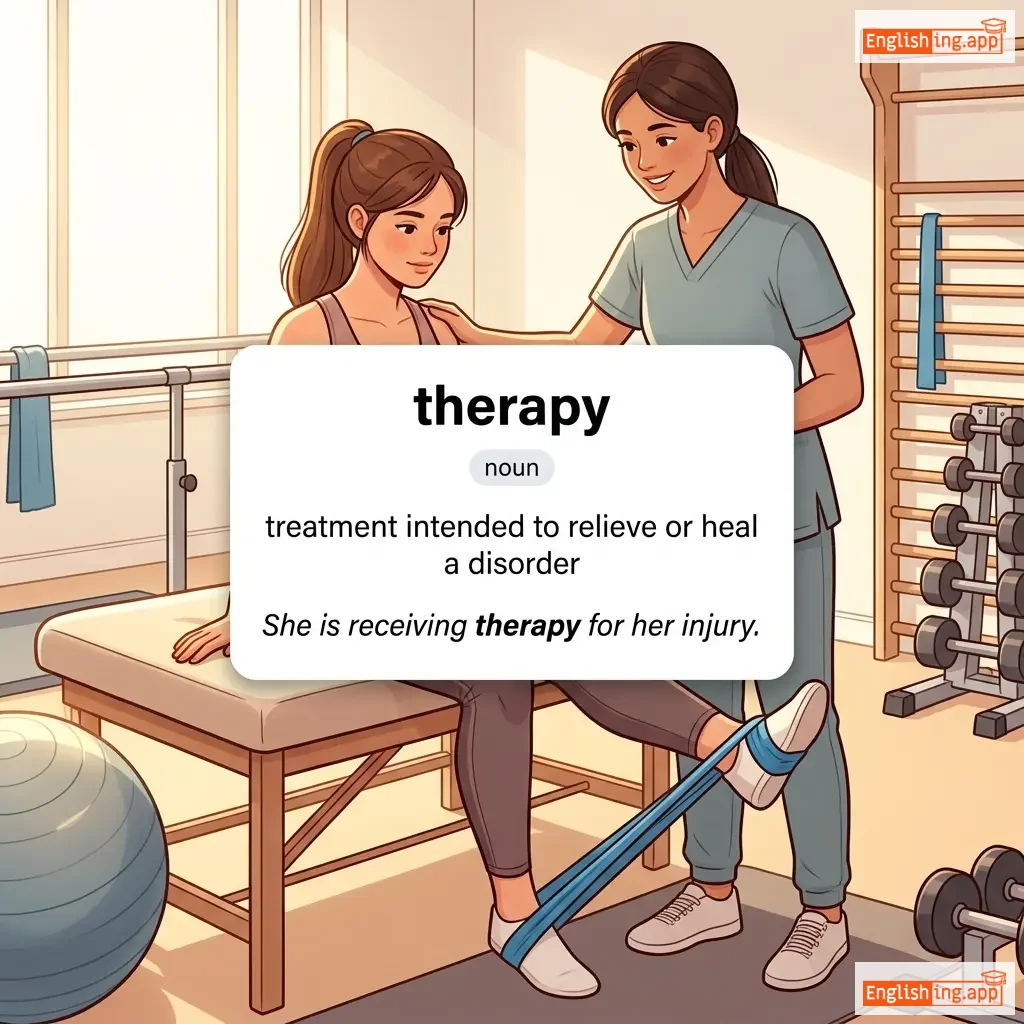
therapy definition card — visual illustration of the meaning
💆‍♀️

therapy (thérapie)

noun
/ˈθɛrəpi/
thérapie (therapie)

treatment intended to relieve or heal a disorder

"She is receiving therapy for her injury."

"Elle reçoit une thérapie pour sa blessure." (Elle reçoit une thérapie pour sa blessure.)
adverb
/ðɛə/
(la)

in, at, or to that place or position

"We are going there tomorrow."

"Nous allons là demain." (Nous allons la demain.)
adverb
/ˌðɛrəˈbaʊt/
environ (environ)

Approximately or around that place, amount, or time.

"The repairs will cost five hundred dollars or thereabout."

"Les réparations coûteront cinq cents dollars ou environ." (Les réparations coûteront cinq cents dollars ou environ.)
adverb
/ðɛrˈæftər/
après cela (apres cela)

from that time on

"He moved to Canada and thereafter started a new life."

"Il est parti au Canada et après cela, il a commencé une nouvelle vie." (Il est parti au Canada et apres cela, il a commence une nouvelle vie.)
adverb
/ˈðeə.baɪ/
ainsi (ainsi)

by that means; as a result of that

"She forgot to set the alarm, thereby missing her early flight."

"Elle a oublié de régler l'alarme, ainsi manquant son vol du matin." (Elle a oublié de régler l'alarme, ainsi manquant son vol du matin.)
adverb
/ˈðɛərfɔːr/
pour cela (pour cela)

For that or for it.

"He received payment and gave a receipt therefor."

"Il a reçu le paiement et a donné un reçu pour cela." (Il a reçu le paiement et a donné un reçu pour cela.)
conjunction
/ðɛəˈfɔː/
donc (therefore)

for that reason; because of that

"She was tired; therefore, she went to bed early."

"Elle était fatiguée; donc, elle est allée se coucher tôt." (Elle etait fatiguee; donc, elle est allee se coucher tot.)
adverb
/ˌðɛərˈɪn/
dedans; (dedan)

in that place; in that respect

"The box contains many treasures, and therein lies its value."

"La boîte contient de nombreux trésors, et dedans réside sa valeur." (La boîte contient de nombreux trésors, et dedans réside sa valeur.)
adverb
/ˌðɛərˈʌv/
de cela (de cela)

of that; from that

"The contract and all amendments thereof must be signed."

"Le contrat et toutes les modifications de cela doivent être signés." (Le contrat et toutes les modifications de cela doivent être signés.)
adverb
/ˌðɛərˈtu/
avec cela; (avec cela)

to that; in addition to that

"The house and the garden attached thereto were sold."

"La maison et le jardin y attachés ont été vendus." (La maison et le jardin y attaches ont ete vendus.)
adverb
/ˌðeərəˈpɒn/
immédiatement après; (immediatement apres)

immediately after that; following that event

"He finished his speech and thereupon left the stage."

"Il a terminé son discours et, immédiatement après, a quitté la scène." (Il a termine son discours et, immediatement apres, a quitte la scene.)
adverb
/ˌðeərˈwɪð/
avec cela; (avec cela)

together with that; in addition to that

"He handed me the contract and the pen therewith."

"Il m'a remis le contrat et le stylo avec cela." (Il m'a remis le contrat et le stylo avec cela.)
adjective
/ˈθɜːrməl/
thermique (thermique)

Related to heat or temperature.

"She wore a thermal jacket to stay warm in winter."

"Elle portait une veste thermique pour rester au chaud en hiver." (Elle portait une veste thermique pour rester au chaud en hiver.)
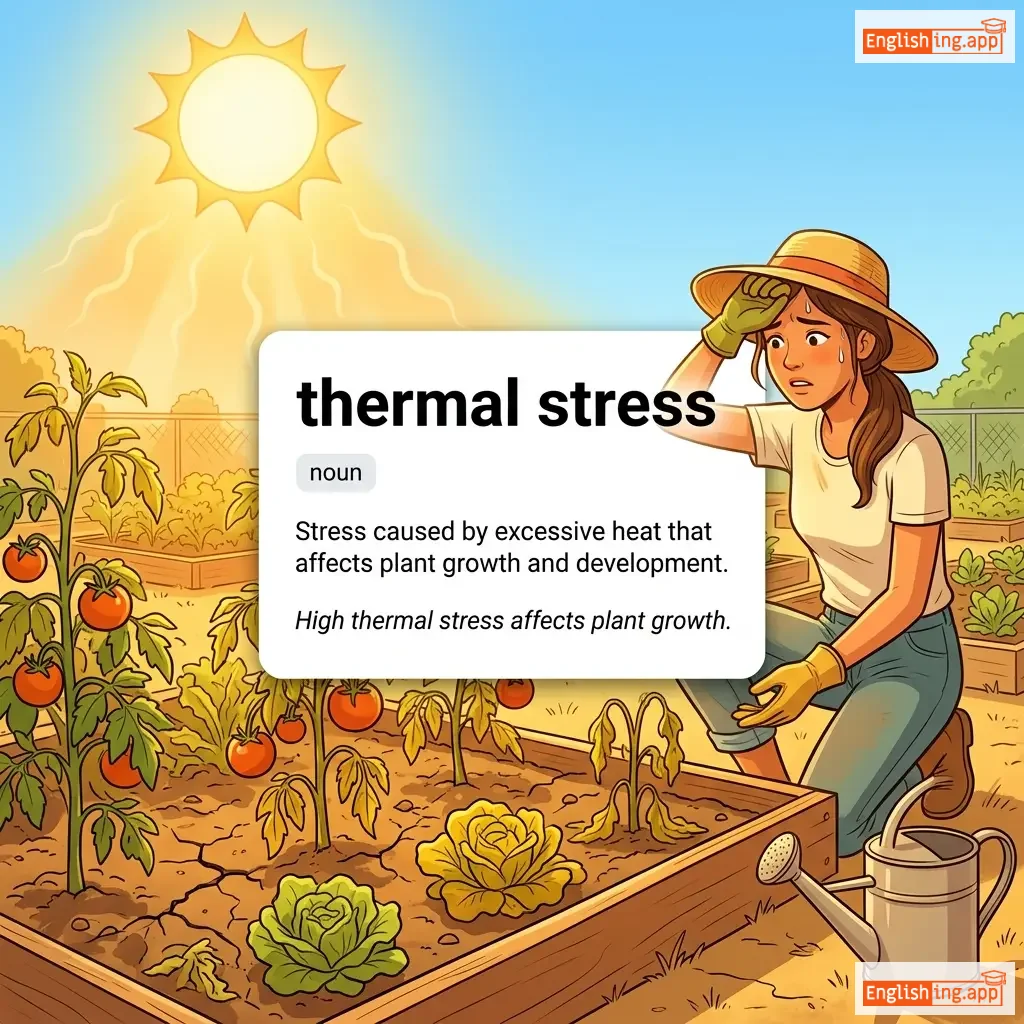
thermal stress definition card — visual illustration of the meaning
noun
ˈθɜː.məl stres
stress thermique (stress thermique)

Stress caused by excessive heat that affects plant growth and development.

"High thermal stress affects plant growth."

"Le stress thermique affecte la croissance des plantes." (Le stress thermique affecte la croissance des plantes.)
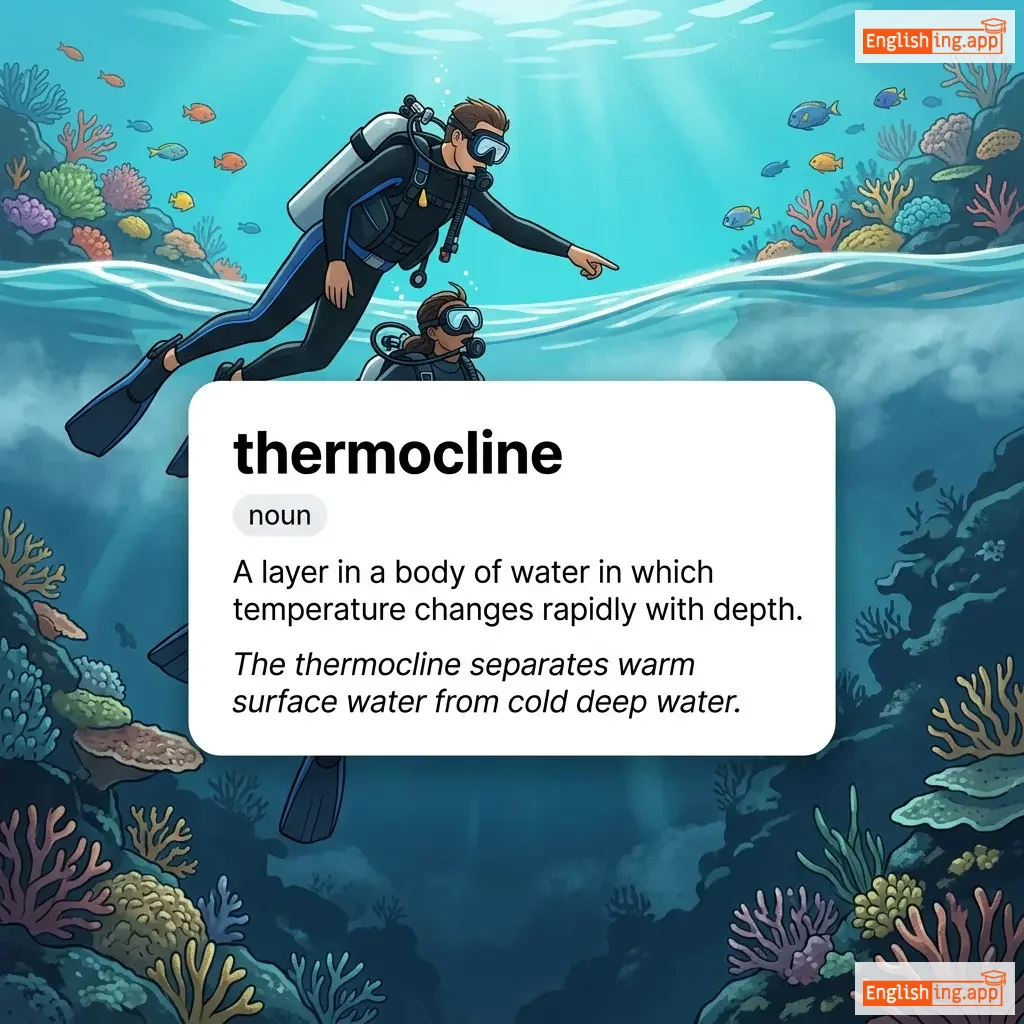
thermocline definition card — visual illustration of the meaning
noun
/ˈθɝː.moʊ.klaɪn/
thermocline (thermocline)

A layer in a body of water in which temperature changes rapidly with depth.

"The thermocline separates warm surface water from cold deep water."

"La thermocline sépare l'eau chaude de la surface de l'eau froide en profondeur." (La thermocline sépare l'eau chaude de la surface de l'eau froide en profondeur.)
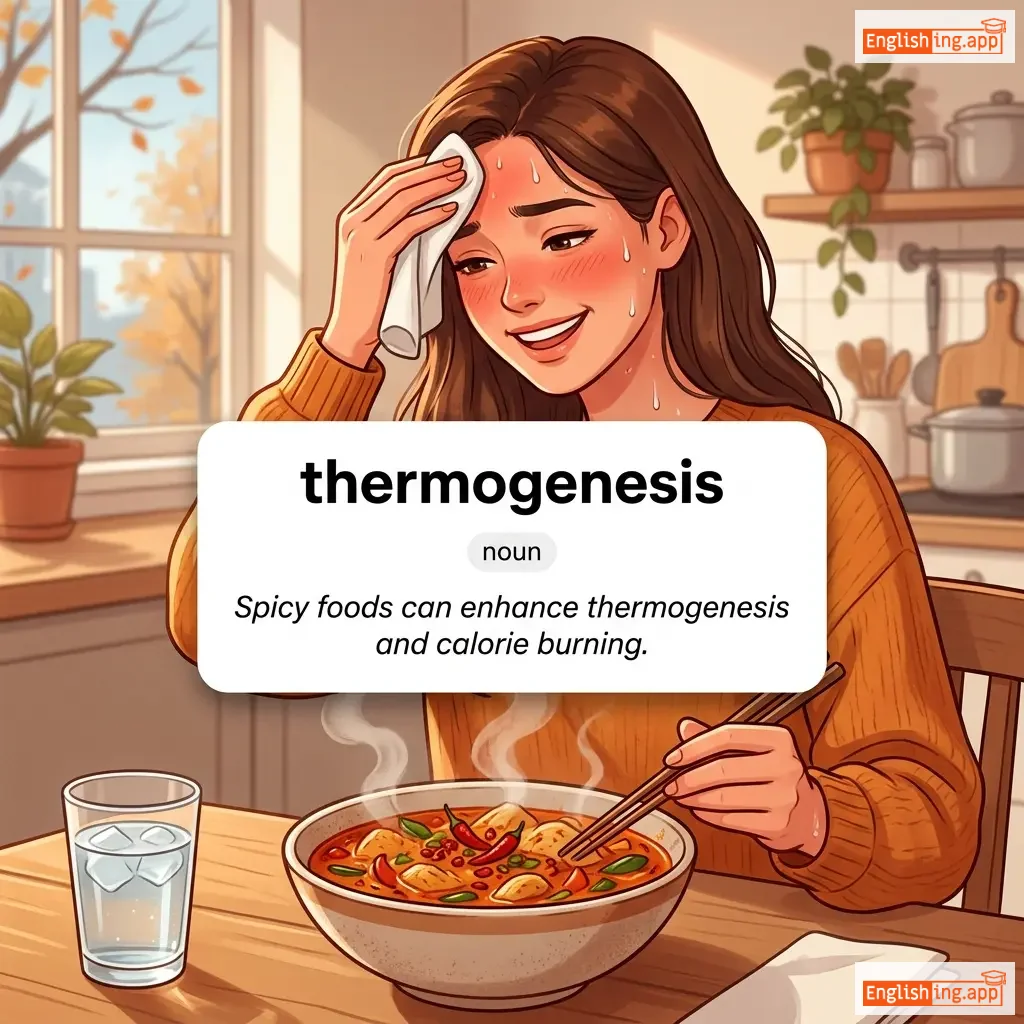
thermogenesis definition card — visual illustration of the meaning
noun
/ˌθɜː.məʊˈdʒen.ɪ.sɪs/
processus de production de chaleur (processus de production de chaleur)

The process of heat production in living organisms, often associated with burning calories and energy expenditure.

"Spicy foods can enhance thermogenesis and calorie burning."

"Les aliments épicés peuvent améliorer la thermogenèse et la combustion des calories." (Les aliments epices peuvent ameliorer la thermogenese et la combustion des calories.)
pronoun
/ðiːz/
ces (ses)

used to refer to things or people that are near or present

"These are my friends."

"Ce sont mes amis." (Ce sont mes amis.)
noun
/ˈθiːsɪs/
thèse (these)

A long piece of writing on a particular subject, usually for a degree at a university.

"She spent two years writing her doctoral thesis."

"Elle a passé deux ans à rédiger sa thèse de doctorat." (Elle a passé deux ans à rédiger sa thèse de doctorat.)
thespian definition card — visual illustration of the meaning
noun
/ˈθɛspiən/
acteur (acteur)

An actor or actress; relating to drama or theater.

"The festival was filled with talented thespians from across the country."

"Le festival était rempli d'acteurs talentueux venus de tout le pays." (Le festival était rempli d'acteurs talentueux venus de tout le pays.)
pronoun
/ðeɪ/
ils (ils)

used to refer to people or things previously mentioned or easily identified

"They are going to the park."

"Ils vont au parc." (Ils vont au parc.)
adjective
/θɪk/
épaissir (épaissir)

having a large distance between two sides; not thin

"The book was so thick it took weeks to finish."

"Le livre était tellement épais qu'il a fallu des semaines pour le finir." (Le livre était tellement épais qu'il a fallu des semaines pour le finir.)
noun
/ˈθɪk.ɪt/
buisson; fourré (thiket)

a dense group of bushes or trees; a thick growth of shrubs

"The rabbit disappeared into the thicket."

"Le lapin a disparu dans le fourré." (Le lapin a disparu dans le fourré.)
adverb
/ˈθɪkli/
densément (denseman)

in a thick manner; densely; heavily

"The forest was thickly wooded with tall pine trees."

"La forêt était densément boisée de grands pins." (La forêt était densément boisée de grands pins.)
noun
/ˈθɪk.nəs/
épaisseur (epaisseur)

The measure of how thick or dense something is

"The thickness of the book made it hard to carry."

"L'épaisseur du livre le rendait difficile à transporter." (L'epaisseur du livre le rendait difficile a transporter.)
🦹‍♂️

Thief (θiːf)

noun
/θiːf/
voleur (voleure)

a person who steals things from others

"The thief was caught stealing from the jewelry store."

"Le voleur a été attrapé en train de voler dans la bijouterie." (Le voleur a ete attrape en train de voler dans la bijouterie.)
noun
/θaɪ/
cuisse (cuisse)

the part of the leg between the hip and the knee

"He felt pain in his right thigh after running for an hour."

"Il a ressenti de la douleur dans sa cuisse droite après avoir couru pendant une heure." (Il a ressenti de la douleur dans sa cuisse droite après avoir couru pendant une heure.)
adjective
/θɪn/
fin (fin)

having little thickness or width

"She wore a thin scarf in the winter."

"Elle portait une écharpe fine en hiver." (Elle portait une echarpe fine en hiver.)
noun
/θɪŋ/
chose (chose)

an object, idea, or matter that is being referred to or dealt with

"This is the thing I was looking for."

"C'est la chose que je cherchais." (C'est la chose que je cherchais.)
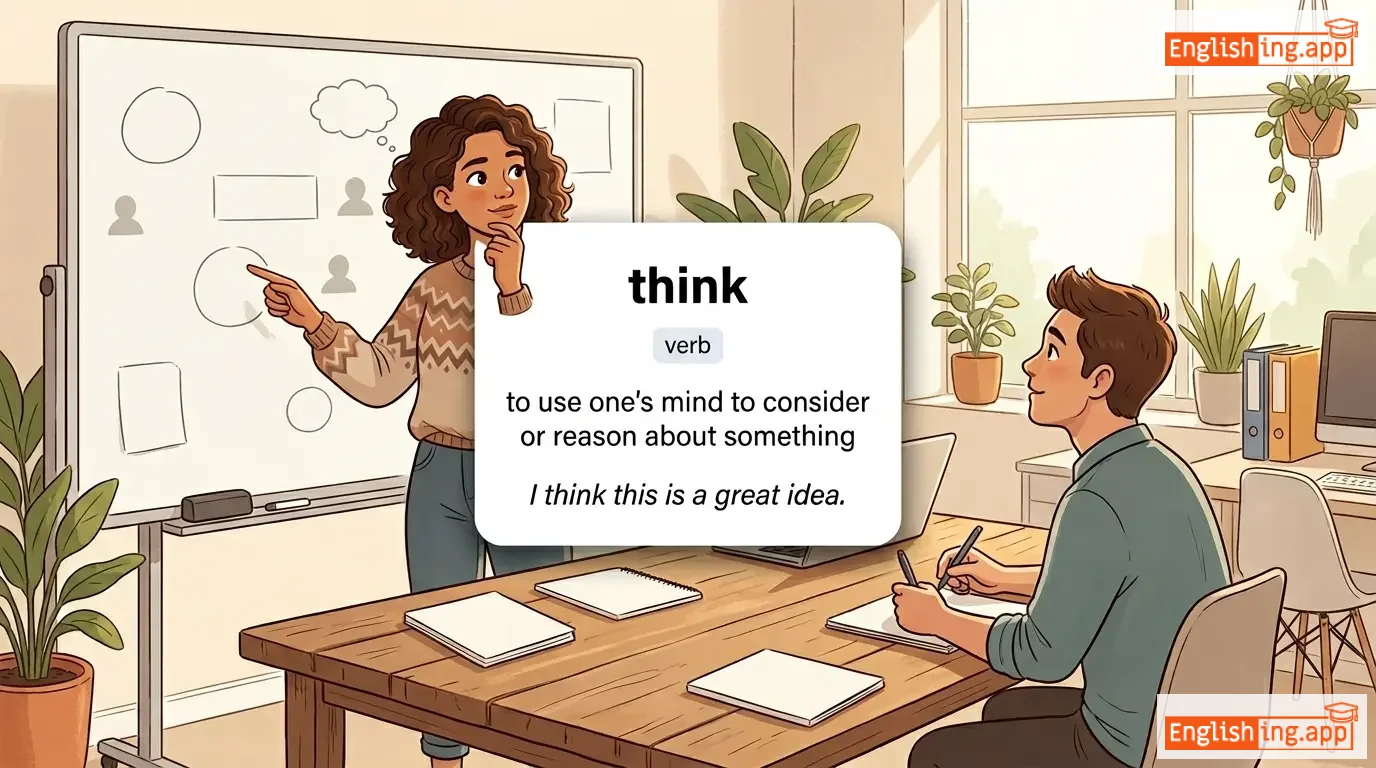
think definition card — visual illustration of the meaning
verb
/θɪŋk/
penser (penser)

to use one's mind to consider or reason about something

"I think this is a great idea."

"Je pense que c'est une excellente idée." (Je pense que c'est une excellente idée.)
adjective
/ˈθɪŋ.kə.bəl/
pensable (pensable)

Capable of being imagined or conceived; possible to consider or believe

"It is hard to believe that such an outcome is even thinkable."

"Il est difficile de croire qu'un tel résultat soit même pensable." (Il est difficile de croire qu'un tel resultat soit meme pensable)
noun
/ˈθɪŋkɪŋ/
réflexion (refleksion)

the process of considering or reasoning about something

"Her thinking was clear and precise."

"Sa réflexion était claire et précise." (Sa réflexion était claire et précise.)
adjective
/θɜrd/
troisième (troisiem)

constituting number three in a sequence

"She finished in third place."

"Elle a terminé à la troisième place." (Elle a termine a la troisieme place.)
adjective
/ˈθɜːr.sti/
assoiffé (assoiffe)

feeling a need to drink; having a strong desire for something

"I am very thirsty after running in the heat."

"Je suis très assoiffé après avoir couru sous la chaleur." (Je suis très assoiffé après avoir couru sous la chaleur.)
3️⃣0️⃣

thirty (thirty)

adjective
/ˈθɜrti/
trente (trente)

equivalent to the number 30

"He is thirty years old."

"Il a trente ans." (Il a trente ans.)
pronoun
/ðɪs/
ceci (se-si)

used to refer to a person or thing that is close or near in space, time, or thought

"This is my favorite book."

"Ceci est mon livre préféré." (Ceci est mon livre préféré.)
noun
/θɔːn/
épine (epine)

a sharp pointed part of a plant; something that causes pain or annoyance

"Be careful of the thorns on the rose bush."

"Faites attention aux épines sur le buisson de roses." (Faites attention aux épines sur le buisson de roses.)
adjective
/ˈθɔːrni/
épineux, compliqué (epineux, complique)

covered with thorns; causing difficulty or trouble

"They faced a thorny issue during the negotiation."

"Ils ont fait face à un problème épineux pendant la négociation." (Ils ont fait face à un problème épineux pendant la négociation.)
adjective
/ˈθʌroʊ/
complet, exhaustif (complet, exhaustif)

complete with regard to every detail; not superficial or partial

"The report was thorough and well-researched."

"Le rapport était complet et bien recherché." (Le rapport était complet et bien recherché.)
noun
/ˈθʌroʊˌbrɛd/
cheval de race pure (cheval de race pure)

a horse of pure and recognized breed; a person of good breeding or education

"The jockey rode a fast thoroughbred in the race."

"Le jockey a monté un cheval de race pure rapide dans la course." (Le jockey a monte un cheval de race pure rapide dans la course.)
noun
/ˈθʌroʊˌfɛr/
rue principale (rue principale)

a main road or public highway that goes through a place

"The new mall is located along the main thoroughfare."

"Le nouveau centre commercial est situé le long de la rue principale." (Le nouveau centre commercial est situé le long de la rue principale.)
adjective
/ˈθʌroʊˌɡoʊɪŋ/
complet, absolu (complet, absolu)

carried out to the full extent; absolute and complete

"She is a thoroughgoing professional in every sense."

"Elle est une professionnelle complète dans tous les sens." (Elle est une professionnelle complète dans tous les sens.)
adverb
/ˈθʌr.ə.li/
complètement (completement)

completely and carefully; in a detailed way

"Please clean the kitchen thoroughly before the guests arrive."

"Veuillez nettoyer la cuisine complètement avant l'arrivée des invités." (Veuillez nettoyer la cuisine completement avant l'arrivee des invites.)
pronoun
/ðoʊz/
ceux (ceux)

used to refer to people or things that are far away or distant in space, time, or thought

"Those are the shoes I want."

"Ceux sont les chaussures que je veux." (Ceux sont les chaussures que je veux.)