Vocabulaires

Découvrez, apprenez et maîtrisez le vocabulaire anglais

noun
/ˈtwaɪ.laɪt/
crépuscule (crepuscule)

the soft glowing light from the sky when the sun is below the horizon; a period of decline

"We walked along the beach at twilight."

"Nous avons marché sur la plage au crépuscule." (Nous avons marche sur la plage au crepuscule.)
👯‍♂️

twin (twɛ̃)

noun
/twɪn/
jumeau (jumeau)

either of two children born at the same time to the same mother

"They have twin girls."

"Ils ont des filles jumelles." (Ils ont des filles jumelles.)
noun
/twɪndʒ/
douleur aiguë (douleur aiguë)

a sudden, sharp pain or an emotional pang

"He felt a twinge of guilt after lying to his friend."

"Il a ressenti une douleur aiguë de culpabilité après avoir menti à son ami." (Il a ressenti une douleur aiguë de culpabilité après avoir menti à son ami.)
verb
/twɪst/
tordre, tourner (tordre, tourner)

to bend or turn something into a coil or spiral shape; to distort.

"He twisted the rope tightly around the pole."

"Il a tordu la corde autour du poteau." (Il a tordu la corde autour du poteau.)
noun
/ˈtwɪstər/
tornade (tornade)

A tornado or something that twists; also refers to a challenging tongue twister.

"The twister destroyed several houses in the village."

"La tornade a détruit plusieurs maisons dans le village." (La tornade a detruit plusieurs maisons dans le village.)
noun
/twɪt/
imbécile; se moquer (imbecile; se moquer)

a silly or foolish person; to tease or make fun of someone

"Don't be such a twit and listen carefully."

"Ne sois pas un imbécile et écoute attentivement." (Ne sois pas un imbécile et écoute attentivement.)
2️⃣

two (tou)

noun
/tuː/
deux (deux)

the number following one

"She has two children."

"Elle a deux enfants." (Elle a deux enfants.)
noun
/tuː θɜːrdz/
deux tiers (deux tiers)

a fraction equal to two parts of three; 2/3.

"Two-thirds of the students passed the exam."

"Deux tiers des étudiants ont réussi l'examen." (Deux tiers des étudiants ont réussi l'examen.)
noun
/ˈtuːsəm/
couple (couple)

A pair of people considered together, often in a romantic or competitive context.

"They entered the dance competition as a twosome."

"Ils sont entrés dans la compétition de danse en tant que couple." (Ils sont entrés dans la compétition de danse en tant que couple.)
noun
/taɪˈkuːn/
magnat (magnat)

a wealthy, powerful businessperson

"The real estate tycoon invested in several skyscrapers."

"Le magnat de l'immobilier a investi dans plusieurs gratte-ciel." (Le magnat de l'immobilier a investi dans plusieurs gratte-ciel.)
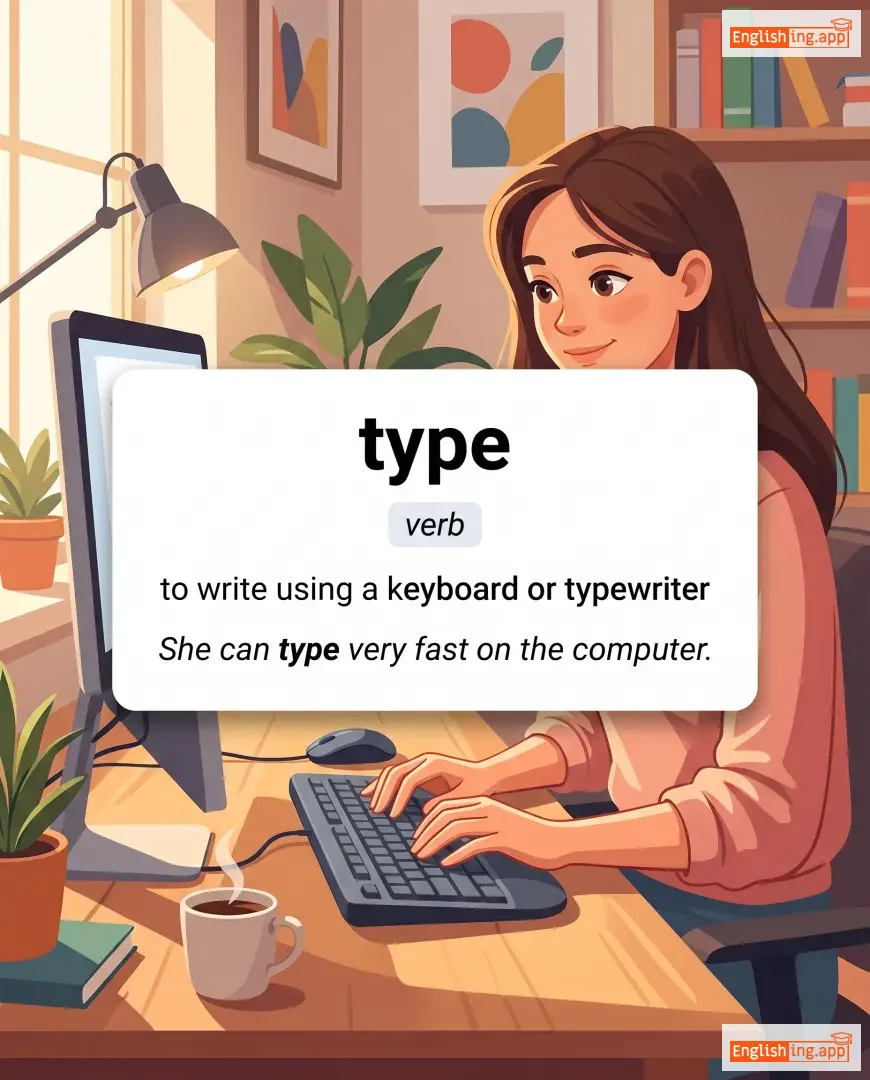
type definition card — visual illustration of the meaning
noun
/taɪp/
type (type)

a category of people or things having common characteristics

"What type of music do you like?"

"Quel type de musique aimez-vous ?" (Quel type de musique aimez-vous ?)
noun
/taɪˈfuːn/
typhon (tyfon)

a tropical storm in the region of the Indian or western Pacific oceans

"The typhoon caused severe flooding in the coastal areas."

"Le typhon a causé des inondations graves dans les zones côtières." (Le typhon a causé des inondations graves dans les zones côtières.)
adjective
/ˈtɪpɪkəl/
ayant les qualités habituelles d'un type particulier de personne ou de chose (ayant les qualites habituelles d'un type particulier de personne ou de chose)

having the usual qualities of a particular type of person or thing

"It was a typical summer day, hot and humid."

"C'était un jour d'été typique, chaud et humide." (C'etait un jour d'ete typique, chaud et humide.)
adverb
/ˈtɪpɪkli/
généralement (generalement)

in a way that is typical of a particular person, thing, or group

"She typically arrives at work at 9 AM."

"Elle arrive généralement au travail à 9 heures." (Elle arrive generalement au travail a 9 heures.)
verb
/ˈtɪpɪfaɪ/
représenter (representer)

to represent or be a typical example of something

"His leadership style typifies the new corporate culture."

"Son style de leadership incarne la nouvelle culture d'entreprise." (Son style de leadership incarne la nouvelle culture d'entreprise.)
noun
/ˈtaɪpoʊ/
faute de frappe (faute de frappe)

a mistake made in typing

"The report was full of typos."

"Le rapport était plein de fautes de frappe." (Le rapport était plein de fautes de frappe.)
adjective
/ˌtaɪpəˈɡræfɪkəl/
typographique (typographique)

relating to the style, arrangement, or appearance of printed text

"There was a typographical error in the book."

"Il y avait une erreur typographique dans le livre." (Il y avait une erreur typographique dans le livre.)
noun
/taɪˈpɒɡrəfi/
typographie (typographie)

the art and technique of arranging type to make written language legible and visually appealing

"Good typography improves the readability of a website."

"Une bonne typographie améliore la lisibilité d'un site web." (Une bonne typographie améliore la lisibilité d'un site web.)
adjective
/tɪˈrænɪkəl/
tyrannique (tyrannique)

exercising power in a cruel or arbitrary way

"The tyrannical ruler silenced all opposition."

"Le dirigeant tyrannique a réduit au silence toute opposition." (Le dirigeant tyrannique a réduit au silence toute opposition.)
noun
/ˈtɪrəni/
tyrannie (tyrannie)

Cruel and oppressive government or rule by a tyrant.

"The people revolted against the tyranny of their ruler."

"Les gens se sont rebellés contre la tyrannie de leur dirigeant." (Les gens se sont rebellés contre la tyrannie de leur dirigeant.)
noun
/ˈtaɪ.rənt/
tyran (tyran)

a cruel and oppressive ruler; a person who exercises power in a harsh manner

"The people rebelled against the cruel tyrant."

"Le peuple s'est rebellé contre le tyran cruel." (Le peuple s'est rebellé contre le tyran cruel)
noun
/ˈtaɪroʊ/
débutant (debutant)

A beginner or novice in a field or activity.

"As a tyro in programming, she needed constant guidance."

"En tant que débutant en programmation, elle avait besoin d'une orientation constante." (En tant que débutant en programmation, elle avait besoin d'une orientation constante.)