Vocabulaires

Découvrez, apprenez et maîtrisez le vocabulaire anglais

verb/noun
/skaʊl/
froncer les sourcils (froncer les sourcils)

To frown in an angry or bad-tempered way.

"She scowled when she heard the unfair remark."

"Elle fronça les sourcils quand elle entendit la remarque injuste." (Elle fronça les sourcils quand elle entendit la remarque injuste.)
verb
/ˈskræmbəl/
grimper ou mélanger rapidement (grimper ou mélanger rapidement)

to move or climb quickly using hands and feet; to mix or arrange in a hurried way

"The kids scrambled up the hill to catch the kite."

"Les enfants ont grimpé rapidement la colline pour attraper le cerf-volant." (Les enfants ont grimpé rapidement la colline pour attraper le cerf-volant.)
noun/verb
/skræp/
morceau / jeter (morceau / jeter)

A small piece of something; to discard or get rid of something.

"He used a scrap of paper to jot down the number."

"Il a utilisé un morceau de papier pour écrire le numéro." (Il a utilisé un morceau de papier pour écrire le numéro.)
verb
/skreɪp/
égratigner, gratter (egratinier, gratter)

to remove or damage the surface of something by rubbing or scratching; to collect something by effort

"He scraped his knee while playing football."

"Il s'est éraflé le genou en jouant au football." (Il s'est erafle le genou en jouant au football.)
adjective
/ˈskræpi/
combattant / en désordre (combattant / en desordre)

Determined and willing to fight or argue; also messy or disorganized.

"Despite being small, he was a scrappy fighter."

"Malgré sa petite taille, il était un combattant déterminé." (Malgré sa petite taille, il était un combattant déterminé.)
noun (plural)
/skræps/
restes (restes)

Small pieces left over from something; also small fights or quarrels.

"The dog ate the scraps from the table."

"Le chien a mangé les restes de la table." (Le chien a mangé les restes de la table.)
verb
/skrætʃ/
bonheur (bonheur)

to rub a surface or skin with something sharp or rough, often to relieve itching

"The cat scratched the door to be let in."

"Elle ne pouvait pas cacher son bonheur lorsqu'elle a reçu le prix." (Elle ne pouvait pas cacher son bonheur lorsqu'elle a reçu le prix.)
verb
/skrɔːl/
écrire rapidement et négligemment (ecrire rapidement et negligemment)

to write or draw something quickly and carelessly, making it hard to read

"He scrawled his signature at the bottom of the page."

"Il a griffonné sa signature au bas de la page." (Il a griffonné sa signature au bas de la page.)
adjective
/ˈskrɔːni/
maigre (maigre)

very thin and bony, often looking unhealthy

"The scrawny boy could barely lift the heavy bag."

"Le garçon maigre pouvait à peine soulever le sac lourd." (Le garçon maigre pouvait à peine soulever le sac lourd.)
verb
/skriːm/
crier (crier)

to make a loud, high-pitched sound, usually because of fear, pain, or excitement

"She screamed when she saw the spider."

"Elle a crié quand elle a vu l'araignée." (Elle a crié quand elle a vu l'araignée.)
verb
/skriːtʃ/
produire un bruit strident (produire un bruit strident)

to make a loud, high-pitched and unpleasant sound

"The car screeched to a halt."

"La voiture a crié avant de s'arrêter brusquement." (La voiture a crié avant de s'arrêter brusquement.)
noun
/skriːd/
écrit long et ennuyeux (écrit long et ennuyeux)

a long, tedious piece of writing or speech; also a layer of material like cement spread on a surface

"He delivered a long screed against corruption."

"Il a livré un long discours contre la corruption." (Il a livré un long discours contre la corruption.)
noun
/skriːn/
écran (ecran)

a flat surface on which images or data are displayed

"The movie was displayed on a large screen."

"Le film a été projeté sur un grand écran." (Le film a ete projete sur un grand ecran.)
noun
/ˈskriːnɪŋ/
dépistage ou projection (depistage ou projection)

the act of examining or testing people to detect disease or evaluate suitability; a showing of a movie or program

"The hospital offered free health screening for all employees."

"L'hôpital a offert un dépistage de santé gratuit pour tous les employés." (L'hopital a offert un depistage de sante gratuit pour tous les employes.)
noun, verb
/skruː/
un dispositif métallique avec une hélice; fixer ou serrer quelque chose avec une vis (un dispositif metalique avec une helice; fixer ou serrer quelque chose avec une vis)

a metal fastener with a helical ridge; to fasten or tighten something with a screw

"He screwed the shelf to the wall tightly."

"Il a vissé l'étagère au mur fermement." (Il a visse l'etagere au mur fermement.)
verb
/ˈskrɪbəl/
gribouiller (gribouiller)

to write or draw carelessly or quickly

"The child scribbled all over the wall."

"L'enfant a griffonné sur toute le mur." (L'enfant a griffonné sur toute le mur.)
noun
/skraɪb/
scribe (scribe)

a person who writes documents, especially in ancient times; a professional copyist

"In ancient Egypt, scribes recorded important events."

"Dans l'Égypte ancienne, les scribes enregistraient les événements importants." (Dans l'Égypte ancienne, les scribes enregistraient les événements importants.)
noun
/ˈskrɪmɪdʒ/
match d'entraînement (match d'entraînement)

A practice game or informal match, often in sports, especially football.

"The team had a scrimmage before the official season started."

"L'équipe a joué un match d'entraînement avant que la saison officielle commence." (L'équipe a joué un match d'entraînement avant que la saison officielle commence.)
noun
/skrɪpt/
scénario (scenario)

The written text of a play, film, or broadcast; handwriting style.

"The actor memorized his lines from the script."

"L'acteur a mémorisé ses répliques du scénario." (L'acteur a mémorisé ses répliques du scénario.)
adjective
/ˈskrɪptʃərəl/
scripturaire (scripturaire)

Relating to or contained in the scriptures or holy writings.

"The priest gave a scriptural reference during the sermon."

"Le prêtre a donné une référence scripturaire pendant le sermon." (Le prêtre a donné une référence scripturaire pendant le sermon.)
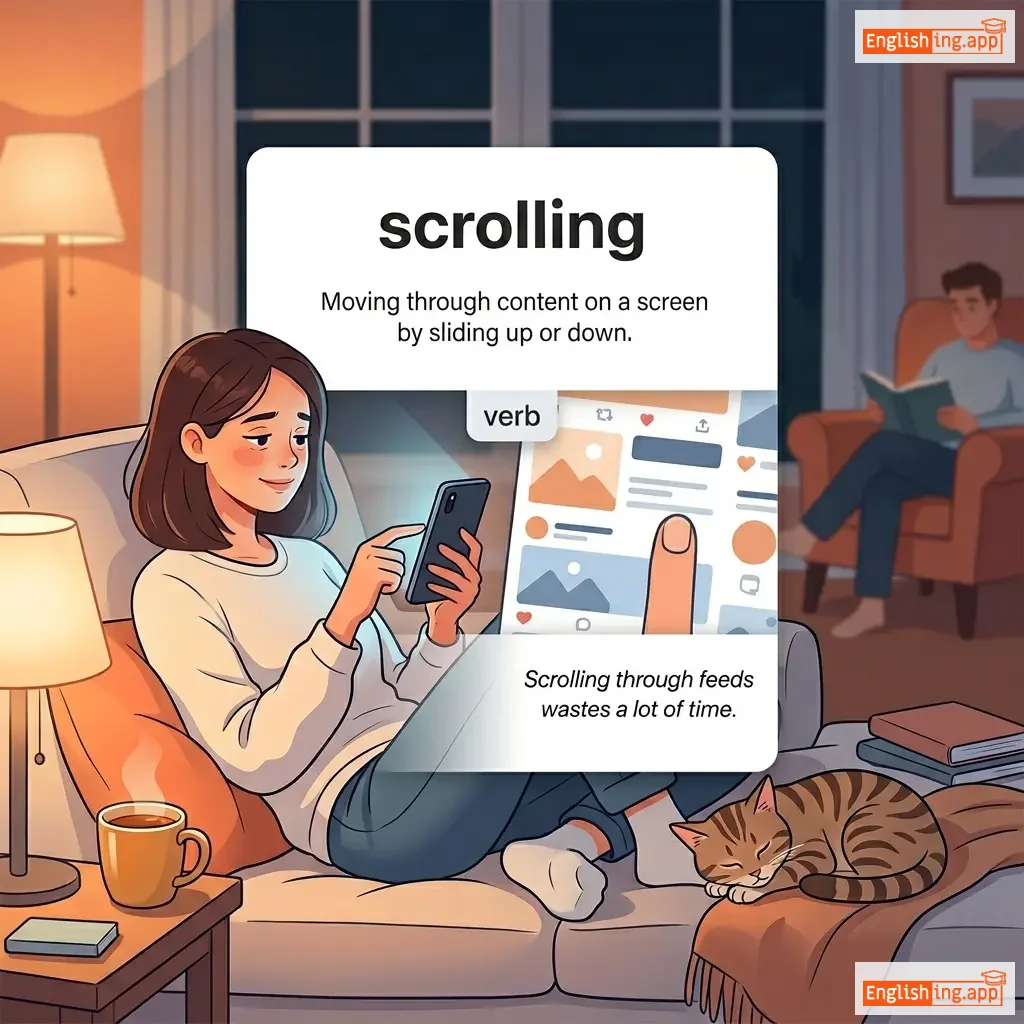
scrolling definition card — visual illustration of the meaning
verb
ˈskroʊlɪŋ
faire défiler (faire defiler)

Moving text or graphics up or down on a computer screen to view different parts of them; continuously browsing through content.

"Scrolling through feeds wastes a lot of time."

"Faire défiler les fils consomme beaucoup de temps." (Faire defiler les fils consomme beaucoup de temps.)
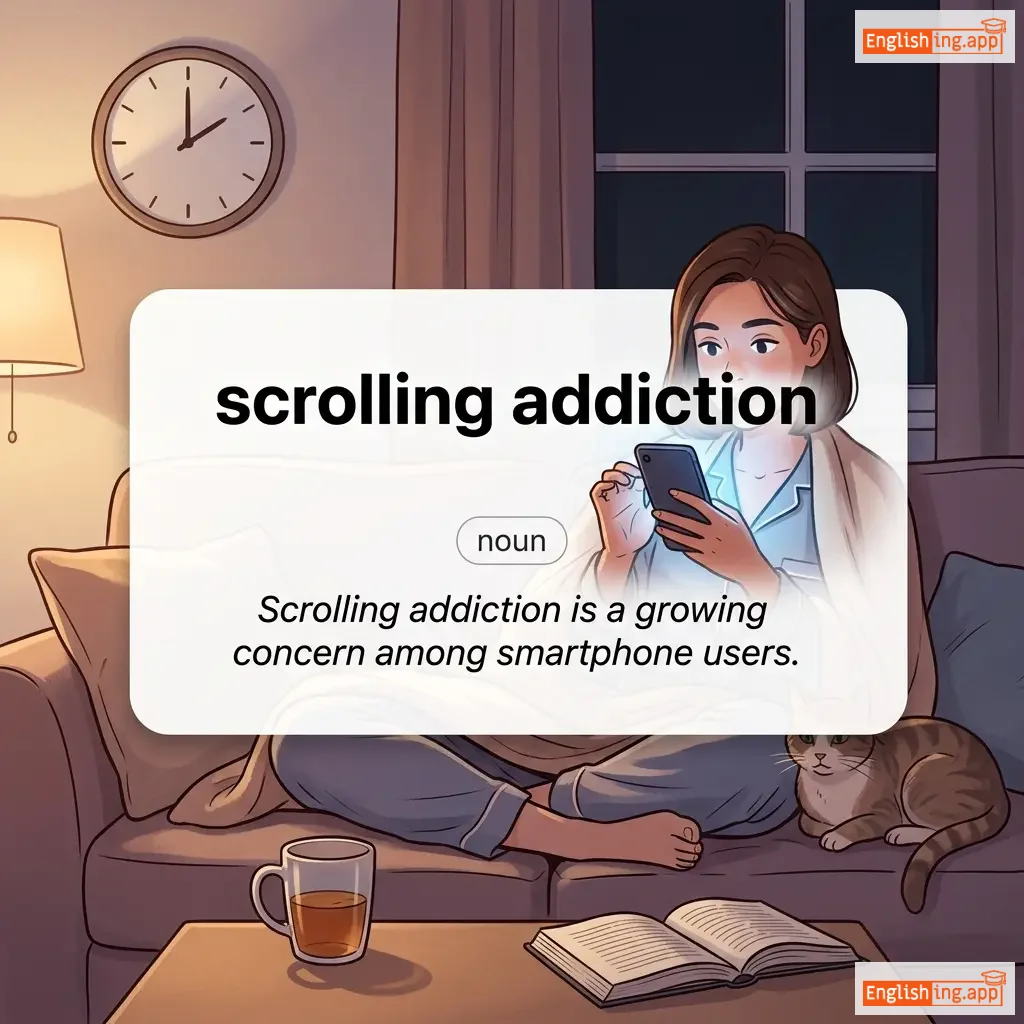
scrolling addiction definition card — visual illustration of the meaning
noun
স্ক্রোলিং অ্যাডিকশন
dépendance au défilement (dependance au defilement)

A compulsive need to continuously scroll through content on digital devices, particularly smartphones and social media platforms.

"Scrolling addiction is a growing concern among smartphone users."

"La dépendance au défilement est une préoccupation croissante parmi les utilisateurs de smartphones." (La dependance au defilement est une preoccupation croissante parmi les utilisateurs de smartphones.)
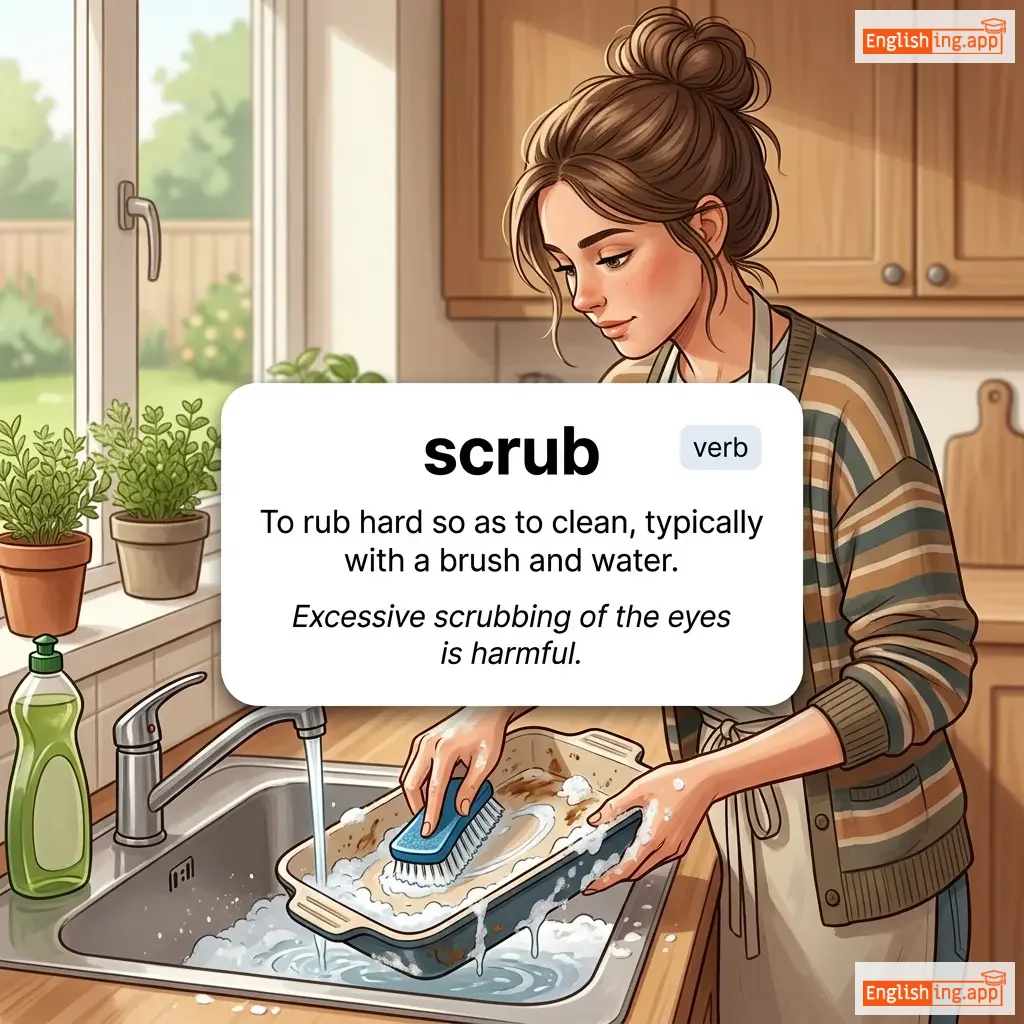
scrub definition card — visual illustration of the meaning
verb
/skrʌb/
frotter (frotter)

To rub hard so as to clean, typically with a brush and water.

"Excessive scrubbing of the eyes is harmful."

"Se frotter les yeux de manière excessive est nuisible." (Se frotter les yeux de manière excessive est nuisible.)
adjective
/ˈskrʌfi/
démodé ou en désordre dans son apparence; sale et usé (démodé ou en désordre dans son apparence; sale et usé)

untidy or unkempt in appearance; shabby and worn

"The scruffy old dog wandered through the streets looking for food."

"Le chien sale se promenait dans les rues à la recherche de nourriture." (Le chien sale se promenait dans les rues à la recherche de nourriture.)
adjective
/ˈskrʌmpʃəs/
délicieux (delicieux)

extremely tasty or delicious

"She baked a scrumptious chocolate cake for the party."

"Elle a préparé un délicieux gâteau au chocolat pour la fête." (Elle a prépare un délicieux gâteau au chocolat pour la fête.)
noun
/ˈskruːpəl/
scrupule (scrupul)

A moral or ethical consideration that restrains actions.

"He had no scruples about lying to get ahead."

"Il n'avait aucun scrupule à mentir pour avancer." (Il n'avait aucun scrupule a mentir pour avancer.)
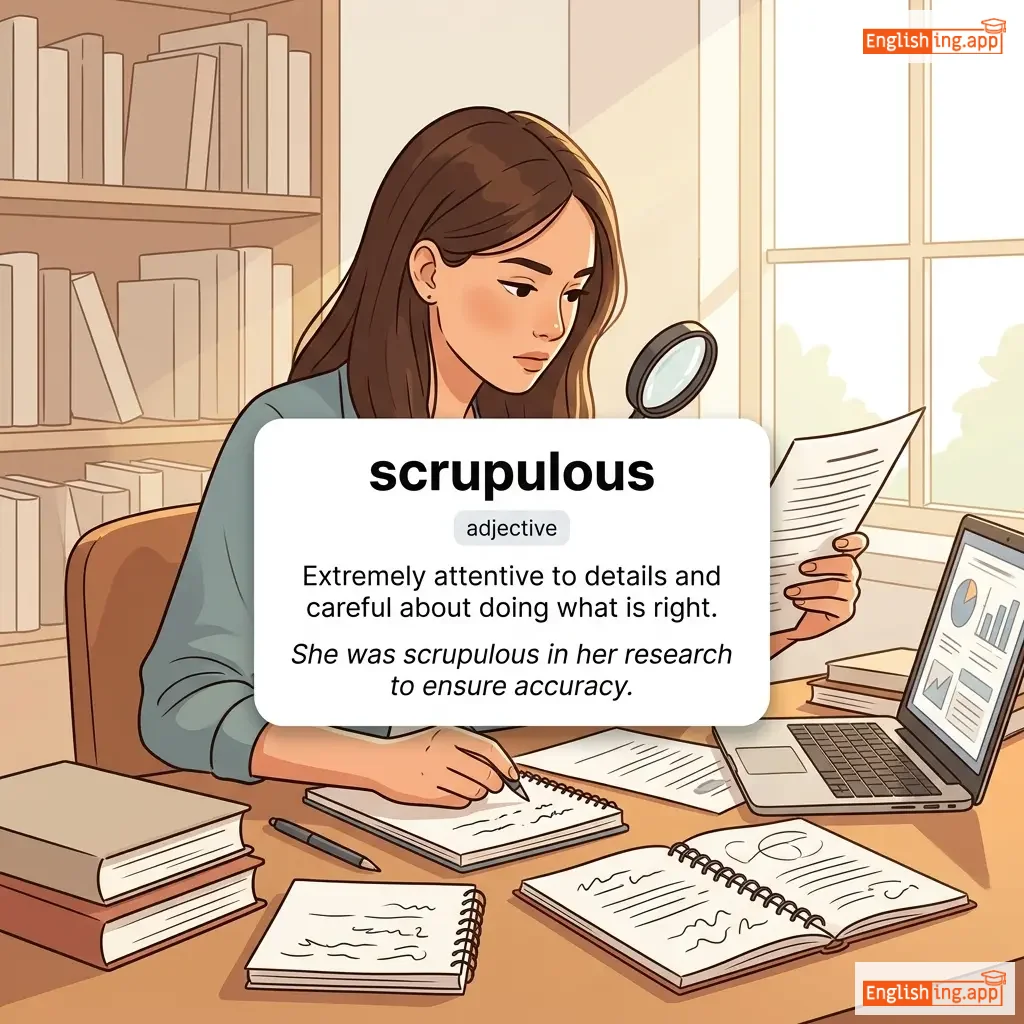
scrupulous definition card — visual illustration of the meaning
adjective
/ˈskruːpjələs/
scrupuleux (scrupuleux)

Extremely attentive to details and careful about doing what is right.

"She was scrupulous in her research to ensure accuracy."

"Elle était scrupuleuse dans ses recherches pour assurer l'exactitude." (Elle etait scrupuleuse dans ses recherches pour assurer l'exactitude.)
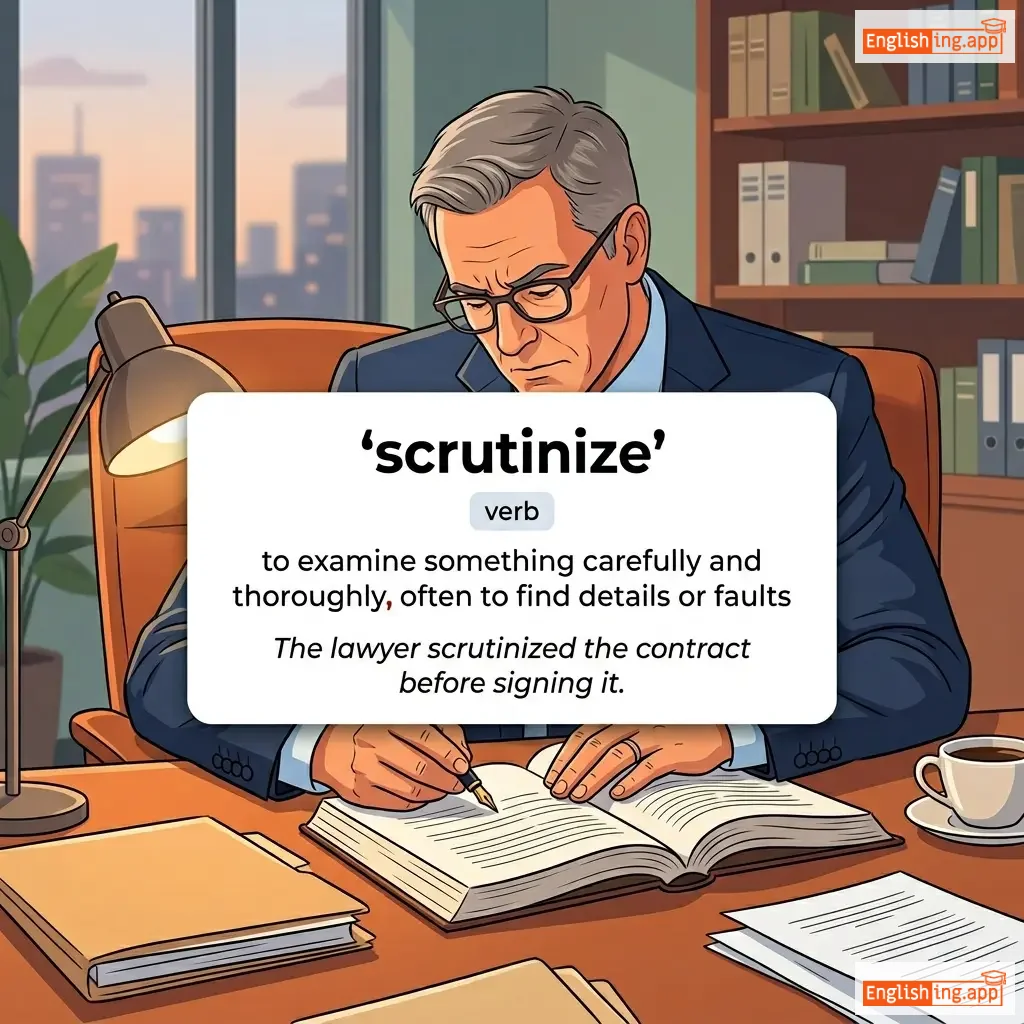
scrutinize definition card — visual illustration of the meaning
verb
/ˈskruː.tɪ.naɪz/
scruter (scruter)

to examine something carefully and thoroughly, often to find details or faults

"The lawyer scrutinized the contract before signing it."

"L'avocat a scruté le contrat avant de le signer." (L'avocat a scruté le contrat avant de le signer.)
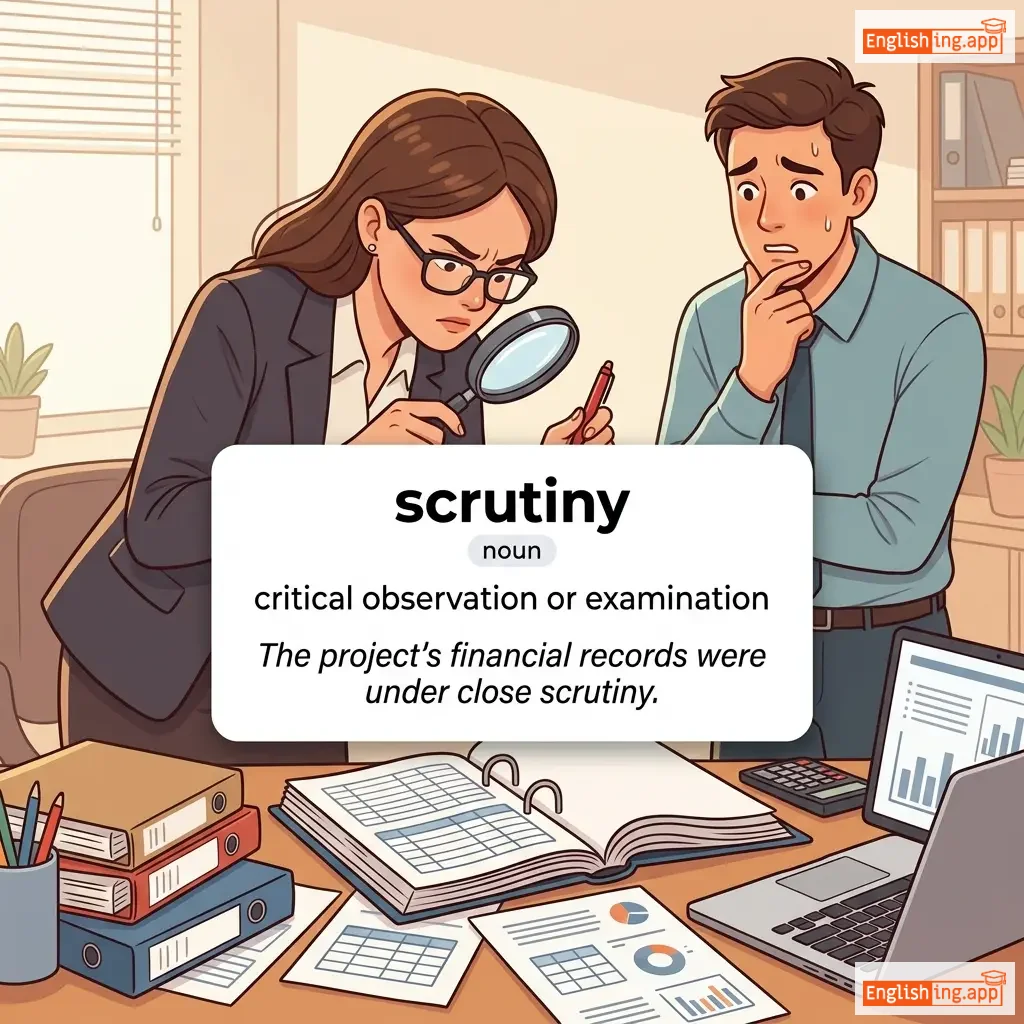
scrutiny definition card — visual illustration of the meaning
noun
/ˈskruːtɪni/
examen (examen)

critical observation or examination

"The project's financial records were under close scrutiny."

"Les registres financiers du projet étaient sous un examen minutieux." (Les registres financiers du projet étaient sous un examen minutieux.)
verb
/skʌf/
griffer (griffer)

to mark or scratch the surface of something by rubbing

"He scuffed his shoes on the pavement."

"Il a griffé ses chaussures sur le trottoir." (Il a griffé ses chaussures sur le trottoir.)
noun, verb
/ˈskʌf.əl/
bagarre (bagarre)

a short, confused fight or struggle; to engage in such a fight

"Two players scuffled on the field after the foul."

"Deux joueurs se sont battus sur le terrain après la faute." (Deux joueurs se sont battus sur le terrain après la faute.)
noun
/ˈskʌl.i.ən/
valet de cuisine (valet de cuisine)

a servant assigned the most menial kitchen tasks

"In medieval times, a scullion was responsible for cleaning pots and pans."

"Au Moyen Âge, un scullion était responsable du nettoyage des casseroles et des poêles." (Au Moyen Âge, un scullion était responsable du nettoyage des casseroles et des poêles.)
verb
/skʌlpt/
bonheur (bonheur)

to create or shape something by carving or molding

"The artist sculpted a beautiful statue from marble."

"Elle ne pouvait pas cacher sa joie lorsqu'elle a reçu le prix." (Elle ne pouvait pas cacher sa joie lorsqu'elle a reçu le prix.)
noun
/ˈskʌlp.tər/
sculpteur (skylpˈtœʁ)

an artist who creates sculptures by carving, modeling, or shaping materials

"The sculptor spent months creating a beautiful marble statue."

"Le sculpteur a passé des mois à créer une belle statue en marbre." (Le sculpteur a passé des mois à créer une belle statue en marbre.)
noun
/ˈskʌlp.tʃər/
sculpture (sculpture)

the art of making two- or three-dimensional representative or abstract forms, especially by carving stone or wood or by casting metal or plaster

"The museum has a beautiful marble sculpture of a woman."

"Le musée possède une belle sculpture en marbre d'une femme." (Le musée possède une belle sculpture en marbre d'une femme.)
adjective
/ˈskʌr.ɪ.ləs/
calomnieux (calomnieux)

Using or expressed in coarse, abusive, or slanderous language.

"The politician faced criticism for his scurrilous remarks about his opponent."

"Le politicien a fait face à des critiques pour ses remarques calomnieuses sur son adversaire." (Le politicien a fait face à des critiques pour ses remarques calomnieuses sur son adversaire.)
verb
/ˈskʌr.i/
courir rapidement (courir rapidement)

To move quickly with short, hurried steps.

"The mice scurried across the kitchen floor when the lights turned on."

"Les souris ont couru rapidement à travers le sol de la cuisine lorsque les lumières se sont allumées." (Les souris ont couru rapidement a travers le sol de la cuisine lorsque les lumieres se sont allumees.)
noun
/ˈskɜː.vi/
Scorbut (Scorbut)

A disease caused by a deficiency of vitamin C, leading to weakness, gum disease, and bleeding.

"Sailors often suffered from scurvy during long sea voyages without fresh fruits."

"Les marins souffraient souvent du scorbut lors de longs voyages en mer sans fruits frais." (Les marins souffraient souvent du scorbut lors de longs voyages en mer sans fruits frais.)
verb
/ˈskʌt.əl/
bonheur (bonheur)

To run hurriedly with short, quick steps; or to deliberately sink a ship.

"The children scuttled back to their seats when the teacher entered."

"Elle ne pouvait pas cacher son bonheur quand elle a reçu le prix." (Elle ne pouvait pas cacher son bonheur quand elle a reçu le prix.)
noun
/saɪð/
faux (faux)

A tool with a long curved blade used for cutting grass or grain.

"The farmer sharpened his scythe before harvesting the wheat."

"Le fermier a aiguisé sa faux avant de récolter le blé." (Le fermier a aiguisé sa faux avant de récolter le blé.)
noun
/siː/
mer (mer)

the large body of saltwater that covers most of the earth's surface

"We spent the day at the sea, enjoying the waves."

"Nous avons passé la journée à la mer, en profitant des vagues." (Nous avons passé la journée à la mer, en profitant des vagues.)
noun
/ˈsiː.hɔːrs/
hippocampe (hippocampe)

a small marine fish with segmented bony armor, an upright posture, and a curled prehensile tail

"The seahorse gracefully floated among the coral reefs."

"L'hippocampe flottait gracieusement parmi les récifs coralliens." (L'hippocampe flottait gracieusement parmi les récifs coralliens.)
verb
/siːl/
sceller, fermer (sceller, fermer)

to close or secure something tightly or officially confirm something

"He sealed the envelope before sending the letter."

"Il a scellé l'enveloppe avant d'envoyer la lettre." (Il a scellé l'enveloppe avant d'envoyer la lettre.)
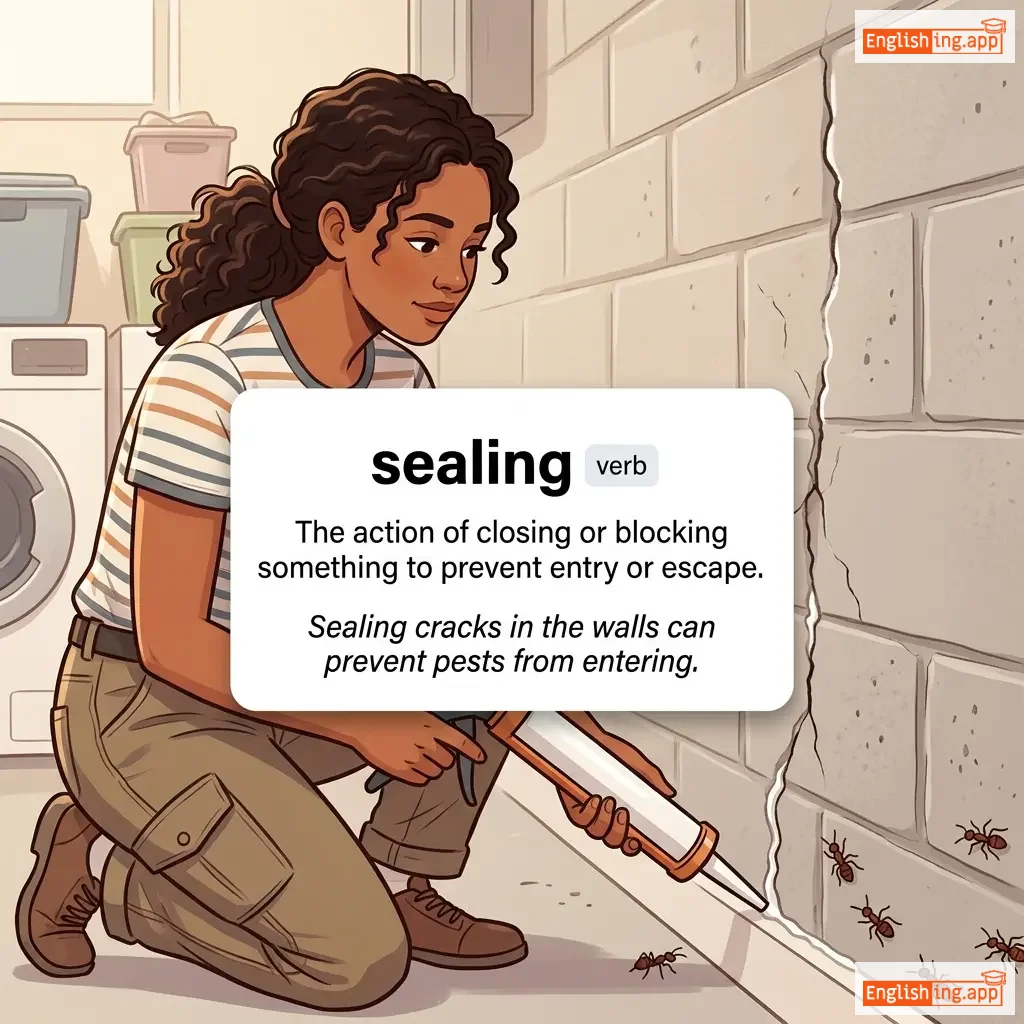
sealing definition card — visual illustration of the meaning
verb
ˈsiːlɪŋ
sceller, fermer (sceller, fermer)

The action of closing or blocking something to prevent entry or escape.

"Sealing cracks in the walls can prevent pests from entering."

"Sceller les fissures dans les murs peut empêcher les insectes d'entrer." (Sceller les fissures dans les murs peut empêcher les insectes d'entrer.)
noun
/ˈsiː.mən/
marin (marin)

a person who works on a ship; sailor

"The experienced seaman navigated the ship through the storm."

"Le marin expérimenté a navigué le bateau à travers la tempête." (Le marin expérimenté a navigué le bateau à travers la tempête.)
seamless definition card — visual illustration of the meaning
adjective
/ˈsiːmləs/
sans couture (sans couture)

Smooth and continuous, with no apparent gaps or spaces between one part and the next.

"The seamless integration of the two systems improved efficiency and reduced errors."

"L'intégration sans couture des deux systèmes a amélioré l'efficacité et réduit les erreurs." (L'intégration sans couture des deux systèmes a amélioré l'efficacité et réduit les erreurs.)
adjective
/ˈsiːmi/
dégradé, sordide (degrade, sordide)

Morally degraded, unpleasant, or sordid.

"The novel reveals the seamy side of city life."

"Le roman révèle le côté sordide de la vie en ville." (Le roman revele le cote sordide de la vie en ville.)
noun
/ˈseɪɑːns/
séance (seance)

A meeting where people attempt to communicate with the spirits of the dead.

"They held a seance to contact their late grandmother."

"Ils ont organisé une séance pour contacter leur grand-mère décédée." (Ils ont organise une seance pour contacter leur grand-mere decedee.)
verb
/sɪr/
saisir (saisir)

To burn or scorch the surface of something with intense heat.

"The chef seared the steak to lock in the flavor."

"Le chef a saisi le steak pour verrouiller la saveur." (Le chef a saisi le steak pour verrouiller la saveur.)
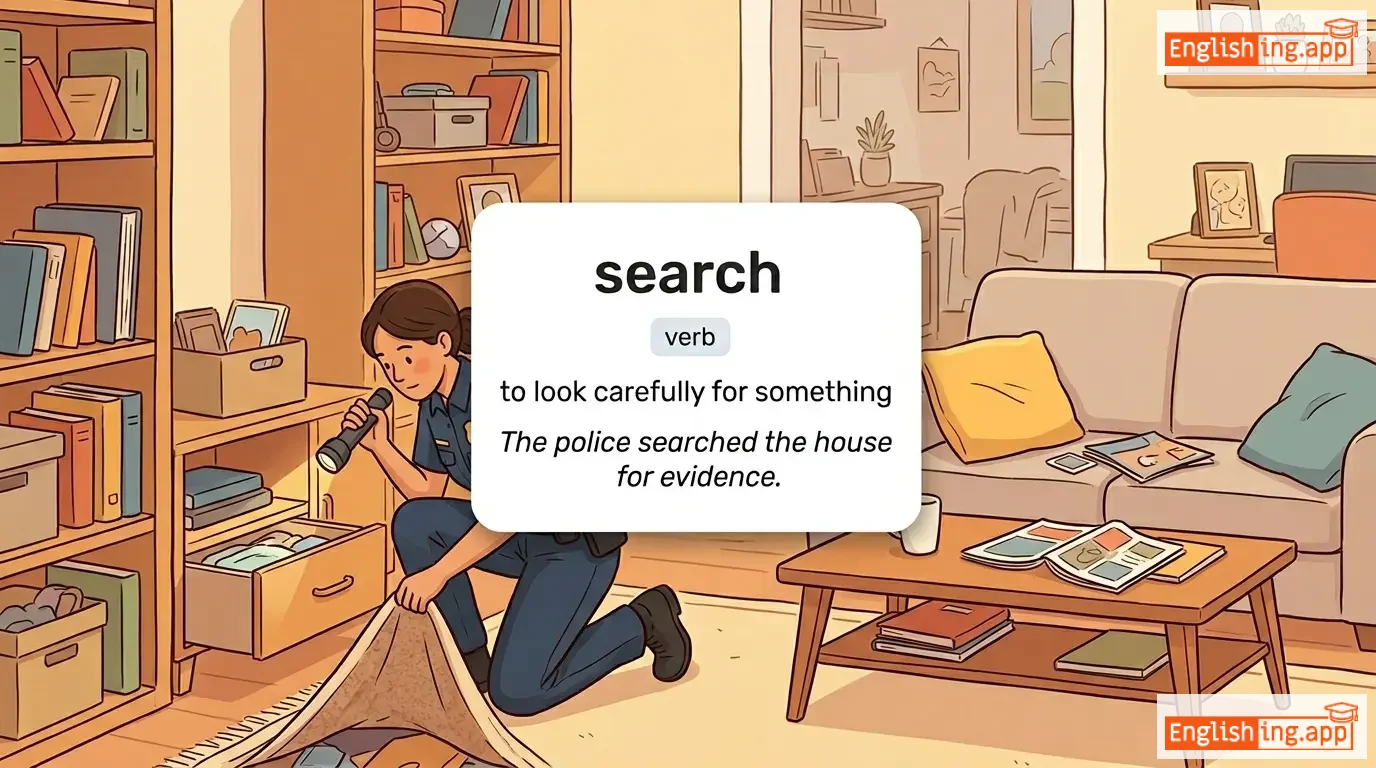
search definition card — visual illustration of the meaning
verb
/sɜːrtʃ/
chercher (chercher)

to look carefully for something

"The police searched the house for evidence."

"La police a cherché la maison pour des preuves." (La police a cherche la maison pour des preuves.)