Vocabulaires

Découvrez, apprenez et maîtrisez le vocabulaire anglais

verb
/ˈstɪp.əl/
couvrir de petits points (couvrir de petits points)

to cover a surface with numerous small dots or specks, often in drawing or painting

"The artist stippled the canvas to create a textured effect."

"L'artiste a couvert la toile de petits points pour créer un effet texturé." (L'artiste a couvert la toile de petits points pour créer un effet texturé.)
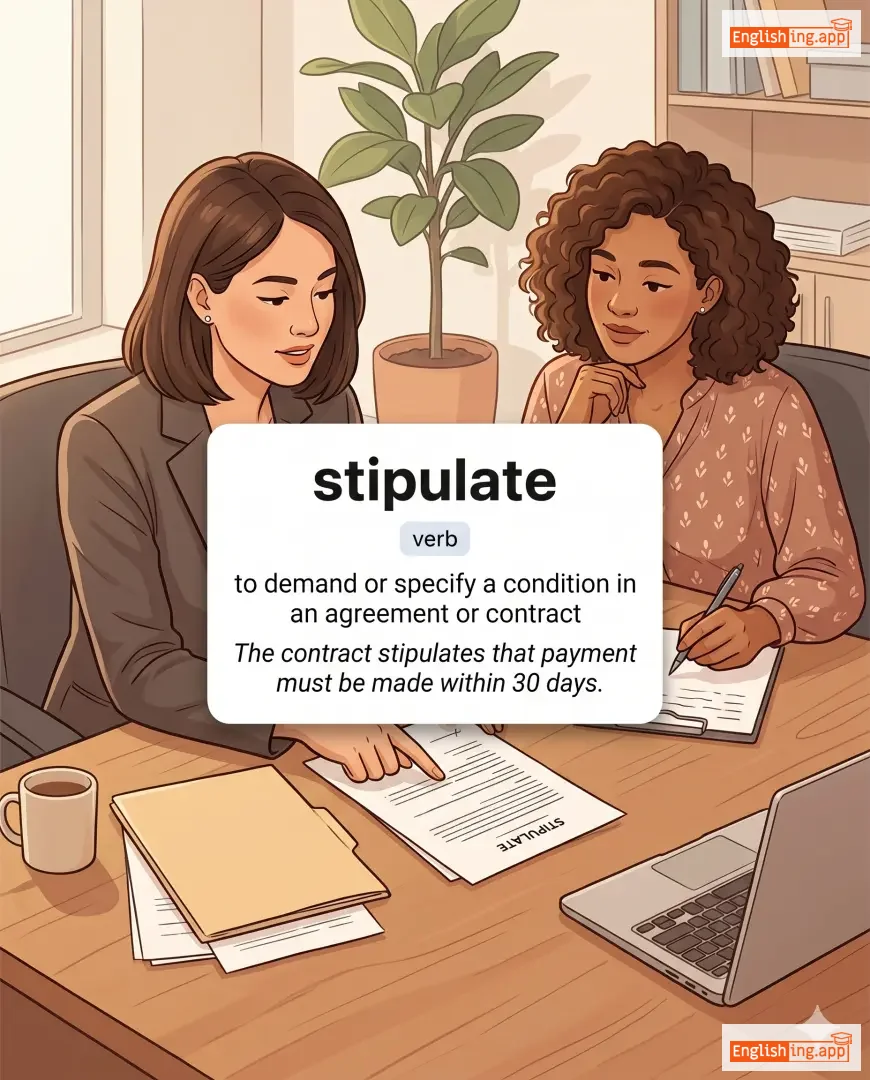
stipulate definition card — visual illustration of the meaning
verb
/ˈstɪp.jʊ.leɪt/
stipuler (stipuler)

to demand or specify a condition in an agreement or contract

"The contract stipulates that payment must be made within 30 days."

"Le contrat stipule que le paiement doit être effectué dans les 30 jours." (Le contrat stipule que le paiement doit être effectué dans les 30 jours.)
verb
/stɜːr/
remuer (remuer)

to mix or move something in a circular motion, especially in liquid

"She stirred the soup to make sure it didn't burn."

"Elle a remué la soupe pour s'assurer qu'elle ne brûle pas." (Elle a remué la soupe pour s'assurer qu'elle ne brûle pas.)
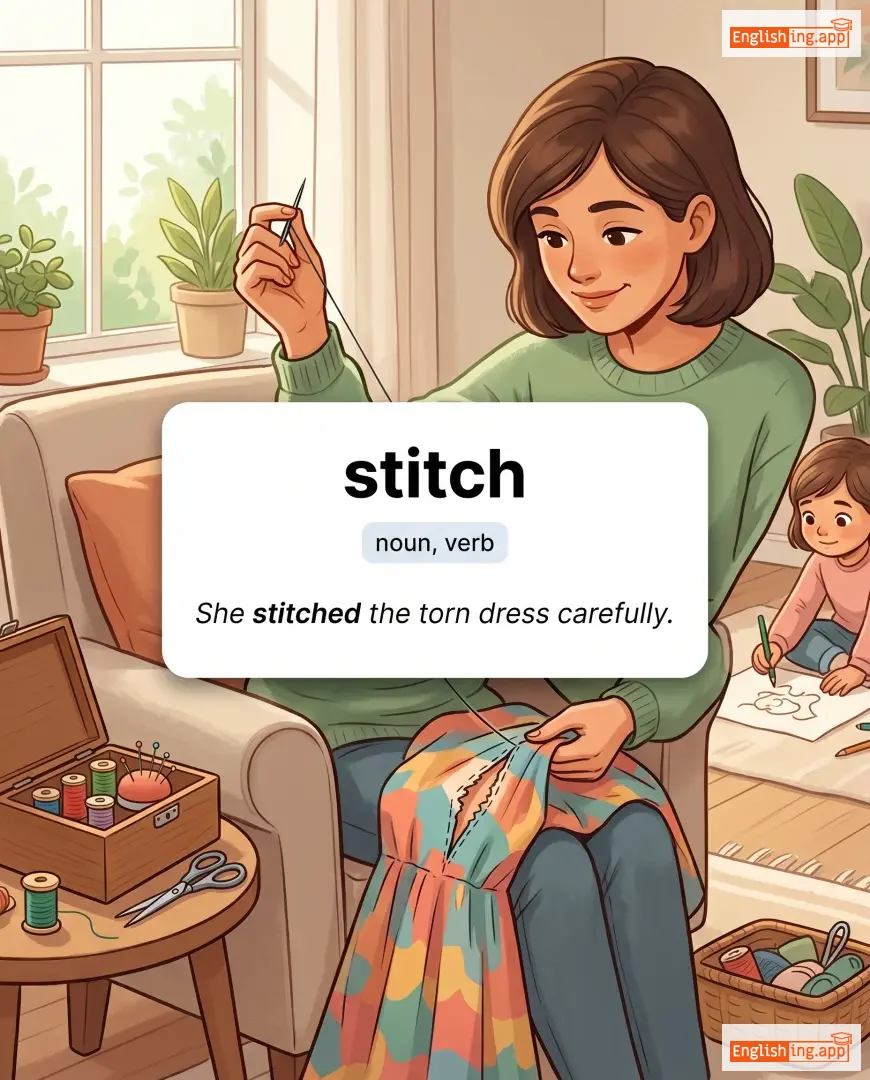
stitch definition card — visual illustration of the meaning
noun, verb
/stɪtʃ/
bonheur (bonheur)

to sew fabric together using a needle and thread; also a single loop of thread in sewing

"She stitched the torn dress carefully."

"Elle a soigneusement cousu la robe déchirée." (Elle a soigneusement cousu la robe déchirée.)
noun, verb
/stɒk/
inventaire (inventaire)

a supply of goods kept for sale or use; to keep or fill with goods

"The shop stocks a wide variety of products."

"Le magasin a un large assortiment de produits." (Le magasin a un large assortiment de produits.)
noun
/stɒˈkeɪd/
clôture en bois (cloture en bois)

a defensive barrier made of strong posts or timbers, often around a fort or prison

"The prisoners were kept inside the wooden stockade."

"Les prisonniers ont été gardés à l'intérieur de la clôture en bois." (Les prisonniers ont été gardés à l'intérieur de la clôture en bois.)
adjective
/ˈstɒdʒi/
lourd, vieilli (lourd, vieilli)

Dull, uninspired, or old-fashioned; also heavy and hard to digest when referring to food.

"The lecture was so stodgy that many students struggled to stay awake."

"La conférence était si lourde que de nombreux étudiants ont eu du mal à rester éveillés." (La conference etait si lourde que de nombreux etudiants ont eu du mal a rester eveilles.)
adjective
/ˈstoʊɪk/
stoïque, implacable (stoique, implacable)

Showing little or no emotion, even in difficult situations.

"She remained stoic during the crisis, never showing fear or panic."

"Elle est restée stoïque pendant la crise, sans montrer de peur ni de panique." (Elle est restée stoïque pendant la crise, sans montrer de peur ni de panique.)
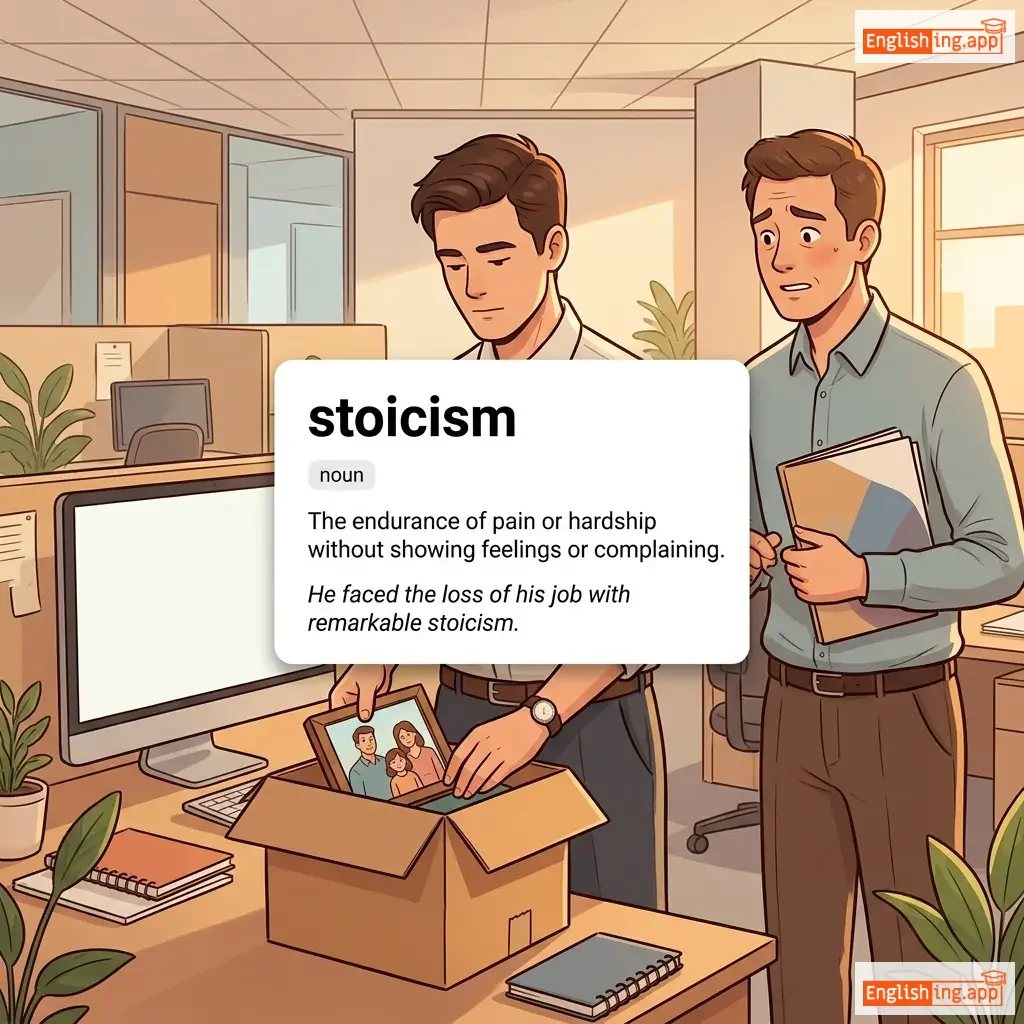
stoicism definition card — visual illustration of the meaning
noun
/ˈstoʊɪˌsɪzəm/
stoïcisme (stoicisme)

The endurance of pain or hardship without showing feelings or complaining.

"He faced the loss of his job with remarkable stoicism."

"Il a affronté la perte de son emploi avec un stoïcisme remarquable." (Il a affronté la perte de son emploi avec un stoïcisme remarquable.)
verb
/stoʊk/
attiser le feu; encourager ou augmenter un sentiment ou une activité forte (attiser le feu; encourager ou augmenter un sentiment ou une activité forte)

To add fuel to a fire; to encourage or increase a strong feeling or activity.

"The politician’s speech stoked anger among the crowd."

"Le discours du politicien a enflammé la colère parmi la foule." (Le discours du politicien a enflamme la colere parmi la foule.)
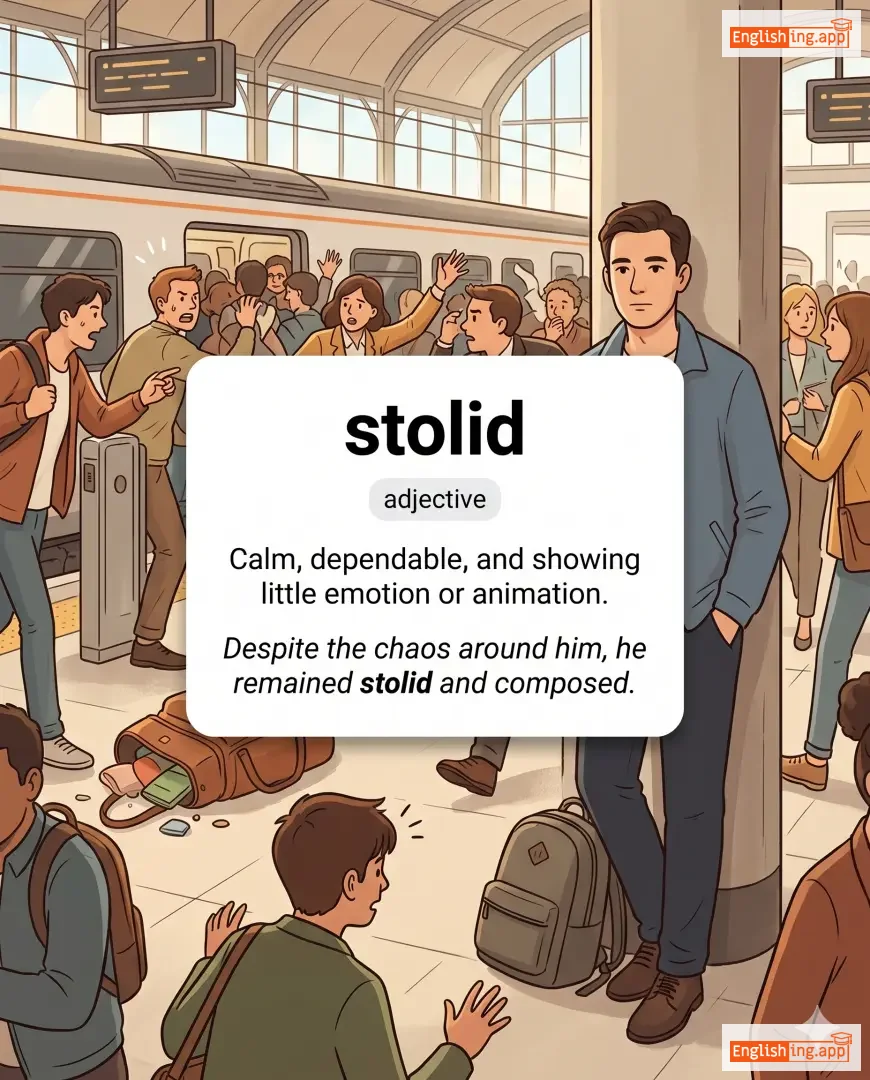
stolid definition card — visual illustration of the meaning
adjective
/ˈstɒlɪd/
impassible, stoïque (impassible, stoïque)

Calm, dependable, and showing little emotion or animation.

"Despite the chaos around him, he remained stolid and composed."

"Malgré le chaos autour de lui, il resta calme et posé." (Malgré le chaos autour de lui, il resta calme et posé.)
noun/verb
/ˈstʌmək/
estomac / supporter (estomac / supporter)

The internal organ in which food is digested; also to tolerate or endure something

"She couldn’t stomach the sight of violence."

"Elle ne pouvait pas supporter la vue de la violence." (Elle ne pouvait pas supporter la vue de la violence.)
noun
/ˈstʌmək eɪk/
mal de ventre (mal de ventre)

Pain in the stomach or abdominal area

"I have a stomach ache after eating too much."

"J'ai mal au ventre après avoir trop mangé." (J'ai mal au ventre apres avoir trop mange)
noun
/stoʊn/
pierre (pierre)

a hard, naturally occurring mineral material found in the earth

"He threw a stone into the lake."

"Il a lancé une pierre dans le lac." (Il a lance une pierre dans le lac.)
verb
/ˈstoʊnwɔːl/
entraver (entraver)

To delay or block progress by refusing to cooperate or answer

"The witness tried to stonewall during the investigation."

"Le témoin a essayé de faire du stonewall lors de l'enquête." (Le témoin a essayé de faire du stonewall lors de l'enquête.)
verb/noun
/stuːp/
bonheur (bonheur)

To bend one's body forward and downward; also a small porch or staircase at the entrance of a house

"He had to stoop to pick up the coin."

"Elle n'a pas pu cacher son bonheur lorsqu'elle a reçu le prix." (Elle n'a pas pu cacher son bonheur lorsqu'elle a reçu le prix.)
verb
/stɑːp/
arrêter (arreter)

to bring to an end or cause to cease

"Please stop talking while I’m working."

"S'il vous plaît, arrêtez de parler pendant que je travaille." (S'il vous plaît, arrêtez de parler pendant que je travaille.)
noun
/ˈstɒpɪdʒ/
arrêt; interruption (arret; interruption)

The act of stopping or ceasing; a halt in operation or activity

"The sudden stoppage of the train caused delays for all passengers."

"L'arrêt soudain du train a provoqué des retards pour tous les passagers." (L'arret soudain du train a provoque des retards pour tous les passagers.)
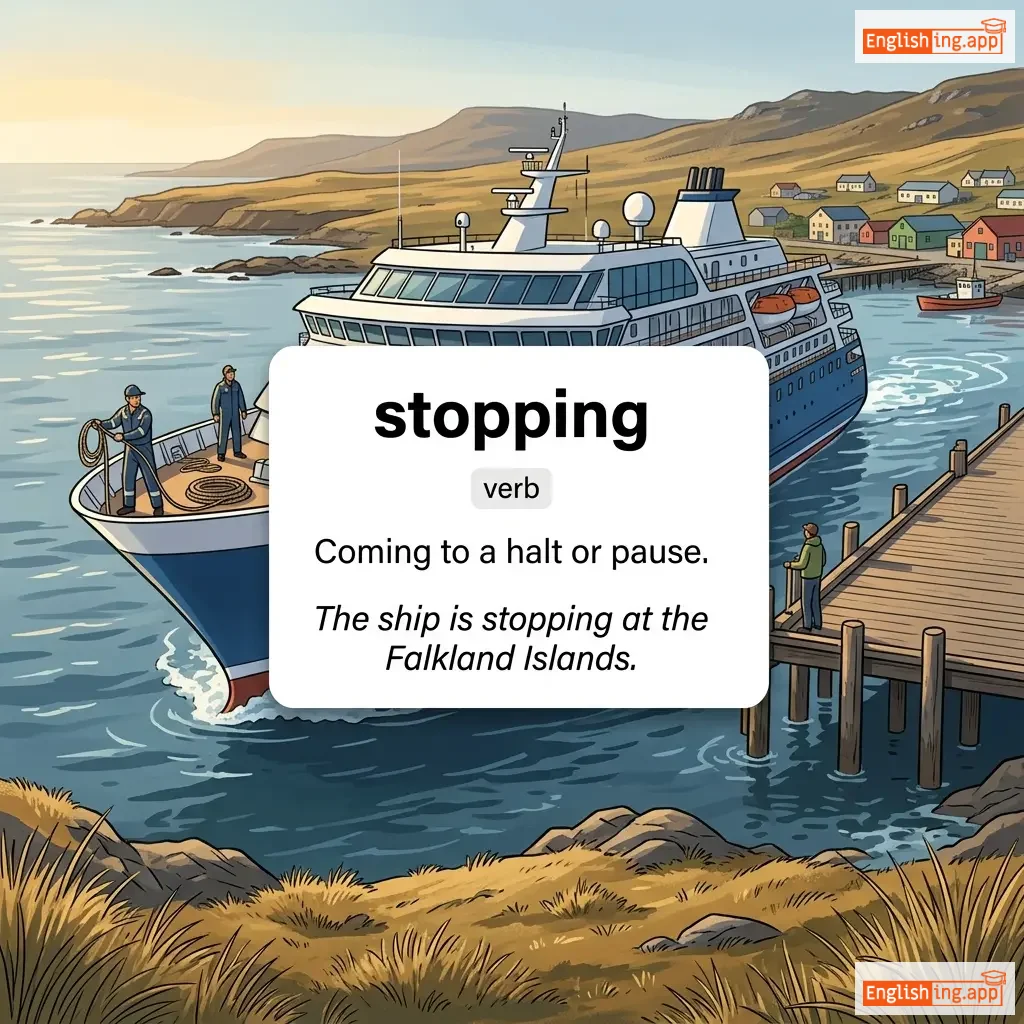
stopping definition card — visual illustration of the meaning
verb
/ˈstɒpɪŋ/
arrêt (arret)

Coming to a halt or pause.

"The ship is stopping at the Falkland Islands."

"Le navire s'arrête aux îles Malouines." (Le navire s'arrête aux îles Malouines.)
noun
/ˈstɔːrɪdʒ/
stockage (stockage)

the action or method of storing something for future use

"The warehouse offers plenty of storage space."

"L'entrepôt offre beaucoup d'espace de stockage." (L'entrepôt offre beaucoup d'espace de stockage.)
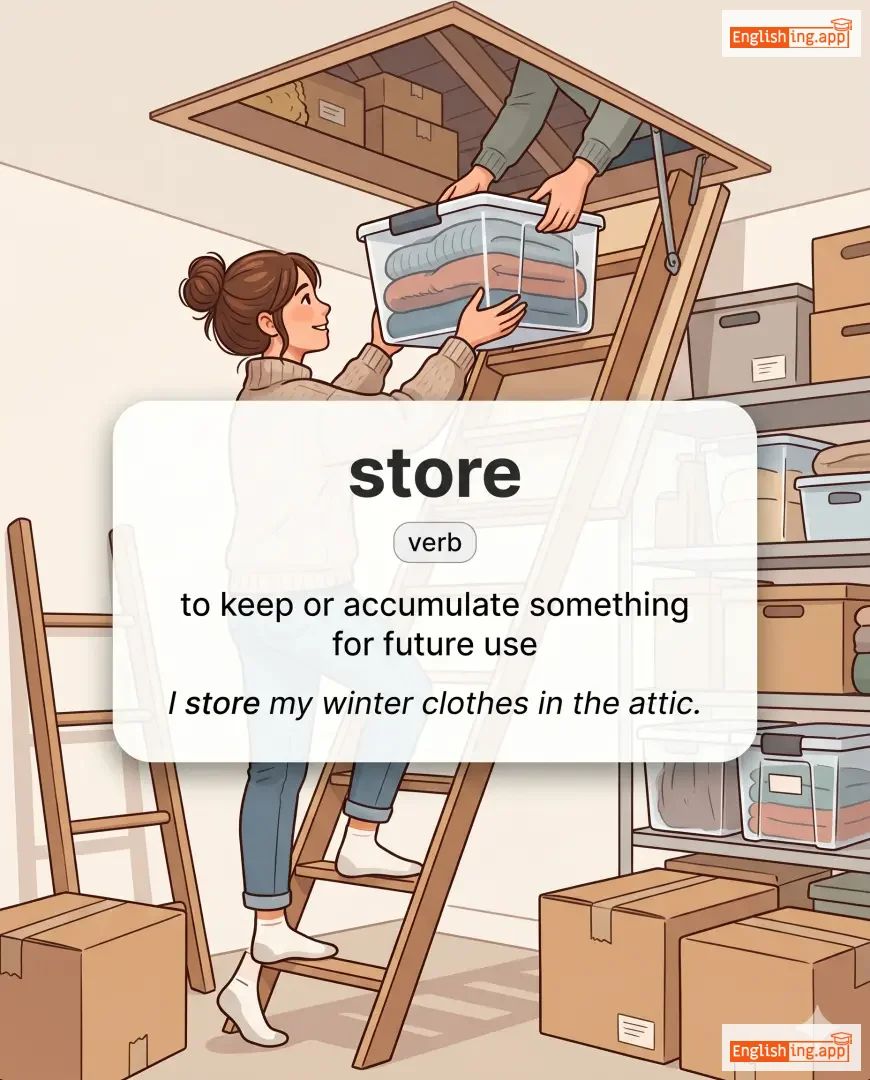
store definition card — visual illustration of the meaning
verb
/stɔːr/
stocker (stocker)

to keep or accumulate something for future use

"I store my winter clothes in the attic."

"Je range mes vêtements d'hiver dans le grenier." (Je range mes vêtements d'hiver dans le grenier.)
noun
/ˈstɔːrhaʊs/
entrepôt (entrepot)

A place where goods, supplies, or valuables are stored; a repository

"The warehouse acted as a storehouse for all the imported goods."

"L'entrepôt servait de storehouse pour tous les produits importés." (L'entrepot servait de storehouse pour tous les produits importes.)
noun
/stɔːrk/
Cigogne (cigogne)

large wading bird with long legs and a long neck

"The stork built its nest on top of the tall chimney."

"La cigogne a construit son nid sur le sommet de la cheminée haute." (La cigogne a construit son nid sur le sommet de la cheminée haute.)
noun
/stɔːrm/
tempête (tempete)

a violent disturbance of the atmosphere with strong winds, rain, and often thunder

"The storm caused major flooding in the area."

"La tempête a provoqué des inondations majeures dans la région." (La tempete a provoque des inondations majeures dans la region.)
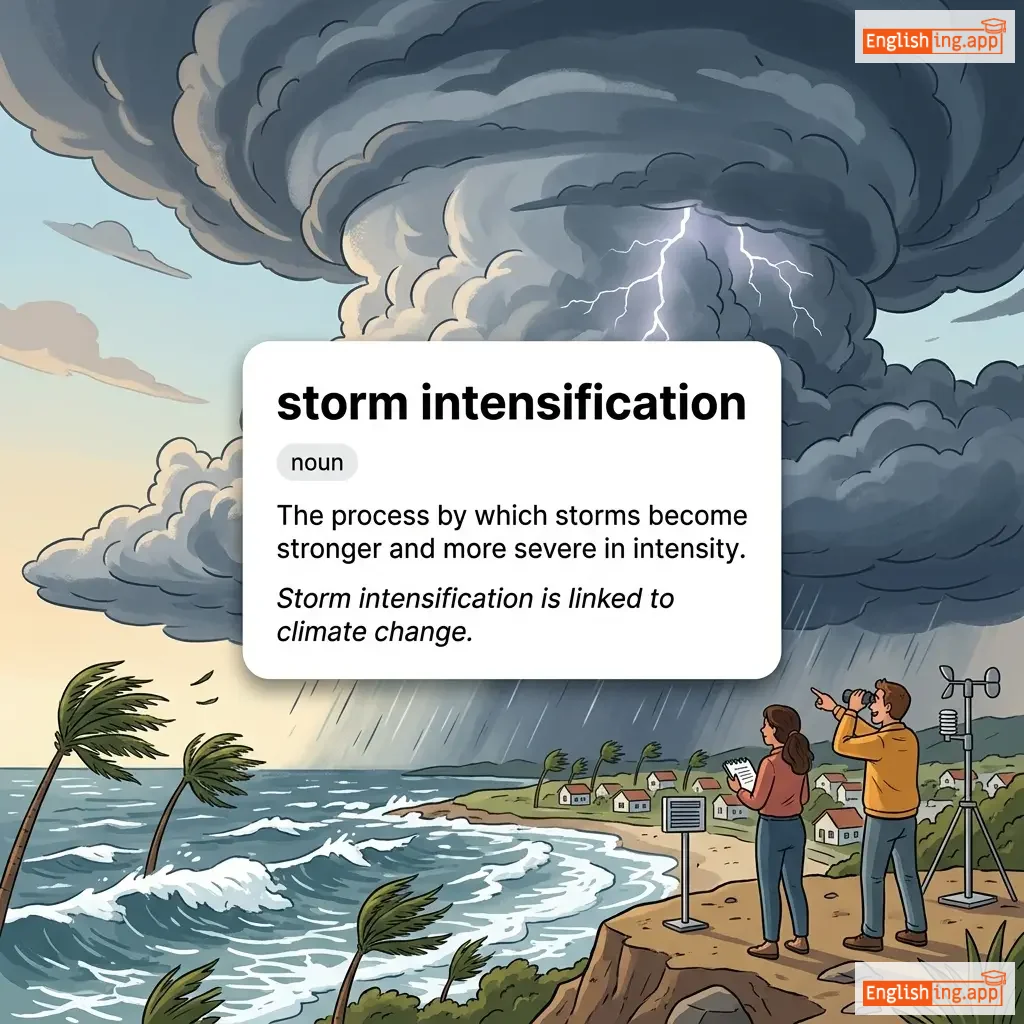
storm intensification definition card — visual illustration of the meaning
noun
stɔːrm ɪnˌtensɪfɪˈkeɪʃən
intensification de la tempête (intensification de la tempete)

The process by which storms become stronger and more severe in intensity.

"Storm intensification is linked to climate change."

"L'intensification de la tempête est liée au changement climatique." (L'intensification de la tempete est liee au changement climatique.)
noun
/ˈstɔːri/
histoire (histoire)

a narrative of real or imaginary events

"She told a fascinating story about her travels."

"Elle a raconté une histoire fascinante de ses voyages." (Elle a raconte une histoire fascinante de ses voyages.)
adjective/noun
/staʊt/
épais / robuste (epais / robuste)

Strong, thick, or heavily built; also a kind of dark beer

"The stout man lifted the heavy box with ease."

"L'homme épais a soulevé la boîte lourde avec facilité." (L'homme épais a soulevé la boîte lourde avec facilité.)
adjective
/ˌstaʊtˈhɑːrtɪd/
courageux (courageux)

Brave, determined, and courageous

"The stouthearted soldier never gave up."

"Le soldat courageux n'a jamais abandonné." (Le soldat courageux n'a jamais abandonné.)
noun
/stoʊv/
poêle (poele)

a device that produces heat for cooking or heating

"She cooked rice on the gas stove."

"Elle a cuit du riz sur la poêle à gaz." (Elle a cuit du riz sur la poêle à gaz.)
noun
/ˈstoʊəˌweɪ/
passager clandestin (passager clandestin)

A person who hides on a ship, plane, or other vehicle in order to travel secretly without paying.

"The crew discovered a stowaway hiding in the cargo hold."

"L'équipage a découvert un passager clandestin caché dans la soute." (L'equipage a decouvert un passager clandestin cache dans la soute.)
verb
/ˈstræɡəl/
se déplacer de manière irrégulière (se deplacer de maniere irreguliere)

To move or spread in an irregular, scattered, or untidy way.

"The children began to straggle behind on the long hike."

"Les enfants ont commencé à traîner derrière pendant la longue randonnée." (Les enfants ont commence a trainer derriere pendant la longue randonnee.)
adjective, adverb
/streɪt/
droit (dwa)

Extending or moving uniformly in one direction only; not curved or bent.

"He walked straight to the door without stopping."

"Il marcha droit vers la porte sans s'arrêter." (Il marcha droit vers la porte sans s'arrêter.)
adjective
/ˌstreɪt ˈfɔːr.wərd/
honnête et clair; pas compliqué; facile à comprendre (honnête et clair; pas compliqué; facile à comprendre)

honest and open; not complicated; easy to understand

"His explanation was very straightforward and easy to follow."

"Son explication était très claire et facile à suivre." (Son explication était très claire et facile à suivre.)
verb
/ˈstreɪtən/
redresser (redresser)

to make something straight or tidy; to correct or organize

"She straightened her hair before the meeting."

"Elle a redressé ses cheveux avant la réunion." (Elle a redressé ses cheveux avant la réunion.)
adjective
/ˌstreɪtˈfɔːwəd/
simple (simple)

easy to understand or do; simple

"Her explanation was straightforward and clear."

"Son explication était simple et claire." (Son explication etait simple et claire.)
noun, verb
/streɪn/
tension / étirement (tension / etirement)

To force something beyond its normal limits; to injure by overexertion; or a type or variety of something.

"He strained his back while lifting the heavy box."

"Il s'est tendu le dos en soulevant la boîte lourde." (Il s'est tendu le dos en soulevant la boîte lourde.)
noun
/ˈstreɪnər/
passoire (passoire)

a device having holes punched in it or made of crossed wires for separating solid matter from a liquid

"Use a strainer to drain the pasta water."

"Utilisez une passoire pour égoutter l'eau des pâtes." (Utilisez une passoire pour égoutter l'eau des pâtes.)
noun
/streɪt/
détroit (detroa)

A narrow passage of water connecting two seas or two large areas of water.

"The Strait of Gibraltar connects the Atlantic Ocean and the Mediterranean Sea."

"Le détroit de Gibraltar relie l'océan Atlantique et la mer Méditerranée." (Le détroit de Gibraltar relie l'océan Atlantique et la mer Méditerranée.)
noun
/strəˈmoʊ.ni.əm ˌflaʊ.ər/
fleur de stramoine (fleur de stramoine)

A trumpet-shaped white or purple flower from the jimsonweed plant, known for its toxic properties

"The stramonium flower blooms at night with a sweet fragrance."

"La fleur de stramoine fleurit la nuit avec un parfum doux." (la fleur de stramoine fleurit la nuit avec un parfum doux)
noun, verb
/strænd/
fil / bloqué (fil / bloque)

Noun: A single thin length of thread, wire, or similar. Verb: To leave someone or something without a way of moving or leaving.

"The storm stranded many tourists on the island."

"La tempête a laissé de nombreux touristes bloqués sur l'île." (La tempête a laissé de nombreux touristes bloqués sur l'île.)
adjective
/streɪndʒ/
étrange (etrange)

unusual or not normal

"It was strange to see him at the party after so long."

"C'était étrange de le voir à la fête après tout ce temps." (C'etait etrange de le voir a la fete apres tout ce temps.)
noun
/ˈstreɪndʒər/
étranger (etranger)

A person whom one does not know.

"A stranger knocked on the door at midnight."

"Un étranger a frappé à la porte à minuit." (Un etranger a frappe a la porte a minuit.)
verb
/ˈstræŋɡəl/
étrangler (etrangler)

to kill or stop someone or something by squeezing the throat or restricting flow

"The villain tried to strangle his opponent in the dark alley."

"Le méchant a essayé d'étrangler son adversaire dans la ruelle sombre." (Le méchant a essayé d'étrangler son adversaire dans la ruelle sombre.)
noun
/ˈstrætədʒəm/
stratagème (stratageme)

a plan or scheme designed to achieve a particular goal, often by trickery

"The general devised a clever stratagem to outwit the enemy."

"Le général a conçu une stratagème astucieux pour tromper l'ennemi." (Le general a concu une stratageme astucieux pour tromper l'ennemi.)
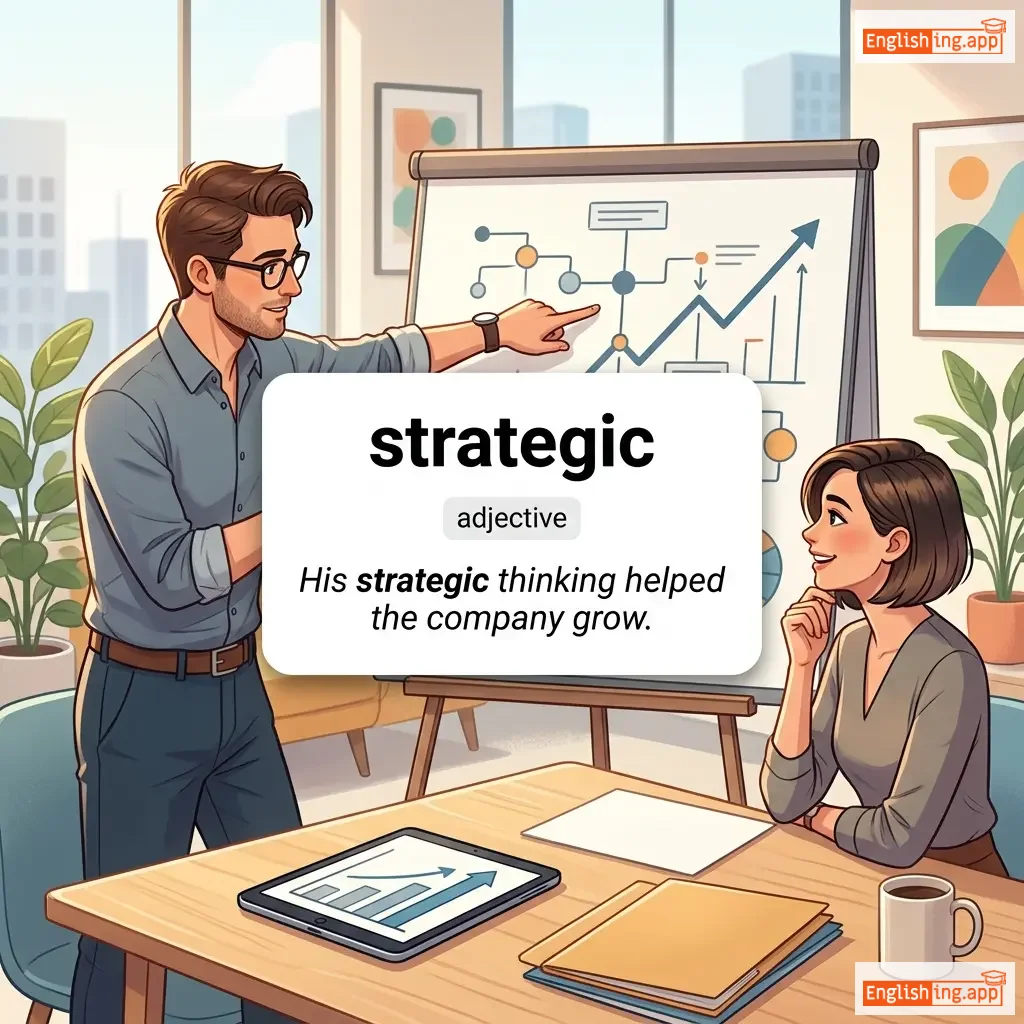
strategic definition card — visual illustration of the meaning
adjective
/strəˈtiːdʒɪk/
stratégique (strategique)

relating to the identification of long-term or overall aims and interests and the means of achieving them

"His strategic thinking helped the company grow."

"Sa pensée stratégique a aidé l'entreprise à se développer." (Sa pensee strategique a aide l'entreprise a se developper.)
strategic insights definition card — visual illustration of the meaning
noun
/strəˈtiː.dʒɪk ˈɪn.saɪts/
perspectives stratégiques (perspectives strategiques)

Deep understanding and wisdom gained through careful analysis for planning purposes.

"Strategic insights guide policymaking."

"Les perspectives stratégiques guident la prise de décision politique." (Les perspectives stratégiques guident la prise de décision politique.)
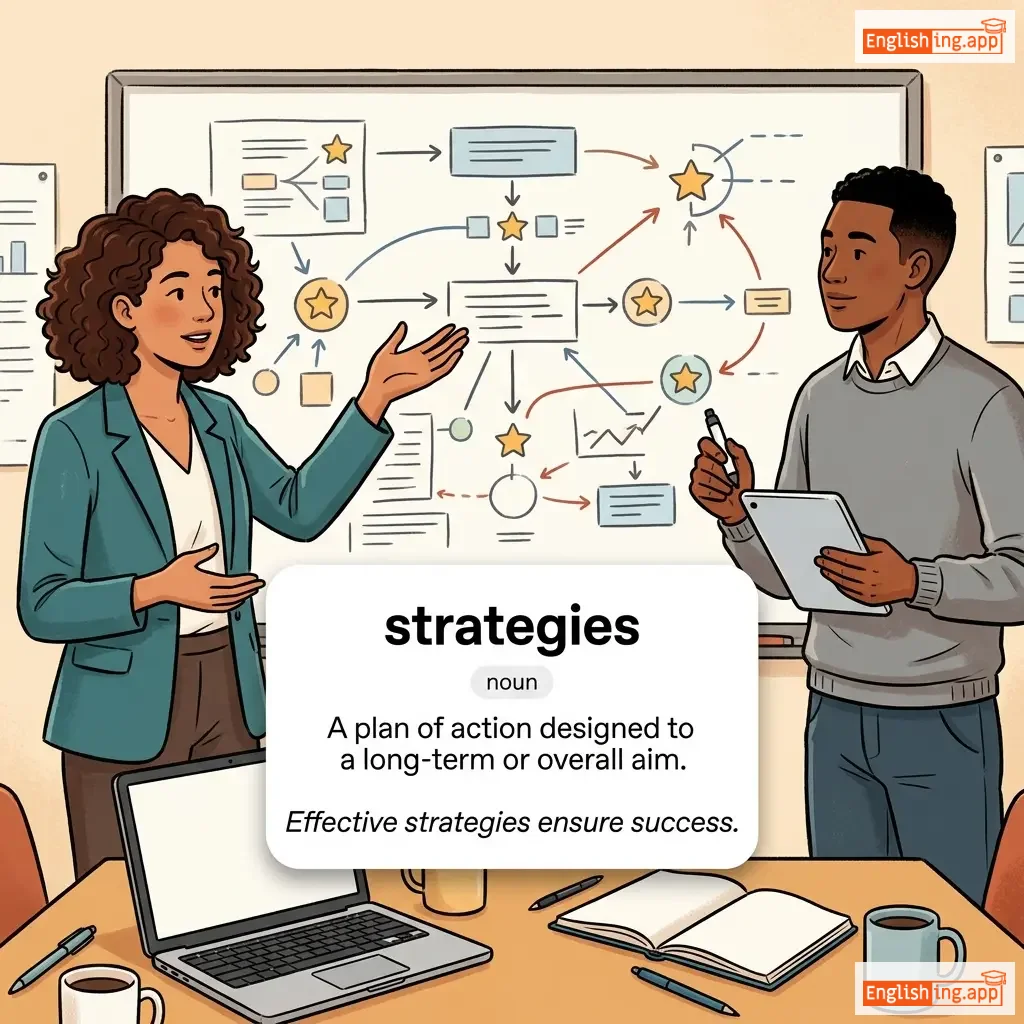
strategies definition card — visual illustration of the meaning
noun
ˈstræt.ə.dʒiz
stratégies (strategies)

A plan of action designed to achieve a long-term or overall aim.

"Effective strategies ensure success."

"Des stratégies efficaces assurent le succès." (Des strategies efficaces assurent le succes.)
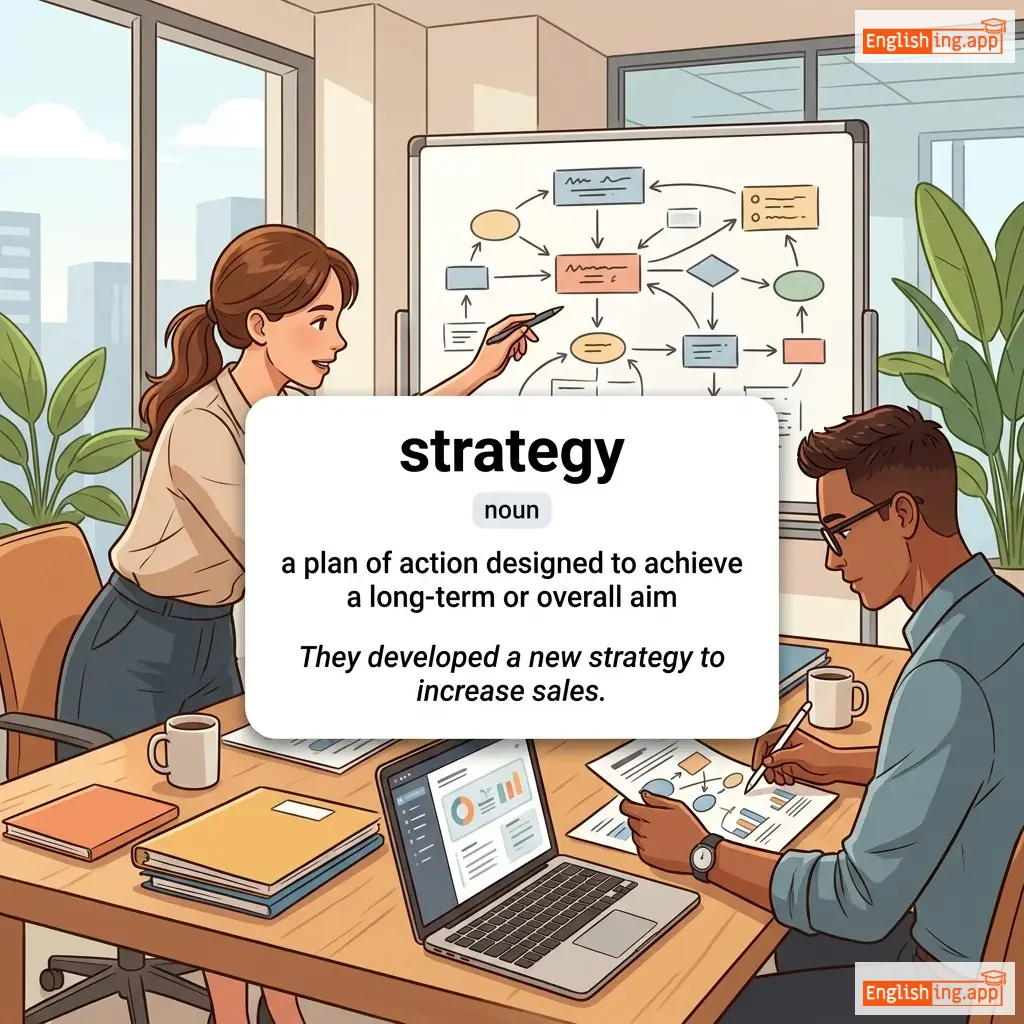
strategy definition card — visual illustration of the meaning
noun
/ˈstrætədʒi/
stratégie (strategie)

a plan of action designed to achieve a long-term or overall aim

"They developed a new strategy to increase sales."

"Ils ont développé une nouvelle stratégie pour augmenter les ventes." (Ilz ont dévélopé une nouvelle stratégie pour augmenter les ventes.)
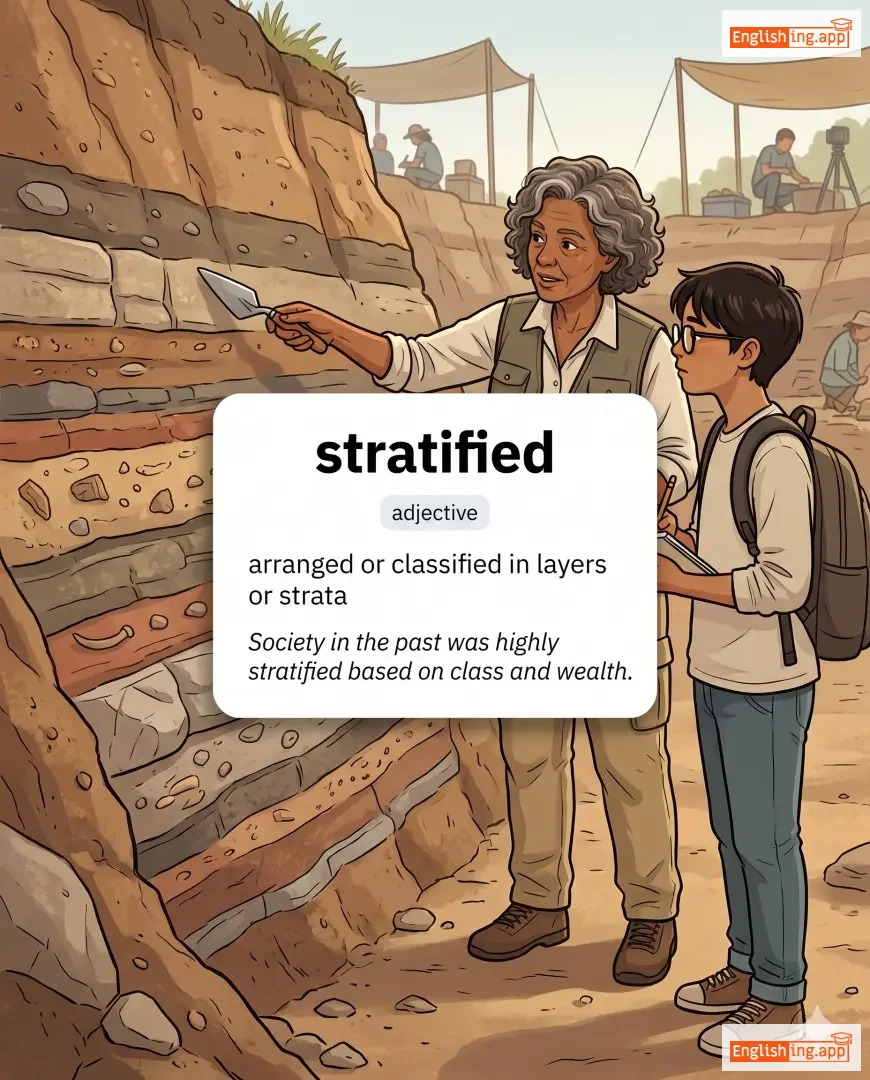
stratified definition card — visual illustration of the meaning
adjective
/ˈstrætɪfaɪd/
stratifié / stratifiée (stratifide)

arranged or classified in layers or strata

"Society in the past was highly stratified based on class and wealth."

"La société du passé était fortement stratifiée en fonction de la classe et de la richesse." (La societe du passe etait fortement stratifiee en fonction de la classe et de la richesse.)
verb
/ˈstrætɪfaɪ/
stratifier (stratifier)

to arrange or divide into layers, classes, or categories

"The researchers plan to stratify the data based on age groups."

"Les chercheurs prévoient de stratifier les données en fonction des groupes d'âge." (Les chercheurs prévoient de stratifier les données en fonction des groupes d'âge.)