Vocabulaires

Découvrez, apprenez et maîtrisez le vocabulaire anglais

adjective
/ˈspaɪn.ləs/
sans courage; de volonté faible; lâche (spainles)

lacking courage or determination; weak-willed

"He was too spineless to stand up for his beliefs."

"Il était trop sans colonne vertébrale pour défendre ses croyances." (Il etait trop sans colonne vertebrale pour defendre ses croyances.)
adjective
/ˈspaɪnəs/
épineux (epineux)

Having spines or thorn-like projections

"The spinous cactus was difficult to handle without gloves."

"Le cactus épineux était difficile à manipuler sans gants." (Le cactus épineux était difficile à manipuler sans gants.)
noun
/ˈspɪnstər/
femme célibataire (femme celibataire)

An unmarried woman, often one who is older and considered unlikely to marry

"The novel featured a kind-hearted spinster who cared for the village children."

"Le roman présentait une femme célibataire au grand cœur qui s'occupait des enfants du village." (Le roman présentait une femme célibataire au grand cœur qui s'occupait des enfants du village.)
adjective
/ˈspaɪni/
épineux (épineux)

covered with or full of spines; having sharp points

"The spiny cactus stood tall in the desert."

"Le cactus épineux se dressait haut dans le désert." (Le cactus épineux se dressait haut dans le désert.)
adjective
/ˈspaɪ.rəl/
spirale (spiral)

winding in a continuous curve; helical

"The spiral staircase led to the top floor."

"L'escalier en spirale menait à l'étage supérieur." (L'escalier en spirale menait à l'étage supérieur.)
noun
/ˈspaɪər/
flèche (fleche)

a tall, pointed structure on top of a building, especially a church

"The church spire could be seen from miles away."

"La flèche de l'église était visible de loin." (La fleche de l'église était visible de loin.)
noun
/ˈspɪrɪt/
esprit (espri)

the non-physical part of a person, regarded as their true self

"Her spirit remained unbroken despite the hardships."

"Son esprit est resté intact malgré les difficultés." (Son esprit est resté intact malgré les difficultés.)
adjective
/ˈspɪrɪtʃuəl/
spirituel (spirituel)

relating to or affecting the human spirit or soul

"She practices spiritual meditation every morning."

"Elle pratique la méditation spirituelle chaque matin." (Elle pratique la meditation spirituelle chaque matin.)
verb
/spɪt/
cracher (cracher)

to force liquid, especially saliva, out of the mouth

"He spat on the ground in anger."

"Il a craché par terre en colère." (Il a craché par terre en colère.)
noun
/spaɪt/
rancune (rancune)

a desire to hurt, annoy, or offend someone

"She refused the gift out of spite."

"Elle a refusé le cadeau par rancune." (Elle a refuse le cadeau par rancune.)
noun
/spliːn/
rate; colère (rate; colere)

an organ in the body that produces lymphocytes and filters blood; also refers to bad temper or spite

"He vented his spleen on his coworkers after the meeting."

"Il a exprimé sa colère sur ses collègues après la réunion." (Il a exprime sa colere sur ses collegues apres la reunion.)
adjective
/ˈsplendɪd/
splendide; magnifique; impressionnant (splendide; magnifique; impressionnant)

magnificent; excellent; very impressive

"The castle looked splendid in the sunset."

"Le château semblait splendide au coucher du soleil." (Le chateau semblait splendide au coucher du soleil.)
adjective
/splɪˈnɛtɪk/
irritable, colérique (irritable, colérique)

bad-tempered, irritable, spiteful

"His splenetic remarks offended everyone in the room."

"Ses remarques colériques ont offensé tout le monde dans la pièce." (Ses remarques colériques ont offensé tout le monde dans la pièce.)
verb
/splaɪs/
joindre (joindre)

to join two pieces of rope, film, or other material by weaving or attaching them together

"The technician spliced the two wires to restore the connection."

"Le technicien a joint les deux fils pour restaurer la connexion." (Le technicien a joint les deux fils pour restaurer la connexion.)
/splɪnt/
attelle (attelle)

A rigid device used to support and immobilize a broken or injured body part.

"The doctor applied a splint to stabilize the patient's broken arm."

"Le médecin a appliqué une attelle pour stabiliser le bras cassé du patient." (Le medecin a applique une attelle pour stabiliser le bras casse du patient.)
verb
/splɪt/
diviser (diviser)

to divide or separate into parts or groups

"He split the log in two with an axe."

"Il a fendu le tronc en deux avec une hache." (Il a fendu le tronc en deux avec une hache.)
verb
/spɔɪl/
gâcher (gâcher)

to damage or ruin something

"The rain spoiled the outdoor event."

"La pluie a gâché l'événement en plein air." (La pluie a gâché l'événement en plein air.)
noun
/ˈspɔɪlˌspɔːrt/
rabat-joie (rabat-joie)

A person who ruins other people's enjoyment or fun.

"Don't be a spoilsport and let us enjoy the party."

"Ne sois pas un rabat-joie et laisse-nous profiter de la fête." (Ne sois pas un rabat-joie et laisse-nous profiter de la fête.)
noun, verb
/spoʊk/
rayons / parlé (rayons / parle)

As a noun, a bar connecting the center of a wheel to its rim; as the past tense of 'speak'.

"The bicycle's spoke was bent after the accident."

"Le rayon de la bicyclette était tordu après l'accident." (Le rayon de la bicyclette était tordu après l'accident.)
noun
/ˈspəʊksmən/
porte-parole (porte-parole)

a person who speaks on behalf of others, especially for a group or organization

"The spokesman addressed the crowd during the rally."

"Le porte-parole a pris la parole devant la foule lors du rassemblement." (Le porte-parole a pris la parole devant la foule lors du rassemblement.)
noun
/ˈspəʊkspɜːrsən/
porte-parole (porte-parole)

a person who speaks on behalf of others or an organization

"The spokesperson addressed the press conference on behalf of the company."

"Le porte-parole a pris la parole lors de la conférence de presse au nom de l'entreprise." (Le porte-parole a pris la parole lors de la conférence de presse au nom de l'entreprise.)
noun
/ˈspəʊkswɪmən/
porte-parole femme (porte-parole femme)

a woman who speaks on behalf of a group or organization

"The spokeswoman for the company announced the new product."

"La porte-parole de l'entreprise a annoncé le nouveau produit." (La porte-parole de l'entreprise a annoncé le nouveau produit.)
noun
/ˌspoʊliˈeɪʃən/
destruction (destruction)

The act of destroying or ruining something, often evidence or property.

"The court punished the company for the spoliation of evidence."

"Le tribunal a puni l'entreprise pour la spoliation des preuves." (Le tribunal a puni l'entreprise pour la spoliation des preuves.)
adjective
/ˈspʌndʒi/
épongeux (epongueux)

soft and full of holes like a sponge; porous

"The cake had a light and spongy texture."

"Le gâteau avait une texture légère et spongieuse." (Le gâteau avait une texture légère et spongieuse.)
noun
/spʌndʒ ɡɔːrd/
courge éponge (courge epong)

a fibrous gourd that becomes sponge-like when dried, used for cleaning and in cooking when young

"The sponge gourd can be eaten when young or dried to make natural scrubbers."

"La courge éponge peut être mangée lorsqu'elle est jeune ou séchée pour fabriquer des éponges naturelles." (La courge éponge peut être mangée lorsqu'elle est jeune ou séchée pour fabriquer des éponges naturelles.)
noun
/ˈspɒnsər/
sponsor (sponsor)

a person or organization that provides funds for a project or activity in exchange for publicity or support

"The company became the main sponsor of the event."

"L'entreprise est devenue le principal sponsor de l'événement." (L'entreprise est devenue le principal sponsor de l'événement.)
noun
/ˈspɒnsəʃɪp/
parrainage (parrainage)

the act of supporting an event, activity, person, or organization financially or through other resources

"The event was made possible due to the sponsorship of several big companies."

"L'événement a été rendu possible grâce au parrainage de plusieurs grandes entreprises." (L'événement a été rendu possible grâce au parrainage de plusieurs grandes entreprises.)
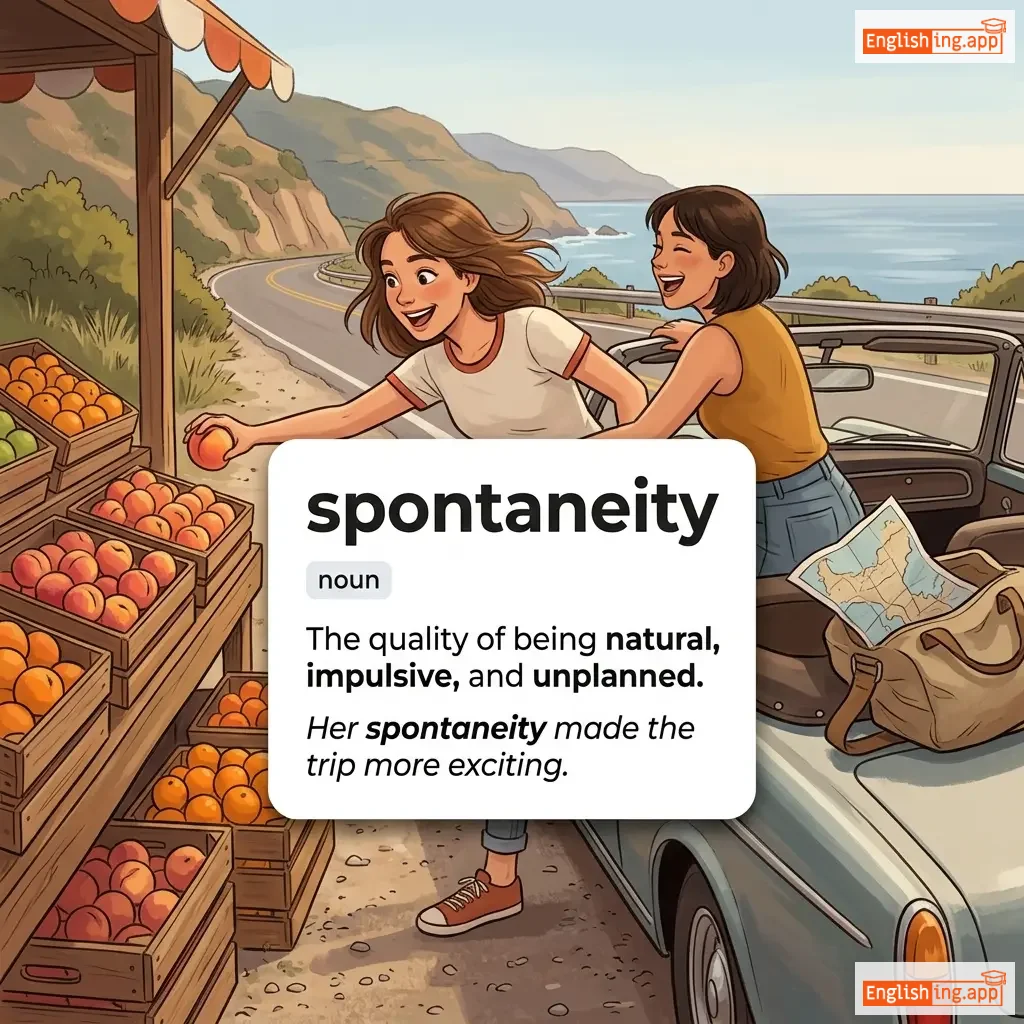
spontaneity definition card — visual illustration of the meaning
noun
/ˌspɑːntəˈneɪəti/
spontanéité (spontaneite)

The quality of being natural, impulsive, and unplanned.

"Her spontaneity made the trip more exciting."

"Sa spontanéité a rendu le voyage plus excitant." (sa spontaneite a rendu le voyage plus excitant.)
adjective
/spɒnˈteɪniəs/
spontané (spontane)

Happening naturally without planning or external cause; impulsive or unplanned.

"Their spontaneous trip to the mountains turned out to be the highlight of the summer."

"Leur voyage spontané en montagne s'est avéré être le point culminant de l'été." (Leur voyage spontane en montagne s'est avéré être le point culminant de l'été.)
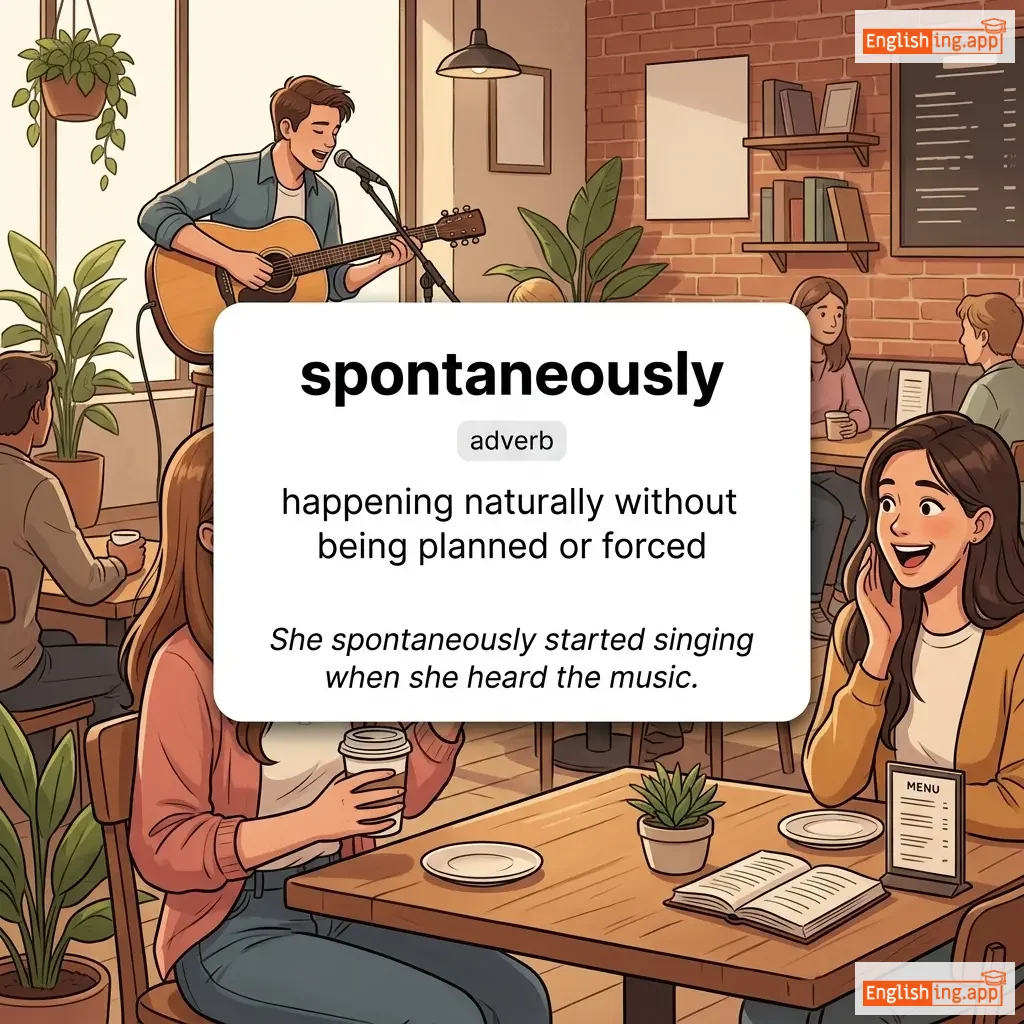
spontaneously definition card — visual illustration of the meaning
adverb
/spɒnˈteɪ.ni.əs.li/
spontanément (spontanément)

happening naturally without being planned or forced

"She spontaneously started singing when she heard the music."

"Elle a commencé à chanter spontanément lorsqu'elle a entendu la musique." (Elle a commencé à chanter spontanément lorsqu'elle a entendu la musique.)
noun/verb
/spuːf/
imitation humoristique (imitation humoristique)

A humorous imitation of something, or to trick or parody someone or something.

"The comedian spoofed the politician’s speech to entertain the audience."

"Le comédien a parodié le discours du politicien pour divertir le public." (Le comedien a parodie le discours du politicien pour divertir le public.)
noun
/spuːn/
cuillère (cuillere)

a utensil consisting of a small shallow bowl with a handle, used for eating, stirring, or serving food

"She stirred her coffee with a silver spoon."

"Elle a remué son café avec une cuillère en argent." (Elle a remué son café avec une cuillère en argent.)
noun
/ˈspuːnərɪzəm/
spounérisme (spounerism)

A verbal error in which the initial sounds of words are swapped to create a humorous effect.

"He made a spoonerism by saying 'queer old dean' instead of 'dear old queen'."

"Il a fait un spounérisme en disant 'vieux doyen bizarre' au lieu de 'vieille reine chère'." (Il a fait un spounérisme en disant 'vieux doyen bizarre' au lieu de 'vieille reine chère'.)
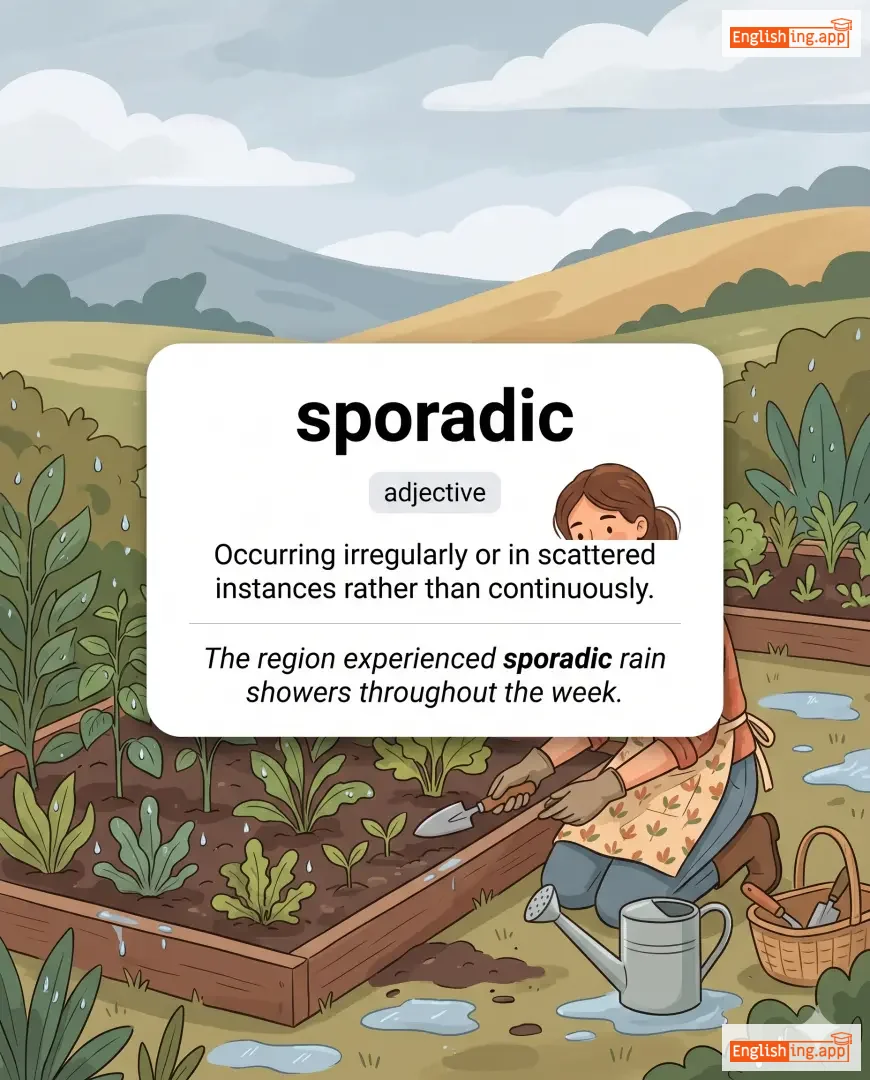
sporadic definition card — visual illustration of the meaning
adjective
/spəˈrædɪk/
sporadique (sporadique)

Occurring irregularly or in scattered instances rather than continuously.

"The region experienced sporadic rain showers throughout the week."

"La région a connu des averses sporadiques tout au long de la semaine." (La région a connu des averses sporadiques tout au long de la semaine.)
noun
/spɔːt/
sport (sport)

an activity involving physical exertion and skill in which an individual or team competes against another or others for entertainment

"Football is a popular sport around the world."

"Le football est un sport populaire dans le monde entier." (Le football est un sport populaire dans le monde entier.)
adjective
/ˈspɔːrtɪv/
sportif (sportif)

Playful, lively, or full of fun.

"The children were in a sportive mood during the picnic."

"Les enfants étaient d'humeur sportive pendant le pique-nique." (Les enfants etaient d'humeur sportive pendant le pique-nique.)
noun
/ˈspɔːrtsmən/
sportif (sportif)

A person who is skilled in sports or enjoys participating in athletic activities.

"He is a true sportsman, always fair and respectful to his opponents."

"C'est un véritable sportif, toujours juste et respectueux envers ses adversaires." (C'est un veritable sportif, toujours juste et respectueux envers ses adversaires.)
noun
/spɒt/
endroit (endroit)

a particular place or position

"I found a great spot for a picnic in the park."

"J'ai trouvé un excellent endroit pour un pique-nique dans le parc." (J'ai trouve un excellent endroit pour un pique-nique dans le parc.)
noun
/ˈspɒt.laɪt/
projecteur (prozhuhter)

a strong beam of light directed onto a particular area; figuratively, public attention

"The singer stood proudly in the spotlight."

"Le chanteur se tenait fièrement sous les projecteurs." (Le chanteur se tenait fierement sous les projecteurs.)
adjective
/ˈspɒtɪd/
tacheté; marqué; vu (tachete; marque; vu)

having spots or marks; noticed or seen

"The spotted leopard moved silently through the jungle."

"Le léopard tacheté s'est déplacé silencieusement à travers la jungle." (Le léopard tacheté s'est déplacé silencieusement à travers la jungle.)
noun
/ˈspɒt.ɪd sneɪk hed/
poisson tête de serpent tachetée (poisson tete de serpent tachetee)

a type of freshwater fish with spotted markings and an elongated head resembling a snake

"The spotted snake head is a popular fish for aquaculture in South Asia."

"Le poisson tête de serpent tachetée est populaire pour l'aquaculture en Asie du Sud." (le poisson tete de serpent tachetee est populaire pour laquaculture en asie du sud)
noun
/spaʊs/
conjoint (conjoint)

a person's husband or wife

"Each employee may include their spouse in the health insurance plan."

"Chaque employé peut inclure son conjoint dans le plan d'assurance santé." (Chaque employé peut inclure son conjoint dans le plan d'assurance santé.)
noun, verb
/spreɪn/
entorse (entorse)

an injury to a joint in which the ligaments are stretched or torn

"She sprained her ankle while running in the park."

"Elle s'est foulé la cheville en courant dans le parc." (Elle s'est fole la cheville en courant dans le parc.)
verb
/spreɪ/
vaporiser (vaporiser)

to apply liquid to something in a fine mist

"She sprayed perfume on her wrist before leaving."

"Elle a vaporisé du parfum sur son poignet avant de partir." (Elle a vaporisé du parfum sur son poignet avant de partir.)
verb
/sprɛd/
étendre (étendre)

to open or extend something over an area

"She spread the blanket on the grass for a picnic."

"Elle a étendu la couverture sur l'herbe pour un pique-nique." (Elle a étendu la couverture sur l'herbe pour un pique-nique.)
adjective
/ˈspraɪtli/
vif (vif)

full of energy and life; lively

"The sprightly old man danced with joy at the wedding."

"L'homme vif a dansé avec joie au mariage." (L'homme vif a dansé avec joie au mariage.)
noun
/sprɪŋ/
printemps (printemps)

the season between winter and summer when plants begin to grow

"Flowers bloom in the spring."

"Les fleurs éclosent au printemps." (Les fleurs éclosent au printemps.)
verb
/ˈsprɪŋkəl/
saupoudrer (saupoudrer)

to scatter small drops or particles of a substance over a surface

"She sprinkled sugar on top of the cake."

"Elle a saupoudré du sucre sur le gâteau." (Elle a saupoudré du sucre sur le gâteau.)
verb, noun
/spraʊt/
germer (germer)

to begin to grow; to produce new leaves or shoots

"The seeds began to sprout after a few days of rain."

"Les graines ont commencé à germer après quelques jours de pluie." (Les graines ont commencé à germer après quelques jours de pluie.)
verb, adjective, noun
/spruːs/
ranger / un type d'arbre (ranger / un type d'arbre)

to make neat or tidy in appearance; also refers to an evergreen tree

"He spruced up his room before the guests arrived."

"Il a arrangé sa chambre avant l'arrivée des invités." (Il a arrangé sa chambre avant l'arrivée des invités.)