Vocabulaires

Découvrez, apprenez et maîtrisez le vocabulaire anglais

noun
/smɔːl boʊl/
petit bol (petit bol)

a round, shallow container of small size used for serving food or liquids

"She served the soup in a small bowl."

"Elle a servi la soupe dans un petit bol." (Elle a servi la soupe dans un petit bol.)
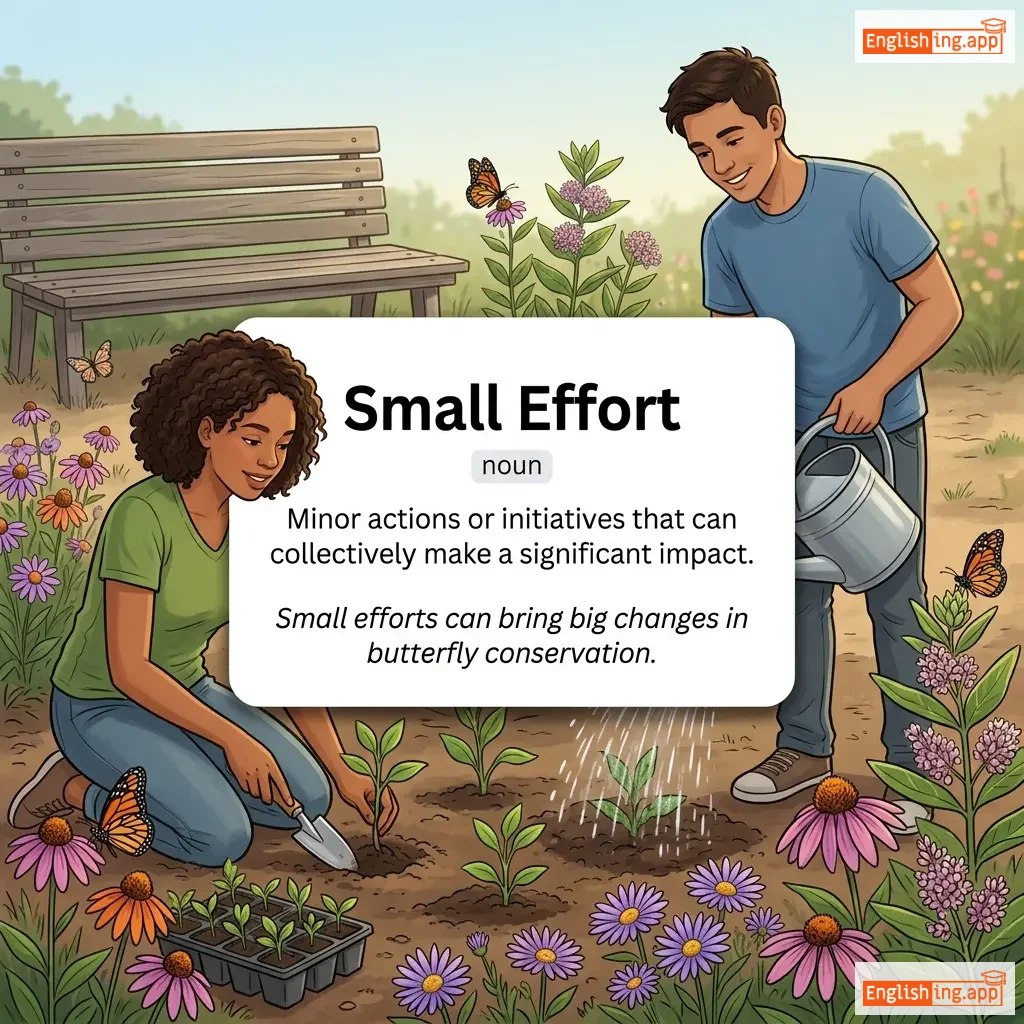
Small Effort definition card — visual illustration of the meaning
noun
smɔːl ˈɛfərt
petit effort (petit effort)

Minor actions or initiatives that can collectively make a significant impact.

"Small efforts can bring big changes in butterfly conservation."

"Les petits efforts peuvent apporter de grands changements dans la conservation des papillons." (Les petits efforts peuvent apporter de grands changements dans la conservation des papillons.)
adjective
/ˈsmɑːrmi/
flatteur / fausse politesse (flatteur / fausse politesse)

Excessively flattering or ingratiating, often insincerely.

"The salesman gave a smarmy pitch that felt fake."

"Le vendeur a donné un discours flatteur qui semblait faux." (Le vendeur a donné un discours flatteur qui semblait faux.)
adjective, noun, verb
/smɑːrt/
intelligent / élégant (intelligent / elegant)

Clever and intelligent; also stylish in appearance; or to feel pain.

"She is a smart student who always excels in class."

"Elle est une étudiante intelligente qui excelle toujours en classe." (Elle est une étudiante intelligente qui excelle toujours en classe.)
adverb
/ˈsmɑːt.li/
intelligemment; avec style; rapidement (intelligemment; avec style; rapidement)

in a clever or intelligent way; neatly and stylishly; quickly

"He was smartly dressed for the business meeting."

"Il était bien habillé pour la réunion d'affaires." (Il était bien habillé pour la réunion d'affaires.)
noun
/ˈsmɑːrt.nəs/
intelligence; astuce; apparence soignée et moderne (intelligence; astuce; apparence soignée et moderne)

intelligence; cleverness; neat and fashionable appearance

"Her smartness in solving problems impressed everyone."

"Son intelligence pour résoudre les problèmes a impressionné tout le monde." (Son intelligence pour résoudre les problèmes a impressionné tout le monde.)
verb
/smæʃ/
casser (casser)

to break something into pieces violently

"She smashed the glass in frustration."

"Elle a brisé le verre dans la frustration." (Elle a brisé le verre dans la frustration.)
noun
/ˈsmætərɪŋ/
connaissance superficielle (connaissance superficielle)

A small amount or superficial knowledge of something.

"He has a smattering of Spanish."

"Il a une connaissance superficielle de l'espagnol." (Il a une connaissance superficielle de l'espagnol.)
verb
/smɪr/
étaler / diffamer (etaler / diffamer)

to spread or apply a substance messily; to damage someone's reputation with false or unfair words

"The child smeared paint across the wall."

"L'enfant a étalé de la peinture sur le mur." (L'enfant a étalé de la peinture sur le mur.)
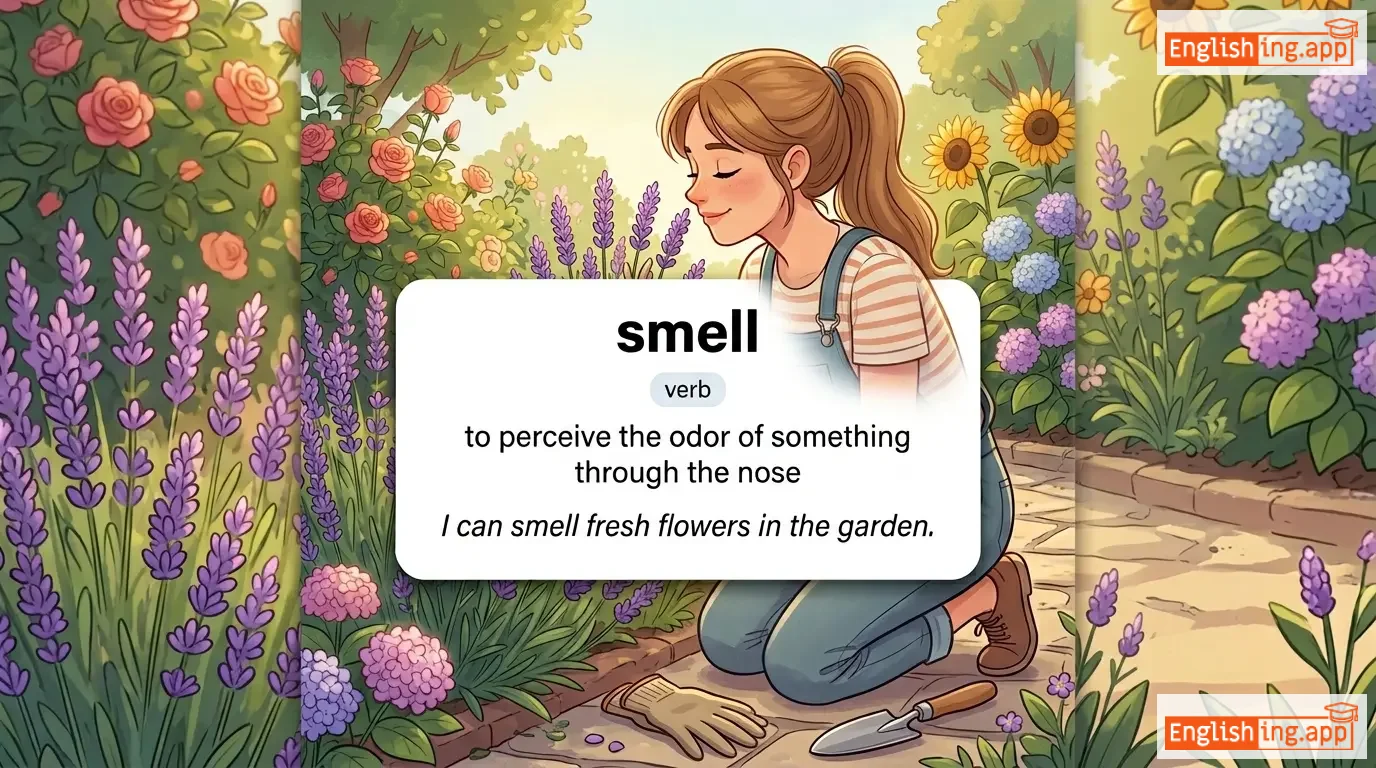
smell definition card — visual illustration of the meaning
verb
/smɛl/
sentir (sentir)

to perceive the odor of something through the nose

"I can smell fresh flowers in the garden."

"Je peux sentir les fleurs fraîches dans le jardin." (Je peux sentir les fleurs fraîches dans le jardin.)
verb
/smɛlt/
fondre (fondre)

to extract metal from its ore by heating and melting

"The workers smelt iron from its ore in the factory."

"Les travailleurs fondent du fer de son minerai dans l'usine." (Les travailleurs fondent du fer de son minerai dans l'usine.)
verb
/smaɪl/
sourire (sourire)

to express happiness or friendliness by turning the corners of the mouth upwards

"She smiled when she saw the gift."

"Elle a souri lorsqu'elle a vu le cadeau." (Elle a souri lorsqu'elle a vu le cadeau.)
verb
/smɜrk/
sourire d'un air suffisant (sourire d'un air suffisant)

to smile in a self-satisfied, smug, or silly way

"He smirked when he won the argument."

"Il a souri lorsqu'il a gagné la dispute." (Il a souri lorsqu'il a gagné la dispute.)
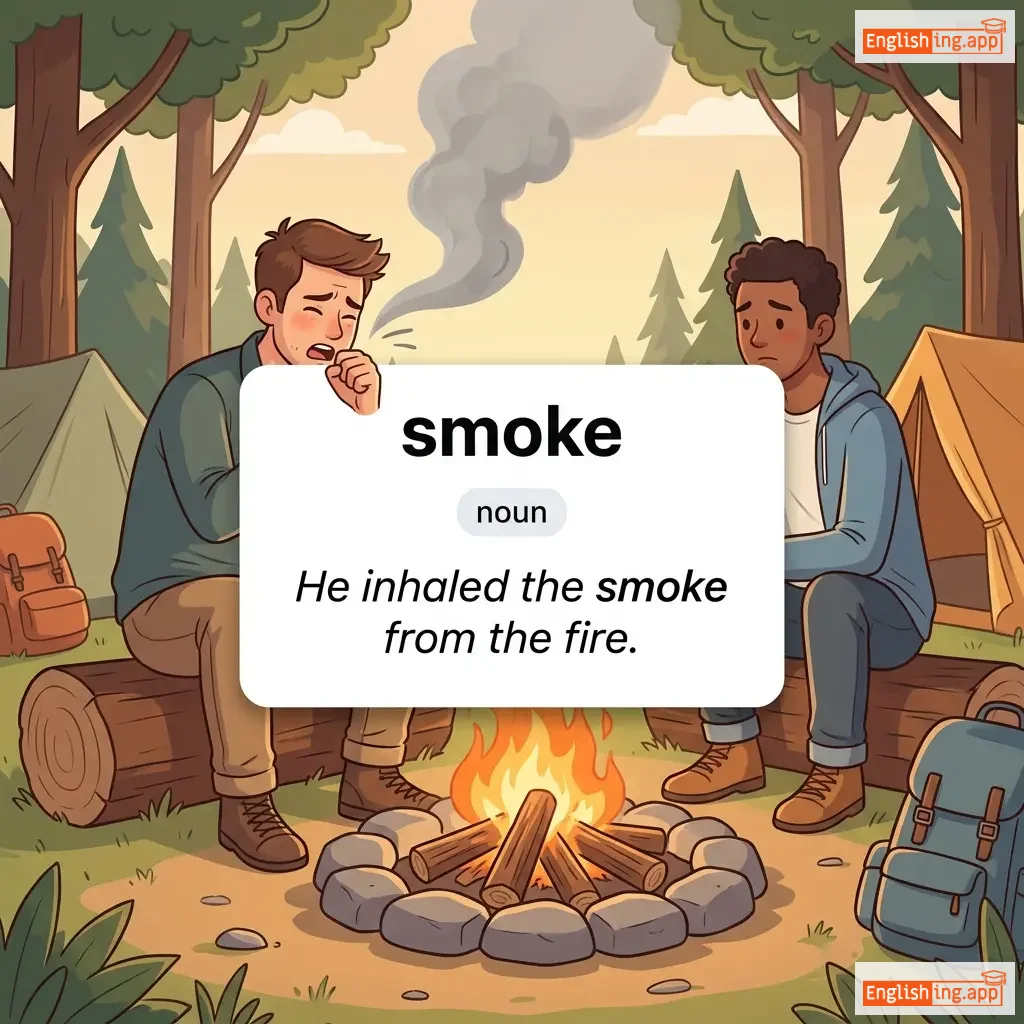
smoke definition card — visual illustration of the meaning
noun
/smoʊk/
fumée (fume)

a visible suspension of fine particles of matter in the air, typically produced by combustion

"He inhaled the smoke from the fire."

"Il a inhalé la fumée du feu." (Il a inhale la fume du feu.)
noun
/ˈsmoʊkər/
fumeur (fumeur)

A person who smokes tobacco or other substances

"He is a heavy smoker and tries to quit every year."

"Il est un fumeur et essaie d'arrêter chaque année." (Il est un fumeur et essaie d'arreter chaque annee.)
noun/adjective
/ˈsmoʊ.kɪŋ/
fumer (fumer)

The act of inhaling and exhaling the smoke of tobacco or other substances; wearing a tuxedo (adjective, formal context).

"Smoking is prohibited inside the building."

"Il est interdit de fumer à l'intérieur du bâtiment." (Il est interdit de fumer a l'interieur du batiment.)
verb
/ˈsmoʊldər/
fumer lentement (fumer lentement)

to burn slowly with smoke but no flame; to show suppressed anger or emotion

"The fire smoldered for hours before it went out."

"Le feu a fumé lentement pendant des heures avant de s'éteindre." (Le feu a fumé lentement pendant des heures avant de s'éteindre.)
adjective
/smuːð/
lisse (lisse)

having an even surface without roughness; happening without difficulty

"The table has a smooth surface."

"La table a une surface lisse." (La table a une surface lisse.)
adverb
/ˈsmuːð.li/
doucement; sans problèmes (doucement; sans problemes)

without problems or difficulties; in an even and regular way

"The car runs smoothly on the new highway."

"La voiture roule doucement sur la nouvelle autoroute." (La voiture roule doucement sur la nouvelle autoroute.)
verb
/ˈsmʌðər/
étouffer / asphyxier (etouffer / asphyxier)

to kill someone by covering their nose and mouth to prevent breathing; to cover something completely; to overwhelm with excessive attention or affection

"She smothered the fire with a blanket."

"Elle a étouffé le feu avec une couverture." (Elle a étouffé le feu avec une couverture.)
noun/verb
/smʌdʒ/
tache, marque sale (tache, marque sale)

a dirty mark or smear; to make something dirty or unclear by rubbing or touching

"She accidentally smudged her lipstick on the napkin."

"Elle a accidentellement étalé son rouge à lèvres sur la serviette." (Elle a accidentellement étalé son rouge à lèvres sur la serviette.)
adjective
/smʌɡ/
prétentieux (pretentieux)

having or showing an excessive pride in oneself or one's achievements

"He wore a smug smile after winning the debate."

"Il portait un sourire prétentieux après avoir gagné le débat." (Il portait un sourire prétentieux après avoir gagné le débat.)
verb
/ˈsmʌɡəl/
faire passer en contrebande (faire passer en contrebande)

to move goods illegally into or out of a country

"The gang tried to smuggle gold across the border."

"Le gang a essayé de faire passer de l'or à travers la frontière." (Le gang a essayé de faire passer de l'or à travers la frontière.)
noun
/sneɪl/
escargot (escargot)

a small soft creature with a shell on its back that moves very slowly

"The snail left a shiny trail as it crawled across the leaf."

"L'escargot a laissé une traînée brillante en rampant sur la feuille." (L'escargot a laisse une trainee brillante en rampant sur la feuille)
noun
/sneɪk/
serpent (serpã)

a long, legless reptile that moves by slithering

"A snake slithered across the garden path."

"Un serpent se glissait sur le sentier du jardin." (Un serpent se glissait sur le sentier du jardin.)
noun
/sneɪk ɡɔːrd/
courge serpent (courge serpent)

a long, curved vegetable that resembles a snake, commonly used in South Asian cuisine

"The snake gourd grows in a twisted, serpentine shape in the garden."

"La courge serpent pousse dans une forme tordue et serpentine dans le jardin." (La courge serpent pousse dans une forme tordue et serpentine dans le jardin.)
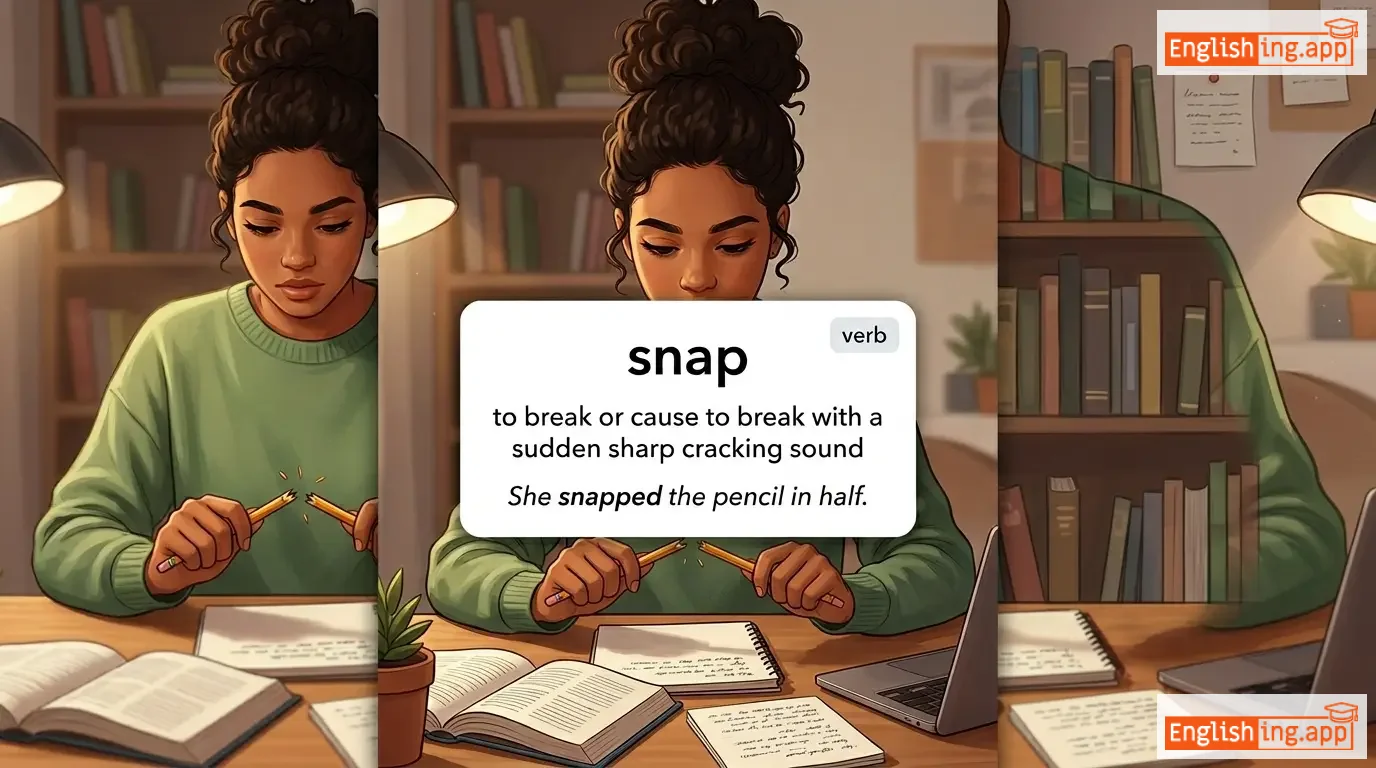
snap definition card — visual illustration of the meaning
verb
/snæp/
casser (casser)

to break or cause to break with a sudden sharp cracking sound

"She snapped the pencil in half."

"Elle a cassé le crayon en deux." (Elle a cassé le crayon en deux.)
noun/verb
/snɛər/
piège (piege)

a trap for catching animals; to catch or trap

"The hunter set a snare to catch rabbits."

"Le chasseur a mis un piège pour attraper des lapins." (Le chasseur a mis un piege pour attraper des lapins.)
verb/noun
/snɑːrl/
grognement, embouteillage (grogne, embouteillage)

to growl aggressively with bared teeth; a tangle or mess

"The dog snarled at the stranger near the gate."

"Le chien a grogné au passant près de la porte." (Le chien a gogne au passant pres de la porte.)
verb
/sniːk/
se faufiler (se faufiler)

to move quietly and secretly to avoid being noticed

"He tried to sneak into the house without waking anyone."

"Il a essayé de se faufiler dans la maison sans réveiller personne." (Il a essayé de se faufiler dans la maison sans réveiller personne.)
verb
/snɪər/
sourire de façon moqueuse (sourire de facon moqueuse)

to smile or speak in a mocking or contemptuous way

"She sneered at his attempt to sing."

"Elle se moquait de sa tentative de chanter." (Elle se moquait de sa tentative de chanter.)
verb, noun
/sniːz/
éternuer (eternuer)

to expel air involuntarily from the nose and mouth due to irritation; the act of sneezing

"I had to sneeze during the meeting."

"J'ai dû éternuer pendant la réunion." (J'ai du eternuer pendant la reunion)
verb
/ˈsnɪkər/
rire discrètement (rire discretement)

to laugh quietly in a disrespectful or mocking way

"The students snickered when the teacher made a mistake."

"Les étudiants ont ri discrètement lorsque le professeur a fait une erreur." (Les etudiants ont ri discrètement lorsque le professeur a fait une erreur.)
adjective
/snaɪd/
moqueur (moqueur)

mocking or insulting in an indirect way

"He couldn’t resist making a snide comment about her dress."

"Il ne pouvait s'empêcher de faire un commentaire moqueur sur sa robe." (Il ne pouvait s'empecher de faire un commentaire moqueur sur sa robe.)
verb
/snɪp/
couper (couper)

to cut something quickly with scissors or a sharp tool

"She snipped the loose thread from her dress."

"Elle a coupé le fil lâche de sa robe." (Elle a coupe le fil lache de sa robe.)
verb
/ˈsnɪvəl/
pleurer ou se plaindre d'une manière faible ou agaçante (pleurer ou se plaindre d'une maniere faible ou agacante)

to cry or complain in a weak or annoying way

"He began to snivel when he didn’t get his way."

"Il a commencé à pleurer quand il n'a pas obtenu ce qu'il voulait." (Il a commence a pleurer quand il n'a pas obtenu ce qu'il voulait.)
adjective
/ˈsnɒbɪʃ/
prétentieux (pretentieux)

having or showing the attitude of people who think they are better than others

"She seemed snobbish because she avoided talking to the waiters."

"Elle semblait prétentieuse parce qu'elle a évité de parler aux serveurs." (Elle semblait prétentieuse parce qu'elle a évité de parler aux serveurs.)
noun
/snoʊ/
neige (neige)

frozen water vapor that falls from the sky as white flakes

"Children love to play in the snow."

"Les enfants adorent jouer dans la neige." (Les enfants adorent jouer dans la neige.)
noun
/ˈsnoʊ.fɔːl/
chute de neige (chute de neige)

the process of snow falling from the sky; the amount of snow that falls

"The heavy snowfall blocked all the roads yesterday."

"La forte chute de neige a bloqué toutes les routes hier." (La forte chute de neige a bloqué toutes les routes hier.)
verb
/snʌb/
mépriser (mepriser)

to insult or ignore someone by treating them rudely

"He felt hurt when his invitation was snubbed."

"Il s'est senti blessé lorsque son invitation a été méprisée." (Il s'est senti blessé lorsque son invitation a été méprisée.)
verb
/ˈsnʌfəl/
respirer bruyamment par le nez (respirer bruyamment par le nez)

to breathe noisily through the nose, often because of crying or a cold

"The child began to snuffle after crying for a long time."

"L'enfant a commencé à respirer bruyamment par le nez après avoir pleuré longtemps." (L'enfant a commencé à respirer bruyamment par le nez après avoir pleuré longtemps.)
adverb
/soʊ/
tellement (tellement)

to such a degree or extent

"She was so happy with the gift."

"Elle était tellement heureuse avec le cadeau." (Elle était tellement heureuse avec le cadeau.)
adjective
/ˈsoʊ kɔːld/
soi-disant (soidisant)

referred to as or known by a particular name or title, often misleadingly

"The so-called expert couldn't answer the question."

"The so-called expert couldn't answer the question." (lexpert soidisant na pas pu repondre ala question)
verb
/soʊk/
tremper (tremper)

to make something completely wet by immersing it in liquid

"She soaked the clothes in water before washing them."

"elle a trempé les vêtements dans l'eau avant de les laver." (elle a trempe les vetements dans l'eau avant de les laver.)
noun
/soʊp/
savon (soap)

a substance used for washing and cleaning, typically made from fats and alkalis

"She washed her hands with soap and water."

"Elle s est lavee les mains avec du savon et de l eau." (Elle s est lavee les mains avec du savon et de l eau)
noun
/soʊp keɪs/
boîte à savon (boit a savon)

a container used to store soap

"She bought a beautiful soap case for the bathroom."

"Elle a acheté une belle boîte à savon pour la salle de bain." (Elle a achete une belle boite a savon pour la salle de bain.)
adjective
/ˈsoʊpi/
couvert de savon; mousseux (couvert de savon; mousseux)

covered with soap; having the characteristics of soap; foamy

"The dishes were still soapy after washing."

"Les assiettes étaient toujours savonneuses après le lavage." (Les assiettes etaient toujours savonneuses apres le lavage.)
verb
/sɔːr/
s'envoler / augmenter rapidement (s'envoler / augmenter rapidement)

to fly or rise high in the air; to increase rapidly or dramatically

"The eagle soared high above the mountains."

"L'aigle s'envola haut au-dessus des montagnes." (L'aigle s'envola haut au-dessus des montagnes.)
verb
/sɑːb/
sangloter bruyamment (sangloter bruyamment)

to cry noisily while taking short breaths

"She began to sob uncontrollably after hearing the news."

"Elle a commencé à sangloter de manière incontrôlable après avoir entendu la nouvelle." (Elle a commence a sangloter de maniere incontrôlable apres avoir entendu la nouvelle.)
adjective
/ˈsoʊbər/
sobre / sérieux (sober / serieux)

not affected by alcohol; serious, sensible, and solemn

"He gave a sober speech about the challenges ahead."

"Il a donné un discours sobre sur les défis à venir." (Il a donné un discours sobre sur les défis à venir.)