Vocabulaires

Découvrez, apprenez et maîtrisez le vocabulaire anglais

noun
/ˈpɛnəlti/
pénalité (penalite)

A punishment imposed for breaking a law, rule, or contract.

"He had to pay a heavy penalty for breaking the traffic rules."

"Il a dû payer une lourde pénalité pour avoir enfreint les règles de circulation." (Il a du payer une lourde penalite pour avoir enfreint les regles de circulation.)
noun
/ˈpɛnəns/
bonheur (bonheur)

Voluntary self-punishment as an expression of repentance for wrongdoing.

"He fasted for a week as a penance for his mistakes."

"Elle n'a pas pu cacher son bonheur lorsqu'elle a reçu le prix." (Elle n'a pas pu cacher son bonheur lorsqu'elle a reçu le prix.)
penchant definition card — visual illustration of the meaning
noun
/ˈpɒ̃ʃɒ̃/
penchant (penchant)

a strong or habitual liking for something or tendency to do something

"She has a penchant for collecting rare books."

"Elle a un penchant pour collectionner des livres rares." (Elle a un penchant pour collectionner des livres rares.)
noun
/ˈpɛnsəl/
crayon (crayon)

an instrument for writing or drawing, typically made of wood with a graphite core

"He drew a picture with a pencil."

"Il a dessiné un dessin avec un crayon." (Il a dessine un dessin avec un crayon.)
noun
/ˈpɛndənt/
pendentif (pendentif)

a piece of jewelry that hangs from a chain worn around the neck

"She wore a silver pendant around her neck."

"Elle portait un pendentif en argent autour du cou." (Elle portait un pendentif en argent autour du cou.)
adjective
/ˈpɛndənt/
pendant (pendant)

hanging down or suspended

"The pendent branches touched the ground."

"Les branches pendantes ont touché le sol." (Les branches pendantes ont touché le sol.)
adjective
/ˈpɛndɪŋ/
en attente (en attente)

awaiting decision or settlement

"The case is still pending in court."

"L'affaire est toujours en attente au tribunal." (L'affaire est toujours en attente au tribunal.)
adjective
/ˈpɛndjʊləs/
bonheur (bonheur)

hanging down loosely; drooping

"The pendulous fruit weighed down the branch."

"Elle ne pouvait cacher son bonheur lorsqu'elle reçut le prix." (Elle ne pouvait cacher son bonheur lorsqu'elle reçut le prix.)
noun
/ˈpɛndjələm/
pendule (pendule)

A weight suspended from a pivot so that it swings freely, often used to regulate clocks.

"The pendulum swung back and forth inside the clock."

"Le pendule oscillait d'avant en arrière à l'intérieur de l'horloge." (Le pendule oscillait d'avant en arrière à l'intérieur de l'horloge.)
adjective
/ˈpɛnɪtrəbl/
pénétrable (penetrable)

Capable of being passed through or entered.

"The thin wall was easily penetrable."

"Le mur mince était facilement pénétrable." (Le mur mince était facilement pénétrable.)
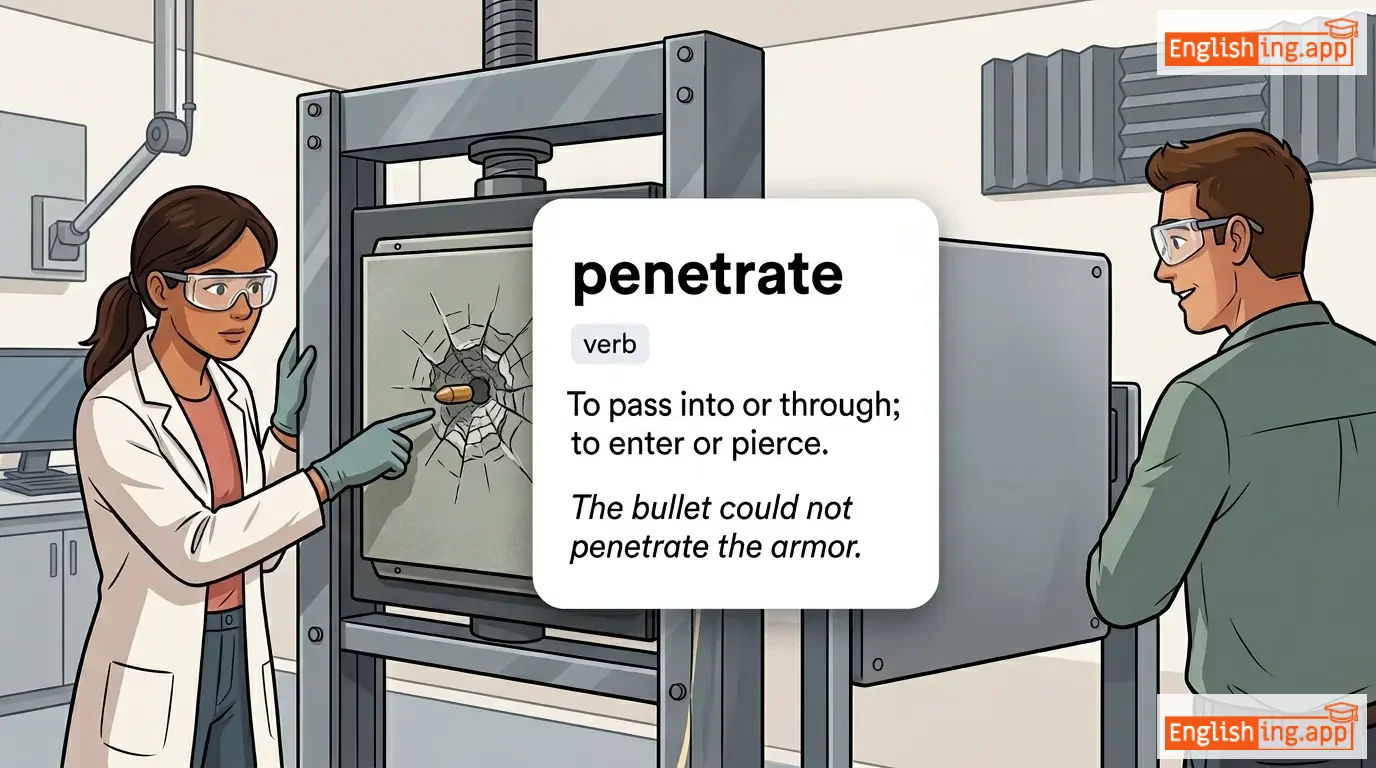
penetrate definition card — visual illustration of the meaning
verb
/ˈpɛnɪtreɪt/
pénétrer (penetrer)

To pass into or through; to enter or pierce.

"The bullet could not penetrate the armor."

"La balle n'a pas pu pénétrer l'armure." (La balle n'a pas pu pénétrer l'armure.)
noun
/ˌpɛnɪˈtreɪʃən/
pénétration (penetration)

The act of piercing or entering into something.

"The company's market penetration grew rapidly."

"La pénétration du marché de l'entreprise a rapidement augmenté." (La penetration du marche de l'entreprise a rapidement augmente.)
noun
/pəˈnɪn.sjə.lə/
péninsule (peninsule)

a piece of land that is almost completely surrounded by water but connected to the mainland

"The Korean Peninsula is located in East Asia."

"La péninsule coréenne est située en Asie de l'Est." (La peninsula coreenne est situee en Asie de l'Est.)
adjective
/pəˈnɪnsjələr/
péninsulaire (peninsulaire)

Relating to or resembling a peninsula.

"The peninsular region is surrounded by water on three sides."

"La région péninsulaire est entourée d'eau sur trois côtés." (La region peninsulaire est entouree d'eau sur trois cotes.)
noun
/ˈpɛnɪtəns/
pénitence (penitans)

The action or feeling of showing sorrow and regret for having done wrong.

"His eyes were full of penitence after realizing his mistake."

"Ses yeux étaient pleins de pénitence après avoir réalisé son erreur." (Ses yeux étaient pleins de pénitence après avoir réalisé son erreur.)
adjective
/ˈpɛnɪtənt/
pénitent (penitent)

Feeling or showing sorrow and regret for having done wrong.

"She was penitent after shouting at her friend."

"Elle était pénitente après avoir crié sur son amie." (Elle était pénitente après avoir crié sur son amie.)
adjective
/ˌpɛnɪˈtɛnʃəl/
pénitent (penitent)

Relating to or expressing penitence or penance.

"The priest delivered a penitential sermon on forgiveness."

"Le prêtre a donné un sermon pénitent sur le pardon." (Le prêtre a donné un sermon pénitent sur le pardon.)
noun
/ˈpɛnənt/
pennon (pennon)

A tapering flag used for signaling or as an emblem of victory or achievement.

"The team raised the championship pennant proudly."

"L'équipe a fièrement brandi le pennon du championnat." (L'équipe a fièrement brandi le pennon du championnat.)
adjective
/ˈpɛneɪt/
en forme de plume (en forme de plume)

Having parts or structures arranged like a feather; feather-shaped.

"The fern has a pennate leaf structure."

"La structure de la feuille de fougère est en forme de plume." (La structure de la feuille de fougère est en forme de plume.)
adjective
/ˈpen.ɪ.ləs/
sans argent; extrêmement pauvre; complètement sans fonds (sans argent; extrêmement pauvre; complètement sans fonds)

having no money; extremely poor; completely without funds

"After losing his job, he became penniless."

"Après avoir perdu son emploi, il est devenu sans argent." (Après avoir perdu son emploi, il est devenu sans argent.)
noun
/ˈpɛni/
centime (centime)

a small coin of low value; a very small amount of money

"He found a penny on the sidewalk and smiled."

"Il a trouvé un centime sur le trottoir et a souri." (il a trouve un centime sur le trottoir et a souri)
noun
/pɪˈnɒlədʒi/
pénologie (penologie)

The study of prison management and criminal rehabilitation.

"He decided to specialize in penology to help improve the prison system."

"Il a décidé de se spécialiser en pénologie pour améliorer le système pénitentiaire." (Il a decide de se specialiser en penologie pour ameliorer le systeme penitencier.)
noun
/ˈpɛnʃən/
pension (pension)

A regular payment made during a person's retirement from an investment fund or employer.

"After 30 years of service, he received a monthly pension."

"Après 30 ans de service, il a reçu une pension mensuelle." (Apres 30 ans de service, il a recu une pension mensuelle.)
adjective
/ˈpɛnsɪv/
pensif/pensive (pensif/pensive)

Engaged in deep or serious thought.

"She looked pensive as she stared out of the window."

"Elle avait l'air pensive en regardant par la fenêtre." (Elle avait l'air pensive en regardant par la fenêtre.)
adjective
/ˈpent ʌp/
réprimé; restreint; confiné (reprime; restreint; confine)

suppressed; restrained; confined

"He had pent-up anger that finally exploded."

"Il avait de la colère réprimée qui a finalement explosé." (Il avait de la colère réprimée qui a finalement explosé.)
noun
/ˈpɛntæd/
groupe de cinq (groupe de cinq)

A group or set of five things.

"The committee was divided into a pentad of working groups."

"Le comité a été divisé en cinq groupes de travail." (Le comité a été divisé en cinq groupes de travail.)
noun
/ˈpɛntəɡən/
pentagone (pentagone)

A plane figure with five straight sides and five angles; also refers to the US Department of Defense building.

"The Pentagon is one of the most iconic government buildings in the United States."

"Le Pentagone est l'un des bâtiments gouvernementaux les plus emblématiques des États-Unis." (Le Pentagone est lun des batiments gouvernementaux les plus emblematiques des EtatsUnis)
noun
/ˈpɛntəˌɡræm/
pentagramme (pentagramme)

A five-pointed star often used as a symbol in magic, mysticism, or religion.

"The wizard drew a pentagram on the floor as part of the ritual."

"Le magicien a tracé un pentagramme sur le sol dans le cadre du rituel." (Le magicien a trace un pentagramme sur le sol dans le cadre du rituel.)
noun
/ˌpɛntəˈhiːdrən/
pentaèdre (pentaedre)

A solid geometric figure with five faces.

"In geometry class, the teacher explained the structure of a pentahedron."

"Dans le cours de géométrie, le professeur a expliqué la structure d'un pentaèdre." (Dans le cours de geometri, le professeur a explique la structure d'un pentaedre.)
noun
/pɛnˈtæmɪtər/
pentamètre (pentametre)

A line of verse consisting of five metrical feet.

"Shakespeare often wrote his plays in iambic pentameter."

"Shakespeare écrivait souvent ses pièces en pentamètre iambique." (Shakespeare ecrivait souvent ses pieces en pentametre iambique.)
noun
/pɛnˈtæθlɒn/
pentathlon (pentathlon)

An athletic contest featuring five different events.

"She trained hard to compete in the modern pentathlon."

"Elle s'est entraînée dur pour participer au pentathlon moderne." (Elle s'est entrainee dur pour participer au pentathlon moderne.)
adjective
/ˌpɛntəˈveɪlənt/
pentavalent (pentavalent)

Having a valence of five, especially in chemistry.

"Phosphorus can exist in a pentavalent state."

"Le phosphore peut exister dans un état pentavalent." (Le phosphore peut exister dans un état pentavalent.)
adjective
/pəˈnʌltɪmət/
avant-dernier (avant-dernier)

second to the last in a sequence or series

"She finished the penultimate chapter before going to sleep."

"Elle a terminé le avant-dernier chapitre avant d'aller dormir." (Elle a termine le avant-dernier chapitre avant d'aller dormir.)
noun
/pəˈnʌmbrə/
zone partiellement ombragée (zone partiellement ombragée)

a partially shaded area around the shadow of an object, especially during an eclipse

"The moon’s penumbra created a dim shadow over the Earth."

"La pénumbra de la lune a créé une ombre tamisée sur la Terre." (La pénumbra de la lune a créé une ombre tamisée sur la Terre.)
adjective
/pəˈnjʊəriəs/
extrêmement pauvre (extremement pauvre)

extremely poor; poverty-stricken; miserly

"The penurious family struggled to buy food."

"La famille extrêmement pauvre peinait à acheter de la nourriture." (La famille extremement pauvre peinait à acheter de la nourriture.)
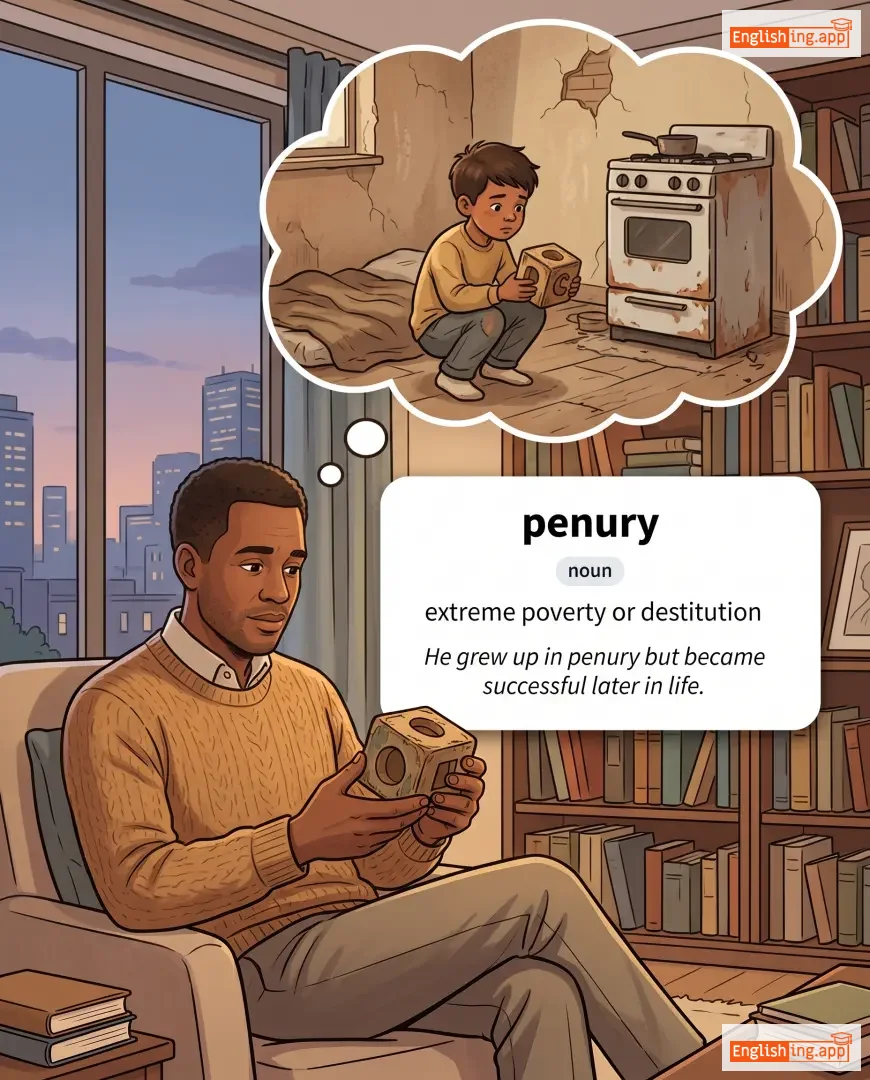
penury definition card — visual illustration of the meaning
noun
/ˈpɛnjʊri/
pauvreté extrême (pauvreté extrême)

extreme poverty or destitution

"He grew up in penury but became successful later in life."

"Il a grandi dans la pénurie, mais il est devenu prospère plus tard dans la vie." (Il a grandi dans la pénurie, mais il est devenu prospère plus tard dans la vie.)
noun
/ˈpiːɒn/
péon (peon)

a low-ranking worker, often performing menial tasks

"The office peon delivered the files to each department."

"Le péon du bureau a remis les dossiers à chaque département." (Le péon du bureau a remis les dossiers à chaque département.)
noun
/ˈpiːpl/
gens (jans)

a group of human beings collectively

"The people in the town gathered for the festival."

"Les gens dans la ville se sont rassemblés pour le festival." (Lez zhan daans la veet se sont rassamblés pour le festival.)
noun
/ˈpɛpər/
poivre (poivre)

a pungent spice obtained from pepper plants, used to flavor food

"I like to add pepper to my soup."

"J'aime ajouter du poivre à ma soupe." (J'aime ajouter du poivre à ma soupe.)
preposition
/pɜːr/
par (par)

for each, according to

"The tickets are priced at $20 per person."

"Les billets sont au prix de 20 $ par personne." (Les billets sont au prix de 20 dollars par personne.)
noun
/pɜːr bɔɪld raɪs/
riz précuit (riz precuit)

Rice that has been partially boiled in the husk before milling; parboiled rice

"Per boiled rice retains more nutrients than regular white rice."

"Le riz précuit conserve plus de nutriments que le riz blanc ordinaire." (Le riz précuit conserve plus de nutriments que le riz blanc ordinaire.)
adverb
/pɜːr ˈseɪ/
en soi (en soi)

By or in itself; intrinsically.

"The idea is not bad per se, but it needs improvement."

"L'idée n'est pas mauvaise en soi, mais elle a besoin d'amélioration." (L'idée n'est pas mauvaise en soi, mais elle a besoin d'amélioration.)
verb
/pəˈræmbjʊˌleɪt/
flâner (flâner)

To walk through or travel around, especially for leisure.

"They perambulated the old town, enjoying the sights."

"Ils ont flâné dans la vieille ville, profitant des vues." (Ils ont flâné dans la vieille ville, profitant des vues.)
noun
/pəˈræm.bjə.leɪ.tər/
poussette (perambulator)

a four-wheeled carriage for a baby; baby stroller or pram

"She pushed the perambulator through the park while the baby slept peacefully."

"Elle poussait le pérambulateur à travers le parc pendant que le bébé dormait paisiblement." (Elle poussait le pérambulateur à travers le parc pendant que le bébé dormait paisiblement.)
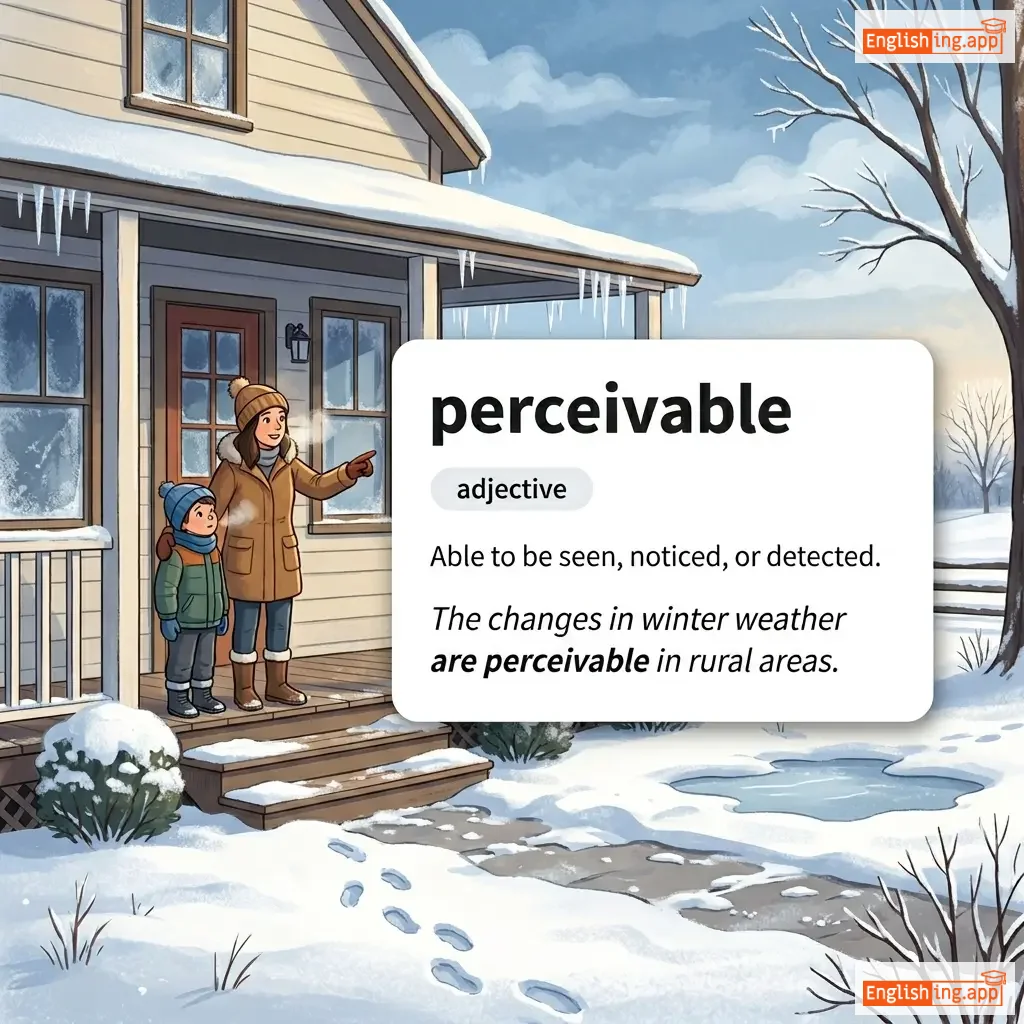
perceivable definition card — visual illustration of the meaning
adjective
পারসিভেবল
perceptible (perceptible)

Able to be seen, noticed, or detected.

"The changes in winter weather are perceivable in rural areas."

"Les changements climatiques hivernaux sont perceptibles dans les zones rurales." (Les changements climatiques hivernaux sont perceptibles dans les zones rurales.)
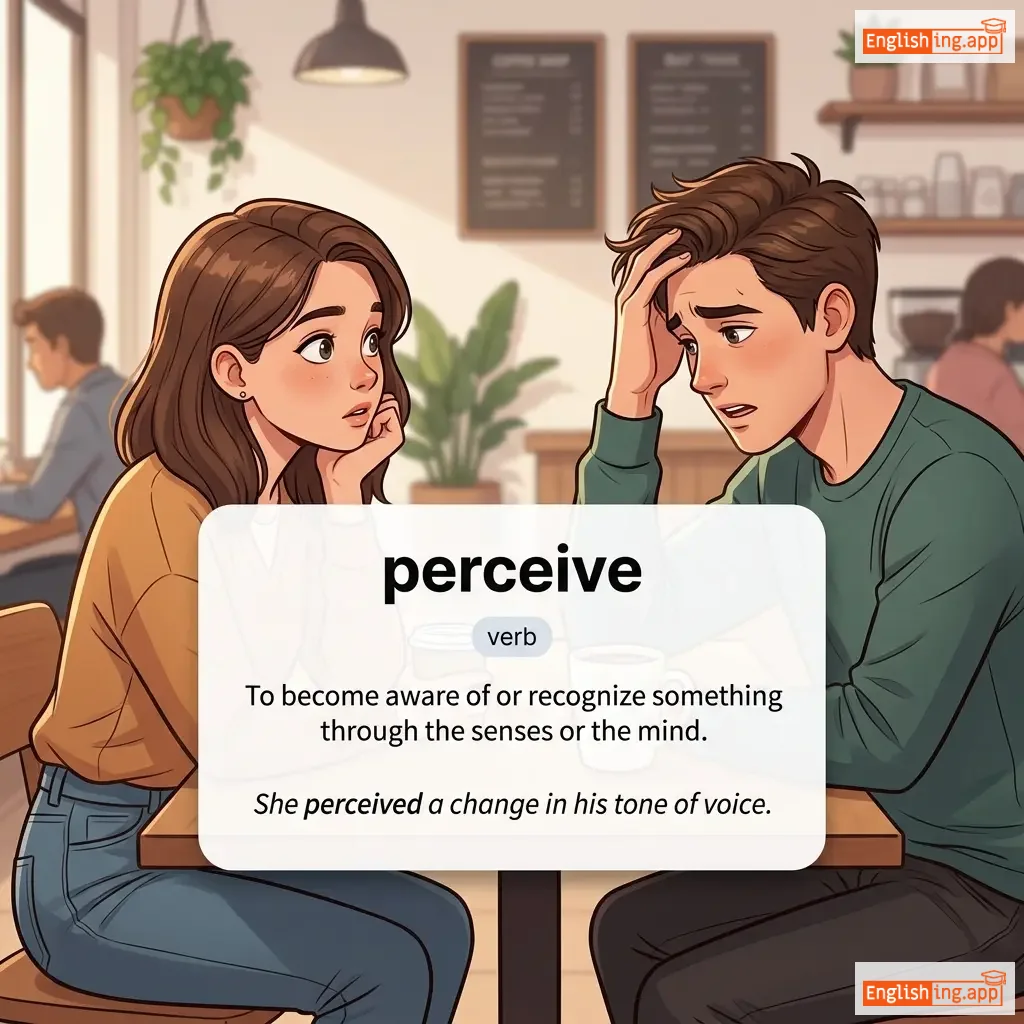
perceive definition card — visual illustration of the meaning
verb
/pərˈsiːv/
percevoir (per-suh-vwar)

To become aware of or recognize something through the senses or the mind.

"She perceived a change in his tone of voice."

"Elle a perçu un changement dans son ton de voix." (El ah per-suh un shahm-zhuh-mon dahn son tohn duh vwah.)
👁️

perceived

verb
/pərˈsiːvd/
bonheur (bonheur)

to become aware of something through the senses or the mind; to understand or interpret

"She perceived a hint of sadness in his voice."

"Elle n'a pas pu cacher son bonheur lorsqu'elle a reçu le prix." (Elle n'a pas pu cacher son bonheur lorsqu'elle a reçu le prix.)
noun; adverb
/pərˈsɛnt/
pour cent (pour cent)

a proportion out of one hundred; by each hundred

"Sales increased by ten percent this year."

"Les ventes ont augmenté de dix pour cent cette année." (Les ventes ont augmente de dix pour cent cette annee)
noun
/pərˈsɛntɪdʒ/
pourcentage (pourcentage)

a proportion or share in relation to a whole

"The percentage of students who passed the exam was high."

"Le pourcentage d'étudiants ayant réussi l'examen était élevé." (Le pourcentage d'etudiants ayant reussi l'examen etait eleve.)
adjective
/pərˈsɛptəbl̩/
perceptible (perceptible)

Able to be noticed or recognized by the senses or the mind.

"There was a perceptible change in the atmosphere."

"Il y a eu un changement perceptible dans l'atmosphère." (Il y a eu un changement perceptible dans l'atmosphère.)