Vocabulaires

Découvrez, apprenez et maîtrisez le vocabulaire anglais

noun, verb, adjective
/ˈpeɪtənt/ or /ˈpætənt/
brevet (brevet)

a government license granting exclusive rights to an inventor; also to obtain such rights

"He patented his new invention to protect it from being copied."

"Il a breveté sa nouvelle invention pour la protéger contre la copie." (Il a breveté sa nouvelle invention pour la protéger contre la copie.)
adjective
/pəˈtɜːrnəl/
paternel (paternel)

Relating to or characteristic of a father.

"He took a paternal interest in the boy’s education."

"Il a pris un intérêt paternel dans l'éducation du garçon." (Il a pris un intérêt paternel dans l'éducation du garçon.)
noun
/pəˈtɜːrnəti/
paternité (paternite)

The state of being someone's father.

"He demanded a paternity test to confirm his relationship with the child."

"Il a exigé un test de paternité pour confirmer sa relation avec l'enfant." (Il a exigé un test de paternité pour confirmer sa relation avec l'enfant.)
noun
/pæθ/
chemin (chemin)

a way or track laid down for walking or made by continual treading

"She walked along the narrow path through the forest."

"Elle a marché le long du chemin étroit à travers la forêt." (Elle a marché le long du chemin étroit à travers la forêt.)
adjective
/pəˈθɛtɪk/
pathétique (pathetique)

Causing feelings of pity, sadness, or sometimes contempt.

"The team’s performance in the match was simply pathetic."

"La performance de l'équipe dans le match était simplement pathétique." (La performance de l'equipe dans le match etait simplement pathétique.)
adjective
/ˌpæθəˈdʒɛnɪk/
pathogène (pathogene)

Capable of causing disease.

"Some bacteria are harmless, while others are highly pathogenic."

"Certaines bactéries sont inoffensives, tandis que d'autres sont très pathogènes." (Certaines bactéries sont inoffensives, tandis que d'autres sont très pathogènes.)
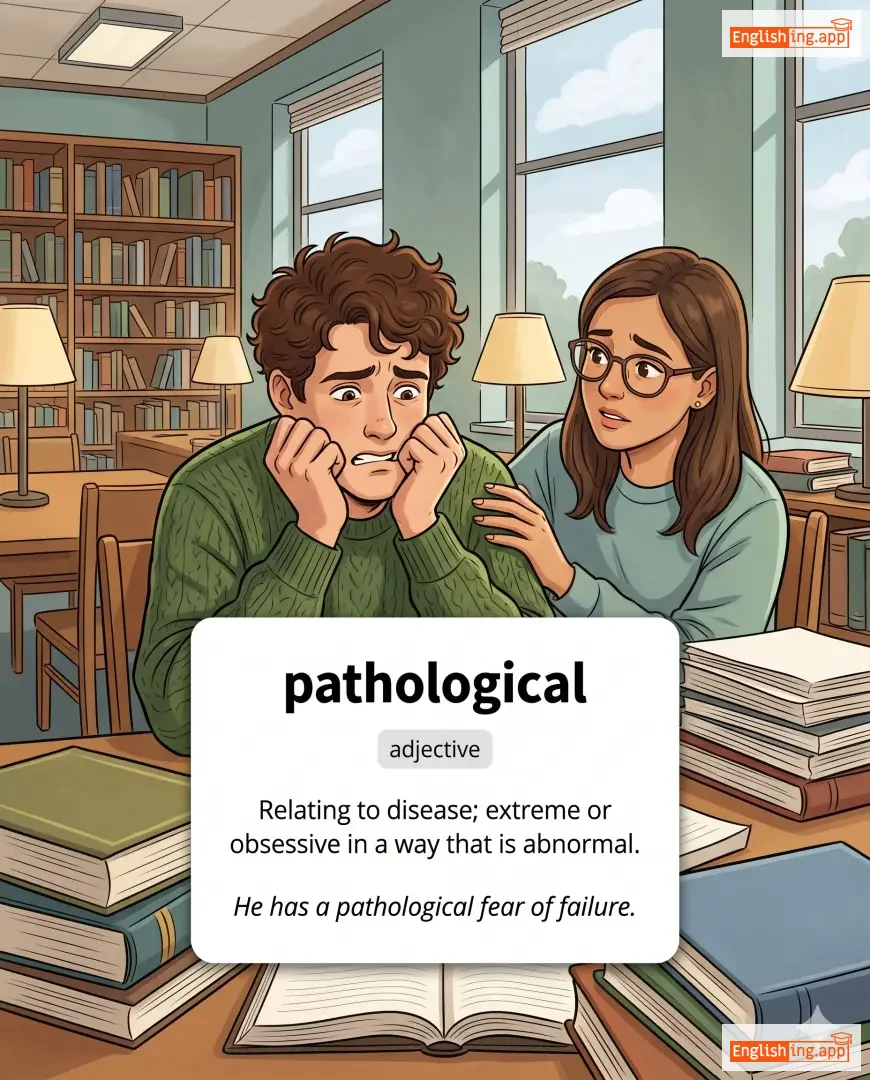
pathological definition card — visual illustration of the meaning
adjective
/ˌpæθəˈlɑːdʒɪkəl/
pathologique, maladif (pathologique, maladif)

Relating to disease; extreme or obsessive in a way that is abnormal.

"He has a pathological fear of failure."

"Il a une peur pathologique de l'échec." (Il a une peur pathologique de l'échec.)
noun
/pəˈθɒlədʒi/
pathologie (pathologie)

the scientific study of diseases, their causes, processes, and effects on the body

"Advances in pathology helped the doctors identify the rare infection quickly."

"Les avancées en pathologie ont aidé les médecins à identifier rapidement l'infection rare." (Les avances en pathologie ont aide les medecins a identifier rapidement l'infection rare.)
noun
/ˈpeɪθɒs/
pathos (pathos)

a quality in speech, writing, or events that evokes pity or deep emotion

"The documentary balanced pathos with hope, making the audience both weep and think."

"Le documentaire a équilibré le pathos avec l'espoir, faisant pleurer et réfléchir le public." (Le documentaire a equilibré le pathos avec l'espoir, faisant pleurer et reflechir le public.)
noun
/ˈpæθweɪ/
chemin (chemin)

a route or course along which something travels or progresses

"The narrow pathway led to the hidden garden."

"Le chemin étroit menait au jardin caché." (Le chemin étroit menait au jardin caché.)
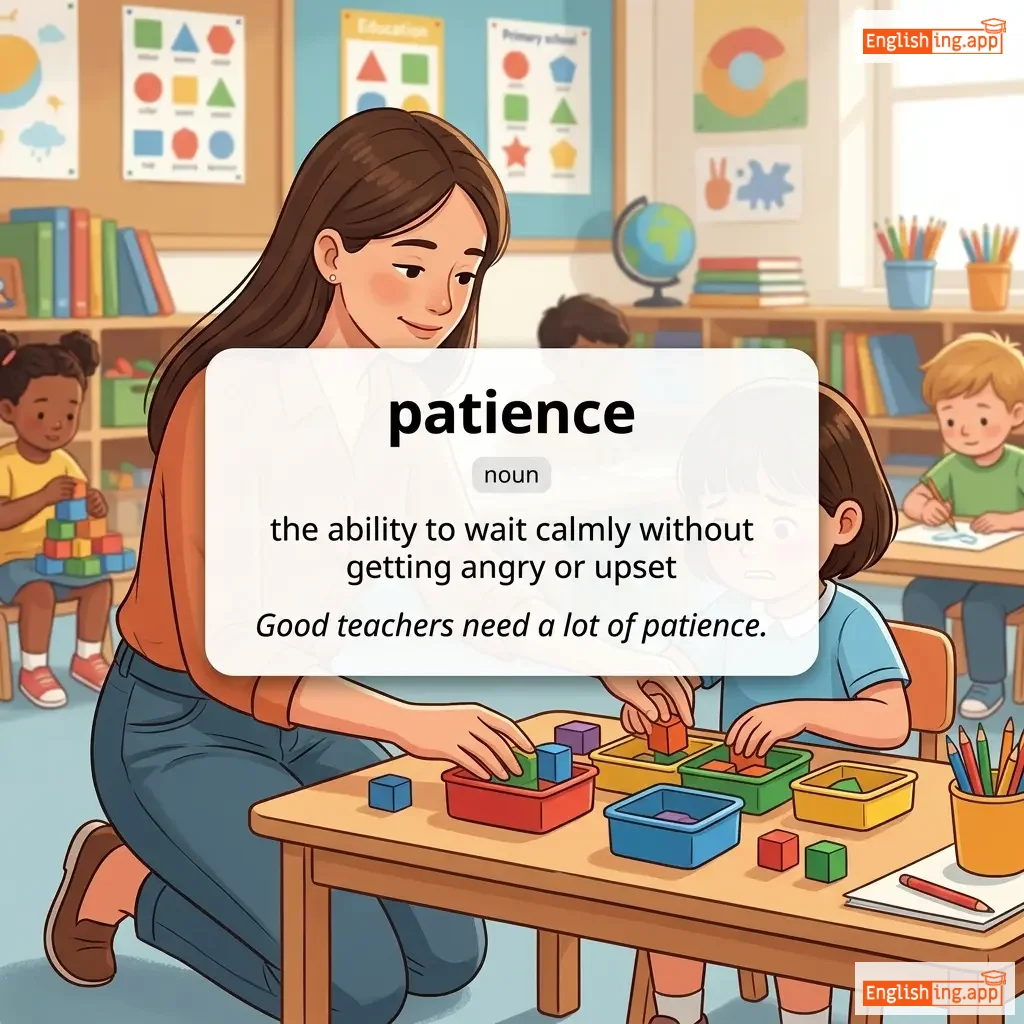
patience definition card — visual illustration of the meaning
noun
/ˈpeɪ.ʃəns/
patience (patience)

the ability to wait calmly without getting angry or upset

"Good teachers need a lot of patience."

"Les bons enseignants ont besoin de beaucoup de patience." (Les bons enseignants ont besoin de beaucoup de patience.)
🧘‍♀️

Patient (péshant)

adjective
/ˈpeɪʃənt/
patient (patient)

able to accept or tolerate delays, problems, or suffering without becoming annoyed or anxious

"She remained patient despite the long wait."

"Elle est restée patiente malgré la longue attente." (Elle est restée patiente malgré la longue attente.)
noun
/pəˈtiːnə/
un film ou une brillance sur le métal, la pierre ou le bois dû à l'âge ou à l'usage; aussi, une apparence superficielle (un film ou une brillance sur le metal, la pierre ou le bois du a l'age ou a l'usage; aussi, une apparence superficielle)

a surface film or sheen on metal, stone, or wood due to age or use; also, a superficial appearance

"The bronze statue developed a green patina after years in the sea air."

"La statue en bronze a développé une patine verte après des années passées dans l'air marin." (La statue en bronze a developpe une patine verte apres des annees passees dans l'air marin.)
noun
/ˈpætwɑː/
patois (patois)

a regional or social dialect, especially one considered nonstandard or informal

"The guide slipped into local patois when chatting with the fishermen."

"Le guide a commencé à parler en patois local en discutant avec les pêcheurs." (Le guide a commencé à parler en patois local en discutant avec les pêcheurs.)
noun
/ˈpeɪtriɑːrk/
patriarche (patriarche)

a male head of a family or tribe; an older respected man who leads a group

"As the family patriarch, he mediated disputes and kept long traditions alive."

"En tant que patriarche de la famille, il a résolu les conflits et a maintenu vivantes les traditions anciennes." (En tant que patriarche de la famille, il a résolu les conflits et a maintenu vivantes les traditions anciennes.)
noun, adjective
/pəˈtrɪʃən/
patricien (patricien)

A person of noble rank or high social standing; relating to aristocracy.

"The patrician families of Rome wielded great power in politics."

"Les familles patriciennes de Rome exerçaient une grande puissance en politique." (Les familles patriciennes de Rome exerçaient une grande puissance en politique.)
noun
/ˈpætrɪsaɪd/
patricide (patricide)

The act of killing one's own father.

"The ancient myth describes a son committing patricide to take the throne."

"Le mythe ancien décrit un fils commettant un patricide pour prendre le trône." (Le mythe ancien décrit un fils commettant un patricide pour prendre le trône.)
noun
/ˈpætrɪˌmoʊni/
patrimoine (patrimoine)

Property or inheritance passed down from one's father or ancestors.

"The castle was part of his patrimony from his noble ancestors."

"Le château faisait partie de son patrimoine provenant de ses ancêtres nobles." (Le château faisait partie de son patrimoine provenant de ses ancêtres nobles.)
noun
/ˈpeɪtriət/
patriote (patriote)

A person who loves and strongly supports their country.

"The patriot stood proudly under the national flag."

"Le patriote se tenait fièrement sous le drapeau national." (Le patriote se tenait fierement sous le drapeau national.)
adjective
/ˌpeɪ.triˈɑː.tɪk/
patriotique (patriotique)

showing love for one's country

"The patriotic citizens celebrated Independence Day with great enthusiasm."

"Les citoyens patriotes ont célébré le jour de l'indépendance avec grand enthousiasme." (Les citoyens patriotes ont celebre le jour de l'independance avec grand enthousiasme.)
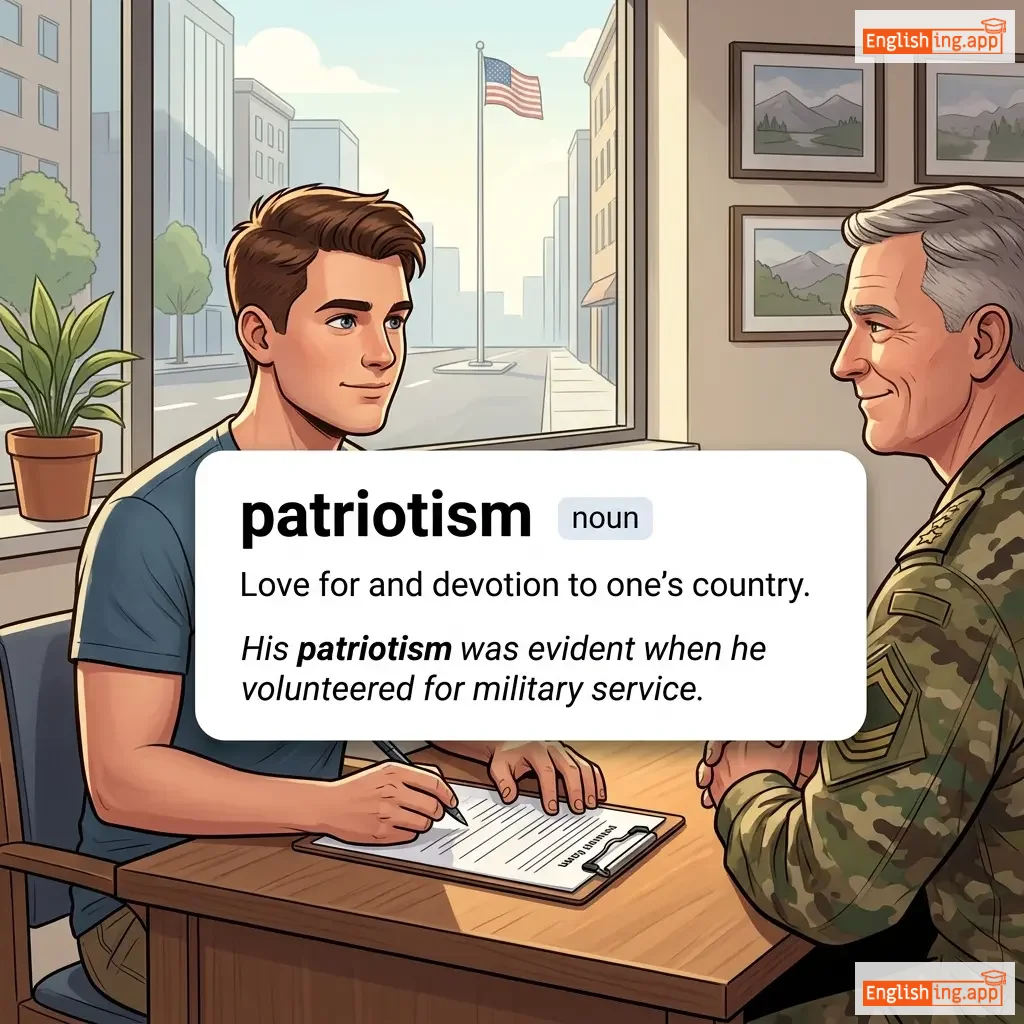
patriotism definition card — visual illustration of the meaning
noun
/ˈpeɪtriətɪzəm/
patriotisme (patriotisme)

Love for and devotion to one's country.

"His patriotism was evident when he volunteered for military service."

"Son patriotisme était évident lorsqu'il s'est porté volontaire pour le service militaire." (Son patriotisme etait evident lorsqu'il s'est porte volontaire pour le service militaire.)
verb
/pəˈtroʊl/
patrouiller (patrouiller)

to move around an area to watch or guard it

"The police patrol the streets at night to ensure safety."

"La police patrouille les rues la nuit pour assurer la sécurité." (La police patrouille les rues la nuit pour assurer la sécurité.)
noun
/ˈpeɪtrən/
mécène (mecene)

a person who gives financial or other support to a person, organization, or cause

"The library is supported by generous patrons."

"La bibliothèque est soutenue par des mécènes généreux." (La bibliothèque est soutenue par des mécènes généreux.)
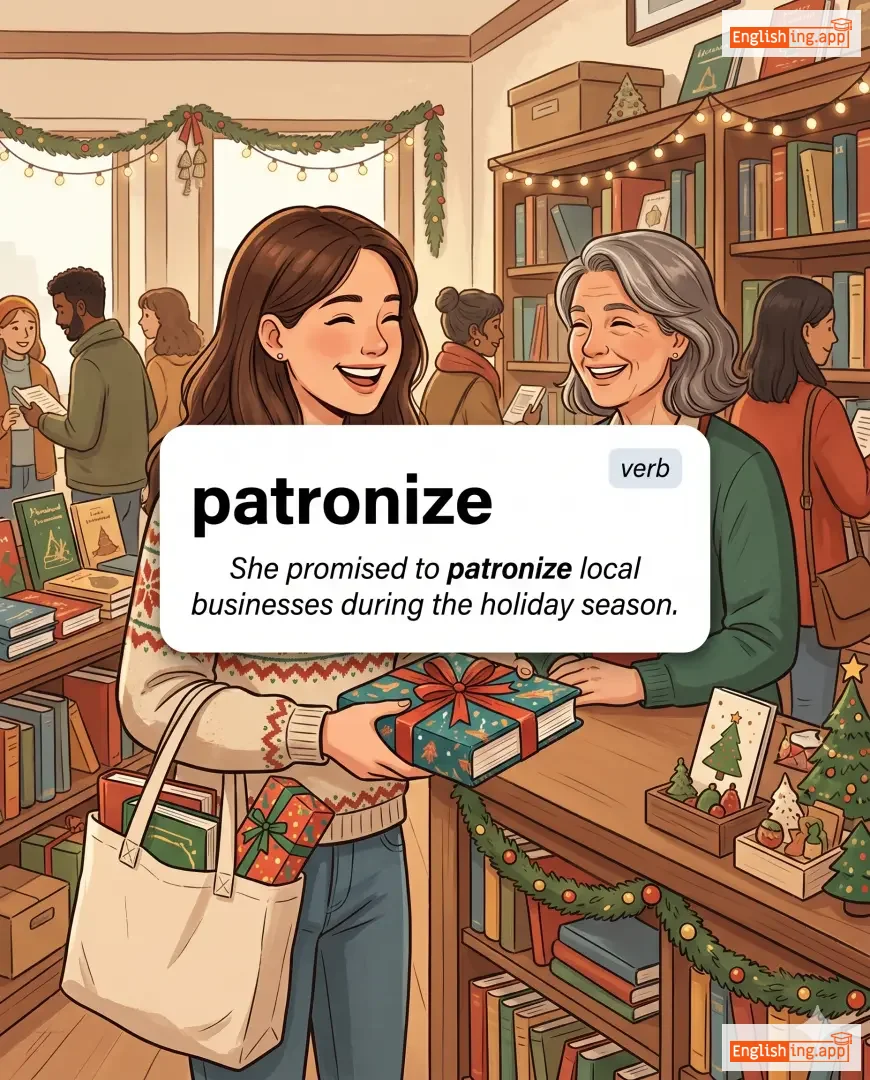
patronize definition card — visual illustration of the meaning
verb
/ˈpeɪtrənaɪz/
soutenir / traiter avec condescendance / être un client régulier (soutenir / traiter avec condescendance / être un client régulier)

to support or sponsor; to treat someone with apparent kindness that betrays a sense of superiority; to be a regular customer of a business

"She promised to patronize local businesses during the holiday season."

"Elle a promis de soutenir les commerces locaux pendant la saison des fêtes." (Elle a promis de soutenir les commerces locaux pendant la saison des fêtes.)
adjective
/ˈpeɪtrənaɪzɪŋ/
condescendant (condescendant)

showing kindness that is perceived as condescending or superior

"His patronizing tone offended the audience."

"Son ton condescendant a offensé le public." (Son ton condescendant a offensé le public.)
noun
/ˌpætrəˈnɪmɪk/
patronymique (patronymique)

a name derived from the name of a father or ancestor

"In many cultures, surnames are patronymic in origin."

"Dans de nombreuses cultures, les noms de famille sont d'origine patronymique." (Dans de nombreuses cultures, les noms de famille sont d'origine patronymique.)
verb
/ˈpætər/
faire un bruit de tapotements répétés / parler rapidement de manière mécanique (faire un bruit de tapotements répétés / parler rapidement de manière mécanique)

to make a repeated light tapping sound; to talk quickly in a rehearsed or mechanical way

"Rain pattered softly on the window."

"La pluie frappait doucement contre la fenêtre." (La pluie frappait doucement contre la fenêtre.)
/ˈpæt.ən/
motif / modèle (motif / modele)

A repeated decorative design or a regular way in which something happens or is done.

"The dress had a beautiful floral pattern."

"La robe avait un joli motif floral." (La robe avait un joli motif floral.)
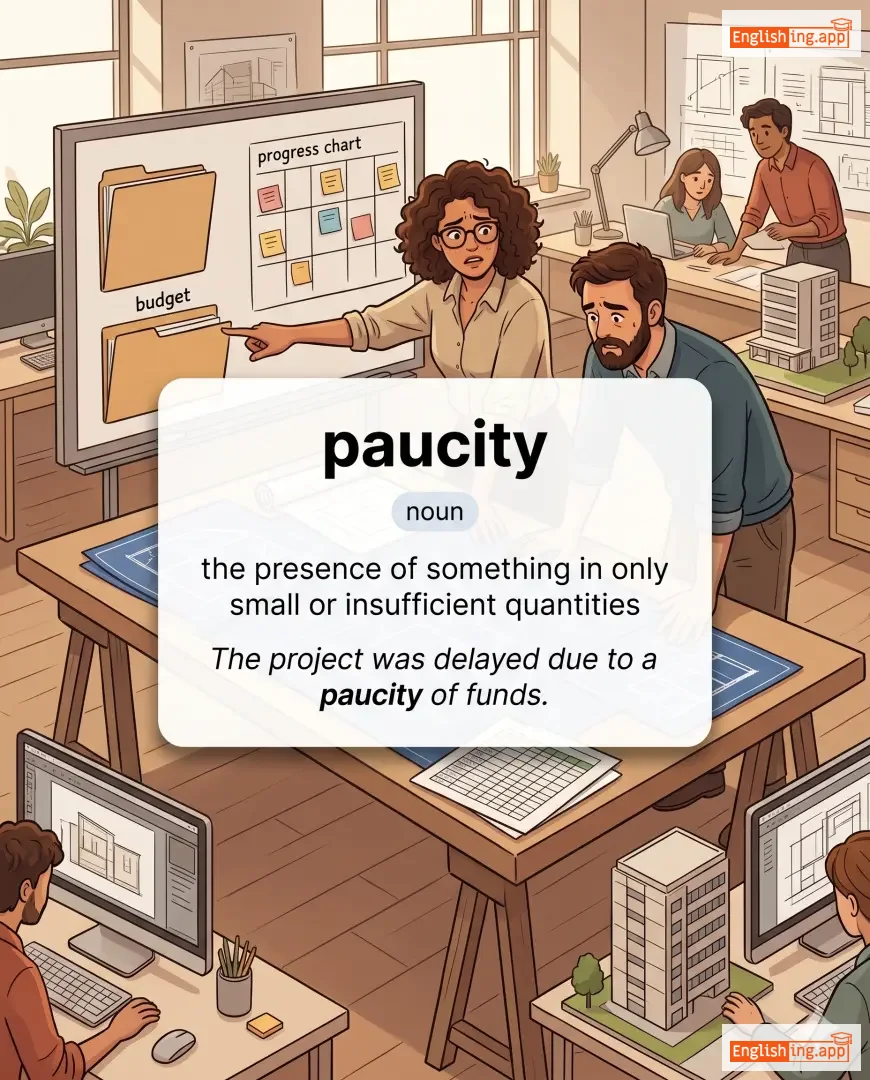
paucity definition card — visual illustration of the meaning
noun
/ˈpɔːsɪti/
pauvreté / manque (pauvrete / manque)

the presence of something in only small or insufficient quantities

"The project was delayed due to a paucity of funds."

"Le projet a été retardé en raison du manque de fonds." (Le projet a été retardé en raison du manque de fonds.)
adjective
/ˈpɔːntʃi/
ventru (ventru)

Having a large or protruding belly.

"The paunchy man struggled to button his shirt."

"L'homme ventru peinait à boutonner sa chemise." (L'homme ventru peinait à boutonner sa chemise.)
🧑‍🦲

pauper (póuper)

noun
/ˈpɔːpər/
mendiant (mendiant)

A very poor person.

"The pauper begged for food on the street corner."

"Le mendiant a demandé de la nourriture au coin de la rue." (Le mendiant a demandé de la nourriture au coin de la rue.)
noun
/ˈpɔːpərɪzəm/
pauvreté (pauvrete)

The state of being extremely poor.

"The country struggled with rising pauperism in the 19th century."

"Le pays a lutté contre le paupérisme croissant au XIXe siècle." (Le pays a lutté contre le paupérisme croissant au XIXe siècle.)
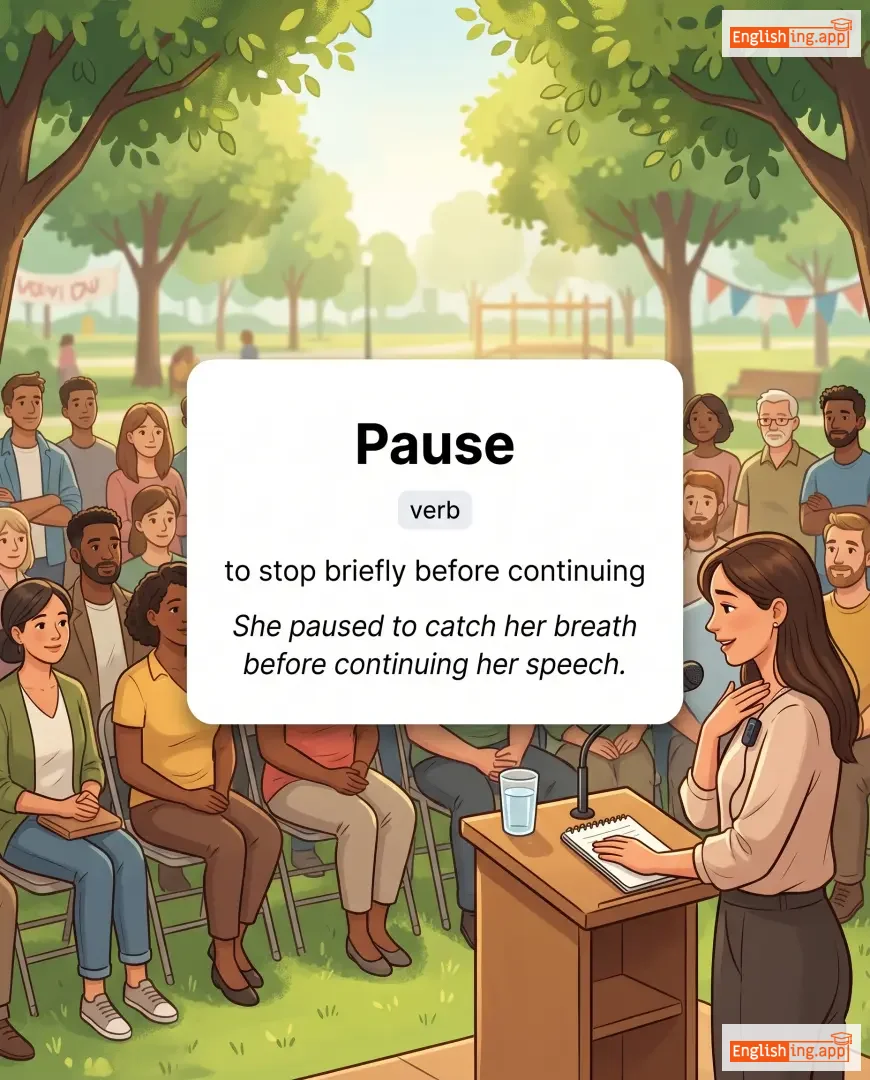
Pause definition card — visual illustration of the meaning
verb
/pɔːz/
pause (pause)

to stop briefly before continuing

"She paused to catch her breath before continuing her speech."

"Elle a fait une pause pour reprendre son souffle avant de continuer son discours." (Elle a fait une pause pour reprendre son souffle avant de continuer son discours.)
noun
/ˈpeɪvmənt/
trottoir (trottoir)

a hard paved surface such as a road or sidewalk; the act or result of paving

"She walked along the pavement to reach the bus stop."

"Elle a marché sur le trottoir pour aller à l’arrêt de bus." (elle a marche sur le trottoir pour aller a l arret de bus)
noun
/pəˈvɪliən/
chapiteau (chapiteau)

A large tent or temporary building, often used for events or exhibitions.

"The wedding reception was held in a decorated pavilion."

"La réception de mariage a eu lieu dans un chapiteau décoré." (La reception de mariage a eu lieu dans un chapiteau decoré.)
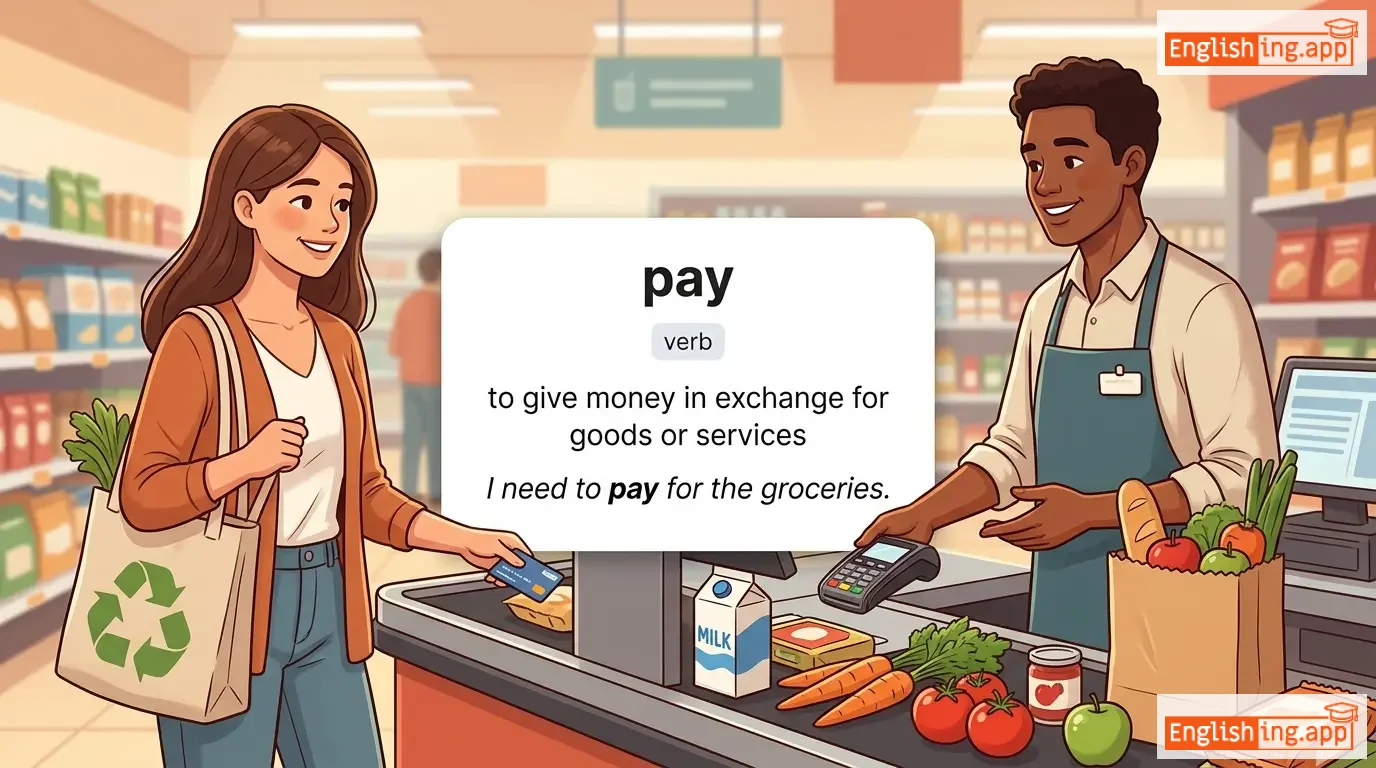
pay definition card — visual illustration of the meaning
verb
/peɪ/
payer (payer)

to give money in exchange for goods or services

"I need to pay for the groceries."

"Je dois payer pour les courses." (Je dois payer pour les courses.)
adjective
/ˈpeɪ.ə.bəl/
payable (payable)

required to be paid; owed as a debt

"The amount is payable within thirty days of the invoice date."

"Le montant est payable dans les trente jours suivant la date de la facture." (Le montant est payable dans les trente jours suivant la date de la facture.)
noun
/peɪˈiː/
bénéficiaire (beneficiaire)

A person to whom money is paid or is to be paid.

"The payee must sign the check before cashing it."

"Le bénéficiaire doit signer le chèque avant de l'encaisser." (Le bénéficiaire doit signer le chèque avant de l'encaisser.)
noun
/ˈpeɪmənt/
paiement (paiement)

the action or process of paying money for something

"The payment for the order was received yesterday."

"Le paiement pour la commande a été reçu hier." (Le paiement pour la commande a été reçu hier.)
noun
/ˈpiːˈsi/
ordinateur personnel (ordinateur personnel)

abbreviation for 'personal computer', a machine for performing digital operations

"I just bought a new PC for work."

"Je viens d'acheter un nouvel ordinateur personnel pour le travail." (Je viens d'acheter un nouvel ordinateur personnel pour le travail.)
noun
/piː/
pois (pois)

a small round green seed eaten as a vegetable

"The children enjoyed eating sweet peas with dinner."

"Les enfants ont apprécié de manger des pois sucrés avec le dîner." (Les enfants ont apprecie de manger des pois sucres avec le diner)
noun
/piːs/
paix (paix)

a state of tranquility or quiet, freedom from disturbance

"They hope for peace in the region."

"Ils espèrent la paix dans la région." (Ils espèrent la paix dans la région.)
adjective
/ˈpiːsəbl/
pacifique (pacifique)

inclined to avoid conflict; friendly and non-violent in nature

"She is a peaceable neighbor who never quarrels with anyone."

"Elle est une voisine pacifique qui ne se querelle jamais avec personne." (Elle est une voisine pacifique qui ne se querelle jamais avec personne.)
adjective
/ˈpiːsfl/
bonheur (bonheur)

free from disturbance; calm and tranquil

"The village remained peaceful even during the festival."

"Elle n'a pas pu cacher son bonheur quand elle a reçu le prix." (Elle n'a pas pu cacher son bonheur quand elle a reçu le prix.)
noun
/piːtʃ/
pêche (pêche)

a soft round fruit with fuzzy skin, sweet flesh, and a large pit in the center

"The peach was perfectly ripe and juicy when I bit into it."

"La pêche était parfaitement mûre et juteuse lorsque je l'ai mordue." (La pêche était parfaitement mûre et juteuse lorsque je l'ai mordue.)
noun
/ˈpiː.kɒk/
paon (paon)

a large bird with beautiful colorful tail feathers that can spread out like a fan

"The magnificent peacock displayed its colorful feathers to attract attention."

"Le magnifique paon a déployé ses plumes colorées pour attirer l'attention." (Le magnifique paon a deploie ses plumes colorees pour attirer l'attention.)
noun
/ˈpiː.kɒk ˈflaʊ.ər/
fleur de paon (fleur de paon)

a tropical tree with bright orange and red flowers that resemble a peacock's tail

"The peacock flower tree blooms with stunning orange flowers in summer."

"L'arbre de fleur de paon fleurit avec des fleurs orange éclatantes en été." (L'arbre de fleur de paon fleurit avec des fleurs orange éclatantes en été.)
noun
/ˈpiː.hən/
paonne (paonne)

female peacock

"The peahen is less colorful than the male peacock."

"La paonne est moins colorée que le paon mâle." (La paonne est moins colorée que le paon mâle.)
🏔️

Peak (pic)

noun
/piːk/
sommet (sommet)

the pointed top of a mountain or hill, or the highest point of something

"They reached the peak of the mountain after hours of hiking."

"Ils ont atteint le sommet de la montagne après des heures de randonnée." (Ils ont atteint le sommet de la montagne après des heures de randonnée.)
noun
/ˈpiːnʌt/
arachide (arachide)

a small seed with a thin shell, eaten as a snack or used to make oil and butter

"He loves eating roasted peanuts during the evening."

"Il aime manger des arachides grillées le soir." (Il aime manger des arachides grillees le soir.)