Vocabulaires

Découvrez, apprenez et maîtrisez le vocabulaire anglais

verb
/ˈpɔːltər/
parler de manière floue, tromper (parler de manière floue, tromper)

to act insincerely or deceitfully; to equivocate or lie

"He paltered when asked about his involvement in the deal."

"Il a évité la question lorsqu'on lui a demandé son implication dans l'accord." (Il a évité la question lorsqu'on lui a demandé son implication dans l'accord.)
adjective
/ˈpɔːltri/
insignifiant, dérisoire (insignifiant, dérisoire)

small or meager; lacking in value or importance

"They offered him a paltry sum for his work."

"Ils lui ont proposé une somme dérisoire pour son travail." (Ils lui ont proposé une somme dérisoire pour son travail.)
adjective
/ˈpeɪli/
rayé (raye)

striped with different colors, usually used in heraldry

"The knight’s shield was decorated with paly stripes of red and gold."

"Le bouclier du chevalier était décoré de rayures rayées rouges et dorées." (Le bouclier du chevalier était décoré de rayures rayées rouges et dorées.)
verb
/ˈpæmpər/
gâter / dorloter (gater / dorloter)

to treat with excessive care and attention; to spoil

"Parents often pamper their first child."

"Les parents gâtent souvent leur premier enfant." (Les parents gatent souvent leur premier enfant.)
noun
/ˈpæm.flət/
prospectus (prospectus)

a small booklet or brochure containing information or arguments about a subject

"The health department distributed a pamphlet about nutrition."

"Le département de la santé a distribué un prospectus sur la nutrition." (Le departement de la sante a distribue un prospectus sur la nutrition.)
noun, verb
/ˌpæm.fləˈtɪər/
écrivain de pamphlets (ecrivain de pamphlets)

a person who writes or distributes pamphlets, often to promote a political or social cause

"In the 18th century, many pamphleteers influenced public opinion."

"Au XVIIIe siècle, de nombreux écrivains de pamphlets ont influencé l'opinion publique." (Au XVIIIe siècle, de nombreux écrivains de pamphlets ont influencé l'opinion publique.)
noun, verb
/pæn/
poêle, casserole (poele, casserole)

a shallow container used for cooking; also means to criticize severely (verb)

"She cooked the eggs in a frying pan."

"Elle a cuisiné les œufs dans une poêle." (Elle a cuisine les oeufs dans une poele.)
adjective
/ˌpæn.əˈmer.ɪ.kən/
Panaméricain (panamericain)

relating to all the countries of North, Central, and South America

"The Pan-American Games bring together athletes from across the continent."

"Les Jeux panaméricains rassemblent des athlètes de tout le continent." (Les Jeux panamericains rassemblent des athlètes de tout le continent.)
noun
/ˌpænəˈsiːə/
panacée (panasee)

A solution or remedy for all difficulties or diseases.

"Education is often seen as a panacea for social problems."

"L'éducation est souvent considérée comme une panacée pour les problèmes sociaux." (L'education est souvent consideree comme une panacee pour les problemes sociaux.)
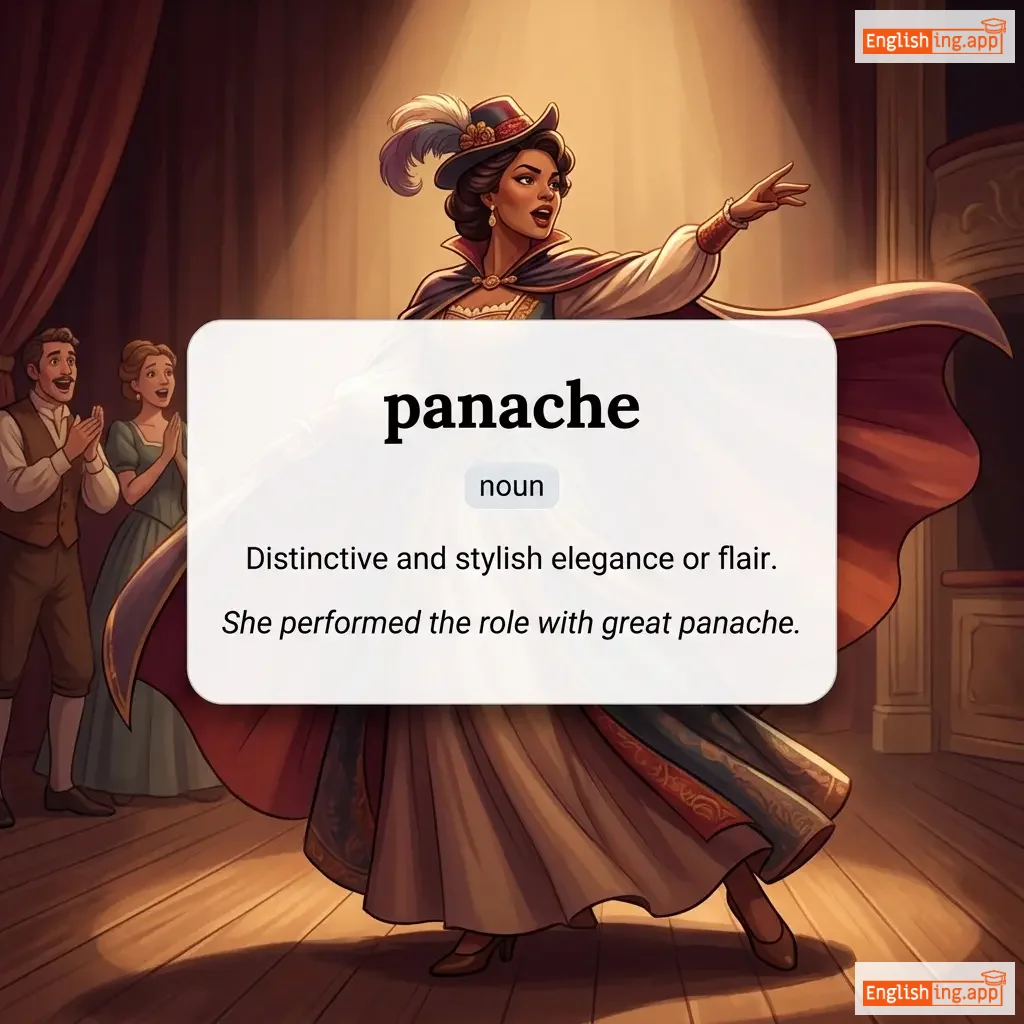
panache definition card — visual illustration of the meaning
noun
/pəˈnæʃ/
élégance distinctive (elegance distinctive)

Distinctive and stylish elegance or flair.

"She performed the role with great panache."

"Elle a joué le rôle avec beaucoup de panache." (Elle a joué le rôle avec beaucoup de panache.)
noun
/pʌntʃ ˈfoʊrən/
panch phoron (panch phoron)

a Bengali spice blend containing five whole spices: cumin, fennel, fenugreek, nigella, and mustard seeds

"The aroma filled the kitchen when she heated panch phoron in oil."

"L'arôme a rempli la cuisine lorsqu'elle a chauffé le panch phoron dans de l'huile." (L'arôme a rempli la cuisine lorsqu'elle a chauffé le panch phoron dans de l'huile.)
noun
/ˈpæŋkriəs/
pancréas (pancreas)

A gland in the abdomen that produces insulin and digestive enzymes.

"The pancreas plays a vital role in digestion and blood sugar regulation."

"Le pancréas joue un rôle vital dans la digestion et la régulation du sucre sanguin." (Le pancreas joue un role vital dans la digestion et la regulation du sucre sanguin.)
noun
/pænˈdɛmɪk/
pandémie (pandemie)

An outbreak of a disease that occurs on a global scale.

"The COVID-19 pandemic changed the world dramatically."

"La pandémie de COVID-19 a changé le monde de manière spectaculaire." (La pandemie de COVID-19 a change le monde de maniere spectaculaire.)
noun
/ˌpændəˈmoʊniəm/
panique (panique)

Wild and noisy disorder or confusion; uproar.

"When the concert was canceled, pandemonium broke out among the crowd."

"Lorsque le concert a été annulé, le pandémonium a éclaté parmi la foule." (Lorsque le concert a été annulé, le pandémonium a éclaté parmi la foule.)
verb
/ˈpændər/
flatter, cirer les bottes (flatter, cirer les bottes)

to indulge or exploit the weaknesses, desires, or immoral tendencies of others

"The politician was accused of pandering to voters' fears."

"Le politicien a été accusé de flatter les peurs des électeurs." (Le politicien a été accusé de flatter les peurs des électeurs.)
noun
/ˌpænəˈdʒɪrɪk/
panégyrique, éloge (panegyrique, eloge)

a formal speech or piece of writing in praise of someone or something

"The author wrote a panegyric on the bravery of the soldiers."

"L'auteur a écrit un panégyrique sur le courage des soldats." (L'auteur a écrit un panégyrique sur le courage des soldats.)
noun
/ˈpænəl/
panel, groupe de juges (panel, groupe de juges)

a group of people gathered to discuss, judge, or advise on a particular topic

"The panel of judges announced the winner of the competition."

"Le panel de juges a annoncé le gagnant de la compétition." (Le panel de juges a annoncé le gagnant de la compétition.)
noun
/pæŋ/
une douleur aiguë ou un malaise émotionnel soudain (une douleur aiguë ou un malaise émotionnel soudain)

a sudden sharp feeling of pain or emotional distress

"She felt a pang of guilt after the argument."

"Elle a ressenti un pang de culpabilité après la dispute." (Elle a ressenti un pang de culpabilité après la dispute.)
noun/verb
/ˈpænɪk/
bonheur (bonheur)

a sudden overwhelming fear or anxiety causing irrational behavior

"The crowd panicked when the fire alarm went off."

"Elle n'a pas pu cacher son bonheur quand elle a reçu le prix." (Elle n'a pas pu cacher son bonheur quand elle a recu le prix.)
adjective
/ˈpæn.ɪ.ki/
paniqué; anxieux et craintif (panike; anxieux et craintif)

feeling or showing panic; anxious and fearful

"The crowd became panicky when the fire alarm sounded."

"La foule est devenue paniquée lorsque l'alarme incendie a retenti." (La foule est devenue paniquée lorsque l'alarme incendie a retenti.)
/ˈpæn.ə.pli/
panoplie (panoplie)

A complete or impressive collection of things; a full set of armor.

"The museum displayed a panoply of ancient weapons."

"Le musée a présenté une panoplie d'armements anciens." (Le musée a présenté une panoplie d'armements anciens.)
noun
/ˌpæn.əˈræm.ə/
panorama (panorama)

An unbroken view of the whole region surrounding an observer.

"From the hilltop, we enjoyed a breathtaking panorama of the city."

"Depuis le sommet de la colline, nous avons apprécié un panorama époustouflant de la ville." (Depuis le sommet de la colline, nous avons apprécié un panorama époustouflant de la ville.)
adjective
/ˌpæn.əˈræm.ɪk/
vue panoramique (vue panoramique)

Giving a wide view of an extensive area in all directions.

"The hotel offers panoramic views of the ocean."

"L'hôtel offre des vues panoramiques de l'océan." (L'hôtel offre des vues panoramiques de l'océan.)
noun
/pænt/
pantalon (pantalon)

a piece of clothing worn from the waist down, covering both legs separately

"He wore a pair of blue pants to the party."

"Il portait un pantalon bleu à la fête." (Il portait un pantalon bleu à la fête.)
noun
/ˈpæn.θi.ɪ.zəm/
panthéisme (pantheisme)

The belief that God and the universe are identical, or that everything is a manifestation of God.

"Spinoza’s philosophy is often associated with pantheism."

"La philosophie de Spinoza est souvent associée au panthéisme." (La philosophie de Spinoza est souvent associée au panthéisme.)
noun
/ˈpæn.θi.ən/
tous les dieux, temple dédié à tous les dieux (tous les dieux, temple dédié à tous les dieux)

All the gods of a religion collectively; a building dedicated to all gods.

"The Roman Pantheon is one of the best-preserved ancient temples."

"Le Panthéon romain est l'un des temples antiques les mieux conservés." (Le Pantheon romain est l'un des temples antiques les mieux conservés.)
noun
/ˈpæntəmaɪm/
pantomime (pantomime)

A type of theatrical performance using gestures and movements without spoken words; in Britain, a musical comedy play for families performed at Christmas.

"The children enjoyed the Christmas pantomime at the local theater."

"Les enfants ont apprécié la pantomime de Noël au théâtre local." (Les enfants ont apprecie la pantomime de Noel au theatre local.)
noun
/ˈpæntəˌskoʊp/
instrument optique offrant une vue panoramique (instrument optique offrant une vue panoramique)

An optical instrument that provides a wide or panoramic view.

"The scientist used a pantoscope to observe the entire horizon."

"Le scientifique a utilisé un pantoscope pour observer tout l'horizon." (Le scientifique a utilisé un pantoscope pour observer tout l'horizon.)
noun
/ˈpæntri/
garde-manger (garde-manger)

A small room or cupboard where food, dishes, and kitchen supplies are stored.

"She stocked the pantry with fresh groceries for the week."

"Elle a rempli le garde-manger de provisions fraîches pour la semaine." (Elle a rempli le garde-manger de provisions fraîches pour la semaine.)
👨‍👧

papa (papa)

noun
/ˈpɑːpə/
papa (papa)

an informal or affectionate term for one’s father

"Papa is picking me up from school today."

"Papa vient me chercher à l’école aujourd’hui." (papa vient me chercher a lecole aujourdhui)
noun
/ˈpeɪpəsi/
papauté (papauté)

The office or authority of the Pope in the Roman Catholic Church.

"The papacy played a significant role in medieval European politics."

"La papauté a joué un rôle important dans la politique médiévale européenne." (La papauté a joué un rôle important dans la politique médiévale européenne.)
noun
/pəˈpaɪə/
papaye (papaye)

a large orange tropical fruit with sweet orange flesh and black seeds

"Papaya is rich in vitamins and very good for health."

"La papaye est riche en vitamines et très bonne pour la santé." (La papaye est riche en vitamines et très bonne pour la santé.)
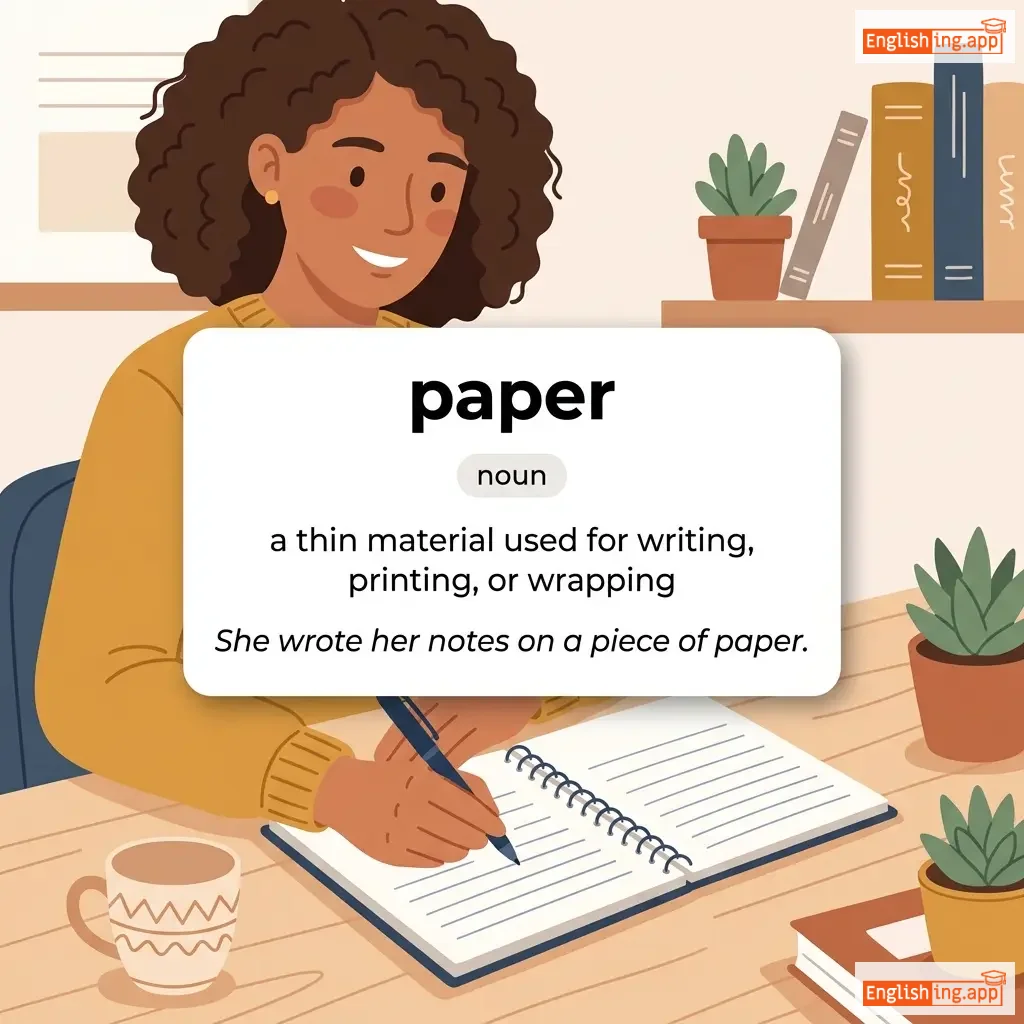
paper definition card — visual illustration of the meaning
noun
/ˈpeɪpər/
papier (papier)

a thin material used for writing, printing, or wrapping

"She wrote her notes on a piece of paper."

"Elle a écrit ses notes sur un morceau de papier." (Elle a ecrit ses notes sur un morceau de papier.)
noun
/pəˈpaɪrəs/
papyre (papyre)

An ancient writing material made from the pith of the papyrus plant; also refers to the plant itself.

"The ancient scroll was written on papyrus."

"Le rouleau ancien a été écrit sur du papyrus." (Le rouleau ancien a été écrit sur du papyrus.)
noun
/ˈpærəbl/
parabole (parabole)

A simple story used to illustrate a moral or spiritual lesson.

"Jesus often taught using a parable to convey deeper truths."

"Jésus enseignait souvent en utilisant une parabole pour transmettre des vérités profondes." (Jésus enseignait souvent en utilisant une parabole pour transmettre des vérités profondes.)
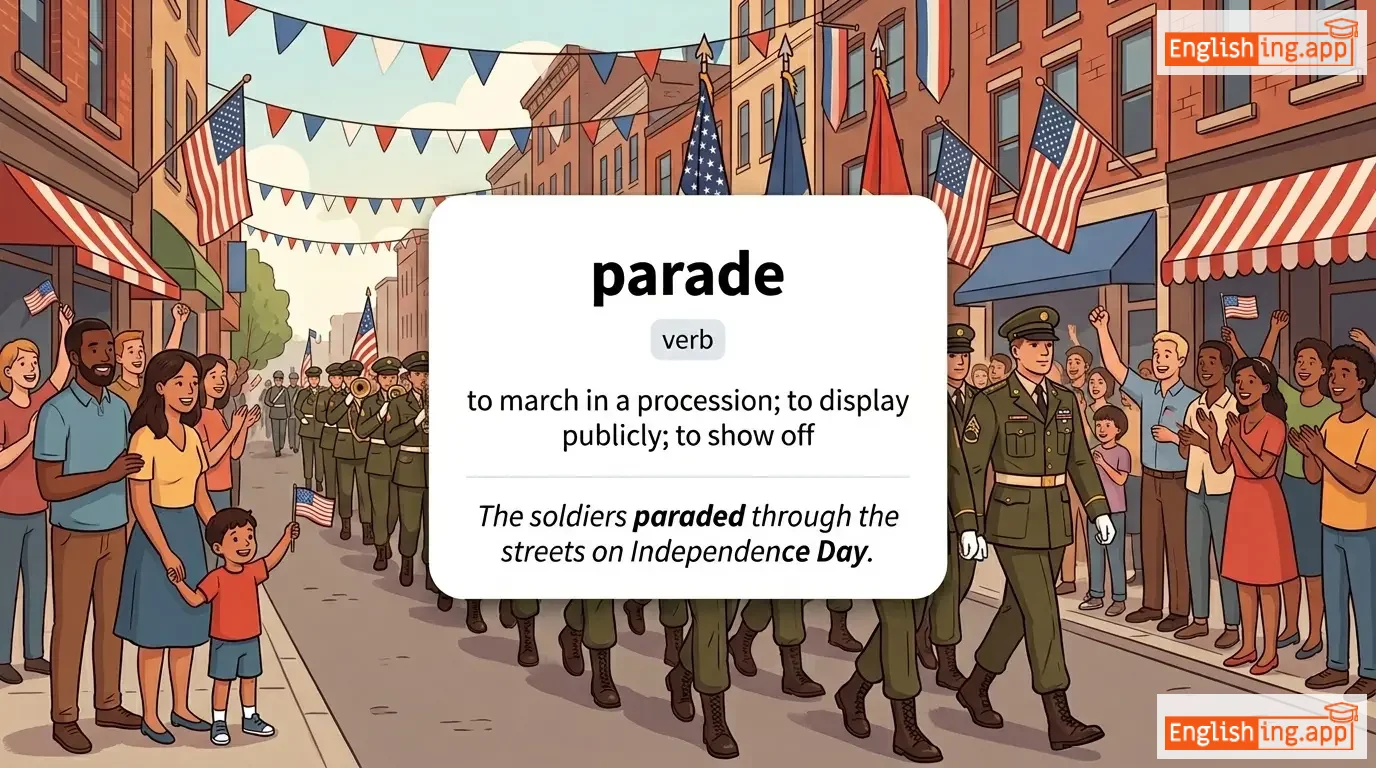
parade definition card — visual illustration of the meaning
noun
/pəˈreɪd/
défilé / procession (defile / procession)

a public procession, especially one celebrating a special day or event

"Thousands of people attended the Independence Day parade."

"Des milliers de personnes ont assisté au défilé du Jour de l'Indépendance." (Des milliers de personnes ont assiste au defile du Jour de l'Independance.)
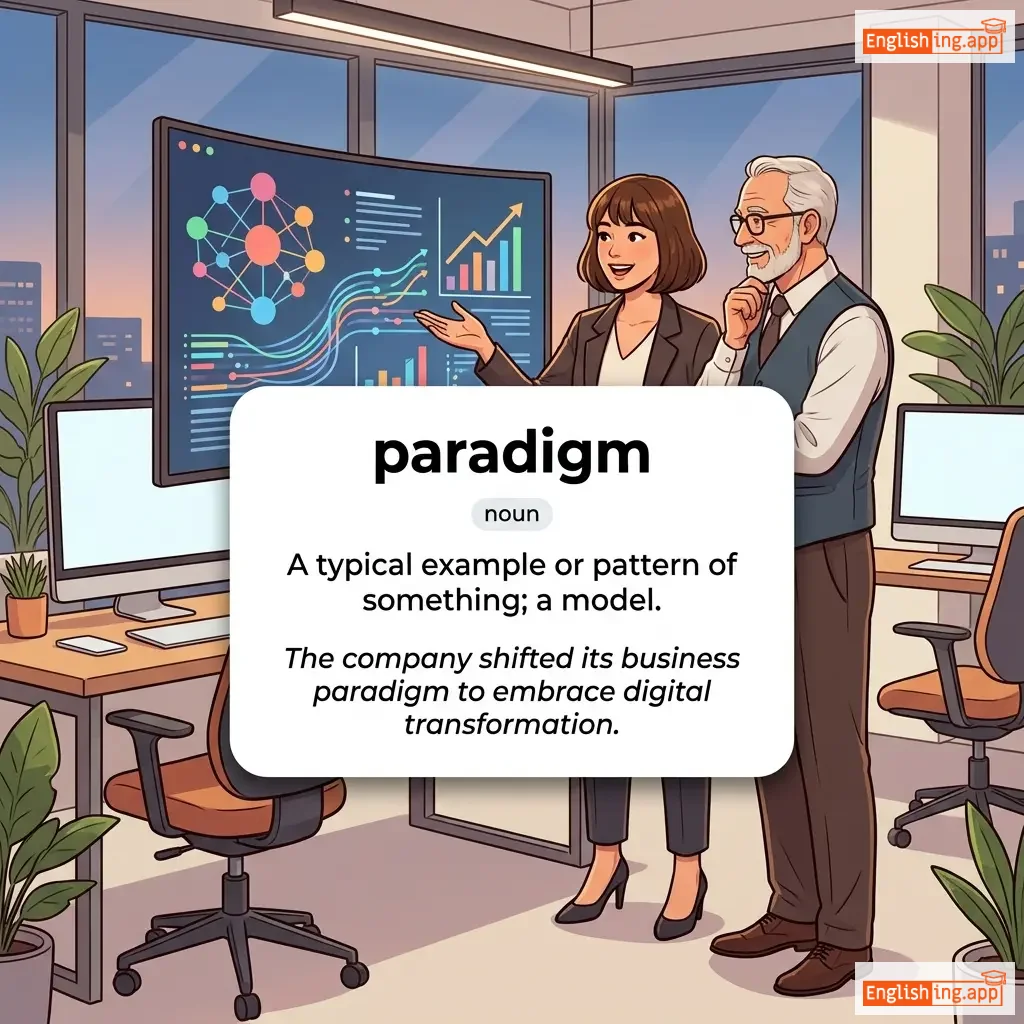
paradigm definition card — visual illustration of the meaning
noun
/ˈpærədaɪm/
modèle (modele)

A typical example or pattern of something; a model.

"The company shifted its business paradigm to embrace digital transformation."

"L'entreprise a changé son paradigme commercial pour adopter la transformation numérique." (L'entreprise a change son paradigme commercial pour adopter la transformation numerique.)
adjective
/ˌpærəˈdɪɡmətɪk/
paradigmatique (paradigmatique)

Serving as a typical example or model of something.

"Her success story is paradigmatic of the opportunities education can provide."

"Son histoire de succès est paradigmatique des opportunités que l'éducation peut offrir." (Son histoire de succès est paradigmatique des opportunités que l'éducation peut offrir.)
noun
/ˈpærədaɪs/
paradis (paradis)

An ideal or perfect place of happiness; often thought of as heaven.

"The tropical island felt like a true paradise."

"L'île tropicale semblait être un véritable paradis." (L'île tropicale semblait être un véritable paradis.)
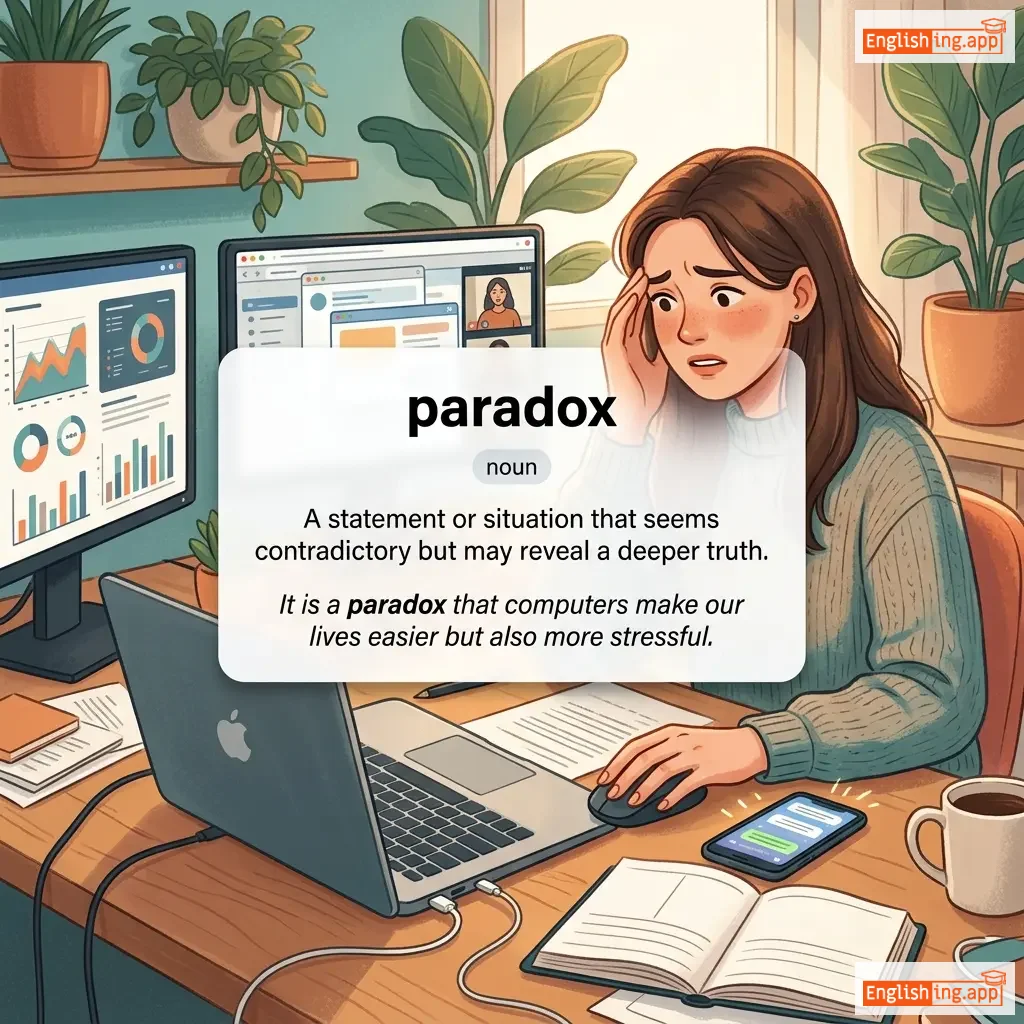
paradox definition card — visual illustration of the meaning
noun
/ˈpærədɒks/
paradoxe (paradoxe)

A statement or situation that seems contradictory but may reveal a deeper truth.

"It is a paradox that computers make our lives easier but also more stressful."

"C'est un paradoxe que les ordinateurs rendent nos vies plus faciles mais aussi plus stressantes." (C'est un paradoxe que les ordinateurs rendent nos vies plus faciles mais aussi plus stressantes.)
adjective
/ˌpærəˈdɒksɪkəl/
paradoxal (paradoxal)

Seemingly contradictory or opposed to common sense, yet possibly true.

"It is paradoxical that standing is often more tiring than walking."

"Il est paradoxal que rester debout soit souvent plus fatiguant que de marcher." (Il est paradoxal que rester debout soit souvent plus fatiguant que de marcher.)
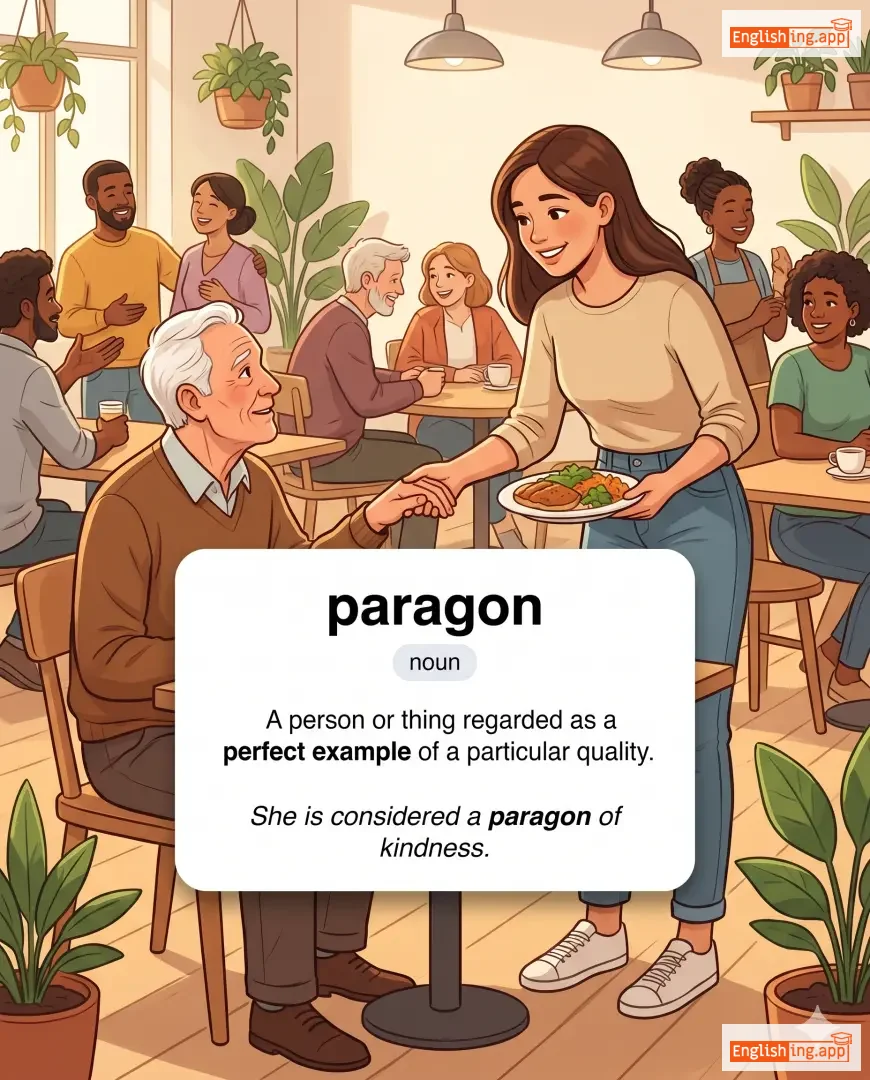
paragon definition card — visual illustration of the meaning
noun
/ˈpærəɡɒn/
parangon (parangon)

A person or thing regarded as a perfect example of a particular quality.

"She is considered a paragon of kindness."

"Elle est considérée comme un parangon de gentillesse." (Elle est considérée comme un parangon de gentillesse.)
noun
/ˈpær.ə.kiːt/
perruche (perruche)

a small colorful parrot with a long tail, often kept as a pet

"The green parakeet learned to say hello."

"La perruche verte a appris à dire bonjour." (La perruche verte a appris à dire bonjour.)
noun, adjective, verb
/ˈpærəˌlɛl/
parallèle (parallele)

Lines, objects, or events that are side by side and never meet; similarity or comparison.

"The road runs parallel to the railway."

"La route suit une ligne parallèle au chemin de fer." (La route suit une ligne parallele au chemin de fer.)
noun
/ˈpærəˌlɛlɪzəm/
parallélisme (parallelisme)

The state of being parallel or similar; in literature, the use of components in a sentence that are grammatically the same or similar in construction.

"The writer used parallelism to give rhythm to his prose."

"L'écrivain a utilisé le parallélisme pour donner du rythme à sa prose." (L'ecrivain a utilise le parallelisme pour donner du rythme a sa prose.)
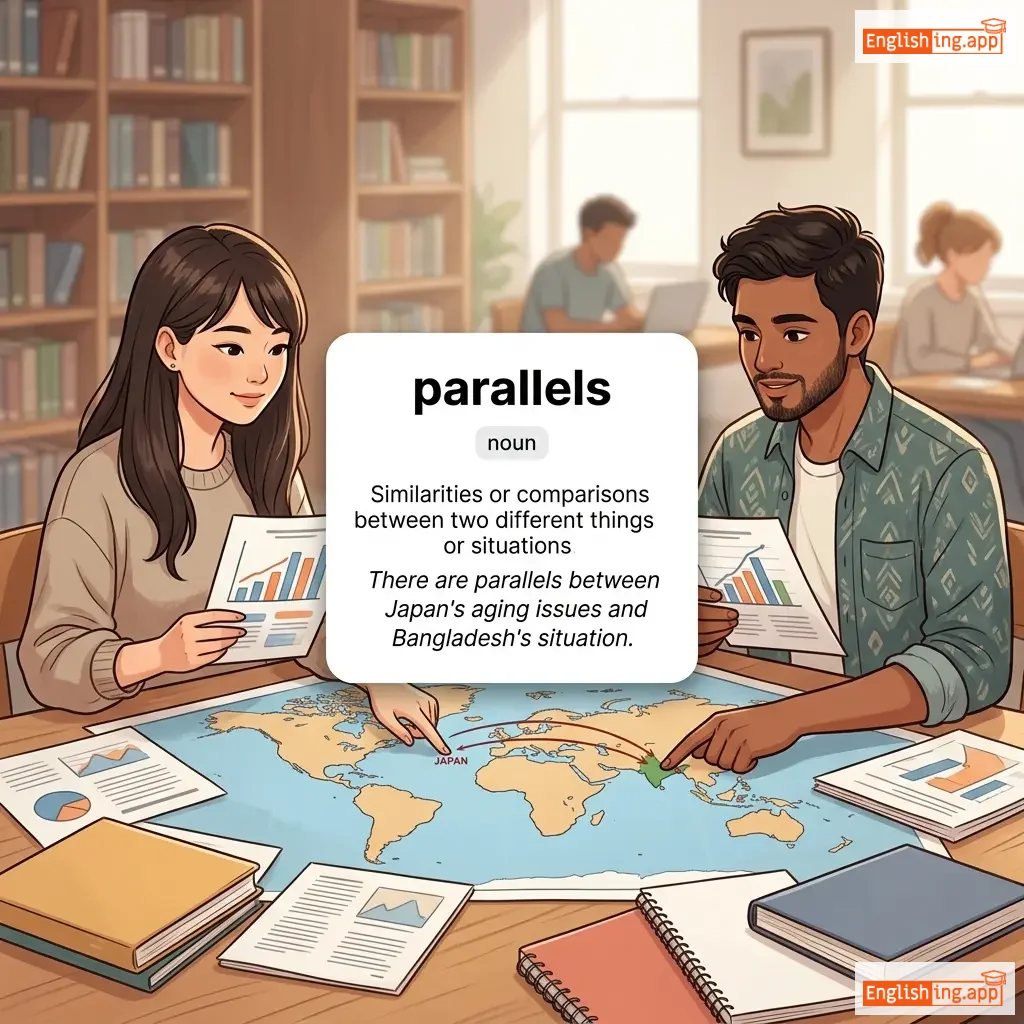
parallels definition card — visual illustration of the meaning
noun
ˈpærəˌlɛlz
parallèles (paralleles)

Similarities or comparisons between two different things or situations

"There are parallels between Japan's aging issues and Bangladesh's situation."

"Il existe des parallèles entre les problèmes de vieillissement du Japon et la situation du Bangladesh." (Il existe des parallèles entre les problèmes de vieillissement du Japon et la situation du Bangladesh.)
noun
/pəˈræləsɪs/
paralysie (paralysie)

Loss of the ability to move in part or most of the body, typically as a result of illness or injury.

"The accident left him with partial paralysis."

"L'accident l'a laissé avec une paralysie partielle." (L'accident l'a laisse avec une paralysie partielle.)
verb
/ˈpærəlaɪz/
paralysé (paralyze)

to cause someone or something to lose the ability to move or function normally

"The sudden shock seemed to paralyze him."

"Le choc soudain semblait le paralyser." (Le choc soudain semblait le paralyser.)
noun
/pəˈræmɪtər/
paramètre (parametre)

a limit, boundary, or measurable factor that defines or determines something

"We need to set clear parameters for this project."

"Nous devons définir des paramètres clairs pour ce projet." (Nous devons definir des parametres clairs pour ce projet.)
adjective
/ˈpærəmaʊnt/
de la plus haute importance (de la plus haute importance)

more important than anything else; supreme

"Safety is of paramount importance in this factory."

"La sécurité est de la plus haute importance dans cette usine." (La sécurité est de la plus haute importance dans cette usine.)