Vocabulaires

Découvrez, apprenez et maîtrisez le vocabulaire anglais

verb
/ˈpoʊ.lə.raɪz/
polariser (polariser)

to divide or cause to divide into two sharply contrasting groups or sets of opinions or beliefs

"The controversial decision polarized public opinion."

"La décision controversée a divisé l'opinion publique en deux groupes opposés." (La décision controversée a divisé l'opinion publique en deux groupes opposés.)
adjective
/ˈpoʊləraɪzd/
polarisé (polarisé)

divided into two sharply contrasting groups or opinions

"The debate polarized the community on the issue of climate change."

"Le débat a polarisé la communauté sur la question du changement climatique." (Le débat a polarisé la communauté sur la question du changement climatique.)
noun
/poʊl/
mât (mat)

a long, slender, vertical object or structure, typically made of wood, metal, or another material

"They placed the flag on top of the pole."

"Ils ont placé le drapeau au sommet du mât." (Ils ont place le drapeau au sommet du mat.)
noun
/pəˈlɛmɪk/
attaque polémique (attaque polemique)

a strong verbal or written attack on someone or something

"The article was a fierce polemic against the government's policies."

"L'article était une attaque polémique contre les politiques du gouvernement." (L'article etait une attaque polemique contre les politiques du gouvernement.)
adjective
/pəˈlɛmɪkəl/
polemique (polemique)

relating to or involving strongly critical or controversial writing or speech

"She wrote a polemical article challenging traditional beliefs."

"Elle a écrit un article polémique remettant en question les croyances traditionnelles." (Elle a ecrit un article polemique remettant en question les croyances traditionnelles.)
noun
/pəˈlɛmɪks/
polémique (polemique)

the art or practice of engaging in controversial debate or dispute

"The conference was full of polemics on economic reforms."

"La conférence était pleine de polémiques sur les réformes économiques." (La conference etait pleine de polemiques sur les reformes economiques.)
noun
/ˈpoʊl.stɑːr/
étoile polaire (etoile polaire)

a bright star that appears to stay in the same position in the sky and is used for navigation

"Sailors used the polestar to navigate across the ocean."

"Les marins ont utilisé l'étoile polaire pour naviguer à travers l'océan." (Les marins ont utilise l'etoile polaire pour naviguer a travers l'ocean.)
noun
/pəˈliːs/
police (police)

a body of officers representing the civil authority of government

"The police arrived quickly to investigate the scene."

"La police est arrivée rapidement pour enquêter sur la scène." (La police est arrivée rapidement pour enquêter sur la scène.)
noun
/pəˈliːsmən/
policier (policier)

a man whose job is to enforce the law and keep public order

"The policeman directed the traffic at the intersection."

"Le policier a dirigé la circulation à l'intersection." (Le policier a dirige la circulation a l'intersection.)
policy definition card — visual illustration of the meaning
noun
/ˈpɑːləsi/
politique (politique)

a course or principle of action adopted or proposed by an organization or individual

"The company revised its privacy policy last month."

"L'entreprise a révisé sa politique de confidentialité le mois dernier." (L'entreprise a révisé sa politique de confidentialité le mois dernier.)
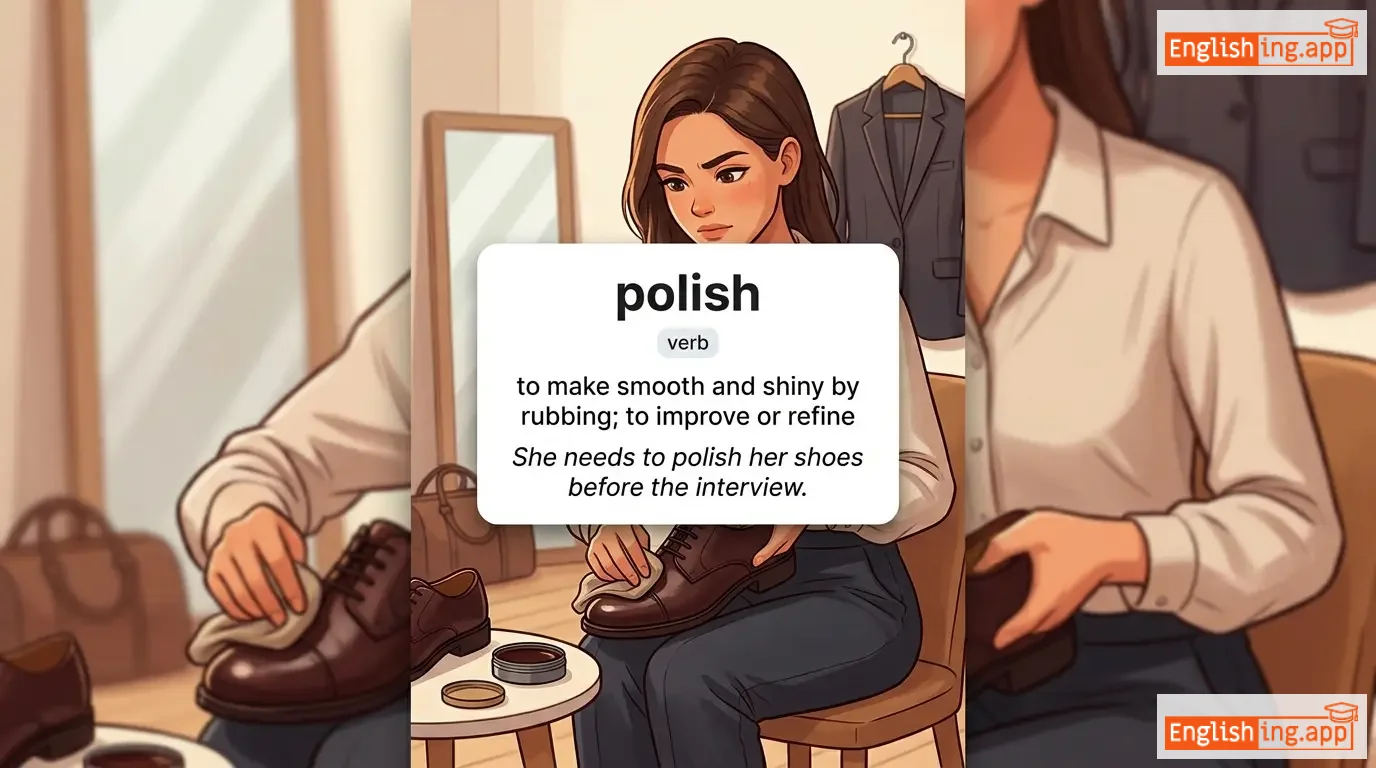
polish definition card — visual illustration of the meaning
verb
/ˈpɑːlɪʃ/
polir (polir)

to make smooth and shiny by rubbing; to improve or refine

"She needs to polish her shoes before the interview."

"Elle doit polir ses chaussures avant l'entretien." (Elle doit polir ses chaussures avant l'entretien.)
adjective
/ˈpɒlɪʃt/
soigné, raffiné et élégant (soigné, raffiné et élégant)

refined, sophisticated, and elegant in appearance or behavior

"She gave a polished performance at the recital."

"Elle a donné une performance soignée lors du récital." (Elle a donné une performance soignée lors du récital.)
adjective
/pəˈlaɪt/
bonheur (bonheur)

Showing good manners and respect towards others.

"He was very polite to the elderly woman."

"Elle n'a pas pu cacher son bonheur lorsqu'elle a reçu le prix." (Elle n'a pas pu cacher son bonheur lorsqu'elle a reçu le prix.)
adverb
/pəˈlaɪt.li/
poliment; (poliment)

in a respectful and considerate manner; courteously; with good manners

"She politely declined the invitation because she had other commitments."

"Elle a poliment décliné l'invitation car elle avait d'autres engagements." (Elle a poliment décliné l'invitation car elle avait d'autres engagements.)
adjective
/ˈpɒlɪtɪk/
astucieux, prudent (astucieux, prudent)

shrewd, prudent, or tactful in practical matters

"It was politic of him to remain silent during the argument."

"Il était astucieux de sa part de rester silencieux pendant l'argument." (Il etait astucieux de sa part de rester silencieux pendant l'argument.)
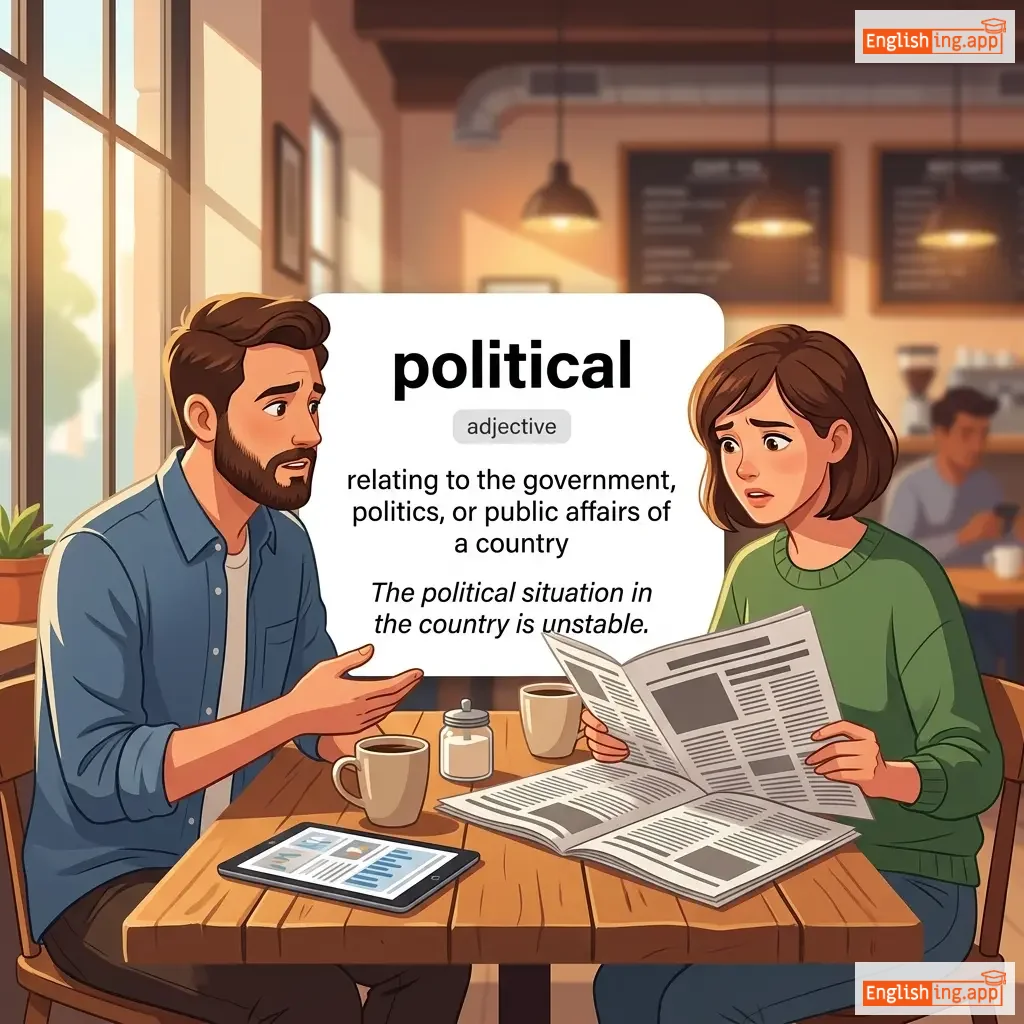
political definition card — visual illustration of the meaning
adjective
/pəˈlɪtɪkəl/
politique (politique)

relating to the government, politics, or public affairs of a country

"The political situation in the country is unstable."

"La situation politique dans le pays est instable." (La situation politique dans le pays est instable.)
adverb
/pəˈlɪtɪkəli/
politiquement (politiquement)

in a way that relates to politics or government

"The country is politically divided between two major parties."

"Le pays est politiquement divisé entre deux grands partis." (Le pays est politiquement divisé entre deux grands partis.)
noun
/pəˈlɪtɪʃən/
homme politique (homme politique)

a person who is involved in politics, especially as a profession

"The politician promised to improve the economy."

"L'homme politique a promis d'améliorer l'économie." (L'homme politique a promis d'améliorer l'économie.)
noun
/ˈpɒlɪtɪks/
politique (politique)

activities related to the governance of a country or area, especially the debate between parties having power

"Politics often involves making difficult decisions."

"La politique implique souvent de prendre des décisions difficiles." (La politique implique souvent de prendre des decisions difficiles.)
noun
/ˈpɒlɪti/
politique, système de gouvernement (politique, systeme de gouvernement)

an organized society or form of government

"The ancient Greek polity had a system of city-states."

"La politique grecque antique avait un système de cités-états." (La politique grecque antique avait un systeme de cites-etats.)
noun/verb
/pəʊl/
sondage (sondage)

a survey of public opinion or voting in an election

"The poll revealed that most people favored the new policy."

"Le sondage a révélé que la plupart des gens soutenaient la nouvelle politique." (Le sondage a révélé que la plupart des gens soutenaient la nouvelle politique.)
noun
/ˈpɒlən/
pollen (pollen)

fine powder produced by flowers, used in fertilization

"Bees collect pollen from flowers to make honey."

"Les abeilles collectent le pollen des fleurs pour fabriquer du miel." (Les abeilles collectent le pollen des fleurs pour fabriquer du miel.)
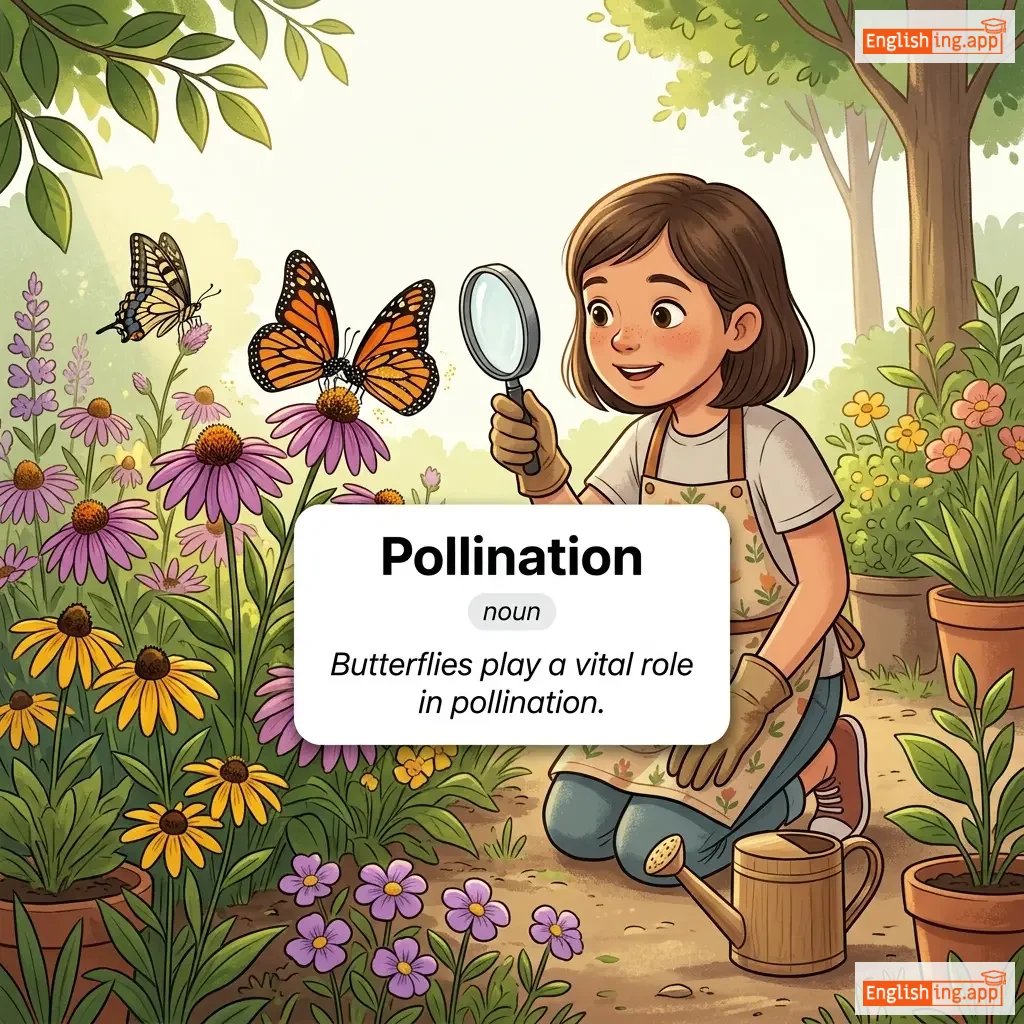
Pollination definition card — visual illustration of the meaning
noun
ˌpɒlɪˈneɪʃən
pollinisation (pollinisation)

The process by which pollen is transferred from flowers, enabling plant reproduction.

"Butterflies play a vital role in pollination."

"Les papillons jouent un rôle essentiel dans la pollinisation." (Les papillons jouent un role essentiel dans la pollinisation.)
noun
/ˈpoʊlstər/
sondeur (sondeur)

a person or organization that conducts surveys to gauge public opinion

"The pollster predicted a close election outcome."

"Le sondeur a prédit un résultat électoral serré." (Le sondeur a prédit un résultat électoral serré.)
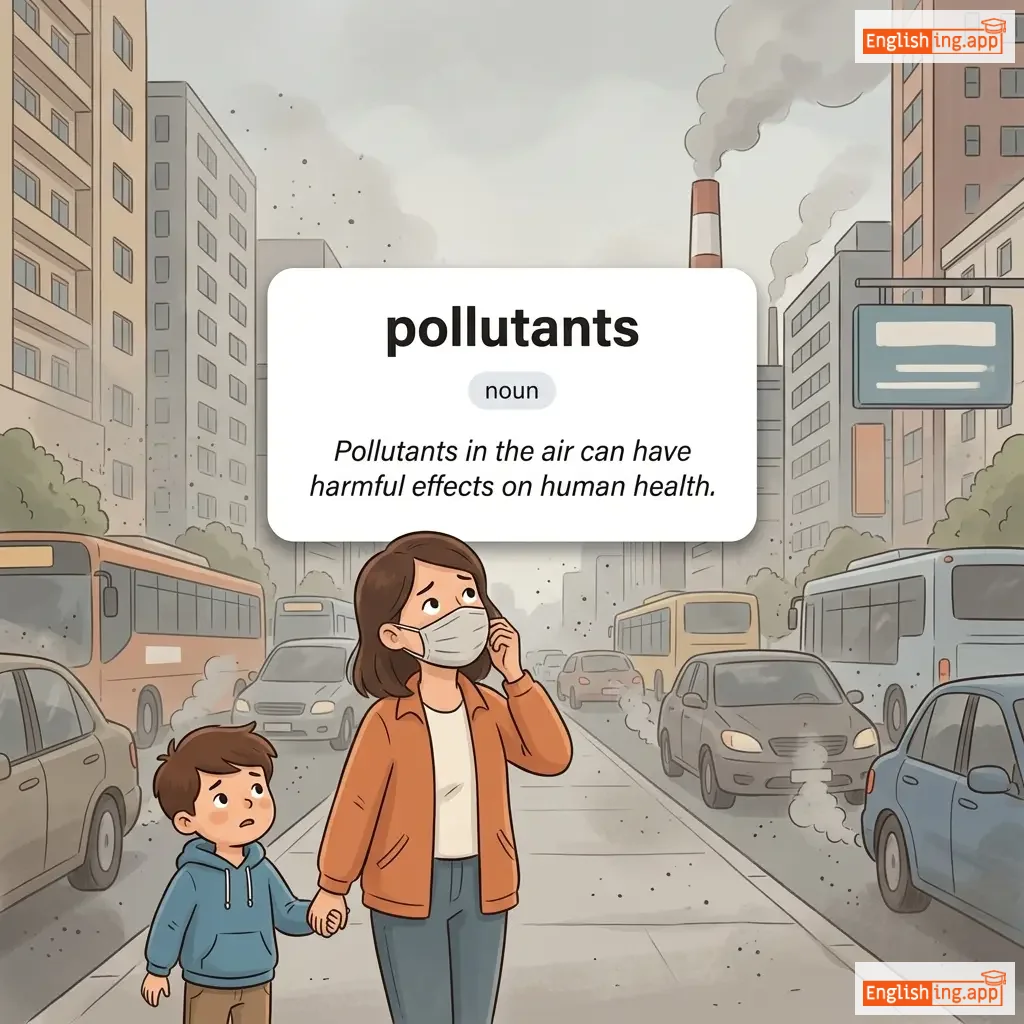
pollutants definition card — visual illustration of the meaning
noun
/pəˈluːtənts/
polluants (polluants)

Harmful substances that contaminate the environment, including air, water, and soil, potentially causing damage to living organisms and ecosystems.

"Pollutants in the air can have harmful effects on human health."

"Les polluants dans l'air peuvent avoir des effets nuisibles sur la santé humaine." (Les polluants dans l'air peuvent avoir des effets nuisibles sur la santé humaine.)
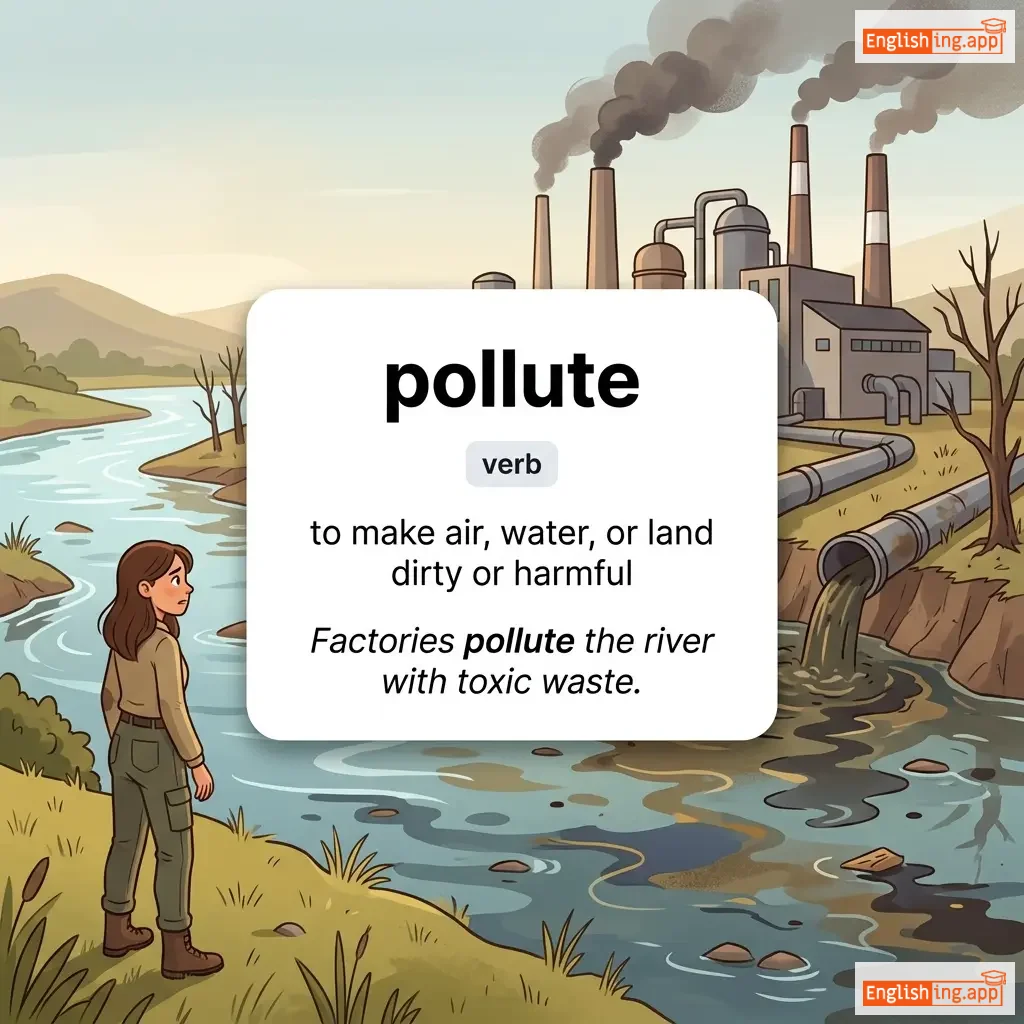
pollute definition card — visual illustration of the meaning
verb
/pəˈluːt/
polluer (polluer)

to make air, water, or land dirty or harmful

"Factories pollute the river with toxic waste."

"Les usines polluent la rivière avec des déchets toxiques." (Les usines polluent la rivière avec des déchets toxiques.)
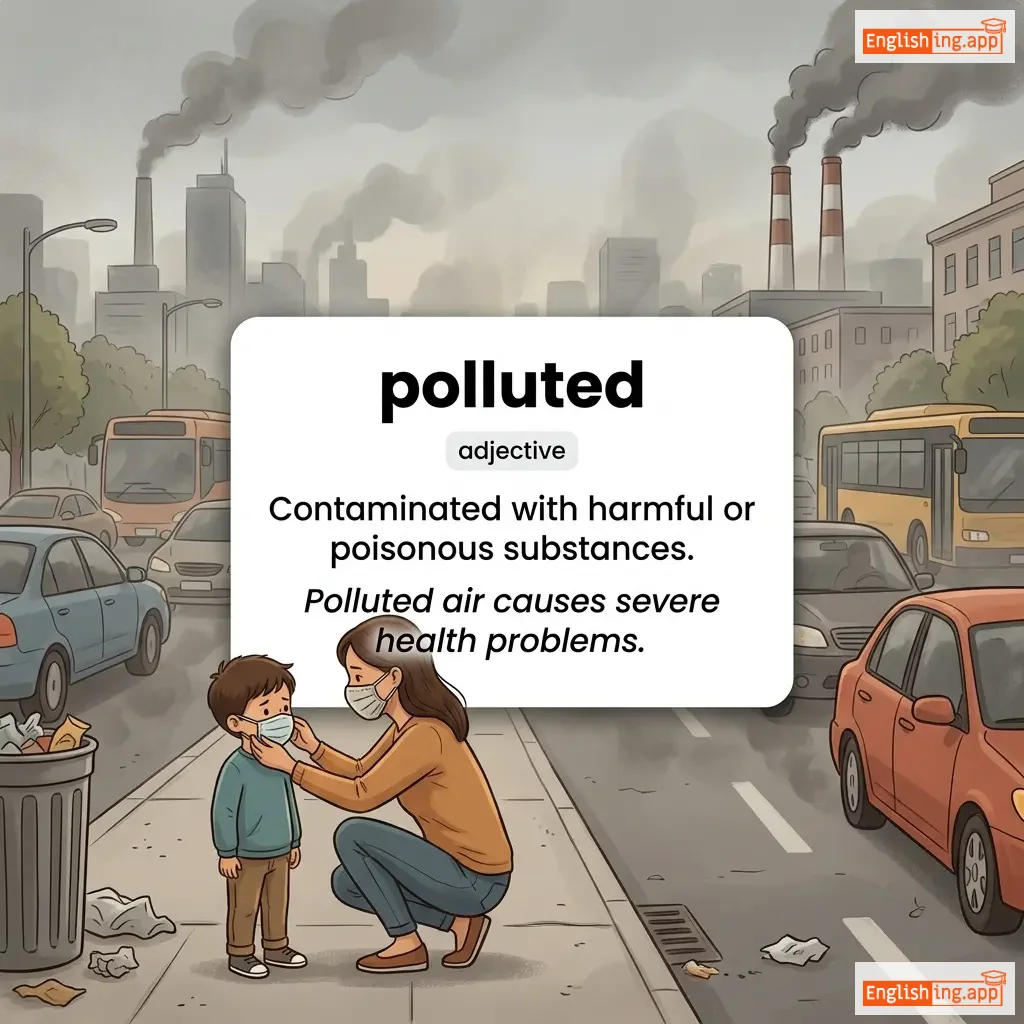
polluted definition card — visual illustration of the meaning
adjective
/pəˈluː.tɪd/
pollué (pollue)

Contaminated with harmful or poisonous substances.

"Polluted air causes severe health problems."

"L'air pollué cause des problèmes de santé graves." (L'air pollué cause des problèmes de santé graves.)
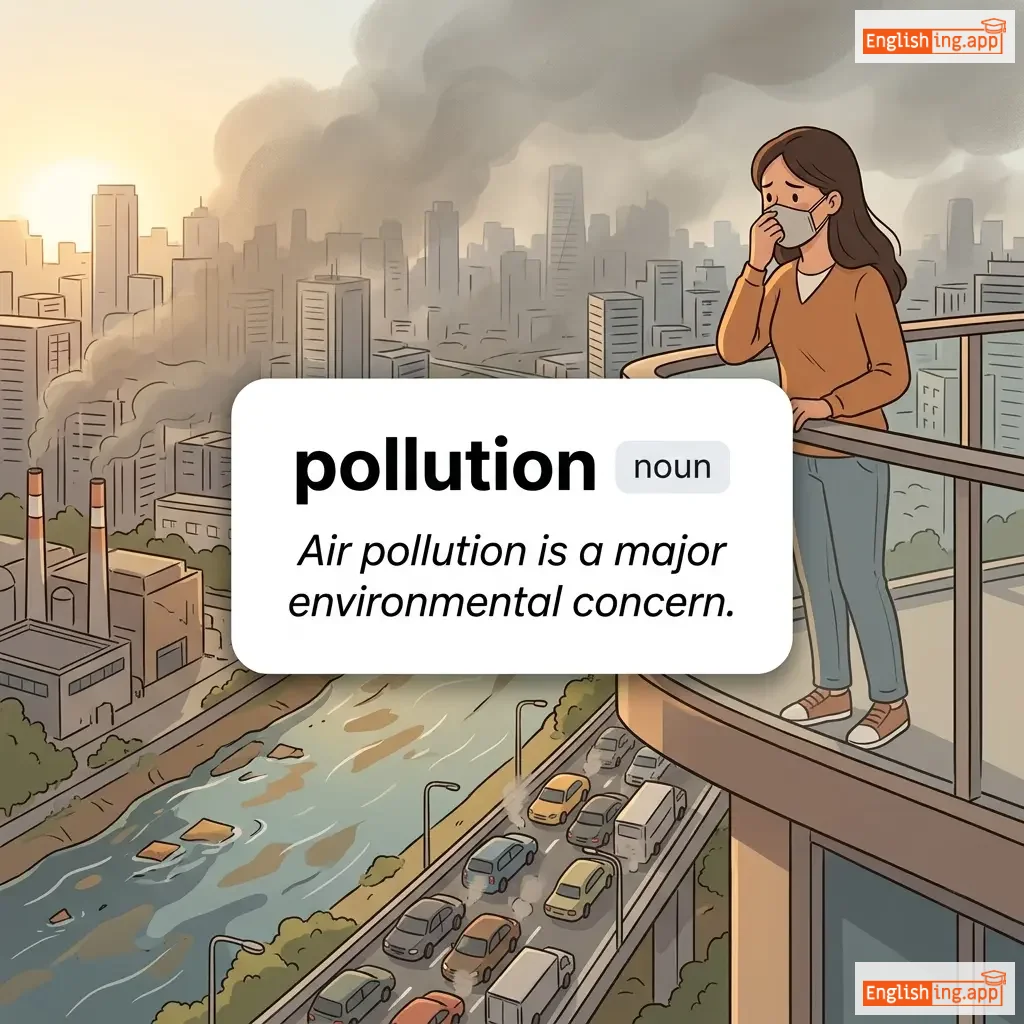
pollution definition card — visual illustration of the meaning
noun
/pəˈlʊʃən/
pollution (pollution)

the presence of harmful substances in the environment, especially the air, water, or soil

"Air pollution is a major environmental concern."

"La pollution de l'air est une préoccupation environnementale majeure." (La pollution de l'air est une preoccupation environnementale majeure.)
adjective
/ˌpɒliˈæn.ɪ.ɪʃ/
excessivement optimiste (excessivement optimiste)

overly or blindly optimistic

"Her pollyannaish attitude ignored the obvious problems."

"Son attitude excessivement optimiste ignorait les problèmes évidents." (Son attitude excessivement optimiste ignorait les problèmes évidents.)
noun
/pəˈtruːn/
lâche (lâche)

a cowardly person

"He acted like a poltroon during the crisis."

"Il a agi comme un lâche pendant la crise." (Il a agi comme un lâche pendant la crise.)
noun
/ˈpɒliˌɑːrki/
polyarchie (polyarchie)

government by many people

"Polyarchy allows multiple parties to share power."

"La polyarchie permet à plusieurs partis de partager le pouvoir." (La polyarchie permet à plusieurs partis de partager le pouvoir.)
noun
/ˈpɒliˌkreɪsi/
policratie (policratie)

rule by many; government by multiple authorities

"The nation experienced a polycracy after decentralization reforms."

"Le pays a connu une policratie après les réformes de décentralisation." (Le pays a connu une policratie apres les reformes de decentralisation.)
👨‍👩‍👧‍👦

polygamist (polygame)

noun
/ˈpɒlɪɡæmɪst/
polygame (polygame)

a person who has more than one spouse at the same time

"The polygamist had three wives living in different houses."

"Le polygame avait trois femmes vivant dans des maisons différentes." (Le polygame avait trois femmes vivant dans des maisons différentes.)
noun
/ˈpɒlɪɡəmi/
polygamie (polygamie)

the practice of having more than one spouse at the same time

"Polygamy is legal in some countries but frowned upon in others."

"La polygamie est légale dans certains pays, mais mal vue dans d'autres." (La polygamie est legale dans certains pays, mais mal vue dans d'autres.)
noun
/ˈpɒlɪɡlɒt/
polyglotte (polyglotte)

a person who knows and can use several languages

"She is a polyglot, fluent in English, Spanish, and Bengali."

"Elle est polyglotte, parlant couramment l'anglais, l'espagnol et le bengali." (Elle est polyglotte, parlant couramment l'anglais, l'espagnol et le bengali.)
noun
/ˈpɒlɪɡɒn/
polygone (polygone)

a flat shape with three or more straight sides

"The artist drew a colorful polygon on the canvas."

"L'artiste a dessiné un polygone coloré sur la toile." (L'artiste a dessiné un polygone coloré sur la toile.)
noun
/ˌpɒlɪˈhiːdrən/
solide à faces polygonales planes (solide a faces polygonales planes)

a solid object with flat polygonal faces, straight edges, and vertices

"The mathematician studied a complex polyhedron model."

"Le mathématicien a étudié un modèle complexe de polyèdre." (Le mathematicien a etudie un modele complexe de polyedre.)
noun
/ˈpɒl.i.mæθ/
polymathe (polymathe)

a person with knowledge of many different subjects

"Leonardo da Vinci was a true polymath, excelling in art, science, and engineering."

"Leonardo da Vinci était un véritable polymathe, excellant dans l'art, la science et l'ingénierie." (Leonardo da Vinci était un véritable polymathe, excellant dans l'art, la science et l'ingénierie.)
noun
/ˌpɒl.iˈsɪl.ə.bəl/
mot polysyllabique (mot polysyllabique)

a word with more than one syllable

"The word 'elephant' is a polysyllable because it has three syllables."

"Le mot 'éléphant' est un mot polysyllabique car il a trois syllabes." (Le mot 'éléphant' est un mot polysyllabique car il a trois syllabes.)
noun
/ˌpɒl.iˈtek.nɪk/
école polytechnique (ecole polytechnique)

an educational institution offering practical and technical courses

"She studied engineering at a well-known polytechnic in her city."

"Elle a étudié l'ingénierie dans un polytechnique bien connu de sa ville." (Elle a etudie l'ingenierie dans un polytechnique bien connu de sa ville.)
noun
/ˈpɒl.iˌθi.ɪz.əm/
polythéisme (politheisme)

the belief in or worship of multiple gods

"Ancient Greeks practiced polytheism, worshiping gods like Zeus and Athena."

"Les anciens Grecs pratiquaient le polythéisme, en adorant des dieux comme Zeus et Athéna." (Les anciens Grecs pratiquaient le polytheisme, en adorant des dieux comme Zeus et Athéna.)
noun
/ˈpɒm.ɪˌɡræn.ɪt/
grenade (pohmuhgraynit)

a round fruit with thick red skin containing many small red seeds with juice

"The pomegranate seeds were sweet and refreshing."

"Les graines de grenade étaient sucrées et rafraîchissantes." (Les graines de grenade etaient sucrees et rafraichissantes.)
noun
/ˈpɒmfrɪt/
poisson pomfret (poisson pomfret)

A deep-bodied marine fish with silvery scales, popular in Asian cuisine

"The restaurant serves delicious pomfret curry with rice."

"Le restaurant sert un délicieux curry de pomfret avec du riz." (le restaurant sert un delisieux curry de pomfret avek du ri)
noun
/ˈpɒm.əl/
le bouton arrondi sur le pommeau d'une épée ou d'une selle (le bouton arrondi sur le pommeau d'une épée ou d'une selle)

the rounded knob on the handle of a sword or saddle

"He gripped the sword firmly by the pommel."

"Il saisit fermement l'épée par le pommel." (Il saisit fermement l'épée par le pommel.)
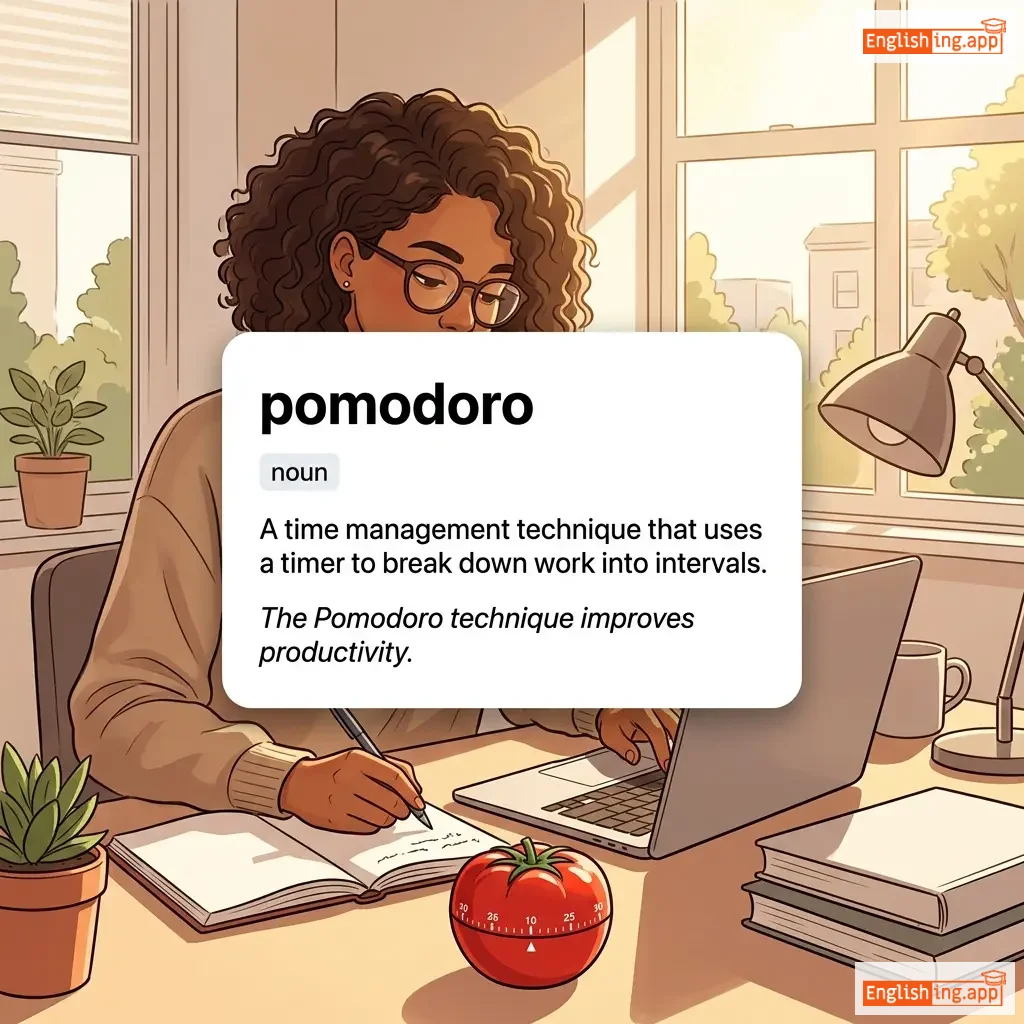
pomodoro definition card — visual illustration of the meaning
noun
/ˌpɒməˈdɔːrəʊ/
pomodoro (pomodoro)

A time management technique that uses a timer to break down work into intervals.

"The Pomodoro technique improves productivity."

"La technique Pomodoro améliore la productivité." (La technique Pomodoro améliore la productivité.)
noun
/pɒmp/
pompe, splendeur (pompe, splendeur)

ceremonial display or splendor; grandeur

"The graduation ceremony was full of pomp and circumstance."

"La cérémonie de remise des diplômes était pleine de pompe et de splendeur." (La ceremonie de remise des diplomes etait pleine de pompe et de splendeur.)
noun
/pɒmˈpɒsəti/
pomposité, arrogance (pomposite, arrogance)

self-important behavior or exaggerated dignity

"His speech was full of pomposity and arrogance."

"Son discours était plein de pomposité et d'arrogance." (Son discours était plein de pomposité et d'arrogance.)
adjective
/ˈpɒmpəs/
pompeux (pompeux)

exaggeratedly self-important; ostentatious

"The manager had a pompous attitude that annoyed his team."

"Le directeur avait une attitude pompeuse qui agaçait son équipe." (Le directeur avait une attitude pompeuse qui agaçait son équipe.)
noun
/pɒnd/
étang (etang)

a small area of still water, smaller than a lake

"The children were feeding ducks at the pond."

"Les enfants nourrissaient des canards dans l'étang." (Les enfants nourrissaient des canards dans l'étang.)
verb
/ˈpɒndər/
réfléchir profondément (reflechir profondement)

to think about something carefully

"She pondered over the meaning of the poem."

"Elle a réfléchi profondément au sens du poème." (Elle a réfléchi profondément au sens du poème.)