Vocabulaires

Découvrez, apprenez et maîtrisez le vocabulaire anglais

noun
/ˈfɪzɪks/
physique (physique)

the natural science that studies matter, energy, and the interactions between them

"She decided to major in physics at the university."

"Elle a décidé de se spécialiser en physique à l'université." (Elle a decide de se specialiser en physique a l'universite.)
noun
/ˌfɪzɪˈɑːkrəsi/
fisiocratie (fisiocratie)

an economic theory that land and its natural products are the source of wealth

"Physiocracy emphasized the importance of agriculture in national wealth."

"La fisiocratie a souligné l'importance de l'agriculture dans la richesse nationale." (La fisiocratie a souligne l'importance de l'agriculture dans la richesse nationale.)
noun
/ˌfɪziˈɒnəmi/
étude des traits du visage (etude des traits du visage)

the study of facial features to judge character or personality

"He believed in physiognomy and tried to read people's personalities from their faces."

"Il croyait à la physiognomonie et essayait de lire la personnalité des gens à partir de leurs visages." (Il croyait à la physiognomonie et essayait de lire la personnalité des gens à partir de leurs visages.)
noun
/ˌfɪziˈɑːɡrəfi/
physiographie (physiographie)

the study of the physical features of the earth's surface

"He specialized in physiography to understand the landscape of the region."

"Il s'est spécialisé en physiographie pour comprendre le paysage de la région." (Il s'est specialise en physiographie pour comprendre le paysage de la region.)
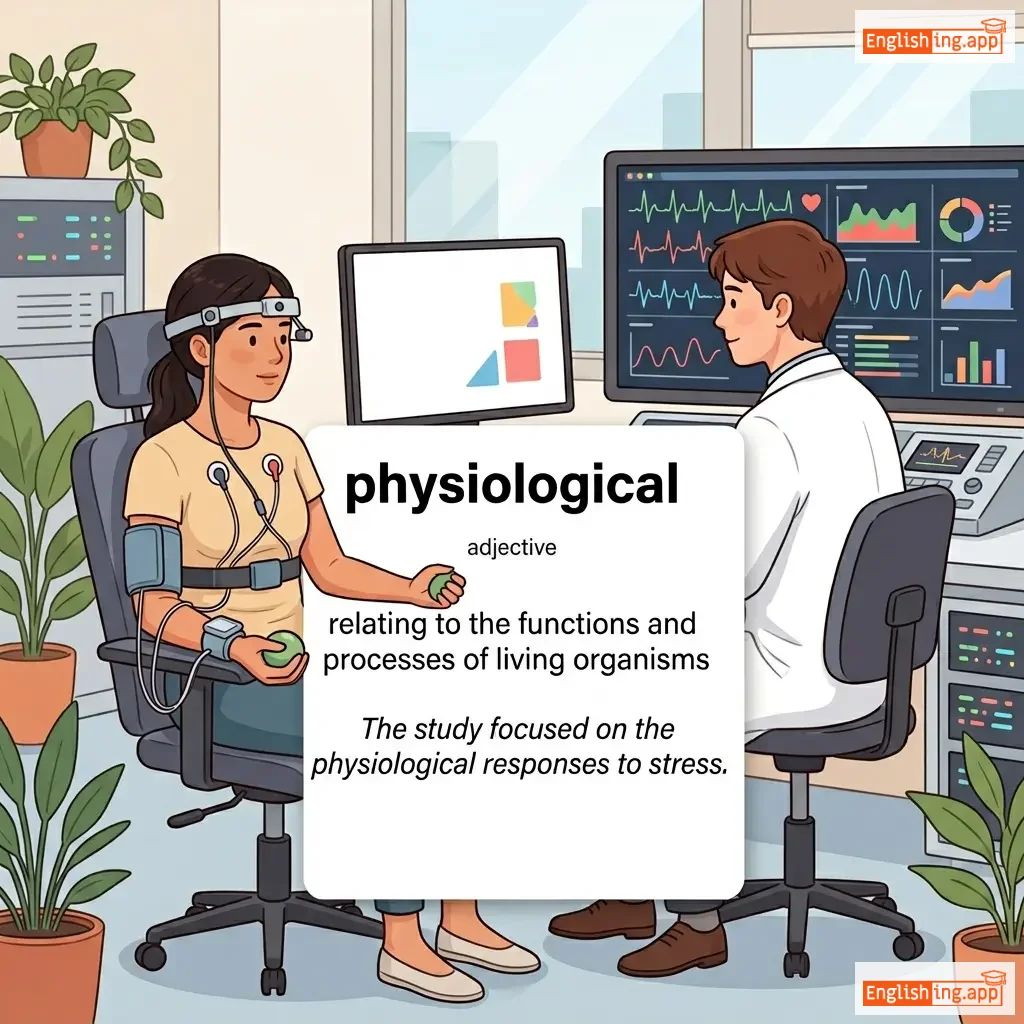
physiological definition card — visual illustration of the meaning
adjective
/ˌfɪziəˈlɑːdʒɪkəl/
physiologique (physiologique)

relating to the functions and processes of living organisms

"The study focused on the physiological responses to stress."

"L'étude s'est concentrée sur les réponses physiologiques au stress." (L'etude s'est concentree sur les reponses physiologiques au stress.)
noun
/ˌfɪziˈɑːlədʒi/
physiologie (physiologie)

the scientific study of the functions and mechanisms in a living system

"She is majoring in human physiology at the university."

"Elle se spécialise en physiologie humaine à l'université." (Elle se specialise en physiologie humaine a l'universite.)
noun
/fɪˈziːk/
physique (physique)

the form, size, and development of a person's body

"He has an athletic physique due to years of training."

"Il a une silhouette athlétique grâce à des années d'entraînement." (Il a une silhouette athlétique grâce à des années d'entraînement.)
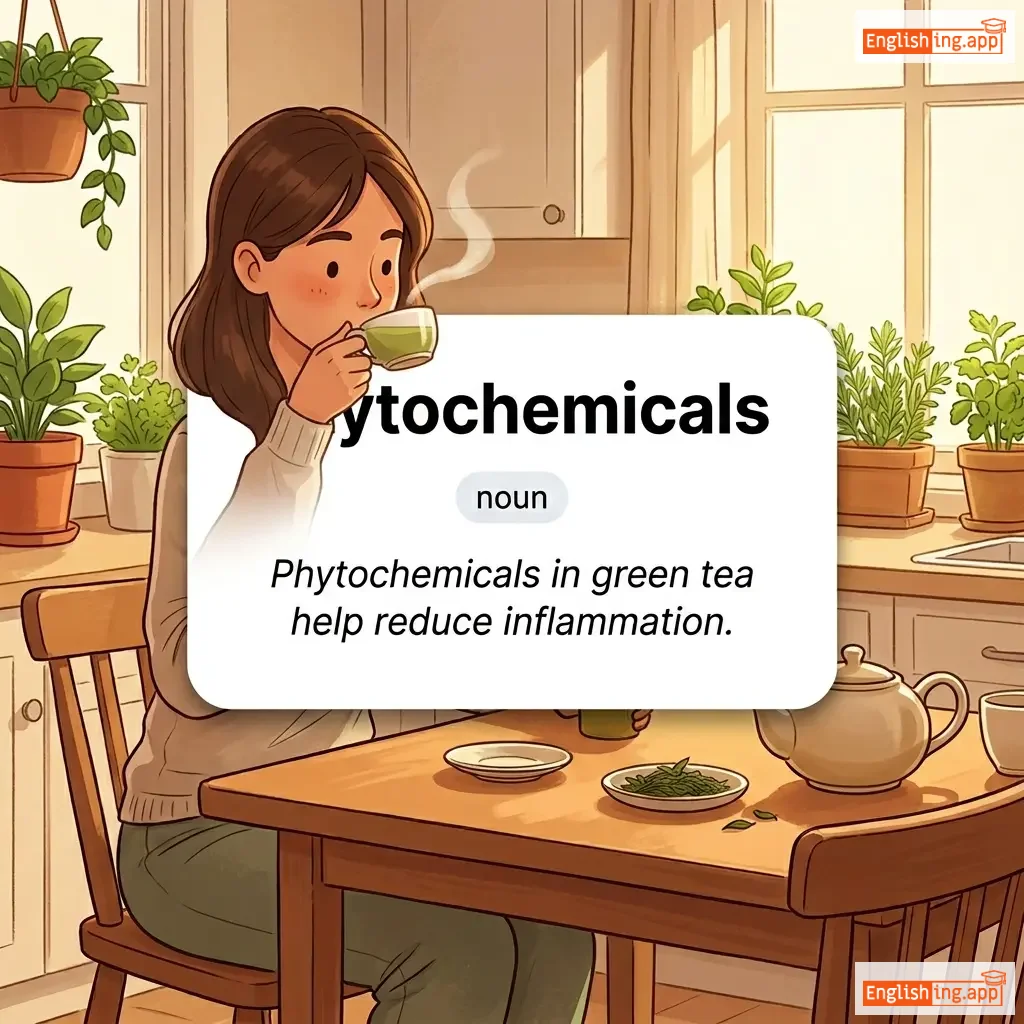
phytochemicals definition card — visual illustration of the meaning
noun
/ˌfaɪ.təʊˈkem.ɪ.kəlz/
phytocomposés (phytocomposes)

Natural chemical compounds produced by plants that provide health benefits beyond basic nutrition, often having antioxidant properties.

"Phytochemicals in green tea help reduce inflammation."

"Les phytocomposés dans le thé vert aident à réduire l'inflammation." (Les phytocomposes dans le the vert aident a reduire l'inflammation.)
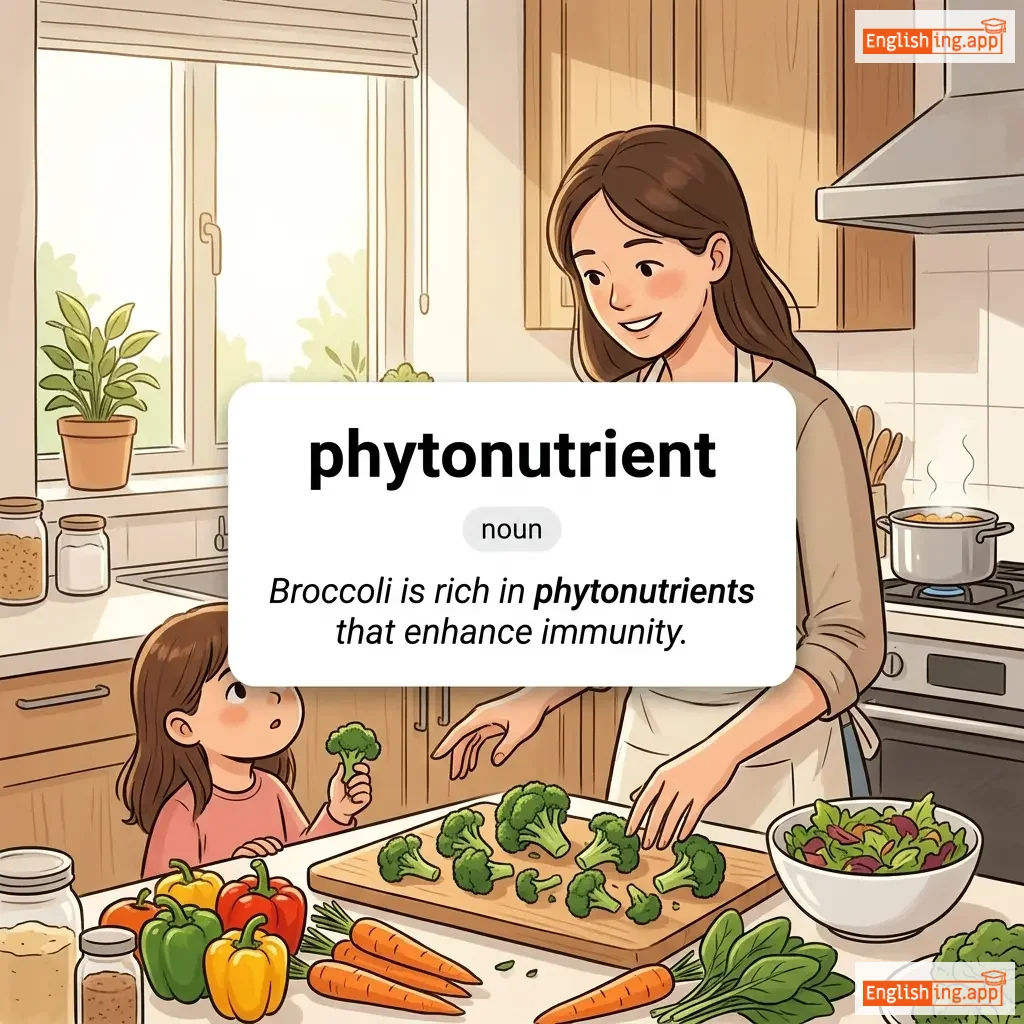
phytonutrient definition card — visual illustration of the meaning
noun
ˈfaɪ.təʊˌnjuː.tri.ənt
phytonutriment (phytonutriment)

Chemical compounds produced by plants that are beneficial to human health but not essential nutrients.

"Broccoli is rich in phytonutrients that enhance immunity."

"Le brocoli est riche en phytonutriments qui renforcent l'immunité." (Le brocoli est riche en phytonutriments qui renforcent l'immunite.)
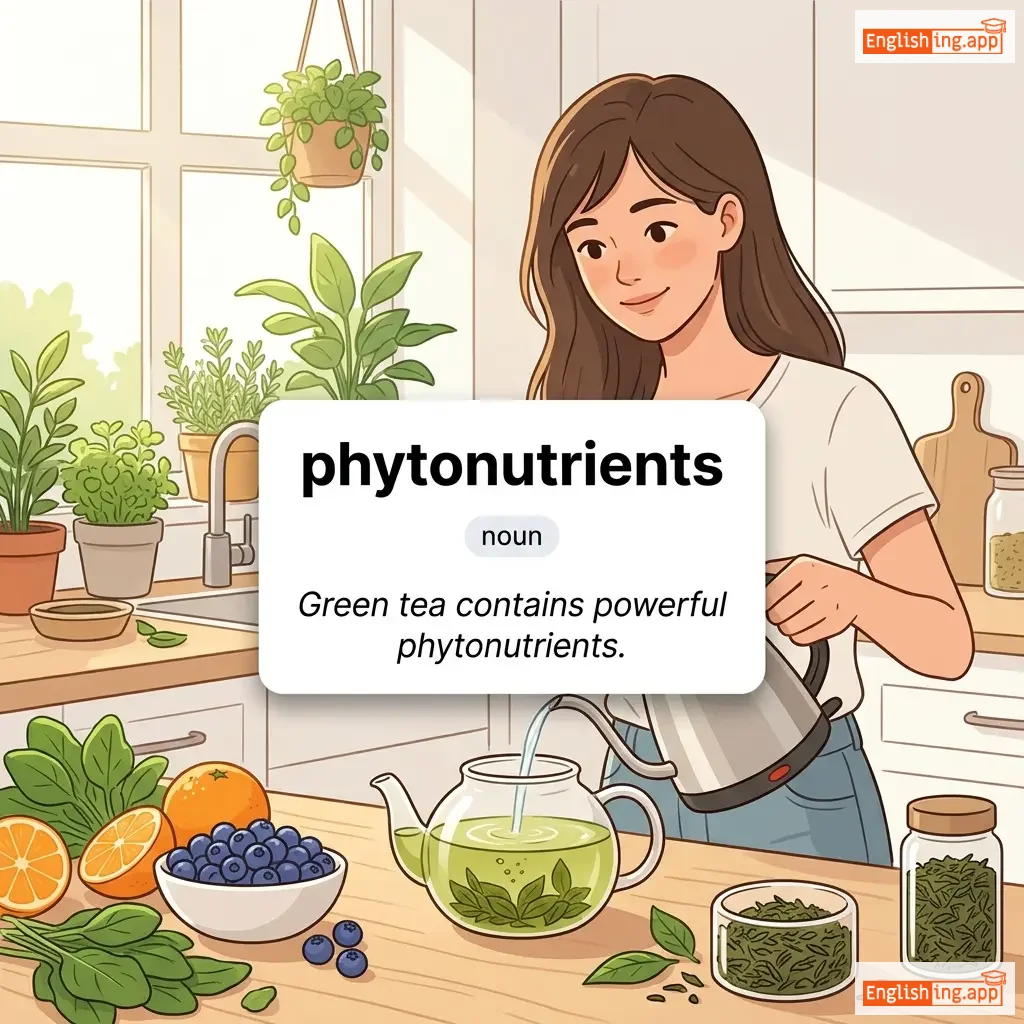
phytonutrients definition card — visual illustration of the meaning
noun
ˈfaɪ.təʊˌnjuː.tri.ənts
phytonutriments (phytonutriments)

Bioactive compounds found in plants that have health benefits beyond basic nutrition.

"Green tea contains powerful phytonutrients."

"Le thé vert contient des phytonutriments puissants." (Le thé vert contient des phytonutriments puissants.)
noun
/piˈænoʊ/
piano (piano)

a large musical instrument with a keyboard, played by pressing keys that cause hammers to strike strings

"She played a beautiful tune on the piano during the concert."

"Elle a joué un beau morceau sur le piano pendant le concert." (Elle a joue un beau morceau sur le piano pendant le concert.)
adjective
/ˌpɪkəˈrɛsk/
histoire d'un héros malicieux (histoire d'un heros malicieux)

relating to a style of fiction depicting the adventures of a roguish hero

"The novel is a picaresque tale of a clever vagabond."

"Le roman est une histoire picaresque d'un vagabond rusé." (Le roman est une histoire picaresque d'un vagabond ruse.)
adjective
/ˌpɪkəˈjuːn/
insignifiant, trivial (insignifiant, trivial)

of little value or importance; trivial

"He complained about the picayune details of the contract."

"Il se plaignait des détails triviaux du contrat." (Il se plaignait des détails triviaux du contrat.)
noun
/ˈpɪkəloʊ/
petite flûte (petite flute)

a small flute, higher in pitch than the regular flute

"She played a lively tune on the piccolo during the concert."

"Elle a joué une mélodie vive sur le piccolo pendant le concert." (Elle a joué une mélodie vive sur le piccolo pendant le concert.)
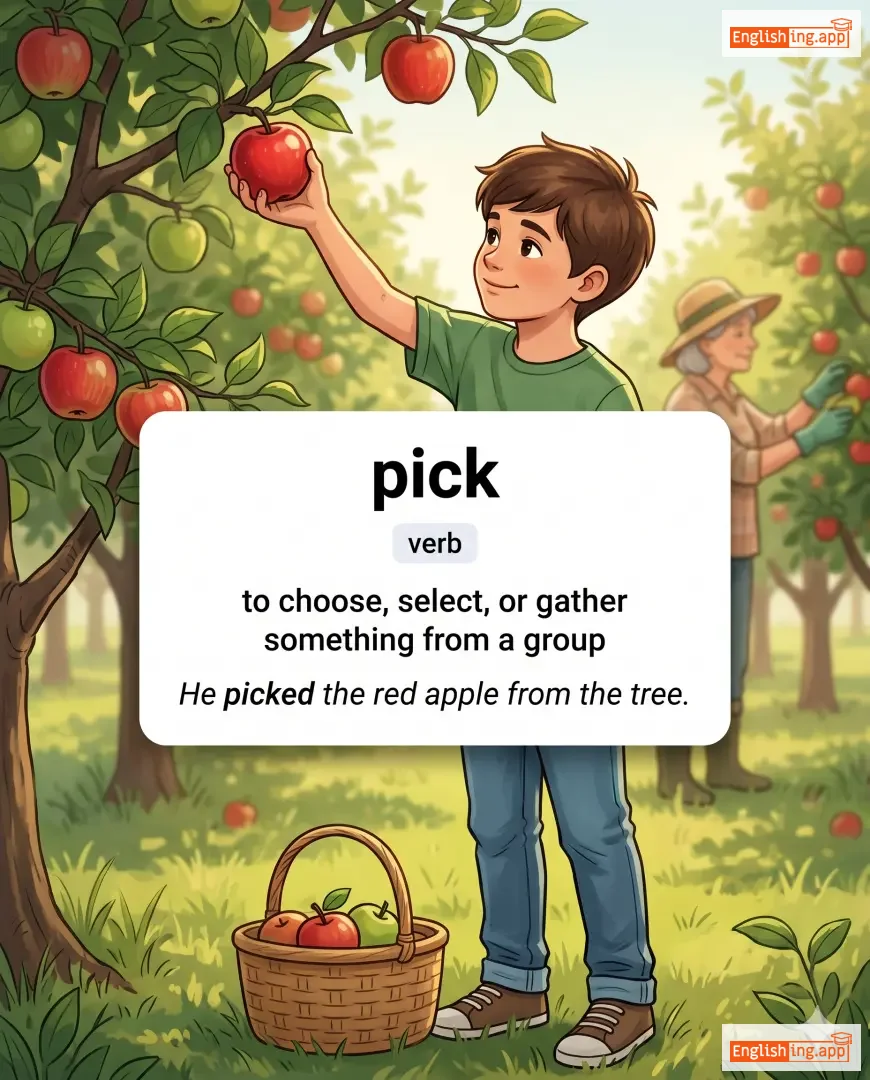
pick definition card — visual illustration of the meaning
verb
/pɪk/
choisir (choisir)

to choose, select, or gather something from a group

"He picked the red apple from the tree."

"Il a choisi la pomme rouge de l'arbre." (Il a choisi la pomme rouge de l'arbre.)
phrasal verb
/pɪk ʌp/
ramasser; prendre; apprendre (ramasser; prendre; apprendre)

to lift something; to collect or receive someone or something; to learn or acquire gradually; to improve or increase

"She picked up the book from the floor."

"Elle a ramassé le livre par terre." (Elle a ramasse le livre par terre)
noun
/ˈpɪk.æks/
pioche (piosh)

a tool with a heavy metal head and long handle used for breaking up hard ground or rock

"The miner used a pick-axe to break through the rocky surface."

"Le mineur a utilisé une pioche pour briser la surface rocheuse." (Le mineur a utilisé une pioche pour briser la surface rocheuse.)
noun
/ˈpɪkʌp/
camionnettes à cabine ouverte ; l'acte de collecter ou d'améliorer quelque chose (camionnettes a cabine ouverte ; l'acte de collecter ou d'amliorer quelque chose)

a small truck with an open back; the act of collecting or improving something

"The company scheduled a pickup for the returned goods."

"L'entreprise a planifié un ramassage pour les produits retournés." (L'entreprise a planifié un ramassage pour les produits retournés.)
noun
/ˈpɪktʃər/
image (image)

a visual representation made by painting, drawing, or photography

"The picture on the wall was painted by a famous artist."

"L'image sur le mur a été peinte par un artiste célèbre." (L'image sur le mur a ete peinte par un artiste celebre.)
adjective
/ˈpɪdlɪŋ/
insignifiant, trivial (insignifiant, trivial)

trivial or insignificant; very small

"He made a piddling amount of money from that deal."

"Il a gagné une somme insignifiante d'argent avec cette affaire." (Il a gagné une somme insignifiante d'argent avec cette affaire.)
noun
/paɪ/
tarte (tarte)

a baked dish typically consisting of a pastry crust and filling

"She baked an apple pie for dessert."

"Elle a cuit une tarte aux pommes pour le dessert." (Elle a cuit une tarte aux pommes pour le dessert.)
adjective
/ˈpaɪbɔːld/
à taches de deux couleurs (a taches de deux couleurs)

having irregular patches of two colors, especially black and white

"The farmer owns a piebald horse with black and white spots."

"Le fermier possède un cheval piebald avec des taches noires et blanches." (Le fermier possède un cheval piebald avec des taches noires et blanches.)
noun
/piːs/
un morceau (un morceau)

a portion or part of something

"He gave me a piece of cake."

"Il m'a donné un morceau de gâteau." (Il m'a donné un morceau de gâteau.)
noun
/ˈpiːs ɡʊdz/
tissu au mètre (tissu au metre)

textiles or fabrics sold by the yard or meter; cloth materials

"The tailor bought piece-goods from the wholesale market to make custom dresses."

"Le tailleur a acheté des tissus au mètre au marché de gros pour fabriquer des robes sur mesure." (Le tailleur a acheté des tissus au mètre au marché de gros pour fabriquer des robes sur mesure.)
adjective
/ˈpiːsmiːl/
fait par étapes (fait par etapes)

done or made in separate stages rather than all at once

"The construction of the new building was carried out piecemeal over several years."

"La construction du nouveau bâtiment a été réalisée par étapes pendant plusieurs années." (La construction du nouveau batiment a ete realisee par etapes pendant plusieurs annees.)
adjective
/paɪd/
de couleurs variées (de couleurs variees)

having two or more different colors, typically in blotches

"The pied cat had black and white patches all over its body."

"Le chat piebald avait des taches noires et blanches sur tout son corps." (Le chat piebald avait des taches noires et blanches sur tout son corps.)
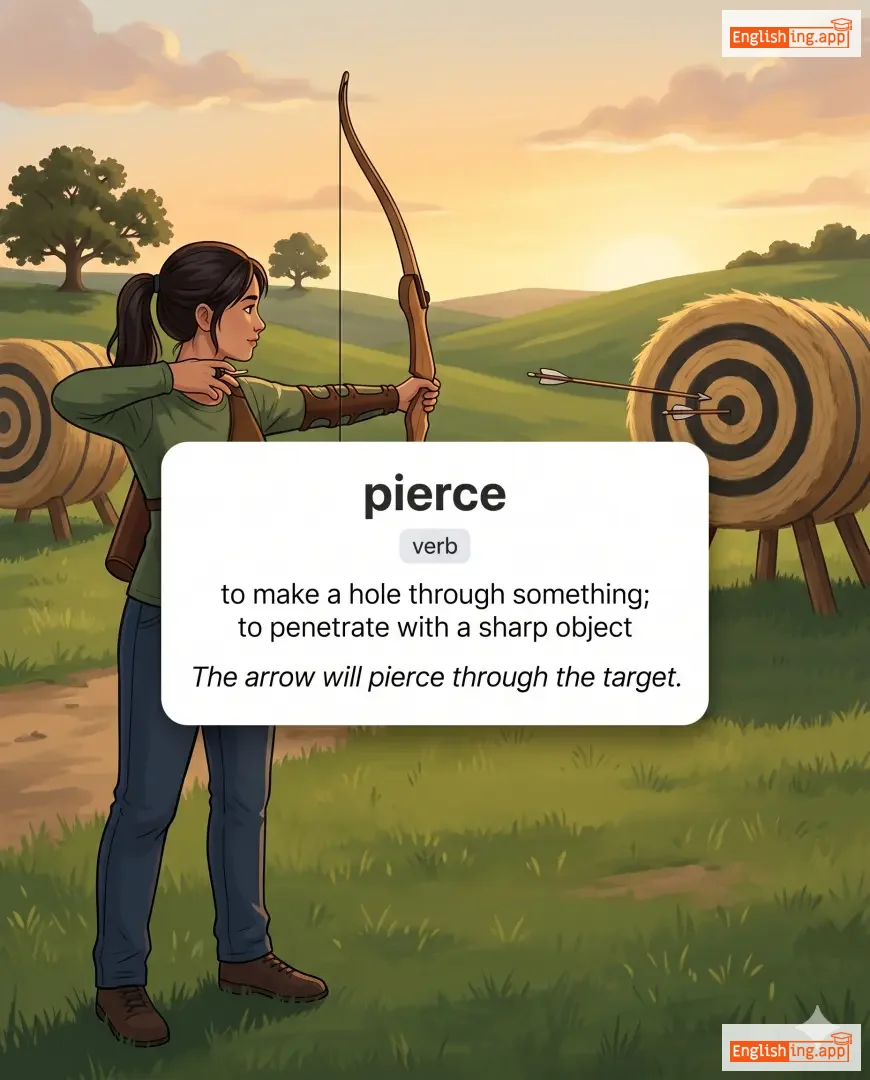
pierce definition card — visual illustration of the meaning
verb
/pɪəs/
percer (percer)

to make a hole through something; to penetrate with a sharp object

"The arrow will pierce through the target."

"La flèche percera la cible." (La flèche percera la cible.)
Piety definition card — visual illustration of the meaning
noun
/ˈpaɪəti/
piété (piete)

the quality of being religious or showing reverence for God

"Her piety was evident in the way she prayed every morning."

"Sa piété était évidente dans la façon dont elle priait chaque matin." (Sa piete etait evidente dans la facon dont elle priait chaque matin.)
noun
/pɪɡ/
cochon (cochon)

a farm animal with a snout used for digging and a curly tail; kept for meat such as pork or bacon

"The pig rolled happily in the mud."

"Le cochon roulait joyeusement dans la boue." (Le cochon roulait joyeusement dans la boue.)
noun
/ˈpɪdʒ.ən/
colombe (colombe)

a grey and white bird with a fat body that is common in cities

"The pigeon pecked at breadcrumbs on the sidewalk."

"La colombe picorait des miettes de pain sur le trottoir." (La colombe picorait des miettes de pain sur le trottoir.)
noun
/ˈpɪɡmənt/
pigment (pigment)

a natural or artificial substance used to give color to something

"The artist mixed different pigments to create the perfect shade of blue."

"L'artiste a mélangé différents pigments pour créer la teinte parfaite de bleu." (L'artiste a mélangé différents pigments pour créer la teinte parfaite de bleu.)
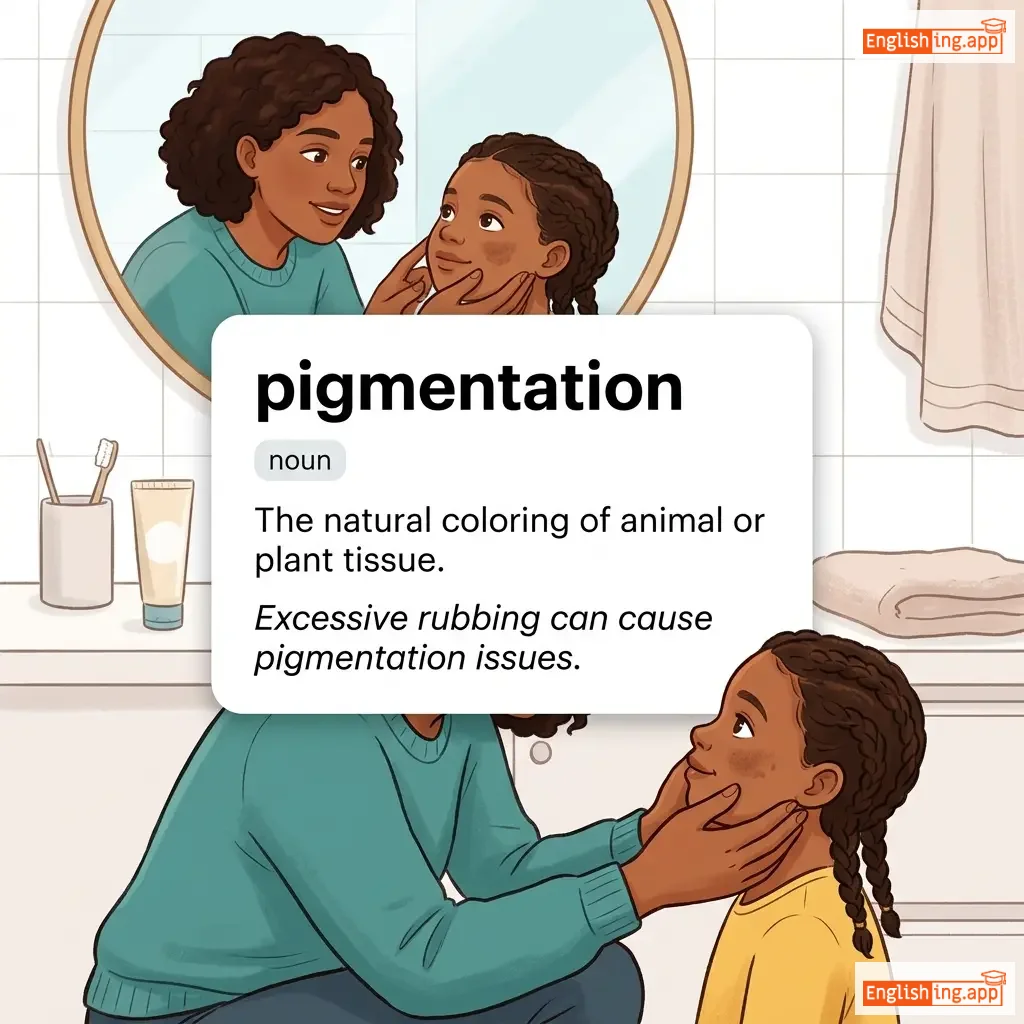
pigmentation definition card — visual illustration of the meaning
noun
/ˌpɪɡ.menˈteɪ.ʃən/
pigmentation (pigmentation)

The natural coloring of animal or plant tissue.

"Excessive rubbing can cause pigmentation issues."

"Un frottement excessif peut provoquer des problèmes de pigmentation." (Un frottement excessif peut provoquer des problemes de pigmentation.)
noun
/paɪl/
tas (tas)

a large amount of something stacked or placed in a heap

"He placed the books in a pile on the table."

"Il a mis les livres en tas sur la table." (Il a mis les livres en tas sur la table.)
🕵️‍♂️

pilfer (pilfèr)

verb
/ˈpɪlfər/
voler (voler)

to steal things of small value or in small quantities

"The employee was caught pilfering office supplies."

"L'employé a été pris en train de voler des fournitures de bureau." (L'employé a été pris en train de voler des fournitures de bureau.)
noun
/ˈpɪl.fər.ɪdʒ/
vol mineur (volmineur)

the theft of small amounts or items, especially from one's workplace

"The company installed cameras to prevent pilferage."

"L'entreprise a installé des caméras pour prévenir le vol." (Lentreprise a installe des cameras pour prevenir le pilferage)
🚶‍♂️

Pilgrim (pèlerins)

noun
/ˈpɪl.ɡrɪm/
pèlerin; voyageur (pelerin; voyageur)

a person who journeys to a sacred place for religious reasons; a traveler

"The pilgrim walked for days to reach the holy shrine."

"Le pèlerin a marché pendant des jours pour atteindre le sanctuaire sacré." (Le pelerin a marche pendant des jours pour atteindre le sanctuaire sacre.)
noun
/pɪl/
pilule (pilule)

a small round piece of medicine to be swallowed

"He took a pill to relieve his headache."

"Il a pris une pilule pour soulager son mal de tête." (Il a pris une pilule pour soulager son mal de tête.)
🏴‍☠️

pillage (pilɛʒ)

verb
/ˈpɪlɪdʒ/
piller (piller)

to rob or plunder a place, especially during war

"The invading army pillaged the village and took all valuables."

"L'armée envahissante a pillé le village et a pris tous les objets précieux." (L'armée envahissante a pillé le village et a pris tous les objets précieux.)
noun
/ˈpɪlər/
pilier (pilier)

a strong vertical support or mainstay of a structure or system

"The ancient temple was supported by massive stone pillars."

"Le temple ancien était soutenu par d'énormes piliers en pierre." (Le temple ancien était soutenu par d'énormes piliers en pierre.)
noun
/pɪˈlɑːf/
pilav (pilav)

a dish of rice cooked in seasoned broth, often with meat and vegetables

"We enjoyed a delicious chicken pillaw for dinner."

"Nous avons dégusté un délicieux pilav au poulet pour le dîner." (Nous avons dégusté un délicieux pilav au poulet pour le dîner.)
noun/verb
/ˈpɪləri/
dispositif de châtiment public (dispositif de châtiment public)

a device for publicly punishing someone / to expose to public ridicule

"The corrupt official was placed in the pillory for the town to jeer at."

"Le fonctionnaire corrompu a été mis en pilori pour que la ville se moque de lui." (Le fonctionnaire corrompu a été mis en pilori pour que la ville se moque de lui.)
noun
/ˈpɪloʊ/
oreiller (oreiller)

a soft cushion filled with material used to support the head while sleeping or resting

"She placed her head on the soft pillow and fell asleep quickly."

"Elle a posé sa tête sur le doux oreiller et s'est endormie rapidement." (Elle a pose sa tete sur le doux oreiller et s'est endormie rapidement.)
noun/verb
/ˈpaɪlət/
pilote (pilote)

a person who operates an aircraft / to guide or lead through a trial

"She piloted the plane safely through the storm."

"Elle a piloté l'avion en toute sécurité à travers la tempête." (Elle a piloté l'avion en toute sécurité à travers la tempête.)
noun
/ˈpɪm.pəl/
bouton (bouton)

a small, inflamed elevation of the skin; a spot on the skin, especially on the face

"She was embarrassed about the pimple on her forehead."

"Elle était gênée par le bouton sur son front." (Elle etait genee par le bouton sur son front.)
noun
/pɪn/
épingle (epingle)

a small thin piece of metal used to fasten or hold things together

"She used a pin to attach the note to the board."

"Elle a utilisé une épingle pour fixer la note sur le tableau." (Elle a utilise une epingle pour fixer la note sur le tableau.)
noun
/ˈpɪnsərz/
pince (pince)

a gripping tool with two arms used for holding or pulling objects

"He used pincers to remove the hot nail from the wood."

"Il a utilisé des pinces pour retirer le clou chaud du bois." (Il a utilisé des pinces pour retirer le clou chaud du bois.)
verb
/pɪntʃ/
pincer (pincer)

to squeeze tightly between the fingers; to take a small amount

"She pinched a bit of salt into the soup."

"Elle a mis un peu de sel dans la soupe." (Elle a mis un peu de sel dans la soupe.)
noun
/ˈpɪntʃərz/
pinces (pinces)

a tool used for gripping or squeezing objects

"Use the pinchers to remove the hot coal safely."

"Utilisez les pinces pour retirer le charbon chaud en toute sécurité." (Utilisez les pinces pour retirer le charbon chaud en toute sécurité.)
verb
/paɪn/
désirer profondément (désirer profondément)

to long intensely for something or someone; to suffer from longing

"He pined for his hometown after moving abroad."

"Après avoir déménagé à l'étranger, il ressentait profondément la nostalgie de sa ville natale." (Après avoir déménagé à l'étranger, il ressentait profondément la nostalgie de sa ville natale.)
noun
/ˈpaɪn.æp.əl/
ananas (ananas)

a large tropical fruit with a tough skin and sweet yellow flesh

"The pineapple has a crown of spiky leaves on top."

"L'ananas a une couronne de feuilles épineuses sur le dessus." (L'ananas a une couronne de feuilles épineuses sur le dessus)