Vocabulaires

Découvrez, apprenez et maîtrisez le vocabulaire anglais

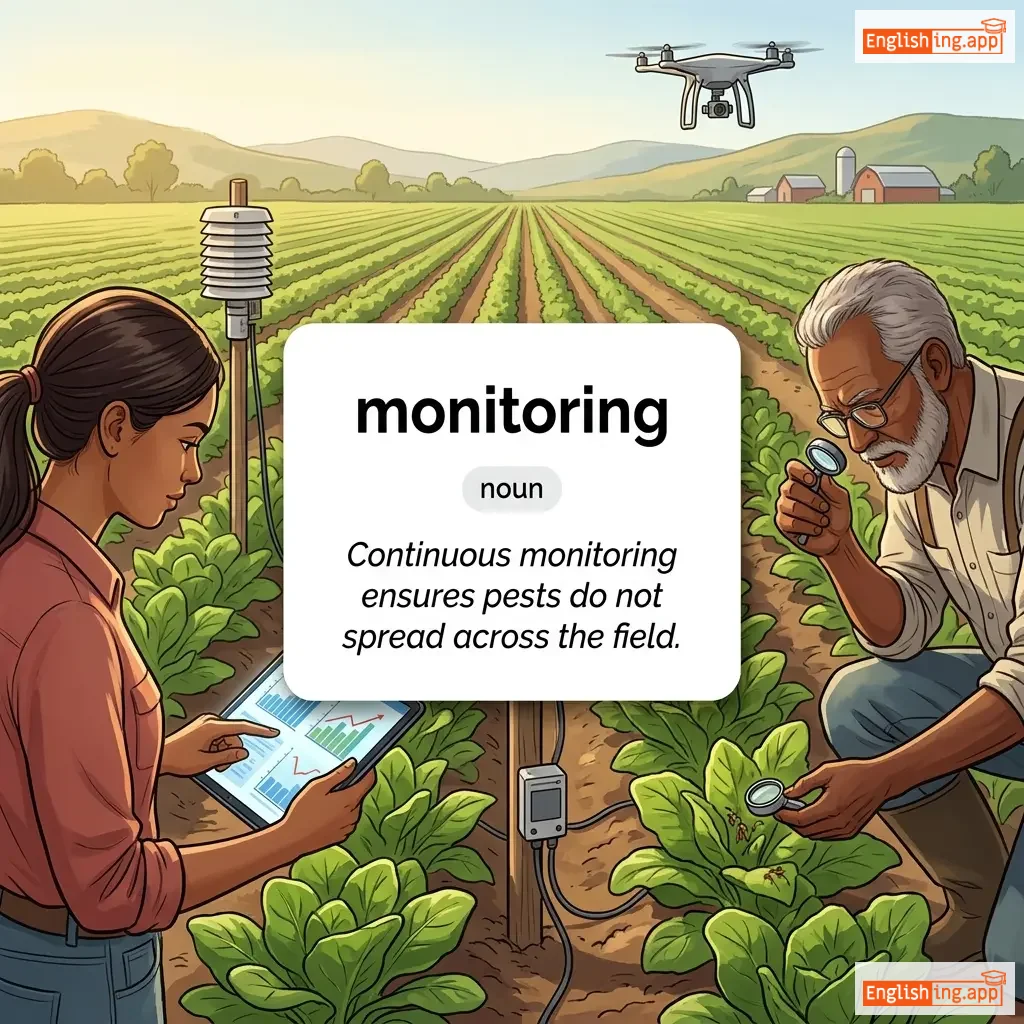
monitoring definition card — visual illustration of the meaning
noun
ˈmɒnɪtərɪŋ
surveillance, suivi continu (surveillance, suivi continu)

The action of observing and checking the progress or quality of something over a period of time.

"Continuous monitoring ensures pests do not spread across the field."

"La surveillance continue garantit que les nuisibles ne se propagent pas dans le champ." (La surveillance continue garantit que les nuisibles ne se propagent pas dans le champ.)
adjective
/ˈmɒnɪtəri/
avertisseur (avertisseur)

Giving a warning or cautionary advice; serving to warn.

"His monitory tone made everyone cautious about their next move."

"Son ton monitory a rendu tout le monde prudent quant à leur prochain mouvement." (Son ton monitory a rendu tout le monde prudent quant à leur prochain mouvement.)
noun
/mɒŋk/
moine (moine)

a member of a religious community living under vows of poverty, chastity, and obedience

"The monk lived a simple and peaceful life in the monastery."

"Le moine vivait une vie simple et paisible au monastère." (Le moine vivait une vie simple et paisible au monastère.)
noun
/ˈmʌŋki/
singe (singe)

a small to medium-sized primate with a long tail, known for its playfulness

"A monkey was jumping from tree to tree in the forest."

"Un singe sautait d'arbre en arbre dans la forêt." (Un singe sautait d'arbre en arbre dans la foret)
adjective
/ˌmɒnəkrəˈmætɪk/
monochromatique (monochromatique)

Consisting of or displaying only one color.

"The artist created a striking monochromatic painting in shades of blue."

"L'artiste a créé une peinture monochromatique frappante dans des nuances de bleu." (Lartiste a cree une peinture monochromatique frappante dans des nuances de bleu)
noun/adjective
/ˈmɒnəkrəʊm/
monochrome (monochrome)

A photograph, painting, or screen image in black and white or varying tones of one color.

"The old film was shot entirely in monochrome."

"Le vieux film a été tourné entièrement en monochrome." (Le vieux film a été tourné entièrement en monochrome.)
noun
/ˈmɒnəkl/
monocle (monocle)

A single round lens for one eye, used to correct or enhance vision.

"The old gentleman wore a monocle at formal events."

"Le vieux monsieur portait un monocle lors des événements officiels." (Le vieux monsieur portait un monocle lors des evenements officiels.)
noun
/məˈnɒkrəsi/
monocratie (monocratie)

A system of government by a single person; autocracy.

"The nation suffered under decades of monocracy."

"La nation a souffert sous des décennies de monocratie." (La nation a souffert sous des décennies de monocratie.)
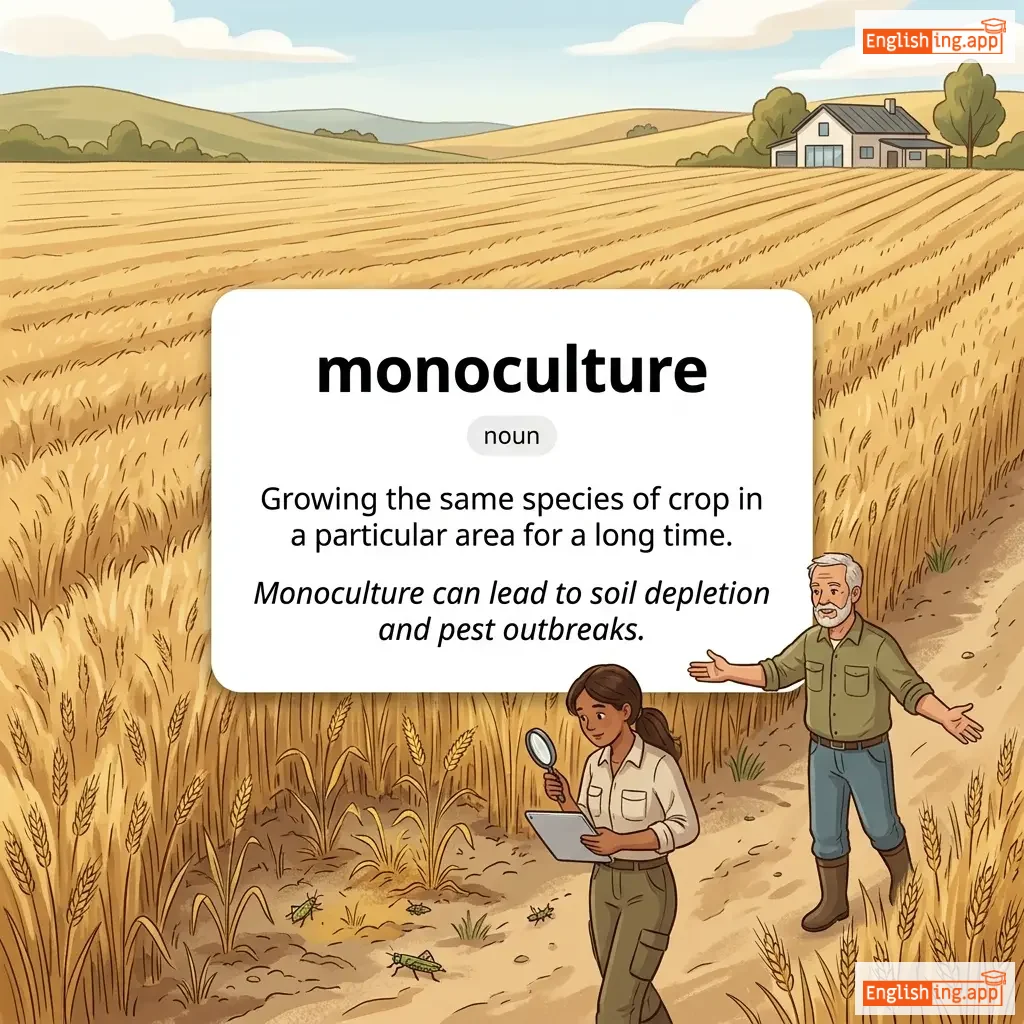
monoculture definition card — visual illustration of the meaning
noun
ˈmɒn.əˌkʌl.tʃər
monoculture (monoculture)

Growing the same species of crop in a particular area for a long time.

"Monoculture can lead to soil depletion and pest outbreaks."

"La monoculture peut entraîner une diminution de la fertilité du sol et des épidémies de parasites." (La monoculture peut entraîner une diminution de la fertilité du sol et des épidémies de parasites.)
noun
/məˈnɒɡəmi/
monogamie (monogamie)

The practice of being married to or in a relationship with only one person at a time.

"Many cultures encourage monogamy as the ideal form of marriage."

"De nombreuses cultures encouragent la monogamie comme la forme idéale de mariage." (De nombreuses cultures encouragent la monogamie comme la forme ideale de mariage.)
noun
/ˈmɒnəɡræm/
monogramme (monogramme)

A design consisting of two or more letters, typically a person's initials, combined or interwoven.

"The towel was embroidered with her monogram."

"La serviette était brodée avec son monogramme." (La serviette etait brodee avec son monogramme.)
noun
/ˈmɒnəɡrɑːf/
monographie (monograhfee)

A detailed written study of a single specialized subject or aspect of it.

"The professor published a monograph on ancient pottery."

"Le professeur a publie une monographie sur la poterie antique." (Leprofesseurapublieunemonographiesurlapoterieantique)
noun
/ˈmɒnəlɪθ/
monolithe (monolithe)

A large single upright block of stone, or a large, powerful, indivisible organization or system.

"The ancient monolith stood in the desert for centuries."

"L'ancien monolithe est resté debout dans le désert pendant des siècles." (L'ancien monolithe est resté debout dans le désert pendant des siècles.)
adjective
/ˌmɒnəˈlɪθɪk/
monolithique (monolithik)

Massive, uniform, and indivisible; resembling a large single stone or structure.

"The company maintained a monolithic structure resistant to change."

"L'entreprise a maintenu une structure monolithique résistante au changement." (L'entreprise a maintenu une structure monolithique résistante au changement.)
noun
/ˈmɒnəˌlɒɡ/
monologue (monologue)

A long speech by one person, often in a play or performance.

"The actor delivered a powerful monologue on stage."

"L'acteur a livré un puissant monologue sur scène." (L'acteur a livré un puissant monologue sur scène.)
noun
/ˌmɒnəˈmeɪniə/
monomanie (monomanie)

Excessive concentration or obsession with a single subject or idea.

"His monomania for collecting stamps worried his family."

"Sa monomanie pour collectionner des timbres inquiétait sa famille." (Sa monomanie pour collectionner des timbres inquietait sa famille)
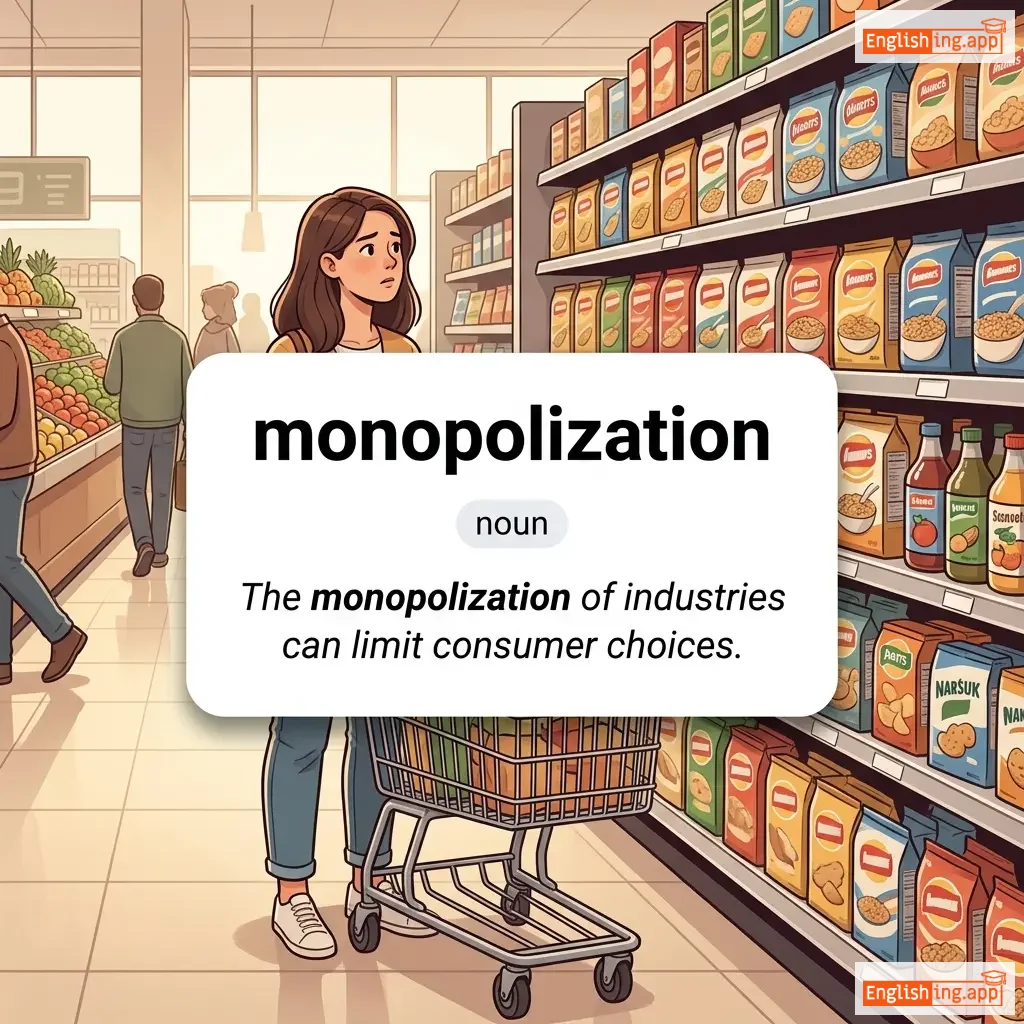
monopolization definition card — visual illustration of the meaning
noun
məˌnɒp.ə.laɪˈzeɪ.ʃən
monopole (monopole)

The process of gaining exclusive possession or control of a trade, commodity, or service.

"The monopolization of industries can limit consumer choices."

"La monopolisation des industries peut limiter les choix des consommateurs." (La monopolisation des industries peut limiter les choix des consommateurs.)
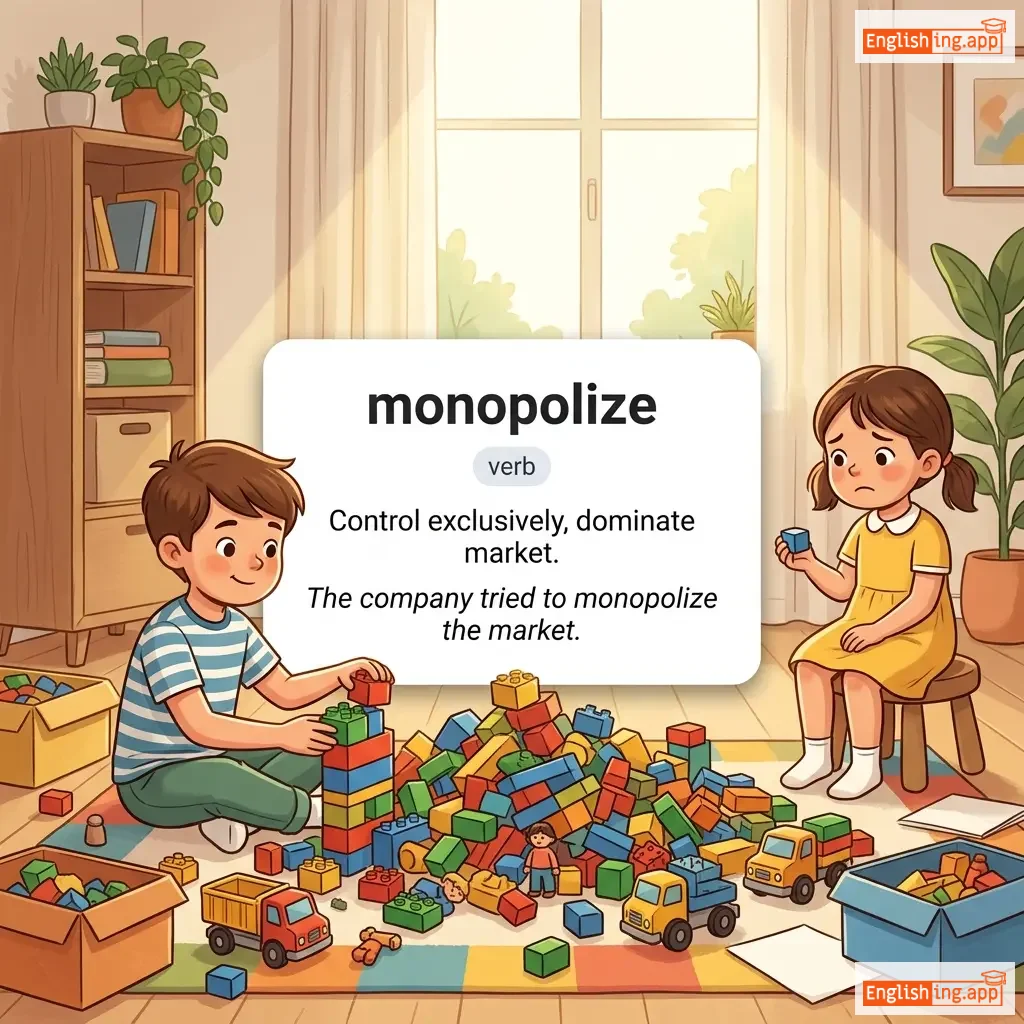
monopolize definition card — visual illustration of the meaning
verb
məˈnɒp.ə.laɪz
monopoliser (monopoliser)

Control exclusively, dominate market.

"The company tried to monopolize the market."

"L'entreprise a essayé de monopoliser le marché." (L'entreprise a essayé de monopoliser le marché.)
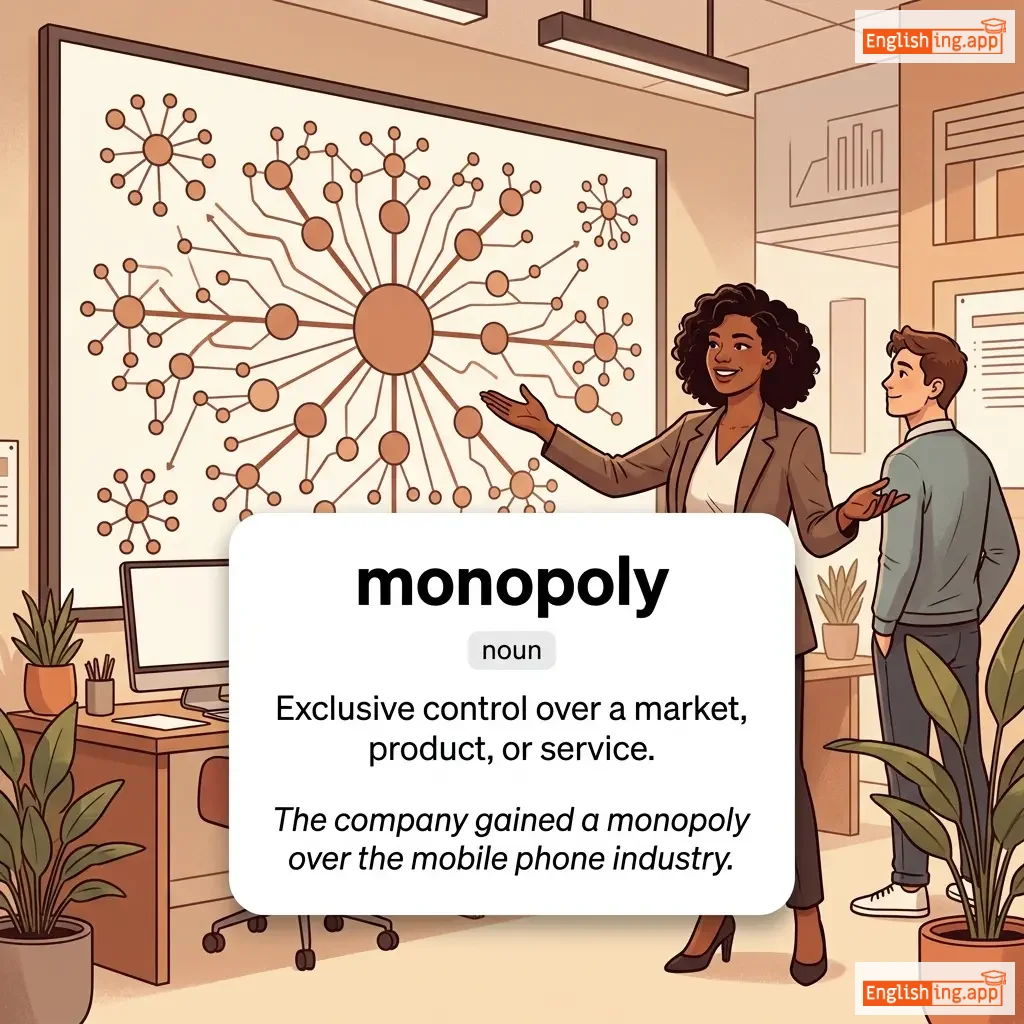
monopoly definition card — visual illustration of the meaning
noun
/məˈnɒpəli/
monopole (monopole)

Exclusive control over a market, product, or service.

"The company gained a monopoly over the mobile phone industry."

"L'entreprise a obtenu un monopole sur l'industrie du téléphone mobile." (Lentreprise a obtenu un monopole sur lindustrie du telephone mobile)
noun
/ˈmɒnəˌsɪləbəl/
mot monosyllabique (mot monosyllabique)

A word consisting of only one syllable.

"Words like 'yes' and 'no' are monosyllables."

"Des mots comme 'oui' et 'non' sont des monosyllabes." (Des mots comme 'oui' et 'non' sont des monosyllabes.)
noun
mɒnəˈtɑːskɪŋ
faire une tâche à la fois (faire une tache a la fois)

The practice of dedicating oneself to a given task and minimizing potential interruptions until the task is completed or a significant period of time has elapsed.

"Monotasking can often lead to higher quality work."

"Le monotasking conduit souvent à un travail de meilleure qualité." (Le monotasking conduit souvent à un travail de meilleure qualité.)
noun
/ˈmɒnəˌθiːɪzəm/
monothéisme (monotheisme)

The belief in the existence of only one God.

"Islam and Christianity are religions based on monotheism."

"L'islam et le christianisme sont des religions basées sur le monothéisme." (L'islam et le christianisme sont des religions basées sur le monothéisme.)
noun
/ˈmɒn.ə.təʊn/
monotone (monotone)

A continuous sound, especially of a person's voice, that does not rise and fall in pitch.

"The teacher's monotone made the lecture hard to follow."

"Le monotone de l'enseignant rendait la conférence difficile à suivre." (Le monotone de l'enseignant rendait la conférence difficile à suivre.)
adjective
/məˈnɒt.ən.əs/
monotone (monotone)

Dull, tedious, and repetitious; lacking in variety and interest.

"The monotonous routine of office work tired him out."

"La routine monotone du travail de bureau l'a épuisé." (La routine monotone du travail de bureau l'a epuise.)
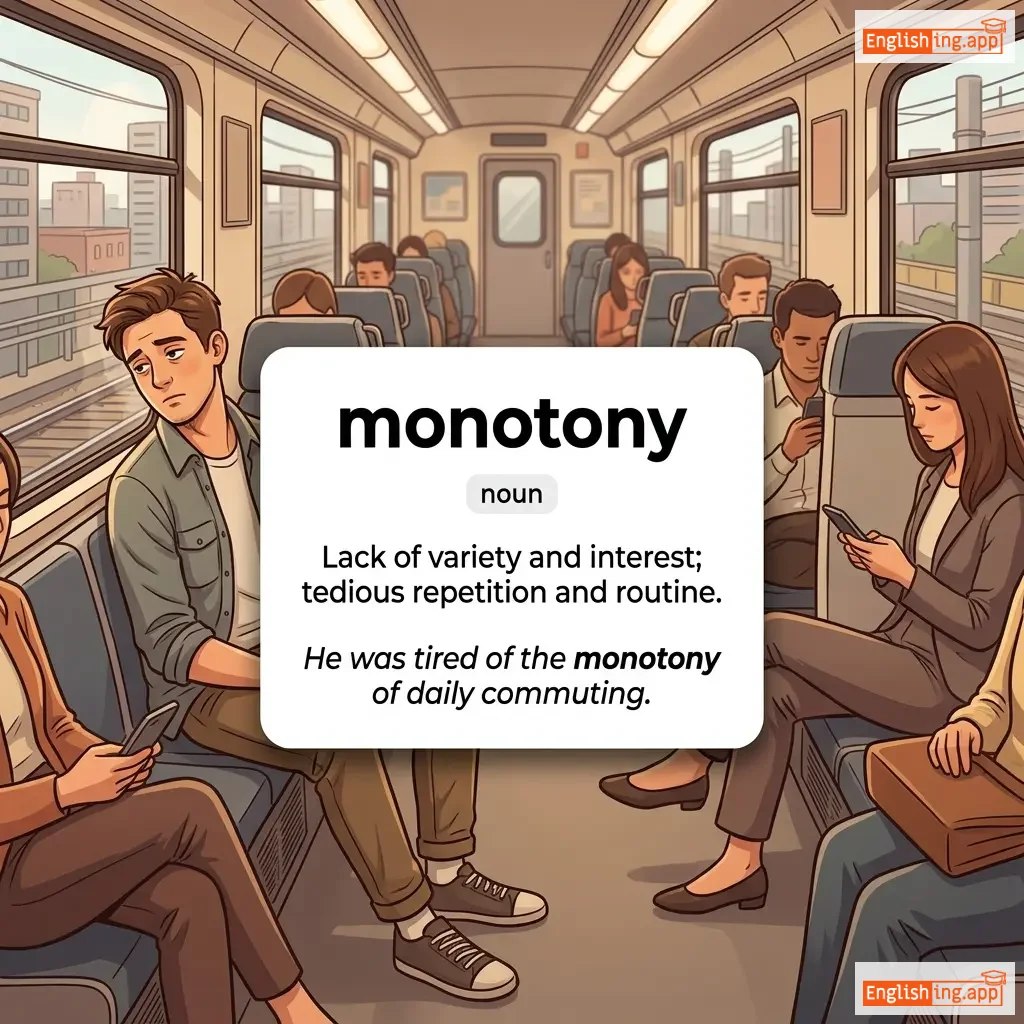
monotony definition card — visual illustration of the meaning
noun
/məˈnɒt.ə.ni/
monotonie (monotonie)

Lack of variety and interest; tedious repetition and routine.

"He was tired of the monotony of daily commuting."

"Il en avait assez de la monotonie des trajets quotidiens." (Il en avait assez de la monotonie des trajets quotidiens.)
noun
/ˈmɒnstər/
bonheur (bonheur)

an imaginary or large frightening creature

"The child was afraid that a monster was hiding under the bed."

"Elle n'a pas pu cacher son bonheur lorsqu'elle a reçu le prix." (Elle n'a pas pu cacher son bonheur lorsqu'elle a reçu le prix.)
adjective
/ˈmɒnstrəs/
monstrueux; extrêmement grand; choquant ou malveillant; anormal ou contre nature (monstrué)

extremely large; shockingly evil or wrong; abnormal or unnatural

"The monstrous crime shocked the entire community."

"Le crime monstrueux a choqué toute la communauté." (Le crime monstrueux a choqué toute la communauté.)
noun
/mɒnˈtɑːʒ/
montage (montage)

A sequence of film editing or a composite image made by combining several separate pictures.

"The film opened with a montage of city life."

"Le film a commencé par un montage de la vie urbaine." (Le film a commence par un montage de la vie urbaine.)
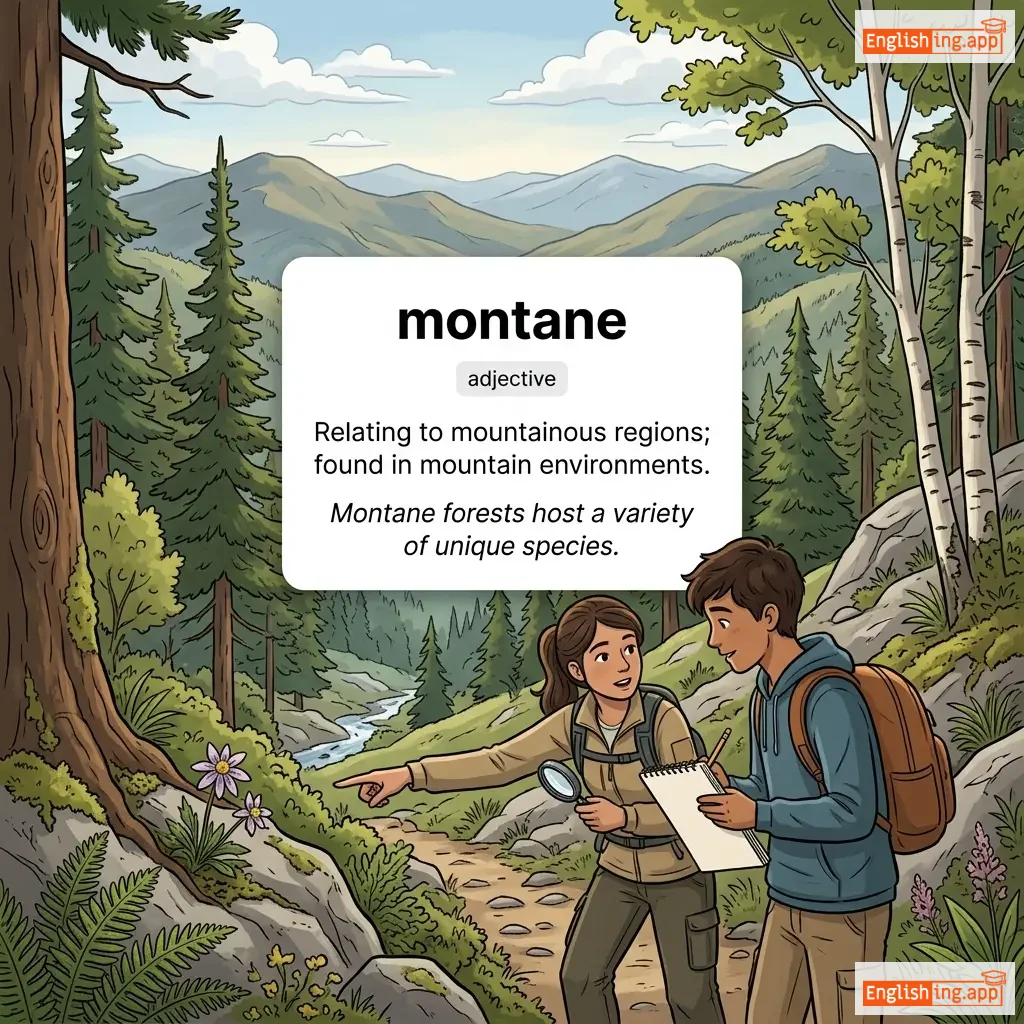
montane definition card — visual illustration of the meaning
adjective
/ˈmɒn.teɪn/
relatif aux régions montagneuses; trouvé dans les environnements montagneux (relatif aux régions montagneuses; trouvé dans les environnements montagneux)

Relating to mountainous regions; found in mountain environments.

"Montane forests host a variety of unique species."

"Les forêts montagnardes abritent une variété d'espèces uniques." (Les forêts montagnardes abritent une variété d'espèces uniques.)
noun
/mʌnθ/
mois (mois)

a period of about four weeks or one-twelfth of a year

"She visits her grandparents once a month."

"Elle visite ses grands-parents une fois par mois." (Elle visite ses grands-parents une fois par mois.)
adjective
/ˈmʌnθli/
mensuel (mensuel)

happening, done, or published once a month

"Employees receive their salary on a monthly basis."

"Les employés reçoivent leur salaire sur une base mensuelle." (Les employés reçoivent leur salaire sur une base mensuelle.)
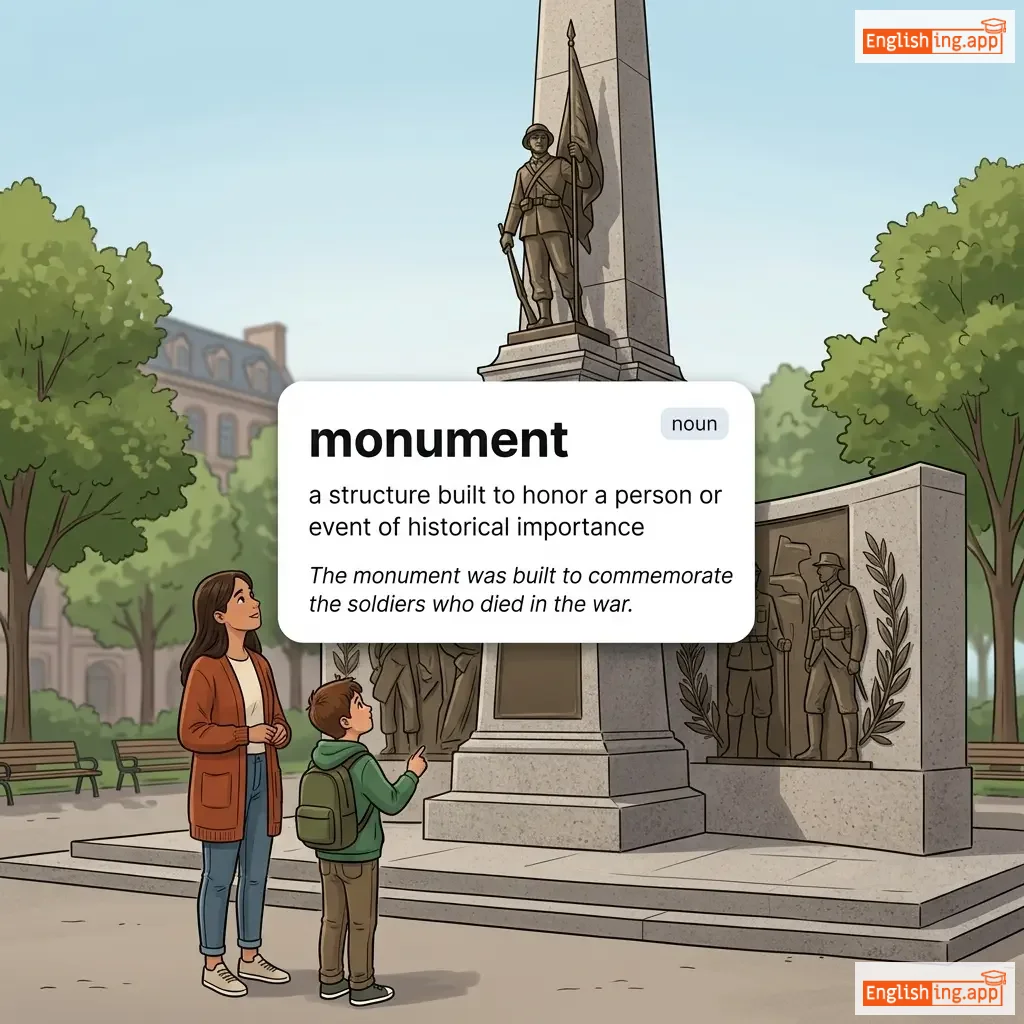
monument definition card — visual illustration of the meaning
noun
/ˈmɒnjumənt/
monument (monument)

a structure built to honor a person or event of historical importance

"The monument was built to commemorate the soldiers who died in the war."

"Le monument a été construit pour commémorer les soldats morts pendant la guerre." (Le monument a été construit pour commémorer les soldats morts pendant la guerre.)
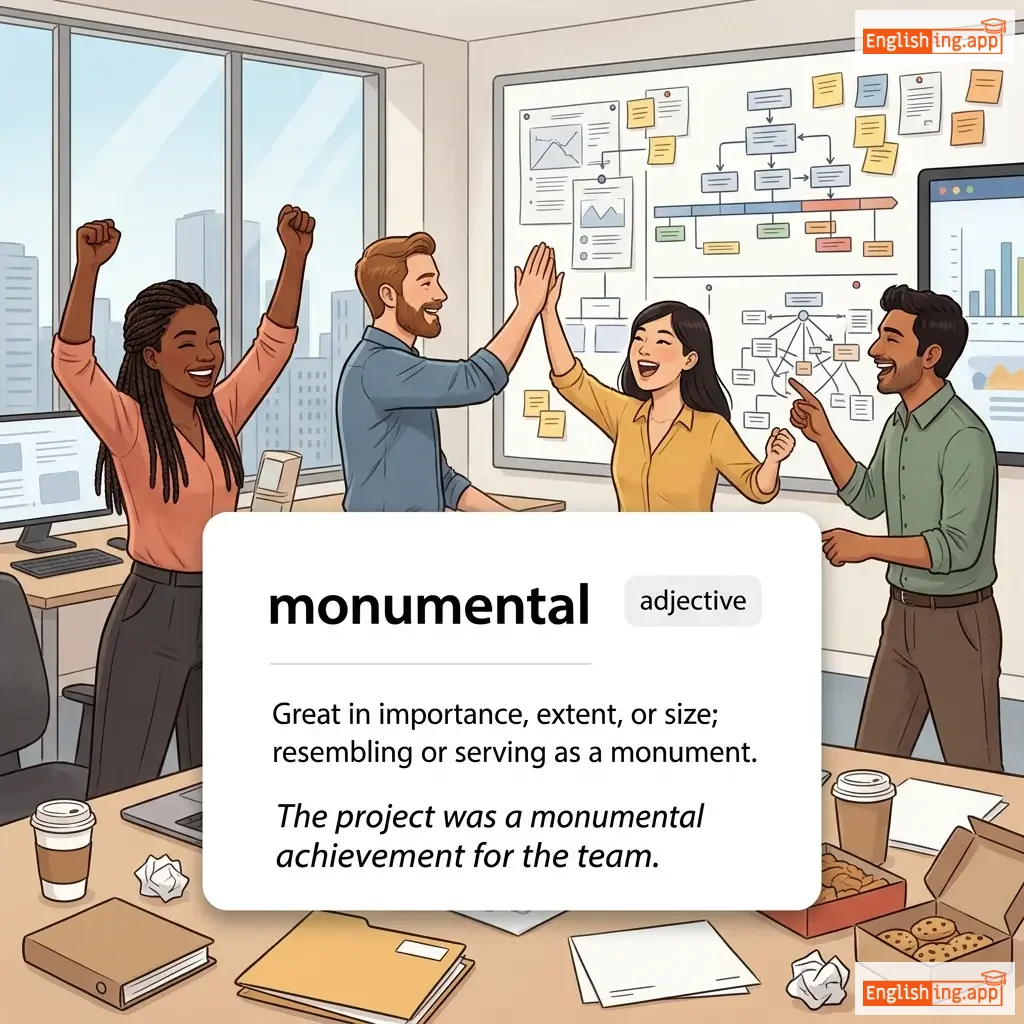
monumental definition card — visual illustration of the meaning
adjective
/ˌmɒn.jʊˈmen.təl/
monumental (monumental)

Great in importance, extent, or size; resembling or serving as a monument.

"The project was a monumental achievement for the team."

"Le projet a été un accomplissement monumental pour l'équipe." (Le projet a été un accomplissement monumental pour l'équipe.)
noun
/muːd/
humeur (humeur)

a temporary state of mind or feeling

"He was in a good mood after getting the job."

"Il était de bonne humeur après avoir obtenu le travail." (Il était de bonne humeur après avoir obtenu le travail.)
noun
/ˈmuːdi.nəs/
instabilité émotionnelle (instabilite emotionnelle)

The state of being frequently subject to changes in mood, especially irritability or sadness.

"Her moodiness made it difficult to predict how she would react."

"Son instabilité émotionnelle rendait difficile de prédire comment elle réagirait." (Son instabilite emotionnelle rendait difficile de predire comment elle reagirait.)
noun
/muːn/
lune (lune)

the natural satellite of the earth, visible mainly at night by reflected light from the sun

"The moon shines brightly in the night sky."

"La lune brille intensément dans le ciel nocturne." (La lune brille intensément dans le ciel nocturne.)
noun
/ˈmuːn.biːm/
rayon de lune (rayon de lune)

A ray of light from the moon.

"A moonbeam lit up the quiet forest clearing."

"Un rayon de lune illumina la clairière silencieuse de la forêt." (Un rayon de lune illumina la clairière silencieuse de la forêt.)
verb, noun
/mʊər/
amarrer / terrain ouvert (amarrer / terrain ouvert)

As a verb: to tie a ship so that it stays in place. As a noun: open, uncultivated land.

"The sailors moored the ship at the dock."

"Les marins ont amarré le bateau au quai." (Les marins ont amarré le bateau au quai.)
adjective, verb
/muːt/
irrélevant / discutable (irrelevant / discutable)

Adjective: subject to debate or irrelevant. Verb: to suggest an idea for discussion.

"The issue of funding became a moot point after the project was canceled."

"La question du financement est devenue un point sans importance après l'annulation du projet." (La question du financement est devenue un point sans importance après l'annulation du projet.)
adjective, noun
/ˈmɔːrəl/
moral (moral)

Adjective: concerned with principles of right and wrong. Noun: a lesson about right and wrong from a story or experience.

"The moral of the story is that honesty is the best policy."

"La morale de l'histoire est que l'honnêteté est la meilleure politique." (La morale de l'histoire est que l'honnêteté est la meilleure politique.)
noun
/məˈræl/
moral (moral)

The confidence, enthusiasm, and discipline of a person or group at a particular time.

"The team's morale improved after their recent victory."

"Le moral de l'équipe s'est amélioré après leur récente victoire." (Le moral de l'équipe s'est amélioré après leur récente victoire.)
noun
/ˈmɒrəlɪst/
moraliste (moraliste)

A person who teaches or promotes moral principles and values.

"The author was known as a strict moralist in his writings."

"L'auteur était connu comme un moraliste strict dans ses écrits." (L'auteur était connu comme un moraliste strict dans ses écrits.)
noun
/məˈrælɪti/
moralité (moralite)

Principles concerning the distinction between right and wrong or good and bad behavior.

"Society's sense of morality changes over time."

"Le sens de la moralité dans la société change avec le temps." (Le sens de la moralité dans la société change avec le temps.)
verb
/ˈmɒrəlaɪz/
moraliser (moralizer)

To comment on issues of right and wrong, often with an air of superiority.

"He tends to moralize about other people's choices."

"Il a tendance à moraliser sur les choix des autres." (Il a tendance à moraliser sur les choix des autres.)
adverb
/ˈmɔːrəli/
moralement (moralement)

in accordance with principles of right and wrong behavior; ethically

"She felt morally obligated to help the refugees."

"Elle se sentait moralement obligée d'aider les réfugiés." (Elle se sentait moralement obligée d'aider les réfugiés.)
noun
/məˈræs/
situation compliquée (situation compliquee)

A complicated or confused situation; a swampy or boggy ground.

"The project got stuck in a bureaucratic morass."

"Le projet est coincé dans un marasme bureaucratique." (Le projet est coince dans un marasme bureaucratique.)
noun
/ˌmɔːrəˈtɔːriəm/
moratoire (moratoire)

A temporary suspension or delay of an activity, law, or obligation.

"The government announced a moratorium on new mining licenses."

"Le gouvernement a annoncé un moratoire sur les nouvelles licences minières." (Le gouvernement a annonce un moratoire sur les nouvelles licences minieres.)
adjective
/ˈmɔːrbɪd/
intérêt anormal pour des sujets perturbants ou désagréables (interet anormal pour des sujets perturbants ou desagreables)

Having an abnormal interest in disturbing or unpleasant subjects such as death or disease.

"She had a morbid fascination with crime stories."

"Elle avait une fascination morbide pour les histoires de crime." (Elle avait une fascination morbide pour les histoires de crime.)
adjective
/mɔːrˈdeɪʃəs/
acerbe ou sarcastique (acerbe ou sarcastique)

Sharp or biting in style, tone, or remark; sarcastic.

"The critic’s mordacious review offended the author."

"La critique mordante du critique a offensé l'auteur." (La critique mordante du critique a offusqué l'auteur.)
adjective
/ˈmɔːrdənt/
mordant, critique ou sarcastique (mordant, critique ou sarcastique)

Having a sharp, critical, or biting quality; especially in humor.

"Her mordant wit often left her friends speechless."

"Son esprit mordant laissait souvent ses amis sans voix." (Son esprit mordant laissait souvent ses amis sans voix.)