Vocabulaires

Découvrez, apprenez et maîtrisez le vocabulaire anglais

noun
/ˌmɒdəˈreɪʃən/
modération (moderation)

The avoidance of excess or extremes; keeping balance or within reasonable limits.

"He drinks wine in moderation."

"Il boit du vin avec modération." (Il boit du vin avec moderation.)
noun
/ˈmɒdəreɪtər/
modérateur (moderateur)

A person who leads or oversees discussions, debates, or forums to maintain order.

"The moderator asked each panelist to share their views."

"Le modérateur a demandé à chaque panéliste de partager leurs points de vue." (Le modérateur a demandé à chaque panéliste de partager leurs points de vue.)
adjective
/ˈmɒdən/
moderne (moderne)

relating to the present or recent times, not ancient or old-fashioned

"They live in a modern apartment with new facilities."

"Ils vivent dans un appartement moderne avec de nouvelles installations." (Ils vivent dans un appartement moderne avec de nouvelles installations.)
noun
/məˈdɜːrnəti/
modernité (modernite)

The quality or condition of being modern; up-to-date ideas, practices, or style.

"The city’s architecture reflects both tradition and modernity."

"L'architecture de la ville reflète à la fois la tradition et la modernité." (L'architecture de la ville reflete a la fois la tradition et la modernite.)
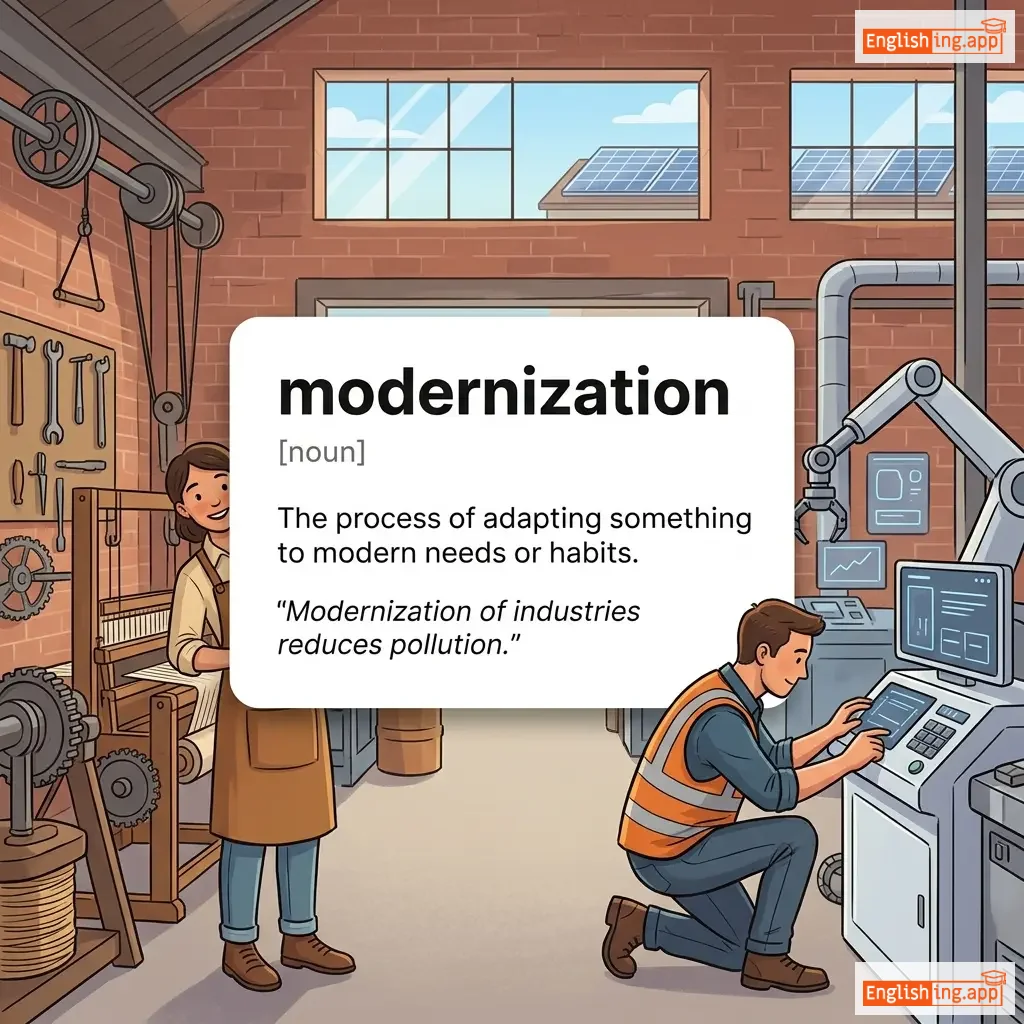
modernization definition card — visual illustration of the meaning
noun
/ˌmɒd.ən.aɪˈzeɪ.ʃən/
modernisation (modernisation)

The process of adapting something to modern needs or habits.

"Modernization of industries reduces pollution."

"La modernisation des industries réduit la pollution." (La modernisation des industries réduit la pollution.)
verb
/ˈmɒdənaɪz/
moderniser (moderniser)

To adapt something to modern needs or styles; to update or improve.

"The company plans to modernize its IT infrastructure."

"L'entreprise prévoit de moderniser son infrastructure informatique." (L'entreprise prévoit de moderniser son infrastructure informatique.)
adjective
/ˈmɒdɪst/
modeste (modeste)

Having or showing a humble estimate of one’s importance; simple and not extravagant.

"She lives in a modest house in the countryside."

"Elle vit dans une maison modeste à la campagne." (Elle vit dans une maison modeste a la campagne.)
noun
/ˈmɒd.ə.sti/
modestie; humilité (modestie; humilité)

the quality of being humble and not boastful about achievements

"Despite his success, he showed great modesty."

"Malgré son succès, il a montré une grande modestie." (Malgre son succes, il a montre une grande modestie.)
noun
/ˈmɒdɪkəm/
une petite quantité (une petite quantite)

a small or moderate amount of something, especially something valuable or desirable

"She showed a modicum of patience during the long meeting."

"Elle a montré une petite quantité de patience pendant la longue réunion." (Elle a montre une petite quantite de patience pendant la longue reunion.)
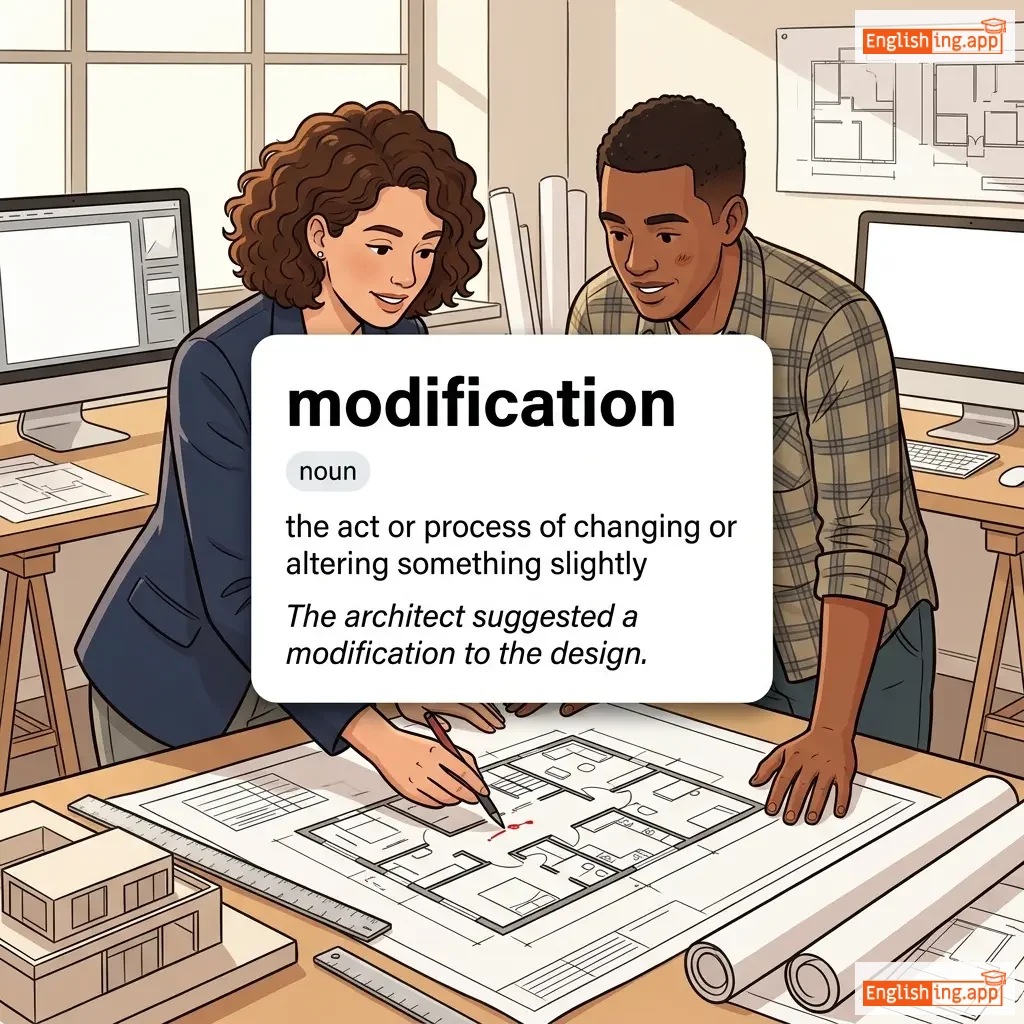
modification definition card — visual illustration of the meaning
noun
/ˌmɒdɪfɪˈkeɪʃən/
modification (modification)

the act or process of changing or altering something slightly

"The architect suggested a modification to the design."

"L'architecte a suggéré une modification du design." (L'architecte a suggéré une modification du design.)
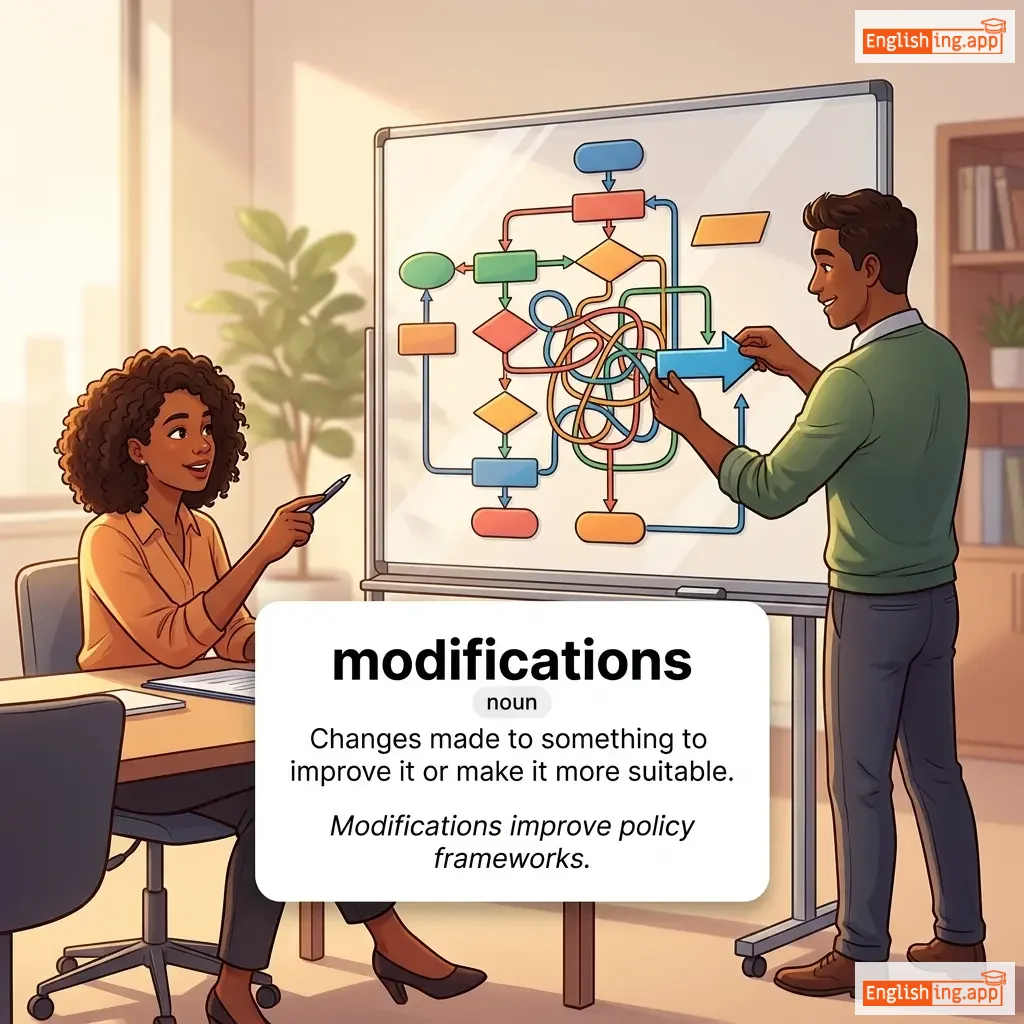
modifications definition card — visual illustration of the meaning
noun
ˌmɒd.ɪ.fɪˈkeɪ.ʃənz
modifications (modifications)

Changes made to something to improve it or make it more suitable.

"Modifications improve policy frameworks."

"Les modifications améliorent les cadres politiques." (Les modifications améliorent les cadres politiques.)
noun
/ˈmɒdɪfaɪər/
modificateur (modificateur)

a word or element that changes, limits, or describes the meaning of another word; something that alters or adjusts

"In the phrase 'very cold', 'very' is a modifier of 'cold'."

"Dans l’expression « very cold », « very » est un modificateur de « cold »." (Dans l expression very cold very est un modificateur de cold)
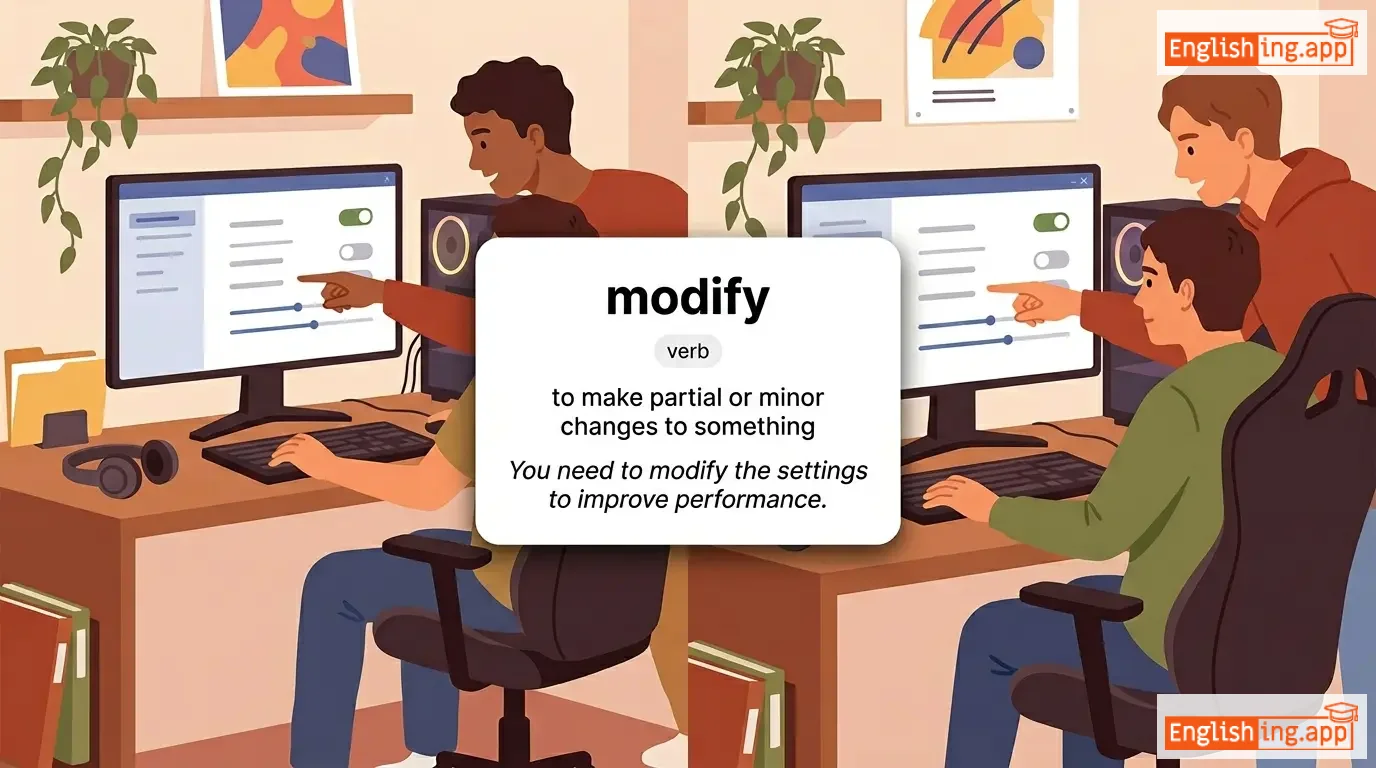
modify definition card — visual illustration of the meaning
verb
/ˈmɒdɪfaɪ/
modifier (modifier)

to make partial or minor changes to something

"You need to modify the settings to improve performance."

"Vous devez modifier les paramètres pour améliorer les performances." (Vous devez modifier les paramètres pour améliorer les performances.)
adjective
/ˈməʊdɪʃ/
à la mode (a la mode)

conforming to or following current fashion or style

"She wore a modish outfit that caught everyone’s attention."

"Elle portait une tenue modish qui attirait l'attention de tout le monde." (Elle portait une tenue modish qui attirait l'attention de tout le monde.)
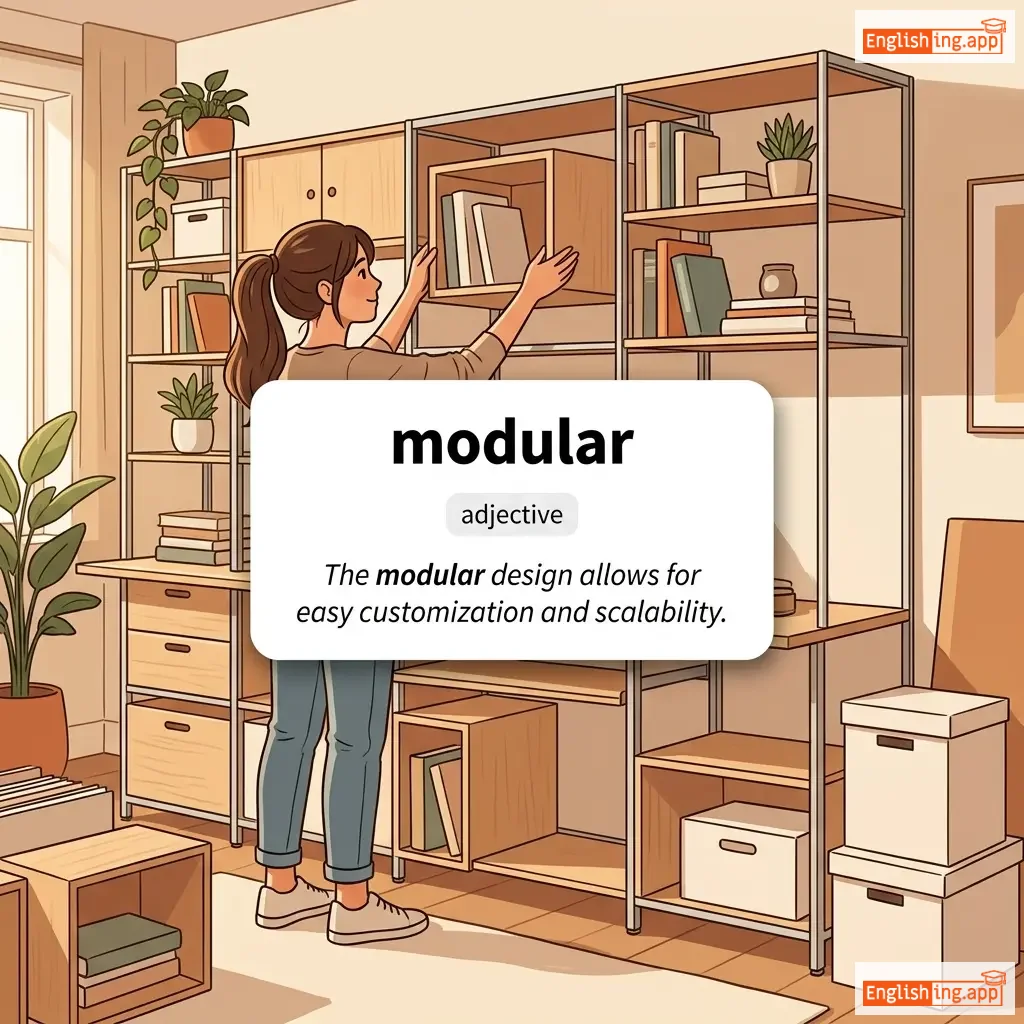
modular definition card — visual illustration of the meaning
adjective
/ˈmɒdʒʊlər/
modulaire (modulaire)

Employing or involving a module or modules as the basis of design or construction.

"The modular design allows for easy customization and scalability."

"La conception modulaire permet une personnalisation et une évolutivité faciles." (La conception modulaire permet une personnalisation et une evolutivite faciles.)
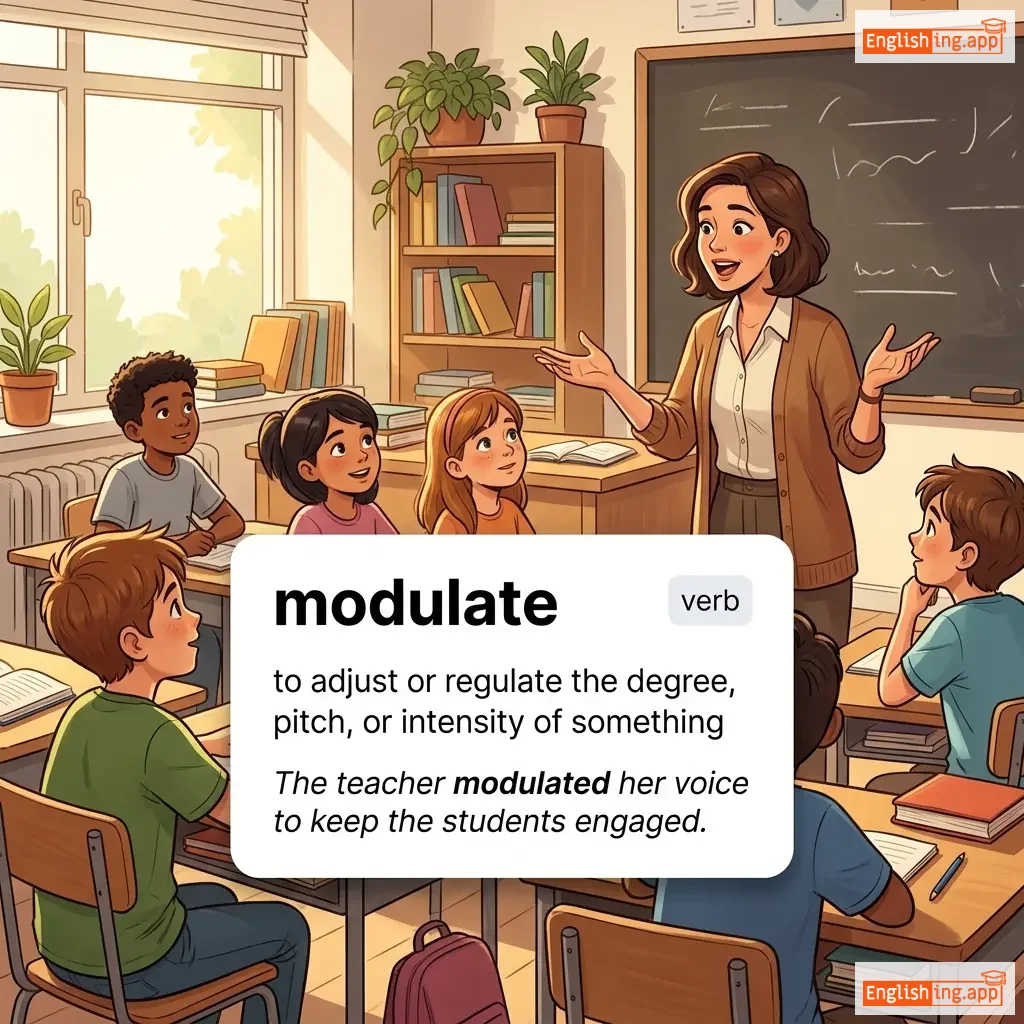
modulate definition card — visual illustration of the meaning
verb
/ˈmɒdjʊleɪt/
moduler (moduler)

to adjust or regulate the degree, pitch, or intensity of something

"The teacher modulated her voice to keep the students engaged."

"L'enseignant a modulé sa voix pour garder les élèves engagés." (L'enseignant a modulé sa voix pour garder les élèves engagés.)
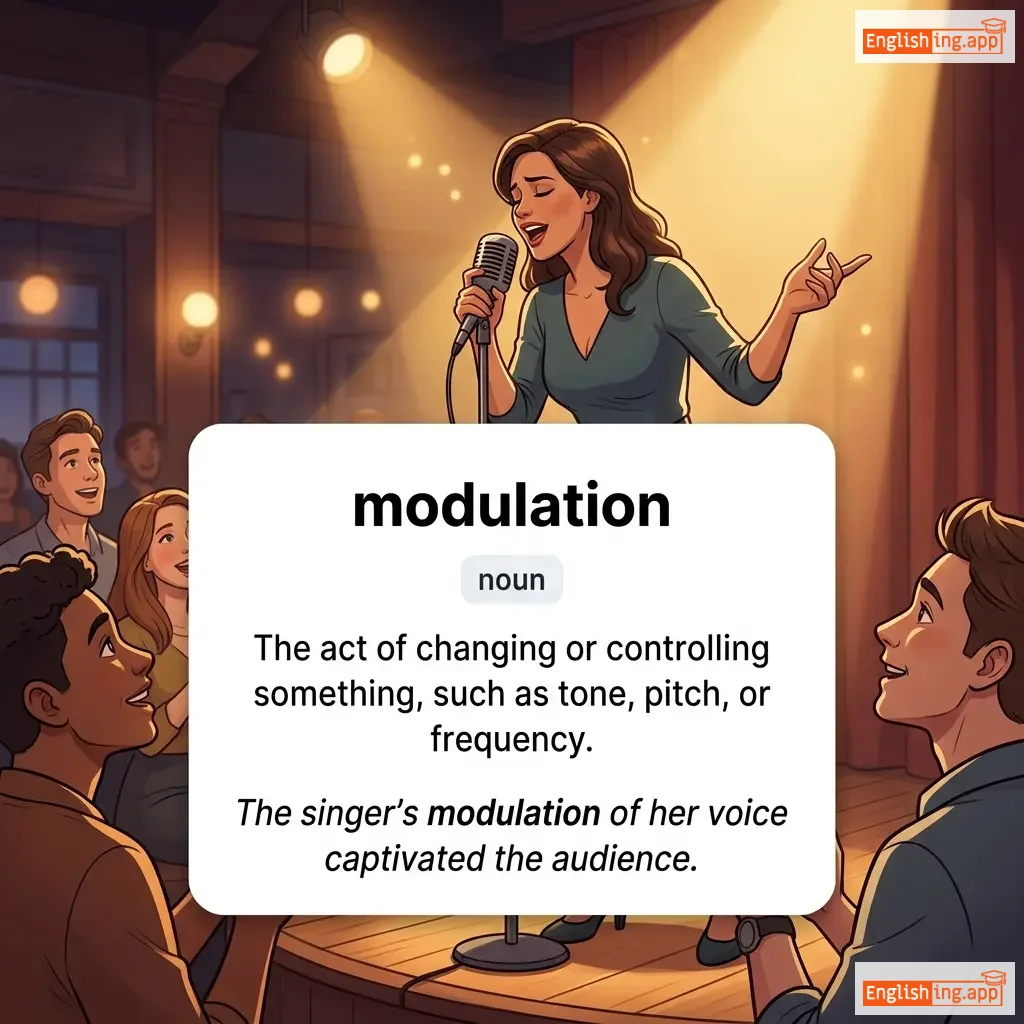
modulation definition card — visual illustration of the meaning
noun
/ˌmɒdjʊˈleɪʃən/
contrôle du ton ou de la fréquence (controle du ton ou de la frequence)

The act of changing or controlling something, such as tone, pitch, or frequency.

"The singer’s modulation of her voice captivated the audience."

"La modulation de la voix de la chanteuse a captivé le public." (La modulation de la voix de la chanteuse a captivé le public.)
noun
/ˈmɒdjuːl/
module (module)

a self-contained unit of a course or system, typically part of a larger whole

"The module on machine learning was difficult but informative."

"Le module sur l'apprentissage automatique était difficile mais instructif." (Le module sur l'apprentissage automatique etait difficile mais instructif.)
noun
/ˈmoʊɡəl/
mogul (mogul)

A powerful or influential person, especially in business or media.

"He became a tech mogul by founding a billion-dollar company."

"Il est devenu un mogul de la technologie en fondant une entreprise d'un milliard de dollars." (Il est devenu un mogul de la technologie en fondant une entreprise d'un milliard de dollars.)
noun
/ˈmɔɪəti/
moitié ou portion (moitié ou portion)

One of two equal parts; a half or portion.

"The estate was divided into two moieties between the heirs."

"La propriété a été divisée en deux moitiés entre les héritiers." (La propriété a été divisée en deux moitiés entre les héritiers.)
noun
/ˈmɔɪs.tʃər/
humidité (humidite)

water or dampness that exists in small amounts in the air or on a surface

"The skin cream helps retain moisture."

"La crème pour la peau aide à retenir l'humidité." (La creme pour la peau aide a retenir l'humidite.)
noun
/ˈmoʊlə ˈkɑrplɪt/
poisson mola (pwason mola)

a small freshwater fish of the carp family, commonly found in South Asian rivers and ponds

"The mola carplet is a popular small fish used in Bengali cuisine."

"Le poisson mola est un petit poisson populaire utilisé dans la cuisine bengalie." (le pwason mola e un peti pwason popule utilize dan la cuisine bengali)
noun
/ˈmoʊlər/
molaire (molaire)

A large tooth at the back of the mouth used for grinding food.

"The dentist had to extract his wisdom molar."

"Le dentiste a dû extraire sa dent de sagesse." (Le dentiste a dû extraire sa dent de sagesse.)
noun
/məˈlæsɪz/
mélasse (melass)

thick, dark, sweet syrup made from sugar cane

"The recipe calls for molasses to give the bread a rich flavor."

"La recette demande de la mélasse pour donner au pain une saveur riche." (La recette demande de la melasse pour donner au pain une saveur riche.)
noun
/ˈmoʊldɪŋ/
moulure décorative (moulure decorative)

A decorative strip or design, often used on walls, ceilings, or furniture.

"The wooden molding gave the room a classic look."

"La moulure en bois a donné à la pièce un aspect classique." (La moulure en bois a donné à la pièce un aspect classique.)
noun
/moʊl/
taupe (taupe)

a small burrowing mammal with tiny eyes and soft fur

"The mole dug tunnels under the garden."

"Le taupe a creusé des tunnels sous le jardin." (Le taupe a creusé des tunnels sous le jardin.)
noun
/ˈmɒlɪkjuːl/
molécule (molekul)

The smallest unit of a chemical compound that retains its chemical properties.

"A water molecule is made up of two hydrogen atoms and one oxygen atom."

"Une molécule d'eau est composée de deux atomes d'hydrogène et d'un atome d'oxygène." (une molekul de o est compose de deux atomes d'hydrogene et d'un atome d'oxygene.)
verb
/məˈlɛst/
harceler / agresser sexuellement (harceler / agresser sexuellement)

to assault or abuse someone, especially in a sexual or physical way

"The criminal was arrested for attempting to molest a child."

"Le criminel a été arrêté pour avoir tenté de molester un enfant." (Le criminel a été arrêté pour avoir tenté de molester un enfant.)
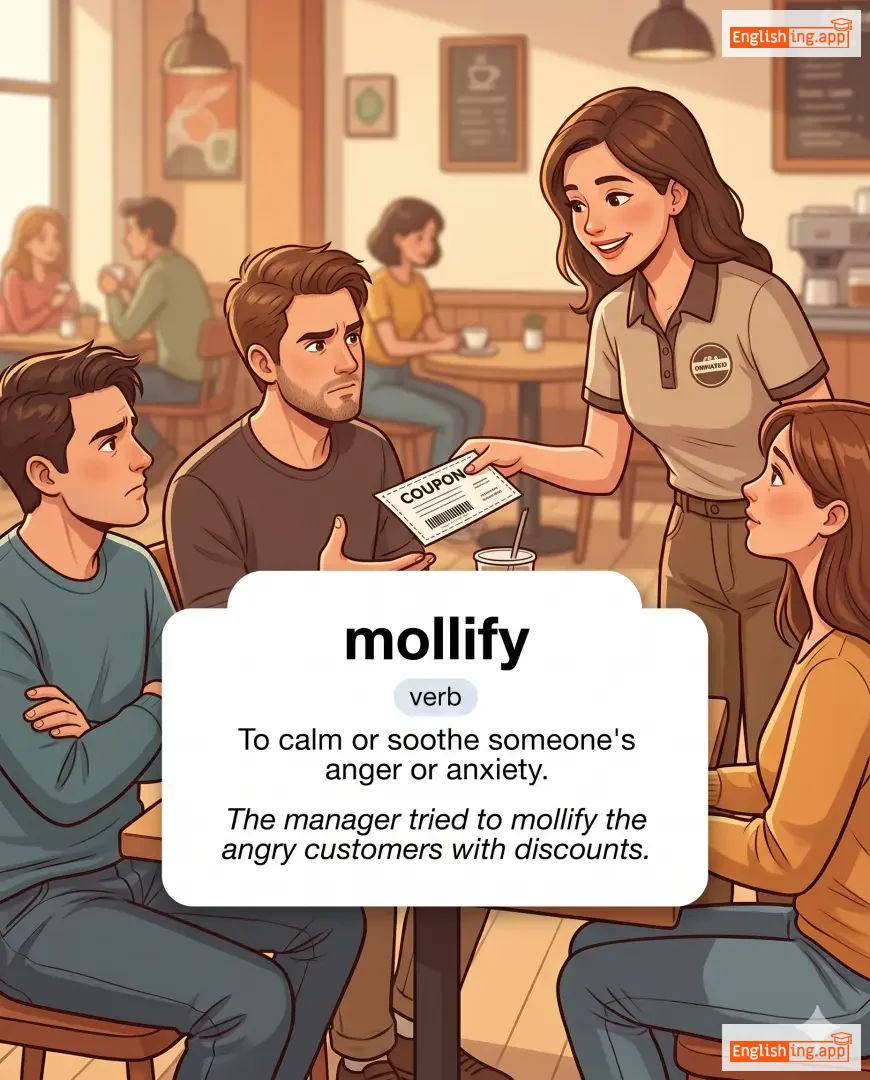
mollify definition card — visual illustration of the meaning
verb
/ˈmɒlɪfaɪ/
apaiser (apaiser)

To calm or soothe someone's anger or anxiety.

"The manager tried to mollify the angry customers with discounts."

"Le responsable a essayé d'apaiser les clients en colère avec des réductions." (Le responsable a essayé d'apaiser les clients en colère avec des réductions.)
verb
/ˈmɒlikɒdl/
gâter (gater)

To treat someone in an overprotective and indulgent way.

"Parents should avoid mollycoddling their children too much."

"Les parents devraient éviter de gâter trop leurs enfants." (Les parents devraient éviter de gâter trop leurs enfants.)
verb
/məʊlt/
muet (muet)

To shed old feathers, skin, or hair to make way for new growth.

"Birds molt their feathers once a year."

"Les oiseaux muent leurs plumes une fois par an." (Les oiseaux muent leurs plumes une fois par an.)
adjective
/ˈməʊltən/
fondu (fondu)

Made into liquid by heat; melted.

"The blacksmith poured molten metal into the mold."

"Le forgeron a versé du métal fondu dans le moule." (Le forgeron a versé du métal fondu dans le moule.)
👩‍👧

mom (maman)

noun
/mɑːm/
maman (maman)

an informal word for mother

"My mom makes the best homemade food."

"Ma maman fait la meilleure cuisine maison." (Ma maman fait la meilleure cuisine maison.)
noun
/ˈmoʊmənt/
moment (moment)

A very short period of time; a particular point in time.

"She paused for a moment before answering."

"Elle s'est arrêtée un moment avant de répondre." (Elle s'est arrete un moment avant de repondre.)
adjective
/ˈmoʊmənˌteri/
momentané (momentane)

Lasting for only a short time.

"There was a momentary silence in the room."

"Il y a eu un silence momentané dans la pièce." (Il y a eu un silence momentane dans la piece.)
adjective
/moʊˈmɛntəs/
important (important)

Of great importance or significance, especially in its effect on the future.

"The signing of the agreement was a momentous event."

"La signature de l'accord a été un événement important." (La signature de l'accord a été un événement important.)
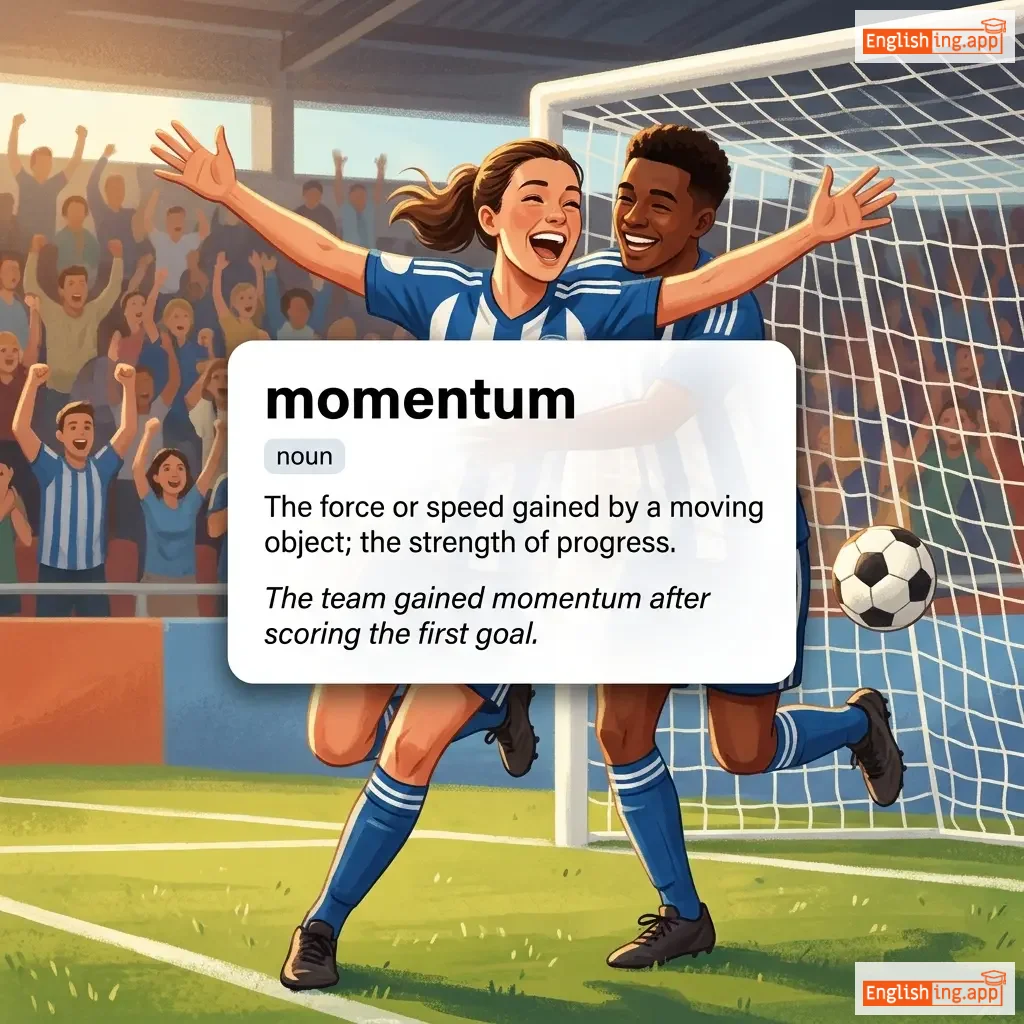
momentum definition card — visual illustration of the meaning
noun
/moʊˈmɛntəm/
quantité de mouvement (momentum)

The force or speed gained by a moving object; the strength of progress.

"The team gained momentum after scoring the first goal."

"L'équipe a pris de l'élan après avoir marqué le premier but." (Lequipe a pris de elan apres avoir marque le premier but)
noun
/ˈmɒn.ɑːk/
monarque (monarque)

a sovereign ruler, especially a king or queen

"The monarch addressed the nation on television."

"Le monarque a adressé la nation à la télévision." (Le monarque a adressé la nation à la télévision.)
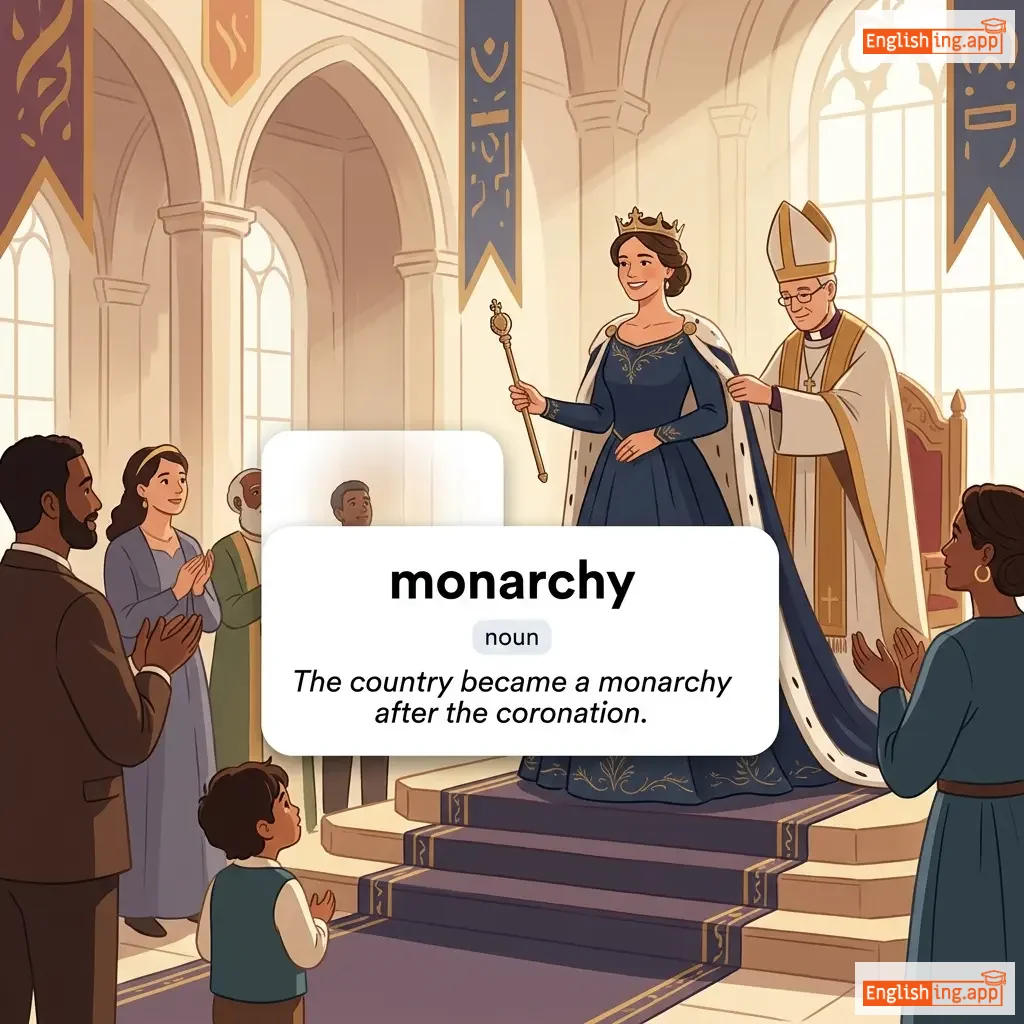
monarchy definition card — visual illustration of the meaning
noun
/ˈmɑːnərki/
monarchie (monarshi)

A system of government with a king or queen as head of state.

"The country became a monarchy after the coronation."

"Le pays est devenu une monarchie après le couronnement." (Le pays est devenu une monarchie apres le couronnement.)
noun
/ˈmɒnəstɛri/
monastère (monastere)

A building or complex where monks or nuns live, work, and worship.

"The old monastery was surrounded by high stone walls."

"Le vieux monastère était entouré de hauts murs de pierre." (Le vieux monastere etait entoure de hauts murs de pierre.)
adjective
/məˈnæstɪk/
monastique (monastik)

Relating to monks, monasteries, or a life of religious seclusion.

"He chose to live a monastic life away from the city."

"Il a choisi de vivre une vie monastique loin de la ville." (Il a choisi de vivre une vie monastique loin de la ville.)
noun
/ˈmʌn.deɪ/
lundi (lundi)

the first day of the working week following Sunday

"I start my new job on Monday."

"Je commence mon nouveau travail lundi." (je commence mon nouveau travail lundi)
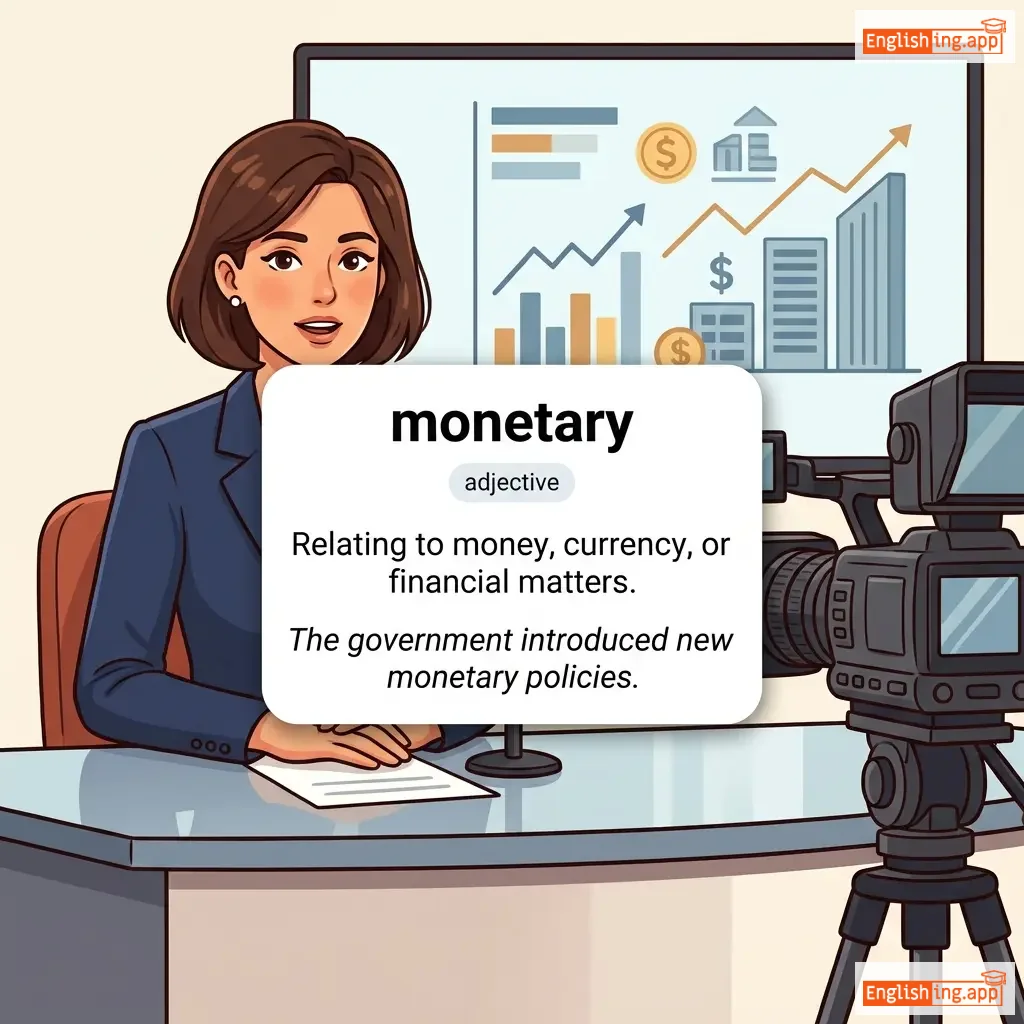
monetary definition card — visual illustration of the meaning
adjective
/ˈmʌnɪtəri/
monétaire (monetaire)

Relating to money, currency, or financial matters.

"The government introduced new monetary policies."

"Le gouvernement a introduit de nouvelles politiques monétaires." (Le gouvernement a introduit de nouvelles politiques monetaires.)
monetization definition card — visual illustration of the meaning
noun
/ˌmɒn.ɪ.taɪˈzeɪ.ʃən/
monétisation (monetisation)

The process of converting assets or services into money, involving commercialization, profit generation, and revenue creation.

"The monetization of digital content has created new income streams."

"La monétisation du contenu numérique a créé de nouvelles sources de revenus." (La monetisation du contenu numerique a cree de nouvelles sources de revenus.)
noun
/ˈmʌni/
bonheur (bonheur)

A medium of exchange in the form of coins and banknotes; wealth or financial resources.

"He saved enough money to buy a new car."

"Elle ne pouvait pas cacher son bonheur lorsqu'elle a reçu le prix." (Elle ne pouvait pas cacher son bonheur lorsqu'elle a reçu le prix.)
adjective
/ˈmʌnid/
riches; fortuné; aisé (manid)

having much money; wealthy; rich

"She comes from a moneyed family with extensive real estate holdings."

"Elle vient d'une famille fortunée avec de vastes biens immobiliers." (elle vient d'une famille fortunée avec de vastes biens immobiliers.)
noun
/ˈmɒŋ.ɡuːs/
mangouste (mangouste)

a small carnivorous mammal known for its ability to kill venomous snakes

"The mongoose quickly attacked the cobra to protect its young."

"La mangouste a attaqué rapidement le cobra pour protéger ses petits." (La mangouste a attaqué rapidement le cobra pour protéger ses petits.)
noun
/ˈmʌŋɡrəl/
chien bâtard (chien bâtard)

A dog of mixed breed; sometimes used to describe something mixed or of inferior quality.

"The stray dog was a friendly mongrel."

"Le chien errant était un chien bâtard amical." (Le chien errant était un chien bâtard amical.)
noun
/məˈnɪʃən/
avertissement (avertissement)

A warning or caution, often of a religious or moral nature.

"The priest gave a monition against dishonesty."

"Le prêtre a donné un avertissement contre la malhonnêteté." (Le pretre a donne un avertissement contre la malhonnetete.)
noun, verb
/ˈmɒnɪtər/
moniteur, surveiller (moniteur, surveiller)

to observe and check the progress or quality of something; also a device that displays information

"The teacher monitors the students during the exam."

"Le professeur surveille les élèves pendant l'examen." (Le professeur surveille les élèves pendant l'examen.)