Vocabulaires

Découvrez, apprenez et maîtrisez le vocabulaire anglais

adjective
/ɪnˈkɒmp(ə)rəbl/
incomparable (incomparable)

Without an equal in quality or excellence; matchless.

"The view from the mountain was incomparable."

"La vue depuis la montagne était incomparable." (La vue depuis la montagne était incomparable.)
noun
/ˌɪnkəmˌpætəˈbɪlɪti/
incompatibilité (incompatibilite)

the state of being unable to exist or work together harmoniously; lack of compatibility

"The project failed because of incompatibility between the two software systems."

"Le projet a échoué à cause de l’incompatibilité entre les deux systèmes logiciels." (Le projet a echoue a cause de l incompatibilite entre les deux systemes logiciels)
adjective
/ˌɪnkəmˈpætəbl/
incompatible (incompatible)

Not able to exist or work together without conflict.

"Their personalities were completely incompatible."

"Leurs personnalités étaient complètement incompatibles." (Leurs personnalités étaient complètement incompatibles.)
noun
/ɪnˈkɒmpɪtəns/
incompétence (incompetence)

Lack of ability, skill, or effectiveness in doing something.

"The project failed due to the manager’s incompetence."

"Le projet a échoué à cause de l'incompétence du manager." (Le projet a échoué à cause de l'incompétence du manager.)
adjective
/ɪnˈkɒmpɪtənt/
incompétent (incompetent)

Lacking the necessary ability or skills to do something successfully.

"He was fired because he was incompetent at his job."

"Il a été licencié parce qu'il était incompétent dans son travail." (Il a ete licencie parce qu il etait incompetent dans son travail.)
adjective
/ˌɪnkəmˈpliːt/
incomplet (incomplet)

Not finished, lacking some parts or not whole.

"Her report was incomplete and needed further details."

"Son rapport était incomplet et nécessitait des détails supplémentaires." (Son rapport était incomplet et nécessitait des détails supplémentaires.)
noun
/ˌɪnkəmˈpliːtnəs/
incomplétude (incompletude)

the state of not being complete or whole; lack of necessary parts or fullness

"The incompleteness of the report caused delays in the project."

"L’incomplétude du rapport a causé des retards dans le projet." (L incompletude du rapport a cause des retards dans le projet)
adjective
/ˌɪnkɒmprɪˈhɛnsəbl/
incompréhensible (incomprehensible)

Impossible or very difficult to understand.

"The professor’s lecture was so fast it became incomprehensible."

"Le cours du professeur était tellement rapide qu'il est devenu incompréhensible." (Le cours du professeur etait tellement rapide qu'il est devenu incomprehensible.)
adjective
/ˌɪnkəmˈprɛsəbl/
incompressible (incompressible)

Not able to be pressed or squeezed into a smaller space.

"Liquids are generally considered incompressible."

"Les liquides sont généralement considérés comme incompressibles." (Les liquides sont généralement considérés comme incompressibles.)
adjective
/ˌɪnkənˈsiːvəbl̩/
inconcevable (inconcevable)

Impossible to imagine or believe; beyond comprehension.

"It seemed inconceivable that she could finish the marathon after such little training."

"Il semblait inconcevable qu'elle puisse finir le marathon après si peu d'entraînement." (Il semblait inconcevable qu'elle puisse finir le marathon apres si peu d'entrainement.)
adjective
/ˌɪnkənˈkluːsɪv/
inconclusif (inconclusif)

Not leading to a definite result or decision.

"The investigation remained inconclusive due to a lack of evidence."

"L'enquête est restée inconclusive en raison d'un manque de preuves." (L'enquete est restee inconclusive en raison d'un manque de preuves.)
adjective
/ɪnˈkɒŋɡruənt/
incongruente (incongruente)

Not in harmony or keeping with the surroundings or other aspects.

"His casual outfit looked incongruent at the formal dinner."

"Sa tenue décontractée semblait incongruente lors du dîner formel." (Sa tenue decontractee semblait incongruente lors du diner formel.)
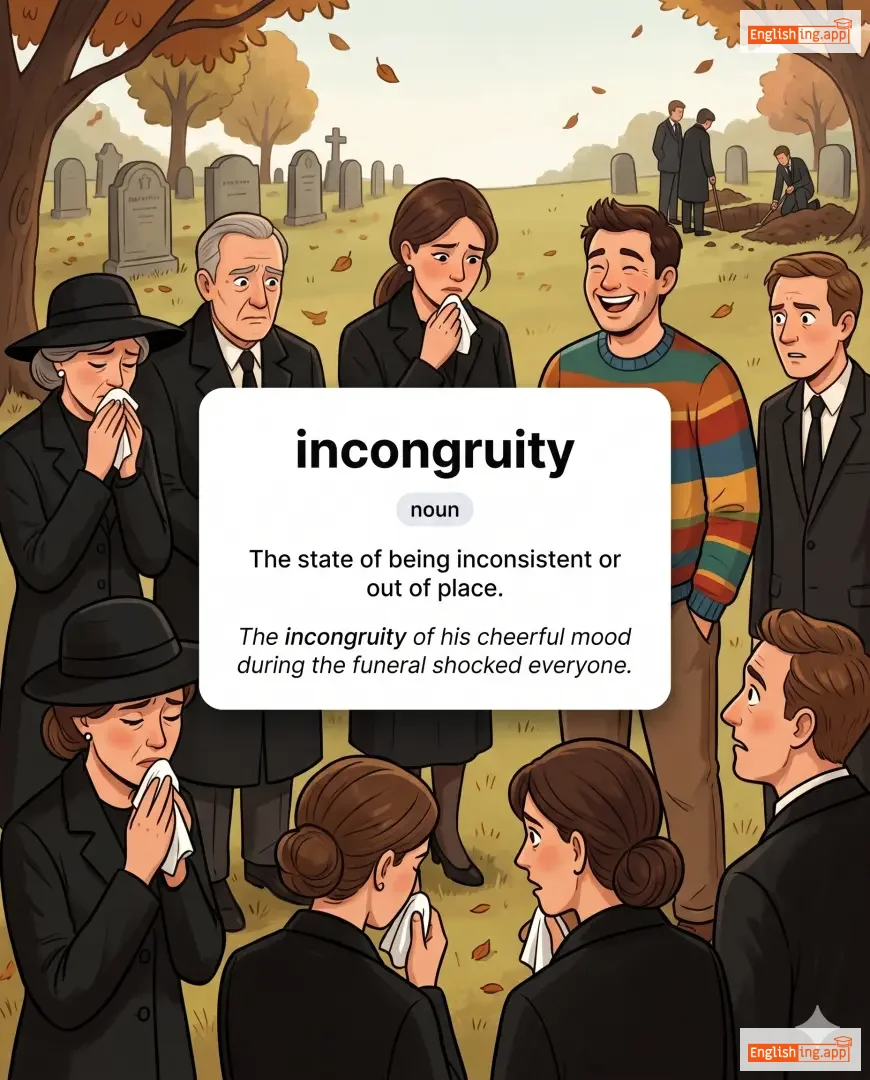
incongruity definition card — visual illustration of the meaning
noun
/ˌɪnkənˈɡruːəti/
incongruité (incongruite)

The state of being inconsistent or out of place.

"The incongruity of his cheerful mood during the funeral shocked everyone."

"L'incongruité de son humeur joyeuse pendant les funérailles a choqué tout le monde." (L'incongruite de son humeur joyeuse pendant les funerailles a choque tout le monde.)
adjective
/ɪnˈkɒŋɡruəs/
incongru (incongru)

Not fitting in with or suitable for the surroundings.

"His jokes were incongruous during the serious meeting."

"Ses blagues étaient incongrues lors de la réunion sérieuse." (Ses blagues étaient incongrues lors de la réunion sérieuse.)
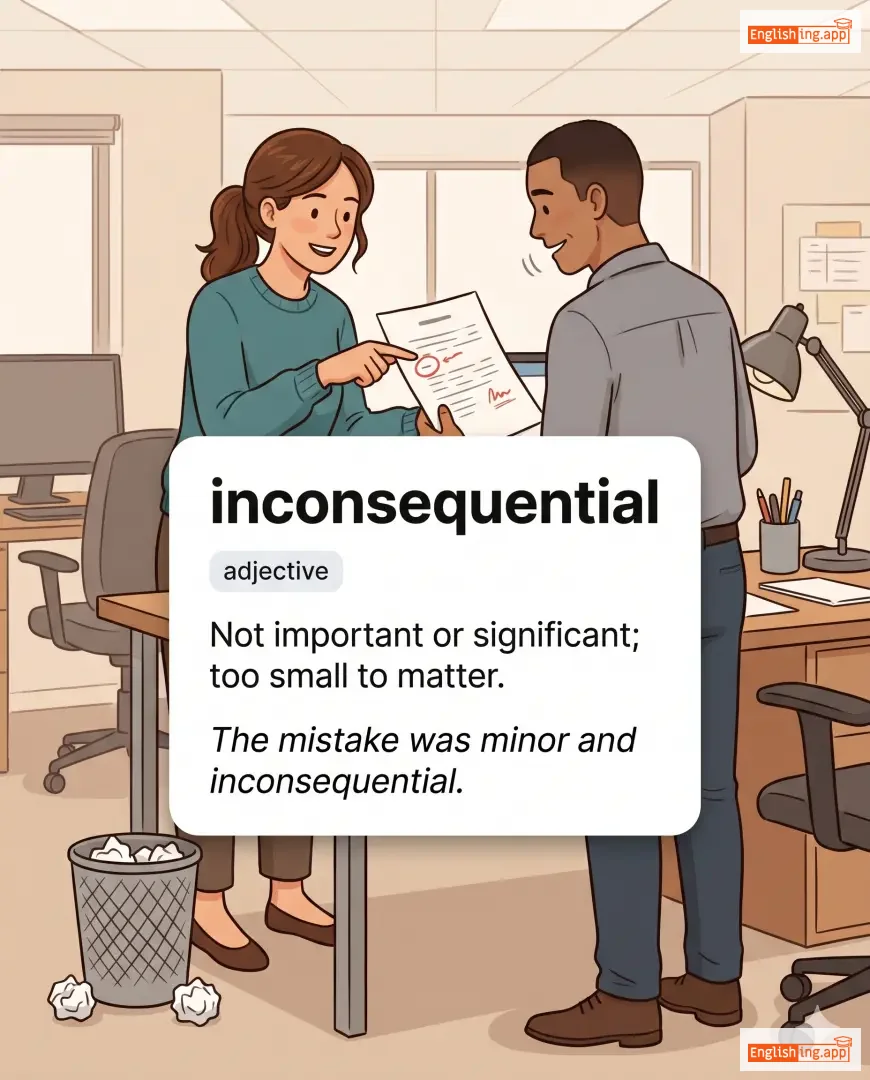
inconsequential definition card — visual illustration of the meaning
adjective
/ˌɪnˌkɒnsɪˈkwɛnʃəl/
insignifiant (insignifiant)

Not important or significant; too small to matter.

"The mistake was minor and inconsequential."

"L'erreur était mineure et insignifiante." (L'erreur était mineure et insignifiante.)
adjective
/ˌɪnkənˈsɪdərəbl/
insignifiant (insignifiant)

Too small or unimportant to be worth considering.

"The donation was not inconsiderable, though smaller than expected."

"La donation n'était pas insignifiante, bien qu'elle fût plus petite que prévu." (La donation n'était pas insignifiante, bien qu'elle fût plus petite que prévu.)
adjective
/ˌɪnkənˈsɪdərət/
inconsidéré (inconsidere)

Thoughtless; showing a lack of concern for others.

"It was inconsiderate of him to play loud music late at night."

"C'était inconsidéré de sa part de jouer de la musique forte tard dans la nuit." (C'etait inconsidere de sa part de jouer de la musique forte tard dans la nuit.)
noun
/ˌɪnkənˈsɪstənsi/
incohérence (incoherence)

The quality of being contradictory, irregular, or not staying the same.

"There is an inconsistency between his words and actions."

"Il y a une incohérence entre ses paroles et ses actions." (Il y a une incoherence entre ses paroles et ses actions.)
adjective
/ˌɪnkənˈsɪstənt/
incohérent (incoherent)

Not staying the same throughout; lacking harmony or regularity.

"His answers were inconsistent and confusing."

"Ses réponses étaient incohérentes et confuses." (Ses réponses étaient incohérentes et confuses.)
noun
/ɪnˈkɒnstənsi/
inconstance (inconstance)

The quality of changing frequently or being unreliable.

"The inconstancy of the weather makes planning difficult."

"L'inconstance du temps rend la planification difficile." (L'inconstance du temps rend la planification difficile.)
adjective
/ɪnˈkɒnstənt/
inconstant (inconstant)

frequently changing; not consistent or dependable

"His inconstant moods made it difficult to work with him."

"Ses humeurs inconstantes rendaient difficile de travailler avec lui." (Ses humeurs inconstantes rendaient difficile de travailler avec lui.)
adjective
/ɪnˈkɒntɪnənt/
incontinent (incontinent)

lacking control over urination or defecation; lacking self-restraint

"The patient was incontinent after surgery."

"Le patient était incontinent après l'opération." (Le patient etait incontinent apres l'operation.)
adjective
/ˌɪnkɒntrəˈvɜːtəbl/
incontournable (incontournable)

impossible to deny or dispute; unquestionable

"The evidence was incontrovertible and proved his innocence."

"La preuve était incontestable et a prouvé son innocence." (La preuve etait incontestable et a prouve son innocence.)
noun, verb
/ˌɪnkənˈviːniəns/
désagrément (desagrement)

trouble or difficulty caused to someone; to cause trouble or difficulty to someone

"We apologize for any inconvenience caused by the delay."

"Nous nous excusons pour tout désagrément causé par le retard." (Nous nous excusons pour tout desagrement cause par le retard)
adjective
/ˌɪnkənˈviːniənt/
incommode (incommode)

causing trouble, difficulties, or discomfort

"It was inconvenient for her to travel during the storm."

"C'était incommode pour elle de voyager pendant la tempête." (C'etait incommode pour elle de voyager pendant la tempete.)
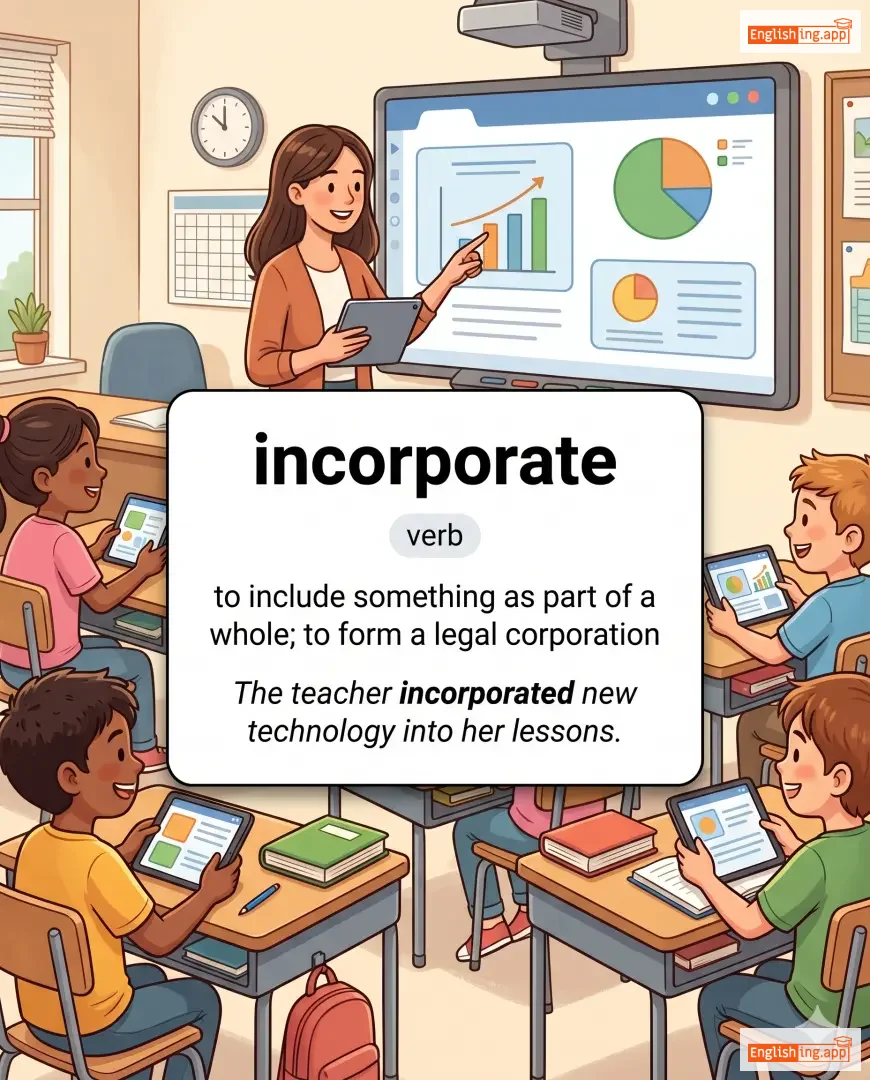
incorporate definition card — visual illustration of the meaning
verb
/ɪnˈkɔːpəreɪt/
incorporer (incorporer)

to include something as part of a whole; to form a legal corporation

"The teacher incorporated new technology into her lessons."

"L'enseignant a incorporé de nouvelles technologies dans ses cours." (L'enseignant a incorporé de nouvelles technologies dans ses cours.)
adjective
/ˌɪnkɔːrˈpɔːriəl/
incorporel (incorporel)

lacking a physical body; not composed of matter; intangible

"Ghosts are often described as incorporeal beings."

"Les fantômes sont souvent décrits comme des êtres incorporels." (Les fantômes sont souvent décrits comme des êtres incorporels.)
adjective
/ɪnkəˈrɛkt/
incorrect (incorrect)

not correct or accurate

"The information you provided was incorrect."

"L'information que vous avez fournie était incorrecte." (L'information que vous avez fournie etait incorrecte.)
adjective
/ɪnˈkɒrɪdʒəbəl/
incorrigible (incorrigible)

incapable of being corrected, improved, or reformed

"He is an incorrigible optimist who never loses hope."

"C'est un optimiste incorrigible qui ne perd jamais espoir." (C'est un optimiste incorrigible qui ne perd jamais espoir.)
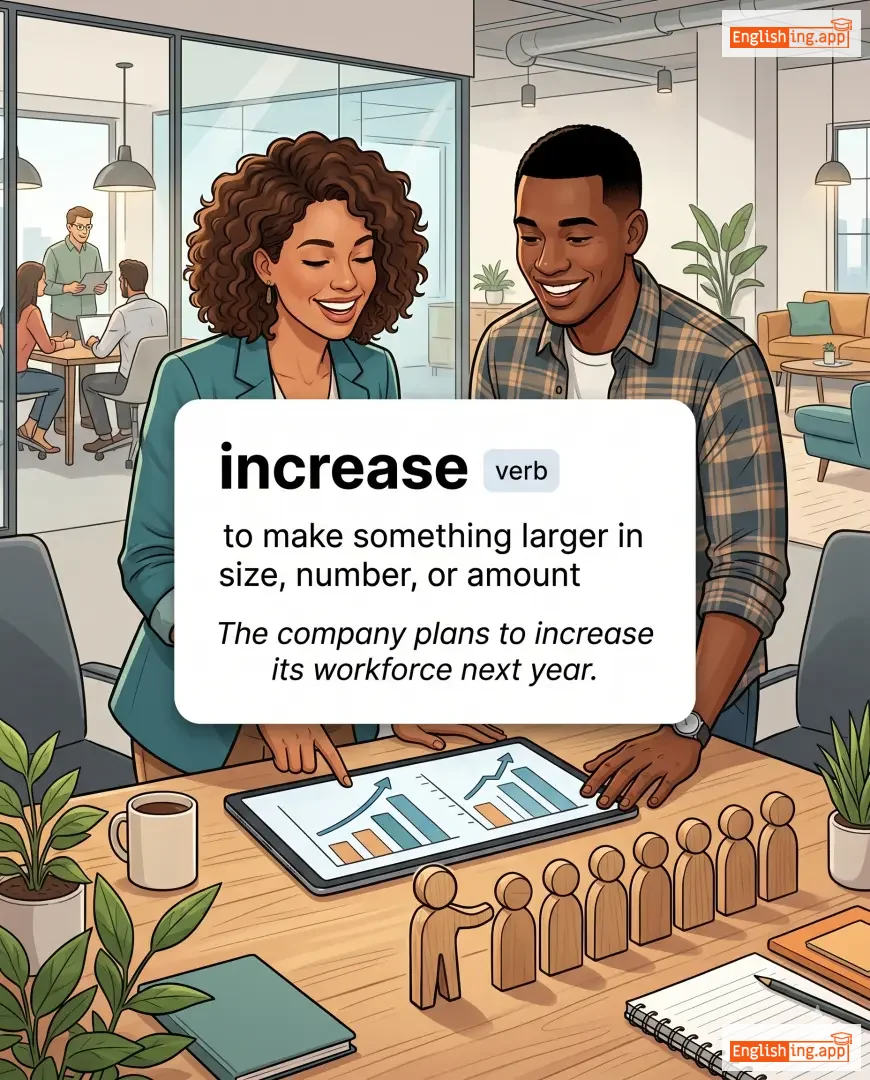
increase definition card — visual illustration of the meaning
verb
/ɪnˈkriːs/
augmenter (augmenter)

to make something larger in size, number, or amount

"The company plans to increase its workforce next year."

"L'entreprise prévoit d'augmenter sa main-d'œuvre l'année prochaine." (L'entreprise prevoit d'augmenter sa main-d'oeuvre l'annee prochaine.)
verb
/ɪnˈkriːst/
augmenté (augmente)

became greater in size, amount, or degree

"The company's revenue increased last year."

"Les revenus de l'entreprise ont augmenté l'année dernière." (Les revenus de l'entreprise ont augmente l'année derniere.)
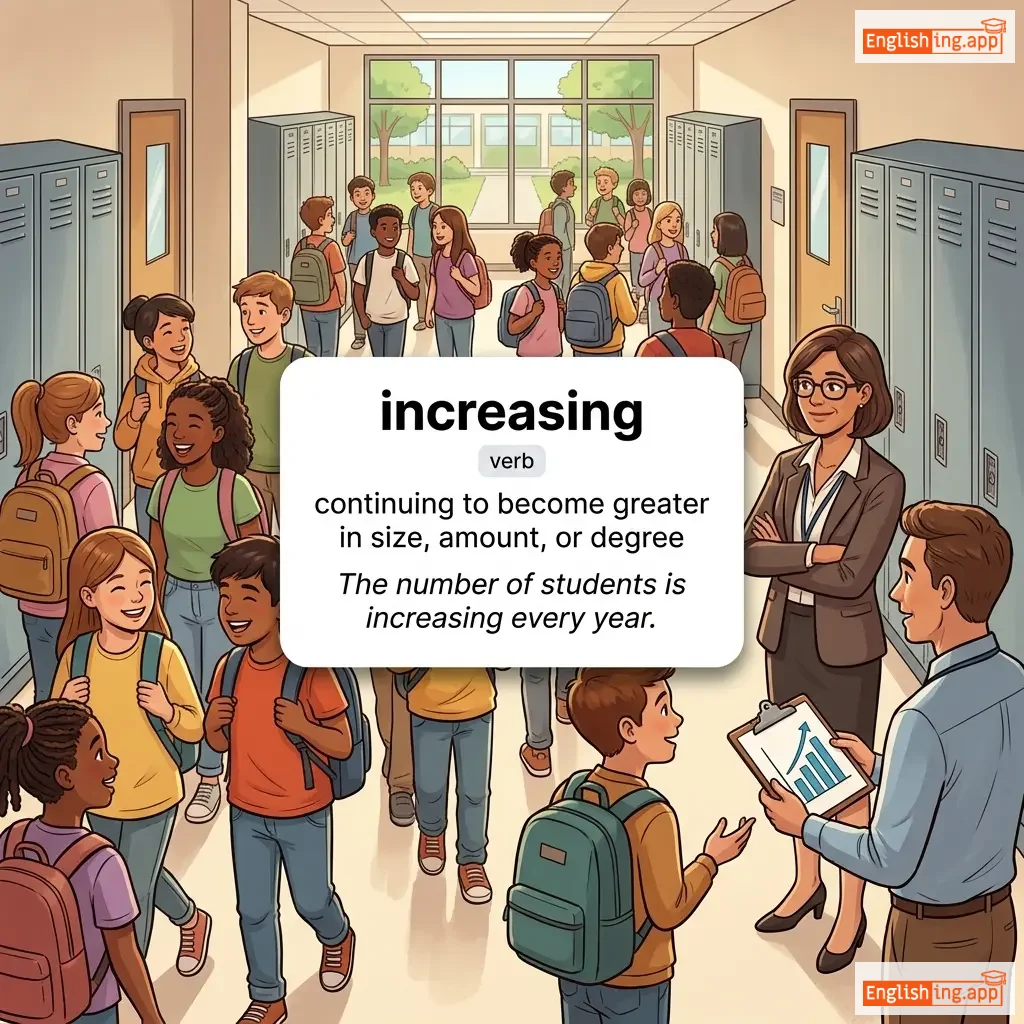
increasing definition card — visual illustration of the meaning
verb
/ɪnˈkriːsɪŋ/
augmenter (augmenter)

continuing to become greater in size, amount, or degree

"The number of students is increasing every year."

"Le nombre d'étudiants augmente chaque année." (Le nombre d'etudiants augmente chaque annee.)
adverb
/ɪnˈkriːsɪŋli/
de plus en plus (de plus en plus)

more and more over time

"People are increasingly concerned about climate change."

"Les gens sont de plus en plus préoccupés par le changement climatique." (Les gens sont de plus en plus preoccupes par le changement climatique.)
adjective
/ɪnˈkrɛdəbl/
incroyable (incroyable)

so extraordinary that it is hard to believe; amazing

"The view from the mountain was incredible."

"La vue depuis la montagne était incroyable." (La vue depuis la montagne était incroyable.)
adverb
/ɪnˈkrɛdɪbli/
incroyablement (incroyablement)

to a great degree; extremely or unbelievably

"The view from the top of the mountain was incredibly beautiful."

"La vue du sommet de la montagne était incroyablement belle." (La vue du sommet de la montagne etait incroyablement belle.)
noun
/ˌɪnkrɪˈdjuːləti/
incrédulité (incredulite)

the state of being unwilling or unable to believe something

"She looked at him with incredulity after hearing the strange story."

"Elle le regarda avec incrédulité après avoir entendu l'histoire étrange." (Elle le regarda avec incredulite apres avoir entendu l'histoire etrange.)
adjective
/ɪnˈkrɛdjələs/

unwilling or unable to believe something

"He gave her an incredulous look when she claimed she could fly."

noun
/ˈɪŋkrɪmənt/
augmentation (augmentation)

an increase or addition, especially one of a series on a fixed scale

"Employees received an annual salary increment."

"Les employés ont reçu une augmentation salariale annuelle." (Les employés ont reçu une augmentation salariale annuelle.)
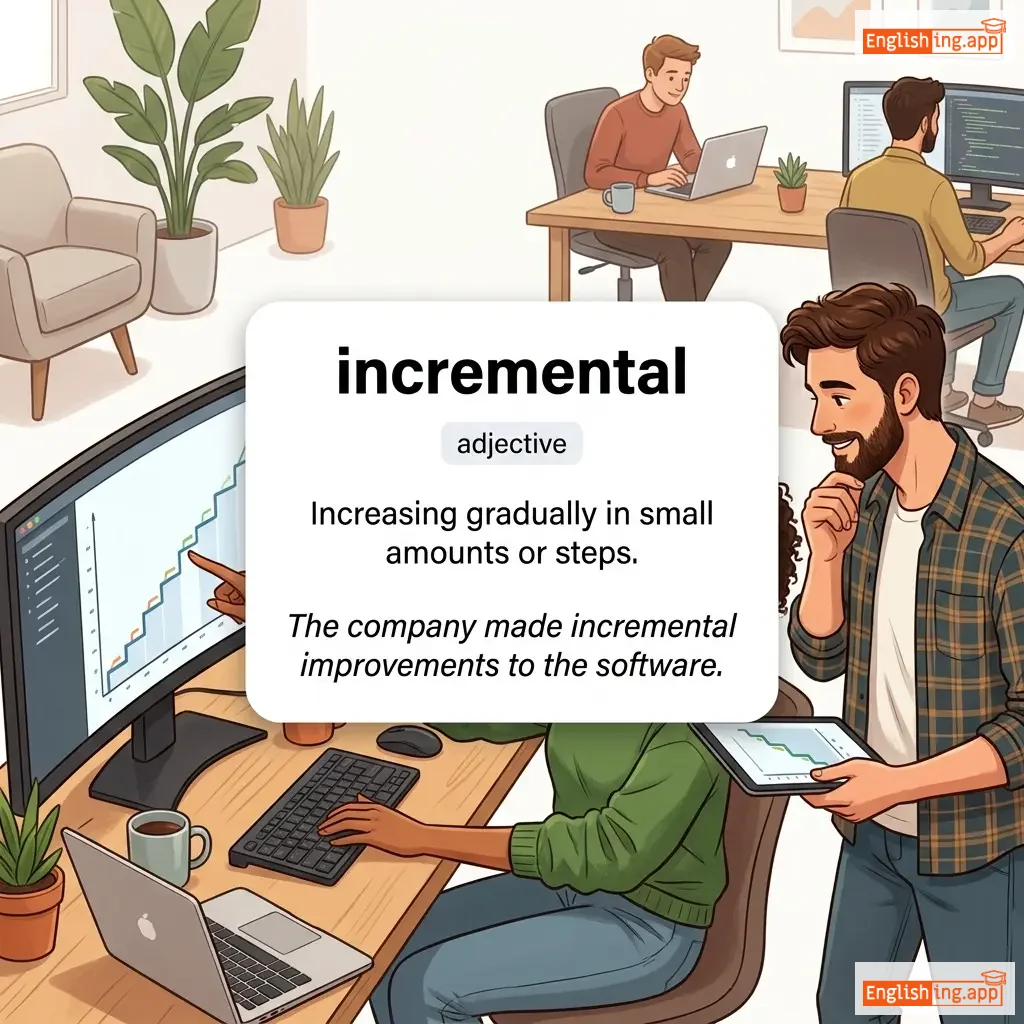
incremental definition card — visual illustration of the meaning
adjective
/ˌɪŋ.krɪˈmen.təl/
incrémental (incremantal)

Increasing gradually in small amounts or steps.

"The company made incremental improvements to the software."

"L'entreprise a effectué des améliorations incrémentales sur le logiciel." (L'entreprise a effectué des améliorations incrémentales sur le logiciel.)
verb
/ɪnˈkrɪmɪˌneɪt/
incriminer (incriminer)

to make someone appear guilty of a crime or wrongdoing

"The new evidence could incriminate the suspect in the robbery case."

"La nouvelle preuve pourrait incriminer le suspect dans l'affaire de vol." (La nouvelle preuve pourrait incriminer le suspect dans l'affaire de vol.)
noun
/ˌɪnkrʌˈsteɪʃən/
croûte (croute)

a crust or hard coating formed on the surface of something

"The old pipes were blocked due to heavy incrustation of minerals."

"Les vieilles tuyauteries étaient bloquées en raison d'une incrustation importante de minéraux." (Les vieilles tuyauteries étaient bloquées en raison d'une incrustation importante de minéraux.)
verb
/ˈɪnkjʊˌbeɪt/
incuber (incuber)

to keep eggs, cells, or organisms at the right conditions for development

"The hen will incubate the eggs until they hatch."

"La poule incubera les œufs jusqu'à ce qu'ils éclosent." (La poule incubera les œufs jusqu'à ce qu'ils éclosent.)
noun
/ˌɪnkjʊˈbeɪʃən/
le processus de maintenir des œufs, des cellules ou des organismes dans les conditions appropriées pour leur développement (le processus de maintenir des œufs, des cellules ou des organismes dans les conditions appropriées pour leur développement)

the process of keeping eggs, cells, or organisms in the right conditions for development

"The incubation of the eggs lasted for three weeks."

"L'incubation des œufs a duré trois semaines." (L'incubation des œufs a duré trois semaines.)
noun
/ˈɪnkjʊˌbeɪtər/
incubateur (incubateur)

a device or environment that provides suitable conditions for eggs, cells, or infants to develop

"The premature baby was placed in an incubator for care."

"Le bébé prématuré a été placé dans un incubateur pour ses soins." (Le bébé prématuré a été placé dans un incubateur pour ses soins.)
noun
/ˈɪŋkjʊbəs/
esprit maléfique (esprit malefique)

An oppressive or nightmarish burden; in folklore, an evil spirit that lies upon sleeping people.

"Debt became an incubus that weighed heavily on the family."

"La dette est devenue un esprit maléfique qui pesait lourdement sur la famille." (La dette est devenue un esprit malefique qui pesait lourdement sur la famille.)
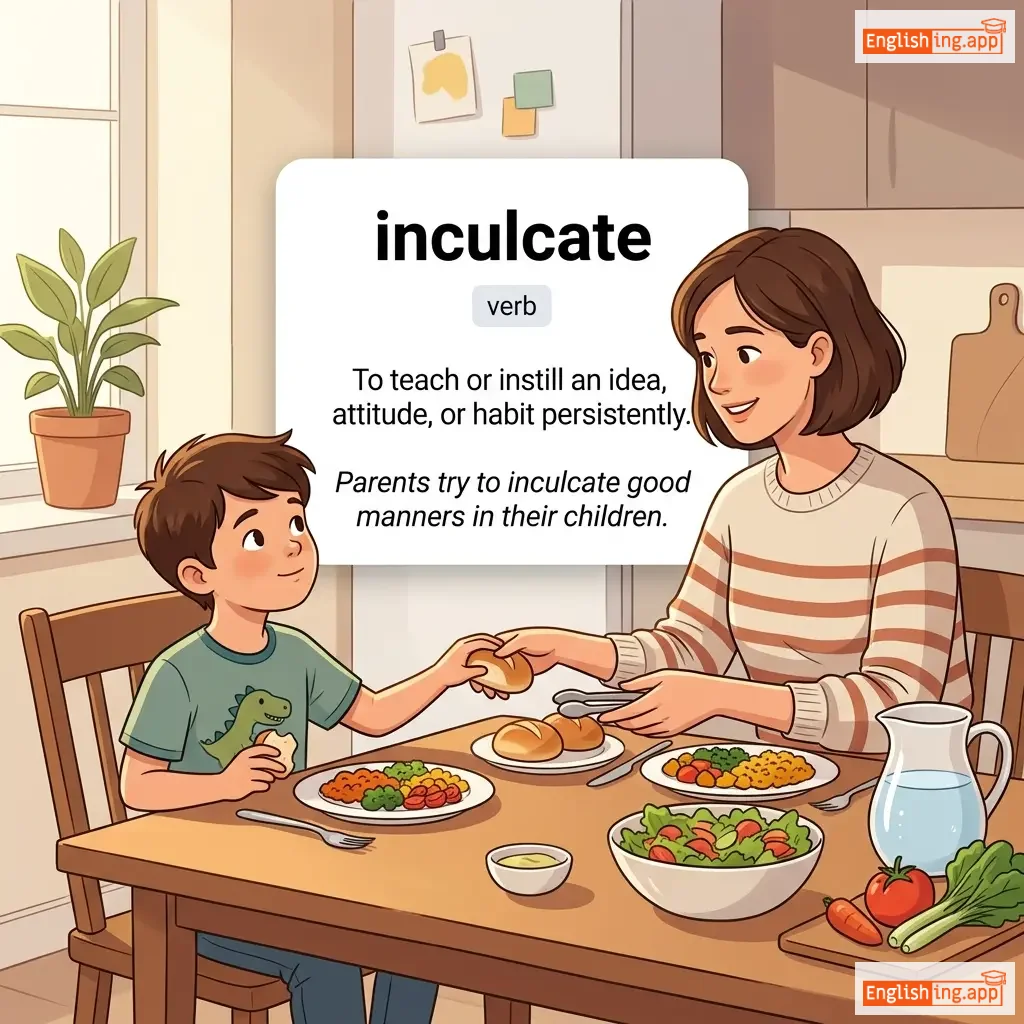
inculcate definition card — visual illustration of the meaning
verb
/ˈɪŋkʌlkeɪt/
inculquer (inculquer)

To teach or instill an idea, attitude, or habit persistently.

"Parents try to inculcate good manners in their children."

"Les parents essaient d'inculquer de bonnes manières à leurs enfants." (Les parents essaient d'inculquer de bonnes manières à leurs enfants.)
verb
/ˈɪŋkʌlpeɪt/
accuser (accuser)

To blame or accuse someone of wrongdoing.

"The evidence seemed to inculpate the suspect in the crime."

"Les preuves semblaient accuser le suspect dans le crime." (Les preuves semblaient accuser le suspect dans le crime.)
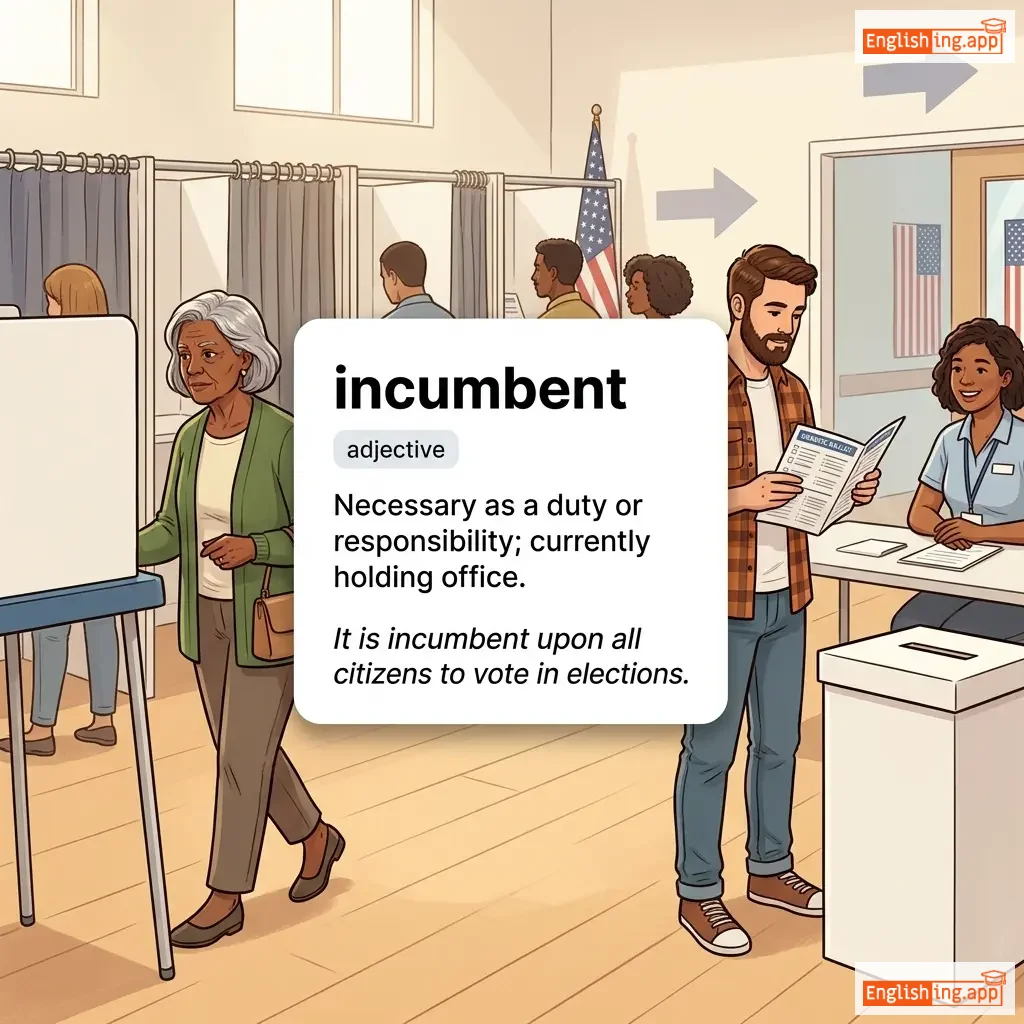
incumbent definition card — visual illustration of the meaning
adjective
/ɪnˈkʌmbənt/
incumbent (incumbent)

Necessary as a duty or responsibility; currently holding office.

"It is incumbent upon all citizens to vote in elections."

"Il est de la responsabilité de tous les citoyens de voter lors des élections." (Il est de la responsabilité de tous les citoyens de voter lors des élections.)
verb
/ɪnˈkɜːr/
encourir (encourir)

To bring upon oneself something undesirable, usually as a result of actions.

"He incurred a fine for parking in the wrong place."

"Il a encouru une amende pour avoir garé sa voiture au mauvais endroit." (Il a encouru une amende pour avoir garé sa voiture au mauvais endroit.)
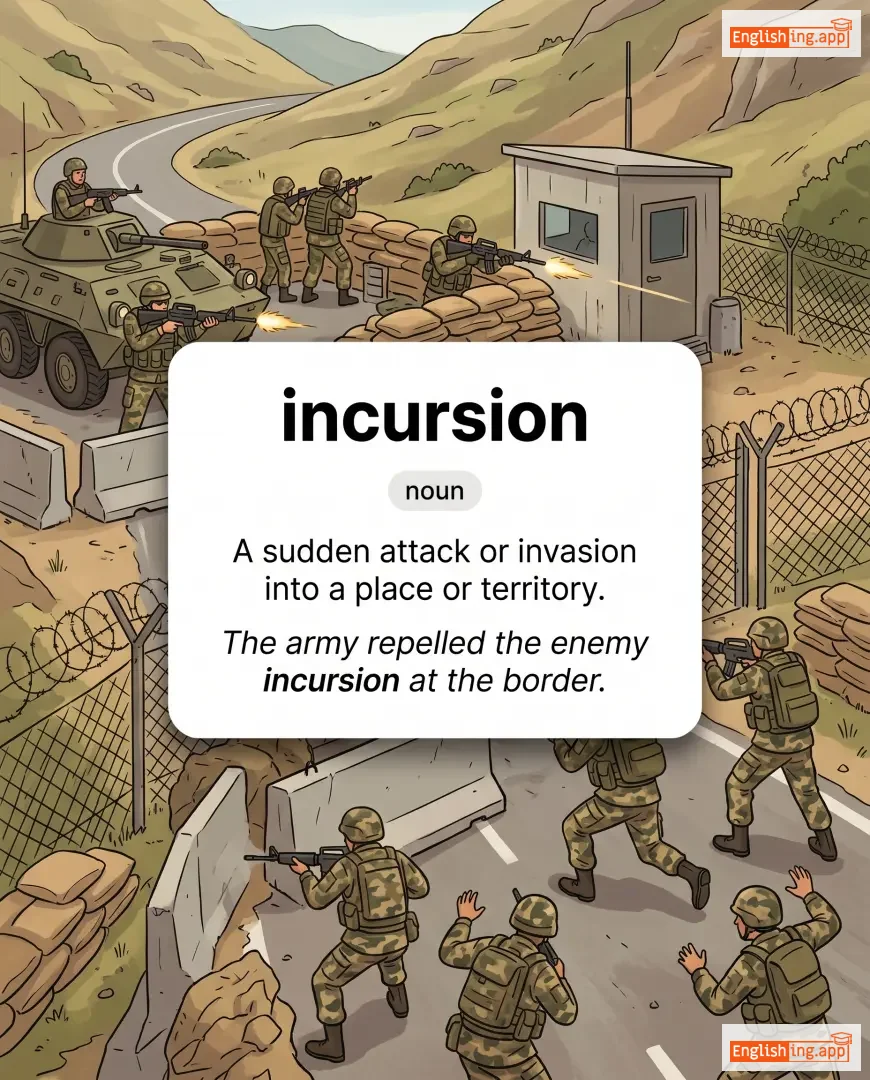
incursion definition card — visual illustration of the meaning
noun
/ɪnˈkɜːrʒən/
incursion (incursion)

A sudden attack or invasion into a place or territory.

"The army repelled the enemy incursion at the border."

"L'armée a repoussé l'incursion ennemie à la frontière." (L'armée a repoussé l'incursion ennemie à la frontière.)