Vocabulaires

Découvrez, apprenez et maîtrisez le vocabulaire anglais

verb
/ˈɪmprəvaɪz/
improviser (improviser)

To create or perform something spontaneously without preparation.

"The actor had to improvise his lines when he forgot the script."

"L'acteur a dû improviser ses répliques lorsqu'il a oublié le script." (L'acteur a dû improviser ses répliques lorsqu'il a oublié le script.)
noun
/ɪmˈpruːdəns/
imprudence (imprudence)

Lack of caution or good judgment.

"His imprudence in investing all his money in one stock was disastrous."

"Son imprudence en investissant tout son argent dans une seule action a été désastreuse." (Son imprudence en investissant tout son argent dans une seule action a ete desastreuse.)
adjective
/ɪmˈpruːdənt/
imprudent (imprudent)

Not showing care for the consequences of an action.

"It was imprudent to drive in such stormy weather."

"C'était imprudent de conduire par un temps aussi orageux." (C'etait imprudent de conduire par un temps aussi orageux.)
noun
/ˈɪmpjʊdəns/
impudence (impudence)

Rude and disrespectful behavior.

"The student's impudence shocked the entire class."

"L'impudence de l'étudiant a choqué toute la classe." (L'impudence de l'étudiant a choqué toute la classe.)
adjective
/ˈɪmpjəd(ə)nt/
imprudent, insolent (imprudent, insolent)

not showing due respect for another person; rude

"The impudent child talked back to the teacher."

"L'enfant impudent a répondu au professeur." (L'enfant impudent a répondu au professeur.)
verb
/ɪmˈpjuːn/
contester la vérité, la validité ou l'honnêteté d'une déclaration ou d'un motif (contester la verite, la validite ou l'honnetete d'une declaration ou d'un motif)

to dispute the truth, validity, or honesty of a statement or motive

"The lawyer tried to impugn the credibility of the witness."

"L'avocat a essayé de contester la crédibilité du témoin." (L'avocat a essaié de contester la crédibilité du témoin.)
noun
/ɪmˈpjuːɪsəns/
impuissance (impwisans)

inability to take effective action; helplessness

"The government’s impuissance in the face of crisis frustrated the people."

"L’impuissance du gouvernement face à la crise a frustré la population." (L’impuissance du gouvernement face à la crise a frustre la population.)
noun
/ˈɪmpʌls/
impulsion (impulsion)

a sudden strong desire or urge to act without thinking

"He bought the watch on impulse without planning to."

"Il a acheté la montre sur un coup de tête sans planifier." (Il a acheté la montre sur un coup de tête sans planifier.)
noun
/ɪmˈpʌlʃən/
impulsion (impulsion)

a strong urge or drive to act; the act of impelling

"His impulsion to travel made him leave his job suddenly."

"Son impulsion de voyager l'a poussé à quitter son travail soudainement." (Son impulsion de voyager l a pousse a quitter son travail soudainement.)
adjective
/ɪmˈpʌlsɪv/
impulsif, spontané (impulsif, spontané)

acting suddenly without careful thought

"She made an impulsive decision to buy the car."

"Elle a pris une décision impulsive d'acheter la voiture." (Elle a pris une décision impulsive d'acheter la voiture.)
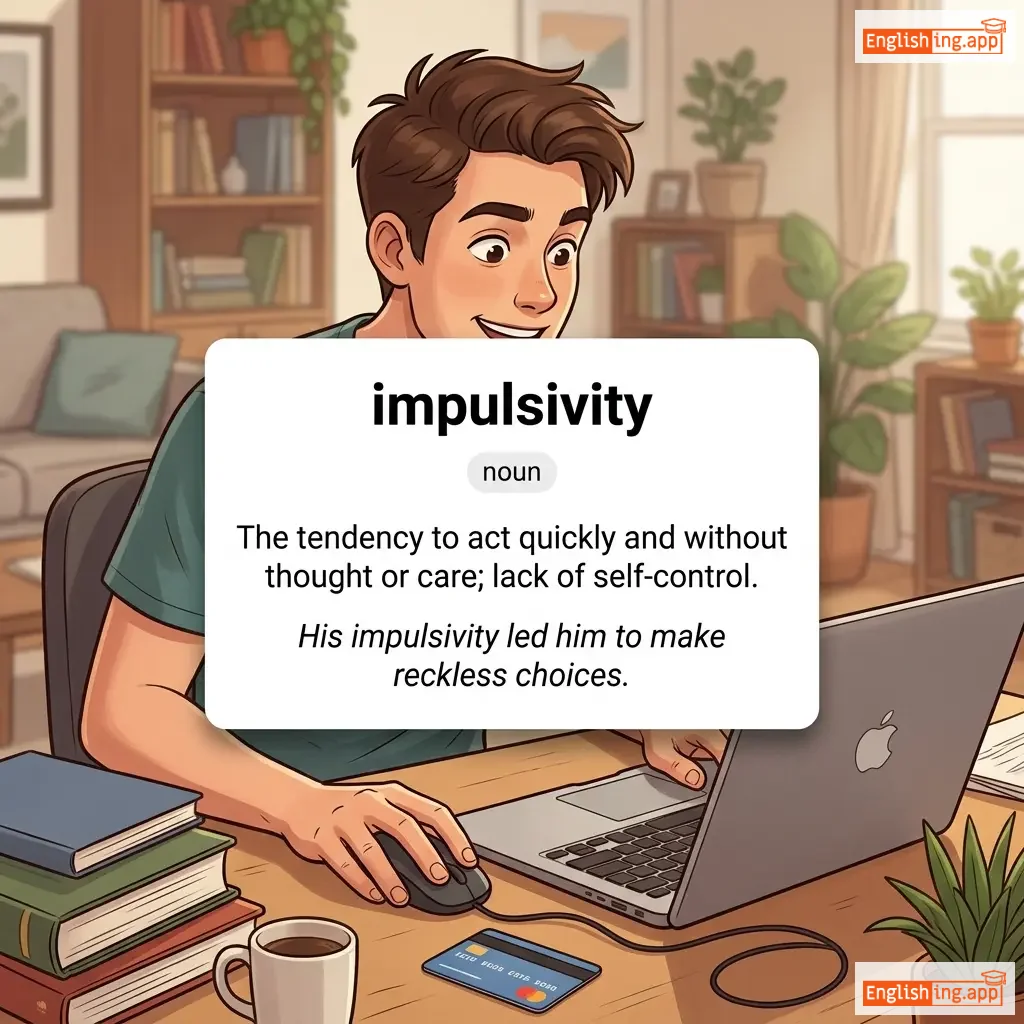
impulsivity definition card — visual illustration of the meaning
noun
ˌɪm.pʌlˈsɪv.ɪ.ti
impulsivité (impulsivite)

The tendency to act quickly and without thought or care; lack of self-control.

"His impulsivity led him to make reckless choices."

"Son impulsivité l'a conduit à prendre des décisions imprudentes." (Son impulsivité l'a conduit à prendre des décisions imprudentes.)
noun
/ɪmˈpjuːnɪti/
impunité (impunite)

freedom from punishment or harmful consequences for an action

"The dictator ruled with impunity, ignoring international laws."

"Le dictateur a régné en toute impunité, ignorant les lois internationales." (Le dictateur a régné en toute impunité, ignorant les lois internationales.)
adjective
/ɪmˈpjʊər/
impur (impur)

not clean or free from contamination; morally corrupt

"The water was impure and unsafe to drink."

"L'eau était impure et dangereuse à boire." (L'eau était impure et dangereuse à boire.)
noun
/ɪmˈpjʊərəti/
impureté (impurete)

the state of being unclean or contaminated; a substance that makes something impure

"The scientist removed every impurity from the water sample."

"Le scientifique a éliminé chaque impureté de l’échantillon d’eau." (le scientifique a elimine chaque impurete de lechantillon deau)
noun
/ˌɪmpjuˈteɪʃən/
imputation (imputation)

an accusation or attribution of blame

"The politician denied the imputation of corruption."

"Le politicien a nié l'imputation de corruption." (Le politicien a nie l'imputation de corruption.)
verb
/ɪmˈpjuːt/
imputer (imputer)

to attribute a fault or responsibility to someone

"They imputed the company's success to good leadership."

"Ils ont imputé le succès de l'entreprise à un bon leadership." (Ils ont imputé le succès de l'entreprise à un bon leadership.)
preposition
/ɪn/
dans (dan)

expressing the situation of being enclosed or surrounded by something

"She is in the kitchen preparing dinner."

"Elle est dans la cuisine en train de préparer le dîner." (Elle est dans la cuisine en train de préparer le dîner.)
preposition
/ɪn ˈfrʌnt əv/
devant (devant)

positioned before or ahead of something; facing or located at the forward side of a person or object

"She stood in front of the building."

"Elle se tenait devant le bâtiment." (Elle se tenait devant le batiment)
noun
/ˌɪnəˈbɪləti/
incapacité (incapacite)

the state of being unable to do something

"His inability to make decisions affected his career."

"Son incapacité à prendre des décisions a affecté sa carrière." (Son incapacite a prendre des decisions a affecte sa carriere.)
adjective
/ˌɪnækˈsɛsəbl/
inaccessible (inaccessible)

unable to be reached, entered, or understood

"The remote village is almost inaccessible during the rainy season."

"Le village éloigné est presque inaccessible pendant la saison des pluies." (Le village eloigné est presque inaccessible pendant la saison des pluies.)
noun
/ɪnˈækjʊrəsi/
inexactitude (inexactitude)

lack of accuracy or precision; an incorrect or wrong detail

"The report contained several factual inaccuracies."

"Le rapport contenait plusieurs inexactitudes." (le rapport contenait plusieurs inexactitudes)
adjective
/ɪnˈækjʊrət/
incorrect (incorrect)

Not correct, precise, or exact; containing errors.

"The report was full of inaccurate data."

"Le rapport était plein de données incorrectes." (Le rapport était plein de données incorrectes.)
adjective
/ɪnˈæktɪv/
inactif (inactif)

Not engaging in activity; not active.

"The account has been inactive for six months."

"Le compte est inactif depuis six mois." (Le compte est inactif depuis six mois.)
noun
/ˌɪnækˈtɪvɪti/
inactivité (inactivite)

the state of not being active physically or mentally; lack of action

"Prolonged inactivity can negatively affect both physical and mental health."

"Une inactivité prolongée peut nuire à la santé physique et mentale." (une inactivite prolongee peut nuire a la sante physique et mentale)
noun
/ɪnˈædɪkwəsi/
insuffisance (insuffisance)

lack of sufficient ability, quality, or strength; a feeling of not being good enough

"She struggled with feelings of inadequacy at work despite her strong qualifications."

"Elle luttait contre un sentiment d’insuffisance au travail malgré ses solides qualifications." (Elle luttait contre un sentiment dinsuffisance au travail malgre ses solides qualifications)
adjective
/ɪnˈædɪkwət/
inadéquat (inadequat)

Not sufficient or good enough.

"The funding was inadequate to complete the project."

"Le financement était insuffisant pour terminer le projet." (Le financement était insuffisant pour terminer le projet.)
adjective
/ˌɪnədˈmɪsəbl̩/
inadmissible (inadmissible)

Not allowed, especially as evidence in a court of law.

"The judge ruled the evidence inadmissible."

"Le juge a déclaré que la preuve était inadmissible." (Le juge a déclaré que la preuve était inadmissible.)
noun
/ˌɪnədˈvɜːrtəns/
inadvertance (inadvertance)

Failure to pay attention; carelessness.

"The error happened through sheer inadvertence."

"L'erreur est survenue par pure inadvertance." (L'erreur est survenue par pure inadvertance.)
adjective
/ˌɪnədˈvɜːrtənt/
involontaire, non intentionnel (involontaire, non intentionnel)

Not resulting from or achieved through deliberate planning; unintentional.

"Her inadvertent mistake caused a delay in the project."

"Son erreur involontaire a causé un retard dans le projet." (Son erreur involontaire a causé un retard dans le projet.)
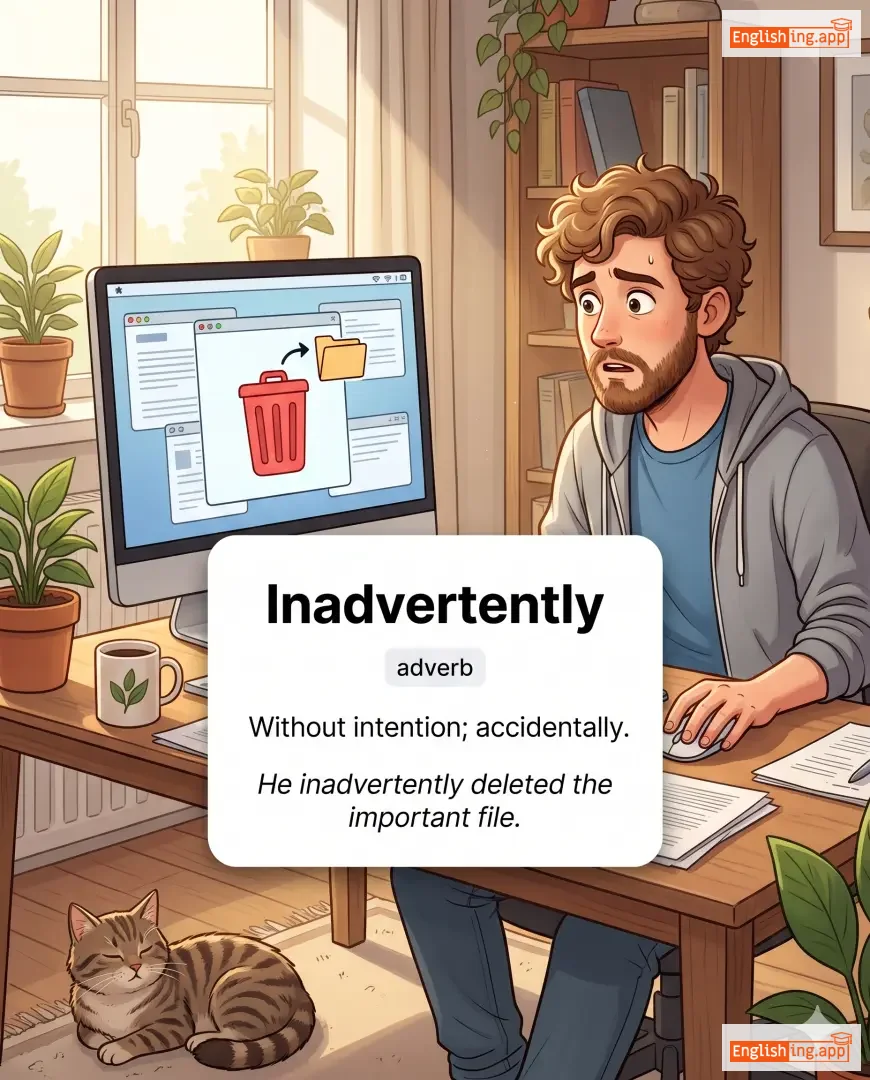
Inadvertently definition card — visual illustration of the meaning
adverb
/ˌɪnədˈvɜːrtəntli/
accidentellement (accidentellement)

Without intention; accidentally.

"He inadvertently deleted the important file."

"Il a accidentellement supprimé le fichier important." (Il a accidentellement supprimé le fichier important.)
adjective
/ˌɪnədˈvaɪzəbl/
déconseillé (deconseillé)

Not recommended; likely to have undesirable consequences.

"It is inadvisable to drive in such heavy rain."

"Il est déconseillé de conduire sous une telle pluie forte." (Il est déconseillé de conduire sous une telle pluie forte.)
adjective
/ɪnˈeɪliənəbl/
inaliénable (inalienable)

Unable to be taken away or transferred; absolute and permanent.

"Freedom of speech is an inalienable right."

"La liberté d'expression est un droit inaliénable." (La liberte d'expression est un droit inalienable.)
noun
/ˌɪnəməˈrɑːtə/
amante (amante)

A woman with whom someone is in love; a female lover.

"He wrote a poem dedicated to his inamorata."

"Il a écrit un poème dédié à son amante." (Il a ecrit un poeme dedie a son amante.)
adjective
/ɪˈneɪn/
insensé, stupide (insense, stupide)

lacking sense, meaning, or significance; silly or pointless

"The movie was criticized for its inane dialogue."

"Le film a été critiqué pour ses dialogues insensés." (Le film a ete critique pour ses dialogues insenses.)
adjective
/ɪˈnænɪmət/
objet inanimé (objet inanimé)

not alive, especially not in the manner of animals and humans; lifeless

"The museum was full of inanimate objects from ancient times."

"Le musée était rempli d'objets inanimés datant de l'époque ancienne." (Le musée était rempli d'objets inanimés datant de l'époque ancienne.)
noun
/ɪˈnænɪti/
ineptie, absurdité (ineptie, absurdité)

a nonsensical remark or action; silliness; emptiness

"The speech was full of inanities that bored the audience."

"Le discours était rempli d'inepties qui ennuyaient le public." (Le discours était rempli d'inepties qui ennuyaient le public.)
adjective
/ˌɪnæprɪˈhɛnsəbl/
incompréhensible (incomprehensible)

not understandable; incomprehensible

"The concept was so abstract that it seemed inapprehensible to most students."

"Le concept était si abstrait qu'il semblait incompréhensible pour la plupart des étudiants." (Le concept était si abstrait qu'il semblait incompréhensible pour la plupart des étudiants.)
adjective
/ˌɪnəˈproʊpriət/
inapproprié (inapproprie)

not suitable or proper in the circumstances

"It was inappropriate to talk loudly in the library."

"Il était inapproprié de parler fort dans la bibliothèque." (Il etait inapproprie de parler fort dans la bibliotheque.)
adjective
/ɪnˈæpt/
inapproprié (inapproprié)

not suitable or appropriate in the circumstances

"His inapt choice of words offended many people."

"Son choix inapproprié de mots a offensé de nombreuses personnes." (Son choix inapproprié de mots a offensé de nombreuses personnes.)
adjective
/ˌɪnɑːrˈtɪkjʊlət/
inaudible (inaudible)

Unable to express oneself clearly or effectively in speech or writing.

"She became inarticulate with emotion during the speech."

"Elle est devenue inaudible avec émotion pendant le discours." (Elle est devenue inaudible avec émotion pendant le discours.)
adverb
/ˌɪnəzˈmʌtʃ/
dans la mesure où (dans la mesure ou)

To the extent that; considering that.

"Inasmuch as you are their teacher, you should guide them carefully."

"Dans la mesure où vous êtes leur enseignant, vous devez les guider soigneusement." (Dans la mesure où vous êtes leur enseignant, vous devez les guider soigneusement.)
conjunction
/ˌɪnəzˈmʌtʃ æz/
puisque (puisque)

Because; since.

"He cannot attend, inasmuch as he is unwell."

"Il ne peut pas assister, puisque qu'il est malade." (Il ne peut pas assister, puisque qu'il est malade.)
adjective
/ˌɪnəˈtɛntɪv/
inattentif (inattentif)

not paying attention; lacking focus or concentration

"The inattentive student missed several important instructions."

"L'étudiant inattentif a manqué plusieurs consignes importantes." (L etudiant inattentif a manque plusieurs consignes importantes)
adjective
/ɪnˈɔːdəbl/
inaudible (inaudible)

Unable to be heard.

"Her voice was almost inaudible over the noise."

"Sa voix était presque inaudible par-dessus le bruit." (Sa voix était presque inaudible par-dessus le bruit.)
adjective
/ɪˈnɔːɡjərəl/
inaugural (inaugural)

marking the beginning of something; first; opening

"The president delivered his inaugural speech."

"Le président a prononcé son discours inaugural." (Le président a prononcé son discours inaugural.)
verb
/ɪˈnɔːɡjʊreɪt/
inaugurer (inaugurer)

To formally begin or introduce something, especially with a ceremony.

"The mayor will inaugurate the new bridge tomorrow."

"Le maire inaugurera le nouveau pont demain." (Le maire inaugurera le nouveau pont demain.)
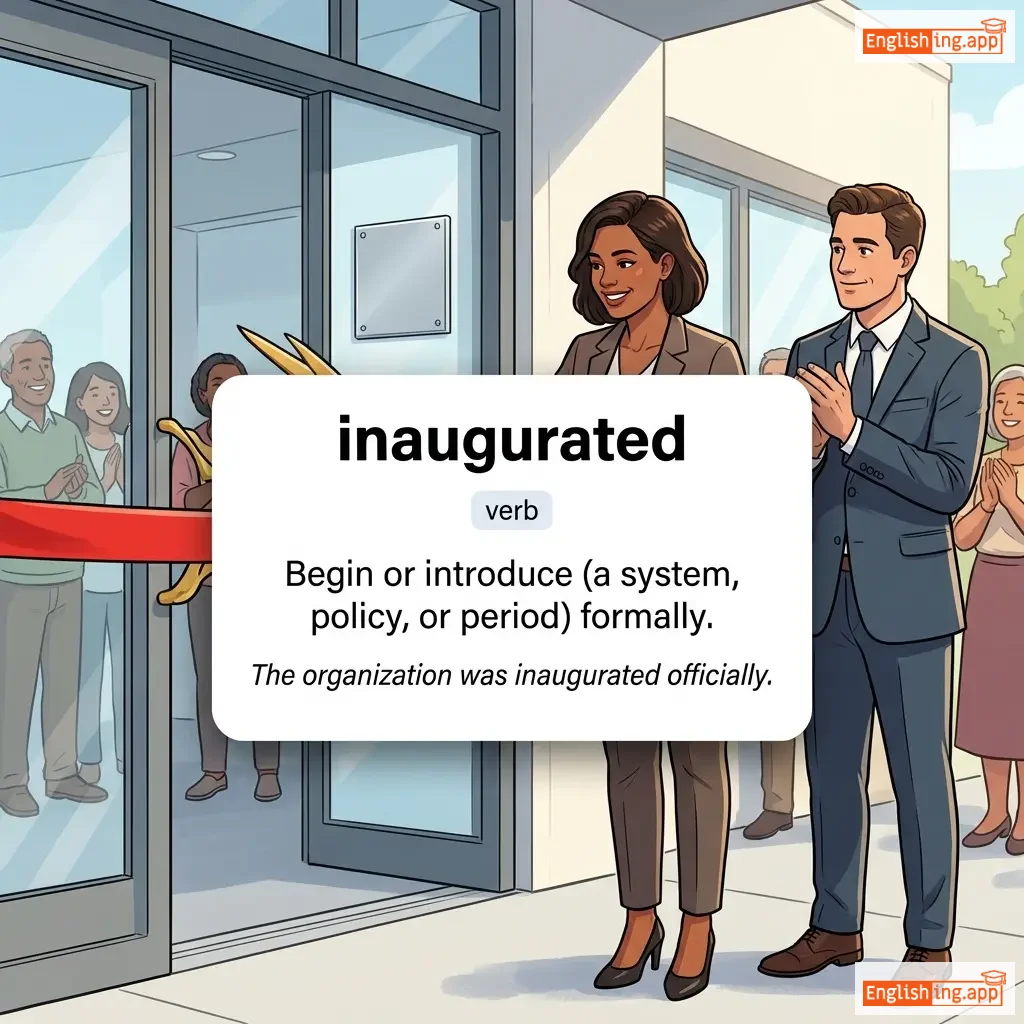
inaugurated definition card — visual illustration of the meaning
verb
ɪˈnɔː.ɡjə.reɪ.tɪd
inauguré (inaugure)

Begin or introduce (a system, policy, or period) formally.

"The organization was inaugurated officially."

"L'organisation a été inaugurée officiellement." (L'organisation a été inaugurée officiellement.)
adjective
/ˌɪnɔːˈspɪʃəs/
néfaste (nefast)

Not conducive to success; unpromising or unlucky.

"The event began under inauspicious circumstances."

"L'événement a commencé dans des circonstances défavorables." (L'evenement a commence dans des circonstances defavorables.)
adjective
/ˈɪnˌbɔːrn/
inné (inborn)

existing from birth; innate

"She has an inborn talent for music."

"Elle a un talent inné pour la musique." (Elle a un talent inne pour la musique.)
adjective
/ˈɪnˌbrɛd/
inné (inne)

existing naturally in a person or animal; also related to reproduction within a limited community

"He has an inbred sense of loyalty."

"Il a un sens inné de la loyauté." (Il a un sens iné de la loyauté.)