Vocabulaires

Découvrez, apprenez et maîtrisez le vocabulaire anglais

adjective
/ˌɪməˈtɪəriəl/
immatériel (immatériel)

Not important or relevant; lacking physical substance.

"The judge ruled that the argument was immaterial to the case."

"Le juge a statué que l'argument était immatériel pour l'affaire." (Le juge a statué que l'argument était immatériel pour l'affaire.)
adjective
/ˌɪməˈtjʊər/
immature (immature)

Not fully developed; childish or lacking maturity.

"His immature behavior annoyed everyone at the meeting."

"Son comportement immature agacait tout le monde lors de la réunion." (Son comportement immature agacait tout le monde lors de la réunion.)
noun
/ˌɪməˈtjʊərəti/
immaturité (immaturite)

the state of not being fully developed emotionally, mentally, or physically; lack of maturity

"His immaturity made it difficult for him to handle responsibility."

"Son immaturité a rendu la gestion des responsabilités difficile." (son immaturite a rendu la gestion des responsabilites difficile)
adjective
/ɪˈmɛʒərəbl/
incommensurable (incommensurable)

Too great or extreme to be measured.

"Her kindness brought him immeasurable happiness."

"Sa gentillesse lui a donné un bonheur immeasurable." (Sa gentillesse lui a donné un bonheur immeasurable.)
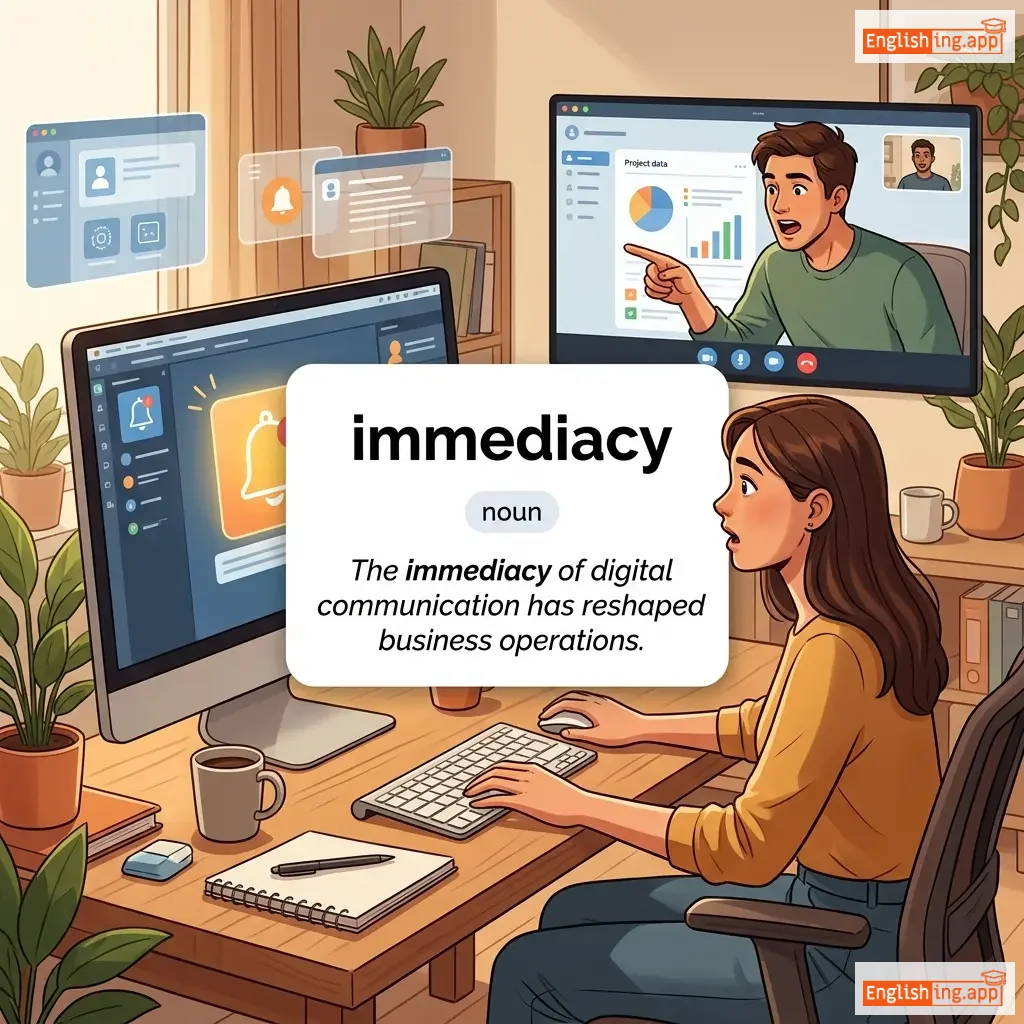
immediacy definition card — visual illustration of the meaning
noun
/ɪˈmiːdiəsi/
immédiateté, urgence (immediatete, urgence)

The quality of bringing one into direct and instant involvement with something, giving rise to a sense of urgency or excitement.

"The immediacy of digital communication has reshaped business operations."

"L'immédiateté de la communication numérique a transformé les opérations commerciales." (L'immediatete de la communication numerique a transforme les operations commerciales.)
adjective
/ɪˈmiːdiət/
immédiat (immediat)

happening or done without delay

"The doctor gave her immediate attention."

"Le médecin lui a donné une attention immédiate." (Le medecin lui a donne une attention immediate.)
adverb
/ɪˈmiːdiətli/
immédiatement (immediatement)

at once; without delay

"She responded immediately to the emergency call."

"Elle a répondu immédiatement à l'appel d'urgence." (Elle a répondu immédiatement à l'appel d'urgence.)
adjective
/ˌɪməˈmɔːriəl/
immémorial (immemorial)

Extending back beyond memory or record; ancient.

"The tradition has been followed since time immemorial."

"La tradition est suivie depuis des temps immémoriaux." (La tradition est suivie depuis des temps immemoriaux.)
adjective
/ɪˈmɛns/
immense (immense)

Extremely large or great in size, amount, or degree.

"The project required an immense amount of effort."

"Le projet a nécessité une quantité immense d'efforts." (Le projet a necessite une quantite immense d'efforts.)
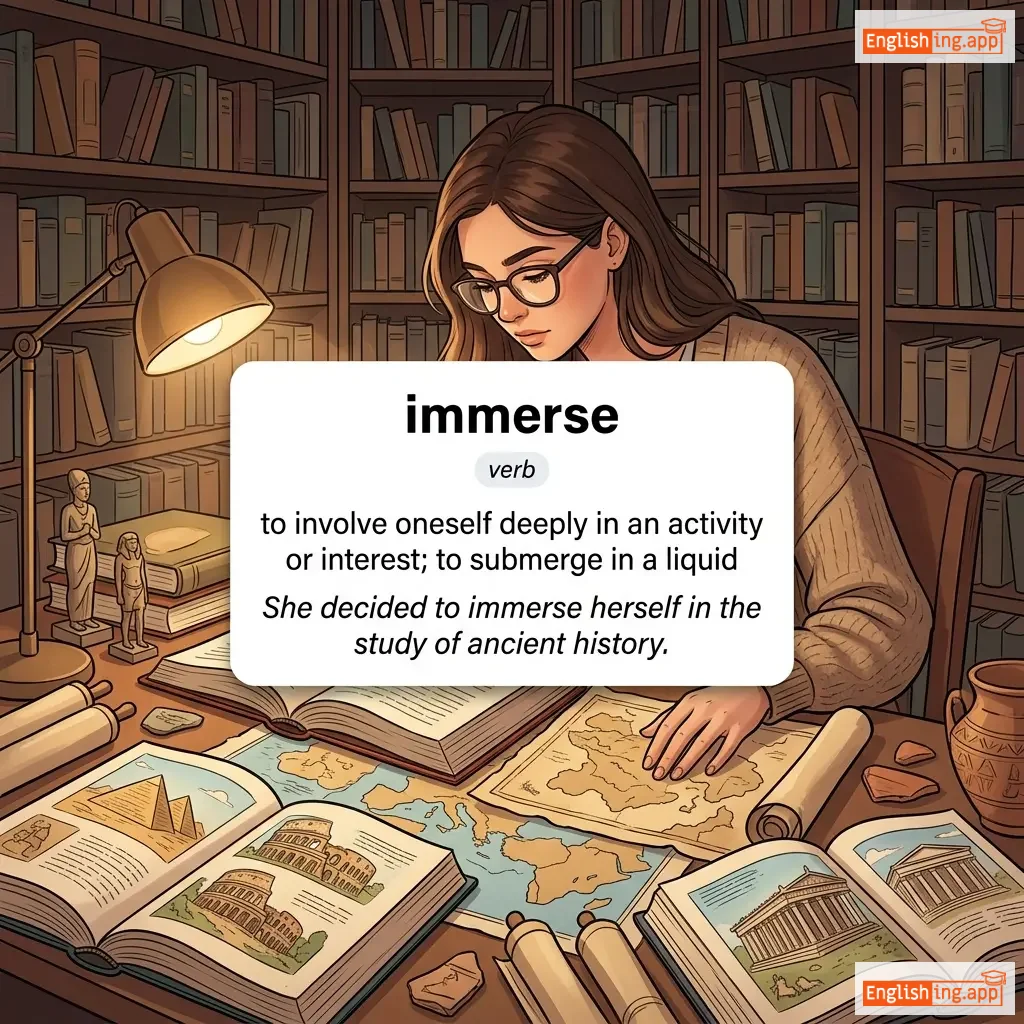
immerse definition card — visual illustration of the meaning
verb
/ɪˈmɜːrs/
immerger, s'engager profondément (immerger, s'engager profondement)

to involve oneself deeply in an activity or interest; to submerge in a liquid

"She decided to immerse herself in the study of ancient history."

"Elle a décidé de s'immerger dans l'étude de l'histoire ancienne." (Elle a decide de s'immerger dans l'etude de l'histoire ancienne.)
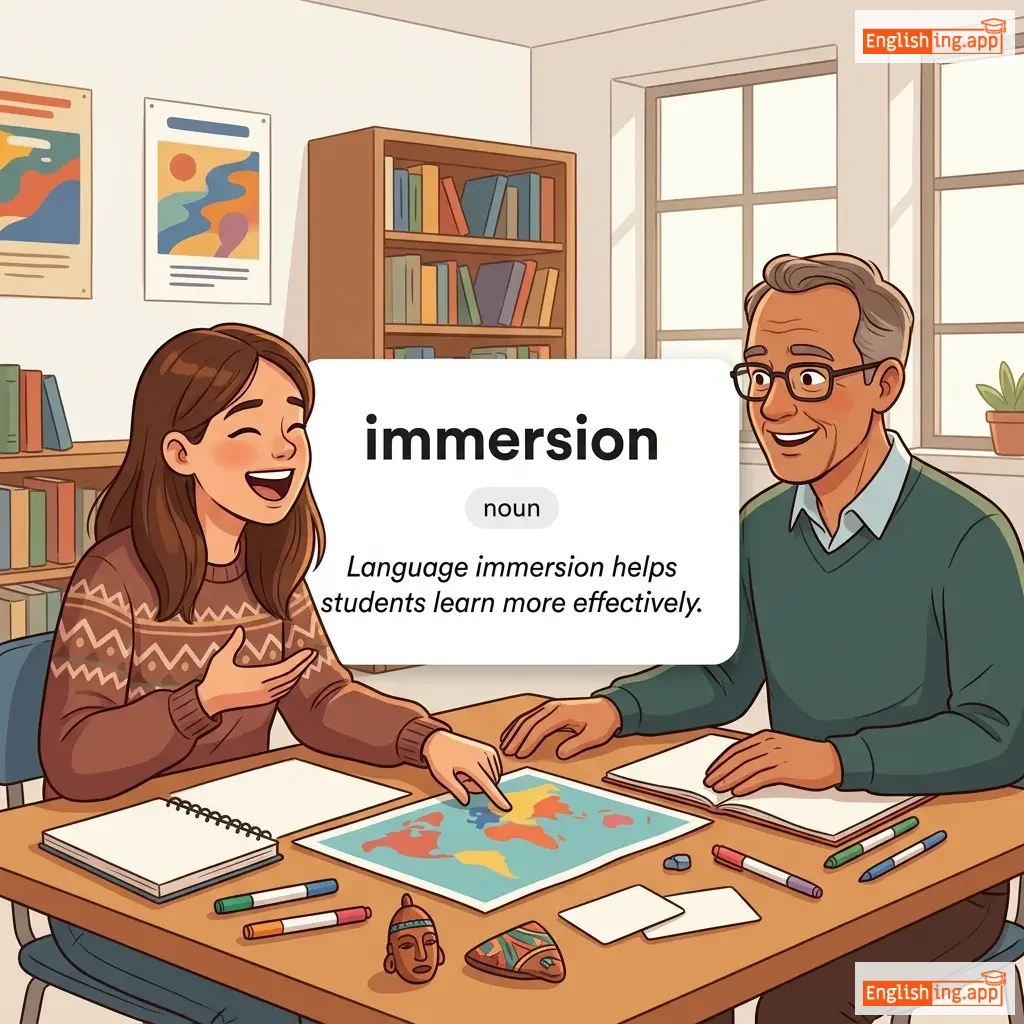
immersion definition card — visual illustration of the meaning
noun
/ɪˈmɜːrʒən/
immersion (immersion)

the act of deeply involving oneself in something; the state of being completely surrounded by liquid

"Language immersion helps students learn more effectively."

"L'immersion linguistique aide les étudiants à apprendre plus efficacement." (L'immersion linguistique aide les étudiants à apprendre plus efficacement.)
immersive definition card — visual illustration of the meaning
adjective
ɪˈmɜː.sɪv
immersif (immersif)

Providing, involving, or characterized by deep absorption or immersion in something.

"The immersive experience of VR makes learning more interactive."

"L'expérience immersive de la réalité virtuelle rend l'apprentissage plus interactif." (L'expérience immersive de la réalité virtuelle rend l'apprentissage plus interactif.)
noun
/ˈɪmɪɡrənt/
immigrant (immigrant)

a person who comes to live permanently in a foreign country

"The city has welcomed many new immigrants this year."

"La ville a accueilli de nombreux nouveaux immigrants cette année." (La ville a accueilli de nombreux nouveaux immigrants cette année.)
verb
/ˈɪmɪɡreɪt/
immigrer (immigrer)

to come to live permanently in a foreign country

"He immigrated to Canada five years ago."

"Il a immigré au Canada il y a cinq ans." (Il a immigré au Canada il y a cinq ans.)
noun
/ˌɪmɪˈɡreɪʃən/
immigration (immigration)

the action of coming to live permanently in a foreign country

"Immigration policies vary from country to country."

"Les politiques d'immigration varient d'un pays à l'autre." (Les politiques d'immigration varient d'un pays à l'autre.)
noun
/ˈɪmɪnəns/
imminence, état de proximité (imminence, etat de proximite)

the state of being about to happen

"The imminence of the storm forced people to take shelter."

"L'imminence de la tempête a forcé les gens à chercher un abri." (L'imminence de la tempête a forcé les gens à chercher un abri.)
adjective
/ˈɪmɪnənt/
imminent (imminent)

About to happen; likely to occur very soon.

"Dark clouds signaled that a storm was imminent."

"Les nuages sombres ont signalé qu'une tempête était imminente." (Les nuages sombres ont signalé qu'une tempête était imminente.)
adjective
/ɪˈmɪsəbl/
immiscible (immiscible)

Describes liquids that do not mix together.

"Oil and water are immiscible liquids."

"L'huile et l'eau sont des liquides immiscibles." (L'huile et l'eau sont des liquides immiscibles.)
adjective
/ɪˈmoʊbəl/
immobile (immobile)

unable to move or be moved

"After the accident, he was immobile for weeks."

"Après l'accident, il est resté immobile pendant des semaines." (Apres l'accident, il est reste immobile pendant des semaines.)
noun
/ˌɪməʊˈbɪləti/
immobilité (immobilite)

The state of being unable to move.

"After the accident, she suffered from immobility in her legs."

"Après l'accident, elle a souffert d'immobilité dans ses jambes." (Apres l'accident, elle a souffert d'immobilite dans ses jambes.)
adjective
/ɪˈmɒdərət/
immodéré (immodere)

excessive; beyond reasonable limits

"He has an immoderate love for sweets."

"Il a un amour immodéré pour les bonbons." (Il a un amour immodéré pour les bonbons.)
adjective
/ɪˈmɒdɪst/
prétentieux / indécent (pretentieuse / indecent)

lacking humility or decency; excessively proud or improper

"His immodest remarks offended the audience."

"Ses remarques prétentieuses ont offensé le public." (Ses remarques prétentieuses ont offensé le public.)
noun
/ɪˈmɒdəsti/
immodestie (immodestie)

lack of modesty or decency; behavior or attitude that is overly bold or improper

"The article was criticized for its tone of immodesty."

"L’article a été critiqué pour son ton d’immodestie." (L article a ete critique pour son ton d immodestie)
verb
/ˈɪməleɪt/
immoler (immoler)

To kill or sacrifice, especially by burning.

"The protesters threatened to immolate themselves in front of the building."

"Les manifestants ont menacé de s'immoler devant le bâtiment." (Les manifestants ont menacé de s'immoler devant le bâtiment.)
adjective
/ɪˈmɒrəl/
immoral (immoral)

Not conforming to accepted standards of morality; unethical or wicked.

"He was fired for his immoral behavior."

"Il a été renvoyé pour son comportement immoral." (Il a ete renvoye pour son comportement immoral.)
noun
/ˌɪməˈrælɪti/
immoralité (immoralite)

the quality of being immoral; behavior that violates accepted moral standards

"The community condemned the immorality of the corrupt officials."

"La communauté a condamné l’immoralité des fonctionnaires corrompus." (La communaute a condamne l immoralite des fonctionnaires corrompus)
adjective; noun
/ɪˈmɔːrtl/
immortel (immortel)

living forever; never dying; lasting forever in fame or memory

"Legends often describe heroes as immortal beings who never die."

"Les légendes parlent d’êtres immortels." (les legendes parlent detres immortels)
noun
/ˌɪmɔːrˈtæləti/
immortalité (immortalite)

the state of living forever; eternal life or lasting fame beyond death

"Many ancient cultures believed that heroes could achieve immortality through great deeds."

"De nombreuses cultures anciennes pensaient que les héros pouvaient atteindre l’immortalité par de grands exploits." (de nombreuses cultures anciennes pensaient que les heros pouvaient atteindre l immortalite par de grands exploits)
verb
/ɪˈmɔːrtəlaɪz/
immortaliser (immortaliser)

to preserve the memory of someone or something forever

"The statue was built to immortalize the hero’s sacrifice."

"La statue a été construite pour immortaliser le sacrifice du héros." (La statue a été construite pour immortaliser le sacrifice du héros.)
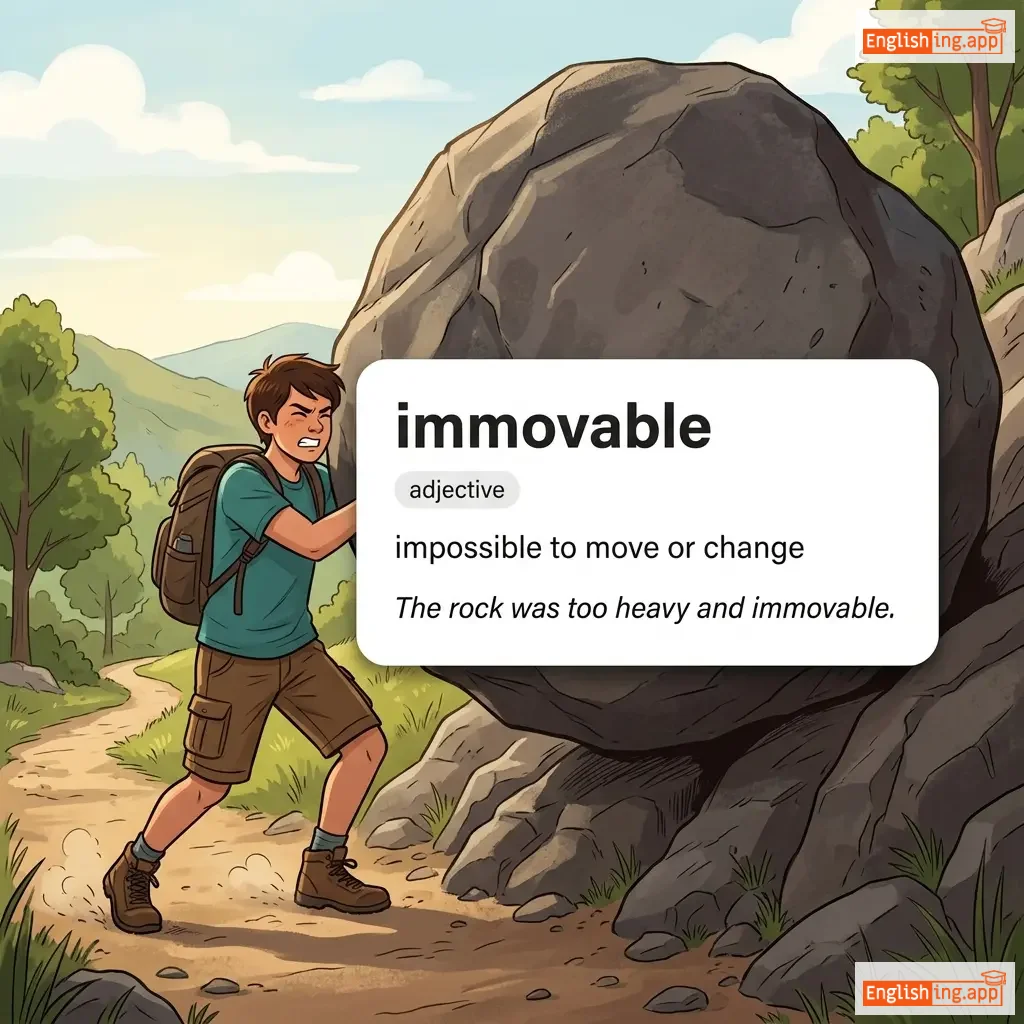
immovable definition card — visual illustration of the meaning
adjective
/ɪˈmuːvəbl/
immobile (immobile)

impossible to move or change

"The rock was too heavy and immovable."

"Le rocher était trop lourd et immobile." (Le rocher etait trop lourd et immobile.)
adjective
/ɪˈmjuːn/
immunisé (immunise)

protected from disease or from the effects of something

"Children who are vaccinated are immune to many diseases."

"Les enfants vaccinés sont immunisés contre de nombreuses maladies." (Les enfants vaccinés sont immunisés contre de nombreuses maladies.)
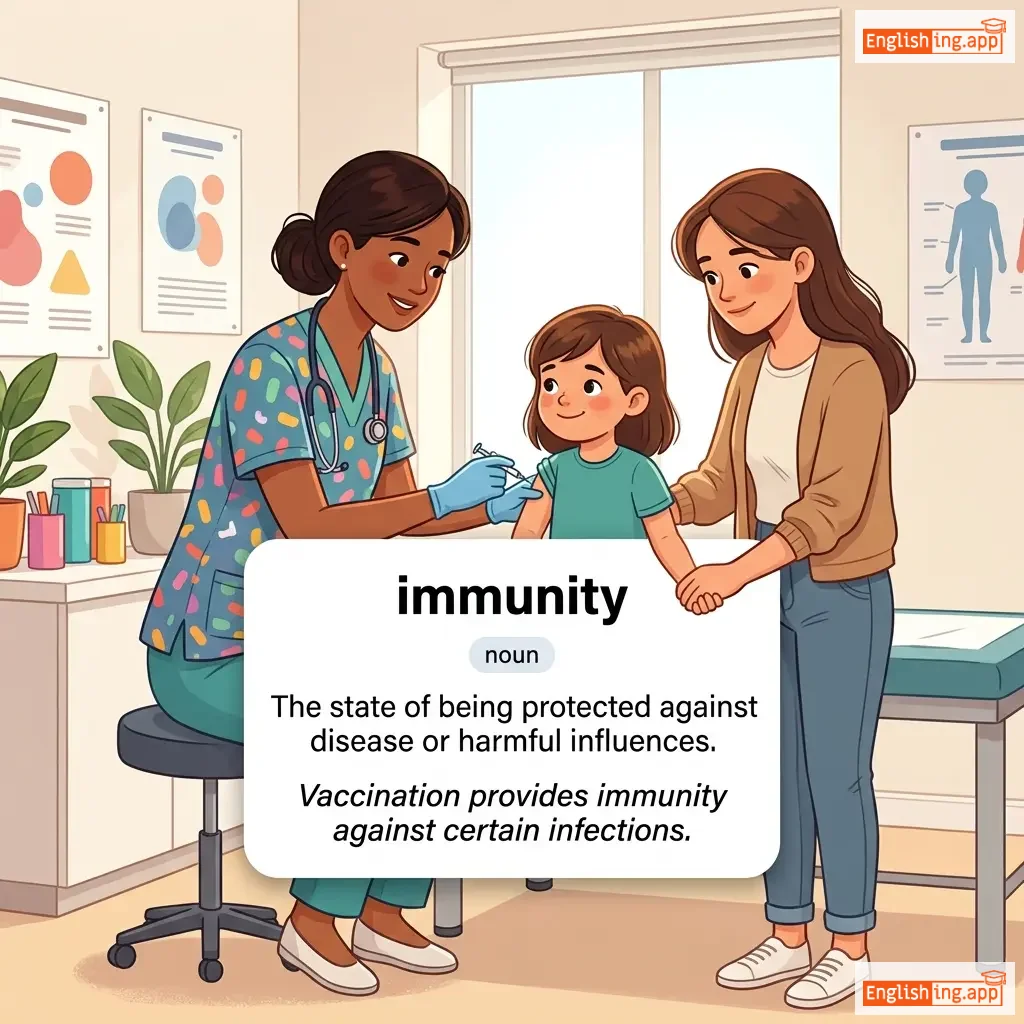
immunity definition card — visual illustration of the meaning
noun
/ɪˈmjuːnɪti/
immunité (immunité)

The state of being protected against disease or harmful influences.

"Vaccination provides immunity against certain infections."

"La vaccination procure une immunité contre certaines infections." (La vaccination procure une immunité contre certaines infections.)
verb
/ɪˈmjʊər/
enfermer (enfermer)

to confine or enclose someone against their will

"The prisoner was immured in a dark cell."

"Le prisonnier a été enfermé dans une cellule sombre." (Le prisonnier a été enfermé dans une cellule sombre.)
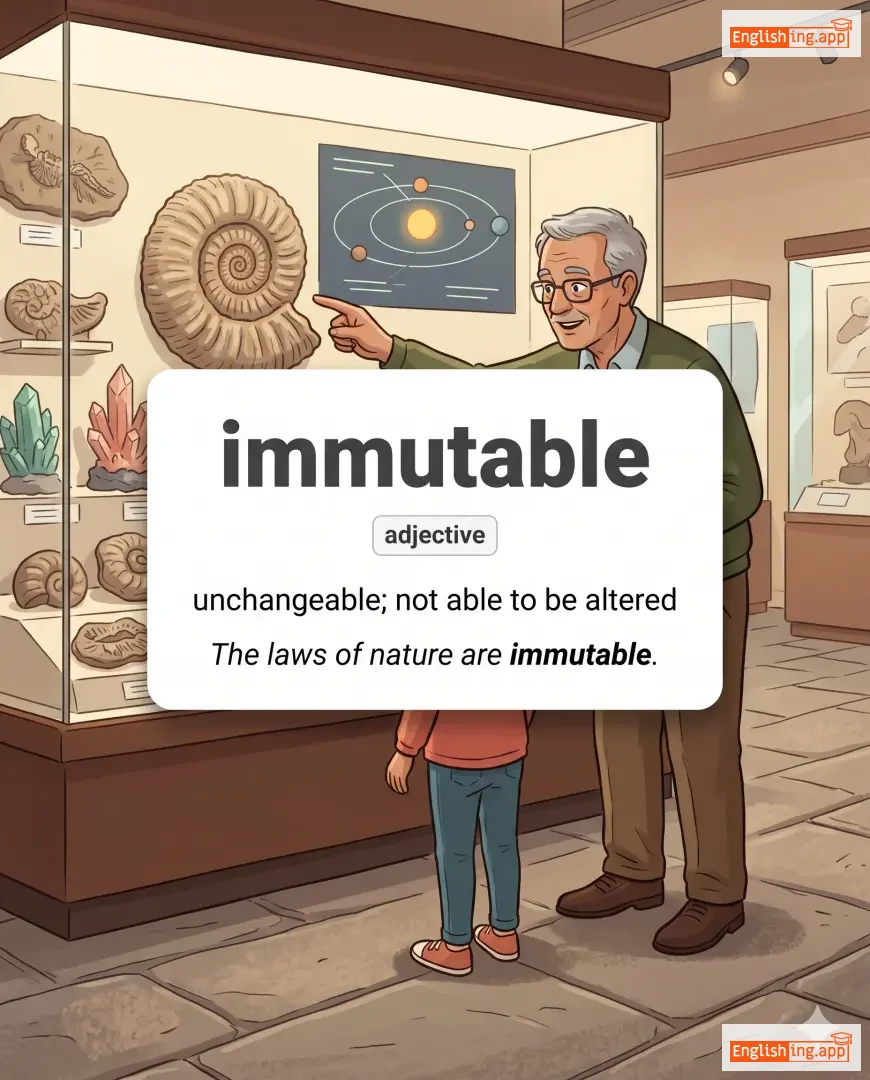
immutable definition card — visual illustration of the meaning
adjective
/ɪˈmjuːtəbl/
immuable (immuable)

unchangeable; not able to be altered

"The laws of nature are immutable."

"Les lois de la nature sont immuables." (Les lois de la nature sont immuables.)
noun
/ɪmp/
petit diablotin espiègle (petit diablotin espiègle)

a small mischievous devil or sprite; a playful troublemaker

"The child was acting like a little imp, hiding his toys everywhere."

"L'enfant agissait comme un petit diablotin, cachant ses jouets partout." (L'enfant agissait comme un petit diablotin, cachant ses jouets partout.)
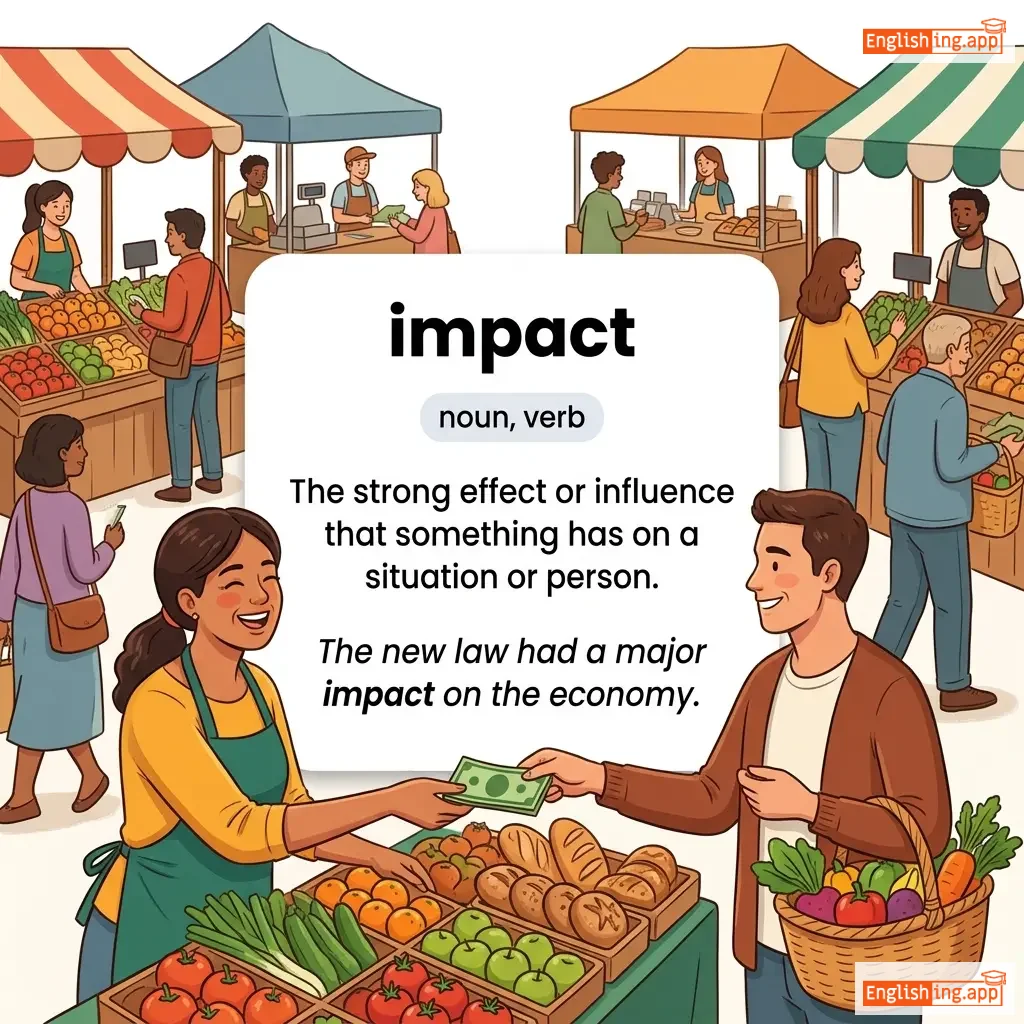
impact definition card — visual illustration of the meaning
noun, verb
/ˈɪmpækt/
impact (impact)

The strong effect or influence that something has on a situation or person.

"The new law had a major impact on the economy."

"La nouvelle loi a eu un grand impact sur l'économie." (La nouvelle loi a eu un grand impact sur l'économie.)
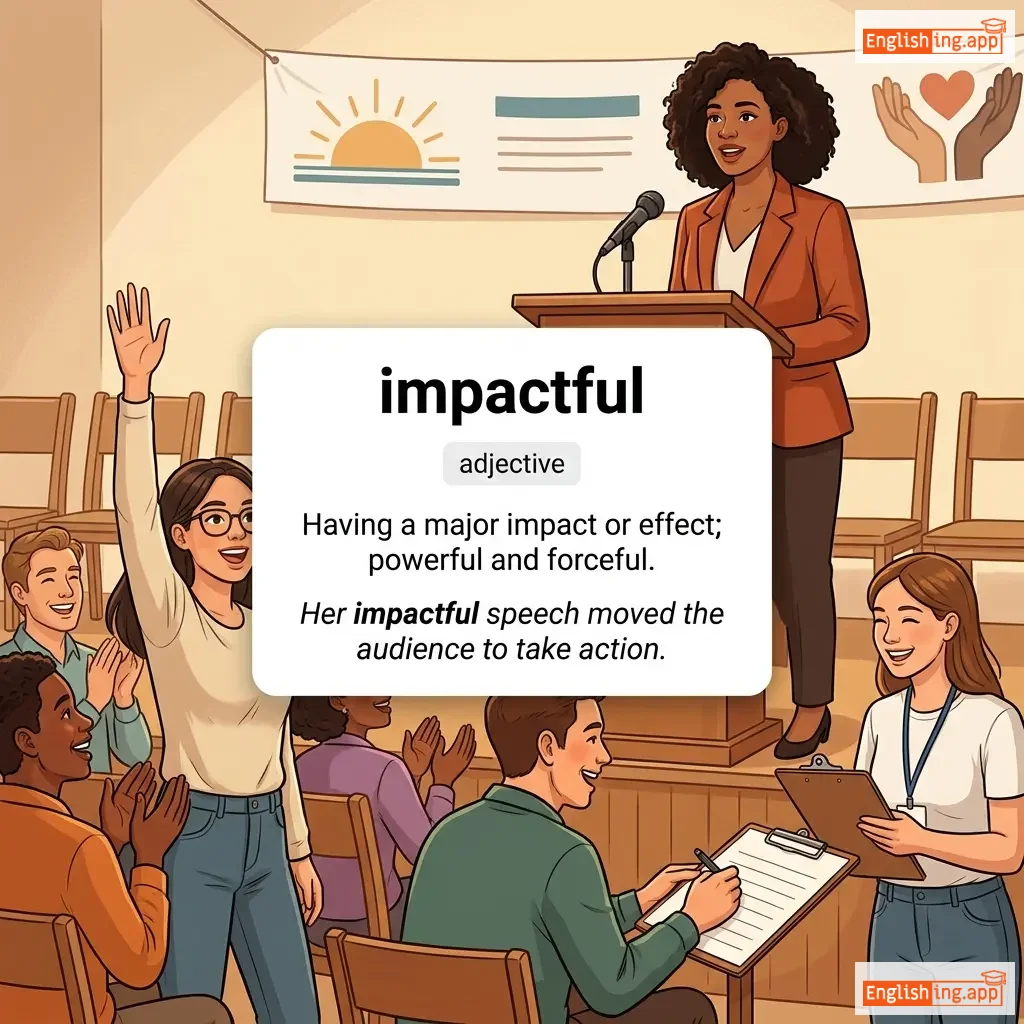
impactful definition card — visual illustration of the meaning
adjective
/ˈɪmpæktfʊl/
impactant (impactant)

Having a major impact or effect; powerful and forceful.

"Her impactful speech moved the audience to take action."

"Son discours impactant a poussé l'auditoire à passer à l'action." (Son discours impactant a poussé l'auditoire à passer à l'action.)
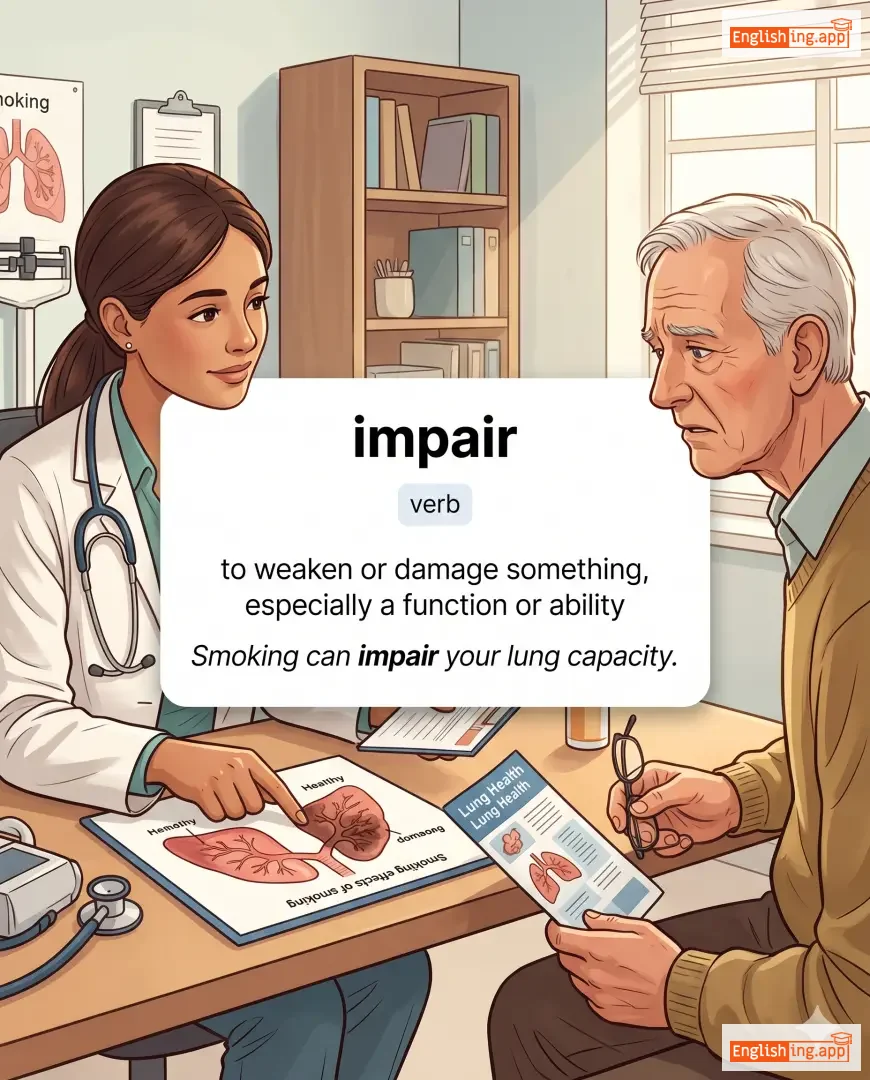
impair definition card — visual illustration of the meaning
verb
/ɪmˈpɛər/
altérer (alterer)

to weaken or damage something, especially a function or ability

"Smoking can impair your lung capacity."

"Fumer peut nuire à votre capacité pulmonaire." (Fumer peut nuire a votre capacite pulmonaire.)
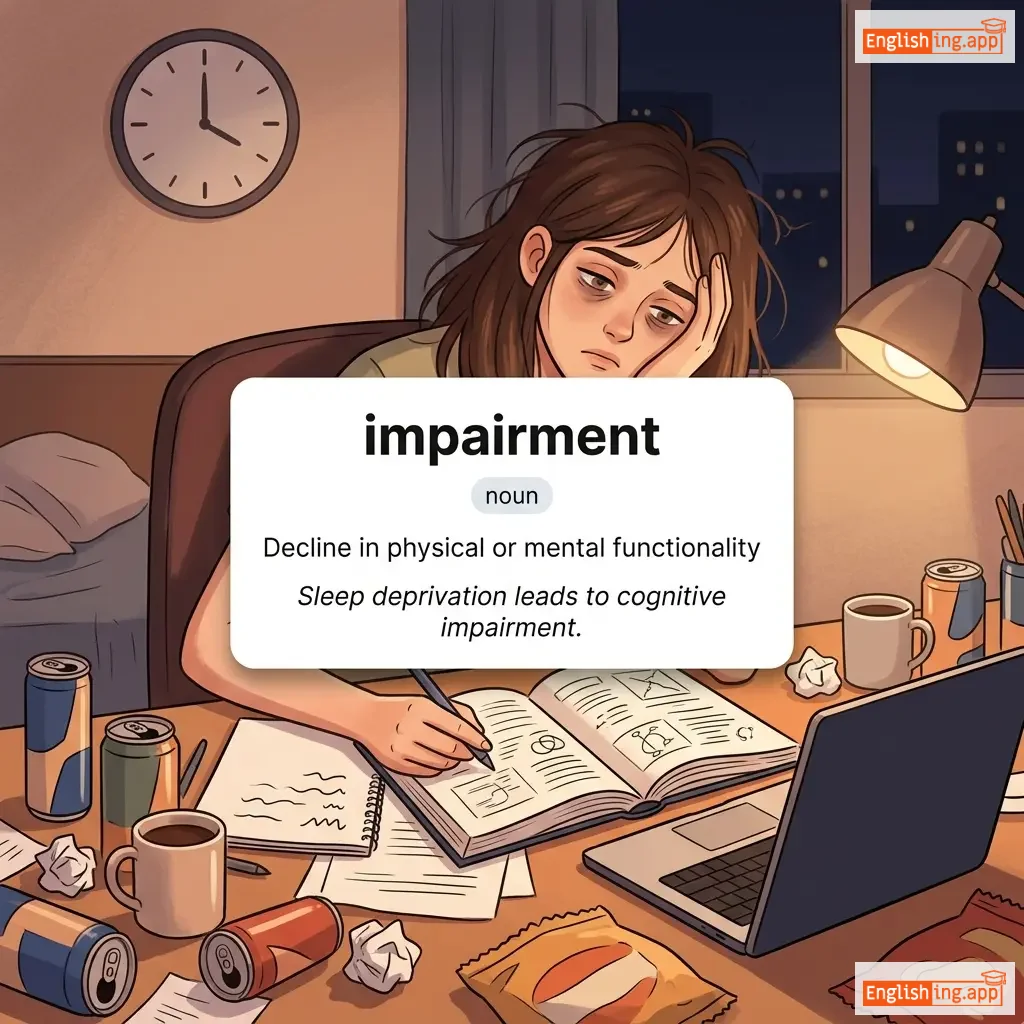
impairment definition card — visual illustration of the meaning
noun
ɪmˈpɛərmənt
déficience (defisience)

Decline in physical or mental functionality

"Sleep deprivation leads to cognitive impairment."

"La privation de sommeil conduit à une déficience cognitive." (La privation de sommeil conduit à une déficience cognitive.)
verb
/ɪmˈpeɪl/
empaler (empaler)

to pierce or fix something with a sharp object

"The knight was impaled by the enemy’s spear."

"Le chevalier a été empalé par la lance de l'ennemi." (Le chevalier a été empalé par la lance de l'ennemi.)
adjective
/ɪmˈpælpəbəl/
intangible (intangible)

unable to be felt by touch; difficult to grasp or understand

"There was an impalpable sense of fear in the room."

"Il y avait une sensation intangible de peur dans la pièce." (Il y avait une sensation intangible de peur dans la piece.)
verb
/ɪmˈpɑːrt/
transmettre (transmettre)

to make information known; to bestow or communicate

"The teacher imparted valuable knowledge to her students."

"L'enseignant a imparté des connaissances précieuses à ses élèves." (L'enseignant a imparté des connaissances précieuses à ses élèves.)
adjective
/ɪmˈpɑːrʃəl/
impartial (impartial)

Treating all rivals or disputants equally; fair and just.

"The judge remained impartial throughout the trial."

"Le juge est resté impartial tout au long du procès." (Le juge est resté impartial tout au long du procès.)
adjective
/ɪmˈpæsəbəl/
impraticable (impraticable)

Impossible to travel along or over.

"The road became impassable after the heavy snowfall."

"La route est devenue impraticable après la forte neige." (La route est devenue impraticable après la forte neige.)
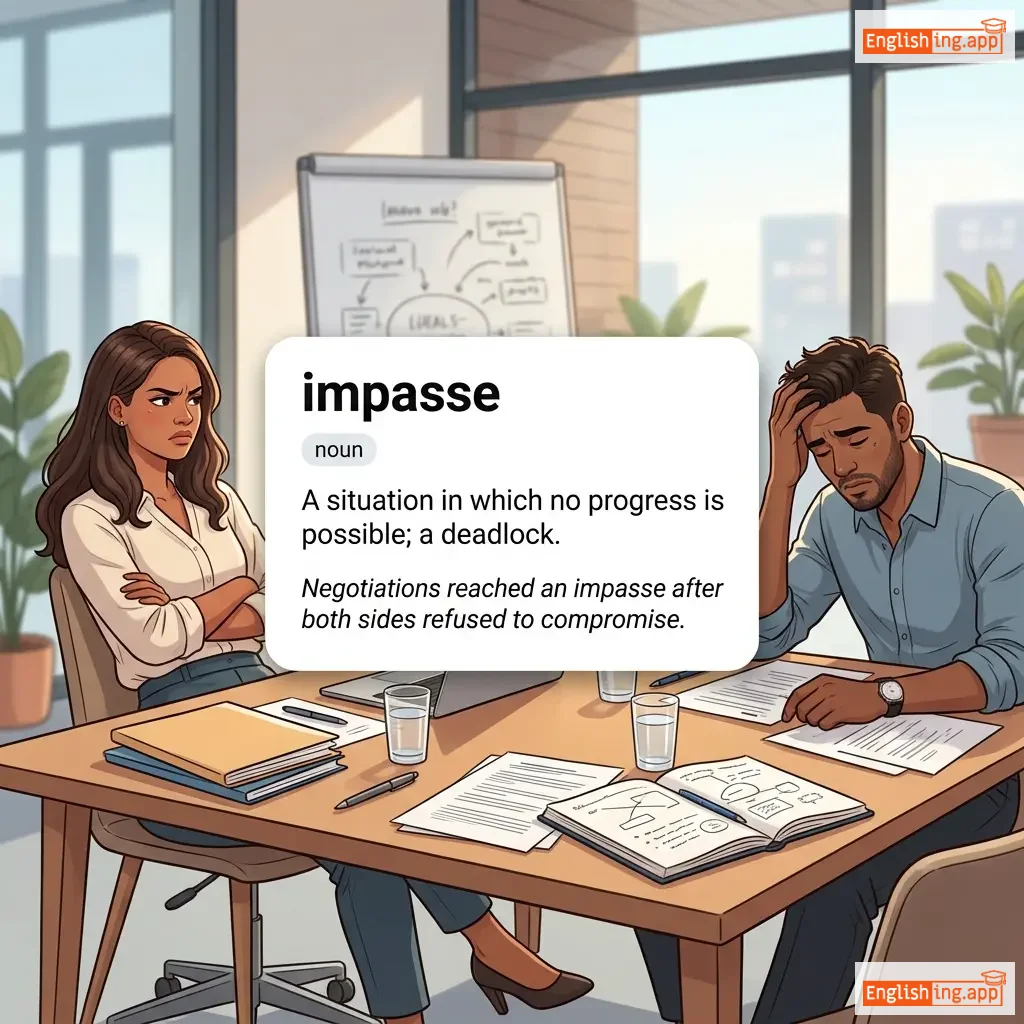
impasse definition card — visual illustration of the meaning
noun
/ˈɪmpæs/
impasse (impasse)

A situation in which no progress is possible; a deadlock.

"Negotiations reached an impasse after both sides refused to compromise."

"Les négociations ont atteint une impasse après que les deux parties aient refusé de faire des compromis." (Les negociations ont atteint une impasse apres que les deux parties aient refuse de faire des compromis.)
adjective
/ɪmˈpæsɪbəl/
impassible (impassible)

Incapable of suffering or feeling pain (used mainly in theological or philosophical contexts).

"Some philosophers argue that God is impassible and cannot experience human emotions."

"Certains philosophes affirment que Dieu est impassible et ne peut pas éprouver les émotions humaines." (Certains philosophes affirment que Dieu est impassible et ne peut pas éprouver les émotions humaines.)
adjective
/ɪmˈpæʃənd/
passionné (passionné)

Filled with or showing great emotion.

"She gave an impassioned speech about human rights."

"Elle a prononcé un discours passionné sur les droits de l'homme." (Elle a prononcé un discours passionné sur les droits de l'homme.)
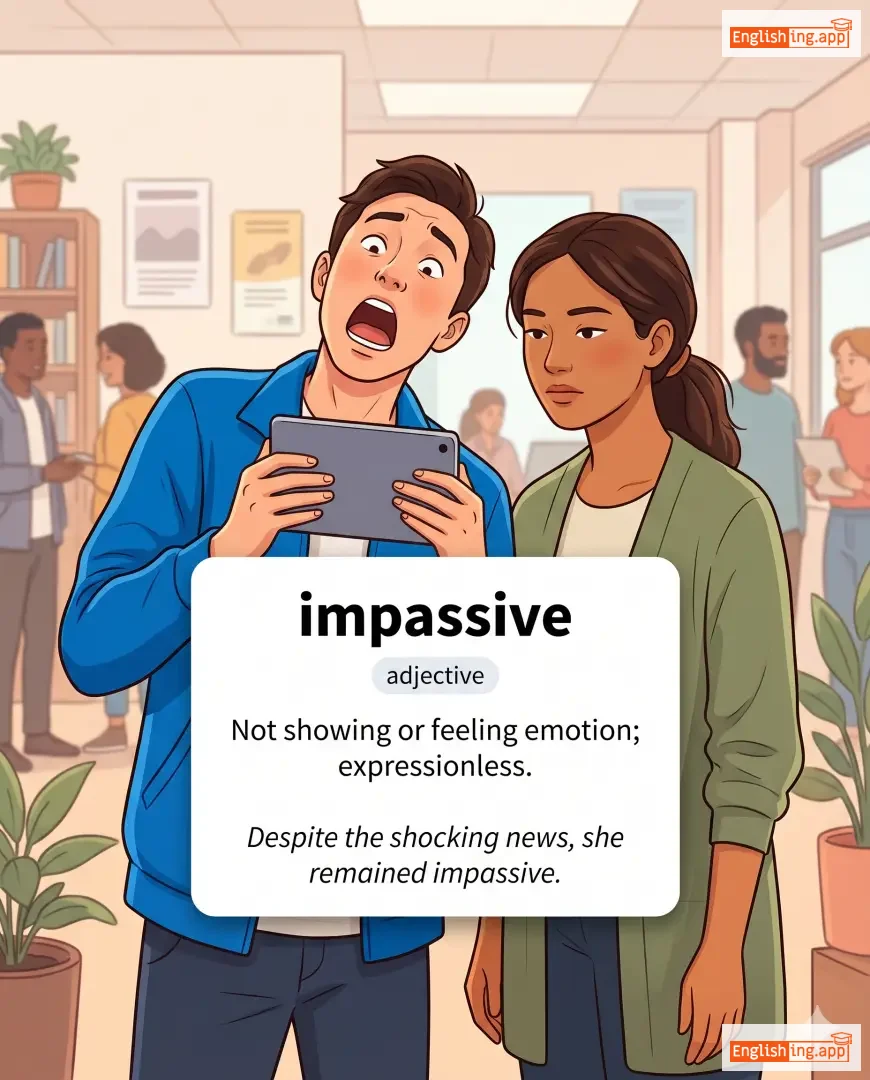
impassive definition card — visual illustration of the meaning
adjective
/ɪmˈpæsɪv/
impassible (impassible)

Not showing or feeling emotion; expressionless.

"Despite the shocking news, she remained impassive."

"Malgré les nouvelles choquantes, elle est restée impassible." (Malgré les nouvelles choquantes, elle est restée impassible.)
noun
/ɪmˈpeɪʃəns/
impatience (impatience)

The state of being quickly irritated or unable to wait calmly.

"His impatience grew as the meeting dragged on."

"Son impatience grandissait à mesure que la réunion s'éternisait." (Son impatience grandissait a mesure que la reunion s'eternisait.)
adjective
/ɪmˈpeɪʃənt/
impatient (impatient)

Not able to wait calmly; restless and eager for something to happen.

"She grew impatient while waiting in the long queue."

"Elle est devenue impatiente en attendant dans la longue file." (Elle est devenue impatiente en attendant dans la longue file.)