Vocabulaires

Découvrez, apprenez et maîtrisez le vocabulaire anglais

integrative diplomacy definition card — visual illustration of the meaning
noun
/ˈɪn.tɪ.ɡreɪ.tɪv dɪˈpləʊ.mə.si/
diplomatie intégrative (diplomatie integrative)

A diplomatic approach that seeks to combine or coordinate different elements, interests, or parties into a unified whole.

"Integrative diplomacy strengthens alliances."

"La diplomatie intégrative renforce les alliances." (La diplomatie intégrative renforce les alliances.)
integrity definition card — visual illustration of the meaning
noun
/ɪnˈtɛɡrɪti/
intégrité (integrite)

The quality of being honest and having strong moral principles.

"She is admired for her honesty and integrity."

"Elle est admirée pour son honnêteté et son intégrité." (Elle est admiree pour son honnete et son integrite.)
noun
/ɪnˈtɛɡ.jʊ.mənt/
revêtement externe (revetement externe)

A natural outer covering, such as skin, shell, or rind.

"The snake sheds its integument as it grows."

"Le serpent mue de son revêtement externe à mesure qu'il grandit." (Le serpent mue de son revetement externe a mesure qu'il grandit.)
noun
/ˈɪn.tə.lekt/
intellect (intellect)

The ability to think, reason, and understand objectively.

"Her intellect is admired by all her colleagues."

"Son intellect est admiré par tous ses collègues." (Son intellect est admire par tous ses collegues.)
adjective, noun
/ˌɪn.təlˈɛk.tʃu.əl/
intellectuel (intellectuel)

Relating to the intellect; a person who engages in critical thinking and study.

"She enjoys intellectual discussions about philosophy."

"Elle aime les discussions intellectuelles sur la philosophie." (Elle aime les discussions intellectuelles sur la philosophie.)
intellectuals definition card — visual illustration of the meaning
noun
ˌɪntəˈlektʃuəlz
intellectuels (intellectuels)

People possessing a highly developed intellect; scholars or academics.

"Intellectuals protested against the dominance."

"Les intellectuels ont protesté contre la domination." (Les intellectuels ont protesté contre la domination.)
intelligence definition card — visual illustration of the meaning
noun
/ɪnˈtɛl.ɪ.dʒəns/
intelligence (intelligence)

The ability to acquire and apply knowledge and skills.

"Artificial intelligence is transforming industries worldwide."

"L'intelligence artificielle transforme les industries dans le monde entier." (L'intelligence artificielle transforme les industries dans le monde entier.)
adjective
/ɪnˈtɛlɪdʒənt/
intelligent (intelligent)

Having or showing high mental capacity, quick to learn and understand.

"She is one of the most intelligent students in the class."

"Elle est l'une des étudiantes les plus intelligentes de la classe." (Elle est l'une des étudiantes les plus intelligentes de la classe.)
noun
/ɪnˌtɛl.ɪˈdʒɛntsi.ə/
intelligentsia (intelligentsia)

The group of people engaged in intellectual and cultural pursuits in a society.

"The intelligentsia played a key role in shaping public opinion."

"L'intelligentsia a joué un rôle clé dans la formation de l'opinion publique." (L'intelligentsia a joué un rôle clé dans la formation de l'opinion publique.)
adjective
/ɪnˈtɛlɪdʒəbl/
intelligible (in tel li juh buhl)

Able to be understood; clear enough to be comprehended.

"Her speech was barely intelligible over the noise."

"Son discours était à peine intelligible à cause du bruit." (Son discours etait a peine intelligible a cause du bruit)
noun
/ɪnˈtɛmpərəns/
intempérance (intemperans)

Lack of moderation or self-control, especially with drinking or eating.

"His intemperance in drinking ruined his health."

"Son intempérance dans l'alcool a ruiné sa santé." (Son intempérance dans l'alcool a ruiné sa santé.)
adjective
/ɪnˈtɛmpərət/
intempérant (intemperant)

Lacking self-control; immoderate, especially in indulgence.

"The politician's intemperate remarks caused controversy."

"Les remarques intempérantes du politicien ont causé la controverse." (Les remarques intempérantes du politicien ont causé la controverse.)
intend definition card — visual illustration of the meaning
verb
/ɪnˈtɛnd/
avoir l'intention (avoir l'intention)

To have a plan or purpose in mind; to aim to do something.

"I intend to finish my work before dinner."

"Je compte finir mon travail avant le dîner." (Je compte finir mon travail avant le dîner.)
adjective
/ɪnˈtɛns/
intense (intense)

Of extreme force, degree, or strength.

"She felt intense pain after the accident."

"Elle a ressenti une douleur intense après l'accident." (Elle a ressenti une douleur intense après l'accident.)
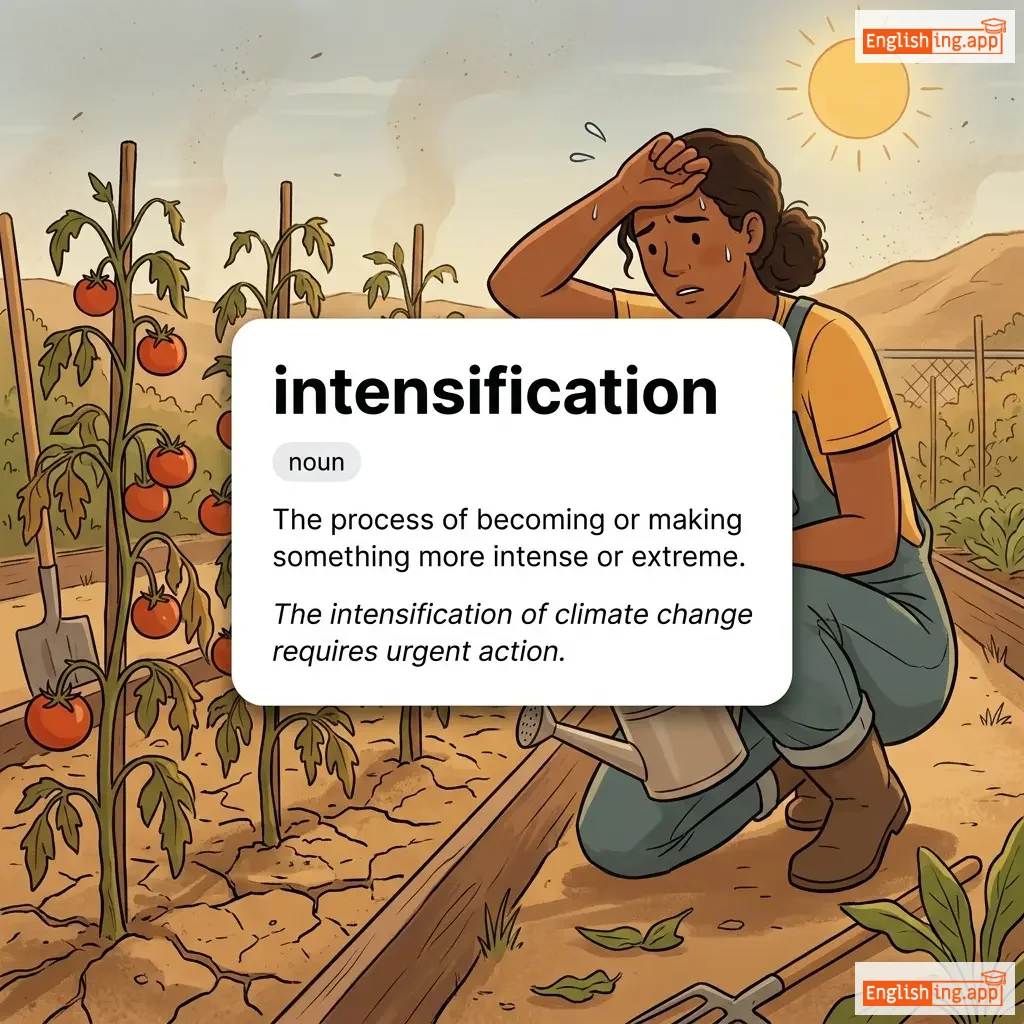
intensification definition card — visual illustration of the meaning
noun
ɪnˌten.sɪ.fɪˈkeɪ.ʃən
intensification (intensification)

The process of becoming or making something more intense or extreme.

"The intensification of climate change requires urgent action."

"L'intensification du changement climatique nécessite une action urgente." (L'intensification du changement climatique nécessite une action urgente.)
verb
/ɪnˈtɛnsɪfaɪ/
intensifier (intensifier)

To make something stronger, more extreme, or more forceful.

"The storm is expected to intensify overnight."

"On s'attend à ce que la tempête s'intensifie pendant la nuit." (On s'attend à ce que la tempête s'intensifie pendant la nuit.)
noun
/ɪnˈtɛnʃən/
contenu interne (contenu interne)

The internal content of a concept; the set of attributes implied by a word or phrase.

"The intension of the word 'dog' includes being a mammal and domesticated."

"L'intension du mot 'chien' inclut être un mammifère et être domestiqué." (L'intension du mot 'chien' inclut être un mammifère et être domestiqué.)
noun
/ɪnˈtɛnsəti/
intensité (intensite)

The quality of being extreme, strong, or forceful in degree.

"The intensity of the storm frightened the villagers."

"L'intensité de la tempête a effrayé les villageois." (L'intensite de la tempete a effraye les villageois.)
adjective
/ɪnˈtɛnsɪv/
intensif (intensif)

Involving a lot of effort, energy, or concentration in a short period of time.

"She attended an intensive English course before moving abroad."

"Elle a suivi un cours intensif d'anglais avant de partir à l'étranger." (Elle a suivi un cours intensif d'anglais avant de partir a l'etranger.)
noun
/ɪnˈtɛnt/
intention (intention)

the purpose or reason behind an action; a strong determination to do something

"Her intent was to improve the quality of education in the community."

"Son intention était d'améliorer la qualité de l'éducation dans la communauté." (Son intention etait d'ameliorer la qualite de l'education dans la communaute.)
noun
/ɪnˈtɛnʃən/
intention (intention)

A plan, aim, or purpose behind an action.

"Her intention was to finish the project before the deadline."

"Son intention était de terminer le projet avant la date limite." (Son intention etait de terminer le projet avant la date limite.)
verb
/ɪnˈtɜːr/
enterrer (enterrer)

To bury a dead body in the ground.

"They decided to inter the soldier with full honors."

"Ils ont décidé d'enterrer le soldat avec tous les honneurs." (Ils ont décidé d'enterrer le soldat avec tous les honneurs.)
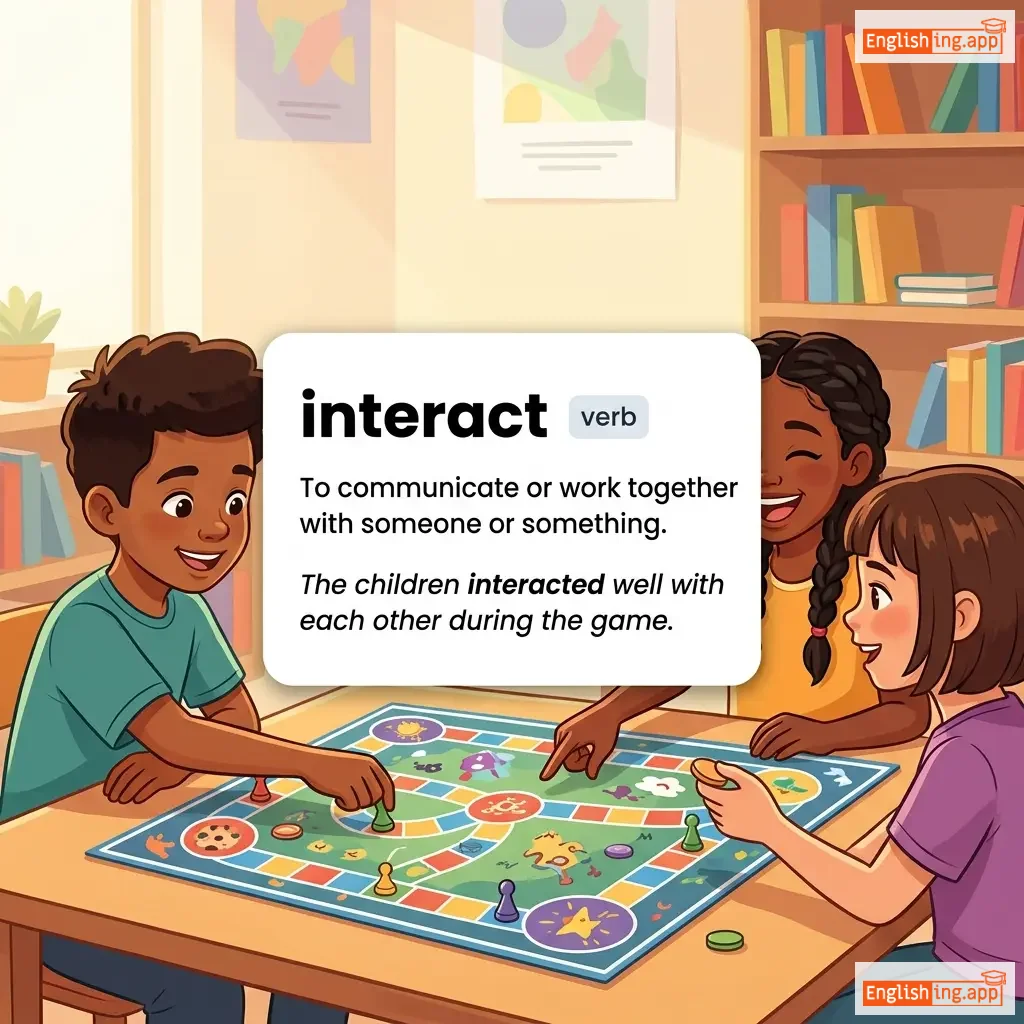
interact definition card — visual illustration of the meaning
verb
/ˌɪntərˈækt/
interagir (interagir)

To communicate or work together with someone or something.

"The children interacted well with each other during the game."

"Les enfants ont bien interagi entre eux pendant le jeu." (Les enfants ont bien interagi entre eux pendant le jeu.)
noun
/ˌɪntərˈækʃən/
interaction mutuelle (interaction mutuelle)

The process of people or things acting upon or influencing each other.

"The teacher encouraged more interaction between students."

"L'enseignant a encouragé plus d'interaction entre les élèves." (L'enseignant a encouragé plus d'interaction entre les élèves.)
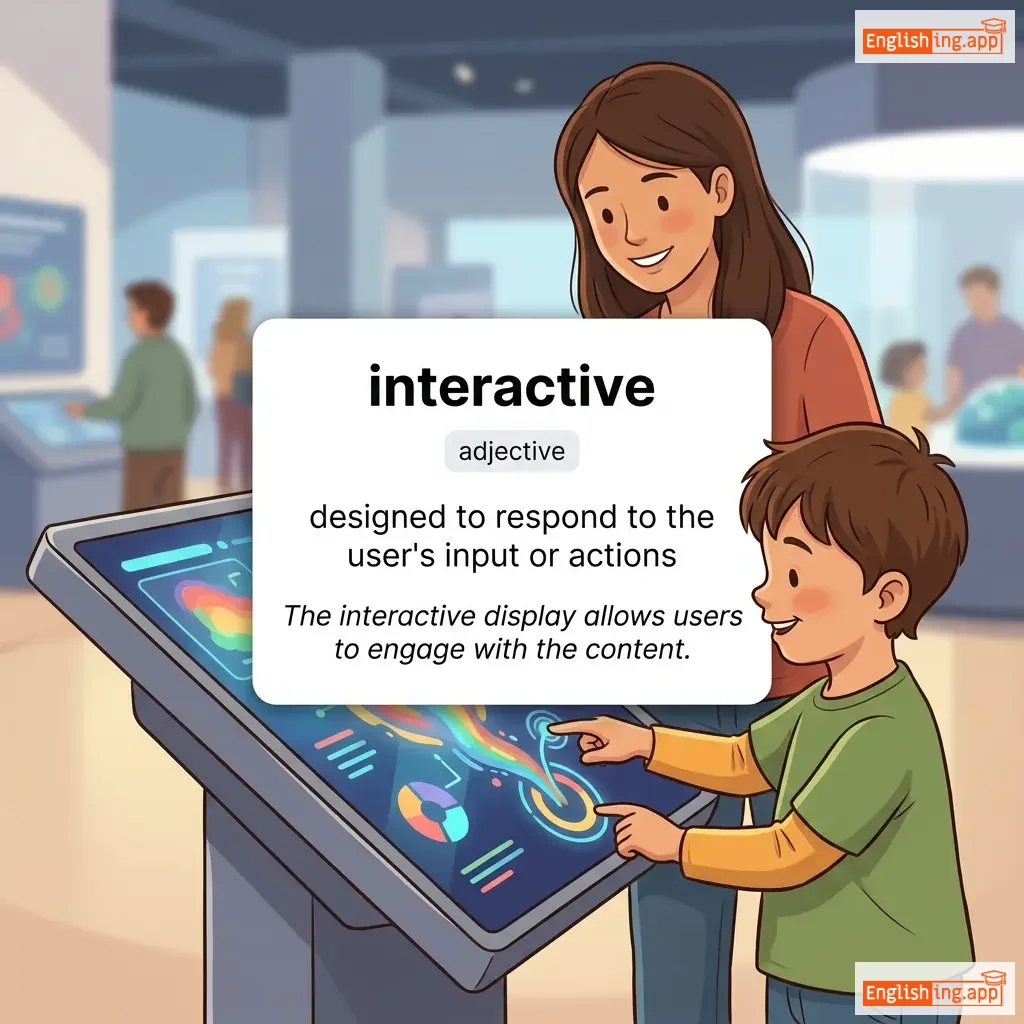
interactive definition card — visual illustration of the meaning
adjective
/ɪnˈtærɪktɪv/
interactif (interactif)

designed to respond to the user's input or actions

"The interactive display allows users to engage with the content."

"L'affichage interactif permet aux utilisateurs d'interagir avec le contenu." (Laffichage interactif permet aux utilisateurs dinteragir avec le contenu)
verb
/ˌɪntərˈsiːd/
intercéder (interceder)

to act or plead on behalf of someone in difficulty or trouble; to intervene between parties to help resolve a dispute

"She interceded with the teacher to give her brother another chance."

"Elle a intercédé auprès du professeur pour donner une autre chance à son frère." (Elle a intercédé auprès du professeur pour donner une autre chance à son frère.)
verb
/ˌɪntərˈsɛpt/

to stop, catch, or seize something on its way from one place to another

"The police intercepted the stolen car before it crossed the border."

noun
/ˌɪntərˈsɛʃən/
intercession (intercession)

the act of intervening or pleading on behalf of another person

"The prisoner was released due to the intercession of influential leaders."

"Le prisonnier a été libéré grâce à l'intercession de leaders influents." (Le prisonnier a été libéré grâce à l'intercession de leaders influents.)
noun
/ˌɪntərˈsɛsər/
intercesseur (intercesseur)

a person who intervenes or pleads on behalf of another

"He acted as an intercessor to resolve the conflict between the two families."

"Il a agi en tant qu'intercesseur pour résoudre le conflit entre les deux familles." (Il a agi en tant qu'intercesseur pour résoudre le conflit entre les deux familles.)
adjective
/ˌɪntərˈtʃeɪndʒəbl/
interchangeable (interchangeable)

able to be exchanged with each other without difference or loss of function

"These machine parts are interchangeable, so they can be replaced easily."

"Ces pièces de machine sont interchangeables, elles peuvent donc être remplacées facilement." (Ces pieces de machine sont interchangeables, elles peuvent donc etre remplacees facilement.)
interconnectivity definition card — visual illustration of the meaning
noun
/ˌɪntəkəˈnɛktɪvɪti/
interconnexion (interconnexion)

The state of being interconnected or the degree of connectivity between components

"The rise of interconnectivity has transformed global communication."

"L'essor de l'interconnectivité a transformé la communication mondiale." (L'essor de l'interconnectivité a transformé la communication mondiale.)
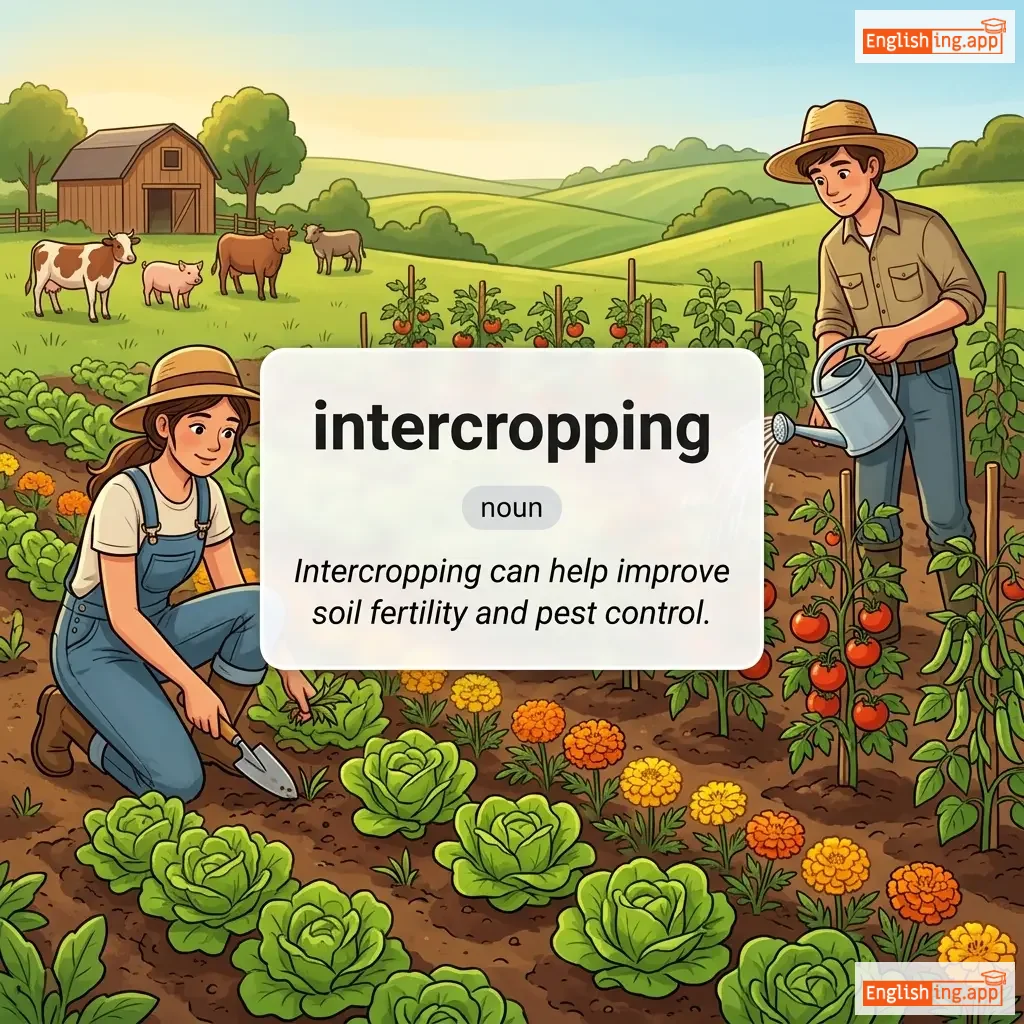
intercropping definition card — visual illustration of the meaning
noun
/ˈɪntəˌkrɒpɪŋ/
cultures intercalaires (cultures intercalaires)

The agricultural practice of cultivating two or more crops simultaneously in the same field to maximize land use efficiency and improve soil health.

"Intercropping can help improve soil fertility and pest control."

"Les cultures intercalaires peuvent aider à améliorer la fertilité du sol et à contrôler les ravageurs." (Les cultures intercalaires peuvent aider à améliorer la fertilité du sol et à contrôler les ravageurs.)
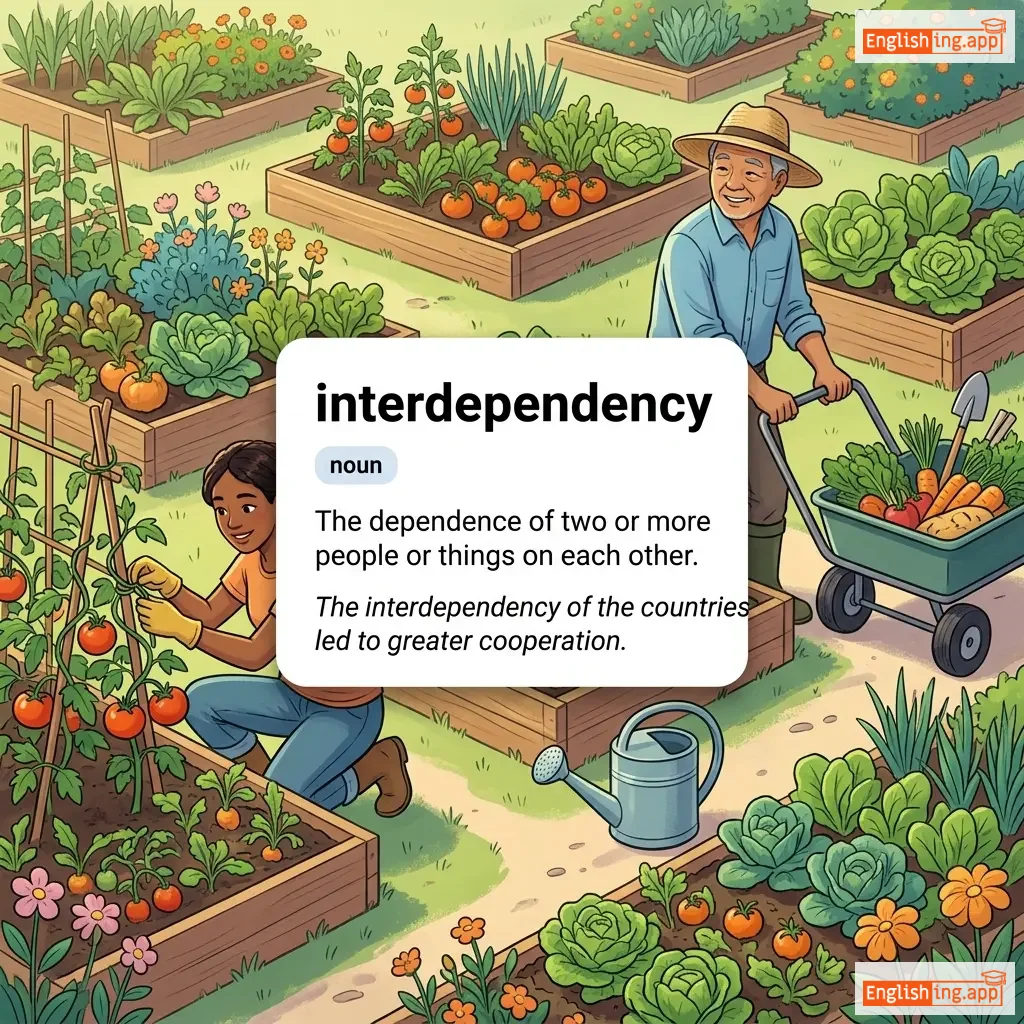
interdependency definition card — visual illustration of the meaning
noun
ˌɪntədɪˈpɛndənsi
interdépendance (interdependance)

The dependence of two or more people or things on each other.

"The interdependency of the countries led to greater cooperation."

"L'interdépendance des pays a conduit à une coopération accrue." (L'interdependance des pays a conduit à une cooperation accrue.)
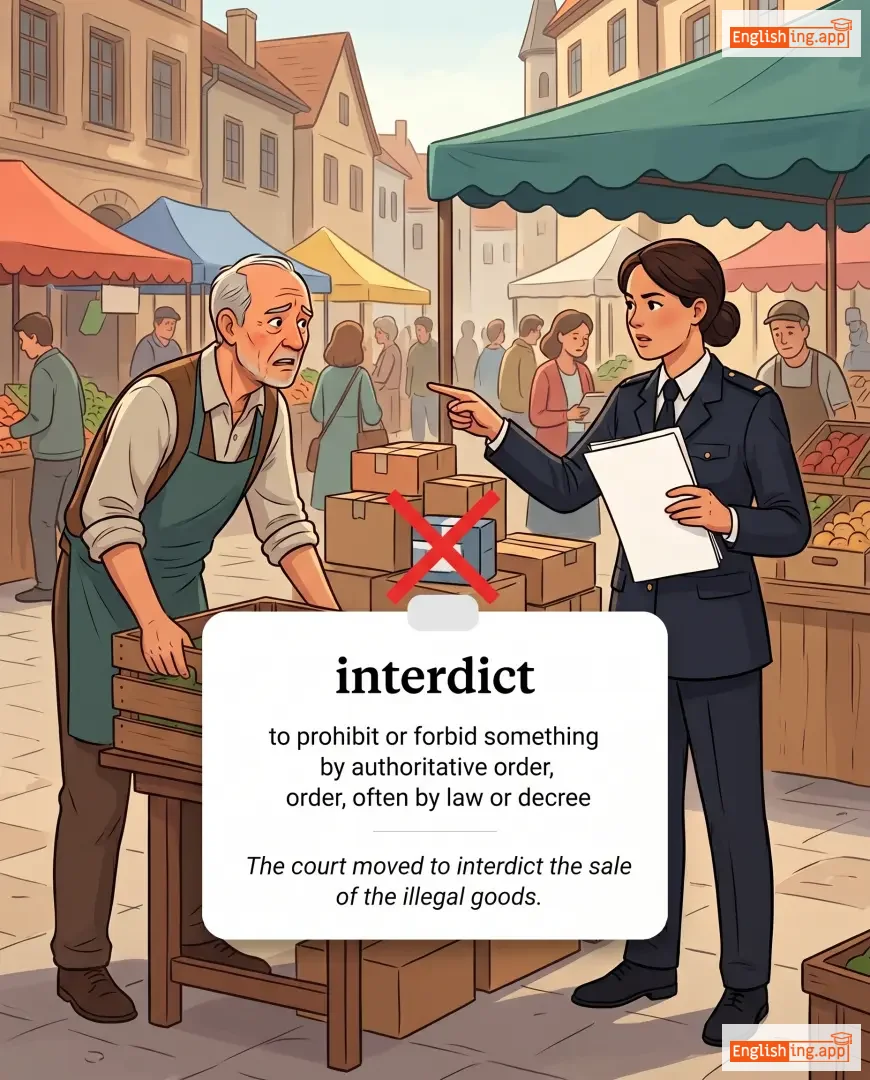
interdict definition card — visual illustration of the meaning
verb
/ˈɪntərˌdɪkt/
interdire (interdire)

to prohibit or forbid something by authoritative order, often by law or decree

"The court moved to interdict the sale of the illegal goods."

"Le tribunal a décidé d'interdire la vente des biens illégaux." (Le tribunal a décidé d'interdire la vente des biens illégaux.)
interdisciplinary definition card — visual illustration of the meaning
adjective
/ˌɪntərˈdɪsəplɪˌnɛri/
interdisciplinaire (interdisciplinaire)

Involving two or more academic subjects or fields of study.

"The university encourages interdisciplinary research projects."

"L'université encourage les projets de recherche interdisciplinaires." (L'université encourage les projets de recherche interdisciplinaires.)
noun/verb
/ˈɪntrəst/ or /ˈɪntəˌrɛst/
intérêt / intérêt financier (interet / interet financier)

A feeling of curiosity or concern about something; or money paid for the use of borrowed money.

"He showed great interest in learning new languages."

"Il a montré un grand intérêt à apprendre de nouvelles langues." (Il a montré un grand interet a apprendre de nouvelles langues.)
adjective
/ˈɪntrəstɪd/
intéressé (interese)

Showing curiosity or concern about something.

"She is very interested in learning new languages."

"Elle est très intéressée par l'apprentissage de nouvelles langues." (Elle est tres intereese par l'apprentissage de nouvelles langues.)
adjective
/ˈɪntrəstɪŋ/ or /ˈɪntəˌrɛstɪŋ/
intéressant (intéressant)

Arousing curiosity or attention; holding one’s interest.

"The documentary about space was very interesting."

"Le documentaire sur l'espace était très intéressant." (Le documentaire sur l'espace était très intéressant.)
noun
/ˈɪntərfeɪs/
interface (interface)

a point where two systems, subjects, or organizations meet and interact

"The user interface is designed to be intuitive and user-friendly."

"L'interface utilisateur est conçue pour être intuitive et facile à utiliser." (L'interface utilisateur est conçue pour être intuitive et facile à utiliser.)
verb
/ˌɪntərˈfɪər/
bonheur (bonheur)

to become involved in something that is not your concern; to hinder or obstruct

"Parents should not interfere in their children’s personal choices."

"Elle ne pouvait pas cacher son bonheur quand elle a reçu le prix." (Elle ne pouvait pas cacher son bonheur quand elle a reçu le prix.)
noun
/ˌɪntərˈfɪərəns/
interférence (interference)

the action of interfering with something

"The radio signal was disrupted due to interference from nearby electronics."

"Le signal radio a été perturbé en raison de l'interférence des appareils électroniques à proximité." (Le signal radio a été perturbé en raison de l'interférence des appareils électroniques à proximité.)
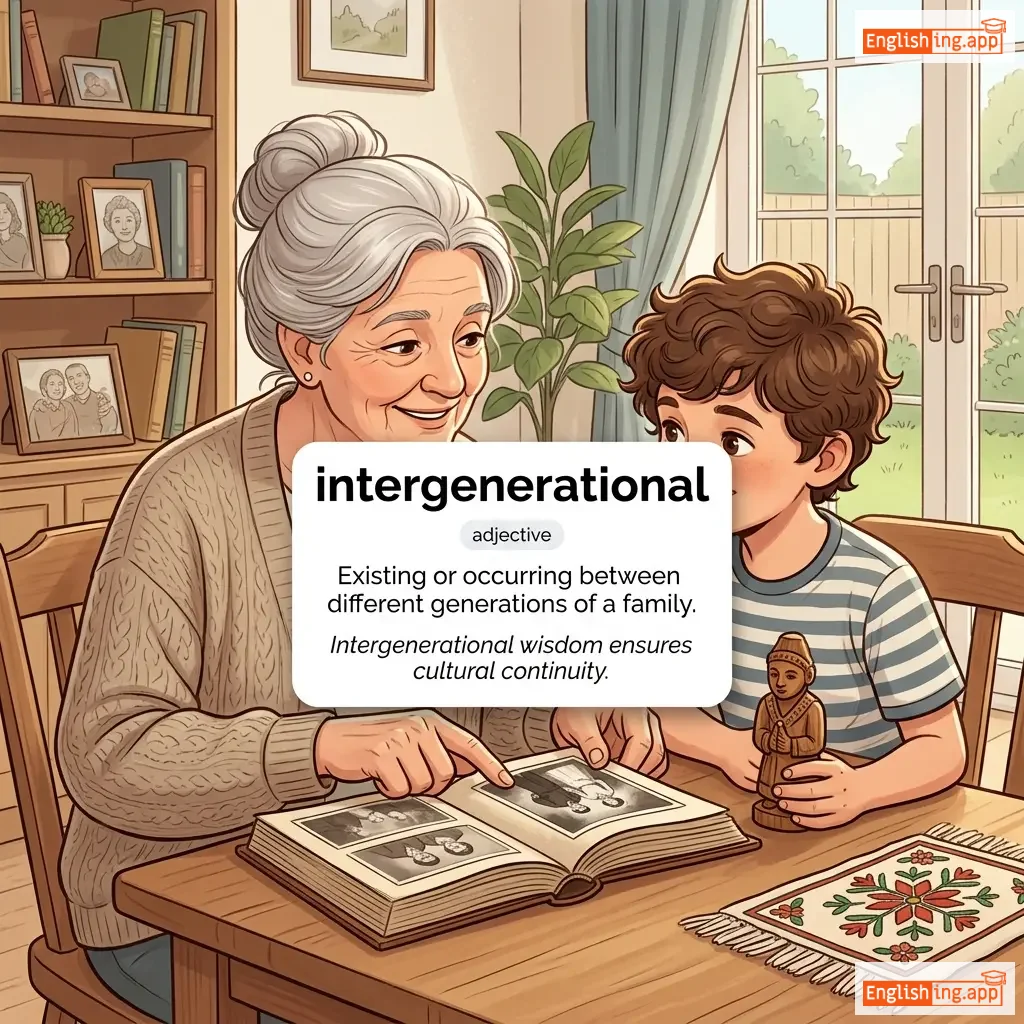
intergenerational definition card — visual illustration of the meaning
adjective
ˌɪn.tə.dʒen.əˈreɪ.ʃən.əl
intergénérationnel, entre différentes générations d'une famille (intergenerationnel, entre differentes generations d'une famille)

Existing or occurring between different generations of a family.

"Intergenerational wisdom ensures cultural continuity."

"La sagesse intergénérationnelle garantit la continuité culturelle." (La sagesse intergenerationnelle garantit la continuité culturelle.)
interim definition card — visual illustration of the meaning
noun
/ˈɪntərɪm/
intérimaire (interimaire)

a temporary or provisional period before something permanent is established

"She was appointed as the interim manager until a permanent replacement was found."

"Elle a été nommée directrice intérimaire jusqu'à ce qu'un remplaçant permanent soit trouvé." (Elle a été nommée directrice intérimaire jusqu'à ce qu'un remplaçant permanent soit trouvé.)
noun
/ɪnˈtɪəriər/
intérieur (interieur)

the inside part of something; inner area of a place or object

"The interior of the hotel was beautifully decorated."

"L'intérieur de l'hôtel était magnifiquement décoré." (L'interieur de l'hotel etait magnifiquement decoré.)
noun
/ˌɪntərˈdʒɛkʃən/
interjection (interjection)

a word or phrase used to express sudden emotion or reaction, often standing alone

"Words like 'wow' and 'ouch' are common interjections in English."

"Des mots comme 'wow' et 'aïe' sont des interjections courantes en anglais." (Des mots comme 'wow' et 'aie' sont des interjections courantes en anglais.)
verb
/ˌɪntərˈlɒk/
emboîter (emboîter)

to fit or connect together securely so that two or more things are joined

"The gears interlock to ensure smooth movement of the machine."

"Les engrenages s'emboîtent pour assurer un mouvement fluide de la machine." (Les engrenages s'emboîtent pour assurer un mouvement fluide de la machine.)
noun
/ˌɪntərˈlɒkjətər/
interlocuteur (interlocuteur)

a person who takes part in a conversation or dialogue

"She was a skilled interlocutor during the debate."

"Elle était une interlocutrice habile pendant le débat." (Elle etait une interlocutrice habile pendant le debat.)
adjective
/ˌɪntərˈlɒkjətəri/
provisoire (provisoire)

Given during the course of a legal action, not final but temporary or provisional.

"The judge issued an interlocutory order to maintain the status quo until the hearing."

"Le juge a émis une ordonnance provisoire pour maintenir le statu quo jusqu'à l'audience." (Le juge a émis une ordonnance provisoire pour maintenir le statu quo jusqu'à l'audience.)
noun
/ˈɪntərˌloʊpər/
intrus (intrus)

A person who becomes involved in a situation or place where they are not wanted.

"He felt like an interloper at the private family gathering."

"Il se sentait comme un intrus lors de la réunion familiale privée." (Il se sentait comme un intrus lors de la réunion familiale privée.)
noun
/ˈɪntərˌluːd/
interlude (interlude)

A short period of time that comes between two events; an interval.

"There was a brief musical interlude between the two acts of the play."

"Il y a eu un bref interlude musical entre les deux actes de la pièce." (Il y a eu un bref interlude musical entre les deux actes de la pièce.)