Vocabulaires

Découvrez, apprenez et maîtrisez le vocabulaire anglais

noun
/hɒˈstɪləti/
hostilité (hostilite)

hostile behavior; unfriendliness or opposition

"The negotiations ended in an atmosphere of hostility."

"Les négociations ont pris fin dans une atmosphère d'hostilité." (Les negociations ont pris fin dans une atmosphère d'hostilité.)
adjective
/hɒt/
chaud (shod)

Having a high degree of heat or a high temperature.

"The soup is too hot to eat right now."

"La soupe est trop chaude pour manger maintenant." (La soupe est trop chaude pour manger maintenant.)
noun
/hɒt drɪŋk/
boisson chaude (boisson chaude)

a warm or heated beverage consumed for refreshment or comfort

"I prefer a hot drink like tea or coffee in the morning."

"Je préfère une boisson chaude comme du thé ou du café le matin." (Je préfère une boisson chaude comme du thé ou du café le matin.)
noun
/hɒtʃ pɒtʃ/
pot-au-feu (pot-au-feu)

A mixed dish; a hodgepodge of ingredients cooked together

"She made a delicious hotch potch with rice, lentils, and vegetables."

"Elle a préparé un délicieux hôtch potch avec du riz, des lentilles et des légumes." (Elle a prepare un delicieux hotch potch avec du riz, des lentilles et des legumes.)
noun
/ˈhɑːtʃ.pɑːtʃ/
mélange confus; un tas de choses mélangées (melange confus; un tas de choses melangees)

a confused mixture; a jumbled assortment of things

"The room was a hotchpotch of old furniture, books, and random decorations."

"La pièce était un mélange confus de vieux meubles, de livres et de décorations aléatoires." (La piece etait un melange confus de vieux meubles, de livres et de decorations aleatoires.)
noun
/hoʊˈtɛl/
hôtel (hotel)

A building where people pay to stay and sleep, usually for short periods.

"We stayed at a hotel near the beach."

"Nous avons séjourné dans un hôtel près de la plage." (Nous avons séjourné dans un hôtel près de la plage.)
noun
/ˈhɒthɛd/
personne impulsive (personne impulsive)

a person who acts quickly and without thinking when angry

"He is such a hothead that he often starts arguments."

"Il est tellement impulsif qu'il commence souvent des disputes." (Il est tellement impulsif qu'il commence souvent des disputes.)
adverb
/ˈhɒtli/
avec colère (avec colere)

in an intense, angry, or passionate way

"She hotly denied the accusations."

"Elle a nié les accusations avec colère." (Elle a nie les accusations avec colere.)
verb
/haʊnd/
harceler (harceler)

to pursue or harass someone persistently

"Reporters hounded the actor for comments."

"les journalistes ont harcelé l'acteur pour des commentaires." (les journalistes ont harcelé l'acteur pour des commentaires.)
noun
/ˈaʊər/
heure (eur)

A period of time equal to 60 minutes.

"The meeting lasted for two hours."

"La réunion a duré deux heures." (La reunion a dure deux heures.)
adverb
/ˈaʊər.li/
chaque heure; se produisant ou fait chaque heure; en continu (chaque heure; se produisant ou fait chaque heure; en continu)

every hour; happening or done each hour; continuously

"The weather report is updated hourly."

"Le rapport météorologique est mis à jour chaque heure." (Le rapport météorologique est mis à jour chaque heure.)
noun
/haʊs/
maison (maison)

A building for people to live in, usually with rooms and a roof.

"They bought a new house in the city."

"Ils ont acheté une nouvelle maison en ville." (Ils ont acheté une nouvelle maison en ville.)
noun
/ˈhaʊs boʊt/
maison flottante (maison flottante)

a boat that has been designed or modified to be used primarily as a home

"They spent their vacation on a beautiful house boat in the lake."

"Ils ont passé leurs vacances sur une magnifique maison flottante sur le lac." (ils ont passé leurs vacances sur une magnifique maison flottante sur le lac)
noun
/ˈhaʊsˌbreɪkɪŋ/
infraction de domicile (infraction de domicile)

the crime of breaking into a house with intent to steal

"The thief was arrested for housebreaking."

"Le voleur a été arrêté pour infraction de domicile." (Le voleur a été arrêté pour infraction de domicile.)
👨‍👩‍👧‍👦

household (hɑʊʃoʊld)

noun
/ˈhaʊshoʊld/
foyer (foyer)

All the people living together in one house, considered as a unit.

"There are five people in our household."

"Il y a cinq personnes dans notre foyer." (Il y a cinq personnes dans notre foyer.)
noun
/ˈhaʊswaɪf/
femme au foyer (femme au foyer)

a married woman who manages a household and whose main occupation is caring for her family and home

"She chose to work as a housewife while raising her children."

"Elle a choisi d’être femme au foyer pour élever ses enfants." (Elle a choisi detre femme au foyer pour elever ses enfants)
noun
/ˈhaʊzɪŋ/
logement (logement)

buildings or structures where people live; accommodation

"The government is working to provide affordable housing for everyone."

"Le gouvernement travaille à fournir des logements abordables pour tous." (Le gouvernement travaille à fournir des logements abordables pour tous.)
noun
/ˈhʌvəl/
taudis (hovel)

a small, poorly built, and dirty house

"The refugees lived in a makeshift hovel."

"Les réfugiés vivaient dans un taudis improvisé." (Les refugies vivaient dans un taudis improvise.)
verb
/ˈhʌvər/
rester en l'air à un endroit sans avancer ni reculer (rester en l'air à un endroit sans avancer ni reculer)

to remain in the air in one place without moving forward or backward

"The helicopter hovered over the city."

"L'hélicoptère est resté suspendu au-dessus de la ville." (L'hélicoptère est resté suspendu au-dessus de la ville.)
adverb
/haʊ/
comment (comment)

in what way or manner; by what means

"How do you solve this problem?"

"Comment résolvez-vous ce problème?" (Comment résolvez-vous ce problème?)
adverb, conjunction
/haʊˈɛvər/
cependant (cependant)

used to introduce a statement that contrasts with or seems to contradict something previously said

"The journey was long; however, it was enjoyable."

"Le voyage était long; cependant, il était agréable." (Le voyage était long; cependant, il était agréable.)
noun
/ˈhɔɪdən/
fille turbulente (fille turbulente)

a boisterous or tomboyish girl

"The hoyden preferred climbing trees to playing with dolls."

"La fille turbulente préférait grimper aux arbres plutôt que de jouer avec des poupées." (La fille turbulente préférait grimper aux arbres plutôt que de jouer avec des poupées.)
noun
/hʌb/
centre (centre)

the central part of a place or activity where things converge

"The city is the hub of the country's trade network."

"La ville est le centre du réseau commercial du pays." (La ville est le centre du réseau commercial du pays.)
noun
/ˈhʌbʌb/
tumulte (tumulte)

a loud noise caused by a crowd of people talking or shouting

"There was a hubbub in the market as the sale began."

"Il y avait un tumulte sur le marché lorsque la vente a commencé." (Il y avait un tumulte sur le marché lorsque la vente a commencé.)
noun
/ˈhjuːbrɪs/
hubris (hubris)

excessive pride or self-confidence

"His hubris led to his downfall."

"Son hubris a conduit à sa chute." (Son hubris a conduit à sa chute.)
noun
/ˈhʌk.stər/
vendeur ambulant (vendeur ambulant)

A person who sells small items aggressively, often in a showy or dishonest way.

"The huckster loudly promoted his goods in the busy marketplace."

"Le vendeur ambulant a bruyamment promu ses marchandises dans le marché bondé." (Le vendeur ambulant a bruyamment promu ses marchandises dans le marché bondé.)
noun
/hjuː/
teinte (teinte)

A color or shade.

"The artist chose a soft blue hue for the background."

"L'artiste a choisi une teinte bleue douce pour l'arrière-plan." (L'artiste a choisi une teinte bleue douce pour l'arrière-plan.)
noun phrase
/ˌhjuː ən ˈkraɪ/
cris de protestation (cris de protestation)

A loud public outcry or protest, often demanding action.

"There was a hue and cry over the new policy changes."

"Il y a eu un grand cri de protestation suite aux nouveaux changements de politique." (Il y a eu un grand cri de protestation suite aux nouveaux changements de politique.)
verb
/hʌɡ/
embrasser (embrasser)

to hold someone tightly in your arms to show affection or comfort

"She hugged her friend before leaving for the airport."

"Elle a embrassé son amie avant de partir pour l'aéroport." (Elle a embrassé son amie avant de partir pour l'aéroport.)
adjective
/hjuːdʒ/
énorme (enorme)

extremely large in size or amount

"The stadium was filled with a huge crowd."

"Le stade était rempli d'une énorme foule." (Le stade était rempli d'une énorme foule.)
interjection
/hʌ/
Quoi? (Quoi?)

used to express confusion, surprise, or that you did not hear something

"Huh? What did you say?"

"Hein? Qu'est-ce que tu as dit?" (Hein? Qu'est-ce que tu as dit?)
noun
/hʌl/
coque de navire / enveloppe de graine (coque de navire / enveloppe de graine)

The outer covering of a seed or fruit; also the main body of a ship.

"The sailors inspected the ship’s hull for any damage."

"Les marins ont inspecté la coque du navire pour détecter d'éventuels dommages." (Les marins ont inspecté la coque du navire pour détecter d'éventuels dommages.)
noun
/hʌm/
bourdonnement (bourdonemont)

a low continuous sound; to make a low continuous droning sound

"The constant hum of the air conditioner helped her fall asleep peacefully."

"Le bourdonnement constant du climatiseur l'a aidée à s'endormir paisiblement." (Le bourdonnement constant du climatiseur l'a aidée à s'endormir paisiblement.)
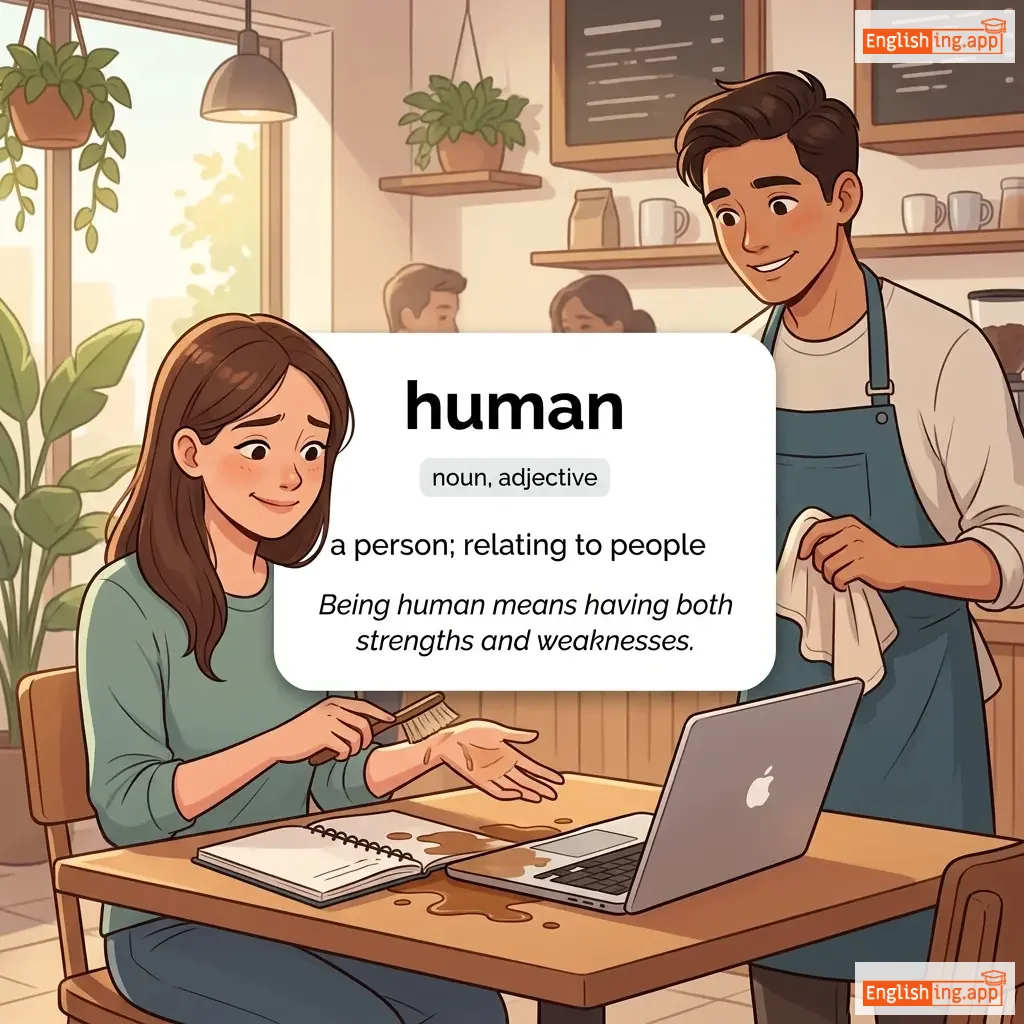
human definition card — visual illustration of the meaning
noun, adjective
/ˈhjuːmən/
humain (humain)

a person; relating to people

"Being human means having both strengths and weaknesses."

"Être humain signifie avoir à la fois des forces et des faiblesses." (Être humain signifie avoir à la fois des forces et des faiblesses.)
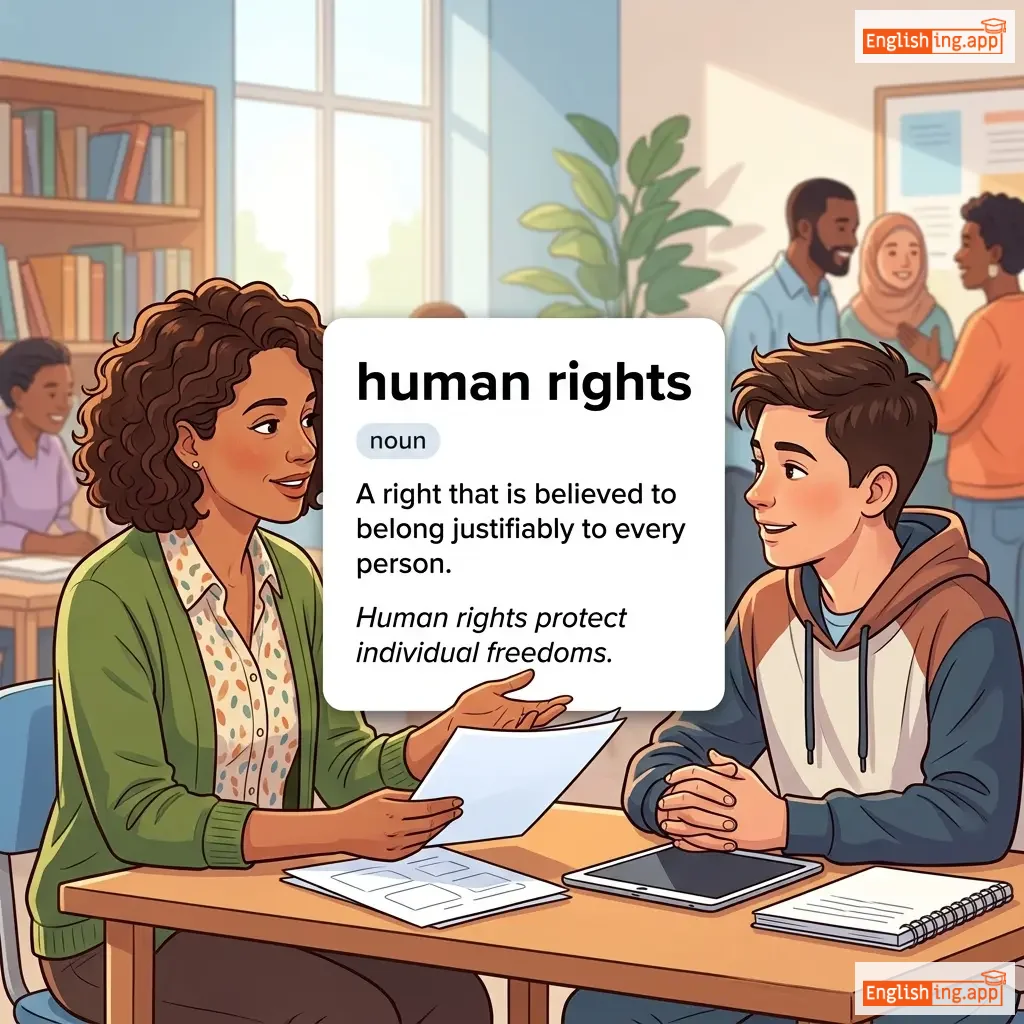
human rights definition card — visual illustration of the meaning
noun
ˌhjuː.mən ˈraɪts
droits de l'homme (droits de l'homme)

A right that is believed to belong justifiably to every person.

"Human rights protect individual freedoms."

"Les droits de l'homme protègent les libertés individuelles." (Les droits de l'homme protègent les libertés individuelles.)
adjective
/hjuːˈmeɪn/
humain (humain)

Showing compassion or benevolence.

"The doctor provided humane treatment to the injured animals."

"Le médecin a prodigué un traitement humain aux animaux blessés." (Le medecin a prodigue un traitement humain aux animaux blesses.)
noun, adjective
/hjuːˌmænɪˈtɛəriən/
humanitaire (humanitaire)

A person who seeks to promote human welfare, or something relating to human welfare and compassion.

"The organization provides humanitarian aid to disaster victims."

"L'organisation fournit une aide humanitaire aux victimes de catastrophes." (L'organisation fournit une aide humanitaire aux victimes de catastrophes.)
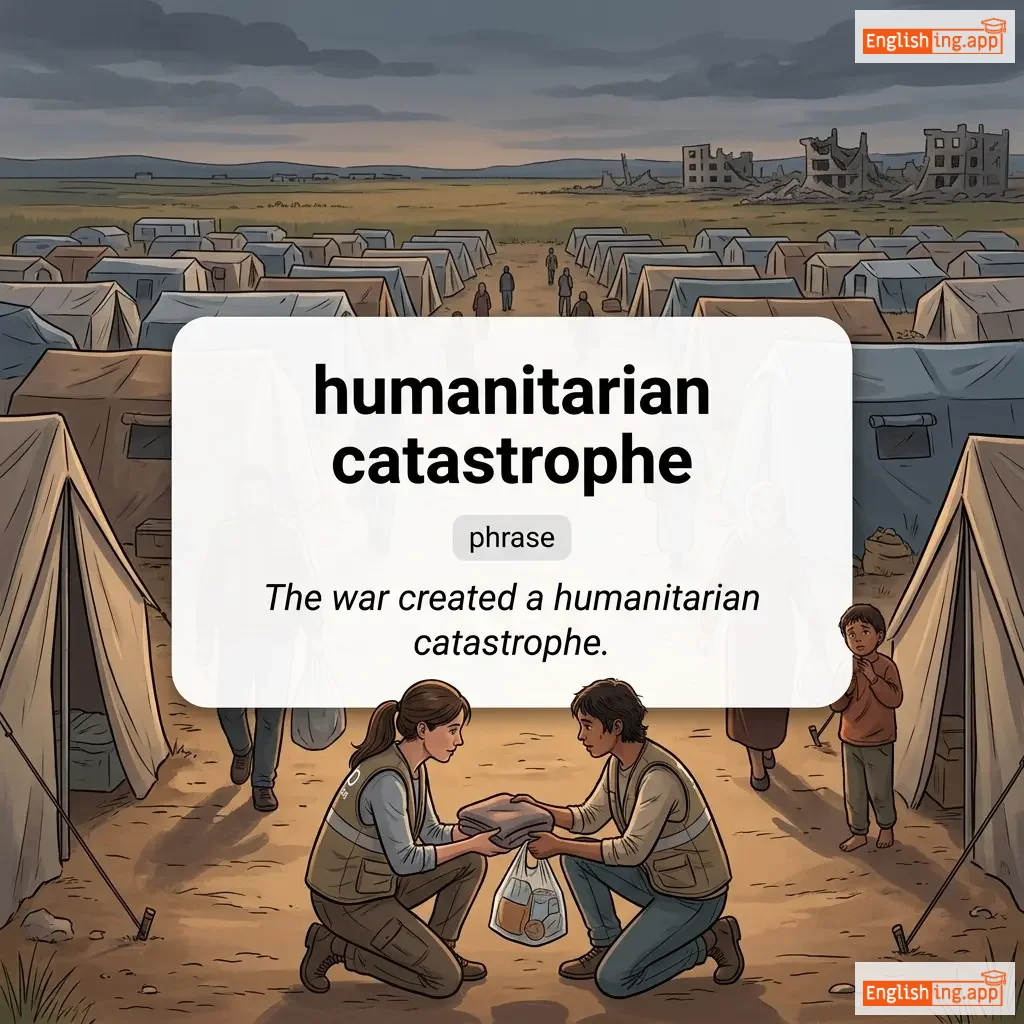
humanitarian catastrophe definition card — visual illustration of the meaning
phrase
ˌhjuː.məˈnɪt.ər.i.kəˈtæs.trə.fi
catastrophe humanitaire (catastrophe humanitaire)

A widespread disaster affecting human life, health, and well-being on a large scale.

"The war created a humanitarian catastrophe."

"La guerre a créé une catastrophe humanitaire." (La guerre a créé une catastrophe humanitaire.)
noun
/hjuːˈmænɪti/
humanité (humanité)

the quality of being human; kindness or compassion towards others; all human beings collectively

"Kindness is one of the greatest expressions of humanity."

"La bonté est l'une des plus grandes expressions de l'humanité." (La bonté est l'une des plus grandes expressions de l'humanité.)
verb
/ˈhjuːmənaɪz/
humaniser (humaniser)

To make something more humane, kind, or relatable.

"The teacher tried to humanize the lesson with personal stories."

"L'enseignant a essayé d'humaniser la leçon avec des histoires personnelles." (L'enseignant a essayé d'humaniser la leçon avec des histoires personnelles.)
adjective, verb
/ˈhʌmbəl/
humble (humble)

Having or showing a modest view of one's importance; to lower pride or status.

"Despite his success, he remained humble."

"Malgré son succès, il est resté humble." (Malgré son succès, il est resté humble.)
noun
/ˈhʌmbʌɡ/
foutaises, balivernes (foutaises, balivernes)

Deceptive or false talk or behavior; nonsense.

"He dismissed the idea as humbug."

"Il a rejeté l'idée comme des foutaises." (Il a rejeté l'idée comme des foutaises.)
adjective
/ˈhʌmdrʌm/
monotone (monotone)

Lacking excitement or variety; dull and monotonous.

"She grew tired of the humdrum routine of office life."

"Elle en avait marre de la routine monotone de la vie de bureau." (Elle en avait marre de la routine monotone de la vie de bureau.)
adjective
/ˈhjuː.mɪd/
humide (umid)

Having a high amount of water vapor in the air; damp or moist.

"The weather was hot and humid during the summer."

"Le temps était chaud et humide pendant l'été." (Le temps était chaud et humide pendant l'été.)
noun
/ˌhjuː.mɪ.fɪˈkeɪ.ʃən/
humification (humification)

The process of organic matter decomposition to form humus in soil.

"Humification enhances soil structure and fertility."

"L'humification améliore la structure et la fertilité du sol." (L'humification ameliorer la structure et la fertilité du sol.)
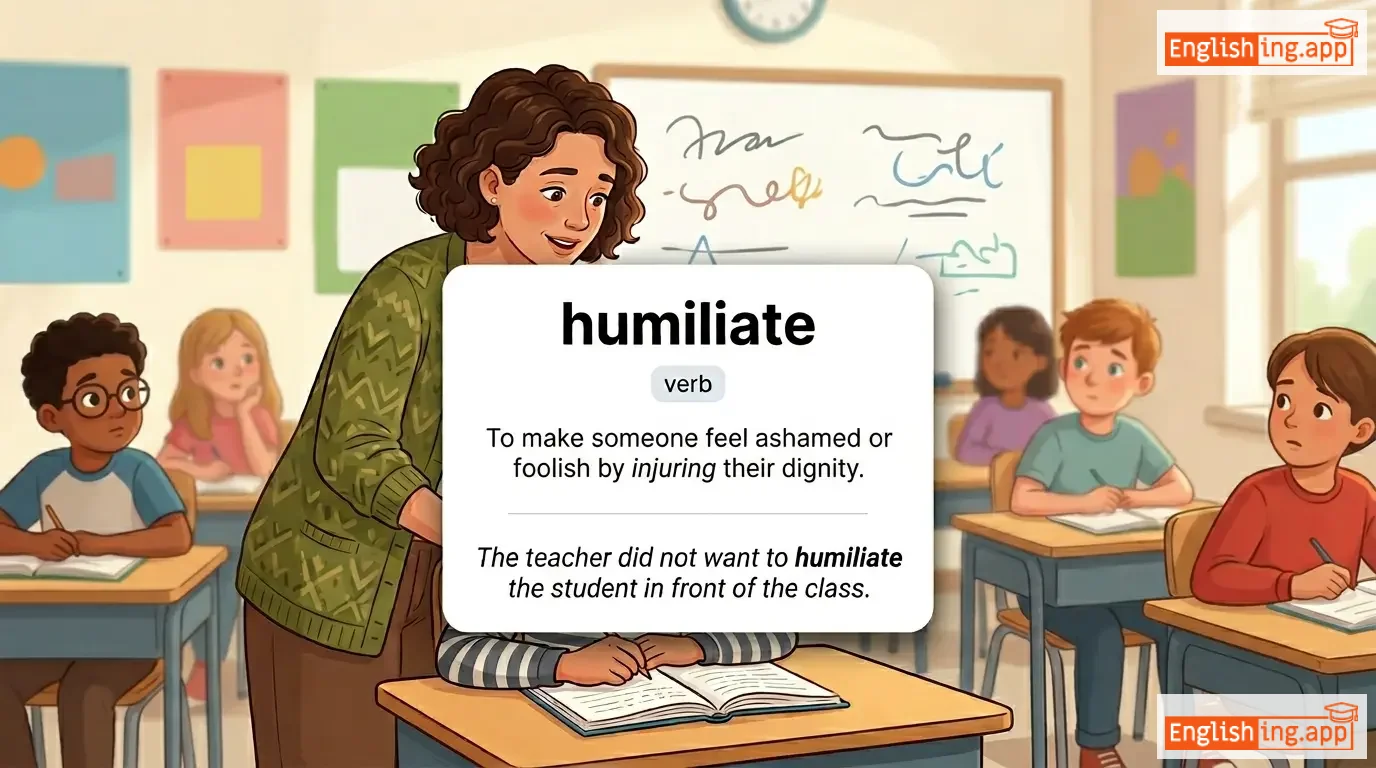
humiliate definition card — visual illustration of the meaning
verb
/hjuːˈmɪl.i.eɪt/
humilier (humilier)

To make someone feel ashamed or foolish by injuring their dignity.

"The teacher did not want to humiliate the student in front of the class."

"Le professeur ne voulait pas humilier l'étudiant devant la classe." (Le professeur ne voulait pas humilier l'étudiant devant la classe.)
noun
/hjuːˈmɪl.ɪ.ti/
humilité (humilite)

The quality of having a modest or low view of one's importance.

"She accepted the award with grace and humility."

"Elle a accepté le prix avec grâce et humilité." (Elle a accepté le prix avec grâce et humilité.)
noun
/ˈhʌm.ək/
butte (butte)

A small hill, mound, or ridge of earth or ice.

"The hikers rested on a grassy hummock by the river."

"Les randonneurs se sont reposés sur une butte herbeuse près de la rivière." (Les randonneurs se sont reposés sur une butte herbeuse près de la rivière.)
noun
/ˈhjuː.mər/
humour (hyoomor)

The quality of being amusing or entertaining.

"His sense of humor always lightens the mood."

"Son sens de l'humour allège toujours l'atmosphère." (Son sens de lhumour allege toujours latmosphere)
adjective
/ˈhjuː.mər.əs/
drôle; amusant; qui provoque des rires; (drole; amusant; ki provoke de rires;)

funny; amusing; causing laughter;

"His humorous stories always make everyone laugh."

"Ses histoires drôles font toujours rire tout le monde." (Ses histoires drôles font toujours rire tout le monde.)