Vocabulaires

Découvrez, apprenez et maîtrisez le vocabulaire anglais

noun
/ˈhɪpnətɪzəm/
hypnotisme (hypnotisme)

The practice or act of inducing hypnosis.

"He studied hypnotism as part of his psychology degree."

"Il a étudié l'hypnotisme dans le cadre de son diplôme en psychologie." (Il a étudié l'hypnotisme dans le cadre de son diplôme en psychologie.)
verb
/ˈhɪpnətaɪz/
hypnotiser (hypnotiser)

to put someone into a state of hypnosis; to influence someone's mind deeply

"The magician tried to hypnotize the audience."

"Le magicien a essayé d'hypnotiser le public." (Le magicien a essayé d'hypnotiser le public.)
noun
/ˌhaɪpəˈkɒndrɪæk/
hypocondriaque (hypocondriaque)

a person who is excessively worried about having a serious illness

"She is a hypochondriac who visits the doctor every week."

"Elle est une hypocondriaque qui consulte le médecin chaque semaine." (Elle est une hypocondriaque qui consulte le médecin chaque semaine.)
noun
/hɪˈpɒkrəsi/
hypocrisie (hypocrisie)

the practice of claiming to have moral standards or beliefs but behaving in a way that contradicts them

"His speech against corruption was full of hypocrisy."

"Son discours contre la corruption était plein d'hypocrisie." (Son discours contre la corruption etait plein d'hypocrisie.)
noun
/ˈhɪpəkrɪt/
hypocrite (hypocrite)

a person who pretends to have moral standards or beliefs but acts against them

"People called him a hypocrite for lying about his actions."

"Les gens l'ont traité d'hypocrite pour avoir menti sur ses actions." (Les gens l'ont traité d'hypocrite pour avoir menti sur ses actions.)
adjective
/ˌhɪpəˈkrɪtɪkəl/
hypocrite (hypocrite)

behaving in a way that suggests you have higher standards than you actually do

"It was hypocritical of him to complain about dishonesty."

"C'était hypocrite de sa part de se plaindre de la malhonnêteté." (C'etait hypocrite de sa part de se plaire de la malhonnetete.)
adjective
/ˌhaɪpəˈdɜːrmɪk/
hypodermique (haipodermik)

relating to the region immediately beneath the skin; also refers to a type of needle or syringe used to inject drugs beneath the skin.

"The doctor used a hypodermic needle to administer the vaccine."

"Le médecin a utilisé une aiguille hypodermique pour administrer le vaccin." (Le medecin a utilise une aiguille hypodermique pour administrer le vaccin.)
noun
/haɪˈpɒtənjuːs/
hypoténuse (hypotenuse)

the longest side of a right-angled triangle, opposite the right angle.

"In a right triangle, the hypotenuse is always longer than the other two sides."

"Dans un triangle rectangle, l'hypoténuse est toujours plus longue que les deux autres côtés." (Dans un triangle rectangle, l'hypotenuse est toujours plus longue que les deux autres cotes.)
verb
/haɪˈpɒθɪkeɪt/
hypothéquer (hypotheker)

to pledge something, such as property, as security for a debt without giving up possession of it.

"The company hypothecated its assets to secure the loan."

"L'entreprise a hypothéqué ses actifs pour sécuriser le prêt." (L'entreprise a hypotheque ses actifs pour securiser le pret.)
noun
/haɪˈpɒθəsɪs/
hypothèse (hypothese)

a proposed explanation made on the basis of limited evidence as a starting point for further investigation.

"The scientist tested her hypothesis through multiple experiments."

"La scientifique a testé son hypothèse au moyen de plusieurs expériences." (La scientifique a teste son hypothese au moyen de plusieurs experiences.)
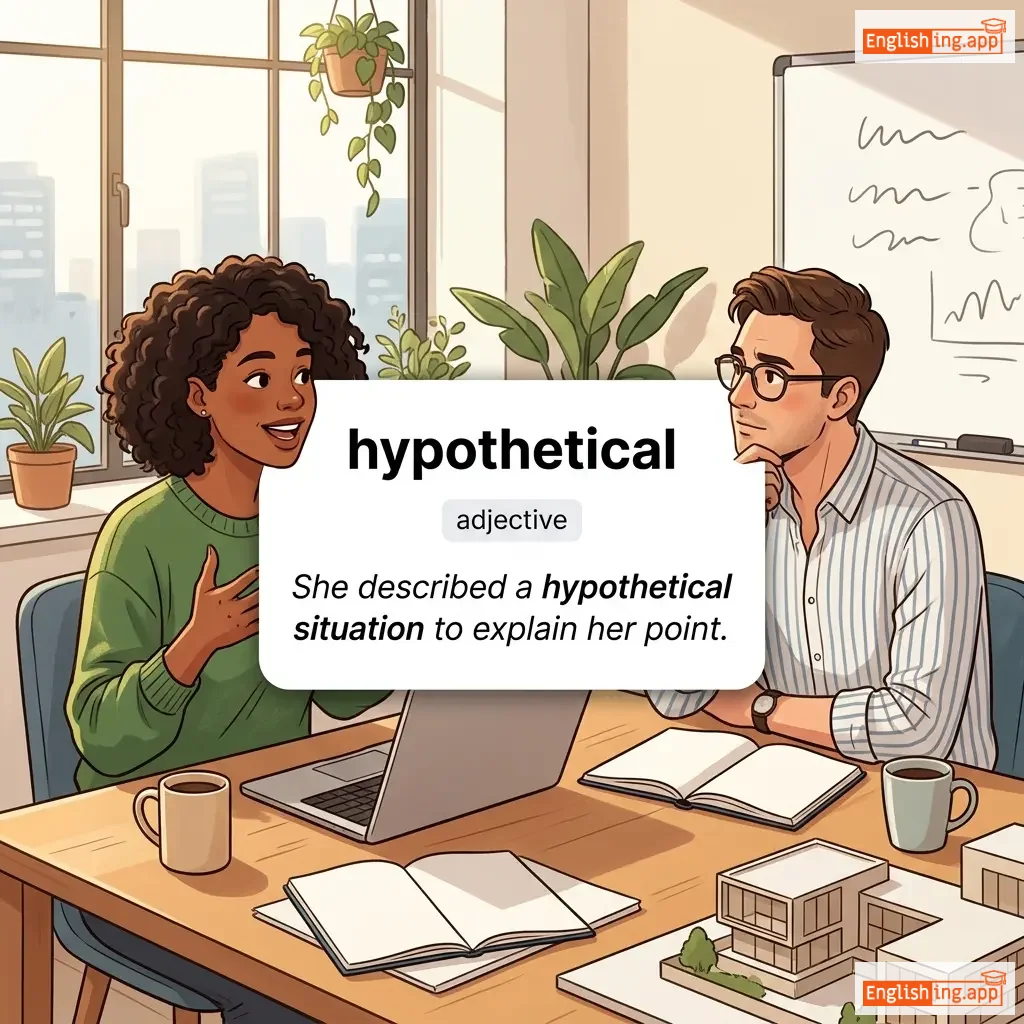
hypothetical definition card — visual illustration of the meaning
adjective
/ˌhaɪpəˈθetɪkl/
hypothétique (hypothetique)

based on or serving as a hypothesis; imagined or supposed for the sake of discussion.

"She described a hypothetical situation to explain her point."

"Elle a décrit une situation hypothétique pour expliquer son point de vue." (Elle a decrit une situation hypothétique pour expliquer son point de vue.)
noun
/hɪˈstɪəriə/
hystérie (hysterie)

An uncontrollable outburst of emotion or fear, often characterized by irrational behavior.

"The crowd was in a state of hysteria during the concert."

"La foule était dans un état d'hystérie pendant le concert." (La foule etait dans un etat d'hysterie pendant le concert.)
adjective
/hɪˈstɛrɪkəl/
hilarant ou émotionnellement incontrôlable (hilarant ou émotionnellement incontrôlable)

Extremely funny or uncontrollably emotional.

"The comedian's jokes were absolutely hysterical."

"Les blagues du comédien étaient absolument hilarantes." (Les blagues du comédien étaient absolument hilarantes.)