Vocabulaires

Découvrez, apprenez et maîtrisez le vocabulaire anglais

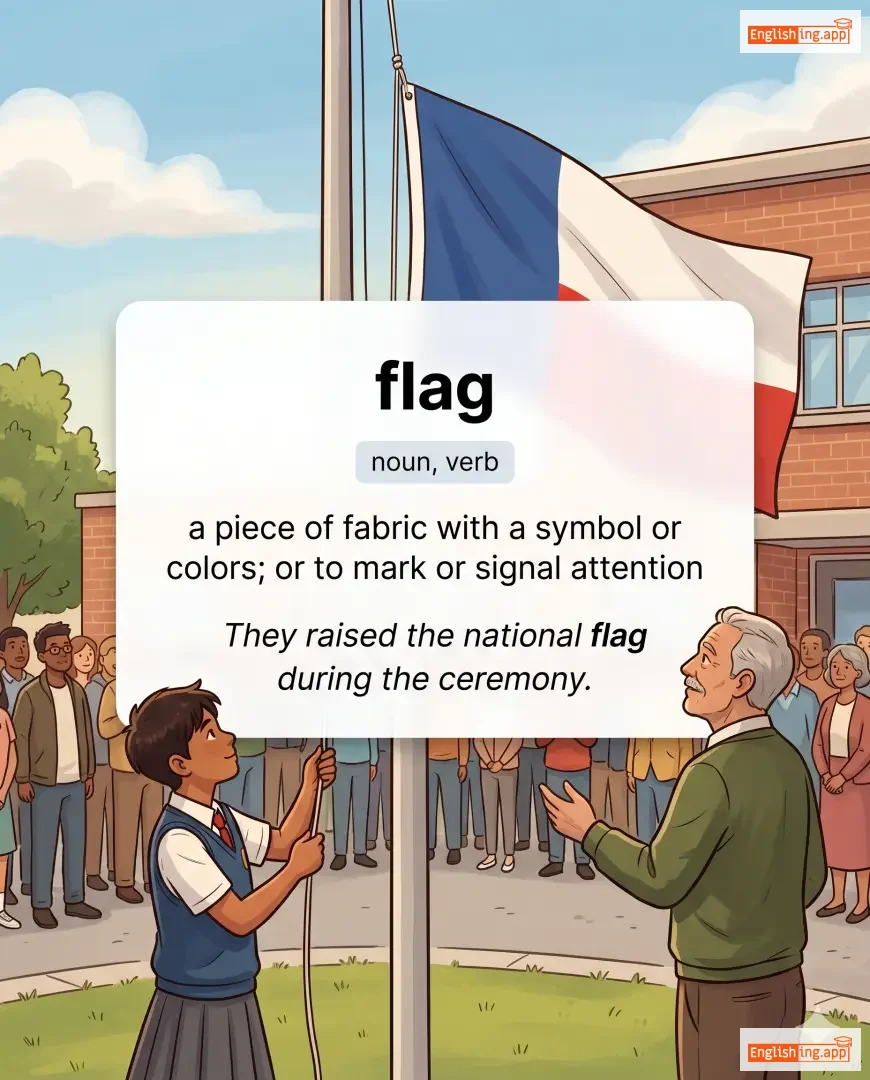
flag definition card — visual illustration of the meaning
noun, verb
/flæɡ/
drapeau, étendard; ou un signe d'avertissement (drapeau, étendard; ou un signe d'avertissement)

a piece of fabric with a symbol or colors; or to mark or signal attention

"They raised the national flag during the ceremony."

"Ils ont levé le drapeau national pendant la cérémonie." (Ils ont levé le drapeau national pendant la cérémonie.)
noun
/ˈflæɡ ˌɒfɪsər/
officier de pavillon (officier de pavillon)

a senior naval officer entitled to fly a flag to mark the command

"The flag-officer reviewed the fleet before the ceremony."

"L'officier de pavillon a examiné la flotte avant la cérémonie." (L'officier de pavillon a examiné la flotte avant la cérémonie.)
verb
/ˈflædʒəˌleɪt/
flageller ou se fouetter comme une forme de punition ou d'autodiscipline (flageller ou se fouetter comme une forme de punition ou d'autodiscipline)

to whip or flog someone, either literally or as a form of punishment or self-discipline

"In history, some monks would flagellate themselves as penance."

"Dans l'histoire, certains moines se flagellaient comme pénitence." (Dans l'histoire, certains moines se flagellaient comme pénitence.)
adjective
/ˈflæɡɪŋ/
faiblir, se fatiguer ou perdre de l'enthousiasme (faiblir, se fatiguer ou perdre de l'enthousiasme)

becoming tired, weaker, or less enthusiastic

"After hours of work, his energy was flagging."

"Après des heures de travail, son énergie était en baisse." (Apres des heures de travail, son energie etait en baisse.)
adjective
/ˈfleɪɡrənt/
flagrant et clairement erroné (flagrant et clairement erroné)

shockingly noticeable or evident; glaringly wrong

"It was a flagrant violation of the rules."

"C'était une violation évidente des règles." (C'était une violation évidente des règles.)
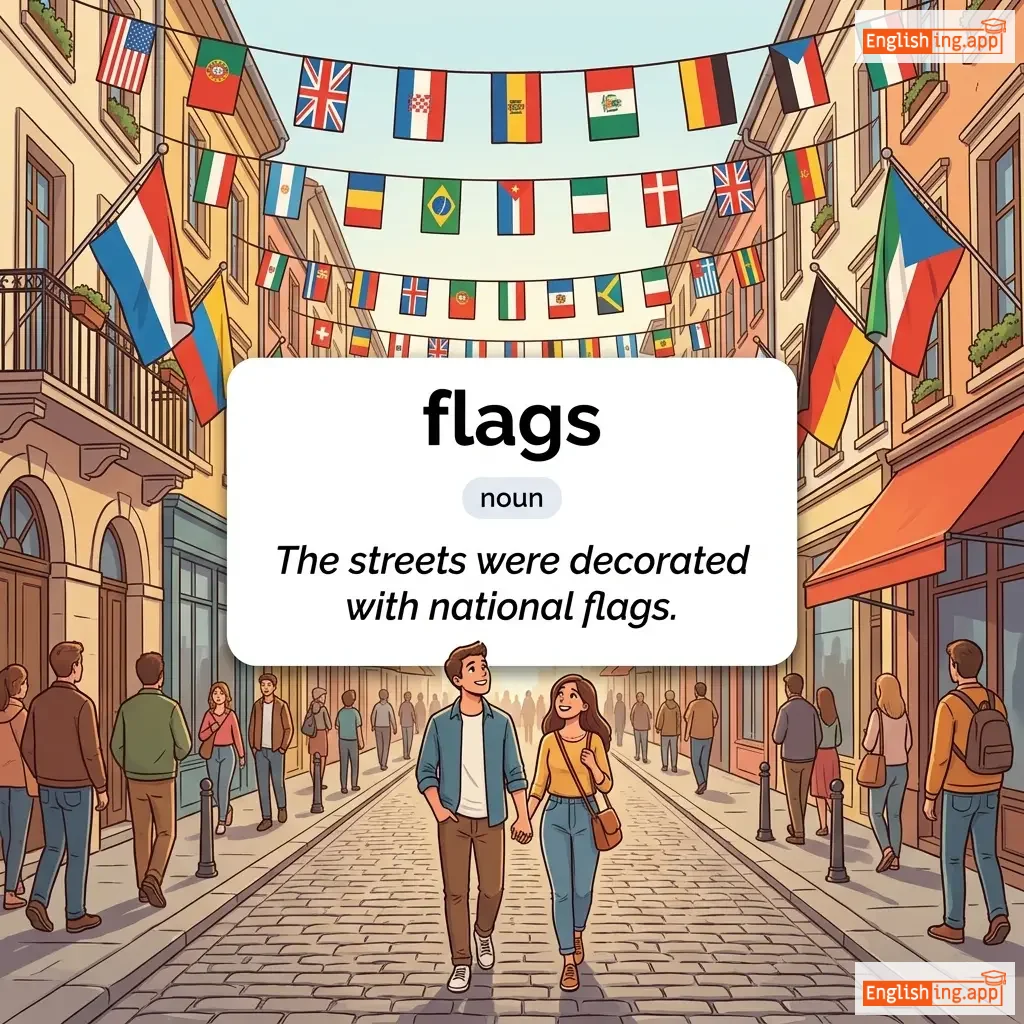
flags definition card — visual illustration of the meaning
noun
flæɡz
drapeau (drapeau)

A piece of cloth or similar material, typically oblong or square, attachable by one edge to a pole or rope.

"The streets were decorated with national flags."

"Les rues étaient décorées de drapeaux nationaux." (Les rues étaient décorées de drapeaux nationaux.)
verb
/fleɪl/
agiter ou balancer quelque chose sauvagement; se débattre (agiter ou balancer quelque chose sauvagement; se débattre)

to wave or swing something about wildly; to thrash about

"He flailed his arms to keep afloat in the water."

"Il agitait ses bras pour rester à flot dans l'eau." (Il agitait ses bras pour rester à flot dans l'eau.)
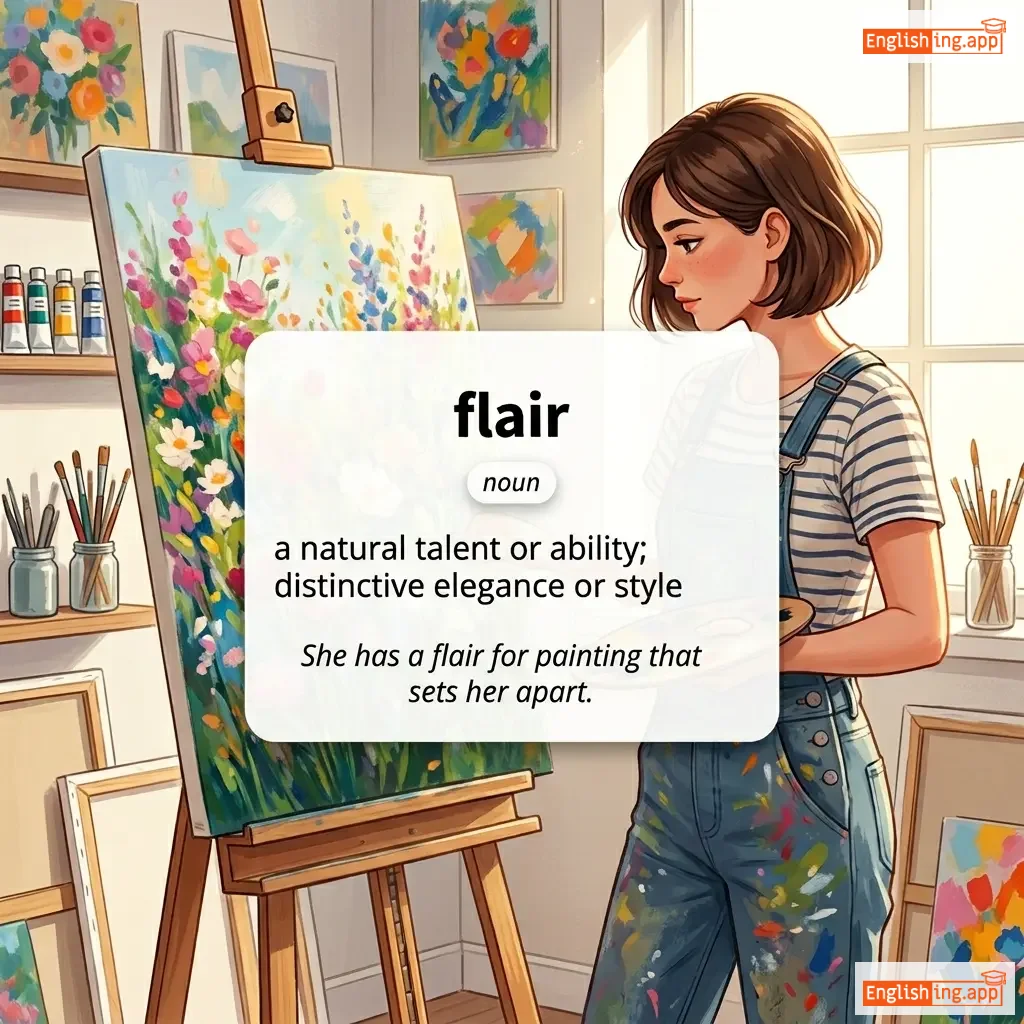
flair definition card — visual illustration of the meaning
noun
/flɛr/
un talent naturel ou une capacité; élégance ou style distinctif (un talent naturel ou une capacite; elegance ou style distinctif)

a natural talent or ability; distinctive elegance or style

"She has a flair for painting that sets her apart."

"Elle a un flair pour la peinture qui la distingue." (Elle a un flair pour la peinture qui la distingue.)
adjective
/flæmˈbɔɪənt/
flamboyant, coloré ou confiant (flamboyant, colore ou confiant)

showy, strikingly bold or colorful; confident and lively

"His flamboyant style drew everyone's attention at the party."

"Son style flamboyant a attiré l'attention de tout le monde à la fête." (Son style flamboyant a attire l'attention de tout le monde a la fete.)
noun
/fleɪm/
flamme (flamme)

A hot glowing body of ignited gas that is generated by something on fire.

"The flame from the candle lit up the dark room."

"La flamme de la bougie éclairait la pièce sombre." (La flamme de la bougie éclairait la pièce sombre.)
noun
/ˈflæn.əl/
flanelle (flanelle)

a soft woven fabric, typically made of wool or cotton and slightly milled and raised

"He wore a warm flannel shirt in winter."

"Il portait une chemise en flanelle chaude en hiver." (Il portait une chemise en flanelle chaude en hiver.)
verb
/flæʃ/
éclairer (éclairer)

to shine or appear suddenly and brightly for a short time

"Lightning flashed across the night sky."

"Un éclair a traversé le ciel nocturne." (Un éclair a traversé le ciel nocturne.)
flashcards definition card — visual illustration of the meaning
noun
ˈflæʃkɑːrdz
cartes mémoire (cartes memoire)

Cards containing small amounts of information, held up for students to see, as an aid to learning.

"Flashcards help in quick memorization."

"Les cartes mémoire aident à la mémorisation rapide." (Les cartes memoire aident a la memorisation rapide.)
adjective
/ˈflæʃi/
voyant, ostentatoire (voyant, ostentatoire)

ostentatious or showy in a way that attracts attention

"He drove a flashy sports car through the city streets."

"Il a conduit une voiture de sport voyante dans les rues de la ville." (Il a conduit une voiture de sport voyante dans les rues de la ville.)
adjective
/flæt/
plat (plat)

Smooth and level, without raised areas or curves.

"The road ahead was completely flat."

"La route devant était complètement plate." (La route devant était complètement plate.)
noun
/flæt fɪʃ/
poisson plat (pwason pla)

a type of fish with a flattened body that lives on the sea floor

"Flat fish like sole and flounder are excellent for grilling."

"Les poissons plats comme la sole et la limande sont excellents pour le grill." (le pwason pla kom la sol e la limand son ekselan pur le gril)
verb
/ˈflætər/
faire des compliments excessifs ou insincères pour obtenir des faveurs (faire des compliments excessifs ou insincères pour obtenir des faveurs)

to praise excessively or insincerely to gain favor

"He tried to flatter his boss to get a promotion."

"Il a essayé de flatter son patron pour obtenir une promotion." (Il a essayé de flatter son patron pour obtenir une promotion.)
noun
/ˈflæt.ər.ər/
flatteur (flatteur)

a person who lavishes praise, often insincerely and in order to gain advantage

"The king was surrounded by flatterers who only told him what he wanted to hear."

"Le roi était entouré de flatteurs qui lui disaient seulement ce qu'il voulait entendre." (Le roi était entouré de flatteurs qui lui disaient seulement ce qu'il voulait entendre.)
noun
/ˈflæt.ər.i/
flatterie (flatterie)

excessive and insincere praise, given especially to further one's own interests

"His constant flattery made everyone suspicious of his true motives."

"Sa flatterie constante a poussé tout le monde à douter de ses véritables intentions." (Sa flatterie constante a poussé tout le monde à douter de ses véritables intentions.)
noun
/ˈflætʃələns/
accumulation de gaz dans le système digestif (accumulation de gaz dans le systeme digestif)

the accumulation of gas in the digestive system; excessive gas in the stomach or intestines

"Eating beans can sometimes cause flatulence."

"Manger des haricots peut parfois provoquer des flatulences." (Manger des haricots peut parfois provoquer des flatulences.)
verb
/flɔːnt/
fanfaronner (fanfaronner)

to show off something proudly, often to attract attention

"She likes to flaunt her new jewelry at parties."

"Elle aime fanfaronner ses nouveaux bijoux lors des soirées." (Elle aime fanfaronner ses nouveaux bijoux lors des soirées.)
noun
/ˈfleɪvər/
goût (gout)

The distinctive taste of a food or drink.

"This ice cream has a delicious mango flavor."

"Cette glace a un délicieux goût de mangue." (Cette glace a un délicieux goût de mangue.)
noun
/ˈfleɪ.vər/
saveur (saveur)

the distinctive taste of a food or drink; a particular quality or atmosphere

"The soup had a rich flavour of herbs and spices from the garden."

"La soupe avait une riche saveur d'herbes et d'épices du jardin." (La soupe avait une riche saveur d'herbes et d'épices du jardin.)
noun
/flɔː/
défaut (defaut)

a defect or imperfection in something

"The diamond had a small flaw that was barely visible."

"Le diamant avait un petit défaut à peine visible." (Le diamant avait un petit defaut a peine visible.)
adjective
/flɔːd/
défectueux (defectueux)

having a mistake or fault that reduces its value or quality

"The flawed design of the car led to a recall."

"Le design défectueux de la voiture a conduit à un rappel." (Le design defectueux de la voiture a conduit a un rappel.)
adjective
/ˈflɔː.ləs/
parfait; sans défauts (flawless)

perfect; without any defects or faults; immaculate

"Her flawless performance earned her a standing ovation."

"Sa prestation parfaite lui a valu une ovation debout." (Sa prestation parfaite lui a valu une ovation debout.)
noun
/flæks/
lin (lin)

a plant whose fibers are used to make linen and whose seeds are edible

"Flax is often used in making linen fabrics."

"Le lin est souvent utilisé pour fabriquer des tissus en lin." (Le lin est souvent utilisé pour fabriquer des tissus en lin.)
verb
/fleɪ/
enlever la peau/criticiser sévèrement (enlever la peau/criticiser sévèrement)

to strip off the skin of something or criticize severely

"The chef flayed the fish before cooking it."

"Le chef a enlevé la peau du poisson avant de le cuisiner." (Le chef a enlevé la peau du poisson avant de le cuisiner.)
noun
/flɛk/
tache petite (tache petite)

a small spot or mark, often of a different color

"There was a fleck of paint on the floor."

"Il y avait une tache de peinture sur le sol." (Il y avait une tache de peinture sur le sol.)
noun
/ˈflɛkʃən/
flexion (flexion)

The act of bending or the state of being bent, especially of a limb or joint.

"The doctor tested the patient's knee flection during the examination."

"Le médecin a testé la flexion du genou du patient lors de l'examen." (Le médecin a testé la flexion du genou du patient lors de l'examen.)
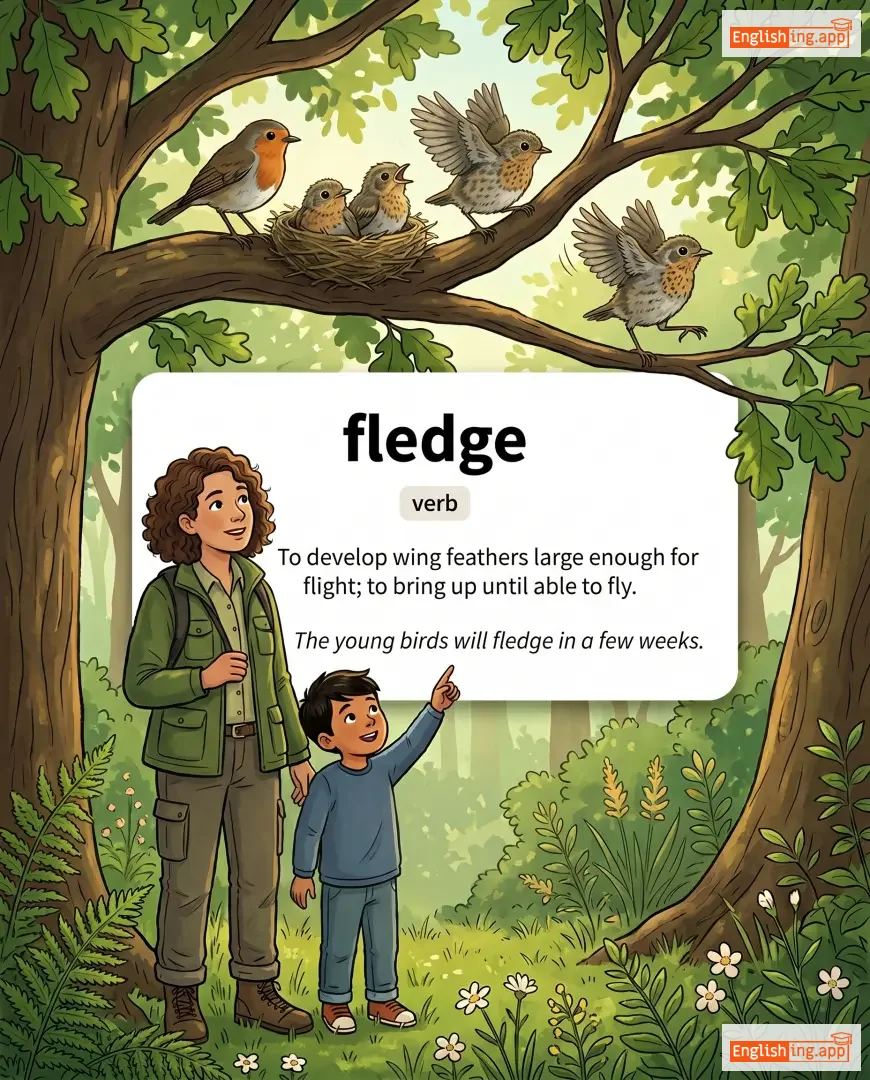
fledge definition card — visual illustration of the meaning
verb
/flɛdʒ/
prêter (preyter)

To develop wing feathers large enough for flight; to bring up until able to fly.

"The young birds will fledge in a few weeks."

"Les jeunes oiseaux vont se préparer à voler dans quelques semaines." (Les jeunes oiseaux vont se préparer à voler dans quelques semaines.)
noun
/ˈflɛdʒlɪŋ/
oiseau débutant (oiseau debutant)

A young bird that has just developed its feathers and is learning to fly; a beginner.

"The fledgeling was trying hard to take its first flight."

"L'oiseau débutant essayait de prendre son premier envol." (L'oiseau debutant essayait de prendre son premier envol.)
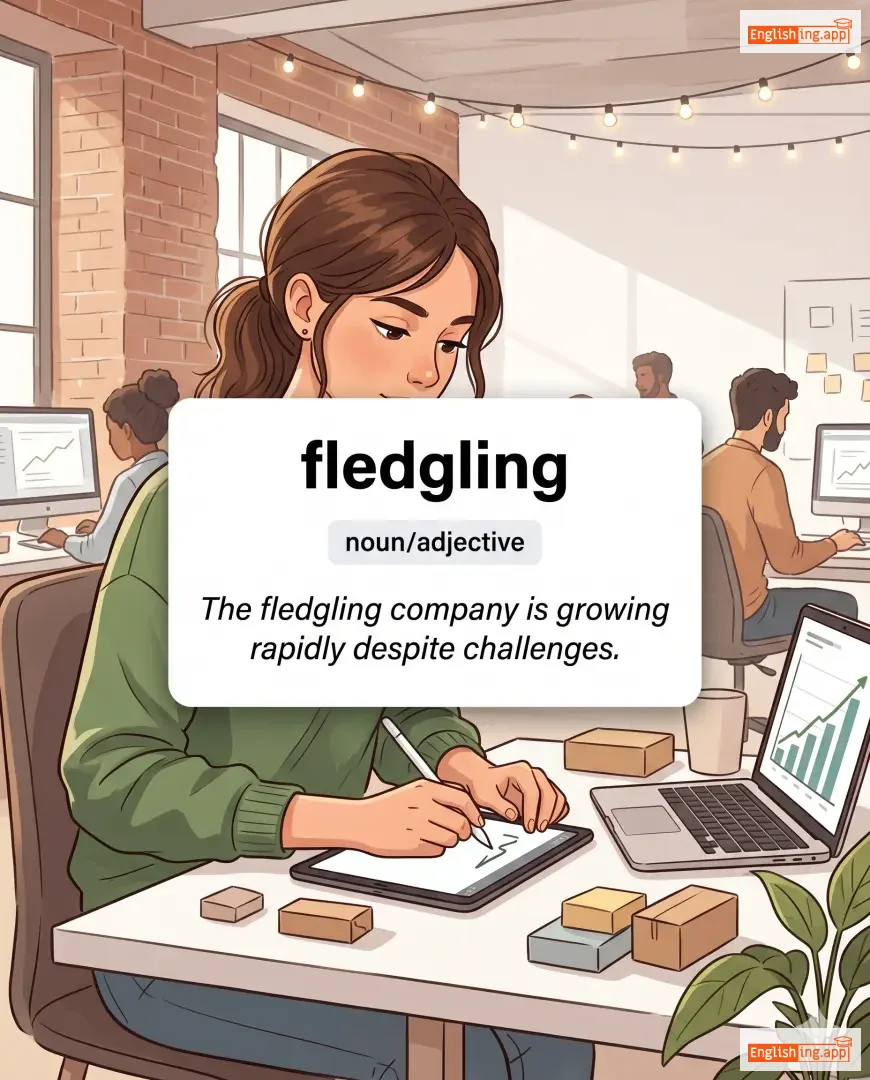
fledgling definition card — visual illustration of the meaning
noun/adjective
/ˈflɛdʒlɪŋ/
nouveau venu (nouveau venu)

A young bird just learning to fly; also used for a person or organization that is inexperienced or new.

"The fledgling company is growing rapidly despite challenges."

"L'entreprise naissante se développe rapidement malgré les défis." (L'entreprise naissante se developpe rapidement malgre les defis.)
🏃‍♂️

flee (flee)

verb
/fliː/
fuir (fuir)

To run away from danger or a threatening situation.

"The villagers had to flee during the flood."

"Les villageois ont dû fuir pendant l'inondation." (Les villageois ont dû fuir pendant l'inondation.)
noun/verb
/fliːs/
la laine de mouton (la laine de mouton)

The woolly covering of a sheep; as a verb, to swindle or cheat someone.

"The farmer sheared the sheep’s fleece carefully."

"Le fermier a soigneusement tondu la laine de la brebis." (Le fermier a soigneusement tondu la laine de la brebis.)
noun
/fliːt/
flotte (flotte)

a group of ships, vehicles, or aircraft operating together under one command

"The navy deployed its entire fleet for the exercise."

"La marine a déployé toute sa flotte pour l'exercice." (La marine a deploye toute sa flotte pour l'exercice.)
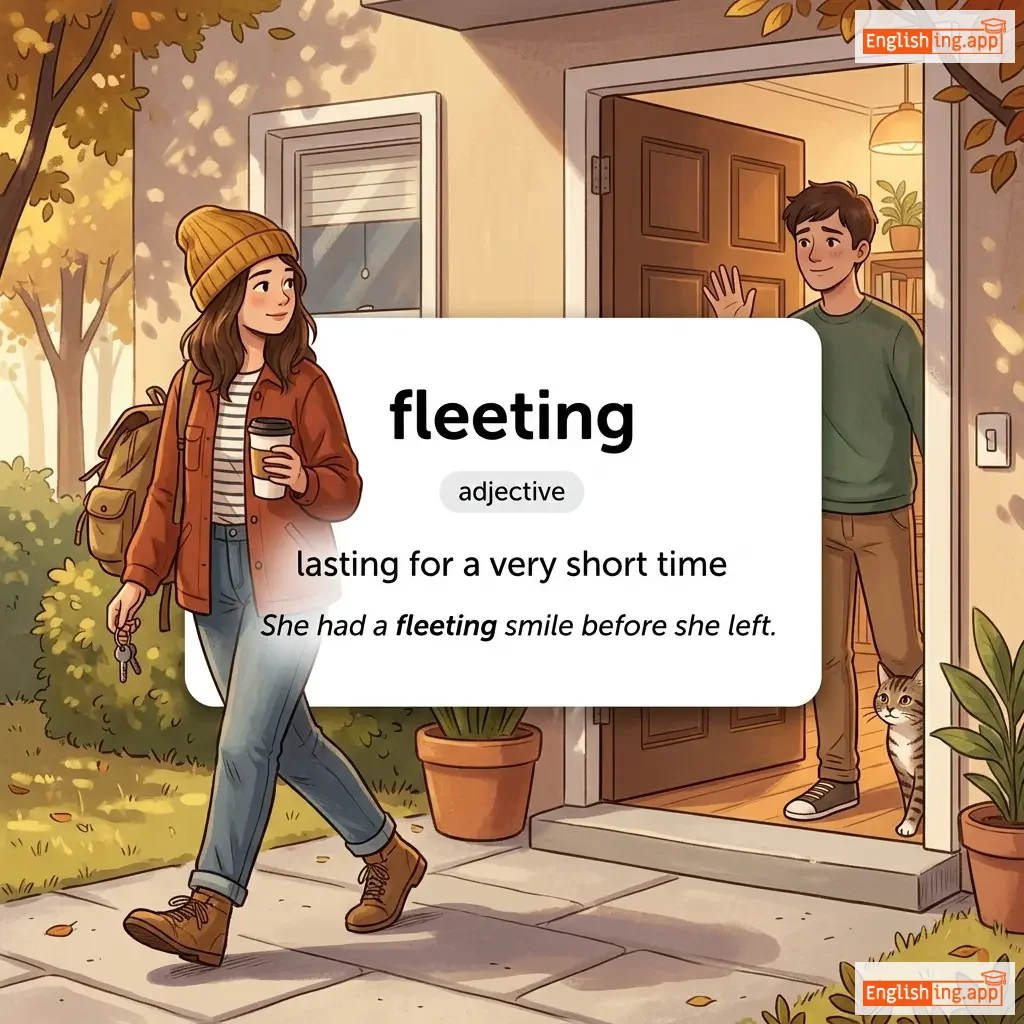
fleeting definition card — visual illustration of the meaning
adjective
/ˈfliː.tɪŋ/
éphémère (ephemere)

lasting for a very short time

"She had a fleeting smile before she left."

"Elle avait un sourire éphémère avant de partir." (Elle avait un sourire ephemere avant de partir.)
noun
/flɛʃ/
chair (chair)

the soft substance consisting of muscle and fat that is found between the skin and bones of animals or humans

"The wound cut deep into the flesh of his arm."

"La blessure a coupé profondément dans la chair de son bras." (La blessure a coupe profondement dans la chair de son bras.)
flexibility definition card — visual illustration of the meaning
noun
/ˌflɛksəˈbɪləti/
flexibilité (flexibilité)

the ability to bend easily without breaking or to adapt to new situations

"Flexibility is essential for success in a changing work environment."

"La flexibilité est essentielle pour réussir dans un environnement de travail changeant." (La flexibilité est essentielle pour réussir dans un environnement de travail changeant.)
adjective
/ˈfleks.ə.bəl/
flexible (flexible)

able to bend easily without breaking; adaptable to change

"Yoga helps to make the body more flexible."

"Le yoga aide à rendre le corps plus flexible." (Le yoga aide à rendre le corps plus flexible.)
verb
/flɪk/
donner un coup rapide (donner un coup rapide)

to move or cause to move with a sudden quick motion

"He flicked the switch to turn on the light."

"Il a flické l'interrupteur pour allumer la lumière." (Il a flické l'interrupteur pour allumer la lumière.)
verb
/ˈflɪk.ər/
clignoter (clignoter)

to shine unsteadily or waver between light and dark

"The candle flickered in the wind."

"La bougie clignotait dans le vent." (La bougie clignotait dans le vent.)
noun
/flaɪt/
vol / vol (vol / vol)

the act of flying, typically through the air; or a scheduled trip by an aircraft

"Our flight to London was delayed due to bad weather."

"Notre vol pour Londres a été retardé en raison du mauvais temps." (Notre vol pour Londres a été retardé en raison du mauvais temps.)
adjective
/ˈflaɪti/
instable (instable)

unstable, impulsive, or easily distracted; lacking seriousness or stability

"She’s too flighty to stick with one job for long."

"Elle est trop instable pour rester dans un seul travail pendant longtemps." (Elle est trop instable pour rester dans un seul travail pendant longtemps.)
adjective
/ˈflɪmzi/
fragile (frajeel)

weak, fragile, or lacking in strength; not convincing

"The chair was too flimsy to support his weight."

"La chaise était trop fragile pour supporter son poids." (La chaise etait trop frajeel pour supporter son poids.)
verb
/flɪntʃ/
reculer (reculer)

to suddenly move back or away due to fear or pain

"He didn’t flinch when the doctor gave him the injection."

"Il n'a pas bronché lorsque le docteur lui a donné l'injection." (Il n'a pas bronché lorsque le docteur lui a donné l'injection.)
verb
/flɪp/
retourner (retourner)

to turn over quickly or suddenly; to toss lightly

"She flipped the pancake in the pan."

"Elle a retourné le pancake dans la poêle." (Elle a retourne le pancake dans la poele.)
noun
/ˈflɪpənsi/
légèreté (legerete)

lack of seriousness; showing a disrespectful or trivial attitude

"His flippancy during the meeting offended his colleagues."

"Sa légèreté pendant la réunion a offensé ses collègues." (Sa legerete pendant la reunion a offense ses collegues.)
adjective
/ˈflɪpənt/
désinvolte (desinvolte)

not showing a serious or respectful attitude

"His flippant remarks annoyed the teacher."

"Ses remarques désinvoltes ont agacé le professeur." (Ses remarques desinvoltes ont agace le professeur.)
verb
/flɜːrt/
flirter (flirter)

to behave as if you are attracted to someone, but not in a serious way

"She often flirts with her colleagues at work."

"Elle flirte souvent avec ses collègues au travail." (Elle flirte souvent avec ses collègues au travail.)