Vocabulaires

Découvrez, apprenez et maîtrisez le vocabulaire anglais

verb
/ɪˈdʒɛkt/
expulser (expulser)

to force someone or something out, usually from a place or position

"The referee had to eject the player for unsportsmanlike behavior."

"L'arbitre a dû expulser le joueur pour un comportement antisportif." (L'arbitre a dû expulser le joueur pour un comportement antisportif.)
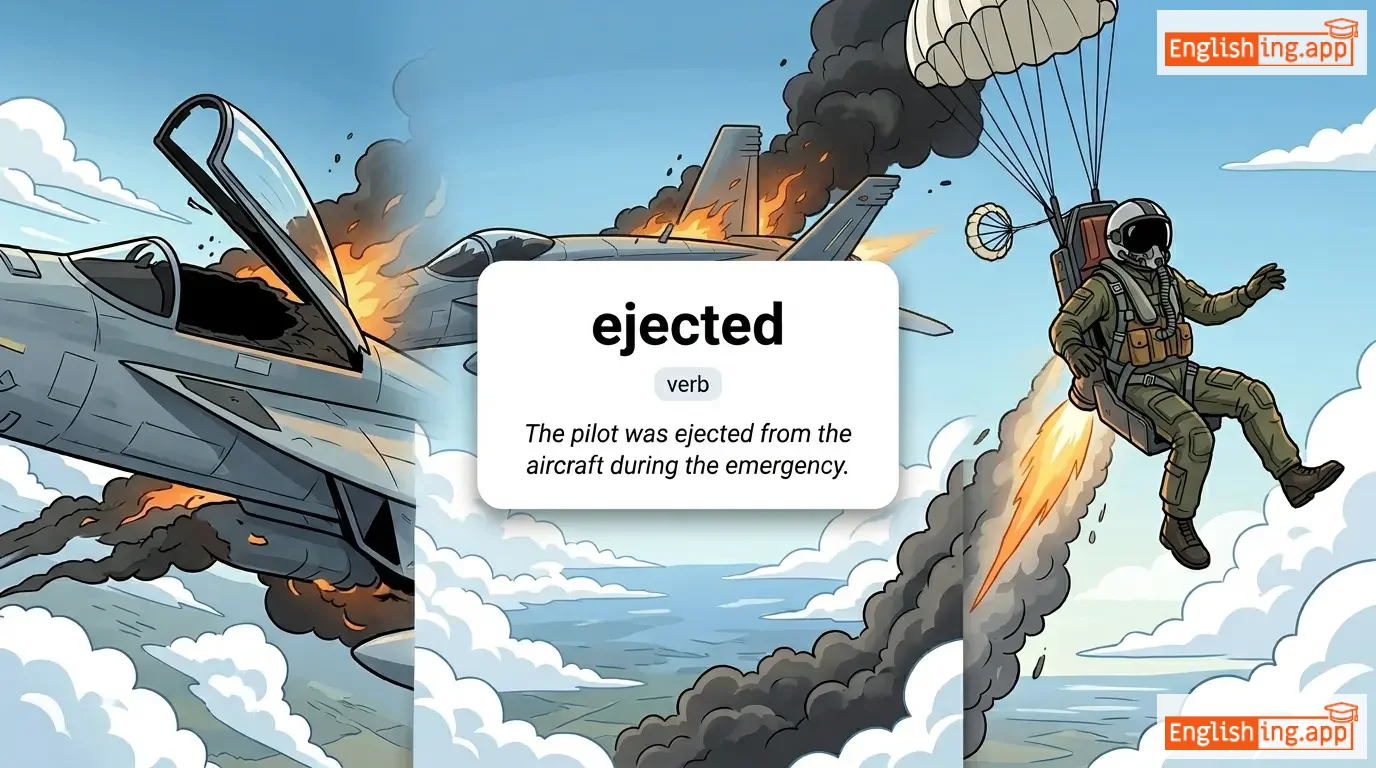
ejected definition card — visual illustration of the meaning
verb
/ɪˈdʒektɪd/
expulser (expulser)

to force someone or something to leave a place; to push or throw something out forcefully

"The pilot was ejected from the aircraft during the emergency."

"Le pilote a été éjecté de l'avion pendant l'urgence." (Le pilote a été éjecté de l'avion pendant l'urgence.)
verb
/iːk/
étirer (etirer)

to make a small amount of something last longer by using it sparingly

"The family tried to eke out their savings during the tough months."

"La famille a essayé de faire durer ses économies pendant les mois difficiles." (La famille a essayé de faire durer ses économies pendant les mois difficiles.)
verb, adjective
/ɪˈlæbəreɪt/ (verb), /ɪˈlæbərət/ (adjective)
élaborer / détaillé et compliqué dans la conception (élaborer / détaillé et compliqué dans la conception)

verb: to explain something in detail; adjective: detailed and complicated in design

"She asked him to elaborate on his proposal."

"Elle lui a demandé d'élaborer sur sa proposition." (Elle lui a demandé d'élaborer sur sa proposition.)
noun
/ɪˌlæbəˈreɪʃən/
élargissement / explication détaillée (élargissement / explication détaillée)

the process of adding more detail or expanding on something

"The teacher appreciated the student's elaboration of the topic."

"Le professeur a apprécié l'élaboration du sujet par l'étudiant." (Le professeur a apprécié l'élaboration du sujet par l'étudiant.)
verb
/ɪˈlæps/
s'écouler (se-koo-lay)

to pass or go by, usually referring to time

"Several hours elapsed before he finally returned home."

"Plusieurs heures se sont écoulées avant qu'il ne revienne finalement à la maison." (Plusieurs heures se sont écoulées avant qu'il ne revienne finalement à la maison.)
adjective
/ɪˈlæstɪk/
élastique (elastik)

Able to return to its original shape or size after being stretched or compressed.

"The waistband of the pants is made of elastic material."

"La ceinture du pantalon est faite de matériau élastique." (La ceinture du pantalon est faite de materiau elastique.)
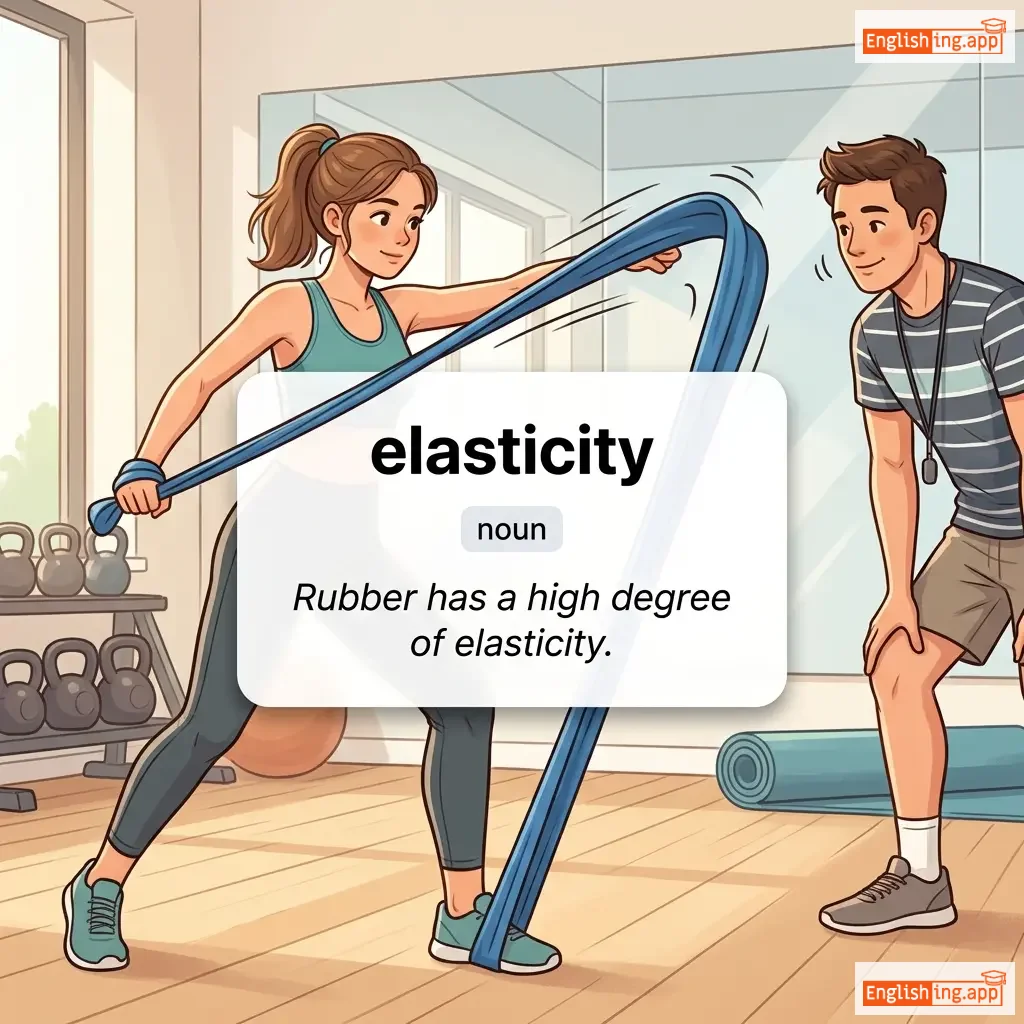
elasticity definition card — visual illustration of the meaning
noun
/ɪˌlæˈstɪsɪti/
élasticité (elasticite)

The ability of an object or material to resume its normal shape after being stretched or compressed.

"Rubber has a high degree of elasticity."

"Le caoutchouc possède une grande élasticité." (Le caoutchouc possede une grande elasticite.)
verb
/ɪˈleɪt/
rendre heureux (rendre heureux)

To make someone very happy or proud.

"The success of the project elated the whole team."

"Le succès du projet a ravi toute l'équipe." (Le succès du projet a ravi toute l'équipe.)
adjective
/ɪˈleɪtɪd/
extrêmement heureux (extremement heureux)

Extremely happy and excited.

"She was elated when she heard the good news."

"Elle était extrêmement heureuse lorsqu'elle a entendu la bonne nouvelle." (Elle était extrêmement heureuse lorsqu'elle a entendu la bonne nouvelle.)
noun
/ɪˈleɪʃən/
extase (extase)

A feeling of great happiness and excitement.

"His elation was evident after winning the championship."

"Son extase était évidente après avoir gagné le championnat." (Son extase était évidente après avoir gagné le championnat.)
noun/verb
/ˈɛl.boʊ/
coude (kud)

The joint connecting the forearm and the upper arm; as a verb, to push aside using the elbow.

"He accidentally hit the table with his elbow."

"Il a accidentellement frappé la table avec son coude." (Il a accidentellement frappé la table avec son kud.)
noun
/ˈɛldər/
aîné (aîne)

a person who is older or has higher rank; an older person in a family or community

"We should always respect our elders."

"Nous devons toujours respecter nos aînés." (Nous devons toujours respecter nos aînés.)
adjective
/ˈɛldərli/
âgé (age)

Being old or advanced in years.

"The elderly man walks slowly across the street."

"L'homme âgé marche lentement à travers la rue." (L'homme age marche lentement a travers la rue.)
verb
/ɪˈlɛkt/
élire (élire)

To choose someone for a position or office by voting.

"The citizens elected a new president."

"Les citoyens ont élu un nouveau président." (Les citoyens ont élu un nouveau président.)
noun
/ɪˈlɛkʃən/
élection (election)

The process of choosing someone for public office by voting.

"The election will be held next month."

"L'élection aura lieu le mois prochain." (L'election aura lieu le mois prochain.)
adjective
/ɪˈlɛktərəl/
électoral (electoral)

related to elections or voting

"The electoral process in the country has been reformed in recent years."

"Le processus électoral dans le pays a été réformé ces dernières années." (Le processus electoral dans le pays a ete reforme ces dernieres annees.)
adjective
/ɪˈlɛktrɪk/
électrique (electrique)

Relating to or operated by electricity.

"The room was lit by an electric lamp."

"La pièce était éclairée par une lampe électrique." (La piece etait eclairee par une lampe electrique.)
noun
/ɪˈlɛktrɪk drɪl/
perceuse électrique (perceuse electrique)

A power tool used for drilling holes in various materials

"He used an electric drill to make holes in the wall for hanging pictures."

"Il a utilisé une perceuse électrique pour faire des trous dans le mur pour accrocher des photos." (Il a utilise une perceuse electrique pour faire des trous dans le mur pour accrocher des photos.)
noun
/ɪˈlek.trɪk fæn/
ventilateur électrique (ventilateur electrique)

a device with rotating blades that creates airflow to cool or ventilate a room

"The electric fan keeps the room cool during hot summer days."

"Le ventilateur électrique garde la pièce fraîche pendant les chaudes journées d'été." (Le ventilateur electrique garde la piece fraiche pendant les chaudes journees d'ete.)
noun
/ɪˈlɛktrɪk ˈkɛtəl/
bouilloire électrique (bouilloire electrique)

An electrical appliance that heats water quickly using electricity

"The electric kettle automatically turns off when the water starts boiling."

"La bouilloire électrique s'éteint automatiquement lorsque l'eau commence à bouillir." (La bouilloire electrique s'eteint automatiquement lorsque l'eau commence a bouillir.)
adjective
/ɪˈlɛktrɪkəl/
électrique (electrique)

related to electricity or the use of electrical power

"The electrical system in the house needs repair."

"Le système électrique de la maison a besoin de réparations." (Le systeme electrique de la maison a besoin de reparations.)
noun
/ɪˌlɛkˈtrɪsɪti/
électricité (electricite)

A form of energy resulting from the existence of charged particles.

"The storm caused a power cut and we had no electricity."

"L'orage a provoqué une coupure de courant et nous n'avions pas d'électricité." (L'orage a provoque une coupure de courant et nous n'avions pas d'electricite.)
verb
/ɪˈlɛktrɪfaɪ/
électrifier; enthousiasmer (electrifier; enthousiasmer)

to charge with electricity; to excite or thrill intensely

"The speaker's speech electrified the audience."

"Le discours a enthousiasmé le public." (Le discours a enthousiasme le public)
noun
/ɪˌlɛkˈtrɑː.lə.sɪs/
électrolyse (electrolyse)

A chemical decomposition produced by passing an electric current through a liquid or solution.

"Electrolysis is used to separate hydrogen from water."

"L'électrolyse est utilisée pour séparer l'hydrogène de l'eau." (L'electrolyse est utilisee pour separer l'hydrogene de l'eau.)
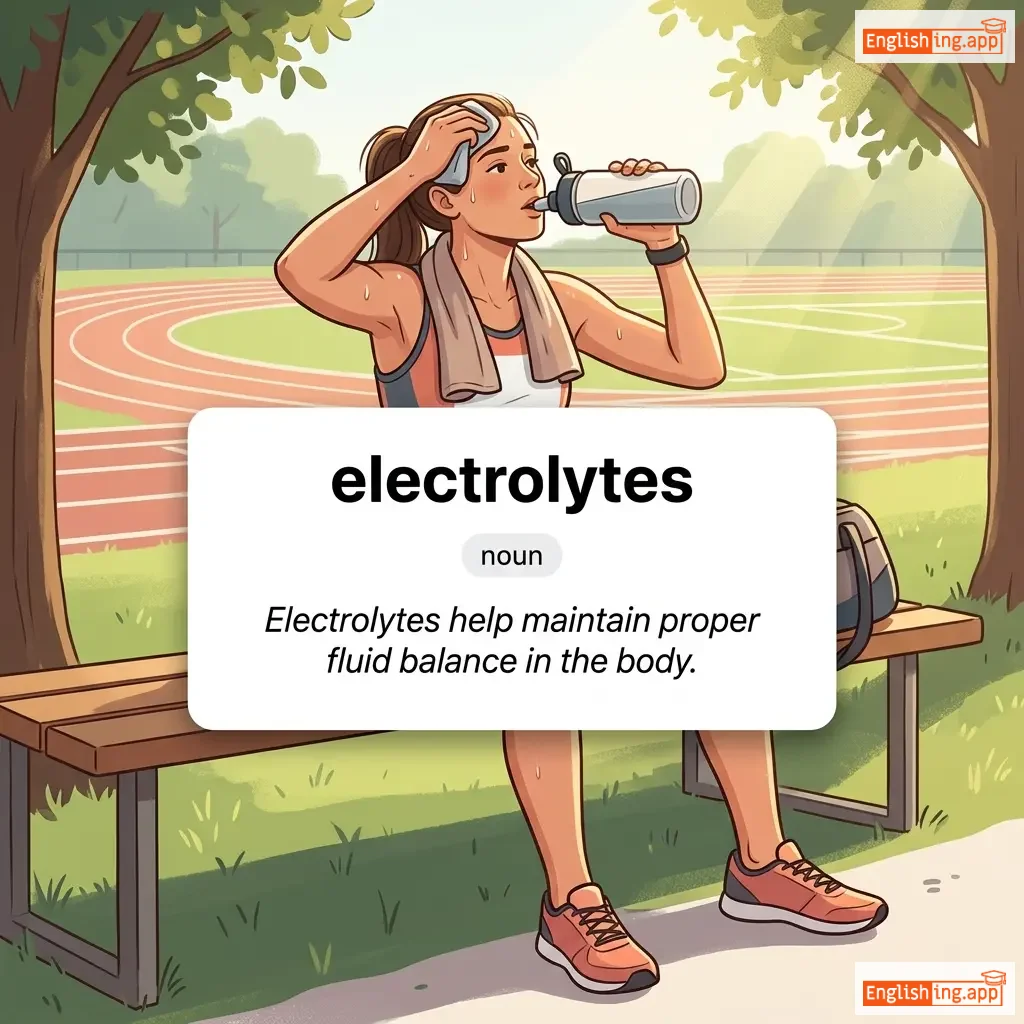
electrolytes definition card — visual illustration of the meaning
noun
/ɪˈlɛk.trəʊ.laɪts/
électrolytes (electrolytes)

Minerals in body fluids that carry an electric charge and are essential for many bodily functions.

"Electrolytes help maintain proper fluid balance in the body."

"Les électrolytes aident à maintenir l'équilibre des fluides dans le corps." (Les electrolytes aident a maintenir l'equilibre des fluides dans le corps.)
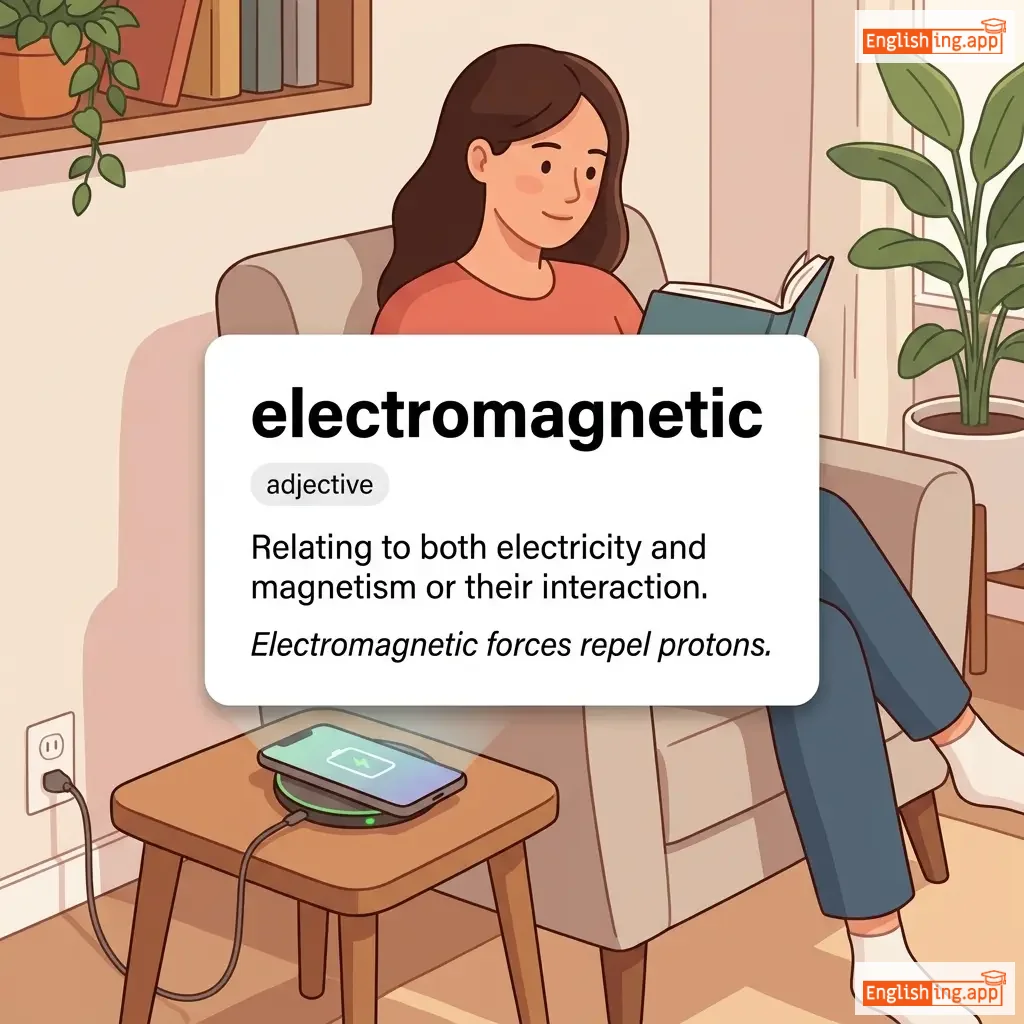
electromagnetic definition card — visual illustration of the meaning
adjective
ɪˌlektrəʊmæɡˈnetɪk
électromagnétique (electromagnetique)

Relating to both electricity and magnetism or their interaction.

"Electromagnetic forces repel protons."

"Les forces électromagnétiques repoussent les protons." (Les forces électromagnétiques repoussent les protons.)
adjective
/ɪˌlɛkˈtrɒnɪk/
électronique (electronique)

Operating with or produced by the use of electronic devices.

"She bought an electronic keyboard for her music lessons."

"Elle a acheté un clavier électronique pour ses cours de musique." (Elle a achete un clavier electronique pour ses cours de musique.)
noun
/ɪˌlɛkˈtrɒnɪks/
électronique (electronique)

the branch of physics and technology dealing with circuits and devices using transistors, microchips, and other components

"He studied electronics at university."

"Il a étudié l'électronique à l'université." (Il a etudié l'électronique à l'université.)
noun
/ɪˈlɛk.trə.taɪp/
électrotype (electrotype)

A duplicate printing plate made by electroplating a mold of the original.

"The printer used an electrotype to produce multiple copies of the page."

"L'imprimeur a utilisé un électrotype pour produire plusieurs copies de la page." (L'imprimeur a utilisé un électrotype pour produire plusieurs copies de la page.)
adjective
/ˌɛl.ɪˈmɑː.səˌnɛr.i/
charitable (charitable)

Relating to charity; dependent on or supported by charity.

"The hospital was founded as an eleemosynary institution."

"L'hôpital a été fondé en tant qu'institution charitable." (L'hôpital a été fondé en tant qu'institution charitable.)
adjective
/ˈɛlɪɡənt/
élégant et raffiné (elegant et raffine)

pleasingly graceful and stylish in appearance or manner

"She looked elegant in her evening gown."

"Elle avait l'air élégante dans sa robe du soir." (Elle avait l'air élégante dans sa robe du soir.)
adjective
/ˌɛl.ɪˈdʒaɪ.ək/
éligiaque (eligiaque)

Expressing sorrow, often for something past; resembling an elegy.

"The novel ends on an elegiac note, mourning the lost era."

"Le roman se termine sur une note élégiaque, pleurant l'ère perdue." (Le roman se termine sur une note elegiaque, pleurant l'ère perdue.)
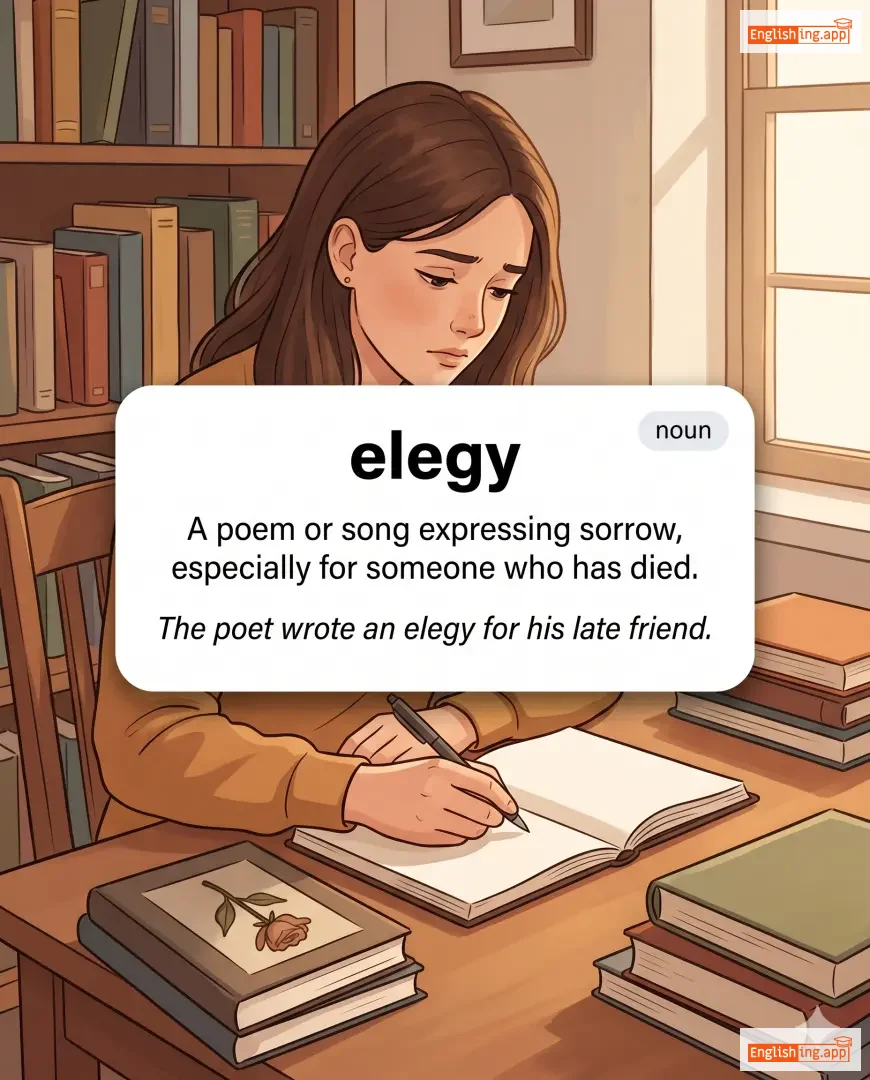
elegy definition card — visual illustration of the meaning
noun
/ˈɛlɪdʒi/
élegie (elegie)

A poem or song expressing sorrow, especially for someone who has died.

"The poet wrote an elegy for his late friend."

"Le poète a écrit une élégie pour son ami défunt." (Le poete a ecrit une elegie pour son ami defunt.)
noun
/ˈɛlɪmənt/
élément (element)

A basic or essential part of something; a simple substance that cannot be broken down further.

"Trust is a key element of any strong relationship."

"La confiance est un élément clé de toute relation solide." (La confiance est un element clé de toute relation solide.)
adjective
/ˌɛlɪˈmɛntəri/
élémentaire (elementaire)

Relating to the basic or fundamental aspects of something; simple or easy to understand.

"She gave an elementary explanation of the problem."

"Elle a donné une explication élémentaire du problème." (Elle a donné une explication élémentaire du problème.)
noun
/ˈɛlɪfənt/
bonheur (bonheur)

a very large animal with a trunk, long curved tusks, and thick gray skin, found in Africa and Asia

"The elephant sprayed water over itself with its trunk."

"Elle n'a pas pu cacher son bonheur lorsqu'elle a reçu le prix." (Elle n'a pas pu cacher son bonheur lorsqu'elle a recu le prix.)
noun
/ˈel.ɪ.fənt ˈæp.əl/
pomme éléphant (pomme elephant)

a tropical fruit with a hard shell and acidic flesh

"Elephant apple is used to make delicious jams and pickles."

"La pomme éléphant est utilisée pour faire des confitures et des pickles délicieux." (La pomme elephant est utilisee pour faire des confitures et des pickles delicieux.)
adjective
/ˌɛlɪˈfæntaɪn/
éléphantin (elephantin)

Huge, clumsy, or resembling an elephant in size or movement.

"The man moved with an elephantine grace."

"L'homme se déplaçait avec une grâce éléphantine." (L'homme se déplaçait avec une grâce éléphantine.)
elevate definition card — visual illustration of the meaning
verb
/ˈɛlɪveɪt/
élever (elever)

To raise or lift something to a higher position; to improve in status, mood, or quality.

"Good music can elevate your mood instantly."

"La bonne musique peut instantanément élever votre humeur." (La bonne musique peut instantanément élever votre humeur.)
noun
/ˌɛlɪˈveɪʃən/
élévation (elevation)

The act of raising something to a higher position or level.

"The hikers reached a high elevation after hours of climbing."

"Les randonneurs ont atteint une grande élévation après des heures de montée." (Les randonneurs ont atteint une grande elevation apres des heures de montee.)
noun
/ˈɛləˌveɪtər/
ascenseur (ascenseur)

a machine that carries people or goods up and down between floors in a building

"We took the elevator to the tenth floor."

"Nous avons pris l'ascenseur jusqu'au dixième étage." (Nous avons pris l'ascenseur jusqu'au dixieme etage.)
1️⃣1️⃣

eleven (eleven)

number
/ɪˈlɛvən/
onze (onz)

the number after ten and before twelve; 11

"There are eleven students in the classroom."

"Il y a onze étudiants dans la classe." (Il ya onze etudiants dans la classe.)
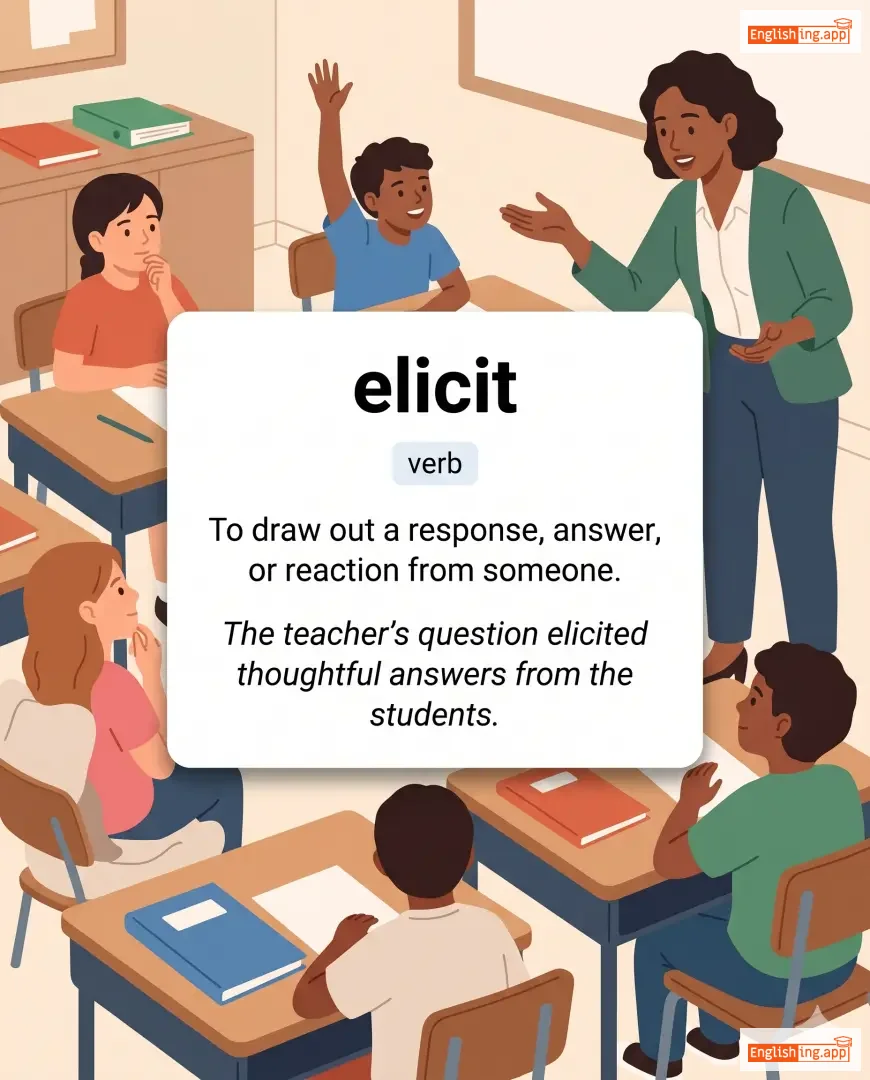
elicit definition card — visual illustration of the meaning
verb
/ɪˈlɪsɪt/
éliciter (eliciter)

To draw out a response, answer, or reaction from someone.

"The teacher’s question elicited thoughtful answers from the students."

"La question du professeur a suscité des réponses réfléchies des élèves." (La question du professeur a suscité des réponses réfléchies des élèves.)
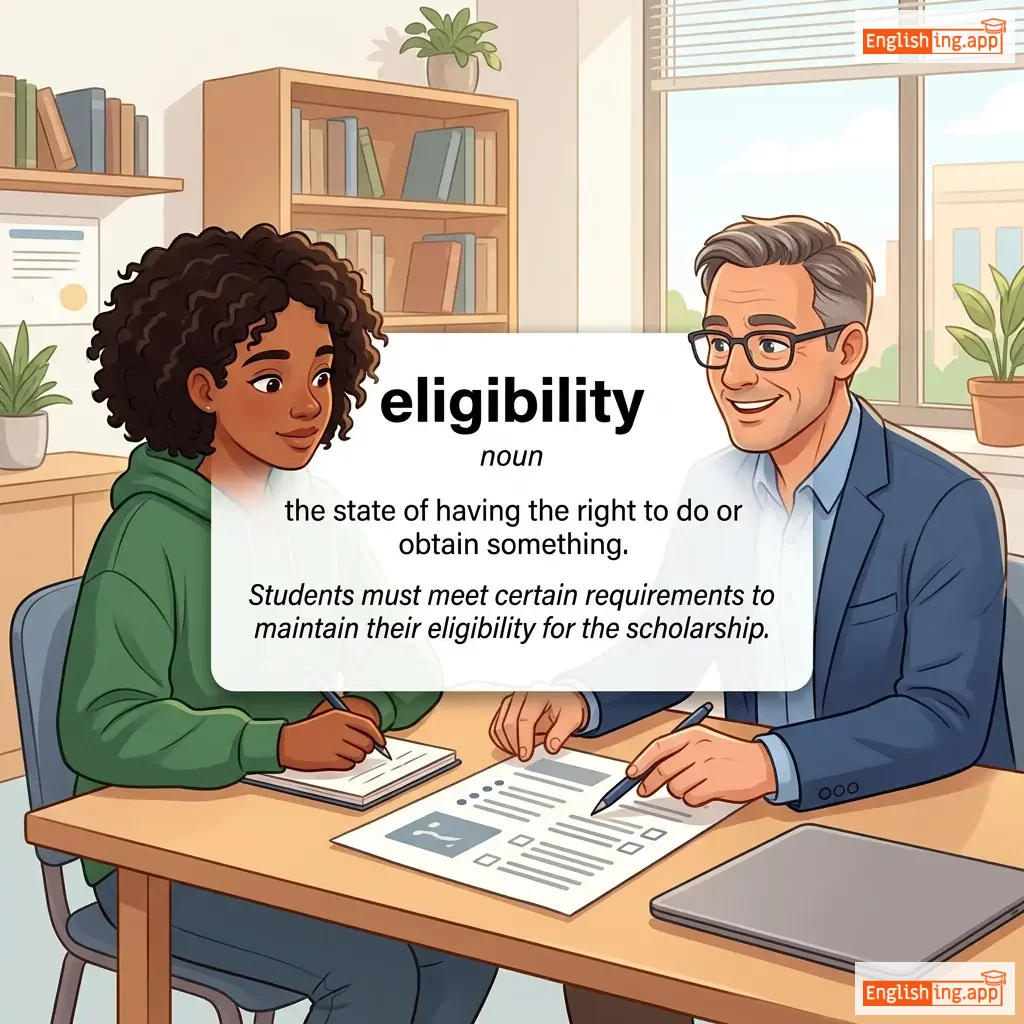
eligibility definition card — visual illustration of the meaning
noun
/ˌel.ɪ.dʒəˈbɪl.ə.ti/
éligibilité (eligibilite)

the state of having the right to do or obtain something

"Students must meet certain requirements to maintain their eligibility for the scholarship."

"Les étudiants doivent remplir certaines exigences pour maintenir leur éligibilité pour la bourse." (Les étudiants doivent remplir certaines exigences pour maintenir leur éligibilité pour la bourse.)
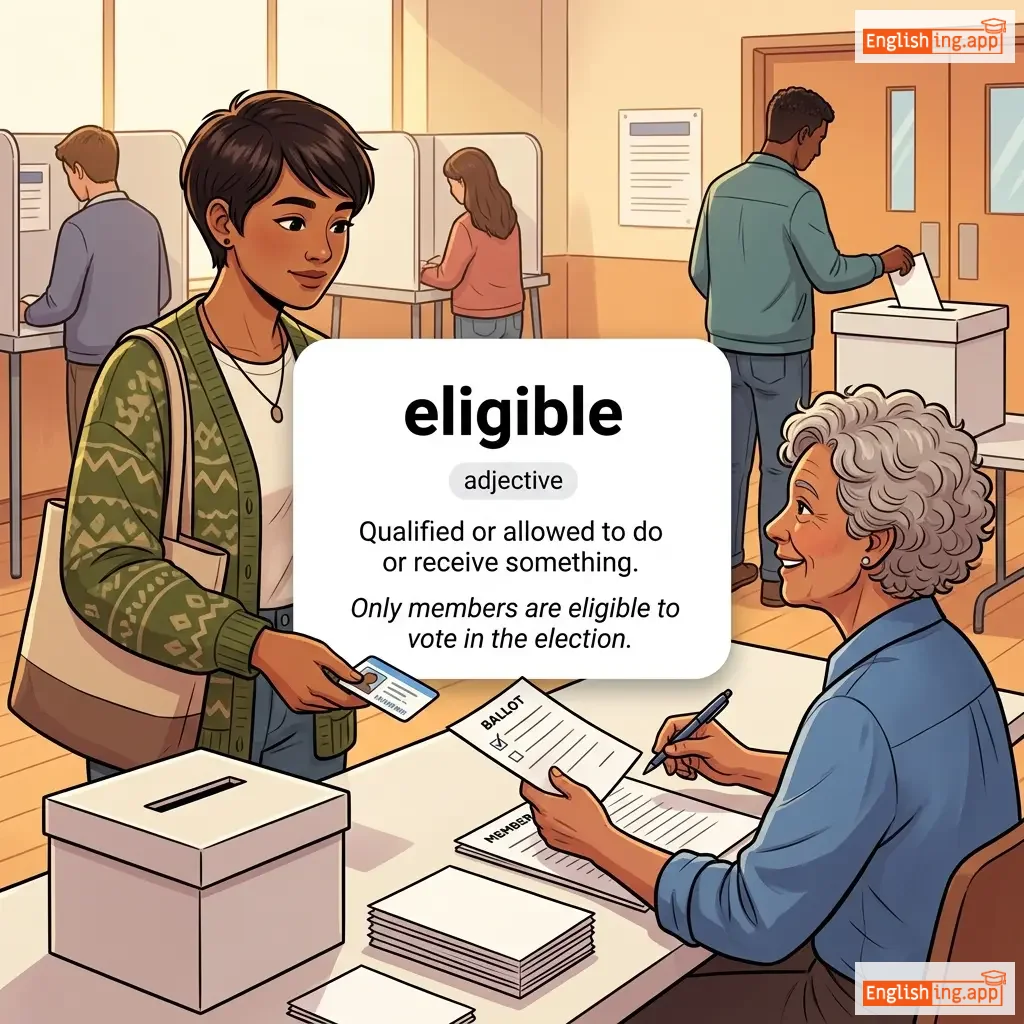
eligible definition card — visual illustration of the meaning
adjective
/ˈɛlɪdʒəbl/
éligible (eligible)

Qualified or allowed to do or receive something.

"Only members are eligible to vote in the election."

"Seuls les membres sont éligibles pour voter lors de l'élection." (Seuls les membres sont éligibles pour voter lors de l'élection.)
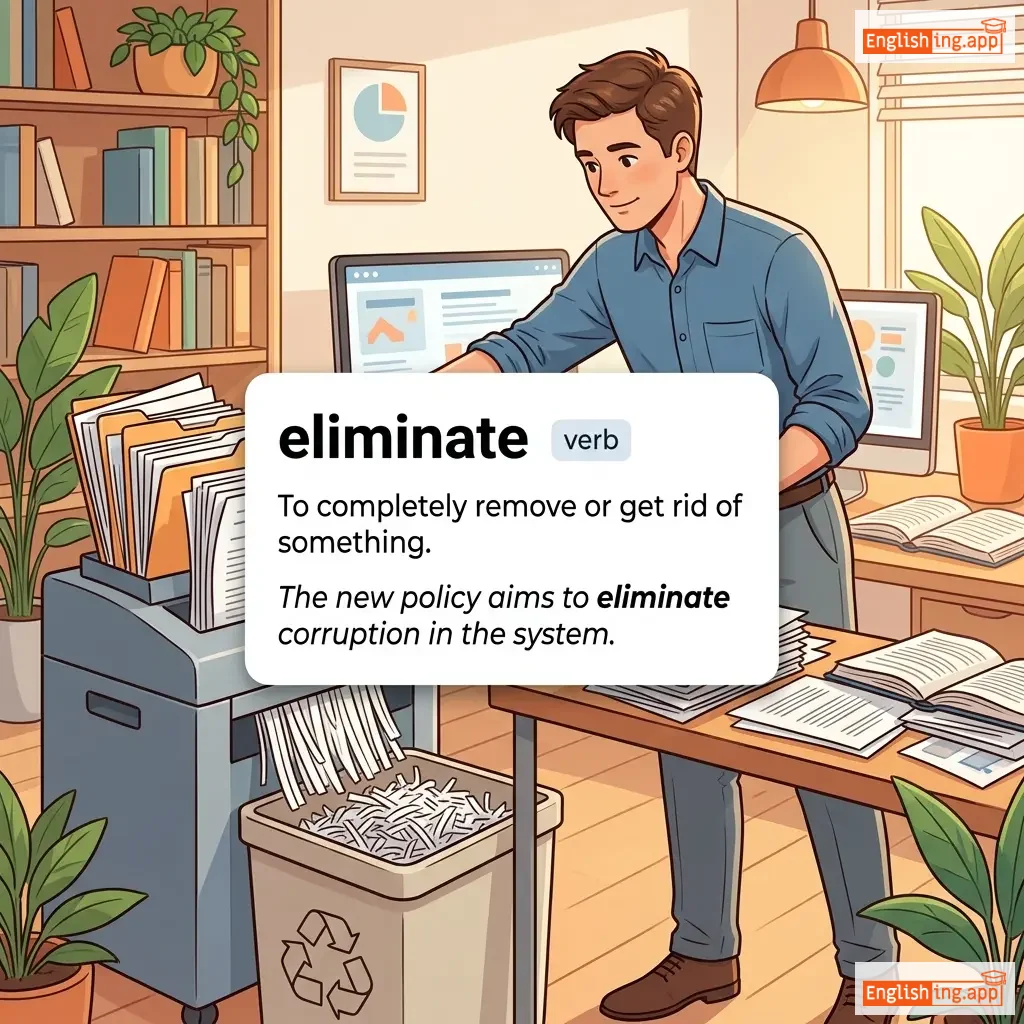
eliminate definition card — visual illustration of the meaning
verb
/ɪˈlɪməˌneɪt/
éliminer (eliminer)

To completely remove or get rid of something.

"The new policy aims to eliminate corruption in the system."

"La nouvelle politique vise à éliminer la corruption dans le système." (La nouvelle politique vise à éliminer la corruption dans le système.)
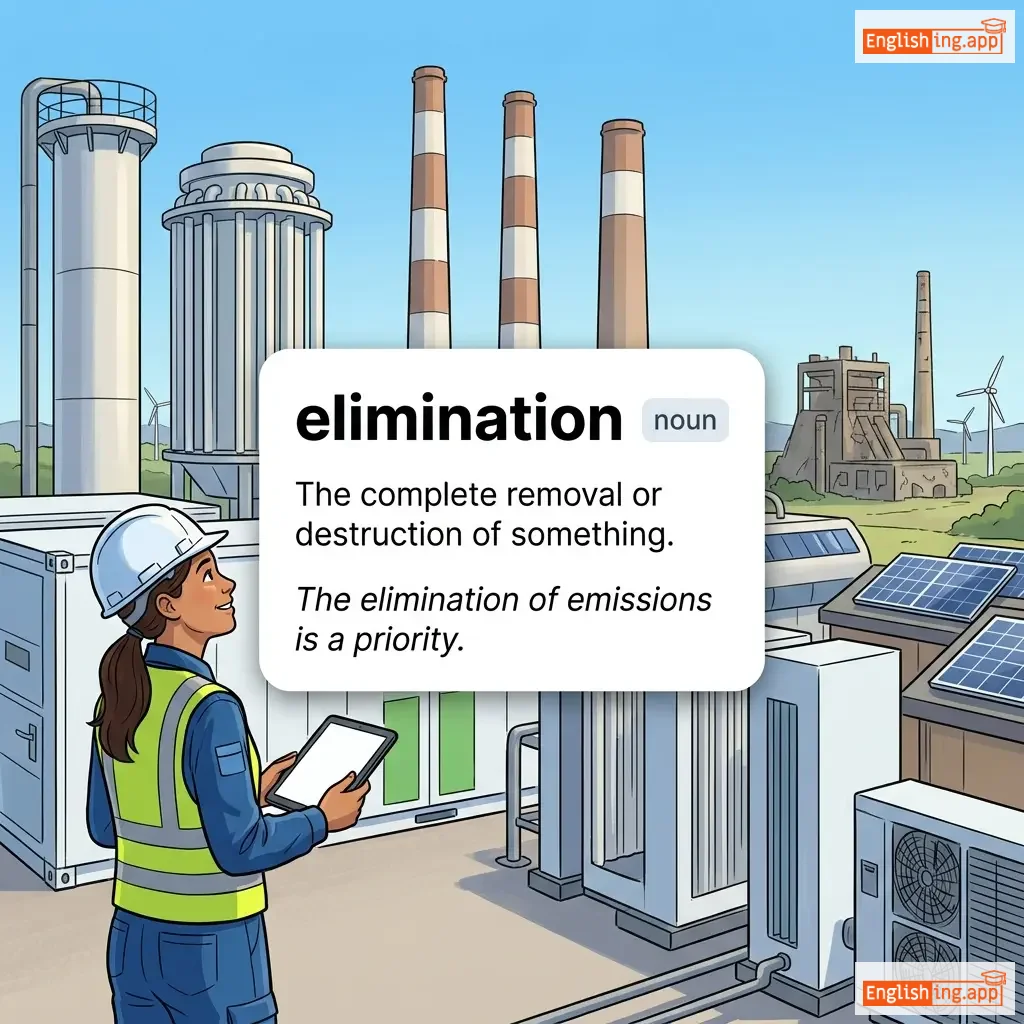
elimination definition card — visual illustration of the meaning
noun
ɪˌlɪm.ɪˈneɪ.ʃən
élimination (elimination)

The complete removal or destruction of something.

"The elimination of emissions is a priority."

"L'élimination des émissions est une priorité." (L'élimination des émissions est une priorité.)
noun
/ɪˈliːt/ or /eɪˈliːt/
élite (elite)

A select group that is superior in terms of ability or qualities.

"Only the elite were invited to the exclusive event."

"Seuls les élites ont été invités à l'événement exclusif." (Seuls les elites ont ete invites a l'evenement exclusif.)
noun/adjective
/ɪˈliːtɪst/
élitiste (elitiste)

A person who believes that a society should be led by an elite; showing preference for a privileged class.

"His elitist attitude made him unpopular among his peers."

"Son attitude élitiste l'a rendu impopulaire parmi ses pairs." (Son attitude élitiste l'a rendu impopulaire parmi ses pairs.)