Vocabulaires

Découvrez, apprenez et maîtrisez le vocabulaire anglais

verb
/ɪkˈsiːd/
dépasser (depasser)

to go beyond a limit or expectation

"The athlete exceeded everyone's expectations by winning the gold medal."

"L'athlète a dépassé les attentes de tout le monde en remportant la médaille d'or." (L'athlete a depasse les attentes de tout le monde en remportant la medaille d'or.)
adjective
/ɪkˈsiːdɪŋ/
excessif; au-delà (excessif; au-dela)

going beyond; surpassing; extremely

"The project was completed with exceeding excellence."

"Le projet a été achevé avec une excellence excessive." (Le projet a ete acheve avec une excellence excessive.)
verb
/ɪkˈsɛl/
exceller (exceller)

to be exceptionally good at or proficient in an activity or subject

"She always tries to excel in her studies."

"Elle essaie toujours d'exceller dans ses études." (Elle essaie toujours d'exceller dans ses études.)
noun
/ˈɛksələns/
excellence (excellence)

the quality of being outstanding or extremely good

"The school is known for its academic excellence."

"L'école est connue pour son excellence académique." (L'école est connue pour son excellence académique.)
noun
/ˈɛksələnsɪ/
excellence (eksélans)

a title of honor for people of high rank, especially ambassadors or governors

"His Excellency the Ambassador attended the ceremony."

"Son Excellence l'Ambassadeur a assisté à la cérémonie." (Son Excellence l'Ambassadeur a assisté à la cérémonie.)
adjective
/ˈɛksələnt/
excellent (excellent)

extremely good; outstanding

"The food at this restaurant is excellent."

"La nourriture dans ce restaurant est excellente." (La nourriture dans ce restaurant est excellente.)
preposition/conjunction
/ɪkˈsɛpt/
sauf (sauf)

not including; other than

"Everyone was invited except John."

"Tout le monde a été invité sauf John." (Tout le monde a été invité sauf John.)
noun
/ɪkˈsɛpʃən/
exception (exception)

A case or instance that does not follow a general rule.

"Every rule has an exception."

"Chaque règle a une exception." (Chacque règle a une exception.)
adjective
/ɪkˈsɛpʃənəbl/
contestable (contestable)

Open to objection; causing disapproval.

"His rude remarks were considered exceptionable by everyone present."

"Ses remarques grossières ont été jugées contestables par tous les présents." (Ses remarques grossières ont été jugées contestables par tous les présents.)
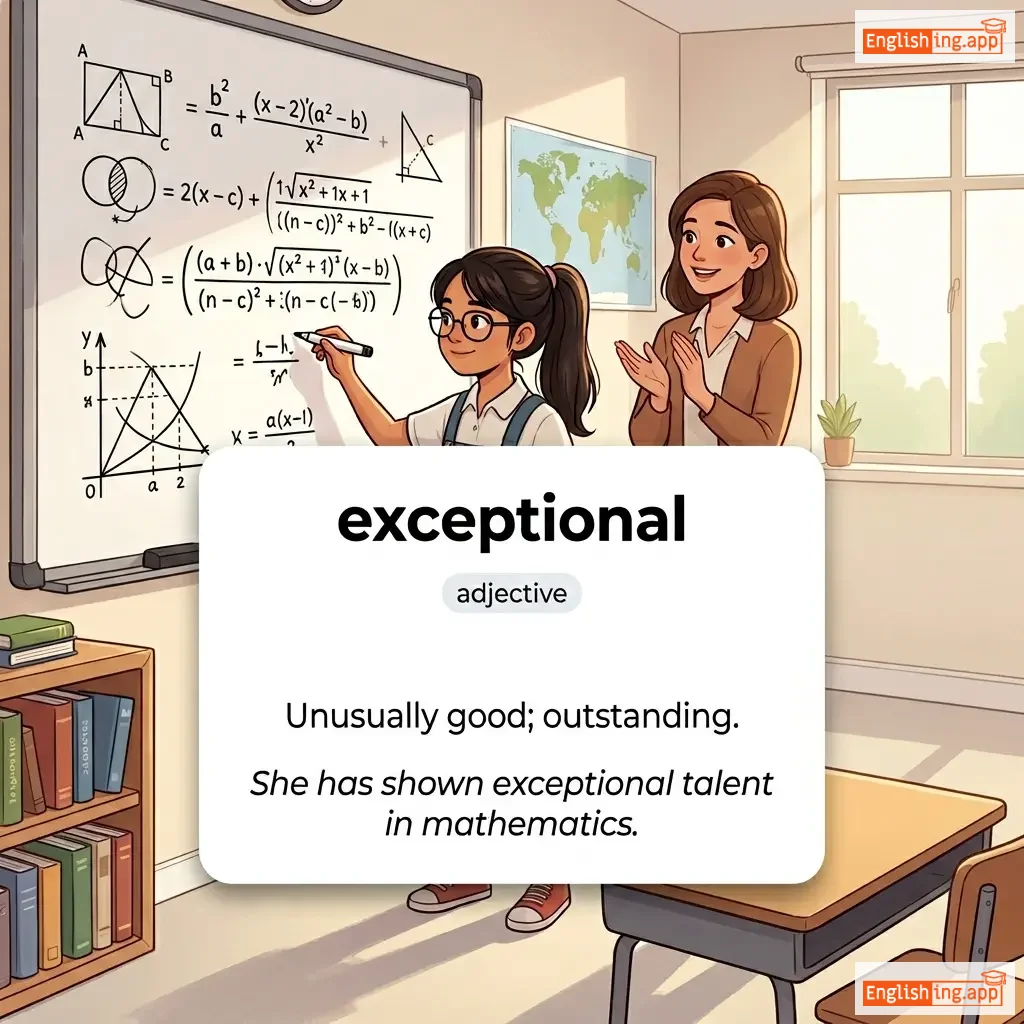
exceptional definition card — visual illustration of the meaning
adjective
/ɪkˈsɛpʃənl/
exceptionnel (exceptionnel)

Unusually good; outstanding.

"She has shown exceptional talent in mathematics."

"Elle a montré un talent exceptionnel en mathématiques." (Elle a montré un talent exceptionnel en mathématiques.)
noun
/ˈɛksɜːrpt/
extrait (extrait)

A short portion taken from a text, film, or piece of music.

"The teacher read an excerpt from the novel."

"Le professeur a lu un extrait du roman." (Le professeur a lu un extrait du roman.)
noun
/ɪkˈsɛs/
excès (exces)

An amount more than necessary, permitted, or desirable.

"Too much sugar can lead to excess weight gain."

"Trop de sucre peut entraîner un gain de poids excessif." (Trop de sucre peut entrer un gain de poids excessif.)
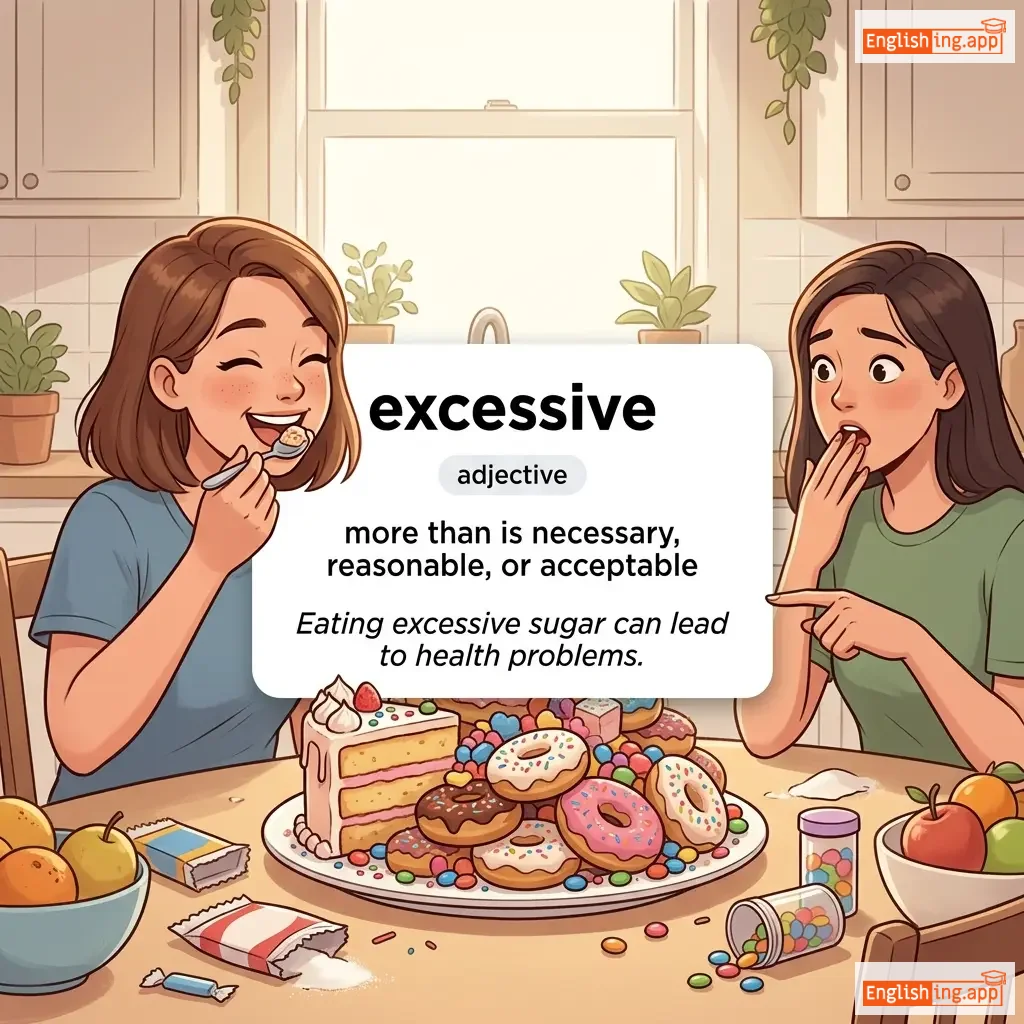
excessive definition card — visual illustration of the meaning
adjective
/ɪkˈsɛsɪv/
excessif (excessif)

more than is necessary, reasonable, or acceptable

"Eating excessive sugar can lead to health problems."

"Manger trop de sucre peut entraîner des problèmes de santé." (Manger trop de sucre peut entrainer des problemes de sante.)
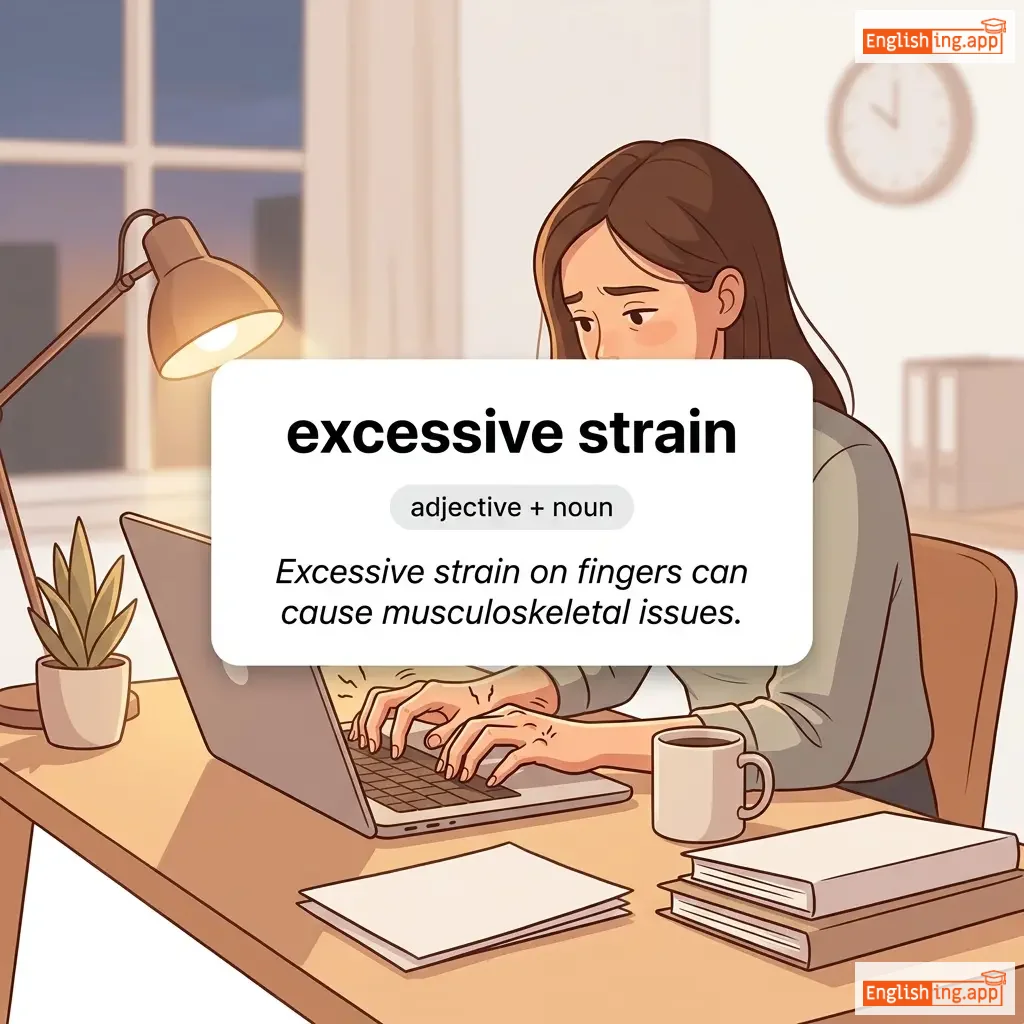
excessive strain definition card — visual illustration of the meaning
adjective + noun
এক্সেসিভ স্ট্রেইন
tension excessive (tension excessive)

An amount of physical pressure or stress that is more than what is normal or acceptable.

"Excessive strain on fingers can cause musculoskeletal issues."

"Une tension excessive sur les doigts peut provoquer des problèmes musculosquelettiques." (Une tension excessive sur les doigts peut provoquer des problemes musculosquelettiques.)
Exchange definition card — visual illustration of the meaning
verb
/ɪksˈtʃeɪndʒ/
échange (echange)

To give something and receive something in return.

"They exchanged gifts during the festival."

"Ils ont échangé des cadeaux pendant le festival." (Ils ont échangé des cadeaux pendant le festival.)
noun
/ɪksˈtʃɛkər/
trésorerie (tresorerie)

The treasury of a state or country.

"The government announced new measures to improve the exchequer."

"Le gouvernement a annoncé de nouvelles mesures pour améliorer la trésorerie." (Le gouvernement a annonce de nouvelles mesures pour ameliorer la tresorerie.)
verb
/ˈɛkˌsaɪz/
exciser (exiser)

to cut out or remove completely, often by surgery

"The surgeon excised the tumor successfully."

"Le chirurgien a excisé la tumeur avec succès." (Le chirurgien a excisé la tumeur avec succès.)
noun
/ɪkˈsɪʒən/
excision (excision)

the act of cutting something out, especially by surgical removal

"The excision of the infected tissue prevented further complications."

"L'excision du tissu infecté a empêché d'autres complications." (L'excision du tissu infecté a empêché d'autres complications.)
adjective
/ɪkˈsaɪtəbl̩/
excitable (excitable)

easily excited or emotionally aroused

"The child was excitable and laughed at every small thing."

"L'enfant était excitable et riait de chaque petite chose." (L'enfant était excitable et riait de chaque petite chose.)
noun
/ˌɛksaɪˈteɪʃən/
excitation (excitation)

a state of great excitement or the process of stimulating activity

"The news created great excitation among the fans."

"Les nouvelles ont créé une grande excitation parmi les fans." (Les nouvelles ont créé une grande excitation parmi les fans.)
verb
/ɪkˈsaɪt/
exciter (exciter)

to cause strong feelings of enthusiasm or eagerness

"The idea of traveling abroad excites her."

"L'idée de voyager à l'étranger l'excite." (L'idée de voyager à l'étranger l'excite.)
adjective
/ɪkˈsaɪtɪd/
excité (excité)

very enthusiastic and eager about something

"The children were excited to open their presents."

"Les enfants étaient excités d'ouvrir leurs cadeaux." (Les enfants étaient excités d'ouvrir leurs cadeaux.)
noun
/ɪkˈsaɪtmənt/
excitation (excitation)

a feeling of great enthusiasm and eagerness

"There was a lot of excitement before the concert began."

"Il y avait beaucoup d'excitation avant que le concert commence." (Il y avait beaucoup d'excitation avant que le concert commence.)
exciting definition card — visual illustration of the meaning
adjective
/ɪkˈsaɪtɪŋ/
excitant (excitant)

Causing great enthusiasm and eagerness.

"The movie was so exciting that I watched it twice."

"Le film était tellement excitant que je l'ai regardé deux fois." (Le film etait tellement excitant que je l'ai regarde deux fois.)
verb
/ɪkˈskleɪm/
s'écrier (secrier)

to cry out suddenly in surprise, strong emotion, or excitement

"She exclaimed with joy when she saw the gift."

"Elle s'est exclamée de joie en voyant le cadeau." (Elle s'est exclamée de joie en voyant le cadeau.)
noun
/ˌɛkskləˈmeɪʃən/
exclamation (exclamation)

A sudden cry or remark expressing strong emotion or surprise.

"She let out an exclamation of joy when she heard the news."

"Elle a laissé échapper une exclamation de joie lorsqu'elle a entendu la nouvelle." (Elle a laisse echapper une exclamation de joie lorsqu'elle a entendu la nouvelle.)
verb
/ɪkˈskluːd/
exclure (eksclure)

To deliberately leave out or prevent someone or something from being included.

"The list excludes temporary workers."

"La liste exclut les travailleurs temporaires." (La liste eksklut les travailleurs temporaires.)
adjective
/ɪkˈskluːdɪd/
exclu; marginalisé (exclu; marginalisé)

not included; left out; barred from participation

"He felt excluded from the group activities and conversations."

"Il se sentait exclu des activités de groupe et des conversations." (Il se sentait exclu des activités de groupe et des conversations.)
noun
/ɪkˈskluːʒən/
exclusion (exclusion)

The process or state of being left out or denied access.

"The policy led to the exclusion of certain groups."

"La politique a conduit à l'exclusion de certains groupes." (La politique a conduit à l'exclusion de certains groupes.)
adjective
/ɪkˈskluːsɪv/
réservé à une personne, un groupe ou une zone particulière; non partagé avec d'autres (reserve a une personne, un groupe ou une zone particuliere; non partage avec d'autres)

restricted to a particular person, group, or area; not shared with others

"The hotel offers exclusive access to a private beach."

"L'hôtel offre un accès exclusif à une plage privée." (L'hotel offre un acces exclusif a une plage privee.)
adverb
/ɪkˈskluːsɪvli/
exclusivement (exclusivement)

only; not shared with others

"This service is available exclusively to premium members."

"Ce service est disponible exclusivement pour les membres premium." (Ce service est disponible exclusivement pour les membres premium.)
verb
/ɛkˈskɔːrieɪt/
critique sévèrement (kritik severman)

To strongly criticize someone; to denounce severely.

"The critic excoriated the film for its poor script."

"Le critique a sévèrement critiqué le film pour son mauvais scénario." (Le critique a severman critique le film pour son mauvais scenario.)
noun
/ɪkˈskrɛsəns/
croissance anormale (croissance anormale)

An abnormal outgrowth or lump, often considered unattractive.

"The building was considered an excrescence on the landscape."

"Le bâtiment a été considéré comme une excroissance dans le paysage." (Le bâtiment a été considéré comme une excroissance dans le paysage.)
verb
/ɪkˈskriːt/
excréter (excreter)

to eliminate waste matter from the body

"Humans excrete carbon dioxide through breathing."

"Les humains excrètent du dioxyde de carbone par la respiration." (Les humains excrètent du dioxyde de carbone par la respiration.)
noun
/ɪkˈskriːʃən/
excrétion (excretion)

the process of eliminating waste matter from the body

"Excretion is vital for maintaining a healthy body."

"L'excrétion est vitale pour maintenir un corps sain." (L'excretion est vitale pour maintenir un corps sain.)
verb
/ɪkˈskruːʃieɪt/
excrucier (éks-kru-sier)

to cause intense pain or suffering

"The injury excruciated him with unbearable pain."

"La blessure l'excruciait avec une douleur insupportable." (La blessure l'excruciait avec une douleur insupportable.)
adjective
/ɪkˈskruːʃieɪtɪŋ/
atroce (atroce)

causing extreme physical or mental pain

"She was in excruciating pain after the accident."

"Elle était dans une douleur atroce après l'accident." (Elle était dans une douleur atroce après l'accident.)
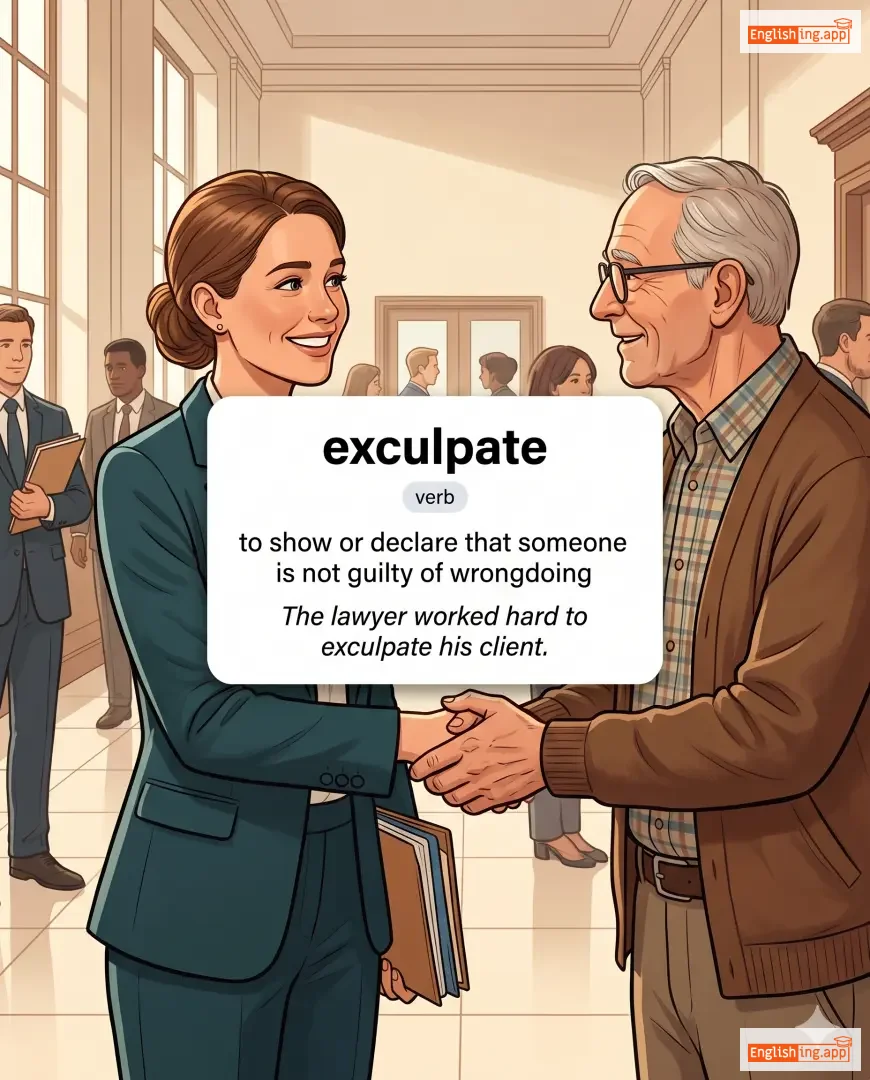
exculpate definition card — visual illustration of the meaning
verb
/ˈɛkskʌlpeɪt/
exculper (exculper)

to show or declare that someone is not guilty of wrongdoing

"The lawyer worked hard to exculpate his client."

"L'avocat a travaillé dur pour exculper son client." (L'avocat a travaillé dur pour exculper son client.)
noun
/ɪkˈskɜːʒən/
excursion (excursion)

A short journey or trip, especially one taken for leisure or educational purposes.

"The students went on an excursion to the national museum."

"Les étudiants sont partis en excursion au musée national." (Les etudiants sont partis en excursion au musee national.)
adjective
/ɪkˈskɜːsɪv/
excurssif (excurssif)

Tending to digress or wander; moving away from the main subject.

"His excursive lecture left the students confused about the main topic."

"Sa conférence excursive a laissé les étudiants confus sur le sujet principal." (Sa conférence excursive a laissé les étudiants confus sur le sujet principal.)
adjective
/ɪkˈskjuːzəbl/
excusable (eksuzabl)

Able to be forgiven or justified.

"Her mistake was excusable given the circumstances."

"Son erreur était excusable étant donné les circonstances." (Son erreur était excusable étant donné les circonstances.)
verb
/ɪkˈskjuːz/
pardonner, justifier (pardonner, justifier)

to forgive someone for doing something wrong or to justify an action

"Please excuse my lateness; there was heavy traffic."

"S'il vous plaît, excusez mon retard ; il y avait beaucoup de circulation." (S'il vous plaît, excusez mon retard ; il y avait beaucoup de circulation.)
execrable definition card — visual illustration of the meaning
adjective
/ˈeksɪkrəbl/
exécrable (exécrable)

Extremely bad or unpleasant.

"The movie was so execrable that many people left the theater early."

"Le film était tellement exécrable que beaucoup de gens sont partis tôt du cinéma." (Le film était tellement exécrable que beaucoup de gens sont partis tôt du cinéma.)
verb
/ˈeksɪkreɪt/
détester (detester)

To feel or express great loathing or hatred for something.

"The community execrated the corrupt politician."

"La communauté a détesté le politicien corrompu." (La communauté a détesté le politicien corrompu.)
noun
/ˌɛksɪˈkreɪʃən/
malédiction (malediction)

An act of cursing or denouncing someone or something with hatred.

"The dictator’s name was spoken with execration after his fall."

"Le nom du dictateur a été prononcé avec malédiction après sa chute." (Le nom du dictateur a été prononcé avec malédiction après sa chute.)
execute definition card — visual illustration of the meaning
verb
/ˈɛksɪkjuːt/
exécuter (executer)

To carry out a plan, order, or action; to perform or put into effect.

"The company plans to execute its new strategy next year."

"L'entreprise prévoit d'exécuter sa nouvelle stratégie l'année prochaine." (L'entreprise prévoit d'exécuter sa nouvelle stratégie l'année prochaine.)
noun
/ˌɛksɪˈkjuːʃən/
exécution, mise en œuvre (execution, mise en œuvre)

the act of carrying out a plan, order, or legal sentence

"The success of a project depends on its proper execution."

"Le succès d'un projet dépend de sa bonne exécution." (Le succes d'un projet depend de sa bonne execution.)
noun
/ˌɛksɪˈkjuːʃənər/
bourreau (bourreau)

A person who carries out a death sentence by execution.

"The executioner prepared the gallows for the condemned prisoner."

"Le bourreau a préparé la potence pour le prisonnier condamné." (Le bourreau a préparé la potence pour le prisonnier condamné.)
executive definition card — visual illustration of the meaning
noun/adjective
/ɪɡˈzɛkjətɪv/
exécutif (exécutif)

A person with senior managerial responsibility in a business; relating to the execution of plans or laws.

"She works as an executive in a multinational company."

"Elle travaille comme exécutive dans une entreprise multinationale." (Elle travaille comme exécutive dans une entreprise multinationale.)
noun
/ɪɡˈzɛkjətər/
exécuteur testamentaire (exécuteur testamentaire)

A person appointed to carry out the terms of someone's will after their death.

"The executor managed the estate according to the deceased’s wishes."

"L'exécuteur a géré la succession conformément aux souhaits du défunt." (L'exécuteur a gere la succession conformement aux souhaits du defunt.)