Vocabulaires

Découvrez, apprenez et maîtrisez le vocabulaire anglais

adjective
/ɛsˈθɛtɪk/
esthétique (esthetique)

Concerned with beauty or the appreciation of beauty.

"The building’s esthetic design attracted many visitors."

"Le design esthétique du bâtiment a attiré de nombreux visiteurs." (Le design esthetique du batiment a attire de nombreux visiteurs.)
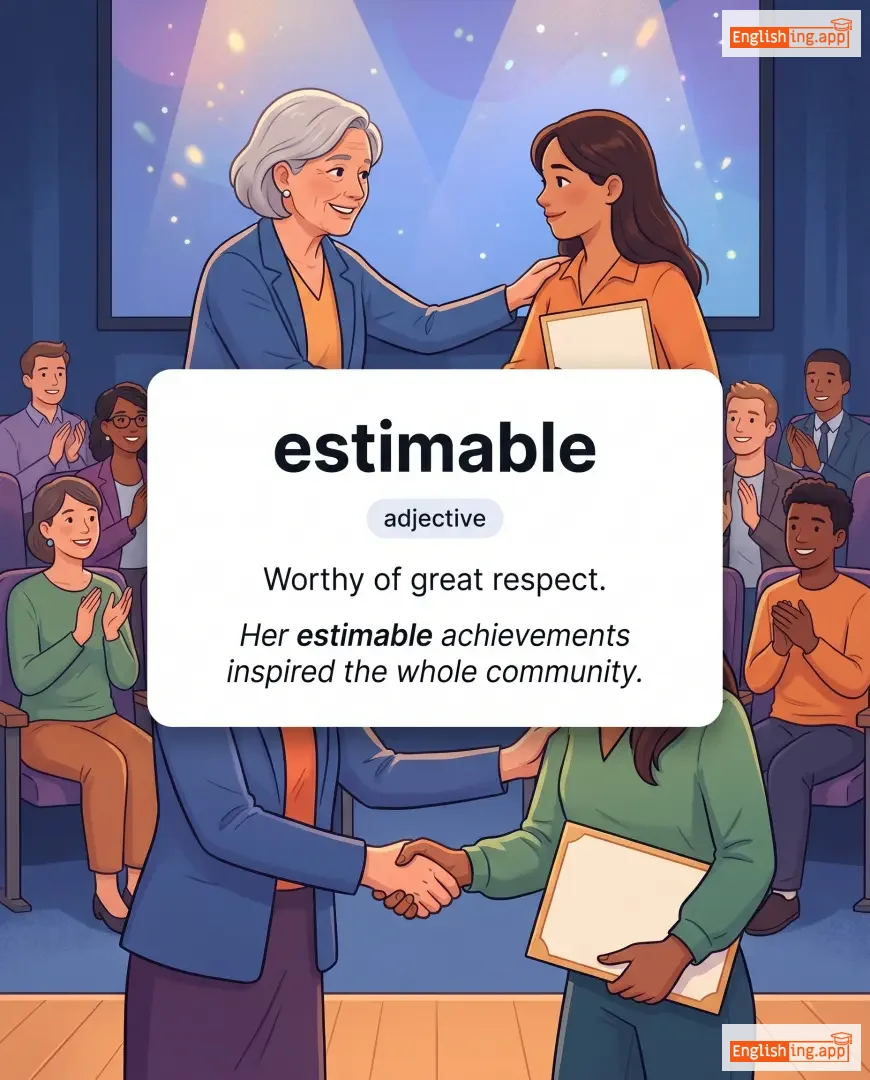
estimable definition card — visual illustration of the meaning
adjective
/ˈɛstɪməbl/
estimable (estimable)

Worthy of great respect.

"Her estimable achievements inspired the whole community."

"Ses réalisations estimables ont inspiré toute la communauté." (Ses réalisations estimables ont inspiré toute la communauté.)
verb
/ˈɛstɪˌmeɪt/
estimer (estimer)

To roughly calculate or judge the value, number, quantity, or extent of something.

"The engineer estimated the cost of the project at $5 million."

"L'ingénieur a estimé le coût du projet à 5 millions de dollars." (L'ingénieur a estimé le coût du projet à 5 millions de dollars.)
adjective
/ˈɛstɪmeɪtɪd/
estimé (estime)

roughly calculated or judged; an approximate value or amount

"The estimated cost of the project is five million dollars."

"Le coût estimé du projet est de cinq millions de dollars." (Le coût estimé du projet est de cinq millions de dollars.)
verb
/ɪˈstreɪndʒ/
aliéner (aliener)

to cause someone to no longer be close or affectionate; to alienate

"His constant criticism began to estrange him from his friends."

"Sa critique constante a commencé à l'éloigner de ses amis." (sa critique constante a commencé à l'éloigner de ses amis.)
adjective
/ɪˈstreɪndʒd/
éloigné (eloigné)

no longer close or affectionate with someone; alienated

"She felt estranged from her family after the long dispute."

"Elle se sentait éloignée de sa famille après le long différend." (Elle se sentait éloignée de sa famille après le long différend.)
noun
/ˈɛstjʊəri/
estuaire (estuaire)

the tidal mouth of a large river, where the tide meets the stream

"The city is located near the estuary of the river."

"La ville est située près de l'estuaire du fleuve." (La ville est située près de l'estuaire du fleuve.)
abbreviation
/ɛtˈsɛtərə/
etcetera (etcetera)

Used to indicate additional, similar items in a list that are not mentioned.

"The shop sells fruits, vegetables, dairy, etc."

"Le magasin vend des fruits, des légumes, des produits laitiers, etcetera." (Le magasin vend des fruits, des légumes, des produits laitiers, etcetera.)
adverb
/ɛtˈsɛtərə/
etcétéra (etcetera)

used at the end of a list to indicate that other similar items are included

"She bought apples, oranges, bananas, etcetera from the market."

"Elle a acheté des pommes, des oranges, des bananes, etcétéra au marché." (Elle a achete des pommes, des oranges, des bananes, etcetera au marche.)
verb
/ɛtʃ/
graver (graver)

to cut or carve a design onto a surface

"The artist etched her initials into the glass."

"L'artiste a gravé ses initiales dans le verre." (L'artiste a grave ses initiales dans le verre.)
adjective
/ɪˈtɜːrnəl/
éternel (eternel)

lasting or existing forever; without end

"They pledged their eternal love for each other."

"Ils ont promis leur amour éternel l'un à l'autre." (Ils ont promis leur amour éternel l'un à l'autre.)
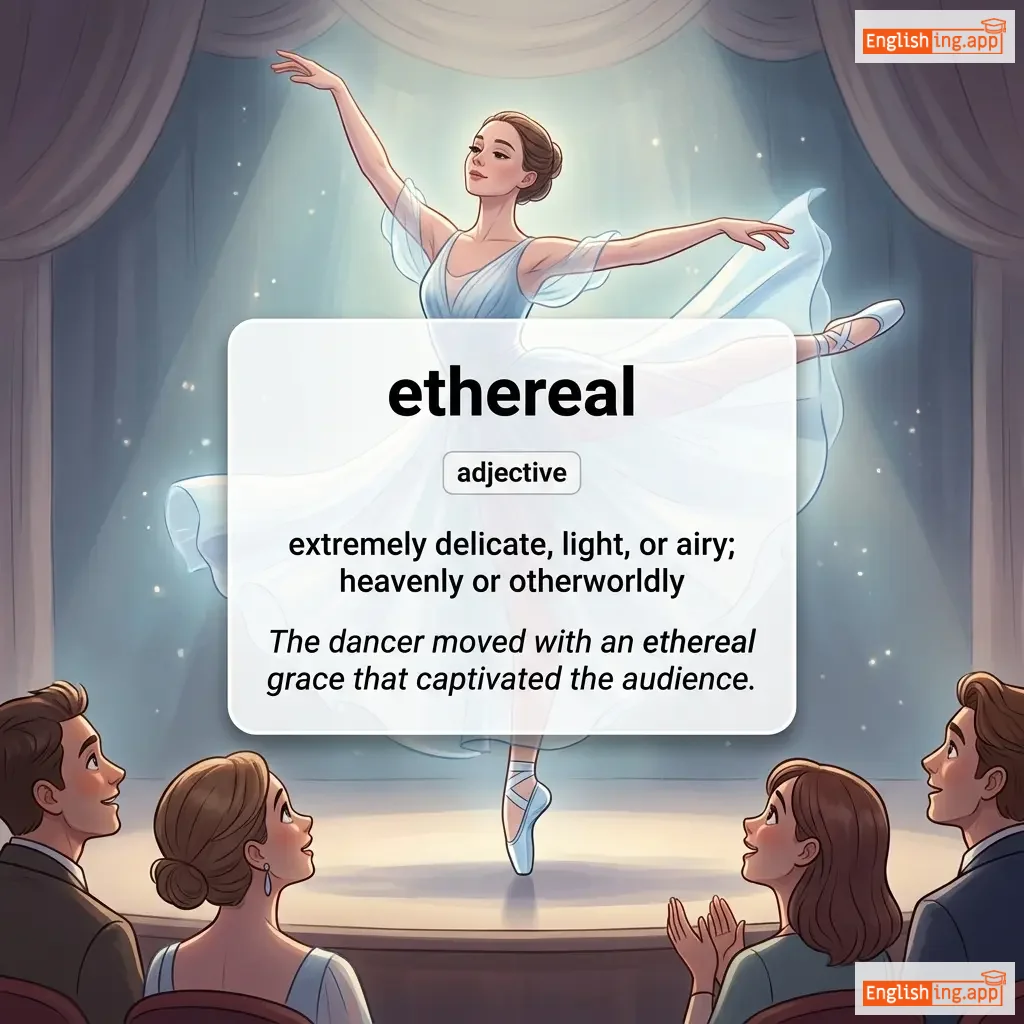
ethereal definition card — visual illustration of the meaning
adjective
/ɪˈθɪəriəl/
éthéré (ethere)

extremely delicate, light, or airy; heavenly or otherworldly

"The dancer moved with an ethereal grace that captivated the audience."

"La danseuse se déplaçait avec une grâce éthérée qui captivait le public." (La danseuse se deplaçait avec une grace etheree qui captivait le public.)
noun
/ˈɛθɪk/
éthique (ethique)

a set of moral principles, especially ones relating to a particular group, system, or profession

"He has a strong work ethic and always meets deadlines."

"Il a une forte éthique de travail et respecte toujours les délais." (Il a une forte ethique de travail et respecte toujours les delais.)
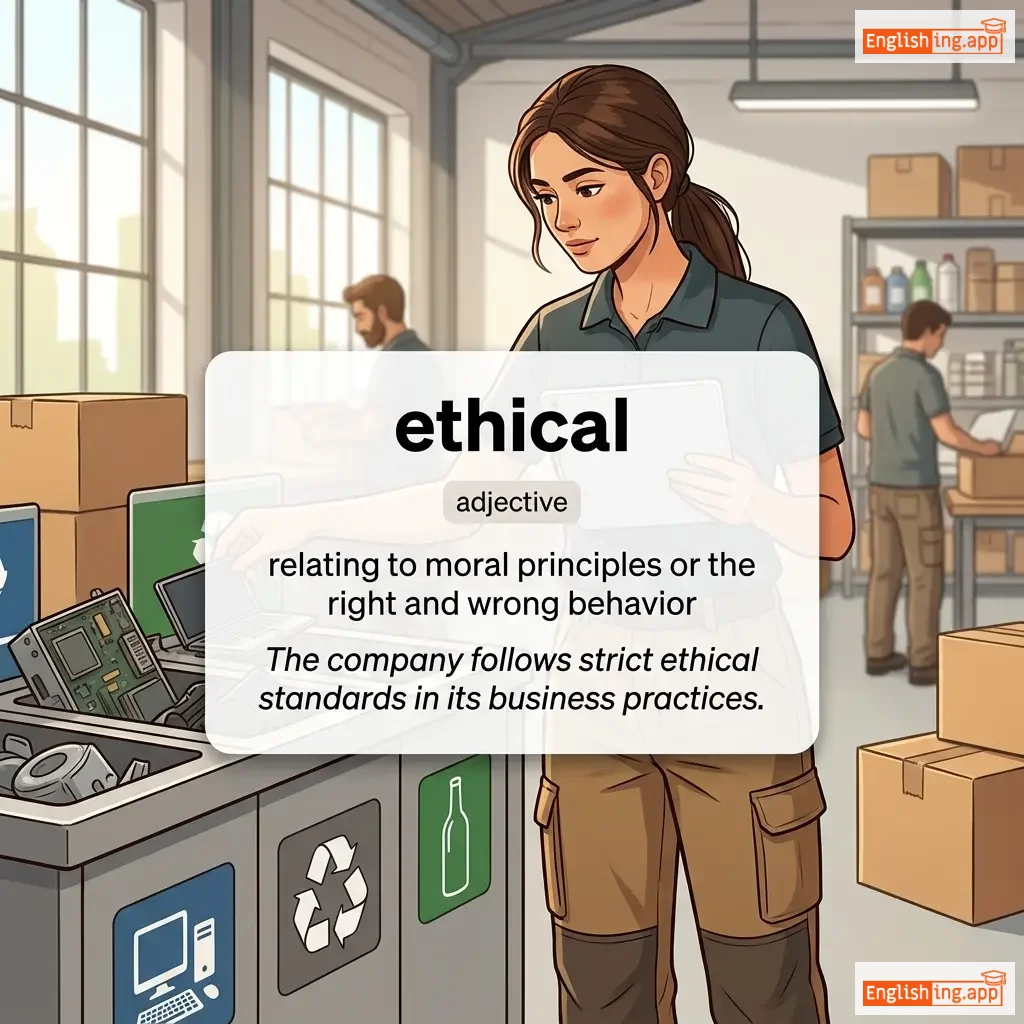
ethical definition card — visual illustration of the meaning
adjective
/ˈɛθɪkəl/
éthique (ethik)

relating to moral principles or the right and wrong behavior

"The company follows strict ethical standards in its business practices."

"L'entreprise suit des normes éthiques strictes dans ses pratiques commerciales." (L'entreprise suit des normes éthiques strictes dans ses pratiques commerciales.)
noun
/ˈɛθɪks/
éthique (ethique)

moral principles that govern a person's behavior or the conduct of an activity

"Business ethics require companies to act fairly and responsibly."

"L'éthique des affaires exige que les entreprises agissent de manière juste et responsable." (L'éthique des affaires exige que les entreprises agissent de manière juste et responsable.)
adjective
/ˈɛθnɪk/
ethnique (ethnique)

relating to a population subgroup with a common national or cultural tradition

"The festival celebrated the city's diverse ethnic communities."

"Le festival a célébré les diverses communautés ethniques de la ville." (Le festival a celebre les diverses communautes ethniques de la ville.)
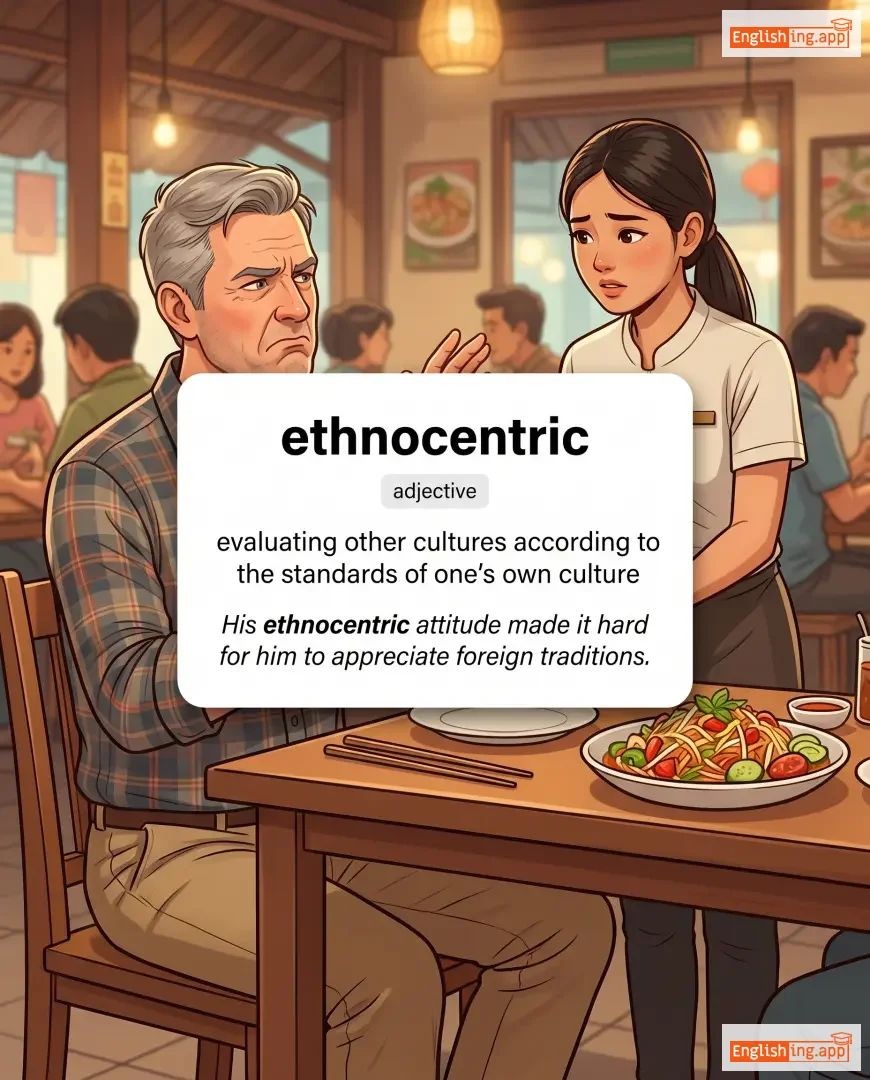
ethnocentric definition card — visual illustration of the meaning
adjective
/ˌeθ.noʊˈsen.trɪk/
ethnocentrique (ethnocentrique)

evaluating other cultures according to the standards of one's own culture

"His ethnocentric attitude made it hard for him to appreciate foreign traditions."

"Son attitude ethnocentrique lui rendait difficile d'apprécier les traditions étrangères." (Son attitude ethnocentrique lui rendait difficile d'aprecier les traditions etrangeres.)
noun
/ɛθˈnɒlədʒi/
ethnologie (ethnologie)

the study of the characteristics of different peoples and the differences and relationships between them

"She specialized in ethnology to better understand cultural diversity."

"Elle s'est spécialisée en ethnologie pour mieux comprendre la diversité culturelle." (Elle s'est spécialisée en ethnologie pour mieux comprendre la diversité culturelle.)
ethos definition card — visual illustration of the meaning
noun
/ˈiːθɒs/
éthos (ethos)

the characteristic spirit, values, or beliefs of a community, culture, or organization

"The company’s ethos emphasizes innovation and customer service."

"L'éthos de l'entreprise met l'accent sur l'innovation et le service client." (L'ethos de l'entreprise met l'accent sur l'innovation et le service client.)
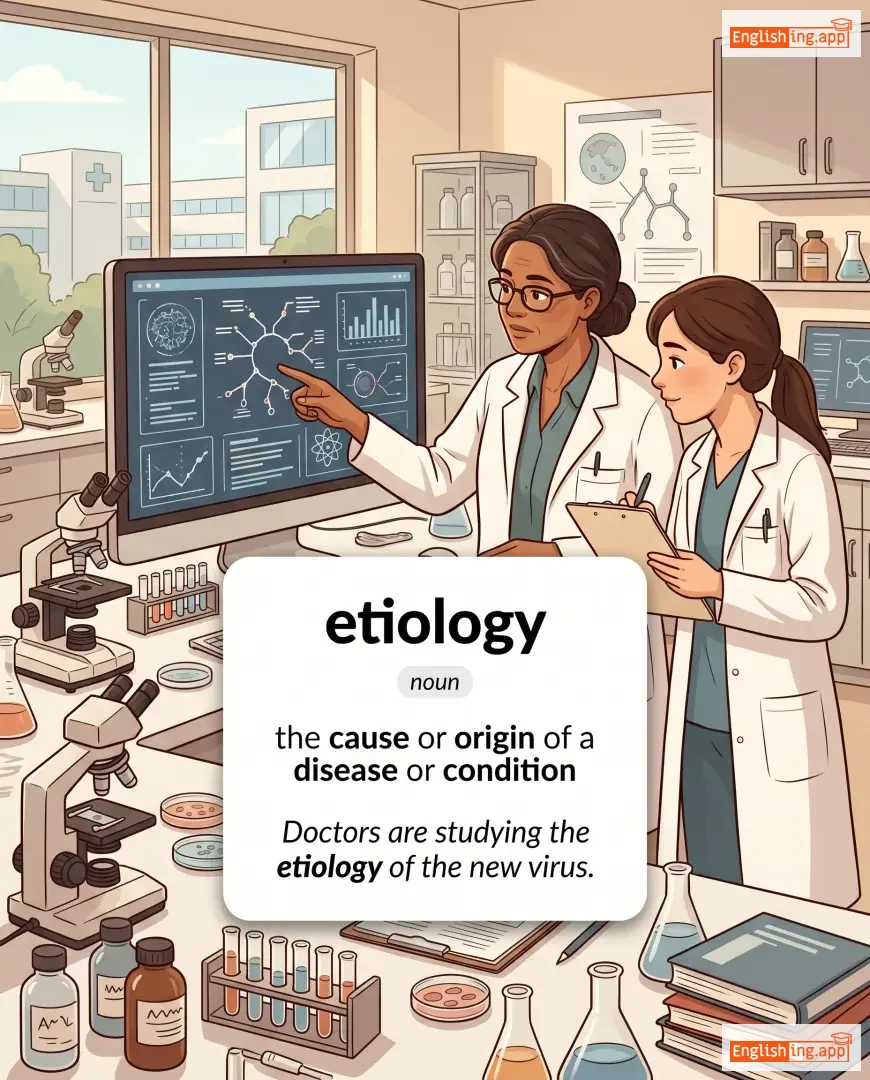
etiology definition card — visual illustration of the meaning
noun
/ˌiː.tiˈɒ.lə.dʒi/
étiologie (etiologie)

the cause or origin of a disease or condition

"Doctors are studying the etiology of the new virus."

"Les médecins étudient l'étiologie du nouveau virus." (Les medecins etudient l'etiologie du nouveau virus.)
noun
/ˈet.ɪ.kət/
étiquette (etiquette)

the customary code of polite behavior in society or among members of a particular profession

"Proper etiquette requires standing when a lady enters the room."

"Une bonne étiquette exige de se lever lorsqu'une dame entre dans la pièce." (Une bonne etiquette exige de se lever lorsqu'une dame entre dans la piece.)
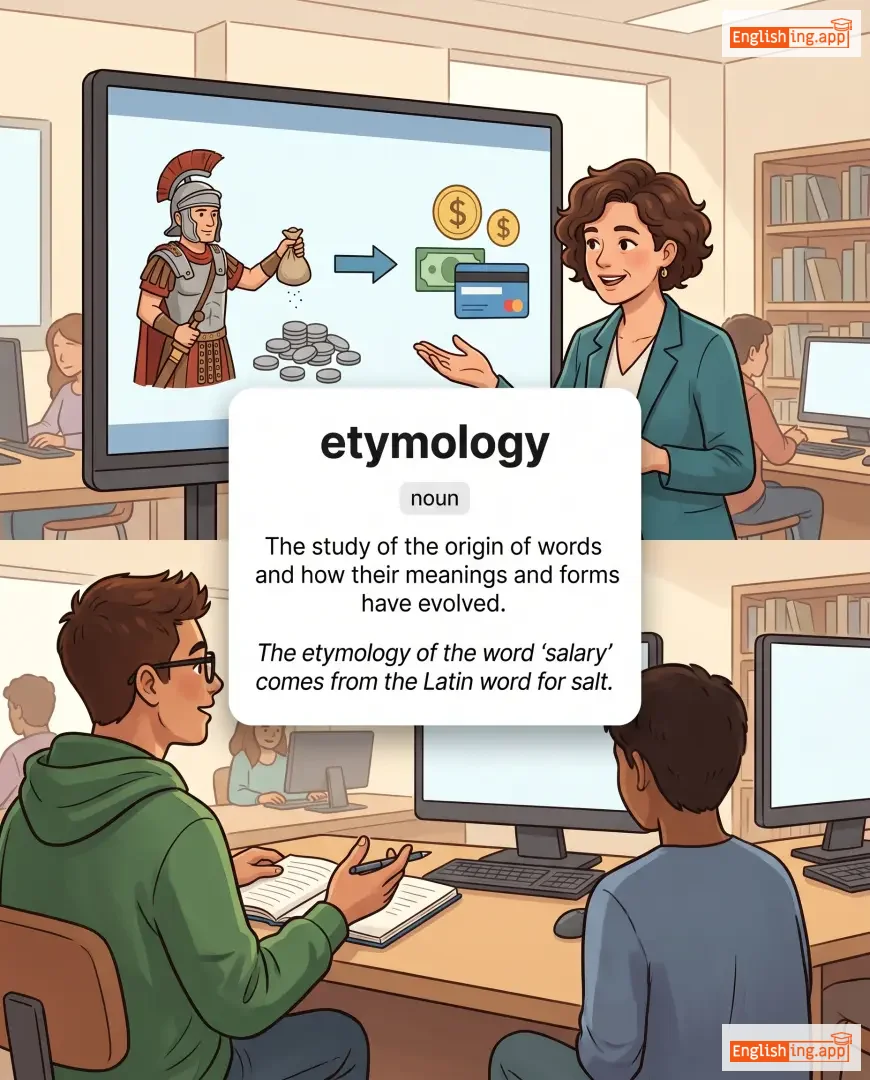
etymology definition card — visual illustration of the meaning
noun
/ˌɛtɪˈmɒlədʒi/
étymologie (etymologie)

The study of the origin of words and how their meanings and forms have evolved.

"The etymology of the word 'salary' comes from the Latin word for salt."

"L'étymologie du mot 'salaire' vient du mot latin pour sel." (L'etymologie du mot 'salaire' vient du mot latin pour sel.)
adjective
/juːˈdʒɛnɪk/
génétique (genetique)

Relating to or aiming at improving the genetic quality of a population.

"In the early 20th century, some scientists supported eugenic policies."

"Au début du 20e siècle, certains scientifiques ont soutenu les politiques eugénistes." (Au début du 20e siècle, certains scientifiques ont soutenu les politiques eugenistes.)
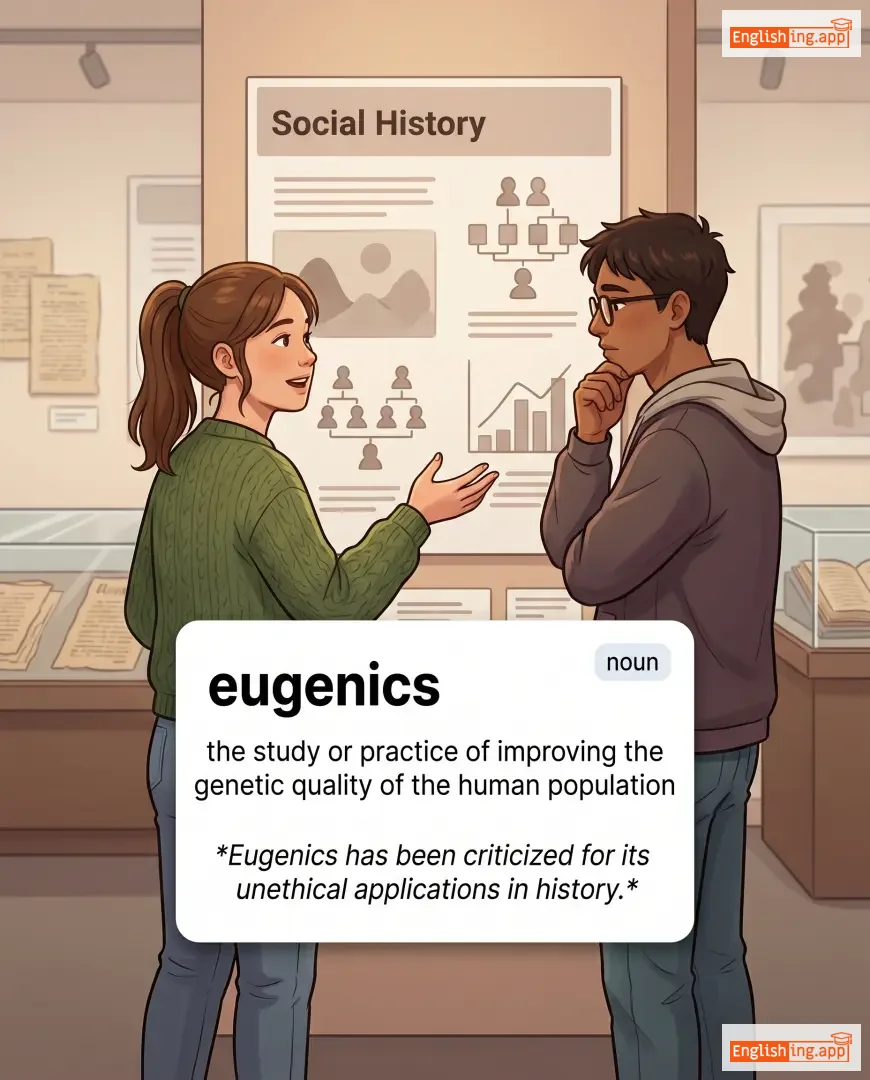
eugenics definition card — visual illustration of the meaning
noun
/juːˈdʒen.ɪks/
eugénisme (eugenisme)

the study or practice of improving the genetic quality of the human population

"Eugenics has been criticized for its unethical applications in history."

"L'eugénisme a été critiqué pour ses applications non éthiques dans l'histoire." (L'eugenisme a ete critique pour ses applications non ethique dans l'histoire.)
adjective
/ˌjuːləˈdʒɪstɪk/
élogieux (elogieux)

Expressing praise or admiration, often formally.

"The speaker gave a eulogistic account of the leader’s achievements."

"L'orateur a donné un compte rendu élogieux des réalisations du leader." (L'orateur a donné un compte rendu élogieux des réalisations du leader.)
verb
/ˈjuːləˌdʒaɪz/
élogier (eloger)

To praise highly in speech or writing, especially in honor of someone who has died.

"They gathered to eulogize their beloved teacher."

"Ils se sont réunis pour faire l'éloge de leur professeur bien-aimé." (Ils se sont réunis pour faire l'éloge de leur professeur bien-aimé.)
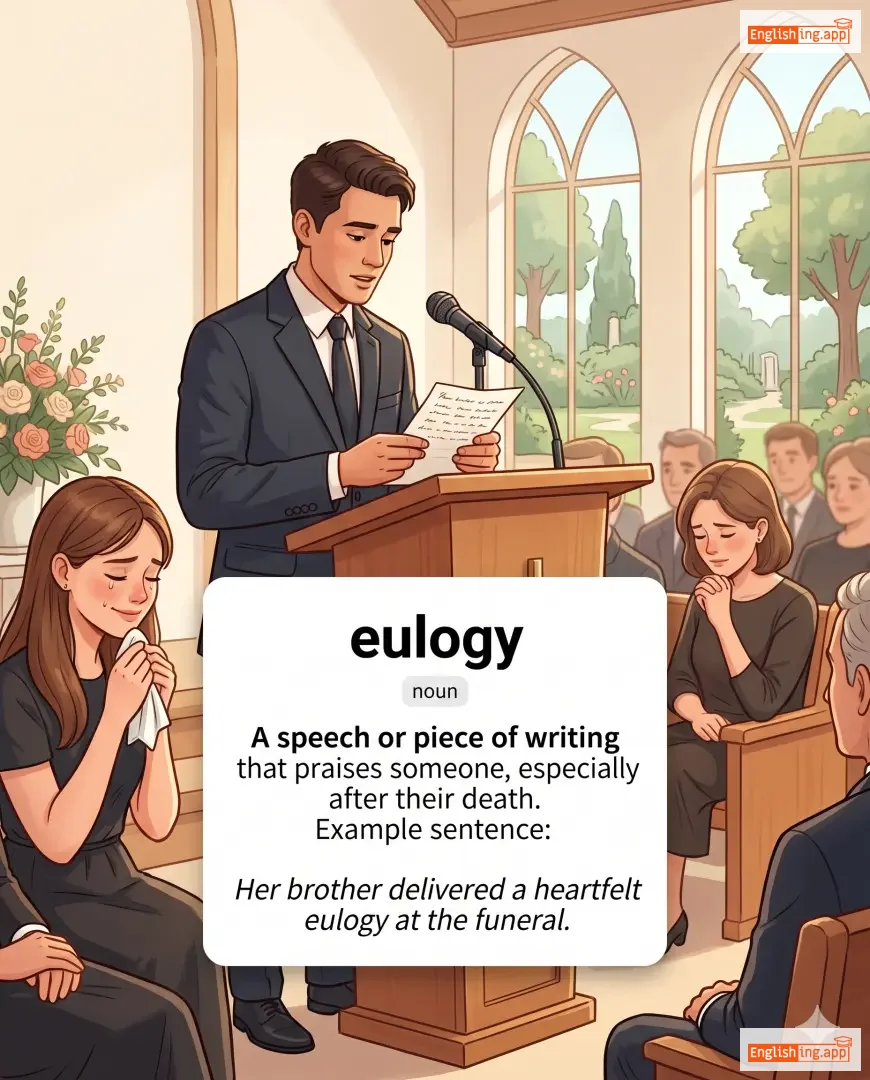
eulogy definition card — visual illustration of the meaning
noun
/ˈjuːlədʒi/
éloge funèbre (eloge funebre)

A speech or piece of writing that praises someone, especially after their death.

"Her brother delivered a heartfelt eulogy at the funeral."

"Son frère a prononcé un éloge funèbre émouvant lors des funérailles." (Son frère a prononcé un éloge funèbre émouvant lors des funérailles.)
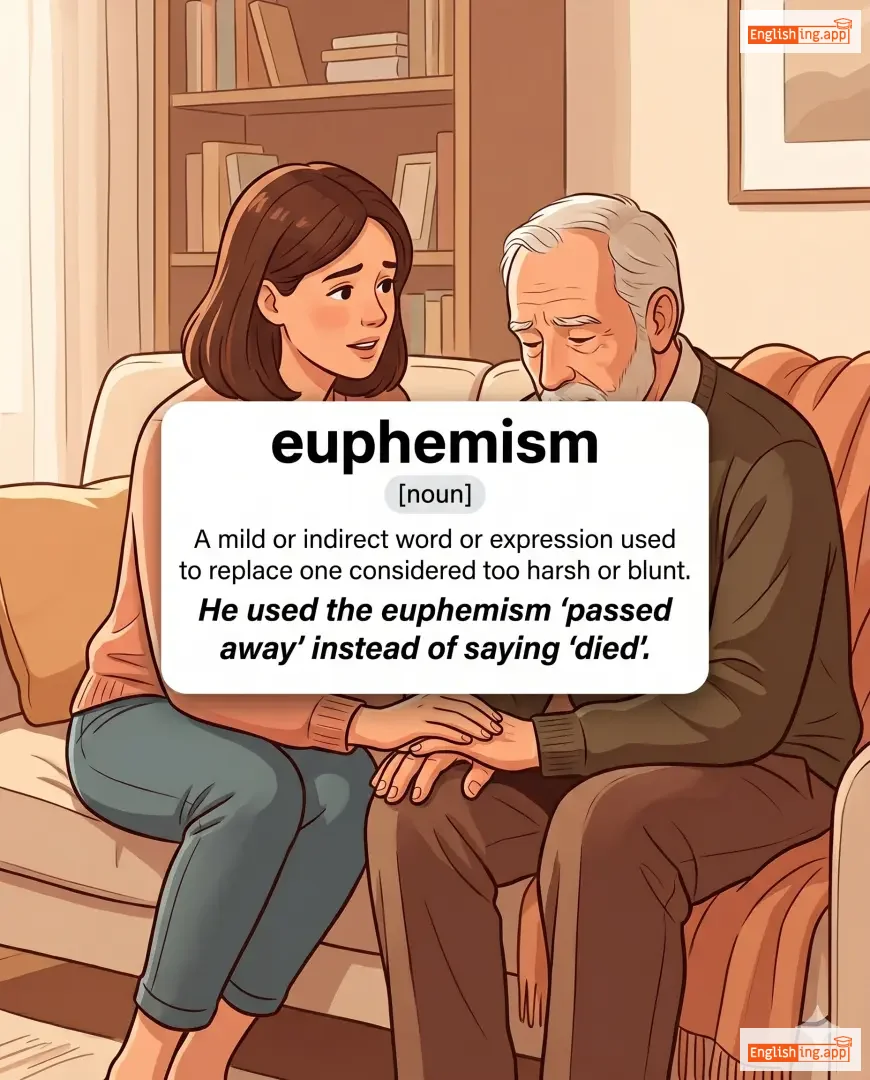
euphemism definition card — visual illustration of the meaning
noun
/ˈjuːfəmɪzəm/
euphémisme (euphemisme)

A mild or indirect word or expression used to replace one considered too harsh or blunt.

"He used the euphemism 'passed away' instead of saying 'died'."

"Il a utilisé l'euphémisme 's'éteindre' au lieu de dire 'mourir'." (Il a utilisé l'euphémisme 's'éteindre' au lieu de dire 'mourir'.)
adjective
/juːˈfoʊniəs/
son harmonieux (son harmonieux)

Pleasing to the ear; having a sweet sound.

"The poet's euphonious language made the verse a delight to read."

"Le langage euphonieux du poète rendait le vers un plaisir à lire." (Le langage euphonieux du poete rendait le vers un plaisir a lire.)
noun
/ˈjuːfəni/
euphonie (eufoni)

The quality of being pleasing to the ear, especially through harmonious combination of words.

"The orator's speech was full of euphony and rhythm."

"Le discours de l'orateur était plein d'euphonie et de rythme." (Le discours de l'orateur était plein d'euphonie et de rythme.)
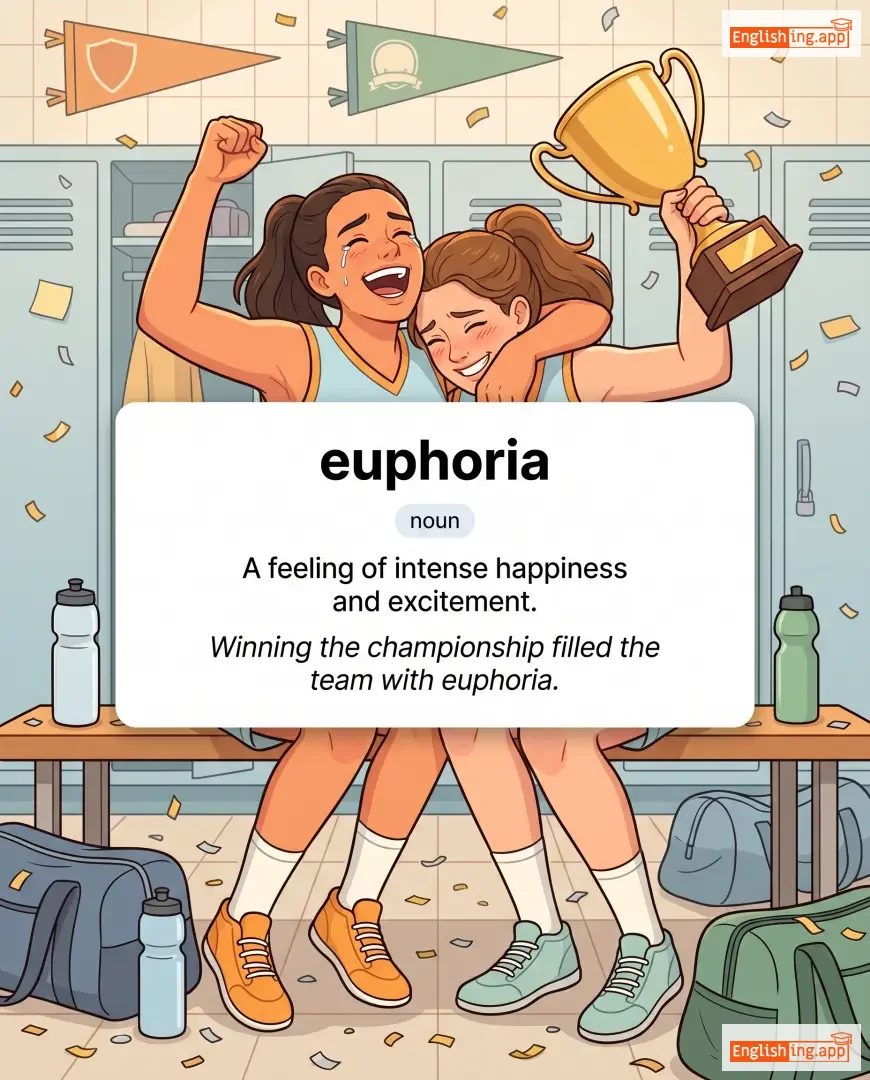
euphoria definition card — visual illustration of the meaning
noun
/juːˈfɔːriə/
euphorie (euphorie)

A feeling of intense happiness and excitement.

"Winning the championship filled the team with euphoria."

"Gagner le championnat a rempli l'équipe d'euphorie." (Gagner le championnat a rempli l'équipe d'euphorie.)
adjective
/juːˈfɔːrɪk/
euphorique (euphorik)

Characterized by or feeling intense excitement and happiness.

"The fans were euphoric after their team's victory."

"Les fans étaient euphorique après la victoire de leur équipe." (Le fans etaient euphorique apres la victoire de leur equipe.)
exclamation
/juˈriːkə/
Eureka! (Eureka!)

An exclamation used to express a sudden discovery or realization.

"When the solution finally came to him, he shouted, 'Eureka!'"

"Quand la solution lui est enfin venue, il a crié : 'Eureka!'" (Quand la solution lui est enfin venue, il a crié : 'Eureka!')
adjective
/ˌjʊərəˈpiːən/
européen (europeen)

Relating to Europe or its people.

"She studied European history at university."

"Elle a étudié l'histoire européenne à l'université." (Elle a étudié l'histoire européenne à l'université.)
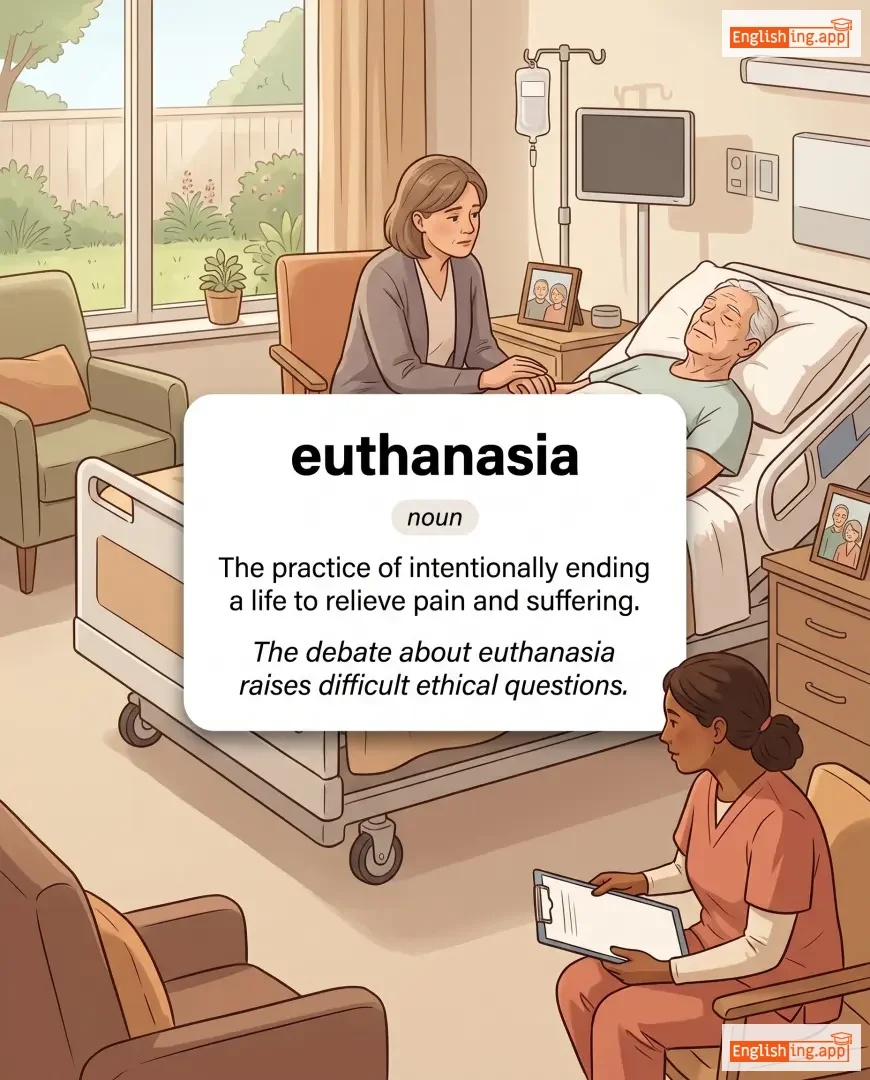
euthanasia definition card — visual illustration of the meaning
noun
/ˌjuːθəˈneɪʒə/
suicide assisté (suicide assiste)

The practice of intentionally ending a life to relieve pain and suffering.

"The debate about euthanasia raises difficult ethical questions."

"Le débat sur l'euthanasie soulève des questions éthiques difficiles." (Le debat sur l'euthanasie souleve des questions ethique difficiles.)
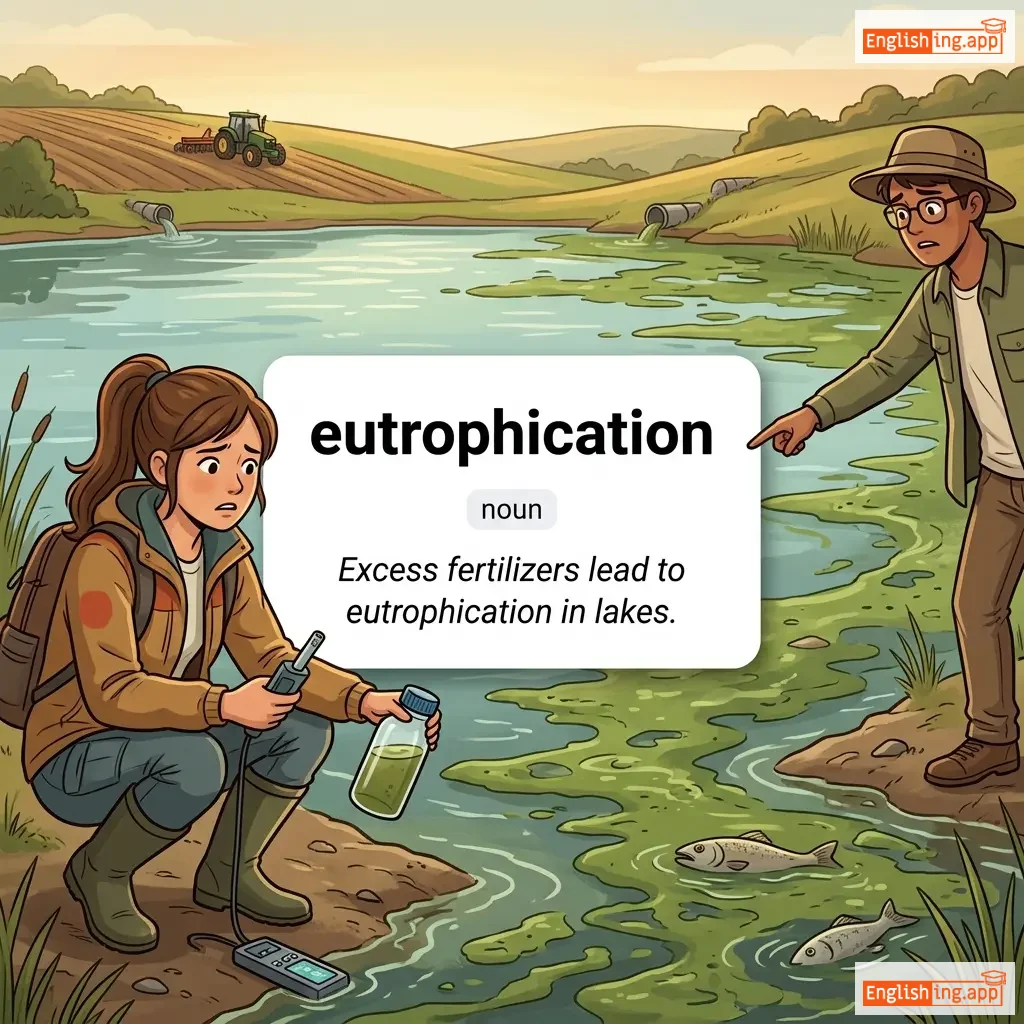
eutrophication definition card — visual illustration of the meaning
noun
/juːˌtrɑː.fɪˈkeɪ.ʃən/
excès de nutriments dans un lac ou un autre plan d'eau (exces de nutriments dans un lac ou un autre plan d'eau)

Excessive richness of nutrients in a lake or other body of water, frequently due to runoff from the land, which causes a dense growth of plant life and death of animal life from lack of oxygen.

"Excess fertilizers lead to eutrophication in lakes."

"Les fertilisants excessifs entraînent l'eutrophisation dans les lacs." (Les fertilisants excessifs entraînent l'eutrophisation dans les lacs.)
verb
/ɪˈvækjueɪt/
évacuer (evacuer)

To remove people from a dangerous place to safety.

"The residents were ordered to evacuate the building after the fire alarm."

"Les résidents ont été invités à évacuer l'immeuble après l'alarme incendie." (Les résidents ont été invités à évacuer l'immeuble après l'alarme incendie.)
verb
/ɪˈveɪd/
évader (evader)

To escape or avoid something, especially by cleverness or trickery.

"He tried to evade the question by changing the subject."

"Il a essayé d'éviter la question en changeant de sujet." (Il a essaye d'éviter la question en changeant de sujet.)
verb
/ɪˈvæljueɪt/
évaluer (evaluer)

To assess or judge the value, quality, or significance of something.

"The teacher will evaluate the students’ projects tomorrow."

"Le professeur évaluera les projets des élèves demain." (Le professeur évaluera les projets des élèves demain.)
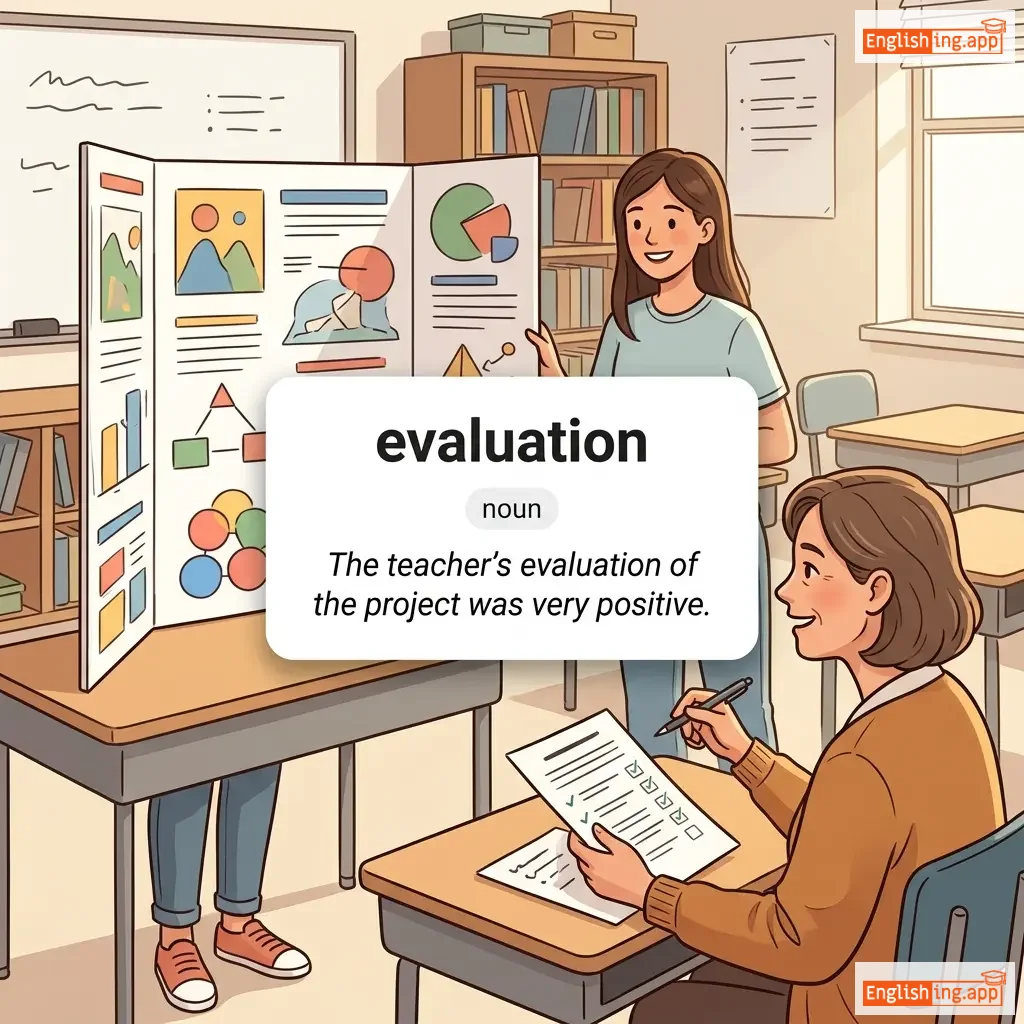
evaluation definition card — visual illustration of the meaning
noun
/ɪˌvæljʊˈeɪʃən/
évaluation (evaluation)

The process of assessing or judging the value, quality, or importance of something.

"The teacher’s evaluation of the project was very positive."

"L'évaluation du projet par l'enseignant a été très positive." (L'évaluation du projet par l'enseignant a été très positive.)
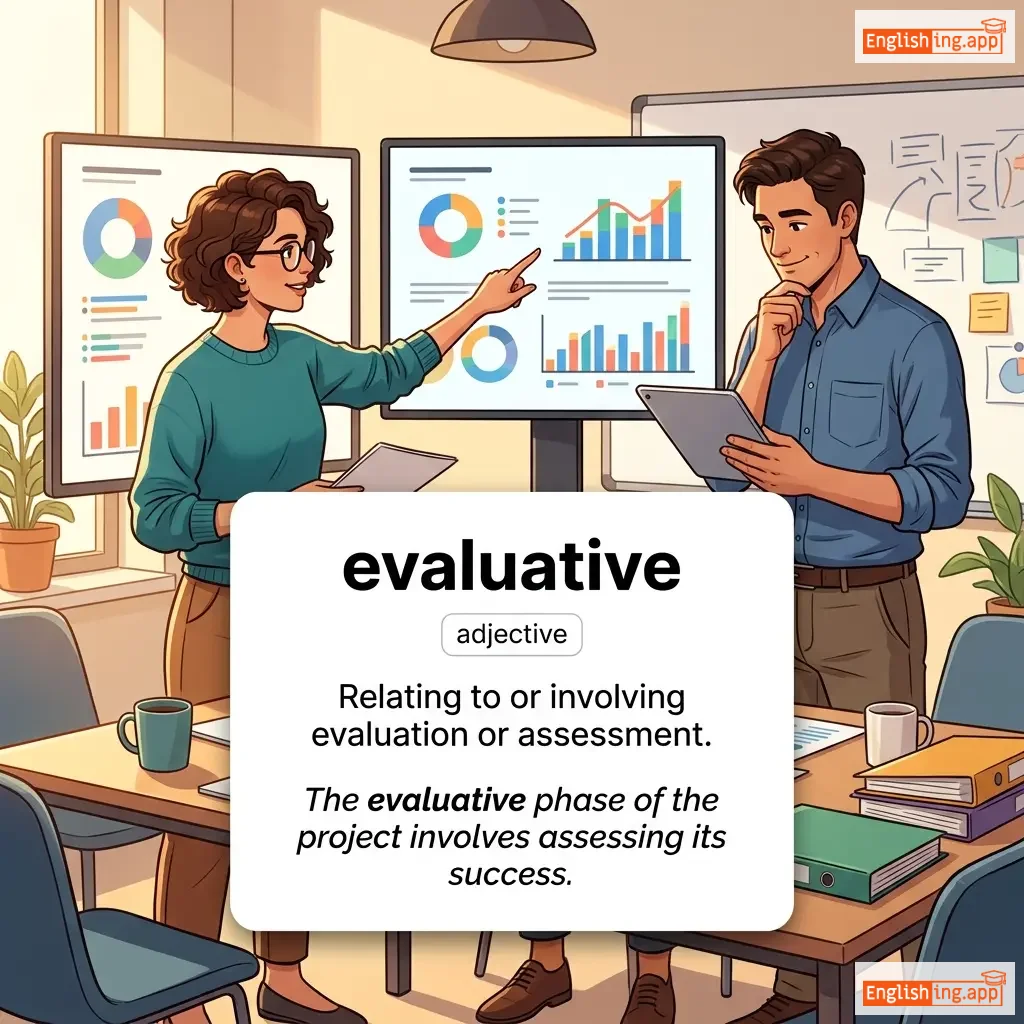
evaluative definition card — visual illustration of the meaning
adjective
/ɪˈvæljʊətɪv/
évaluatif (evaluatif)

Relating to or involving evaluation or assessment.

"The evaluative phase of the project involves assessing its success."

"La phase évaluative du projet consiste à évaluer son succès." (La phase evaluative du projet consiste a evaluer son succes.)
verb
/ˌɛvəˈnɛs/
s'évanouir (sevanouir)

To disappear gradually; to fade away.

"The mist began to evanesce as the sun rose higher."

"La brume a commencé à s'évanouir à mesure que le soleil montait plus haut." (La brume a commencé à s'évanouir à mesure que le soleil montait plus haut.)
adjective
/ˌɛvəˈnɛsənt/
éphémère (ephemere)

Quickly fading or disappearing; lasting for only a very short time.

"The beauty of the sunset was evanescent, fading within minutes."

"La beauté du coucher du soleil était éphémère, disparaissant en quelques minutes." (La beaute du coucher du soleil etait ephemere, disparaissant en quelques minutes.)
adjective
/ˌiːvænˈdʒɛlɪkəl/
évangélique (evangelique)

Relating to the Christian gospel, especially the teachings that emphasize personal faith and the authority of the Bible.

"She grew up in an evangelical church community."

"Elle a grandi dans une communauté chrétienne évangélique." (Elle a grandi dans une communaute chretienne evangelique.)
noun
/ɪˈvændʒəlɪst/
évangéliste (evangeliste)

A person who seeks to convert others to the Christian faith, especially by public preaching.

"The evangelist traveled across the country spreading his message."

"L'évangéliste a voyagé à travers le pays en diffusant son message." (L'évangéliste a voyagé à travers le pays en diffusant son message.)
noun
/ɪˈvæp.ər.ə.tɪv ˈkuː.lər/
refroidisseur par évaporation (refroidisseur par evaporation)

a cooling device that uses water evaporation to reduce air temperature

"The evaporative cooler works best in dry climates."

"Le refroidisseur par évaporation fonctionne mieux dans les climats secs." (Le refroidisseur par evaporation fonctionne mieux dans les climats secs)
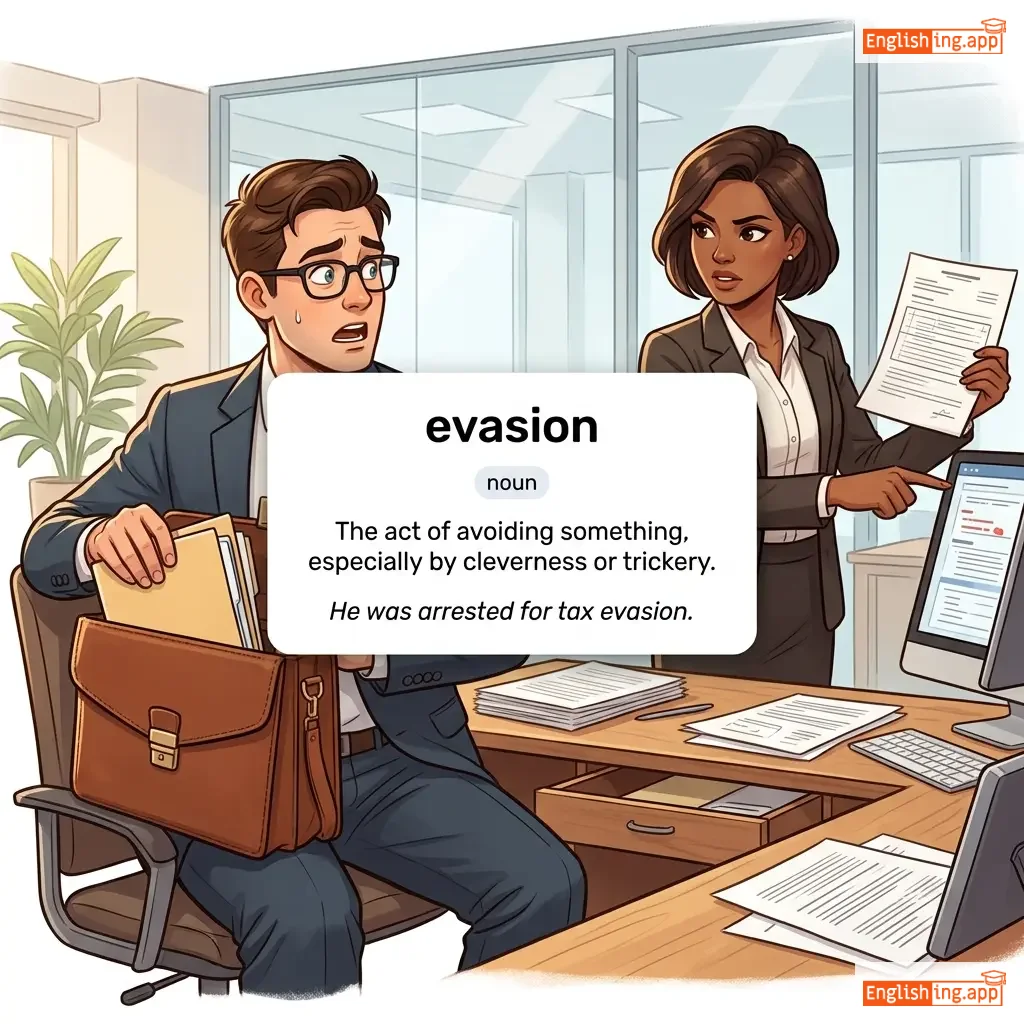
evasion definition card — visual illustration of the meaning
noun
/ɪˈveɪʒən/
évasion (évasion)

The act of avoiding something, especially by cleverness or trickery.

"He was arrested for tax evasion."

"Il a été arrêté pour évasion fiscale." (Il a été arrêté pour évasion fiscale.)
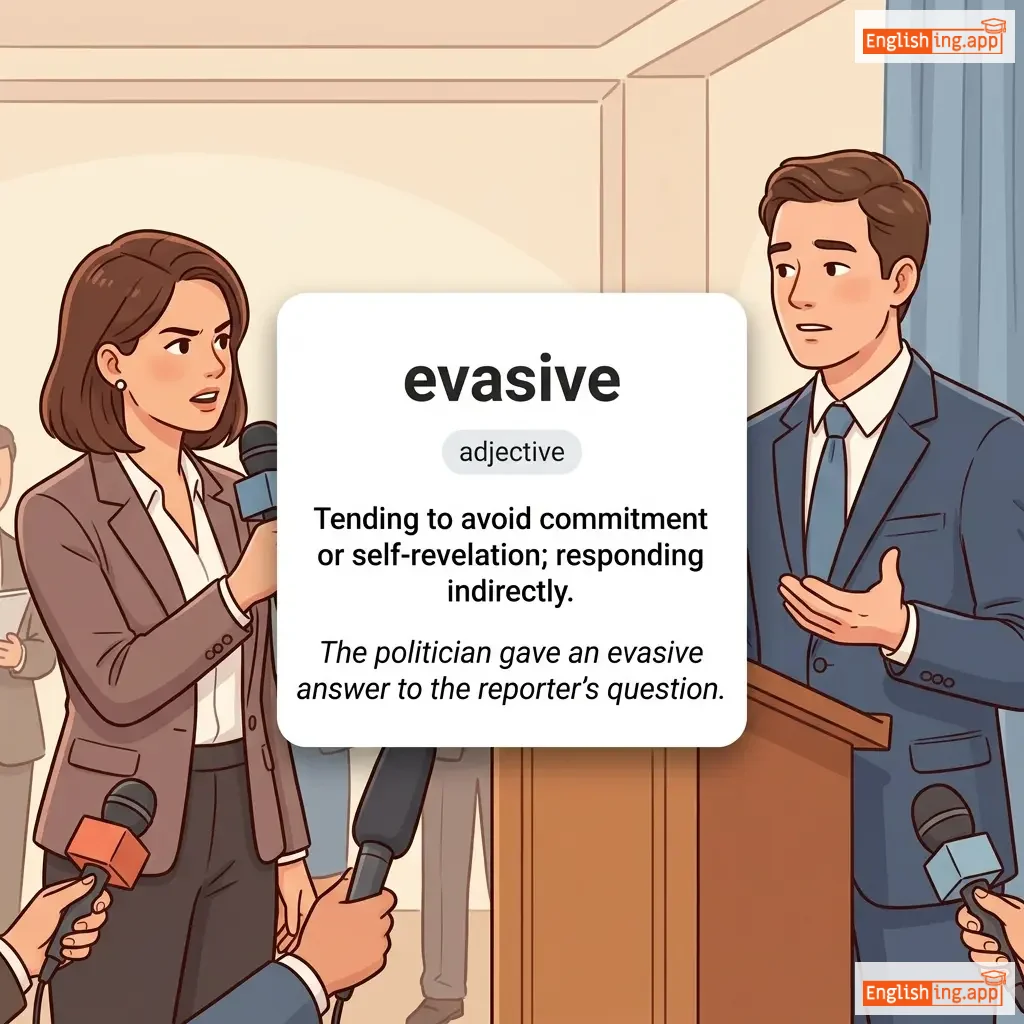
evasive definition card — visual illustration of the meaning
adjective
/ɪˈveɪsɪv/
évasif (évasif)

Tending to avoid commitment or self-revelation; responding indirectly.

"The politician gave an evasive answer to the reporter's question."

"Le politicien a donné une réponse évasive à la question du reporter." (Le politicien a donné une réponse évasive à la question du reporter.)
adjective, adverb
/ˈiː.vən/
égal (egal)

flat or smooth; equal in degree or amount; used to emphasize something surprising

"The road was surprisingly even after the storm."

"La route était étonnamment lisse après la tempête." (La route était étonnamment lisse après la tempête.)
adjective
/ˌiːvənˈhændɪd/
impartial (impartial)

Fair and impartial; showing no bias or favoritism.

"The judge was praised for her evenhanded approach to the case."

"Le juge a été félicité pour son approche impartiale du cas." (Le juge a été félicité pour son approche impartiale du cas.)