Vocabulaires

Découvrez, apprenez et maîtrisez le vocabulaire anglais

e-commerce definition card — visual illustration of the meaning
noun
ˈiːˌkɒm.ɜːrs
commerce en ligne (commerce en ligne)

The process of buying and selling goods or services through the internet.

"E-commerce has revolutionized the way people shop."

"Le commerce en ligne a révolutionné la façon dont les gens font leurs achats." (Le commerce en ligne a révolutionné la façon dont les gens font leurs achats.)
noun, verb
/ˈiː.meɪl/
courrier électronique (courrier electronique)

messages distributed by electronic means from one computer user to another

"I sent an e-mail to my professor yesterday."

"J'ai envoyé un courrier électronique à mon professeur hier." (J'ai envoyé un courrier électronique à mon professeur hier.)
abbreviation
/iː ˈdʒiː/
par exemple (par exemple)

For example (from Latin 'exempli gratia').

"You should eat more fruits, e.g., apples and bananas."

"Vous devriez manger plus de fruits, par exemple, des pommes et des bananes." (Vous devriez manger plus de fruits, par exemple, des pommes et des bananes.)
determiner/pronoun
/iːtʃ/
chaque (chaque)

every one of two or more people or things considered separately

"Each student received a certificate."

"Chaque étudiant a reçu un certificat." (Chaque étudiant a reçu un certificat.)
adjective
/ˈiːɡər/
enthousiaste / impatient (enthousiaste / impatient)

very excited and interested; keen to do something

"The children were eager to open their gifts."

"Les enfants étaient impatients d'ouvrir leurs cadeaux." (Les enfants étaient impatients d'ouvrir leurs cadeaux.)
adverb
/ˈiːɡərli/
avec empressement; avec grand désir (avec empressement; avec grand desir)

with keen interest or enthusiasm; with great desire

"The children eagerly waited for the holiday to begin."

"Les enfants attendaient avec empressement que les vacances commencent." (Les enfants attendaient avec empressement que les vacances commencent)
noun
/ˈiː.ɡəl/
aigle (aigle)

large bird of prey with powerful wings and sharp talons

"The eagle soared high above the mountains."

"L'aigle a volé haut au-dessus des montagnes." (L'aigle a vole haut au-dessus des montagnes)
noun
/ˈiːɡlət/
aiglon (aiglon)

A young eagle.

"The eaglet waited in the nest for its mother to return."

"L'aiglon attendait dans le nid que sa mère revienne." (L'aiglon attendait dans le nid que sa mère revienne.)
noun
/ɪə(r)/
oreille (oreille)

the organ of hearing and balance in humans and other animals

"She whispered something in his ear."

"Elle lui a chuchoté quelque chose à l'oreille." (Elle lui a chuchoté quelque chose à l'oreille.)
noun
/ˈɪər.ɪŋ/
boucle d'oreille (boucle d'oreille)

a piece of jewelry worn on the earlobe or ear

"Her diamond earrings caught everyone's attention."

"Ses boucles d'oreilles en diamant ont attiré l'attention de tout le monde." (Ses boucles d'oreilles en diamant ont attiré l'attention de tout le monde.)
adjective/adverb
/ˈɜːrli/
tôt (tot)

before the usual or expected time

"She arrived early to the meeting."

"Elle est arrivée tôt à la réunion." (Elle est arrivee tot a la reunion.)
verb
/ˈɪə.mɑːrk/
affecter (affecter)

To designate funds, resources, or time for a particular purpose.

"The government has earmarked funds for education."

"Le gouvernement a affecté des fonds pour l'éducation." (Le gouvernement a affecté des fonds pour l'éducation.)
earn definition card — visual illustration of the meaning
verb
/ɜːrn/
gagner (gagner)

To receive money or reward in return for work or service.

"She worked hard to earn enough money for college."

"Elle a travaillé dur pour gagner assez d'argent pour l'université." (Elle a travaille dur pour gagner assez d'argent pour l'université.)
noun
/ˈɜːrnər/
gagnant (gagnant)

A person who earns money through work or business

"She is the primary earner in her family."

"Elle est la principale gagnant de sa famille." (Elle est la principale gagnant de sa famille.)
adjective
/ˈɜːrnɪst/
sérieux et sincère (sérieux et sincère)

showing sincere and intense conviction

"She spoke in an earnest voice about the importance of honesty."

"Elle parlait avec une voix sincère de l'importance de l'honnêteté." (Elle parlait avec une voix sincère de l'importance de l'honnêteté.)
noun
/ˈɜːnɪŋz/
revenus (revenus)

money obtained in return for labor or services

"Her monthly earnings are enough to support her family."

"Ses revenus mensuels sont suffisants pour soutenir sa famille." (Ses revenus mensuels sont suffisants pour soutenir sa famille.)
noun
/ˈɪrˌplʌɡ/
bouchon d'oreille (bouchon d'oreille)

a device inserted into the ear to block out noise or water

"He wore earplugs to sleep during the noisy night."

"Il portait des bouchons d'oreilles pour dormir pendant la nuit bruyante." (Il portait des bouchons d'oreilles pour dormir pendant la nuit bruyante.)
noun
/ˈɪrˌʃɑːt/
plage d'audition (plage d'audition)

the range or distance within which a sound can be heard

"The children whispered secrets out of earshot of their parents."

"Les enfants ont chuchoté des secrets hors de portée de leurs parents." (Les enfants ont chuchote des secrets hors de portee de leurs parents.)
adjective
/ˈɪrˌsplɪtɪŋ/
assourdissant (assourdissant)

extremely loud or piercing sound

"The earsplitting noise of the fire alarm startled everyone."

"Le bruit assourdissant de l'alarme incendie a surpris tout le monde." (Le bruit assourdissant de l'alarme incendie a surpris tout le monde.)
noun
/ɜːrθ/
terre (terre)

the planet we live on; soil or ground

"The astronauts looked back at the Earth from space."

"Les astronautes ont regardé la Terre depuis l'espace." (Les astronautes ont regardé la Terre depuis l'espace.)
noun
/ˈɜːθ.wɜːm/
ver de terre (ver de terre)

a segmented worm that lives in soil and helps decompose organic matter

"The gardener was happy to find many earthworms in the soil."

"Le jardinier était heureux de trouver de nombreux vers de terre dans le sol." (Le jardinier était heureux de trouver de nombreux vers de terre dans le sol.)
adjective
/ˈɜːr.θən/
fait de terre ou d'argile; lié à la poterie (fait de terre ou d'argile; lié à la poterie)

made of earth or clay; relating to pottery or ceramic materials

"The kitchen had beautiful earthen pots for storage."

"La cuisine avait de beaux pots en terre cuite pour le stockage." (La cuisine avait de beaux pots en terre cuite pour le stockage.)
noun
/ˈɜːr.θən pɒt/
pot en terre cuite (pot en terre cuite)

a container made of baked clay or earth, used for cooking or storing

"The earthen pot keeps water naturally cool in summer."

"Le pot en terre cuite garde l'eau naturellement fraîche en été." (Le pot en terre cuite garde l'eau naturellement fraîche en été.)
noun
/ˈɜːrθənˌwɛr/
céramique (ceramique)

pottery made of clay and hardened by heat

"The shop displayed beautiful earthenware pots and bowls."

"Le magasin a exposé de beaux pots et bols en céramique." (Le magasin a exposé de beaux pots et bols en céramique.)
adjective
/ˈɜːrθli/
terrestre (terrestre)

relating to the physical world as opposed to the spiritual or heavenly; worldly

"He was more concerned with earthly pleasures than spiritual matters."

"Il était plus préoccupé par les plaisirs terrestres que par les affaires spirituelles." (Il était plus préoccupé par les plaisirs terrestres que par les affaires spirituelles.)
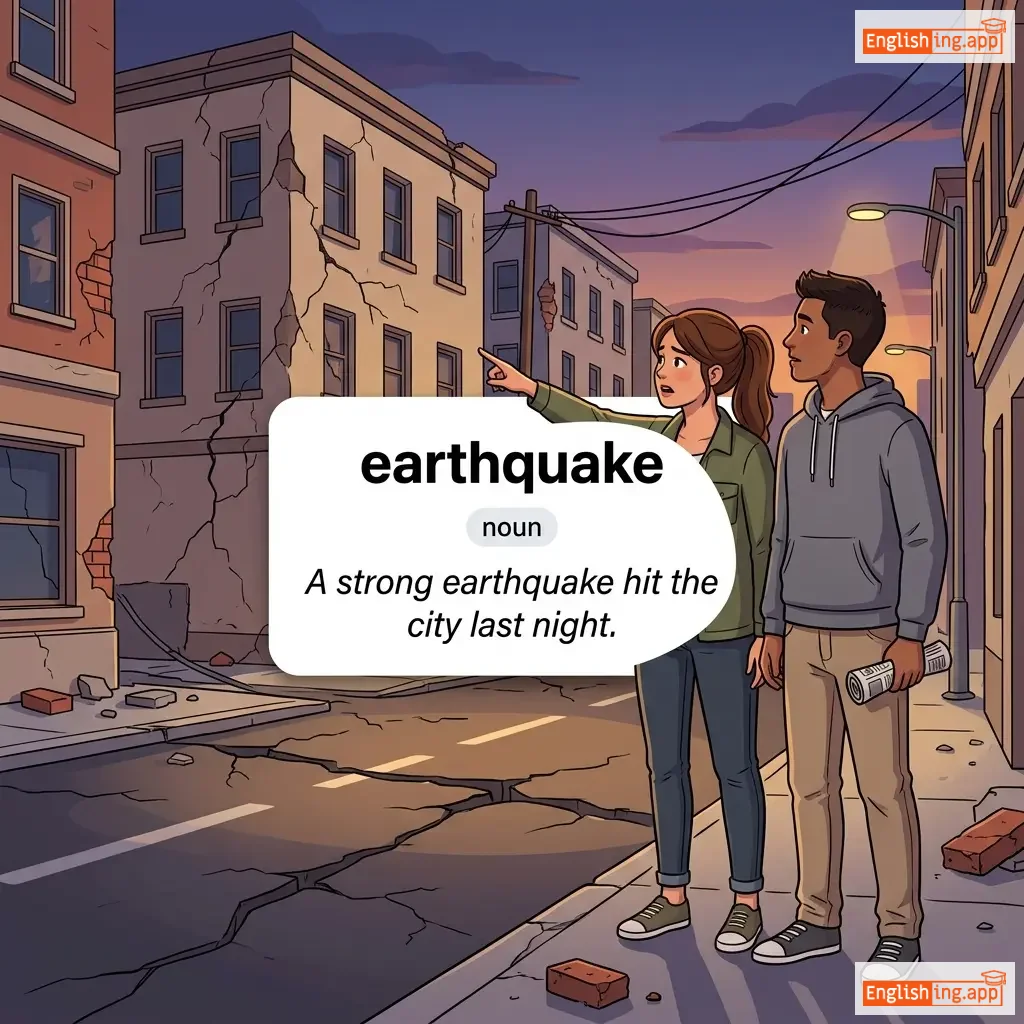
earthquake definition card — visual illustration of the meaning
noun
/ˈɜːrθ.kweɪk/
séisme (seisme)

a sudden shaking of the ground caused by movements within the Earth's crust or volcanic action

"A strong earthquake hit the city last night."

"Un fort séisme a frappé la ville la nuit dernière." (Un fort séisme a frappé la ville la nuit dernière.)
adjective
/ˈɜːrθi/
terrestre / simple (terrestre / simple)

resembling or suggestive of earth or soil; simple, natural, and sometimes coarse

"The dish had a rich, earthy flavor from the mushrooms."

"Le plat avait une saveur riche et terreuse provenant des champignons." (Le plat avait une saveur riche et terreuse provenant des champignons.)
noun/verb
/iːz/
aisance (aisance)

absence of difficulty or effort; to make something less serious or severe

"Meditation helps ease stress."

"La méditation aide à soulager le stress." (La meditation aide a soulager le stress.)
noun
/ˈiːzl̩/
support pour toile (support pour toile)

a frame for supporting an artist's canvas while painting or drawing

"The artist placed the canvas on the easel before starting to paint."

"L'artiste a placé la toile sur le chevalet avant de commencer à peindre." (L'artiste a place la toile sur le chevalet avant de commencer a peindre.)
adverb
/ˈiːzəli/
facilement (facilement)

without difficulty or effort

"He solved the problem easily."

"Il a résolu le problème facilement." (Il a résolu le problème facilement.)
noun
/iːst/
est (est)

The direction from which the sun rises; one of the four cardinal points.

"The sun rises in the east."

"Le soleil se lève à l'est." (Le soleil se leve a l'est.)
adjective
/ˈiːstərn/
oriental (oriental)

Relating to, situated in, or characteristic of the east.

"They traveled to the eastern part of the country."

"Ils ont voyagé dans la partie orientale du pays." (Ils ont voyagé dans la partie orientale du pays.)
adverb
/ˈiːstwədz/
vers l'est (vers l'est)

towards the east; in an eastern direction

"The river flows eastwards into the ocean."

"La rivière coule vers l'est dans l'océan." (La riviere coule vers l'est dans l'ocean.)
adjective
/ˈiːzi/
facile (fasil)

not difficult; requiring little effort

"The exam was surprisingly easy."

"L'examen était étonnamment facile." (L'examen etait etonnamment facile.)
noun
/ˈiː.zi tʃeər/
fauteuil (eezichair)

a comfortable chair with arms and a back that reclines

"He relaxed in his favorite easy-chair after work."

"Il s'est détendu dans son fauteuil préféré après le travail." (il sest detendu dans son fauteuil prefere apres le travail)
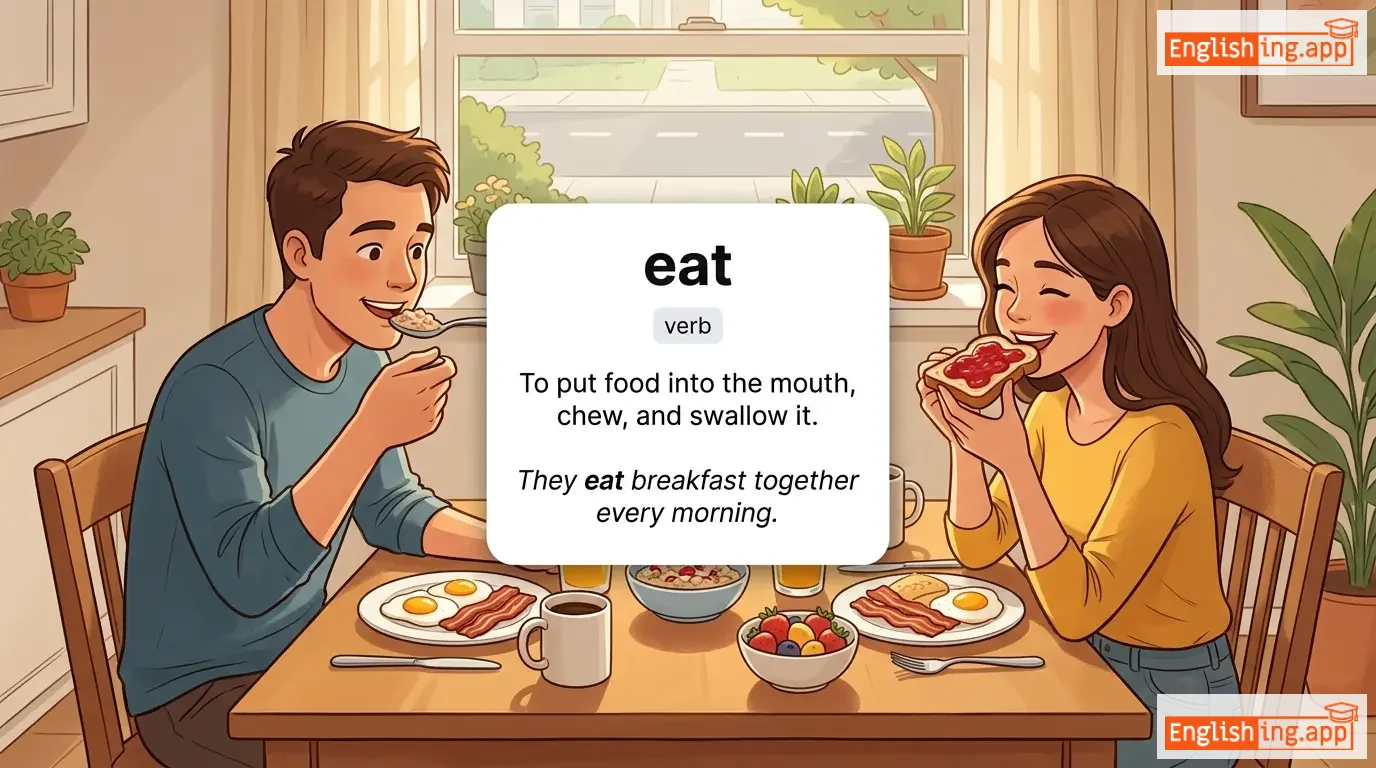
eat definition card — visual illustration of the meaning
🍽️

eat (ite)

verb
/iːt/
manger (manger)

To put food into the mouth, chew, and swallow it.

"They eat breakfast together every morning."

"Ils prennent leur petit-déjeuner ensemble tous les matins." (Ils prennent leur petit-déjeuner ensemble tous les matins.)
adjective
/ˈiːtəbl̩/
comestible (comestible)

suitable or safe for eating

"The berries are not only eatable but also quite tasty."

"Les baies ne sont pas seulement comestibles mais aussi assez savoureuses." (Les baies ne sont pas seulement comestibles mais aussi assez savoureuses.)
verb
/ˈiːtɪŋ/
manger (manger)

the act of consuming food

"They were eating dinner when the phone rang."

"Ils étaient en train de manger le dîner lorsque le téléphone a sonné." (Ils etaient en train de manger le diner lorsque le telephone a sonne.)
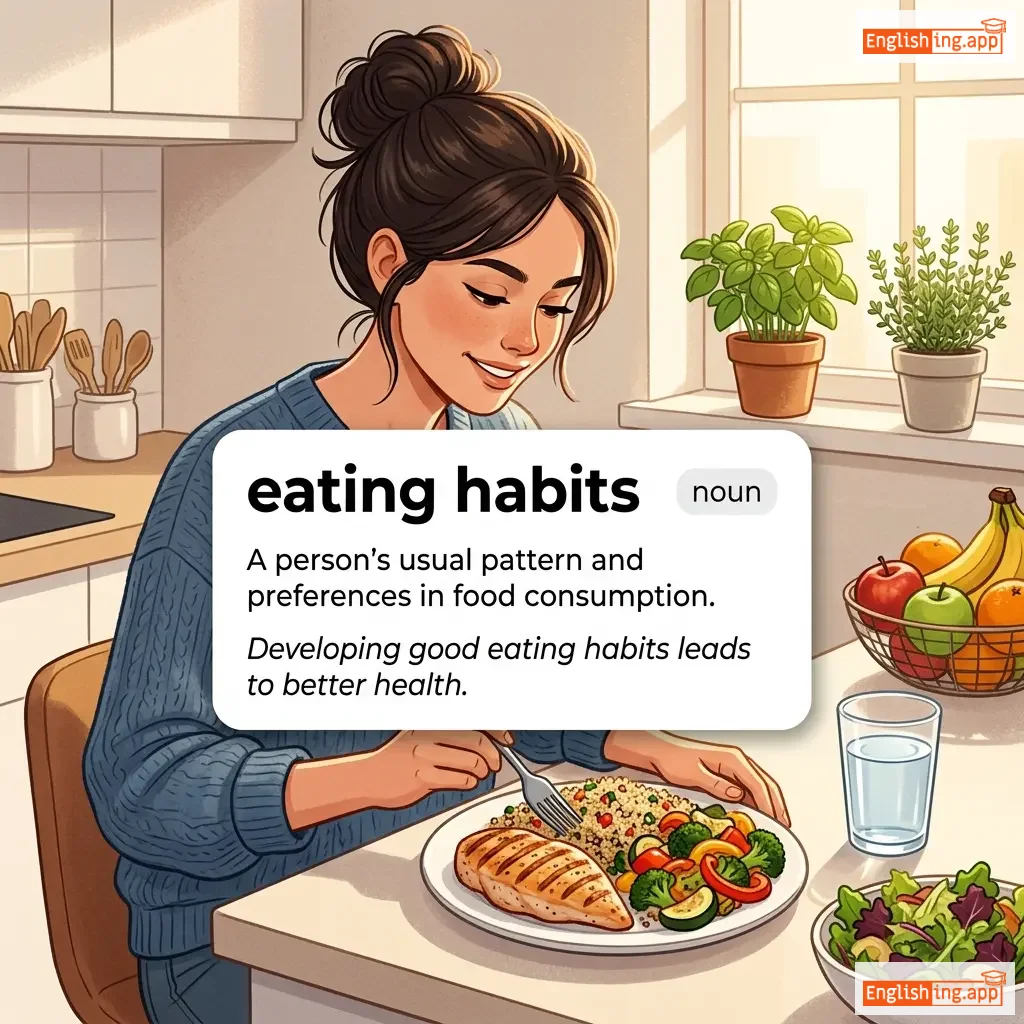
eating habits definition card — visual illustration of the meaning
noun
/ˈiː.tɪŋ ˈhæb.ɪts/
habitudes alimentaires (habitudes alimentaires)

A person's usual pattern and preferences in food consumption.

"Developing good eating habits leads to better health."

"Développer de bonnes habitudes alimentaires conduit à une meilleure santé." (Developper de bonnes habitudes alimentaires conduit a une meilleure sante.)
verb
/ˈiːvzdrɒp/
écouter en cachette (ecouter en cachette)

to secretly listen to a conversation

"She stood near the door to eavesdrop on their conversation."

"Elle était près de la porte pour écouter discrètement leur conversation." (Elle etait pres de la porte pour ecouter discretement leur conversation.)
verb
/ɛb/
diminuer (diminuer)

to recede, decline, or lessen gradually, often referring to the tide or emotions

"Her confidence began to ebb after the repeated failures."

"Sa confiance a commencé à diminuer après les échecs répétés." (Sa confiance a commencé à diminuer après les échecs répétés.)
noun
/ˈeb.taɪd/
basse mer (basse mer)

the movement of the tide out to sea; a time when the sea level is falling

"During ebb-tide, we could walk further out on the beach."

"Pendant la basse mer, nous pouvions marcher plus loin sur la plage." (Pendant la basse mer, nous pouvions marcher plus loin sur la plage.)
noun
/ɪˈbʊliəns/
exubérance (exuberance)

the quality of being cheerful, enthusiastic, and full of energy

"The teacher's ebullience inspired her students."

"L'enthousiasme de l'enseignante a inspiré ses élèves." (L'enthousiasme de l'enseignante a inspire ses eleves.)
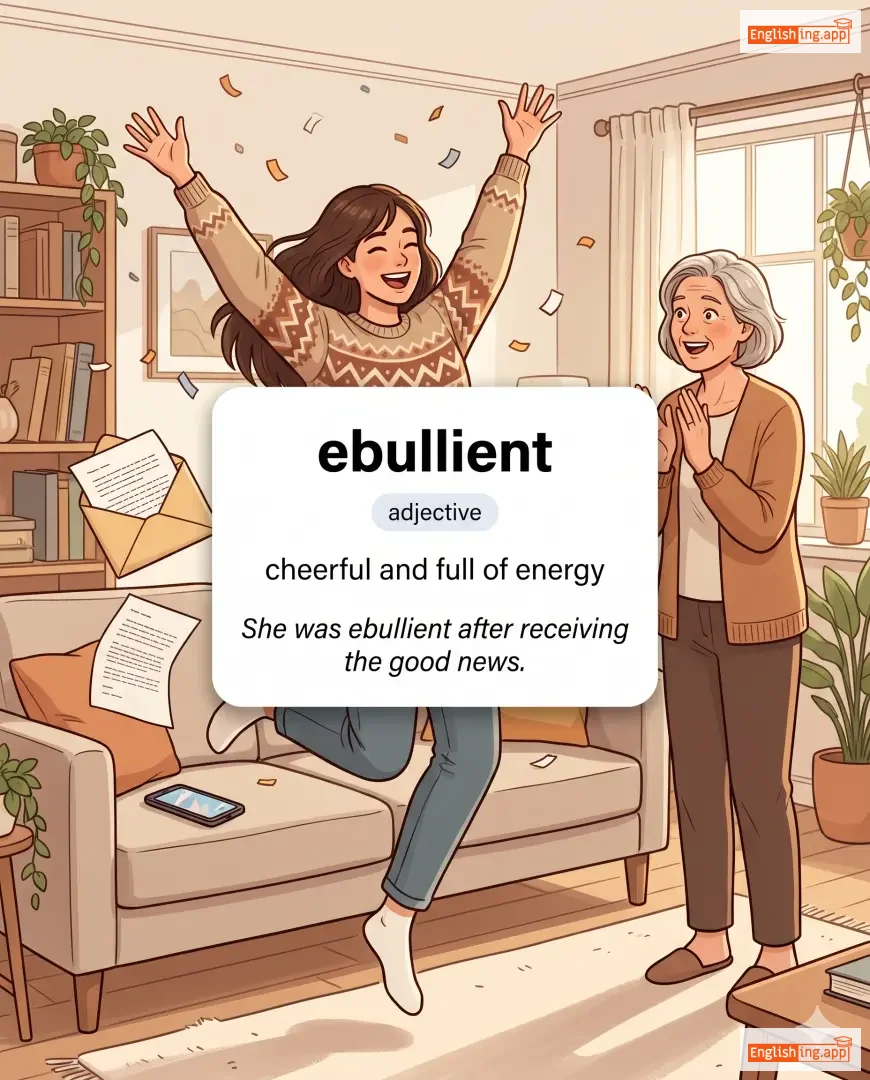
ebullient definition card — visual illustration of the meaning
adjective
/ɪˈbʊliənt/
exubérant (exuberant)

cheerful and full of energy

"She was ebullient after receiving the good news."

"Elle était exubérante après avoir reçu la bonne nouvelle." (Elle etait exuberante apres avoir recu la bonne nouvelle.)
adjective
/ɪkˈsɛntrɪk/
excentrique (eksantrik)

unconventional and slightly strange in behavior or appearance

"The artist was known for his eccentric style."

"L'artiste était connu pour son style excentrique." (L'artiste était connu pour son style eksantrik.)
noun
/ˌɛksɛnˈtrɪsəti/
excentricité (excentricite)

the quality of being unconventional or slightly strange

"His eccentricity made him both admired and misunderstood."

"Son excentricité a fait de lui une personne à la fois admirée et incomprise." (Son excentricité a fait de lui une personne à la fois admirée et incomprise.)
noun
/ɪˌkliːziˈæstɪk/
ecclésiastique (ecclesiastique)

A member of the clergy or church official.

"The council was attended by several high-ranking ecclesiastics."

"Le conseil a été assisté par plusieurs ecclésiastiques de haut rang." (Le conseil a été assisté par plusieurs ecclésiastiques de haut rang.)
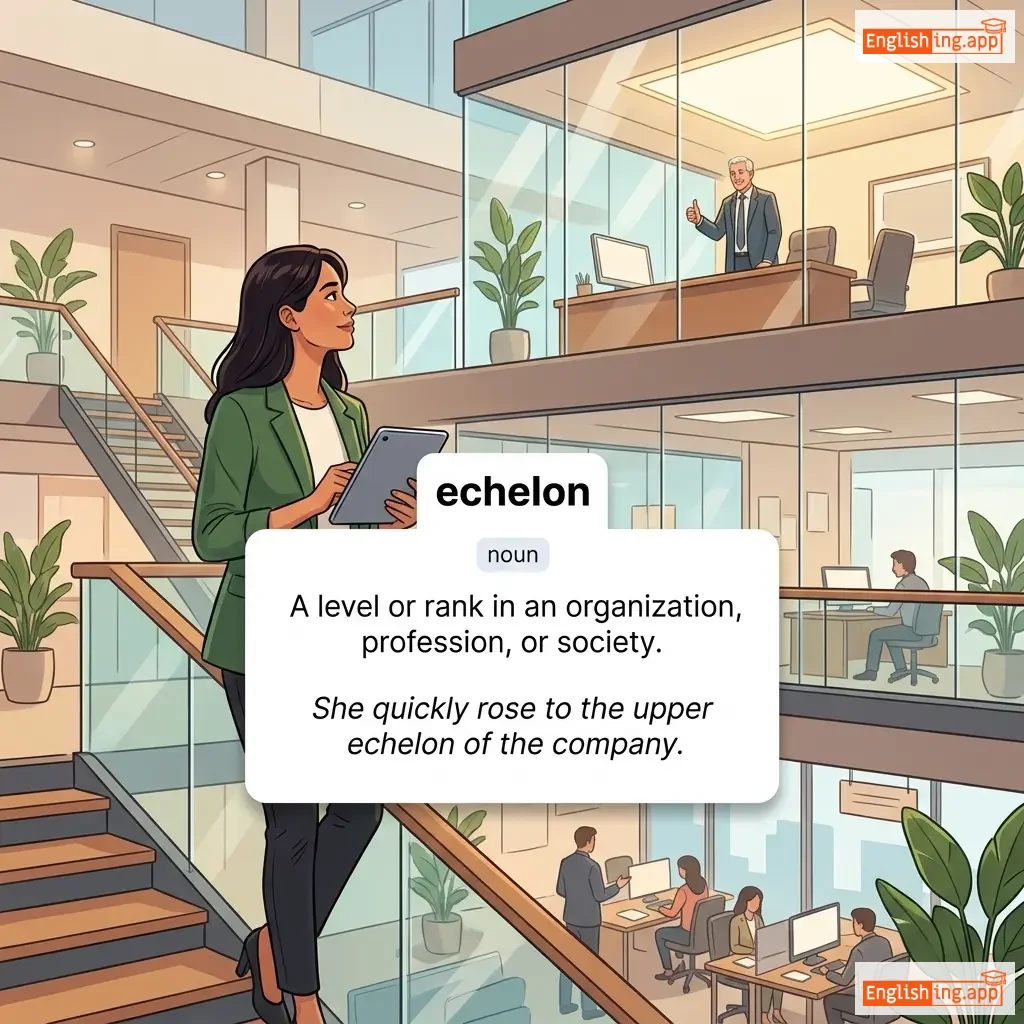
echelon definition card — visual illustration of the meaning
noun
/ˈɛʃəlɒn/
échelon (échelon)

A level or rank in an organization, profession, or society.

"She quickly rose to the upper echelon of the company."

"Elle a rapidement atteint le niveau supérieur de l'entreprise." (Elle a rapidement atteint le niveau supérieur de l'entreprise.)
noun, verb
/ˈɛkəʊ/
bonheur (bonheur)

a sound that is reflected off a surface and heard again; to repeat or reflect a sound or idea.

"Her laughter echoed through the empty hall."

"Elle n'a pas pu cacher son bonheur lorsqu'elle a reçu le prix." (Elle n'a pas pu cacher son bonheur lorsqu'elle a reçu le prix.)
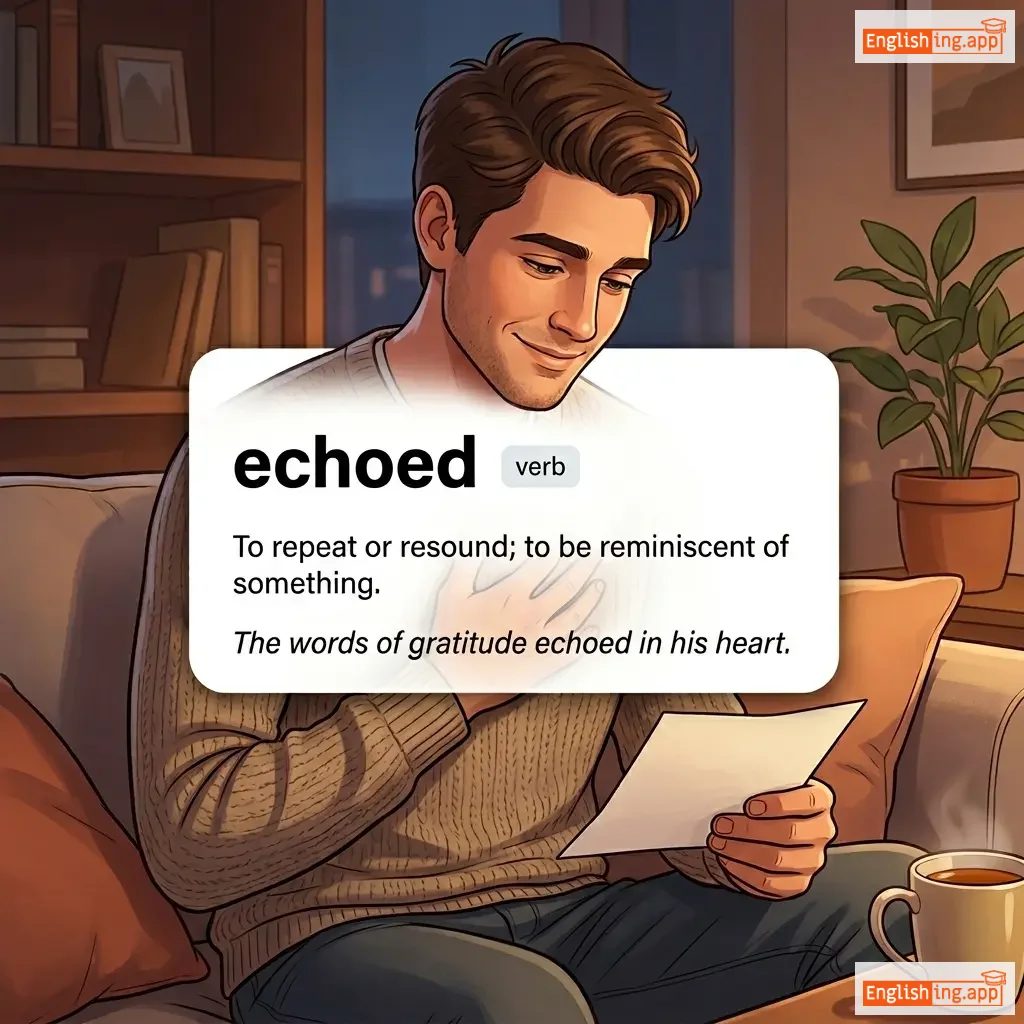
echoed definition card — visual illustration of the meaning
verb
ˈɛkəʊd
résonné (resonne)

To repeat or resound; to be reminiscent of something.

"The words of gratitude echoed in his heart."

"Les mots de gratitude ont résonné dans son cœur." (Les mots de gratitude ont resonne dans son coeur.)