Vocabulaires

Découvrez, apprenez et maîtrisez le vocabulaire anglais

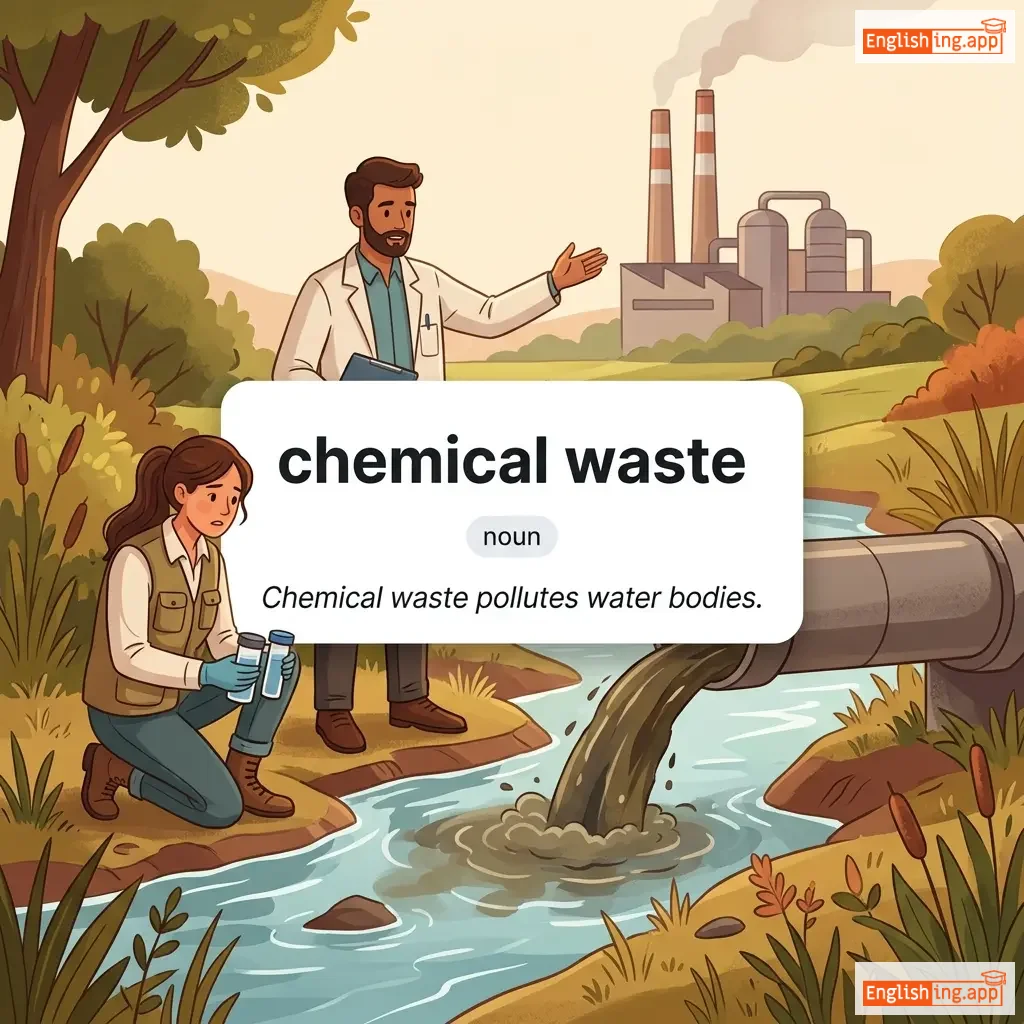
chemical waste definition card — visual illustration of the meaning
noun
ˈkɛmɪkəl weɪst
déchets chimiques (dechets chimiques)

Waste material from industrial or laboratory processes that contains harmful chemicals.

"Chemical waste pollutes water bodies."

"Les déchets chimiques polluent les plans d'eau." (Les dechets chimiques polluent les plans d'eau.)
noun
/ʃəˈmiːz/
chemise (chemise)

a woman's loose-fitting undergarment or dress hanging straight from the shoulders

"The vintage chemise was made of delicate lace and silk."

"La chemise vintage était faite de dentelle délicate et de soie." (La chemise vintage était faite de dentelle délicate et de soie.)
noun
/ˈkemɪst/
chimiste; pharmacien (chimiste; pharmacien)

a scientist who studies chemistry; a person trained to prepare and dispense medicines

"The chemist analyzed the sample to determine its composition."

"Le chimiste a analysé l’échantillon pour déterminer sa composition." (Le chimiste a analyse lechantillon pour determiner sa composition)
noun
/ˈkɛmɪstri/
chimie (chimie)

the branch of science that studies substances and their interactions; also the emotional connection between people

"They have great chemistry and work well together."

"Ils ont une excellente chimie et travaillent bien ensemble." (Ils ont une excellente chimie et travaillent bien ensemble.)
adjective
/ˈtʃɛkərd/
à rayures (a rayures)

Having a pattern of squares, or marked by varied and contrasting experiences or periods.

"He had a chequered career with both great successes and failures."

"Il a eu une carrière à rayures avec de grands succès et des échecs." (Il a eu une carrière a rayures avec de grands succes et des echecs.)
verb
/ˈtʃɛrɪʃ/
chérir (cherir)

To hold something dear, to love and protect, or to keep a hope or memory alive.

"She cherishes the memories of her childhood home."

"Elle chérit les souvenirs de sa maison d'enfance." (Elle chérit les souvenirs de sa maison d'enfance.)
noun
/ˈtʃer.i/
cerise (cerise)

a small round red or black fruit with a hard seed inside

"She picked fresh cherries from the tree in her garden."

"Elle a cueilli des cerises fraîches de l'arbre dans son jardin." (Elle a cueilli des cerises fraiches de l'arbre dans son jardin.)
noun
/ˈtʃer.i ˌblɒs.əm/
fleur de cerisier (fleur de cerisier)

the pink or white flowers of a cherry tree that bloom in spring

"The cherry blossoms bloom beautifully in April."

"Les fleurs de cerisier fleurissent magnifiquement en avril." (Les fleurs de cerisier fleurissent magnifiquement en avril.)
adjective
/tʃəˈruːbɪk/
angélique (angelique)

Innocent, sweet, and angelic, like a cherub.

"The baby had a cherubic smile that melted everyone’s heart."

"Le bébé avait un sourire angélique qui faisait fondre le cœur de tout le monde." (Le bebe avait un sourire angelique qui faisait fondre le coeur de tout le monde.)
noun
/tʃɛst/
poitrine (poitrine)

the front part of the human body between the neck and the stomach

"He felt a pain in his chest after running."

"Il a ressenti une douleur dans sa poitrine après avoir couru." (Il a ressenti une douleur dans sa poitrine après avoir couru.)
noun
/ˈʃɛvrən/
symbole en forme de V (symbole en forme de V)

A V-shaped pattern, often used in military insignia or design.

"The sergeant’s uniform displayed three chevrons on the sleeve."

"L'uniforme du sergent affichait trois chevrons sur la manche." (L'uniforme du sergent affichait trois chevrons sur la manche.)
verb
/tʃuː/
bonheur (bonheur)

to bite food into smaller pieces with your teeth before swallowing it

"You should chew your food properly to help with digestion."

"Elle n'a pas pu cacher son bonheur lorsqu'elle a reçu le prix." (Elle n'a pas pu cacher son bonheur lorsqu'elle a reçu le prix.)
noun
/kiˌɑːrəˈskjʊəroʊ/
contraste dramatique entre lumière et ombre (contraste dramatique entre lumiere et ombre)

The use of strong contrasts between light and dark in art or literature to create a dramatic effect.

"The artist's painting used chiaroscuro to highlight the figure's face."

"Le tableau de l'artiste a utilisé le chiaroscuro pour mettre en valeur le visage de la figure." (Le tableau de l'artiste a utilise le chiaroscuro pour mettre en valeur le visage de la figure.)
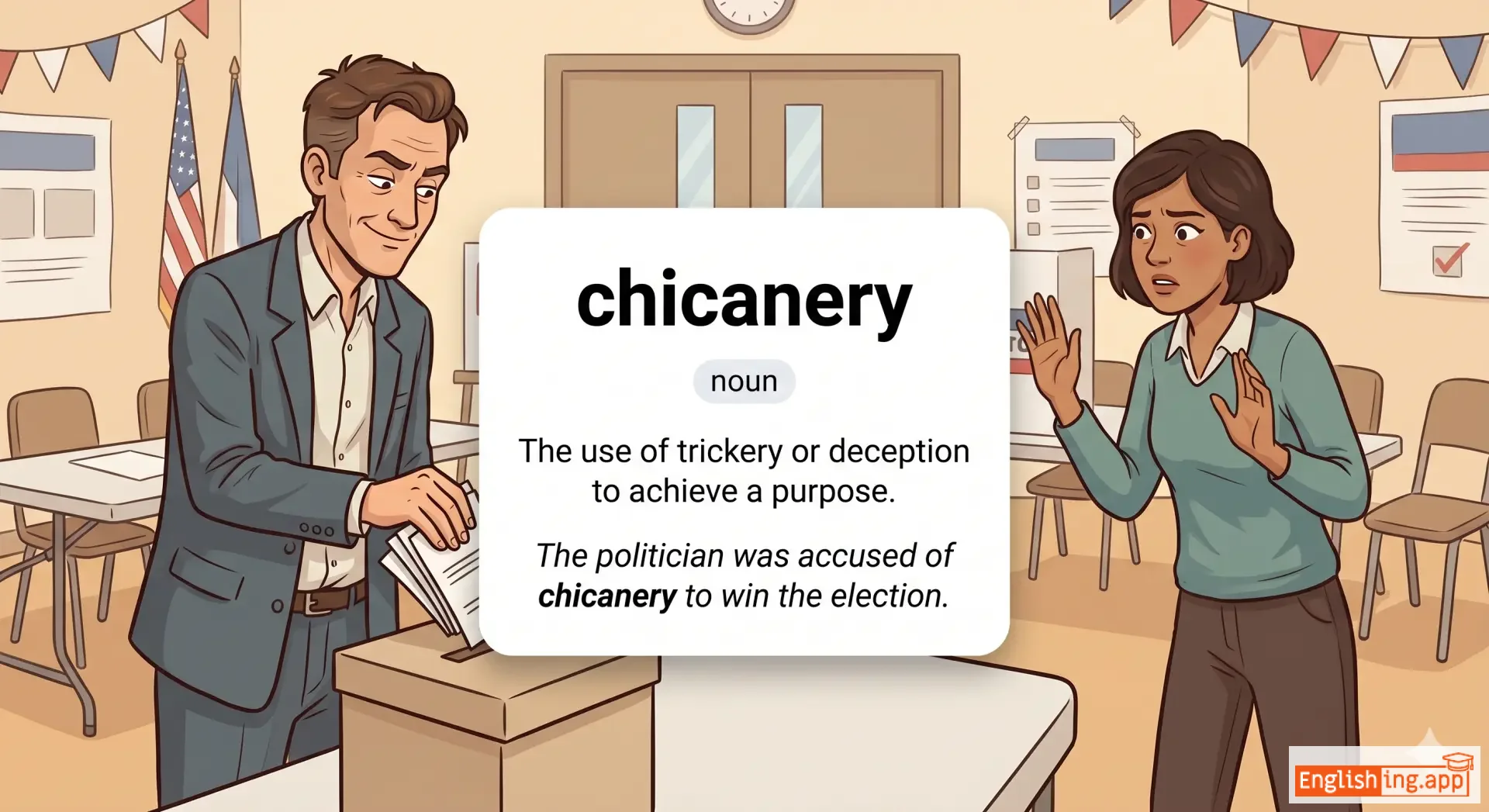
chicanery definition card — visual illustration of the meaning
noun
/ʃɪˈkeɪnəri/
tromperie (tromperie)

The use of trickery or deception to achieve a purpose.

"The politician was accused of chicanery to win the election."

"Le politicien a été accusé de tromperie pour gagner l'élection." (Le politicien a ete accuse de tromperie pour gagner l'election.)
noun
/ˈtʃɪk piː/
pois chiches (pois chiches)

round beige legume; protein-rich pulse used in various dishes

"Soak the chick peas overnight before cooking them for better digestion."

"Faites tremper les pois chiches toute la nuit avant de les cuire pour une meilleure digestion." (Faites tremper les pois chiches toute la nuit avant de les cuire pour une meilleure digestion.)
noun
/ˈtʃɪkɪn/
poulet (poulet)

a domestic bird kept for its eggs or meat

"We had fried chicken for dinner."

"Nous avons eu du poulet frit pour le dîner." (Nous avons eu du poulet frit pour le dîner.)
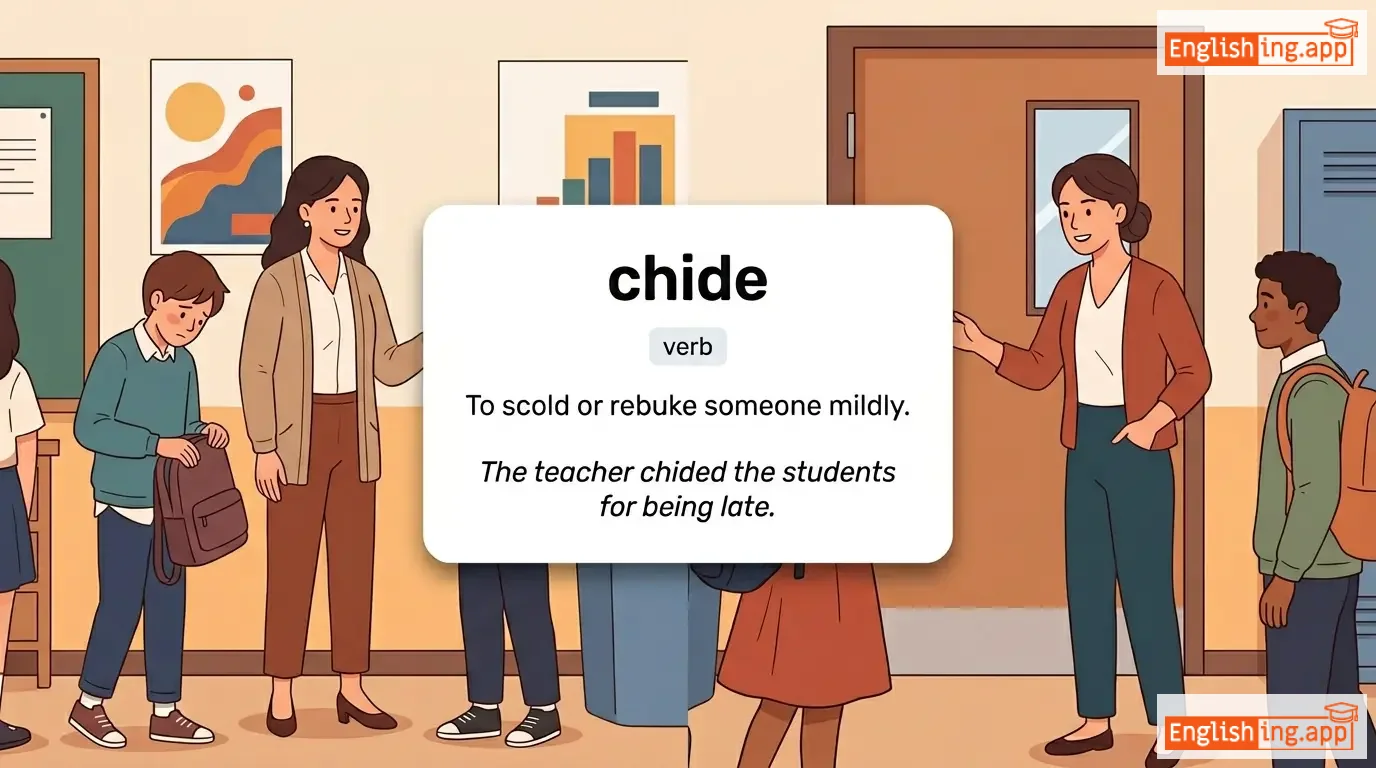
chide definition card — visual illustration of the meaning
👩‍🏫

chide (tchaïd)

verb
/tʃaɪd/
réprimander (reprimander)

To scold or rebuke someone mildly.

"The teacher chided the students for being late."

"Le professeur a réprimandé les étudiants pour leur retard." (Le professeur a réprimandé les étudiants pour leur retard.)
noun
/tʃiːf/
chef (chef)

a leader or person in charge of a group or organization

"The chief of the village made an important decision."

"Le chef du village a pris une décision importante." (Le chef du village a pris une decision importante.)
adverb
/ˈtʃiːfli/
principalement (principalement)

mainly; primarily

"The festival is celebrated chiefly by young people."

"Le festival est célébré principalement par les jeunes." (Le festival est célébré principalement par les jeunes.)
noun
/ʃɪˈfɒn/
chiffon (chiffon)

A lightweight, sheer fabric often used in dresses or scarves.

"She wore a beautiful chiffon dress at the party."

"Elle portait une belle robe en chiffon à la fête." (Elle portait une belle robe en chiffon à la fête.)
noun
/tʃaɪld/
enfant (enfant)

a young human being below the age of puberty or below the legal age of majority

"The child played happily in the park."

"L'enfant a joué joyeusement dans le parc." (L'enfant a joué joyeusement dans le parc.)
noun
/ˈtʃaɪldhʊd/
enfance (enfance)

the period of being a child

"She spent her childhood in a small village."

"Elle a passé son enfance dans un petit village." (Elle a passé son enfance dans un petit village.)
adjective
/ˈtʃaɪl.dɪʃ/
enfantin; immature mais inapproprié pour un adulte (enfantin; immature mais inapproprié pour un adulte)

immature and silly; behaving in a way that is typical of a child but inappropriate for an adult

"His childish behavior during the meeting was quite embarrassing."

"Son comportement enfantin pendant la réunion était assez embarrassant." (Son comportement enfantin pendant la réunion était assez embarrassant.)
adjective
/ˈtʃaɪld.laɪk/
enfantin; innocent et confiant; pur et simple (enfantin; innocent et confiant; pur et simple)

innocent and trusting like a child; having the good qualities of a child; pure and simple

"She maintained a childlike wonder about the world around her."

"Elle a conservé une étonnement enfantin pour le monde autour d'elle." (elle a conservé une étonnement enfantin pour le monde autour d'elle.)
verb
/tʃɪl/
refroidir / se détendre (refroidir / se détendre)

to make something cold or to relax and take it easy

"We decided to chill at home after a long day."

"Nous avons décidé de nous détendre à la maison après une longue journée." (Nous avons décidé de nous détendre à la maison après une longue journée.)
noun
/ˈtʃɪl.i ˈpaʊ.dər/
poudre de chili (poudre de chili)

a spice made from ground dried chili peppers, used to add heat and flavor to food

"Add two teaspoons of chilli powder to make the dish spicier."

"Ajoutez deux cuillères à café de poudre de chili pour rendre le plat plus épicé." (Ajoutez deux cuilleres a cafe de poudre de chili pour rendre le plat plus epice.)
adjective
/ˈtʃɪli/
froid (froi)

uncomfortably or unpleasantly cold

"It was a chilly morning in December."

"C'était un matin froid en décembre." (C'etait un matin froid en decembre.)
noun
/ˈtʃɪl.i/
froid; piment épicé; (froid, piment epice)

noticeably cold; a hot-tasting pod of a variety of capsicum, used as a spice

"The chef added red chilli to make the curry spicier."

"Le chef a ajouté du piment rouge pour rendre le curry plus épicé." (Le chef a ajouté du piment rouge pour rendre le curry plus épicé.)
noun
/kaɪˈmɪərə/
chimère (chimère)

A mythical creature with parts from different animals; also used to mean a fanciful illusion or unattainable dream.

"The idea of a perfect society is often a chimera."

"L'idée d'une société parfaite est souvent une chimère." (L'idée d'une société parfaite est souvent une chimère.)
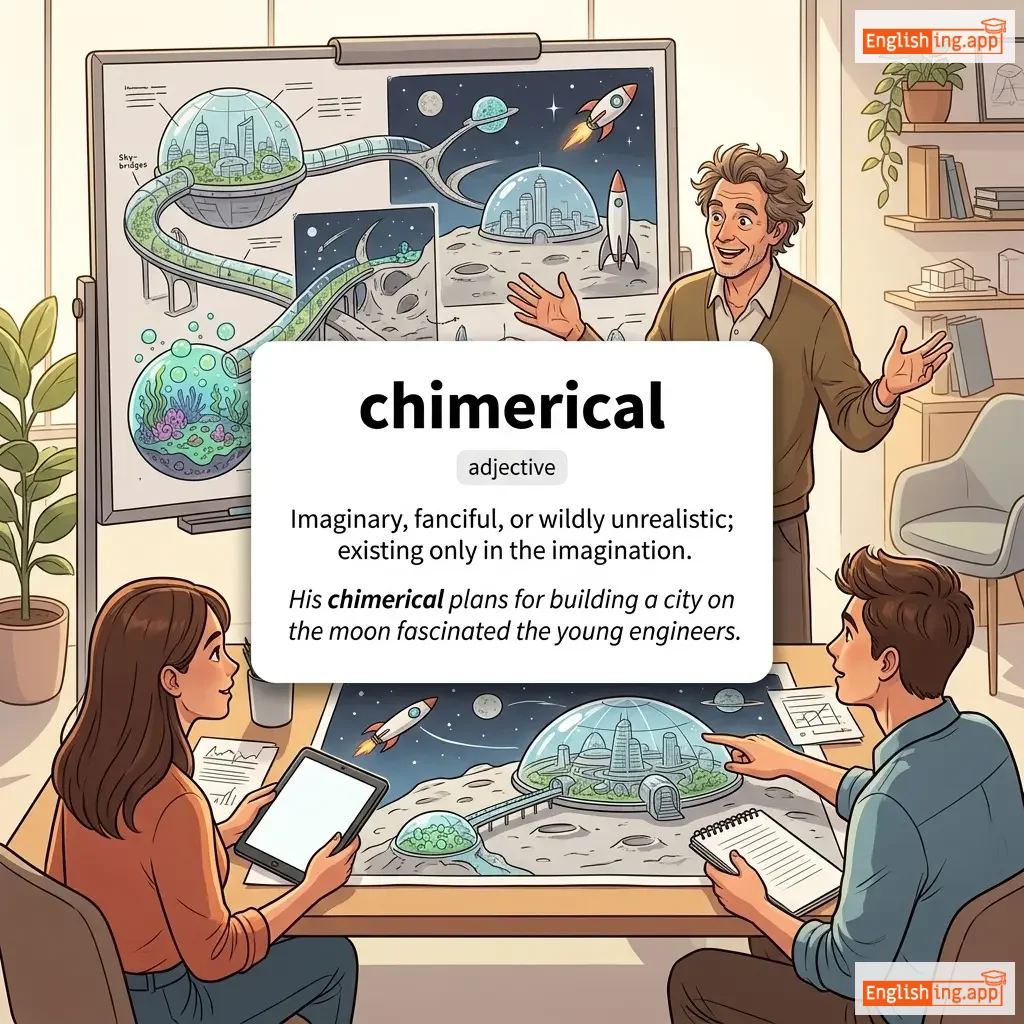
chimerical definition card — visual illustration of the meaning
adjective
/kaɪˈmɛrɪkəl/
chimérique (chimerique)

Imaginary, fanciful, or wildly unrealistic; existing only in the imagination.

"His chimerical plans for building a city on the moon fascinated the young engineers."

"Ses plans chimériques pour construire une ville sur la lune ont fasciné les jeunes ingénieurs." (Ses plans chimeriques pour construire une ville sur la lune ont fascine les jeunes ingenieurs.)
noun
/tʃɪn/
menton (menton)

the part of the face below the mouth

"He rested his chin on his hand while thinking."

"Il posa son menton sur sa main tout en réfléchissant." (Il posa son menton sur sa main tout en réfléchissant.)
noun
/ˈtʃaɪ.nə bɑːks/
jasmin d'oranger (jasmin doranger)

a small evergreen shrub with tiny white fragrant flowers

"The China box plant produced clusters of small white flowers."

"La plante de jasmin d'oranger a produit des grappes de petites fleurs blanches." (La plante de jasmin doranger a produit des grappes de petites fleurs blanches.)
noun
/ˈtʃaɪ.nə roʊz/
hibiscus (ibiskus)

a tropical flowering plant with large, showy flowers in various colors

"The bright red China-rose flowers decorated the entrance of the house."

"Les fleurs rouges vives d'hibiscus décoraient l'entrée de la maison." (Le flor rouzh viv d ibiskus dekoray lontré de la mezon.)
noun
/ˈtʃaɪ.nə.weər/
vaisselle en porcelaine (vaissele en porcelen)

dishes, plates, cups, and other tableware made of porcelain or fine ceramic

"The expensive china-ware was displayed in the cabinet."

"La vaisselle en porcelaine coûteuse a été exposée dans l'armoire." (La vaisselle en porcelaine coûteuse a été exposée dans l'armoire.)
adjective, noun
/tʃaɪˈniːz/
chinois (shinoa)

relating to China, its people, or its language

"We went to a Chinese restaurant last night."

"Nous sommes allés dans un restaurant chinois hier soir." (Nous sommes allés dans un restaurant chinois hier soir.)
noun, verb
/tʃɪp/
morceau / fragment cassé (morceau / fragment casse)

A small piece broken off from something; or to cut or break a small piece from something.

"He accidentally chipped the edge of the table."

"Il a accidentellement ébréché le bord de la table." (Il a accidentellement ebreche le bord de la table.)
noun
/ˈkaɪrəˌmænsi/
chiromancie (kiromansie)

The practice of predicting the future by interpreting the lines on the palms of hands; palmistry.

"The old woman practiced chiromancy and told fortunes for travelers."

"La vieille femme pratiquait la chiromancie et prédisait l'avenir des voyageurs." (La vieille femme pratiquait la chiromancie et predisait l'avenir des voyageurs.)
noun
/kɪˈrɒpədɪst/
pédicure-podologue (pedicure-podologue)

A healthcare professional who diagnoses and treats foot problems.

"The chiropodist treated her painful corns and calluses."

"Le pédicure-podologue a traité ses cors et callosités douloureux." (Le pedicure-podologue a traite ses cors et callosites douloureux.)
noun, verb
/ˈtʃɪzəl/
ciseau (ciseau)

A tool with a sharp edge used for cutting or shaping hard materials; or to cut or carve with such a tool.

"The sculptor chiseled the marble into a beautiful statue."

"Le sculpteur a ciselé le marbre en une belle statue." (Le sculpteur a ciselé le marbre en une belle statue.)
noun
/tʃɪt/
billet, note (billet, note)

a short note, typically a brief informal letter; a voucher for a sum owed

"She left a chit on the table asking him to call her back."

"Elle a laissé un chit sur la table lui demandant de la rappeler." (Elle a laisse un chit sur la table lui demandant de la rappeler.)
adjective
/ˈʃɪvəlrəs/
cavalier (cavalier)

Behaving in a courteous, gallant, and honorable way, especially toward women.

"He was chivalrous, always opening doors for others."

"Il était chevaleresque, toujours en train d'ouvrir les portes pour les autres." (Il était chevaleresque, toujours en train d'ouvrir les portes pour les autres.)
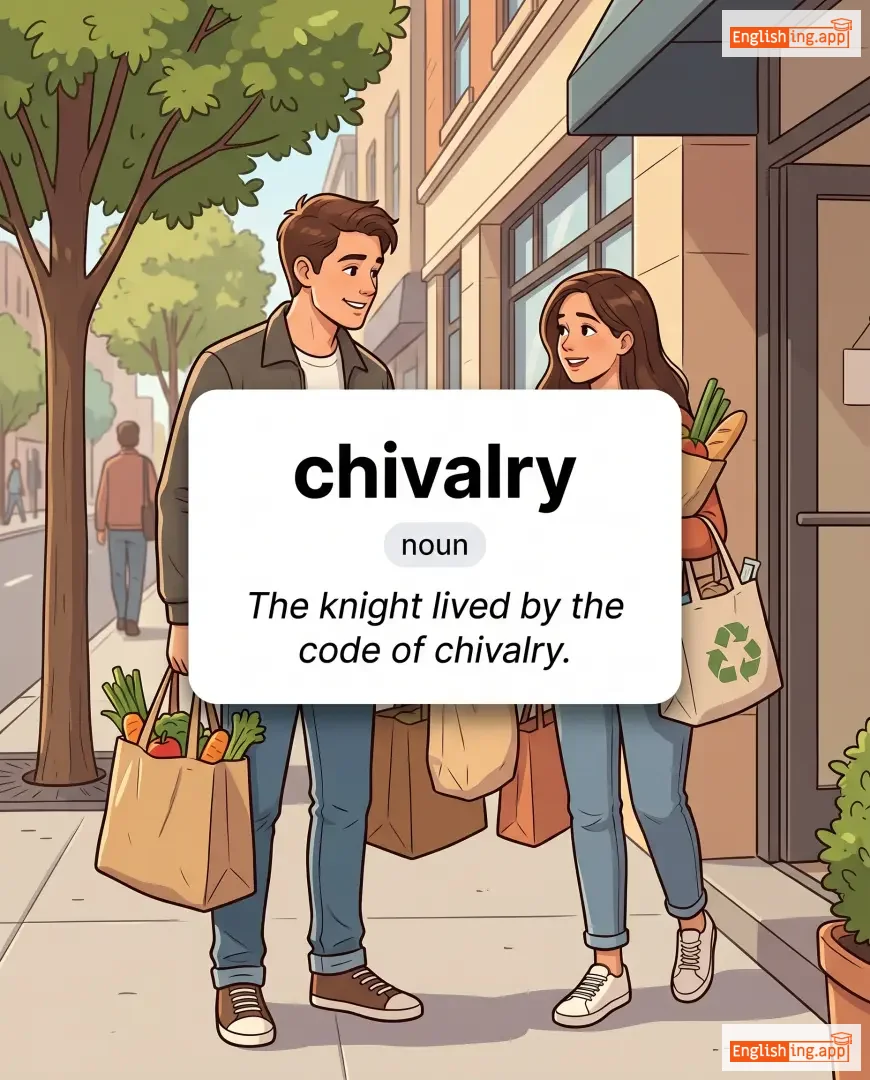
chivalry definition card — visual illustration of the meaning
noun
/ˈʃɪvəlri/
chevalerie (chevalerie)

The medieval knightly system with its moral, social, and religious code; courteous behavior, especially toward women.

"The knight lived by the code of chivalry."

"Le chevalier vivait selon le code de la chevalerie." (Le chevalier vivait selon le code de la chevalerie.)
noun
/ˈtʃɒklət/
chocolat (chocolat)

a sweet, brown food made from roasted cocoa beans

"She bought a bar of chocolate from the store."

"Elle a acheté une barre de chocolat au magasin." (Elle a acheté une barre de chocolat au magasin.)
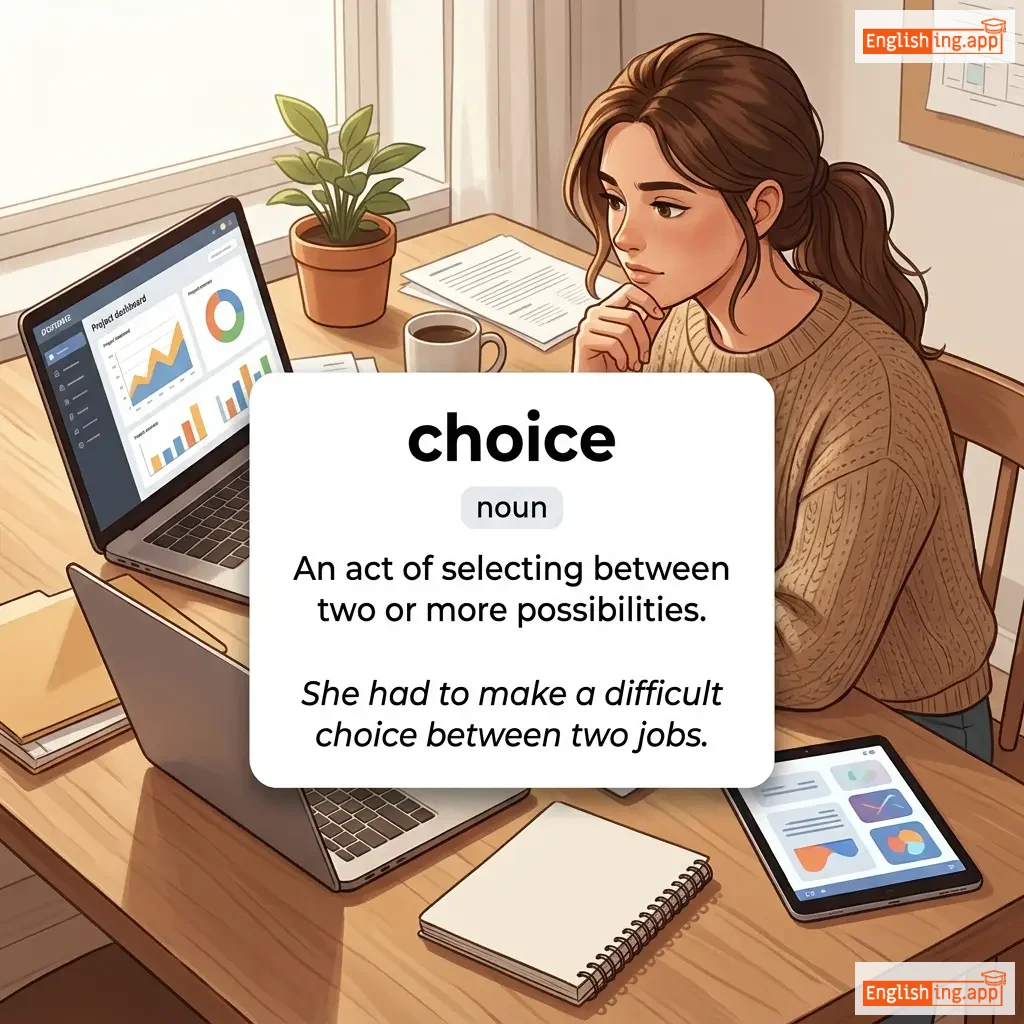
choice definition card — visual illustration of the meaning
noun
/tʃɔɪs/
choix (choix)

An act of selecting between two or more possibilities.

"She had to make a difficult choice between two jobs."

"Elle a dû faire un choix difficile entre deux emplois." (Elle a du faire un choix difficile entre deux emplois.)
noun
/ˈkwaɪər/
chorale (chorale)

An organized group of singers, typically performing in church services or concerts.

"The choir sang beautifully during the ceremony."

"La chorale a chanté magnifiquement lors de la cérémonie." (La chorale a chanté magnifiquement lors de la cérémonie.)
noun
/ˈkɒlərə/
choléra (sholera)

An infectious disease of the small intestine causing severe vomiting and diarrhea.

"The village suffered an outbreak of cholera after the flood."

"Le village a connu une épidémie de choléra après l'inondation." (Le village a connu une epidemie de cholera apres l inondation.)
adjective
/ˈkɒlərɪk/
colérique (colerique)

Easily angered; irritable and hot-tempered.

"His choleric nature often got him into arguments."

"Sa nature colérique le mettait souvent dans des disputes." (sa nature colerique le mettait souvent dans des disputes)
noun
/kəˈlɛstərɒl/
cholestérol (cholesterol)

a fatty substance found in the blood, high levels of which can cause health problems

"High cholesterol can increase the risk of heart disease."

"Un taux élevé de cholestérol peut augmenter le risque de maladies cardiaques." (Un taux élevé de cholestérol peut augmenter le risque de maladies cardiaques.)
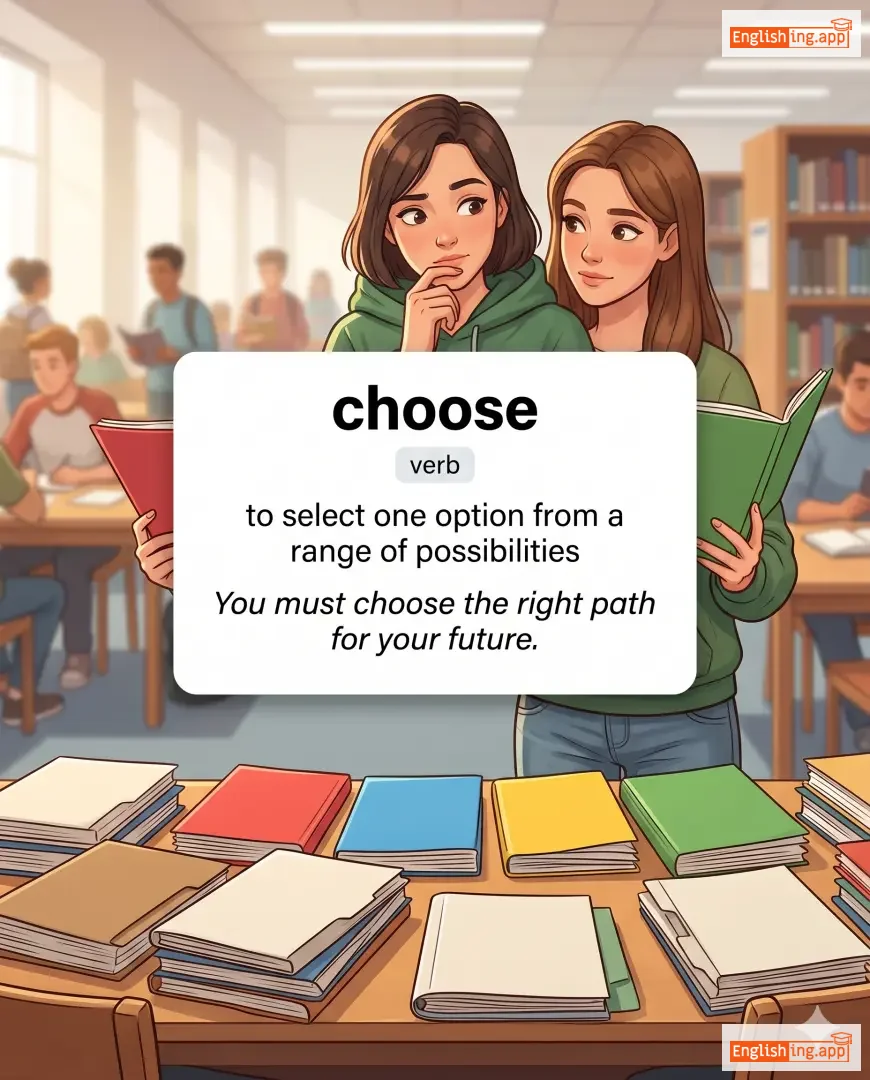
choose definition card — visual illustration of the meaning
verb
/tʃuːz/
choisir (choisir)

to select one option from a range of possibilities

"You must choose the right path for your future."

"Tu dois choisir le bon chemin pour ton futur." (Tu dois choisir le bon chemin pour ton futur.)
adjective
/ˈtʃuː.zi/
exigeant; très sélectif; particulier sur ce qu'il aime ou accepte (exigeant)

very careful in choosing; selective; particular about what one likes or accepts

"He's very choosy about the restaurants where he eats."

"Il est très exigeant avec les restaurants où il mange." (Il est très exigeant avec les restaurants où il mange.)