Vocabulaires

Découvrez, apprenez et maîtrisez le vocabulaire anglais

verb
/ˈkɒsɪt/
choyer (choyer)

to care for and protect in an overindulgent way

"The little girl was cosseted by her grandparents."

"La petite fille était choyée par ses grands-parents." (La petite fille était choyée par ses grands-parents.)
adjective
/ˈkɒs.ɪ.tɪd/
choyé (choye)

pampered, treated with excessive care and attention

"The cosseted child always got what he wanted."

"L'enfant choyé a toujours obtenu ce qu'il voulait." (L'enfant choyé a toujours obtenu ce qu'il voulait.)
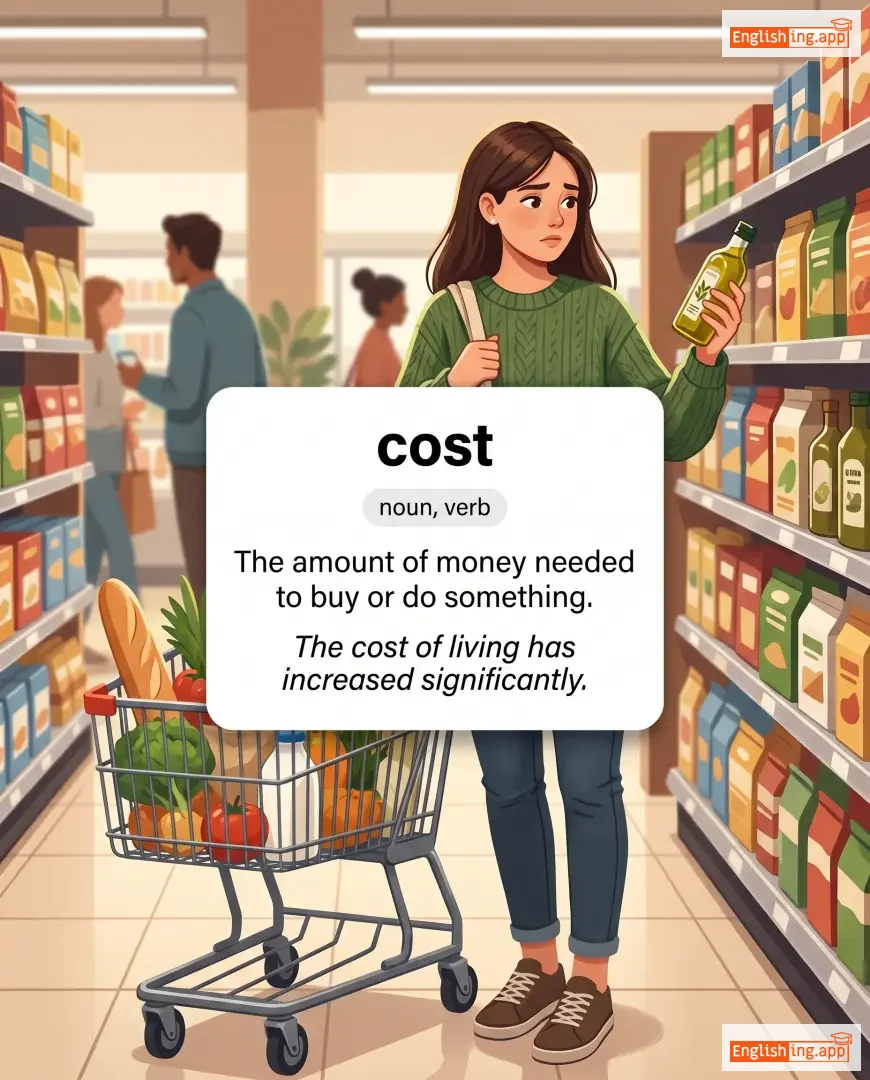
cost definition card — visual illustration of the meaning
noun, verb
/kɒst/
coût (kut)

The amount of money needed to buy or do something.

"The cost of living has increased significantly."

"Le coût de la vie a considérablement augmenté." (Le cout de la vie a considereablement augmente.)
cost-efficient definition card — visual illustration of the meaning
adjective
/ˌkɒst.ɪˈfɪʃ.ənt/
rentable (rentable)

Achieving maximum productivity with minimum wasted effort or expense.

"Cost-efficient solutions benefit industries."

"Les solutions rentables bénéficient aux industries." (Les solutions rentables beneficient aux industries.)
adjective
/ˈkɔːstli/
coûteux (coûteux)

expensive or causing a lot of money, time, or effort

"Their mistake proved to be very costly for the company."

"Leurs erreurs se sont avérées très coûteuses pour l'entreprise." (Leurs erreurs se sont avérées très coûteuses pour l'entreprise.)
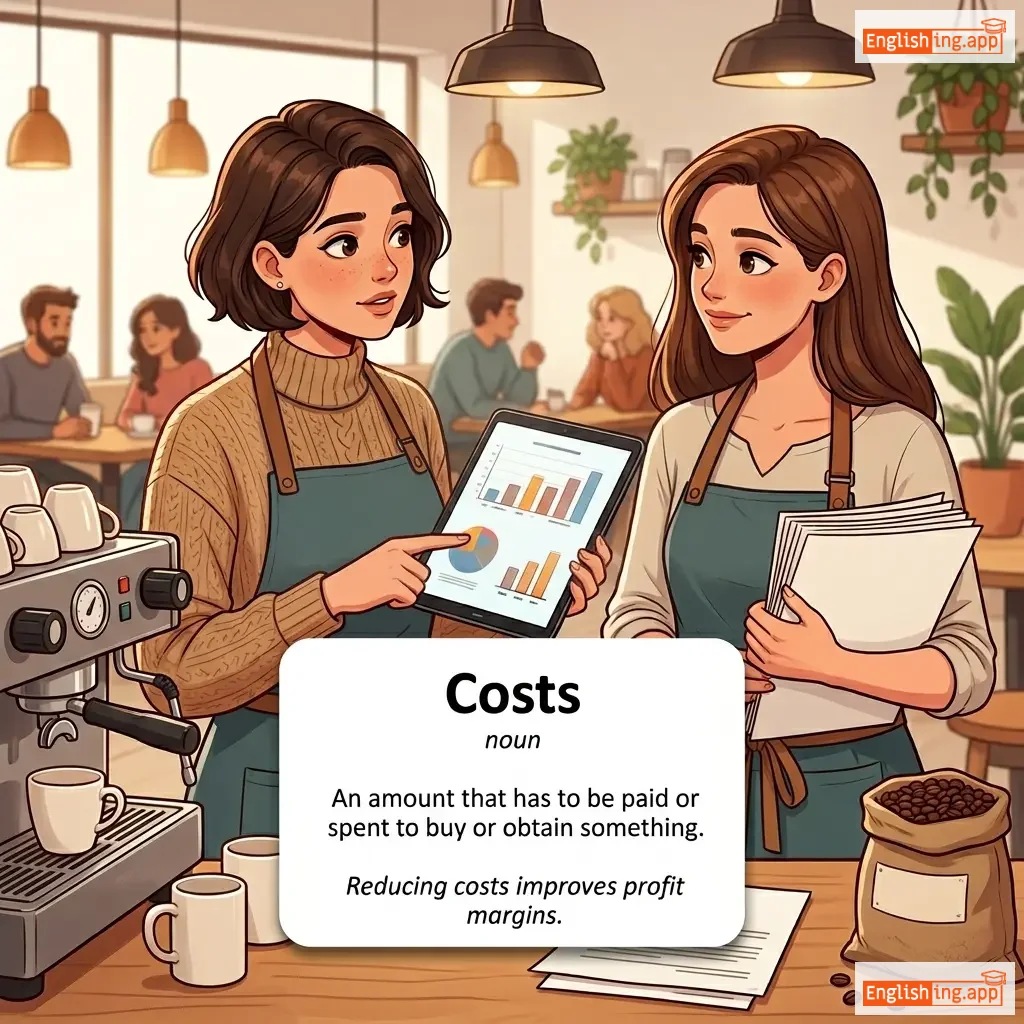
Costs definition card — visual illustration of the meaning
noun
kɒsts
coûts (kuts)

An amount that has to be paid or spent to buy or obtain something.

"Reducing costs improves profit margins."

"Réduire les coûts améliore les marges bénéficiaires." (Réduire les coûts améliore les marges bénéficiaires.)
noun
/ˈkɒstjuːm/
costume (costume)

a set of clothes worn to represent a particular character, culture, or occasion

"She wore a beautiful costume for the Halloween party."

"Elle a porté un magnifique costume pour la fête d'Halloween." (Elle a porté un magnifique costume pour la fête d'Halloween.)
🛏️

Cot (kot)

noun
/kɒt/
Lit de bébé (lit de bebe)

a small bed, especially a portable one or one for a baby

"The baby sleeps peacefully in her cot."

"Le bébé dort paisiblement dans son lit de bébé." (Le bebe dort paisiblement dans son lit de bebe.)
noun
/ˈkoʊ.tə.ri/
un petit groupe exclusif (un petit groupe exclusif)

a small, exclusive group of people with shared interests

"He belonged to a coterie of artists who met every Friday."

"Il faisait partie d'un groupe d'artistes qui se réunissaient chaque vendredi." (Il faisait partie d'un groupe d'artistes qui se réunissaient chaque vendredi.)
adjective
/koʊˈtɜːr.mɪ.nəs/
coextensif (coextensif)

having the same boundaries or extent in space, time, or meaning

"The two jurisdictions are coterminous, sharing the same borders."

"Les deux juridictions sont coextensives, partageant les mêmes frontières." (Les deux juridictions sont coextensives, partageant les memes frontieres.)
noun
/ˈkɒtɪdʒ/
cabane (cabane)

a small simple house, typically in the countryside

"They spent their vacation in a cozy cottage by the lake."

"Ils ont passé leurs vacances dans une cabane confortable près du lac." (Ils ont passe leurs vacances dans une cabane confortable pres du lac.)
noun
/ˈkɒtən/
bonheur (bonheur)

A soft white fibrous substance used to make cloth and thread.

"This shirt is made of pure cotton."

"Elle ne pouvait pas cacher son bonheur lorsqu'elle a reçu le prix." (Elle ne pouvait pas cacher son bonheur lorsqu'elle a reçu le prix.)
noun
/ˈkɒt.ən ˈfæb.rɪk/
tissu de coton (tissu de coton)

textile made from cotton fibers, known for being soft, breathable, and comfortable

"Cotton fabric is perfect for summer clothing."

"Le tissu de coton est parfait pour les vêtements d'été." (Le tissu de coton est parfait pour les vetements d'ete.)
noun
/kaʊtʃ/
canapé (canape)

a comfortable seat for two or more people, typically upholstered

"They sat on the couch and watched TV."

"Ils se sont assis sur le canapé et ont regardé la télévision." (Ils se sont assis sur le canapé et ont regardé la télévision.)
noun, verb
/kɒf/
toux (toux)

a sudden noisy release of air from the lungs to clear the throat or airway; to expel air suddenly from the lungs with a cough

"He has a bad cough and stayed home today."

"Il a une forte toux et est resté à la maison aujourd’hui." (il a une forte toux et est reste a la maison aujourd hui)
modal verb
/kʊd/
pourrait (pourrait)

Used to indicate possibility, ability, or permission in the past or as a polite suggestion.

"He could swim when he was a child."

"Il pouvait nager quand il était enfant." (Il pouvait nager quand il était enfant.)
noun
/ˈkaʊn.səl/
conseil (conseil)

an assembly of people chosen or elected to make decisions or advise on matters

"The city council voted to improve public transportation."

"Le conseil municipal a voté pour améliorer les transports publics." (Le conseil municipal a voté pour améliorer les transports publics.)
noun
/ˈkaʊnsələr/
conseiller municipal (conseiller municipal)

an elected member of a local council who helps make decisions and represent the community

"The councillor spoke to residents about improving local roads."

"Le conseiller municipal a parlé des routes locales." (le conseiller municipal a parle des routes locales)
noun
/ˈkaʊnsɪlər/
conseiller (conseiller)

an elected member of a council, especially a local government body

"The councilor held a public meeting to discuss local issues."

"Le conseiller a organisé une réunion publique pour discuter des problèmes locaux." (Le conseiller a organisé une réunion publique pour discuter des problèmes locaux.)
verb
/ˈkaʊnsəl/
conseiller (conseiller)

to give professional advice or guidance to someone

"The teacher counseled the students on their career choices."

"Le professeur a conseillé les étudiants sur leurs choix de carrière." (Le professeur a conseillé les étudiants sur leurs choix de carrière.)
noun
/ˈkaʊnsəlɪŋ/
conseil (conseil)

professional guidance or therapy to help resolve personal or psychological problems

"She decided to go for counseling after feeling stressed for months."

"Elle a décidé de consulter après avoir ressenti du stress pendant des mois." (Elle a decide de consulter apres avoir ressenti du stress pendant des mois.)
noun
/ˈkaʊn.səl.ɪŋ/
conseil psychologique (conseil psychologique)

the process of giving professional guidance and support to help someone deal with personal, social, psychological, or career-related problems

"She decided to seek counselling to manage stress and anxiety."

"Elle a choisi le conseil psychologique pour gérer le stress." (elle a choisi le conseil psychologique pour gerer le stress)
noun
/ˈkaʊnsələr/
conseiller (conseiller)

a person trained to give guidance on personal, social, or psychological problems; an advisor

"She spoke to a counsellor to get advice about her career."

"Elle a parlé à un conseiller pour obtenir des conseils sur sa carrière." (elle a parle a un conseiller pour obtenir des conseils sur sa carriere)
noun
/ˈkaʊn.səl.ər/
conseiller (conseiller)

a person trained to give guidance on personal, social, or psychological problems

"The school counselor helped the student deal with stress."

"Le conseiller scolaire a aidé l'élève à gérer le stress." (Le conseiller scolaire a aide l'eleve a gerer le stress.)
verb
/kaʊnt/
compter (kompter)

to determine the total number of something

"She carefully counted the money on the table."

"Elle a soigneusement compté l'argent sur la table." (Elle a soigneusement compté l'argent sur la table.)
noun
/ˈkaʊn.tə.nəns/
visage, expression; soutien (visage, expression; soutien)

a person's face or expression; support or approval

"Her cheerful countenance brightened the room."

"Son visage joyeux a éclairé la pièce." (Son visage joyeux a eclaire la piece.)
noun
/ˈkaʊn.tər/
comptoir (comptoir)

a flat surface in a shop, bank, or kitchen where transactions or work are done

"The cashier stood behind the counter."

"Le caissier se tenait derrière le comptoir." (Le caissier se tenait derrière le comptoir.)
noun
/ˈkaʊn.tər kleɪm/
contre-demande (contre-demande)

a claim made to rebut a previous claim, often in legal contexts

"The defendant filed a counter-claim against the plaintiff."

"Le défendeur a déposé une contre-demande contre le demandeur." (Le defendeur a depose une contre-demande contre le demandeur.)
verb
/ˌkaʊntərˈækt/
contrer (contrer)

to act against something in order to reduce its effect

"The medicine helps counteract the side effects of the treatment."

"Le médicament aide à contrer les effets secondaires du traitement." (Le médicament aide à contrer les effets secondaires du traitement.)
verb
/ˌkaʊntərˈbæləns/
contrebalancer (contrebalancer)

to offset or balance the effect of something

"Exercise can counterbalance the negative effects of stress."

"L'exercice peut contrebalancer les effets négatifs du stress." (L'exercice peut contrebalancer les effets négatifs du stress.)
noun, verb
/ˈkaʊntərˌtʃɑːrdʒ/
contre-accusation (contre-accusation)

an opposing charge or accusation; to make an opposing attack

"The lawyer filed a countercharge against the accuser."

"L'avocat a déposé une contre-accusation contre l'accusateur." (L'avocat a déposé une contre-accusation contre l'accusateur.)
adjective, verb, noun
/ˈkaʊntərfɪt/
contrefait (contrefait)

made to look like something genuine in order to deceive

"The police seized a batch of counterfeit currency."

"La police a saisi un lot de billets contrefaits." (La police a saisi un lot de billets contrefaits.)
adjective
/ˌkaʊntərɪnˈtuːɪtɪv/
contre-intuitif (contre-intuitif)

contrary to what one would intuitively expect

"His approach seems counterintuitive but it actually works."

"Son approche semble contre-intuitive, mais elle fonctionne réellement." (Son approche semble contre-intuitive, mais elle fonctionne réellement.)
verb
/ˌkaʊntərˈmænd/
annuler un ordre (annuler un ordre)

to revoke or cancel an order or command

"The general countermanded the previous orders immediately."

"Le général a annulé les ordres précédents immédiatement." (Le général a annulé les ordres précédents immédiatement.)
noun
/ˈkaʊntərˌpɑːrt/
homologue (homologue)

a person or thing that corresponds to or has the same function as another

"The CEO met with his counterpart in the partner company."

"Le PDG a rencontré son homologue dans l'entreprise partenaire." (Le PDG a rencontre son homologue dans l'entreprise partenaire.)
noun
/ˈkaʊntərˌpɔɪnt/
contrepoint (contrepoint)

an argument, idea, or theme contrasting with another; also a musical term for independent melody

"Her calm attitude was a counterpoint to his anger."

"Son attitude calme était un contrepoint à sa colère." (Son attitude calme était un contrepoint à sa colère.)
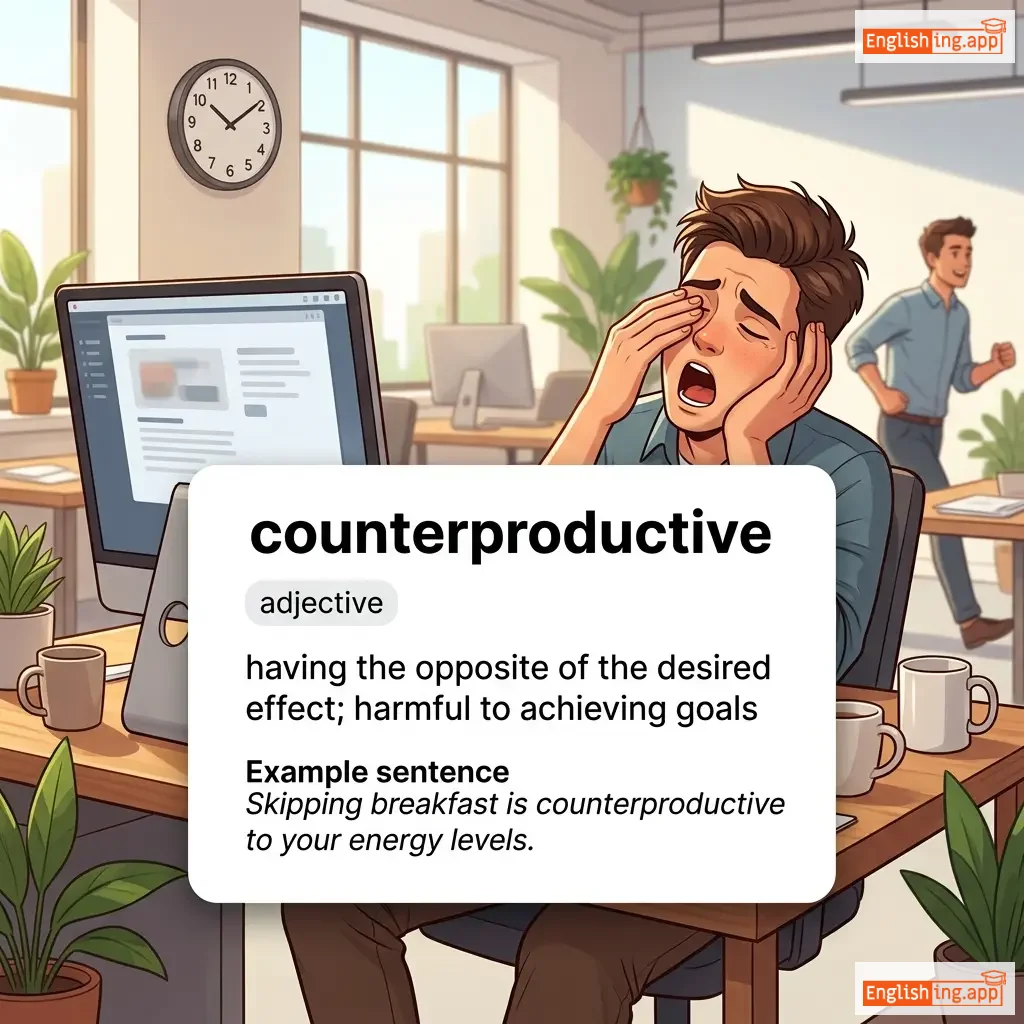
counterproductive definition card — visual illustration of the meaning
adjective
/ˌkaʊntərprəˈdʌktɪv/
contre-productif (contre-productif)

having the opposite of the desired effect; harmful to achieving goals

"Skipping breakfast is counterproductive to your energy levels."

"Sauter le petit-déjeuner est contre-productif pour vos niveaux d'énergie." (Sauter le petit-déjeuner est contre-productif pour vos niveaux d'énergie.)
verb
/ˌkaʊntərˈveɪl/
contrebalancer (contrebalancer)

to offset or counteract the effect of something

"The benefits of the new policy countervail its drawbacks."

"Les avantages de la nouvelle politique contrebalancent ses inconvénients." (Les avantages de la nouvelle politique contrebalancent ses inconvénients.)
noun
/ˈkaʊntɪŋˌhaʊs/
bureau de comptabilité (bureau de comptabilité)

a business office where accounts are kept and financial transactions are managed

"The merchant spent most of his day in the counting-house reviewing ledgers."

"Le marchand passait la majeure partie de sa journée dans le bureau de comptabilité à examiner les livres de comptes." (Le marchand passait la majeure partie de sa journée dans le bureau de comptabilité à examiner les livres de comptes.)
adjective
/ˈkaʊntləs/
innombrable (innombrable)

too many to be counted; innumerable

"There are countless stars in the sky."

"Il y a des étoiles innombrables dans le ciel." (Il y a des étoiles innombrables dans le ciel.)
noun
/ˈkʌn.tri/
pays (pays)

a nation with its own government and borders

"Bangladesh is a beautiful country with rich culture."

"Le Bangladesh est un beau pays avec une culture riche." (Le Bangladesh est un beau pays avec une culture riche.)
noun
/ˈkʌntrɪmən/
compatriote (compatriote)

a person from one's own country or rural area

"He was proud to meet a fellow countryman at the international conference."

"Il était fier de rencontrer un compatriote à la conférence internationale." (Il etait fier de rencontrer un compatriote a la conference internationale.)
noun
/ˈkʌntrisaɪd/
campagne (campagne)

land outside cities and towns; rural areas with farms, fields, and villages

"She enjoys the peace and beauty of the countryside."

"Elle apprécie le calme et la beauté de la campagne." (elle apprecie le calme et la beaute de la campagne)
noun
/ˈkaʊnti/
comté (comte)

A territorial division within a country, typically a region with its own local government.

"She grew up in a small county in northern England."

"Elle a grandi dans un petit comté du nord de l'Angleterre." (Elle a grandi dans un petit comte du nord de l'Angleterre.)
noun
/kuː/
coup d'État (cou d'etat)

a sudden, decisive action that brings about a change, especially in government

"The military staged a coup to overthrow the existing regime."

"L'armée a organisé un coup d'État pour renverser le régime en place." (L'armee a organise un coup d'Etat pour renverser le regime en place.)
noun
/ˈkʌpəl/
couple (couple)

two people or things considered together; a pair

"They make a lovely couple and have been married for five years."

"Ils forment un couple adorable et sont mariés depuis cinq ans." (Ils forment un couple adorable et sont mariés depuis cinq ans.)
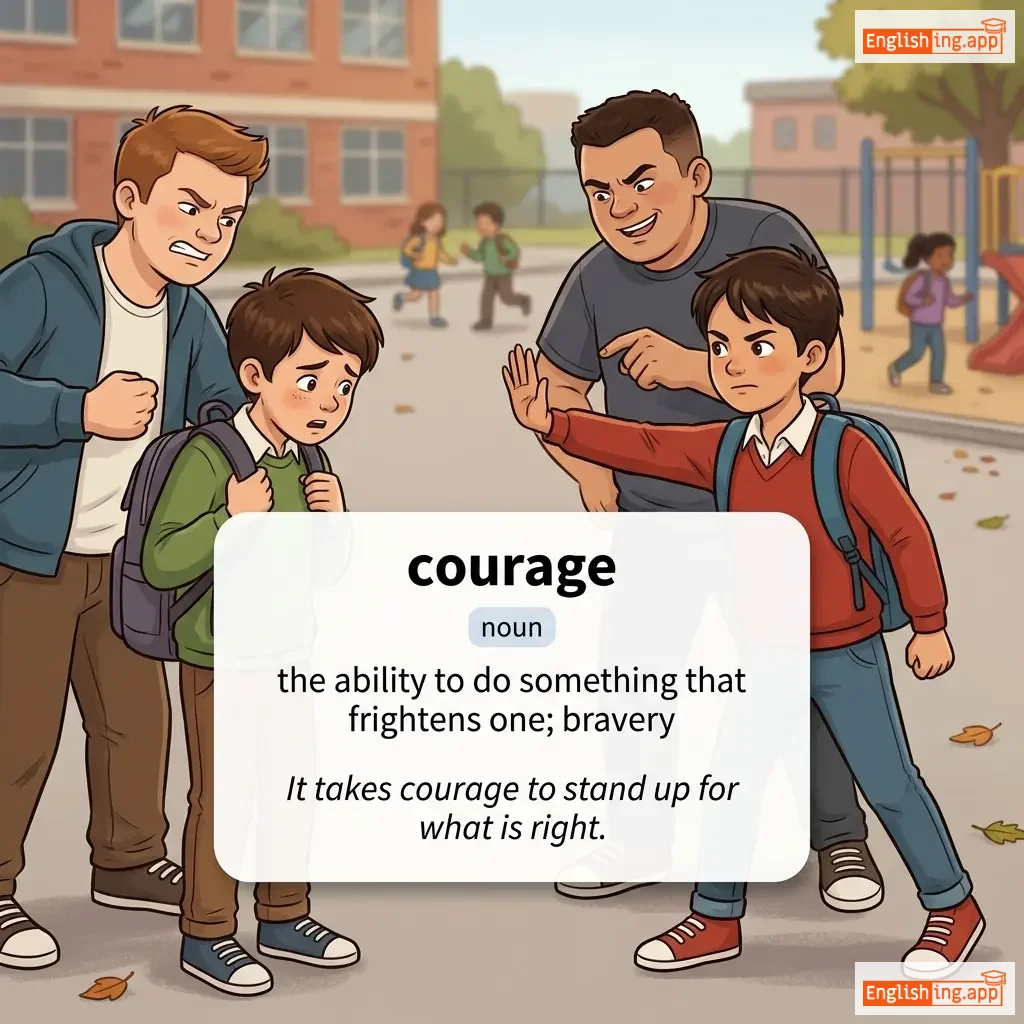
courage definition card — visual illustration of the meaning
noun
/ˈkʌrɪdʒ/
courage (courage)

the ability to do something that frightens one; bravery

"It takes courage to stand up for what is right."

"Il faut du courage pour défendre ce qui est juste." (Il faut du courage pour défendre ce qui est juste.)
adjective
/kəˈreɪdʒəs/
courageux (courageux)

having or showing bravery; able to face danger or difficulty

"The firefighter was courageous as he rescued the children from the burning building."

"Le pompier était courageux lorsqu'il a sauvé les enfants du bâtiment en feu." (Le pompier était courageux lorsqu'il a sauvé les enfants du bâtiment en feu.)
noun
/ˈkʊriər/
livreur (livreur)

a person or company that delivers messages, packages, or mail

"The courier delivered the documents on time."

"Le livreur a livré les documents à temps." (Le livreur a livré les documents à temps.)
noun
/kɔːrs/
cours, chemin ou ensemble de leçons éducatives (cours, chemin ou ensemble de leçons éducatives)

a direction, path, or a set of educational lessons

"She enrolled in a computer science course."

"Elle s'est inscrite à un cours de sciences informatiques." (Elle s'est inscrite à un cours de sciences informatiques.)