Vocabulaires

Découvrez, apprenez et maîtrisez le vocabulaire anglais

adjective
/kənˈsɪdərət/
attentif (attentif)

showing concern for the needs and feelings of others

"He is always considerate of his neighbors."

"Il est toujours attentif à ses voisins." (Il est toujours attentif à ses voisins.)
noun
/kənˌsɪdəˈreɪʃən/
bonheur (bonheur)

careful thought or attention to something before making a decision

"After much consideration, she accepted the job offer."

"Elle ne pouvait pas cacher son bonheur lorsqu'elle a reçu le prix." (Elle ne pouvait pas cacher son bonheur lorsqu'elle a reçu le prix.)
verb
/kənˈsaɪn/
consigner (consigner)

to deliver something to a person or place, often for selling or safekeeping

"He consigned the package to the shipping company."

"Il a consigné le paquet à la société de transport." (Il a consigné le paquet à la société de transport.)
noun
/ˌkɒnsaɪˈniː/
destinataire (destinataire)

the person or company to whom goods are delivered

"The consignee received the shipment on time."

"Le destinataire a reçu l'envoi à temps." (Le destinataire a reçu l'envoi à temps.)
noun
/kənˈsaɪnər/
expéditeur (expediteur)

a person or company that sends goods to be sold or transported

"The consignor shipped the goods to the warehouse."

"L'expéditeur a envoyé les marchandises à l'entrepôt." (L'expéditeur a envoyé les marchandises à l'entrepôt.)
verb
/kənˈsɪst/
consister (consister)

to be made up or composed of certain parts or elements

"The committee consists of five members."

"Le comité est composé de cinq membres." (Le comité est composé de cinq membres.)
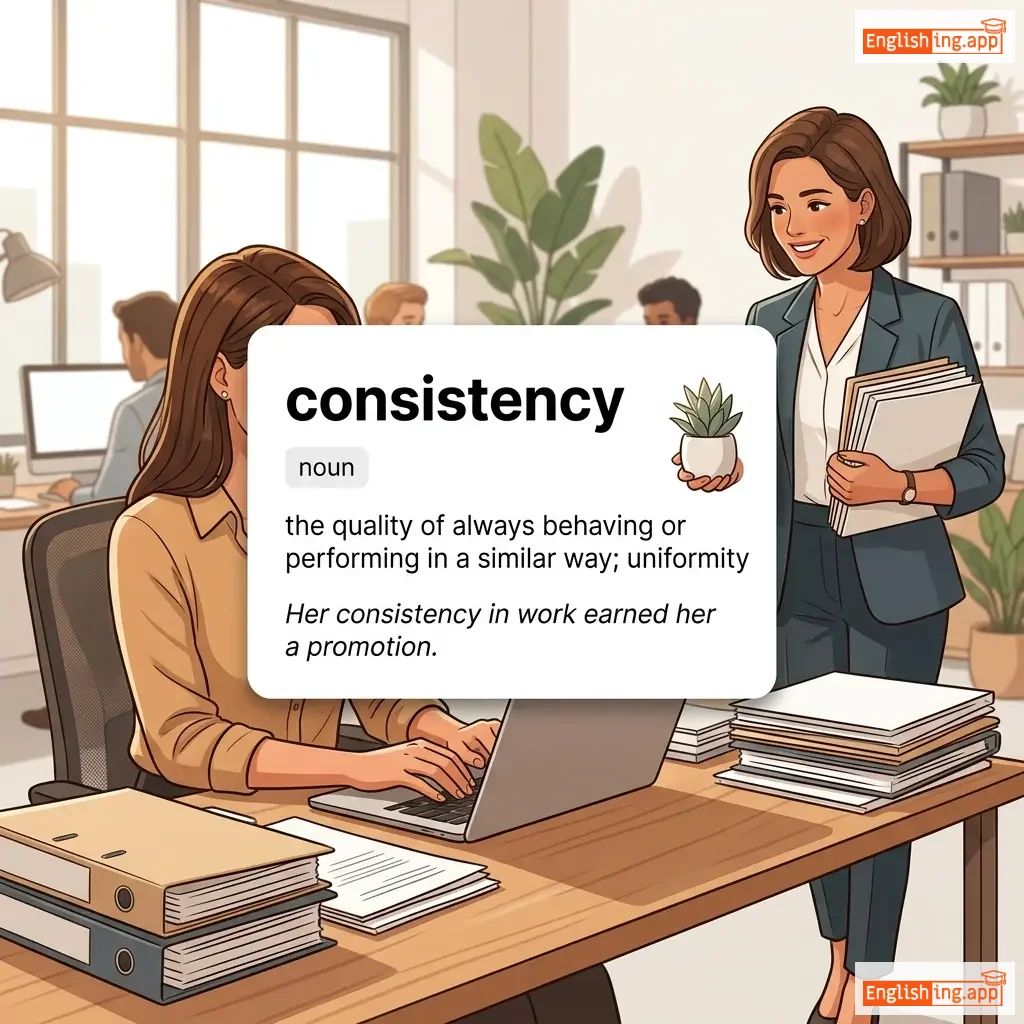
consistency definition card — visual illustration of the meaning
noun
/kənˈsɪstənsi/
consistance, stabilité (consistance, stabilité)

the quality of always behaving or performing in a similar way; uniformity

"Her consistency in work earned her a promotion."

"Sa consistance au travail lui a valu une promotion." (Sa consistance au travail lui a valu une promotion.)
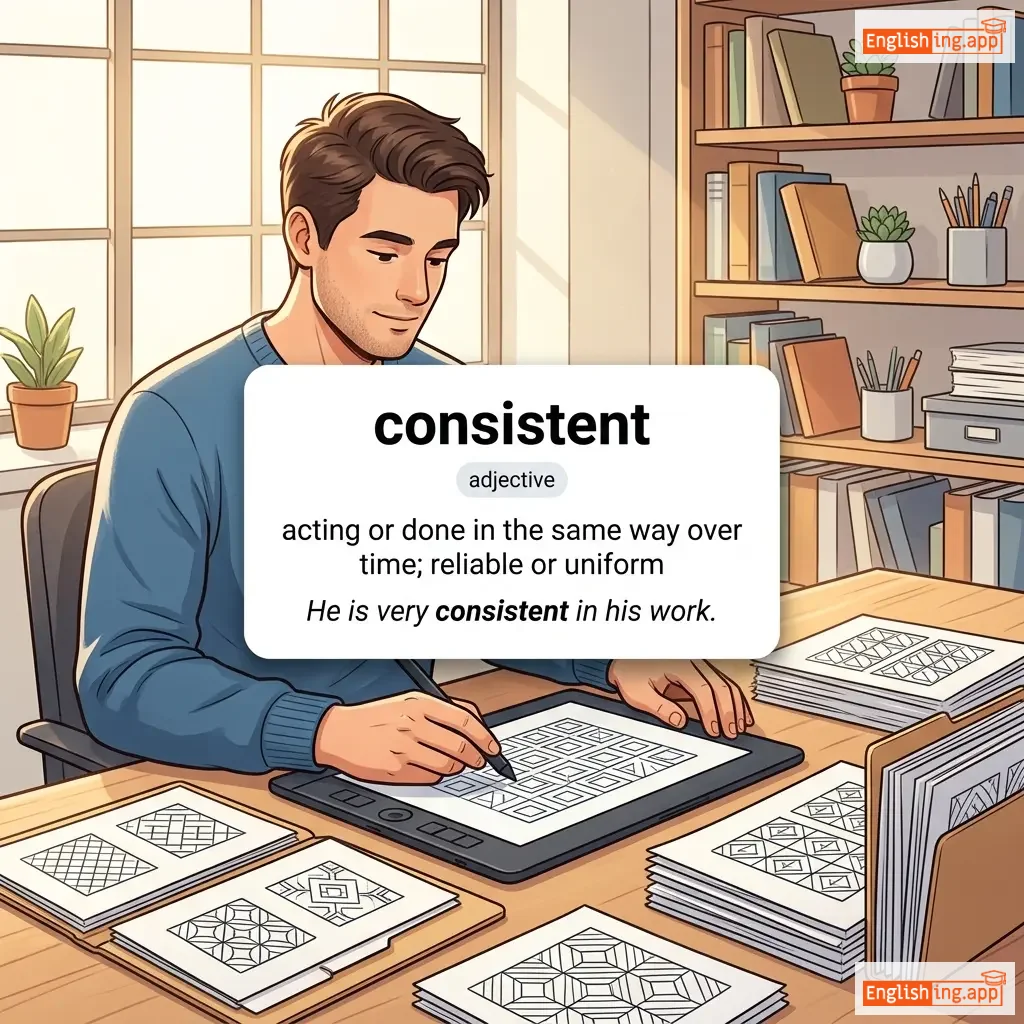
consistent definition card — visual illustration of the meaning
adjective
/kənˈsɪstənt/
consistant (consistant)

acting or done in the same way over time; reliable or uniform

"He is very consistent in his work."

"Il est très consistent dans son travail." (Il est très consistent dans son travail.)
adverb
/kənˈsɪstəntli/
constamment (constamment)

in a way that does not vary; regularly and dependably

"She has been performing consistently well in her studies."

"Elle a constamment bien performé dans ses études." (Elle a constamment bien performé dans ses études.)
verb
/kənˈsoʊl/
consoler (consoler)

to comfort someone at a time of grief or disappointment

"She tried to console him after his loss."

"Elle a essayé de le réconforter après sa perte." (Elle a essaye de le reconforter apres sa perte.)
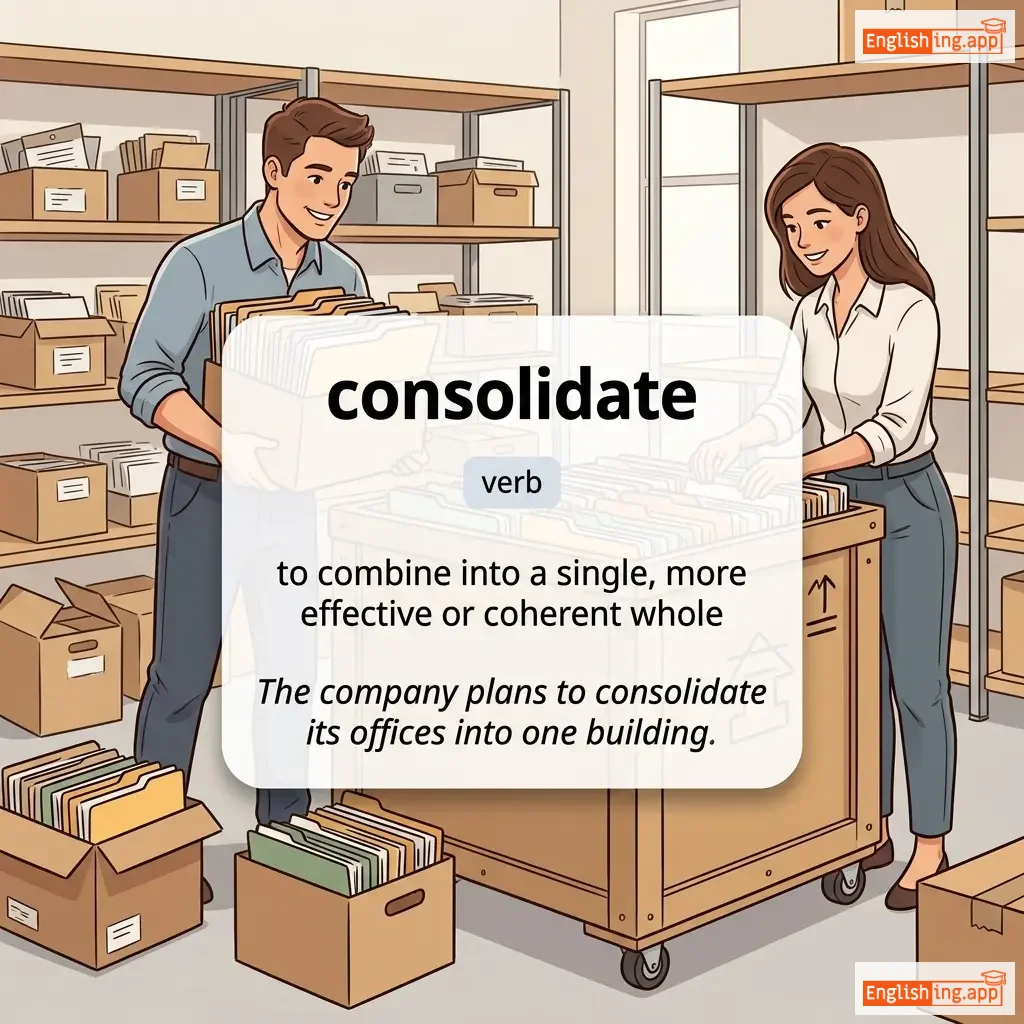
consolidate definition card — visual illustration of the meaning
verb
/kənˈsɑːlɪdeɪt/
consolider (kohn-soh-lee-day)

to combine into a single, more effective or coherent whole

"The company plans to consolidate its offices into one building."

"L'entreprise prévoit de consolider ses bureaux dans un seul bâtiment." (L'entreprise prévoit de consolider ses bureaux dans un seul bâtiment.)
Consolidation definition card — visual illustration of the meaning
noun
/kənˌsɑːlɪˈdeɪʃən/
consolidation (consolidation)

the act or process of combining into a single, stronger or more effective entity

"The consolidation of the two companies improved efficiency."

"La consolidation des deux entreprises a amélioré l'efficacité." (La consolidation des deux entreprises a ameliore l'efficacite.)
noun
/ˈkɒnsənəns/
consonance, harmonie (consonance, harmonie)

Agreement or harmony among parts; a pleasing combination of sounds in music or words.

"The consonance between their ideas made the project successful."

"La consonance entre leurs idées a rendu le projet réussi." (La consonance entre leurs idées a rendu le projet réussi.)
noun
/ˈkɒnsənənt/
consonne (consonne)

A speech sound produced by blocking air flow, or a letter representing such a sound.

"The word 'cat' has two consonants and one vowel."

"Le mot 'chat' a deux consonnes et une voyelle." (Le mot 'chat' a deux consonnes et une voyelle.)
verb
/ˈkɒnsɔːrt/
partenaire, conjoint royal (partenaire, conjoint royal)

To associate with someone, typically with disapproval; also, a spouse of a reigning monarch.

"He was criticized for consorting with criminals."

"Il a été critiqué pour avoir fréquenté des criminels." (Il a été critiqué pour avoir fréquenté des criminels.)
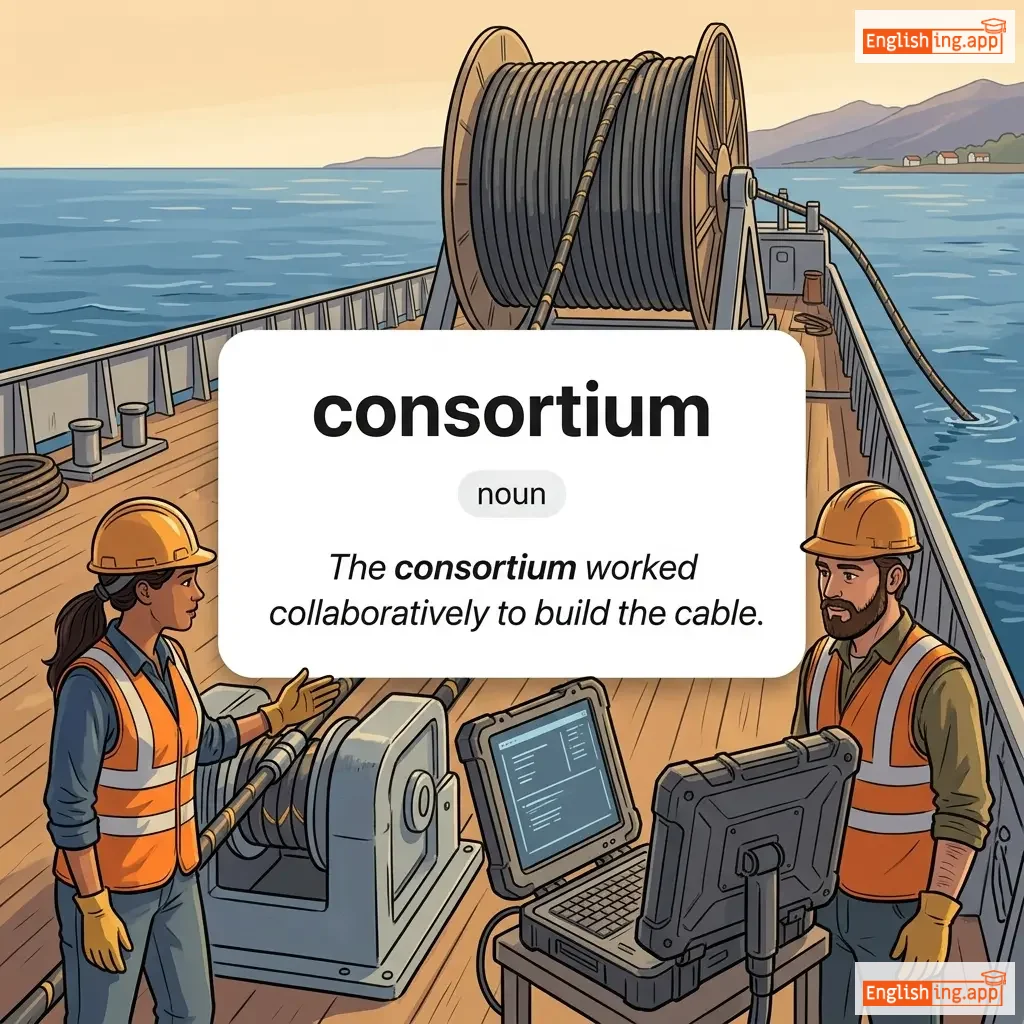
consortium definition card — visual illustration of the meaning
noun
kənˈsɔː.ti.əm
consortium (consortium)

An association of several companies or organizations formed to undertake an enterprise beyond the resources of any one member.

"The consortium worked collaboratively to build the cable."

"Le consortium a travaillé de manière collaborative pour construire le câble." (Le consortium a travaille de maniere collaborative pour construire le cable.)
adjective
/kənˈspɪkjuəs/
conspicueux (conspicueux)

Easily noticeable; attracting attention due to being unusual or prominent.

"Her red dress made her conspicuous at the party."

"Sa robe rouge la rendait conspicueuse à la fête." (Sa robe rouge la rendait conspicueuse à la fête.)
noun
/kənˈspɪrəsi/
conspiration (conspiration)

A secret plan by a group to do something unlawful or harmful.

"The police uncovered a conspiracy to overthrow the government."

"La police a découvert une conspiration pour renverser le gouvernement." (La police a découvert une conspiration pour renverser le gouvernement.)
noun
/kənˈspɪrə.tər/
conspirateur (conspirateur)

a person who secretly plans with others to do something unlawful or harmful

"The conspirator was arrested before the plan could be carried out."

"Le conspirateur a été arrêté avant que le plan ne puisse être mis à exécution." (Le conspirateur a été arrêté avant que le plan ne puisse être mis à exécution.)
verb
/kənˈspaɪər/
conspirer (conspirer)

to secretly plan with others to do something harmful or illegal

"They conspired to overthrow the government."

"Ils ont conspiré pour renverser le gouvernement." (Ils ont conspiré pour renverser le gouvernement.)
noun
/ˈkʌn.stə.bəl/
agent de police (agent de police)

a police officer of the lowest rank

"The constable directed traffic at the busy intersection."

"L'agent de police a dirigé la circulation à l'intersection animée." (L'agent de police a dirigé la circulation à l'intersection animée.)
noun
/ˈkɒnstənsi/
constance (constance)

the quality of being faithful and dependable

"Her constancy in friendship is admirable."

"Sa constance en amitié est admirable." (Sa constance en amitier est admirable.)
adjective
/ˈkɒn.stənt/
constant (constant)

happening all the time or staying the same without change

"She lived in constant fear of losing her job."

"Elle vivait dans la peur constante de perdre son emploi." (Elle vivait dans la peur constante de perdre son emploi.)
adverb
/ˈkɒnstəntli/
constamment (constamment)

continuously over a period of time; always

"He is constantly improving his skills."

"Il améliore constamment ses compétences." (Il améliore constamment ses compétences.)
noun
/ˌkɒn.stəˈleɪ.ʃən/
constellation (constellation)

a group of stars forming a recognizable pattern in the night sky

"Orion is one of the most famous constellations."

"Orion est l'une des constellations les plus célèbres." (Orion est l'une des constellations les plus celebres.)
noun
/ˌkɒnstəˈneɪʃən/
consternation (consternation)

A feeling of anxiety, dismay, or confusion, often caused by something unexpected.

"The sudden announcement caused widespread consternation among the employees."

"L'annonce soudaine a provoqué une consternation généralisée parmi les employés" (L'annonce soudaine a provoqué une consternation généralisée parmi les employés)
noun
/kənˈstɪtʃuənsi/
circonscription (circonscription)

A geographical area whose residents elect a representative to a legislative body.

"She campaigned tirelessly across her constituency."

"Elle a fait campagne sans relâche dans sa circonscription." (Elle a fait campagne sans relache dans sa circonscription.)
noun/adjective
/kənˈstɪtʃuənt/
composant / électeur (composant / electeur)

Noun: A member of a constituency or an essential part of something. Adjective: Being a necessary part of a whole.

"The senator met with his constituents to discuss local issues."

"Le sénateur a rencontré ses électeurs pour discuter des problèmes locaux." (Le sénateur a rencontré ses électeurs pour discuter des problèmes locaux.)
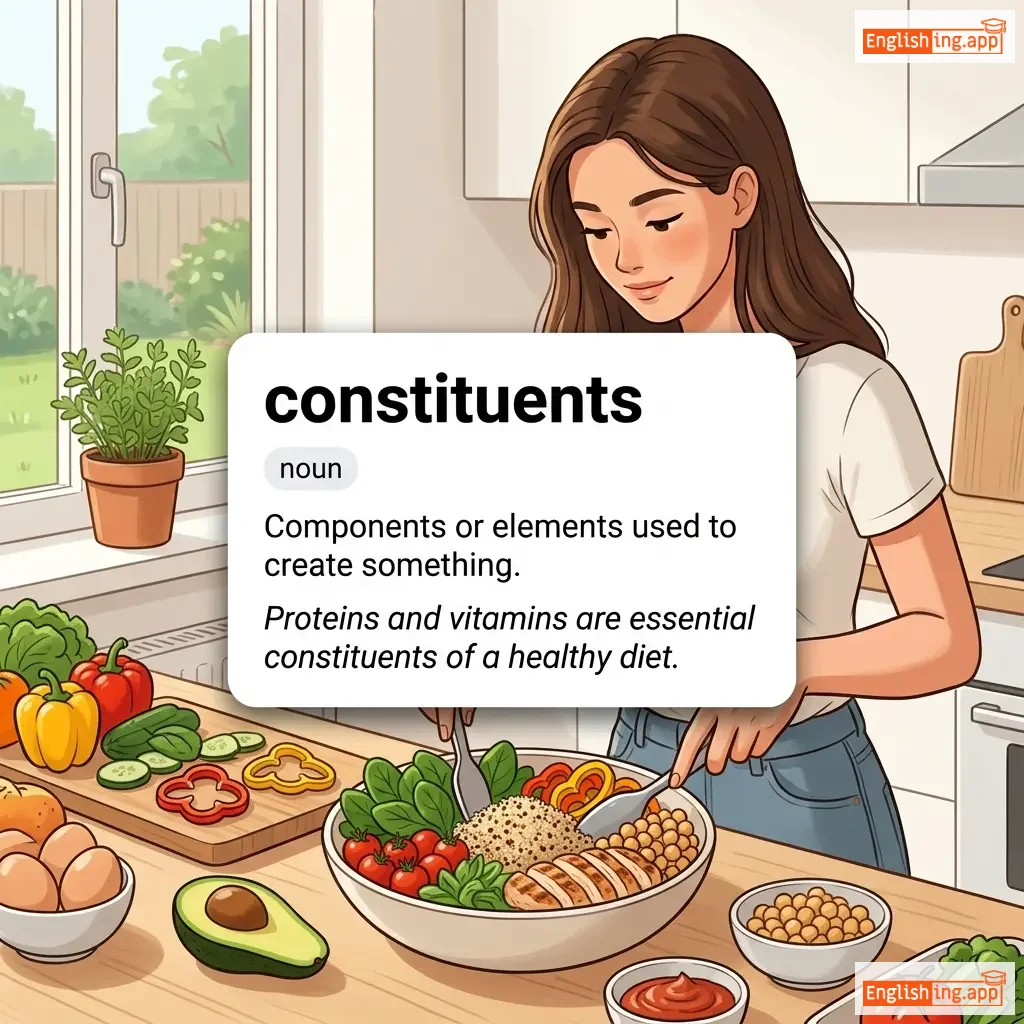
constituents definition card — visual illustration of the meaning
noun
/kənˈstɪtʃ.u.ənts/
constituants (constituants)

Components or elements used to create something.

"Proteins and vitamins are essential constituents of a healthy diet."

"Les protéines et les vitamines sont des constituants essentiels d'un régime alimentaire sain." (Les protéines et les vitamines sont des constituants essentiels d'un régime alimentaire sain.)
verb
/ˈkɒnstɪtjuːt/
constituer (constituer)

To make up, form, or establish something.

"These documents constitute the legal agreement between the two parties."

"Ces documents constituent l'accord légal entre les deux parties." (Ces documents constituent l'accord légal entre les deux parties.)
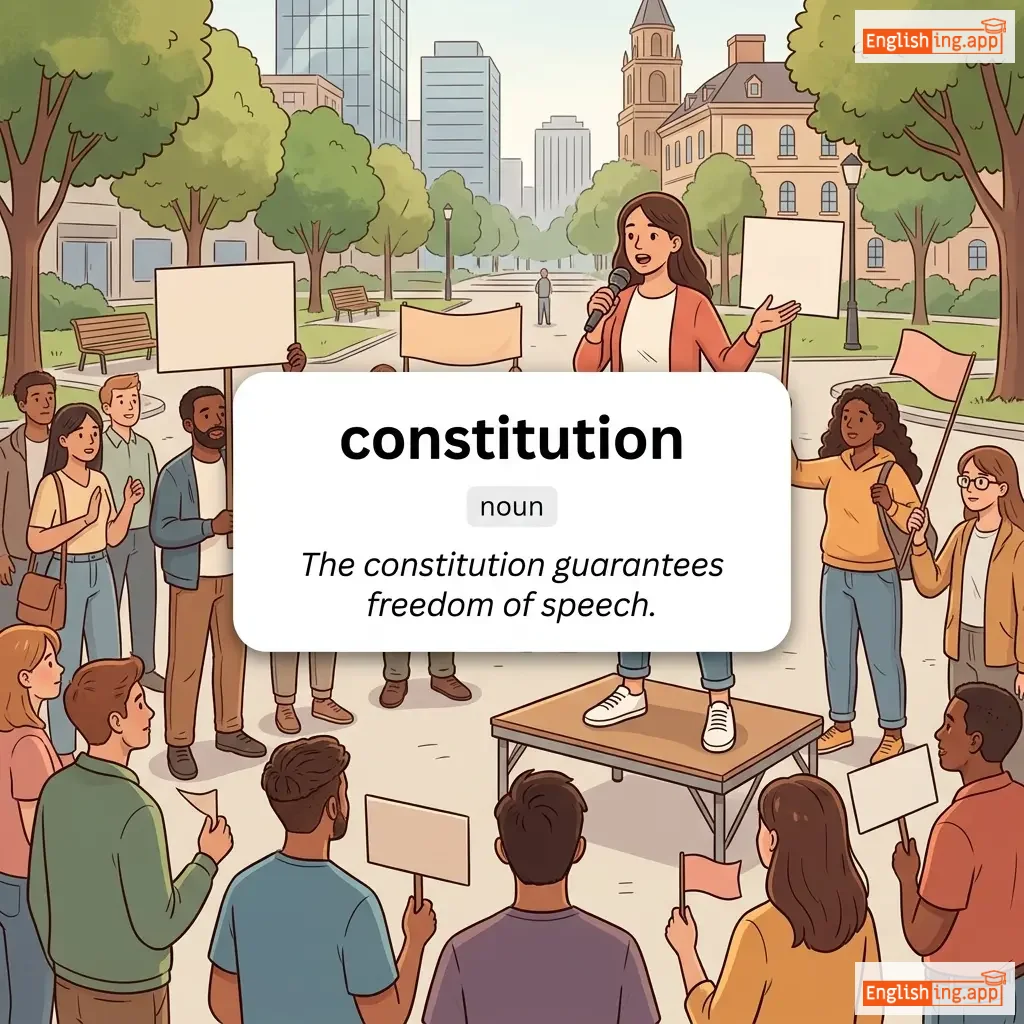
constitution definition card — visual illustration of the meaning
noun
/ˌkɒnstɪˈtjuːʃən/
constitution (constitution)

The system of fundamental principles according to which a nation or organization is governed.

"The constitution guarantees freedom of speech."

"La constitution garantit la liberté d'expression." (La constitution garantit la liberte d'expression.)
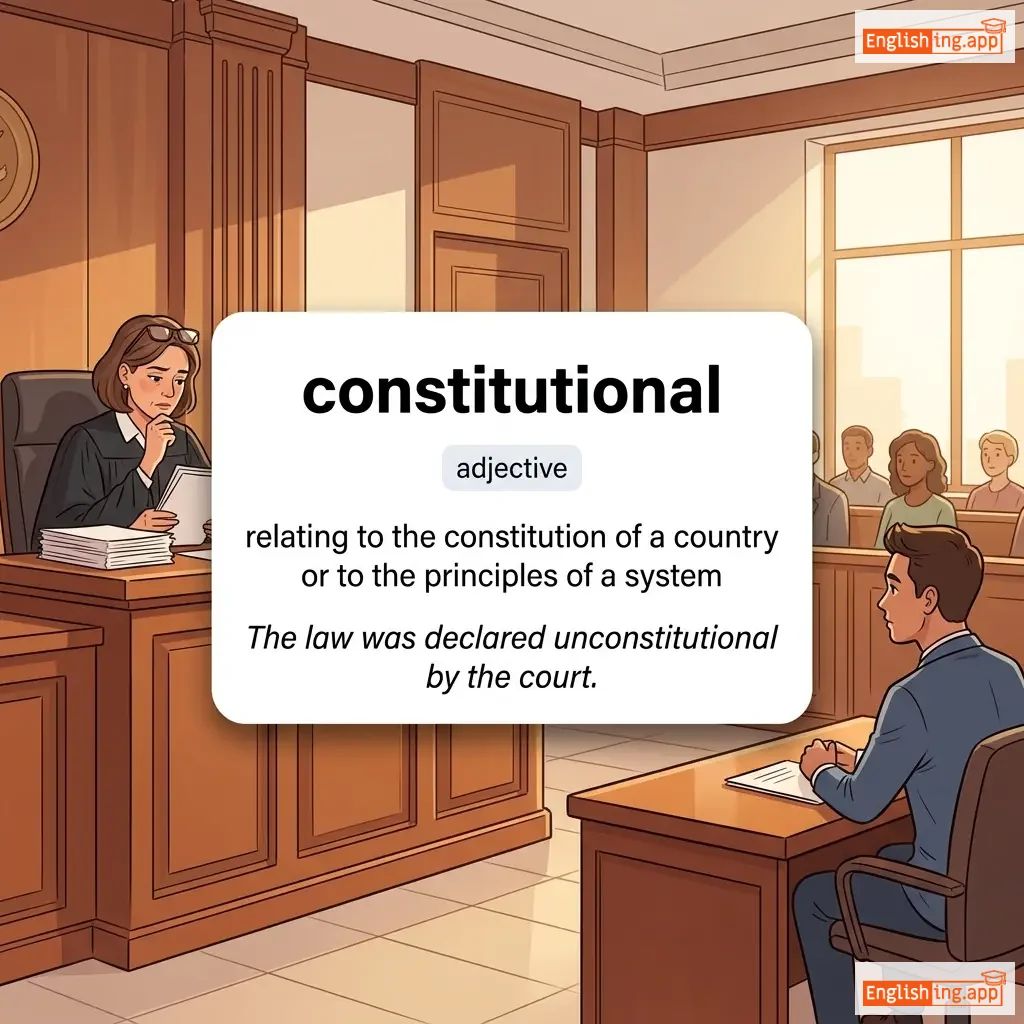
constitutional definition card — visual illustration of the meaning
adjective
/ˌkɒnstɪˈtjuːʃənəl/
constitutionnel (konstitooshunul)

relating to the constitution of a country or to the principles of a system

"The law was declared unconstitutional by the court."

"La loi a ete declaree inconstitutionnelle par le tribunal." (Laloiaeteclareeinconstitutionnelleparlettribunal)
verb
/kənˈstreɪn/
contraindre (contraindre)

to limit or restrict someone or something; to force or compel

"The new regulations constrain businesses from polluting the environment."

"Les nouvelles régulations contraignent les entreprises à ne pas polluer l'environnement." (Les nouvelles régulations contraignent les entreprises à ne pas polluer l'environnement.)
adjective
/kənˈstreɪnd/
contraint, forcé (contraint, force)

appearing forced, unnatural, or restricted

"He gave a constrained smile during the awkward meeting."

"Il a donné un sourire forcé pendant la réunion maladroite." (Il a donné un sourire forcé pendant la réunion maladroite.)
noun
/kənˈstreɪnt/
contrainte (contrainte)

a limitation or restriction

"Time is the biggest constraint in completing the project."

"Le temps est la plus grande contrainte pour terminer le projet." (Le temps est la plus grande contrainte pour terminer le projet.)
verb
/kənˈstrɪkt/
constrict (constrict)

to make narrower or tighter; to shrink or compress

"The snake constricted its prey before swallowing."

"Le serpent a contracté sa proie avant de l'avaler." (Le serpent a contracté sa proie avant de l'avaler.)
verb
/kənˈstrɪndʒ/
contracter (contracter)

to cause to shrink or contract; to constrict

"The medicine helped constringe the swollen tissues."

"Le médicament a aidé à contracter les tissus enflés." (Le médicament a aidé à contracter les tissus enflés.)
verb
/kənˈstrʌkt/
construire (construir)

to build or form something by putting parts together

"They plan to construct a new bridge over the river."

"Ils prévoient de construire un nouveau pont au-dessus de la rivière." (Ils prévoient de construire un nouveau pont au-dessus de la rivière.)
construction definition card — visual illustration of the meaning
noun
/kənˈstrʌkʃən/
construction (construction)

The process of building something, typically large structures such as houses, roads, or bridges.

"The construction of the new bridge will take two years."

"La construction du nouveau pont prendra deux ans." (La construction du nouveau pont prendra deux ans.)
verb
/kənˈstruː/
interpréter (interpreter)

to interpret or understand the meaning of something in a particular way

"His words could be construed as a threat."

"Ses mots pouvaient être interprétés comme une menace." (Ses mots pouvaient être interprétés comme une menace.)
noun
/ˈkɒnsəl/
consul / ambassadeur (consul / ambassadeur)

an official appointed by a government to live in a foreign city and protect its citizens and interests there

"The consul assisted travelers who lost their passports."

"Le consul a aidé les voyageurs qui ont perdu leurs passeports." (Le consul a aide les voyageurs qui ont perdu leurs passeports.)
noun
/ˈkɒnsjʊlət/
consulat (consulat)

the building or office where a consul works

"He went to the consulate to renew his visa."

"Il est allé au consulat pour renouveler son visa." (Il est alle au consulat pour renouveler son visa.)
verb
/kənˈsʌlt/
consulter (consulter)

To seek advice or information from someone with expertise.

"You should consult a doctor before starting the treatment."

"Vous devriez consulter un médecin avant de commencer le traitement." (Vous devriez consulter un médecin avant de commencer le traitement.)
noun
/kənˈsʌltənt/
consultant (consultant)

A professional who provides expert advice in a particular area.

"The company hired a consultant to improve its marketing strategy."

"L'entreprise a embauché un consultant pour améliorer sa stratégie marketing." (L'entreprise a embauché un consultant pour améliorer sa stratégie marketing.)
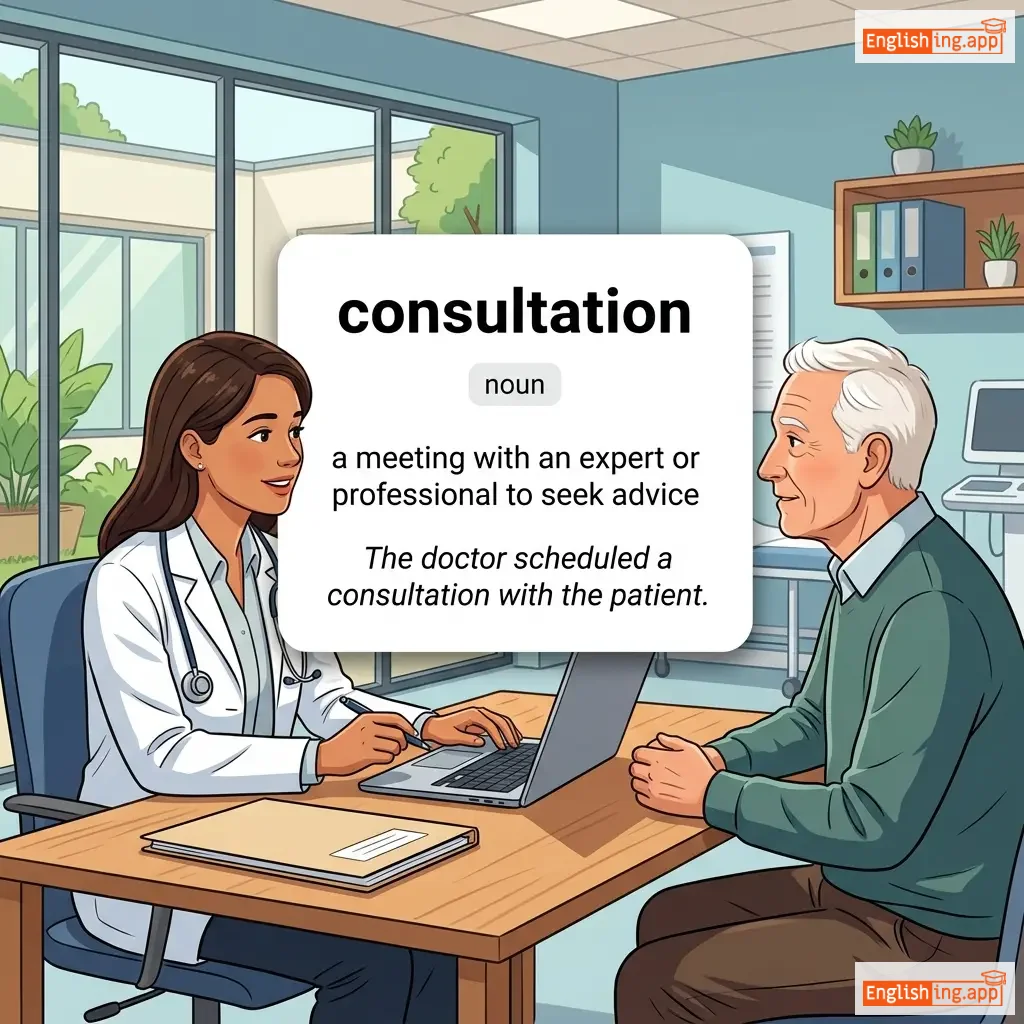
consultation definition card — visual illustration of the meaning
noun
/ˌkɒnsʌlˈteɪʃən/
consultation (consultation)

a meeting with an expert or professional to seek advice

"The doctor scheduled a consultation with the patient."

"Le médecin a planifié une consultation avec le patient." (Le medecin a planifie une consultation avec le patient.)
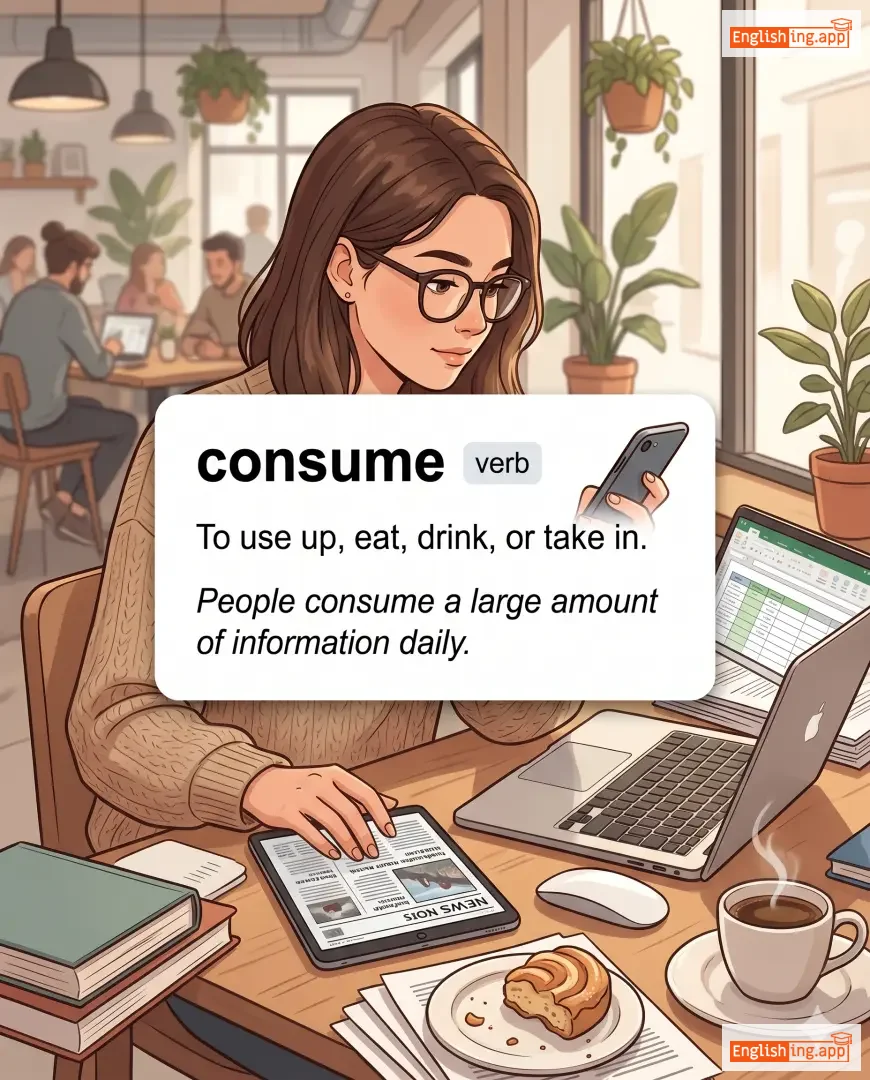
consume definition card — visual illustration of the meaning
verb
/kənˈsjuːm/
consommer (consommer)

To use up, eat, drink, or take in.

"People consume a large amount of information daily."

"Les gens consomment une grande quantité d'informations chaque jour." (Les gens consomment une grande quantité d'informations chaque jour.)
noun
/kənˈsjuːmər/
consommateur (consommateur)

A person who buys and uses goods and services.

"The company focuses on understanding consumer needs."

"L'entreprise se concentre sur la compréhension des besoins des consommateurs." (L'entreprise se concentre sur la compréhension des besoins des consommateurs.)
consumerism definition card — visual illustration of the meaning
noun
kənˈsjuː.mə.rɪ.zəm
consumérisme (consumerism)

The tendency to increase consumption of goods and the importance given to consuming products.

"Modern consumerism leads to increased demand for luxury goods."

"Le consumérisme moderne entraîne une demande accrue de biens de luxe." (Le consumérisme moderne entraîne une demande accrue de biens de luxe.)
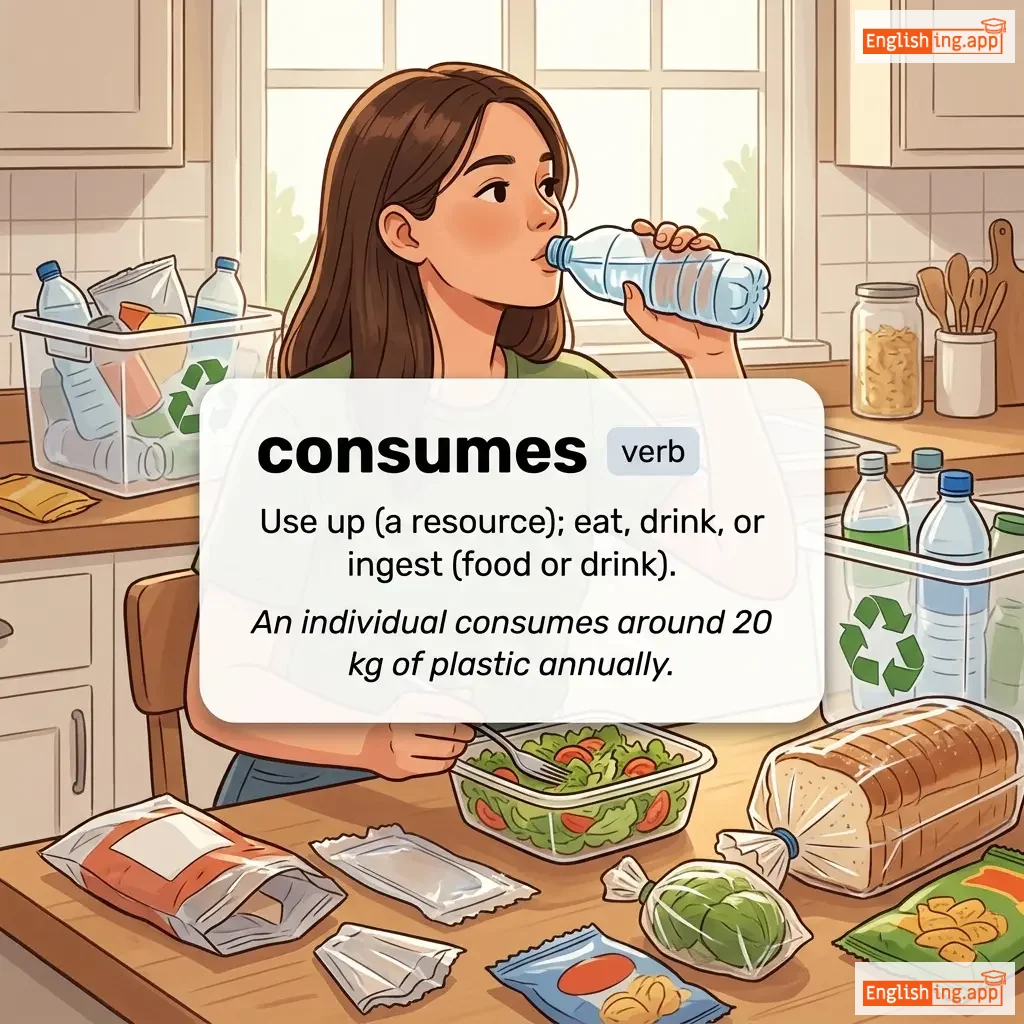
consumes definition card — visual illustration of the meaning
verb
kənˈsjuːmz
consommer (consommer)

Use up (a resource); eat, drink, or ingest (food or drink).

"An individual consumes around 20 kg of plastic annually."

"Une personne consomme environ 20 kg de plastique chaque année." (Une personne consomme environ 20 kg de plastique chaque année.)
consummate definition card — visual illustration of the meaning
adjective, verb
/ˈkɒnsəmət/ (adj), /ˈkɒnsəmeɪt/ (verb)
consommer / complet (consommer / komple)

to complete or perfect something; showing great skill or excellence

"She is a consummate professional in her field."

"Elle est une professionnelle accomplie dans son domaine." (Elle est une professionnelle accomplie dans son domaine.)