Vocabulaires

Découvrez, apprenez et maîtrisez le vocabulaire anglais

noun
/kəmˈpænjən/
compagnon (compagnon)

a person or animal you spend time with or travel with

"He was my companion during the long journey."

"Il a été mon compagnon pendant le long voyage." (Il a ete mon compagnon pendant le long voyage.)
noun
/ˈkʌm.pə.ni/
entreprise (entreprise)

a business organization; the presence of other people

"She started her own company to sell handmade products."

"Elle a créé sa propre entreprise pour vendre des produits faits main." (Elle a cree sa propre entreprise pour vendre des produits faits main.)
adjective
/ˈkɒmp(ə)rəbl/
comparable (comparable)

Able to be likened to something else in size, amount, or quality.

"The two products are comparable in quality but differ in price."

"Les deux produits sont comparables en qualité mais diffèrent par le prix." (le deu produi son comparabl an kalite me difer par le pri)
adjective
/kəmˈpærətɪv/
comparatif (comparatif)

Measured or considered by comparison; relative.

"She lives in comparative comfort after moving to the city."

"Elle vit dans un confort comparatif après avoir déménagé en ville." (el vi dan un konfor comparatif apre avuar demenaje an vil)
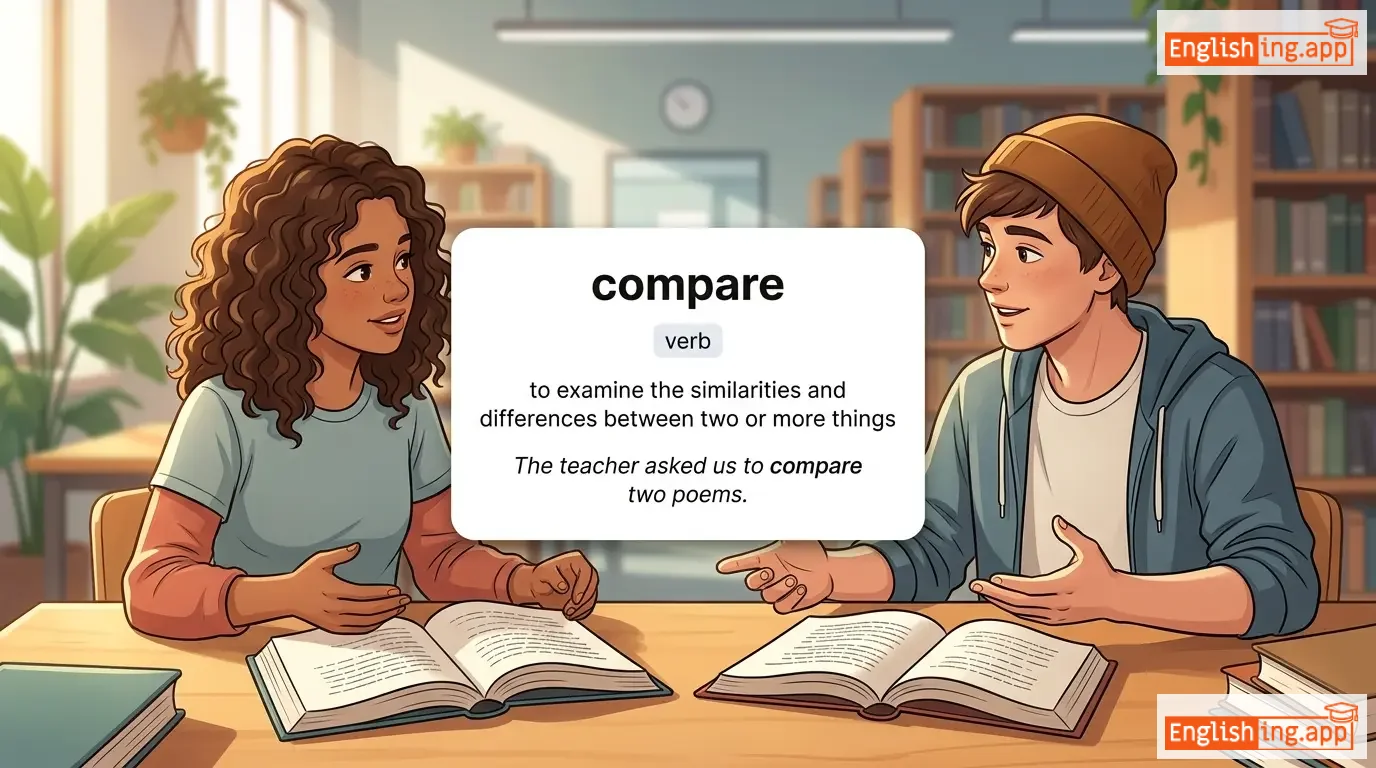
compare definition card — visual illustration of the meaning
verb
/kəmˈpeər/
comparer (comparer)

to examine the similarities and differences between two or more things

"The teacher asked us to compare two poems."

"Le professeur nous a demandé de comparer deux poèmes." (Le professeur nous a demandé de comparer deux poèmes.)
noun
/kəmˈpærɪsən/
comparaison (comparaison)

The act or process of examining the similarities and differences between things.

"A comparison of the two reports shows several inconsistencies."

"Une comparaison des deux rapports montre plusieurs incohérences." (Une comparaison des deux rapports montre plusieurs incoherences)
noun
/kəmˈpɑːtmənt/
compartiment (compartiment)

A separate section or space within a larger structure, such as a train or a container.

"He kept his passport in a small compartment of his bag."

"Il a mis son passeport dans un petit compartiment de son sac." (Il a mis son passeport dans un petit compartiment de son sac.)
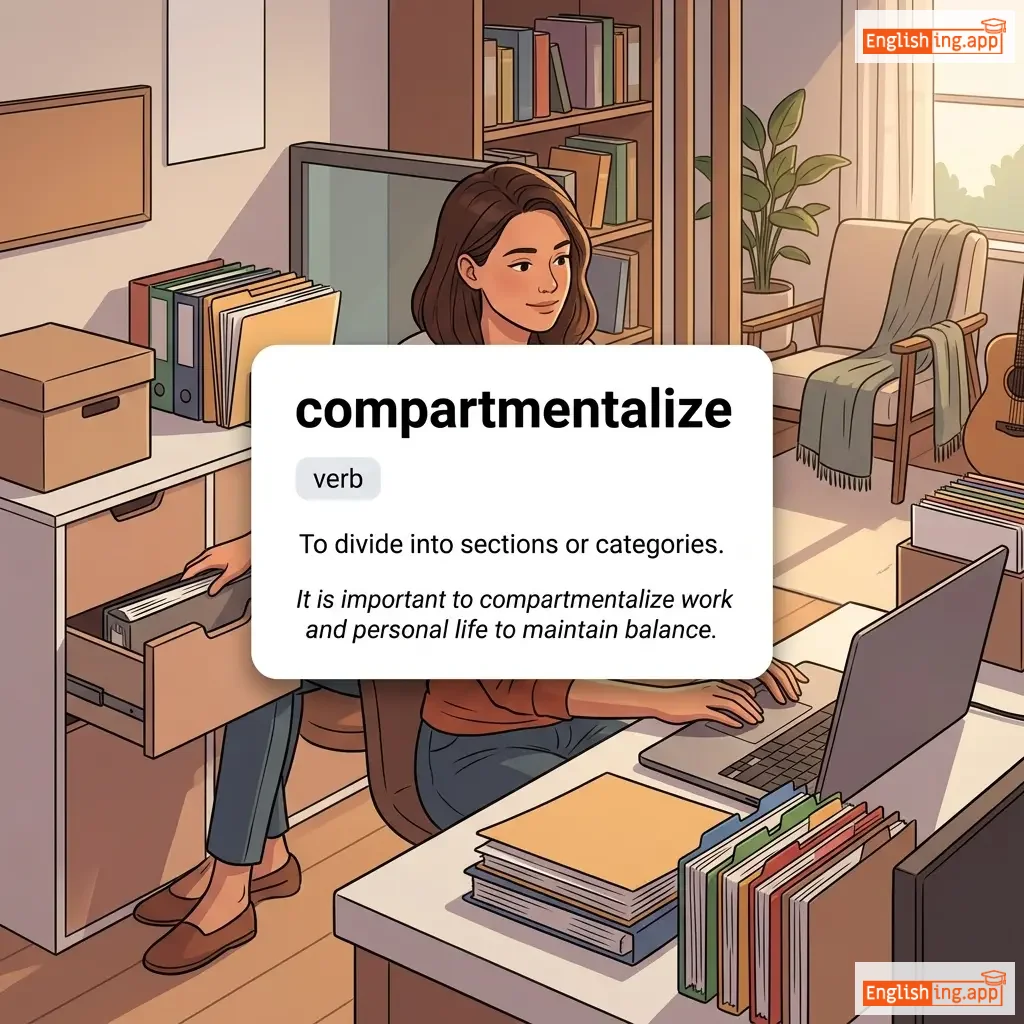
compartmentalize definition card — visual illustration of the meaning
verb
/kəmˈpɑːtməntəˌlaɪz/
compartimenter (compartimenter)

To divide into sections or categories.

"It is important to compartmentalize work and personal life to maintain balance."

"Il est important de compartimenter le travail et la vie personnelle pour maintenir l'équilibre." (Il est important de compartimenter le travail et la vie personnelle pour maintenir l'équilibre.)
noun
/ˈkʌm.pəs/
boussole (boussole)

an instrument for finding direction with a magnetic needle pointing to magnetic north

"The hiker used a compass to find the right direction."

"Le randonneur a utilisé une boussole pour trouver la bonne direction." (Le randonneur a utilise une boussole pour trouver la bonne direction)
noun
/kəmˈpæʃən/
compassion (compassion)

Sympathetic concern for the sufferings or misfortunes of others.

"The nurse treated the patients with great compassion."

"L'infirmière a traité les patients avec une grande compassion." (L'infirmière a traité les patients avec une grande compassion.)
adjective
/kəmˈpæʃənət/
compatissant; plein de compassion (compatissant; plein de compassion)

feeling or showing sympathy and concern for others who are suffering

"The compassionate nurse took extra time to comfort the worried patients."

"L'infirmière compatissante a pris du temps supplémentaire pour réconforter les patients inquiets." (L'infirmière compatissante a pris du temps supplémentaire pour réconforter les patients inquiets.)
adjective
/kəmˈpætəbl/
compatible (compatible)

Able to exist or work together without conflict; harmonious.

"This software is compatible with both Windows and Mac systems."

"Ce logiciel est compatible avec les systèmes Windows et Mac." (Ce logiciel est compatible avec les systèmes Windows et Mac.)
verb
/kəmˈpɛl/
forcer (for-ser)

To force or drive someone to do something.

"The law compels citizens to pay taxes."

"La loi oblige les citoyens à payer des impôts." (La loi oblige les citoyens à payer des impôts.)
adjective
/kəmˈpɛlɪŋ/
captivant (captivant)

Evoking interest, attention, or admiration in a powerful way.

"She gave a compelling speech about climate change."

"Elle a donné un discours captivant sur le changement climatique." (Elle a donne un discours captivant sur le changement climatique.)
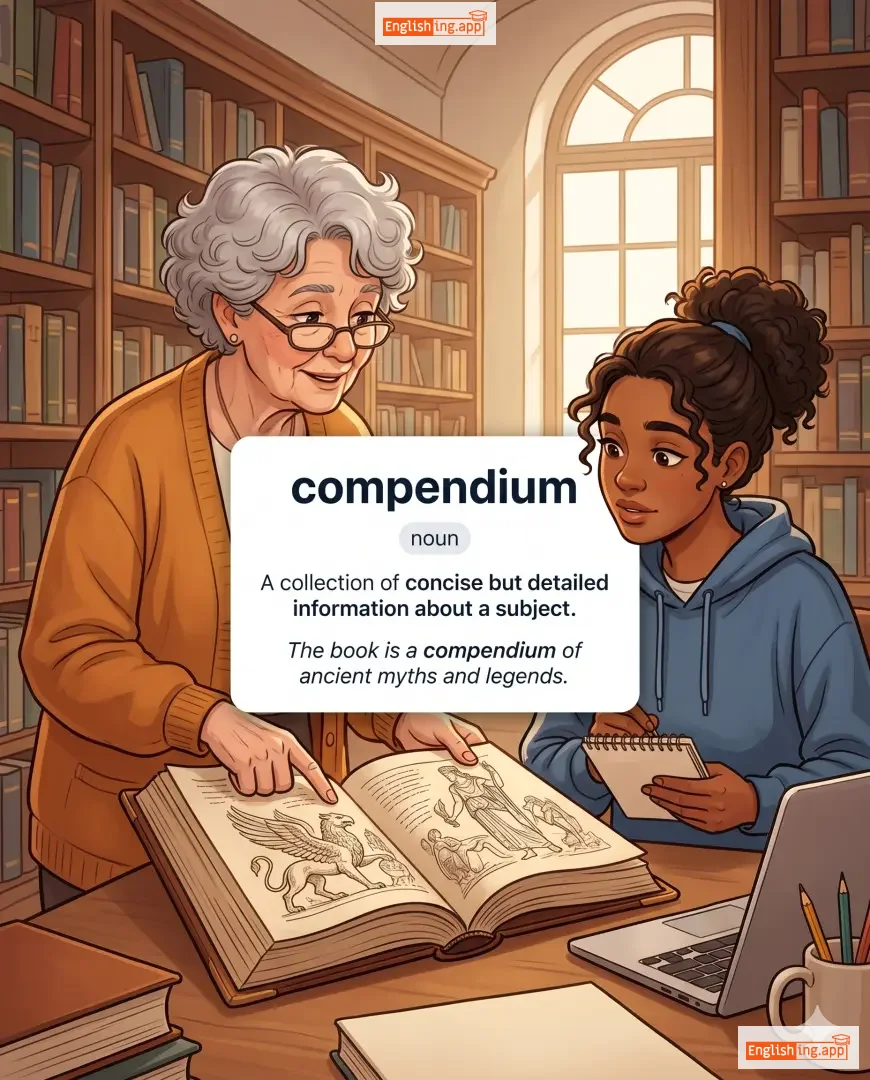
compendium definition card — visual illustration of the meaning
noun
/kəmˈpɛndiəm/
compendium (compendium)

A collection of concise but detailed information about a subject.

"The book is a compendium of ancient myths and legends."

"Le livre est un compendium de mythes et de légendes anciennes." (Le livre est un compendium de mythes et de légendes anciennes.)
verb
/ˈkɒmpənseɪt/
compenser (compenser)

To give something, typically money, in recognition of loss, suffering, or work done.

"The company compensated the worker for his injury."

"L'entreprise a compensé le travailleur pour sa blessure." (L'entreprise a compense le travailleur pour sa blessure.)
verb
/ˈkɒmpənseɪtɪd/
compensé (compensé)

to have been given something, typically money, as a recompense for loss, suffering, or work done

"The workers were compensated for their overtime hours."

"Les travailleurs ont été compensés pour leurs heures supplémentaires." (Les travailleurs ont été compensés pour leurs heures supplémentaires.)
noun
/ˌkɒmpənˈseɪʃən/
compensation (compensation)

something, typically money, given to make up for loss, injury, or work done

"She received financial compensation for the accident."

"Elle a reçu une compensation financière pour l'accident." (Elle a recu une compensation financiere pour l'accident.)
adjective
/kəmˈpensətɔːri/
compensatoire (compensatoire)

serving to make up for a loss, damage, or injury

"The court awarded him compensatory damages."

"Le tribunal lui a accordé des dommages-intérêts compensatoires." (Le tribunal lui a accorde des dommages-interets compensatoires.)
verb
/kəmˈpiːt/
compéter (compéter)

to try to win or be more successful than others in a contest or activity

"Several companies compete for dominance in the market."

"Plusieurs entreprises se battent pour la domination du marché." (Plusieurs entreprises se battent pour la domination du marché.)
noun
/ˈkɒmpɪtəns/
compétence (competence)

the ability to do something successfully or efficiently

"Her competence as a manager impressed the board."

"Sa compétence en tant que gestionnaire a impressionné le conseil." (Sa competence en tant que gestionnaire a impressionne le conseil.)
adjective
/ˈkɒmpɪtənt/
compétent (kompetan)

having the necessary ability, knowledge, or skill to do something successfully

"He is a competent driver who rarely makes mistakes."

"Il est un conducteur compétent qui fait rarement des erreurs." (Il est un conducteur compétent qui fait rarement des erreurs.)
competition definition card — visual illustration of the meaning
noun
/ˌkɒmpəˈtɪʃən/
compétition (competition)

a situation in which people or organizations try to be more successful than others

"The competition in the tech industry is very intense."

"La compétition dans l'industrie technologique est très intense." (La competition dans l'industrie technologique est tres intense.)
adjective
/kəmˈpetətɪv/
compétitif (competitif)

relating to or characterized by competition; having a strong desire to win or be more successful

"She has a competitive spirit that drives her to excel."

"Elle a un esprit compétitif qui la pousse à exceller." (Elle a un esprit compétitif qui la pousse à exceller.)
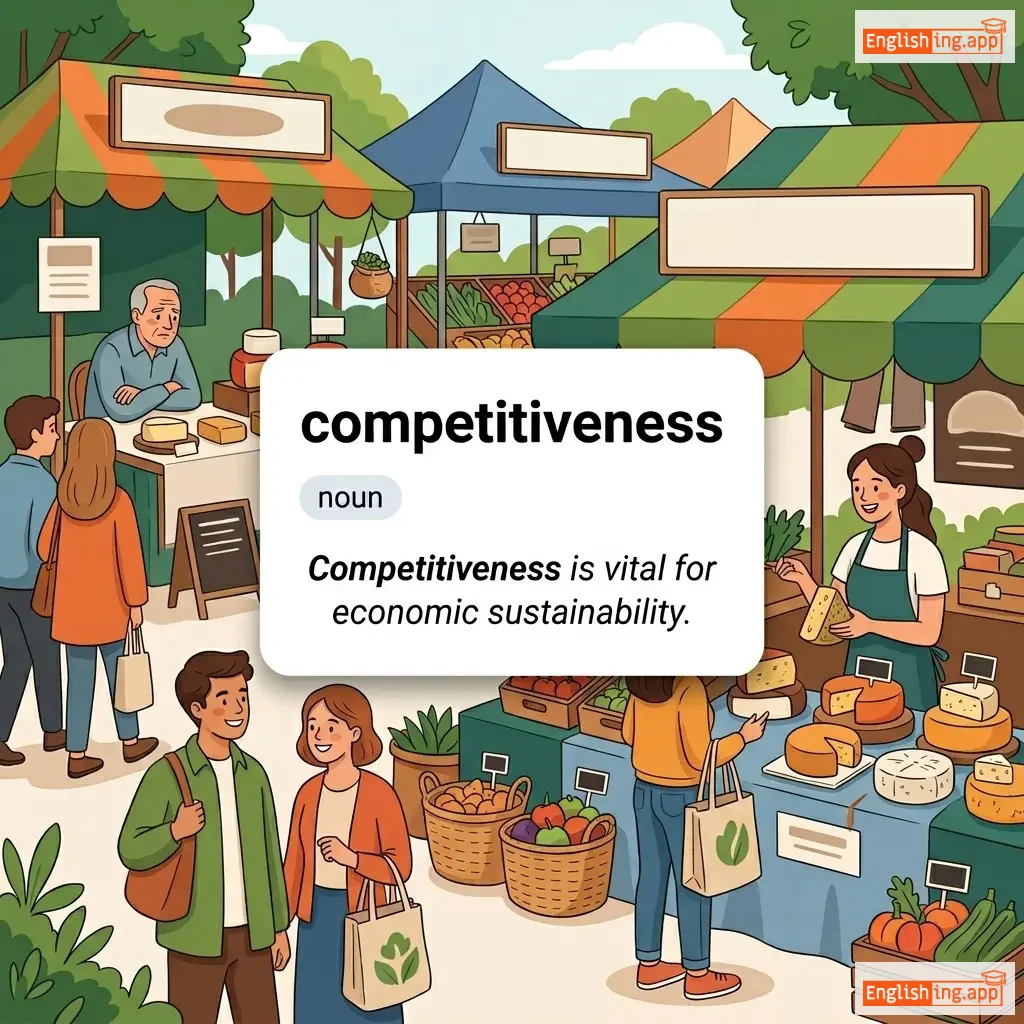
competitiveness definition card — visual illustration of the meaning
noun
kəmˈpet.ɪ.tɪv.nəs
compétitivité (competitivite)

The quality of being as good as or better than others of a comparable nature; the ability to compete successfully.

"Competitiveness is vital for economic sustainability."

"La compétitivité est essentielle pour la durabilité économique." (La competitivite est essentielle pour la durabilite economique.)
noun
/kəmˈpɛtɪtər/
concurrenț (konkurans)

a person, team, or company that competes with others

"The company lowered its prices to beat its main competitor."

"L'entreprise a baissé ses prix pour battre son principal concurrent." (L'entreprise a baissé ses prix pour battre son principal concurrent.)
noun
/ˌkɒmpɪˈleɪʃən/
compilation (compilation)

a collection of things, especially pieces of writing or music, gathered together

"The book is a compilation of his best essays."

"Le livre est une compilation de ses meilleurs essais." (Le livre est une compilation de ses meilleurs essais.)
verb
/kəmˈpaɪl/
compiler (compiler)

to collect information or material and put it together in a list, report, or book

"She compiled the research data into a detailed report."

"Elle a compilé les données de recherche dans un rapport détaillé." (Elle a compilé les données de recherche dans un rapport détaillé.)
noun
/kəmˈpleɪsəns/

a feeling of quiet pleasure or self-satisfaction, often without awareness of potential danger

"His complacence prevented him from noticing the risks."

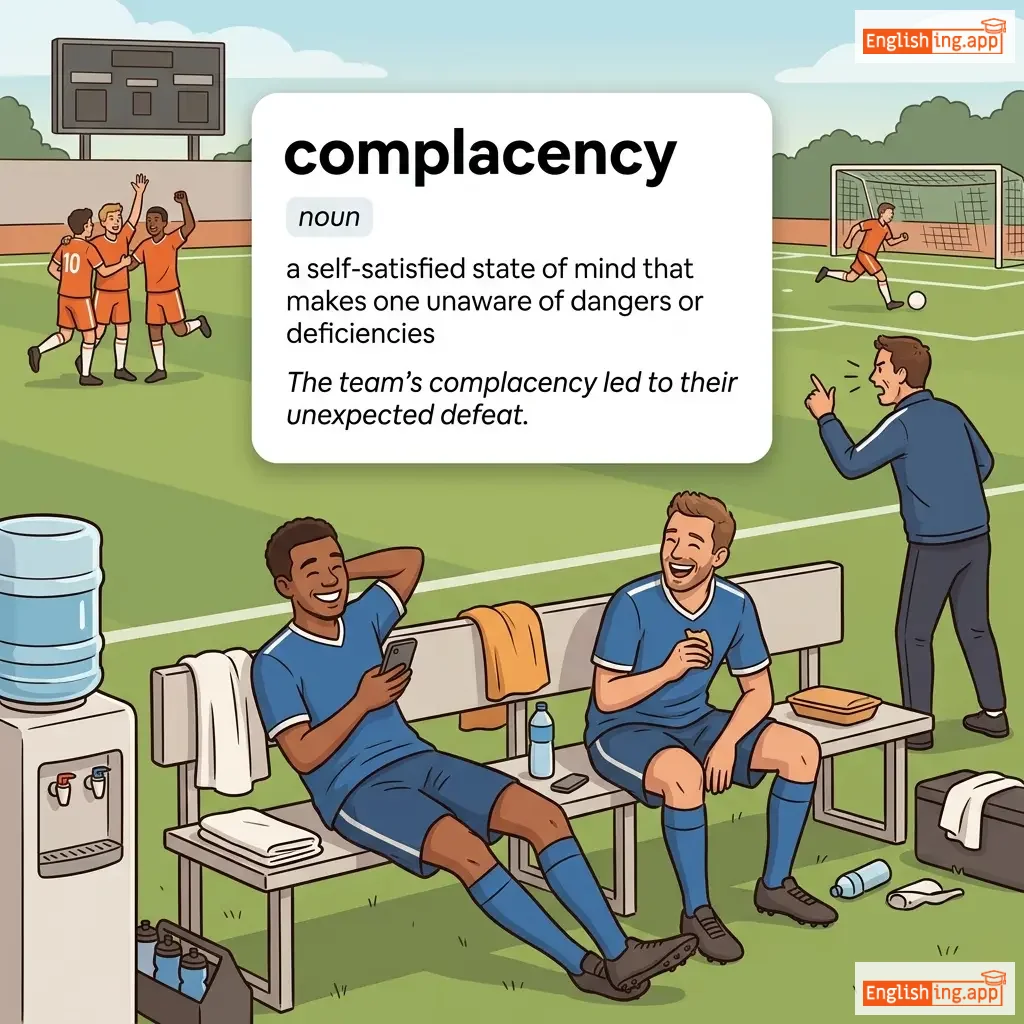
complacency definition card — visual illustration of the meaning
noun
/kəmˈpleɪsənsi/
auto-satisfaction (auto-satisfaction)

a self-satisfied state of mind that makes one unaware of dangers or deficiencies

"The team's complacency led to their unexpected defeat."

"L'auto-satisfaction de l'équipe a conduit à leur défaite inattendue." (L'auto-satisfaction de l'equipe a conduit a leur defaite inattendue.)
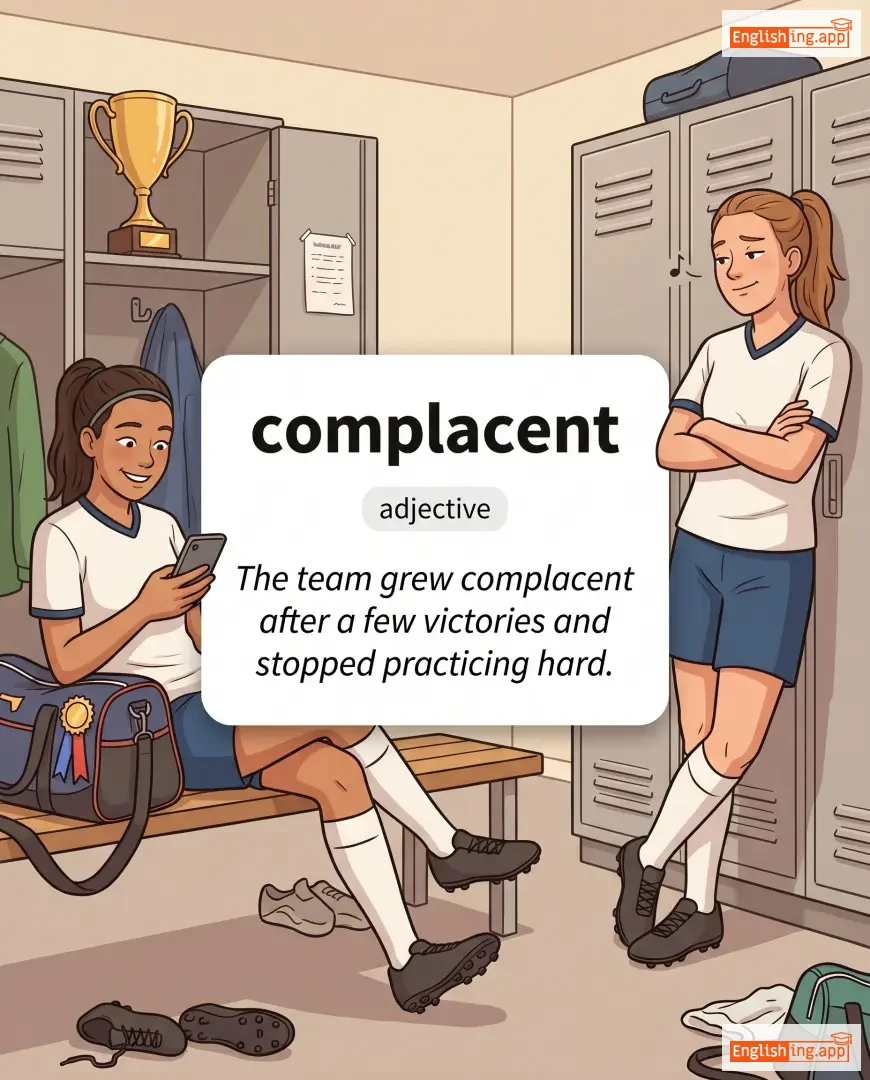
complacent definition card — visual illustration of the meaning
adjective
/kəmˈpleɪsənt/
complaisant (complaisant)

showing self-satisfaction and a lack of concern about potential dangers or problems

"The team grew complacent after a few victories and stopped practicing hard."

"L'équipe est devenue complaisante après quelques victoires et a arrêté de s'entraîner dur." (L'équipe est devenue complaisante après quelques victoires et a arrêté de s'entraîner dur.)
verb
/kəmˈpleɪn/
se plaindre (se plaindre)

to express dissatisfaction or annoyance about something

"He often complains about the noise in the neighborhood."

"Il se plaint souvent du bruit dans le quartier." (Il se plaint souvent du bruit dans le quartier.)
noun
/kəmˈpleɪnt/
plainte (plent)

a statement that something is wrong or not satisfactory

"The manager received a complaint from a customer about poor service."

"Le responsable a reçu une plainte d'un client concernant un mauvais service." (Le responsable a reçu une plainte d'un client concernant un mauvais service.)
noun
/kəmˈpleɪsəns/
complaisance (complaisance)

willingness to please others; courteous compliance

"Her complaisance made her popular among her colleagues."

"Sa complaisance l'a rendue populaire parmi ses collègues." (Sa complaisance l'a rendue populaire parmi ses collegues.)
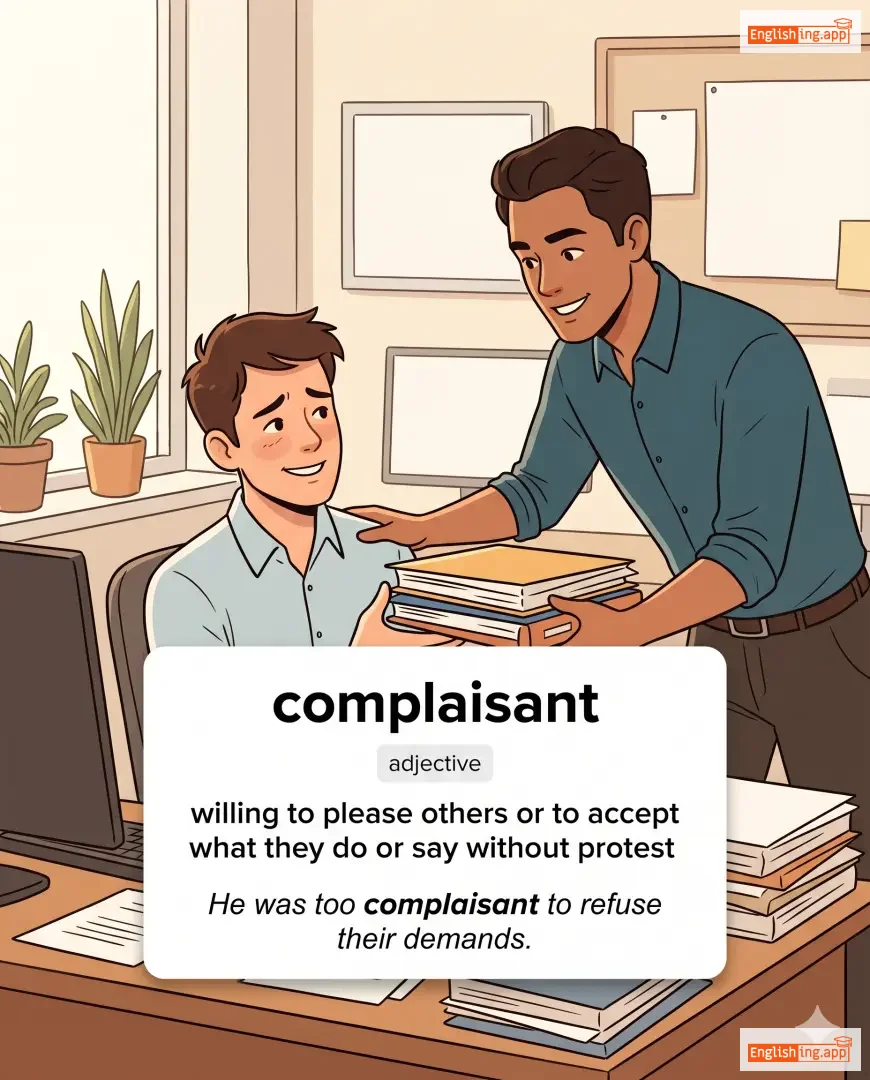
complaisant definition card — visual illustration of the meaning
adjective
/kəmˈpleɪzənt/
trop complaisant (trop complaisant)

willing to please others or to accept what they do or say without protest

"He was too complaisant to refuse their demands."

"Il était trop complaisant pour refuser leurs demandes." (Il etait trop complaisant pour refuser leurs demandes.)
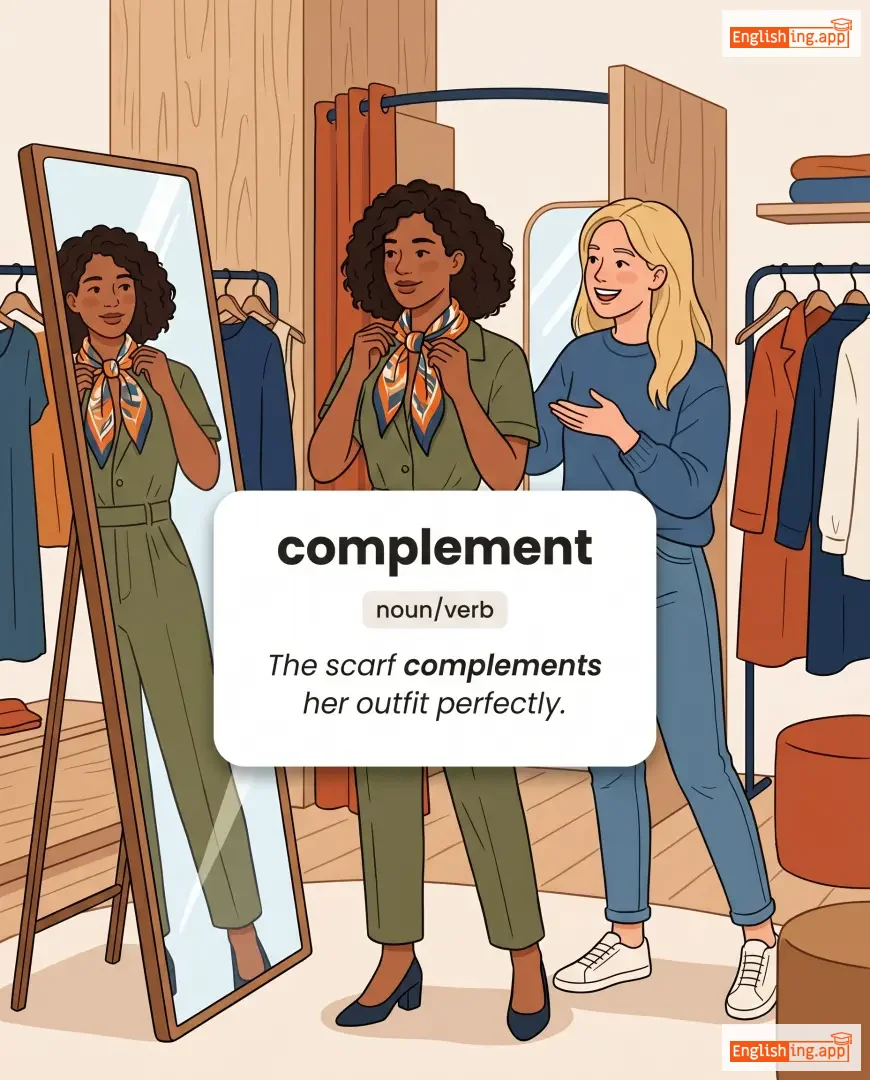
complement definition card — visual illustration of the meaning
noun/verb
/ˈkɒmplɪmənt/
complément (complement)

something that completes or goes well with something; to add something that enhances or improves

"The scarf complements her outfit perfectly."

"le foulard complète parfaitement sa tenue." (le foulard complète parfaitement sa tenue.)
adjective
/ˌkɒmplɪˈmɛntəri/
complémentaire (complementaire)

combining in such a way as to enhance or emphasize the qualities of each other

"The two partners have complementary skills."

"Les deux partenaires ont des compétences complémentaires." (Les deux partenaires ont des compétences complémentaires.)
verb
/kəmˈpliːt/
compléter (completer)

to finish making or doing something; to bring something to an end

"She managed to complete the project on time."

"Elle a réussi à compléter le projet à temps." (Elle a réussi à compléter le projet à temps.)
adverb
/kəmˈpliːtli/
complètement (completement)

totally; in every way possible

"The room was completely silent."

"La pièce était complètement silencieuse." (La piece etait completement silencieuse.)
noun
/kəmˈpliːʃən/
achèvement (achevement)

the action or process of finishing something

"The completion of the project will take another few weeks."

"L'achèvement du projet prendra encore quelques semaines." (L'achevement du projet prendra encore quelques semaines.)
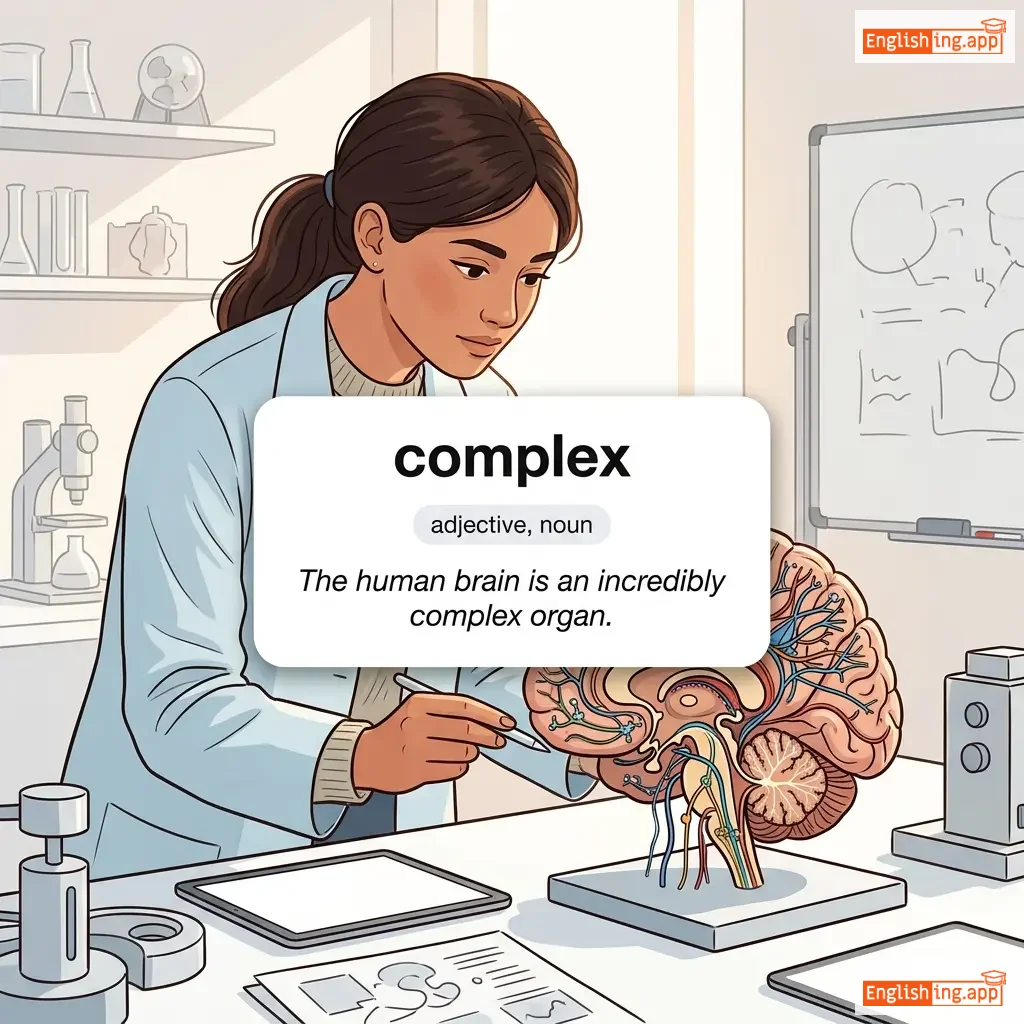
complex definition card — visual illustration of the meaning
adjective, noun
/ˈkɒm.pleks/
complexe (complexe)

Consisting of many different and connected parts; not easy to understand or analyze.

"The human brain is an incredibly complex organ."

"Le cerveau humain est un organe incroyablement complexe." (Le cerveau humain est un organe incroyablement complexe.)
noun
/kəmˈplek.ʃən/
teint (teint)

the natural color, texture, and appearance of a person's skin, especially on the face

"Her fair complexion glowed beautifully in the morning sunlight."

"Sa peau claire brillait magnifiquement sous la lumière du matin." (Sa peau claire brillait magnifiquement sous la lumière du matin.)
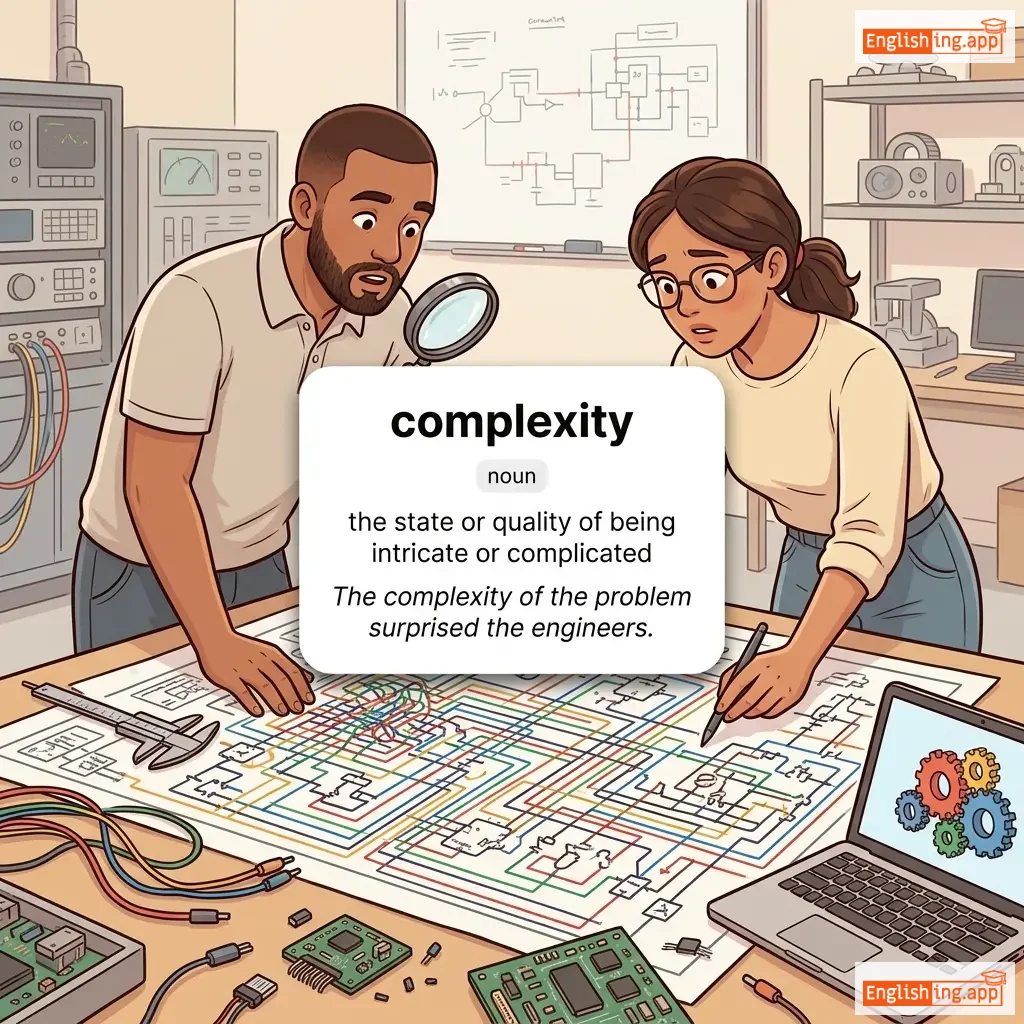
complexity definition card — visual illustration of the meaning
noun
/kəmˈplɛksɪti/
complexité (complexite)

the state or quality of being intricate or complicated

"The complexity of the problem surprised the engineers."

"La complexité du problème a surpris les ingénieurs." (La complexité du problème a surpris les ingénieurs.)
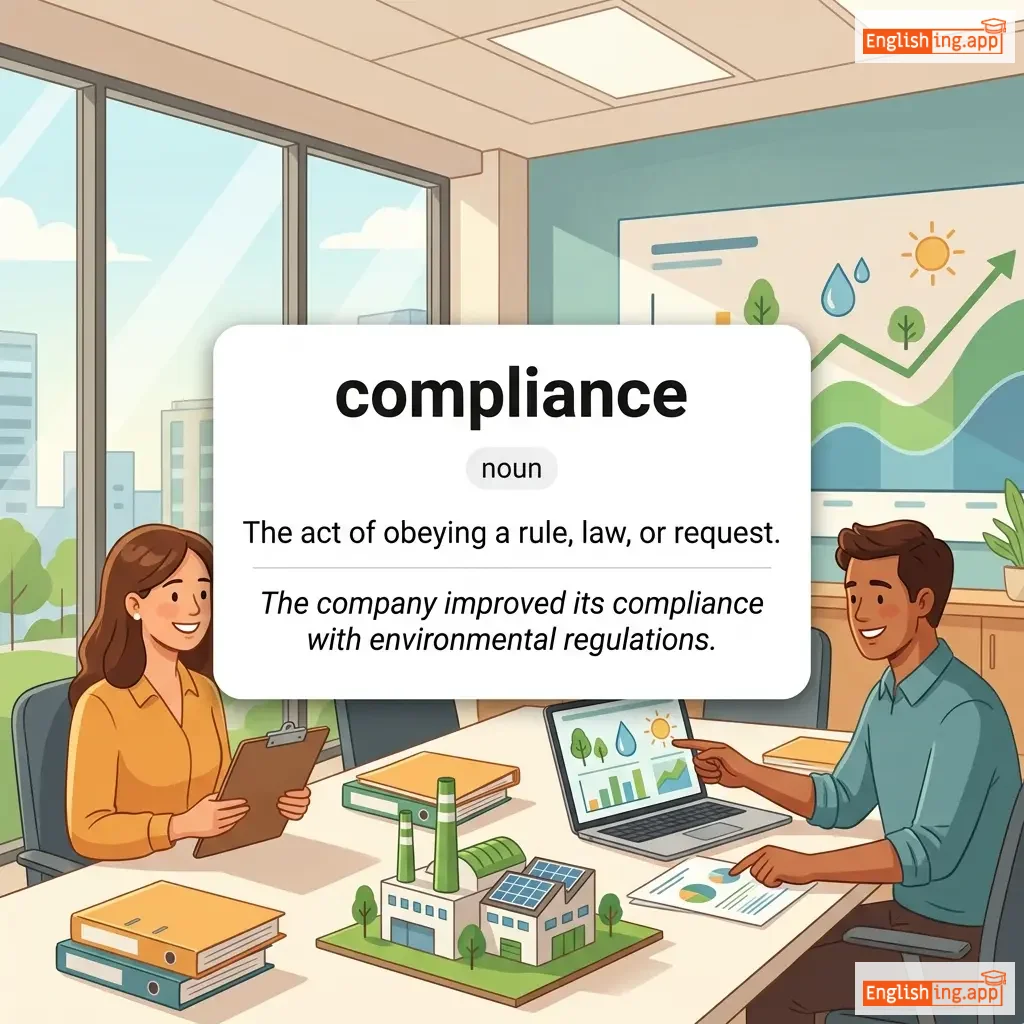
compliance definition card — visual illustration of the meaning
noun
/kəmˈplaɪəns/
conformité (conformite)

The act of obeying a rule, law, or request.

"The company improved its compliance with environmental regulations."

"L'entreprise a amélioré sa conformité aux réglementations environnementales." (L'entreprise a amélioré sa conformité aux réglementations environnementales.)
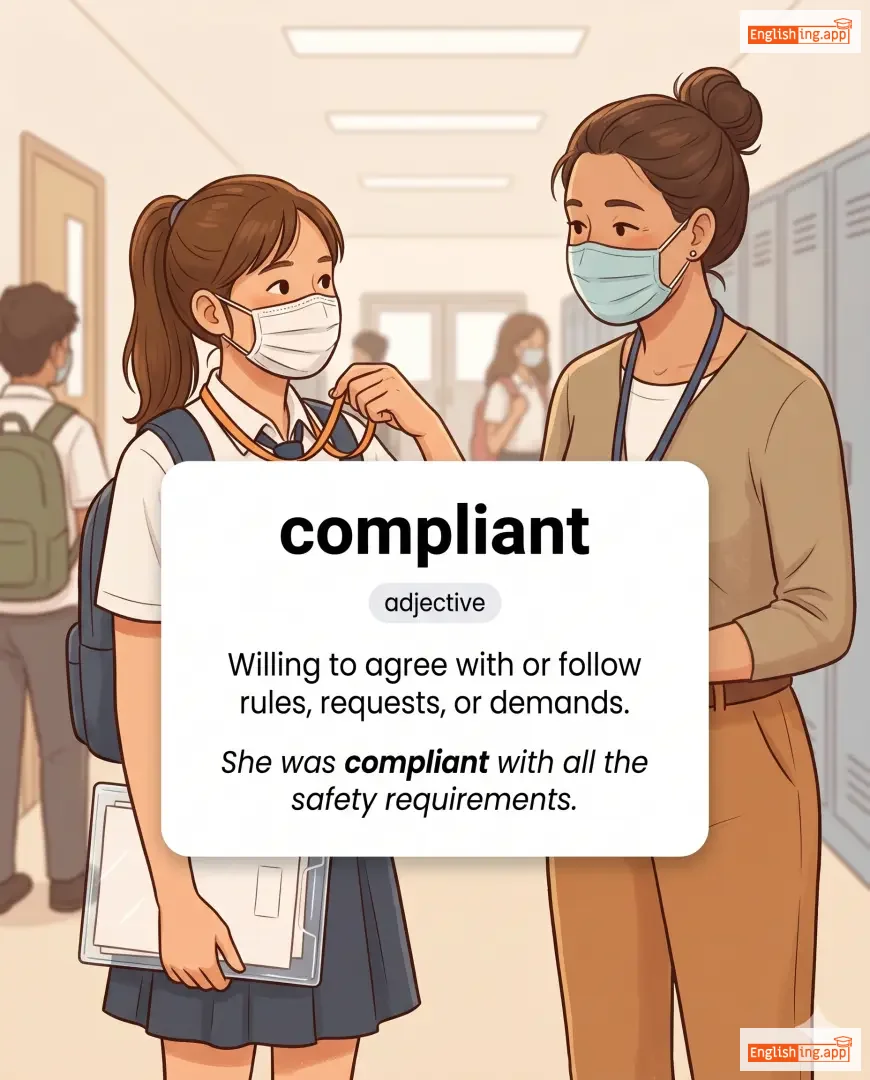
compliant definition card — visual illustration of the meaning
adjective
/kəmˈplaɪənt/
conforme (conforme)

Willing to agree with or follow rules, requests, or demands.

"She was compliant with all the safety requirements."

"Elle était conforme à toutes les exigences de sécurité." (Elle était conforme à toutes les exigences de sécurité.)
verb
/ˈkɒm.plɪ.keɪt/
compliquer (compliquer)

To make something more difficult or confusing.

"The new rules will only complicate the process."

"Les nouvelles règles ne feront qu'encombrer le processus." (Les nouvelles règles ne feront qu'encombrer le processus.)
adjective
/ˈkɒmplɪˌkeɪtɪd/
compliqué (complique)

consisting of many interconnected parts; difficult to understand

"The instructions for the machine are too complicated to follow."

"Les instructions de la machine sont trop compliquées à suivre." (Les instructions de la machine sont trop compliquées à suivre.)
noun
/ˌkɒmplɪˈkeɪʃən/
complication (complication)

A problem or difficulty that makes a situation harder to deal with.

"His illness led to serious complications after surgery."

"Sa maladie a causé des complications graves après la chirurgie." (Sa maladie a cause des complications graves apres la chirurgie.)
adjective
/kəmˈplɪsɪt/
complice (dans un crime) (complice (dans un crime))

involved with others in an illegal activity or wrongdoing

"He was found complicit in the crime."

"Il a été trouvé complice dans le crime." (Il a été trouvé complice dans le crime.)
noun
/kəmˈplɪsəti/
complicité (complicité)

the state of being involved with others in an illegal activity or wrongdoing

"The court revealed his complicity in the fraud scheme."

"Le tribunal a révélé sa complicité dans le plan de fraude." (Le tribunal a révélé sa complicité dans le plan de fraude.)