Vocabulaires

Découvrez, apprenez et maîtrisez le vocabulaire anglais

noun
/kəˈmændər/
commandant (commandant)

a person in authority, especially over a military group

"The commander led his troops into battle."

"Le commandant a mené ses troupes au combat." (Le commandant a mené ses troupes au combat.)
noun
/kəˈmændər ɪn tʃiːf/
commandant en chef (commandant en chef)

the supreme leader of a nation's armed forces

"The president serves as the commander-in-chief of the military."

"Le président agit en tant que commandant en chef des forces armées." (Le président agit en tant que commandant en chef des forces armées.)
verb
/kəˈmɛmɔˌreɪt/
commémorer (commémorer)

To honor and remember someone or something through a ceremony or action.

"The statue was built to commemorate the fallen heroes."

"La statue a été construite pour commémorer les héros tombés." (La statue a été construite pour commémorer les héros tombés.)
adjective
/kəˈmɛmərətɪv/
commémoratif (commemoratif)

Serving as a reminder or in honor of a person or event.

"They issued a commemorative coin for the independence anniversary."

"Ils ont émis une pièce commémorative pour l'anniversaire de l'indépendance." (Ils ont émis une pièce commémorative pour l'anniversaire de l'indépendance.)
verb
/kəˈmɛns/
commencer (commencer)

to begin or start something

"The ceremony will commence at noon."

"La cérémonie commencera à midi." (La cérémonie commencera à midi.)
commencement definition card — visual illustration of the meaning
noun
/kəˈmɛnsmənt/
commencement, cérémonie de remise des diplômes (commencement, ceremonie de remise des diplomes)

the beginning of something; a ceremony for conferring academic degrees

"The commencement of the project was delayed by two weeks."

"Le commencement du projet a été retardé de deux semaines." (Le commencement du projet a ete retarde de deux semaines.)
verb
/kəˈmɛnd/
complimenter (complimenter)

to praise formally or officially

"The teacher commended the students for their hard work."

"L'enseignant a complimenté les étudiants pour leur travail acharné." (L'enseignant a complimenté les étudiants pour leur travail acharné.)
adjective
/kəˈmɛndəbl̩/
digne d'éloges (digne d'eloge)

deserving praise or approval

"Her dedication to the project was truly commendable."

"Son engagement envers le projet était vraiment digne d'éloges." (Son engagement envers le projet etait vraiment digne d'eloge.)
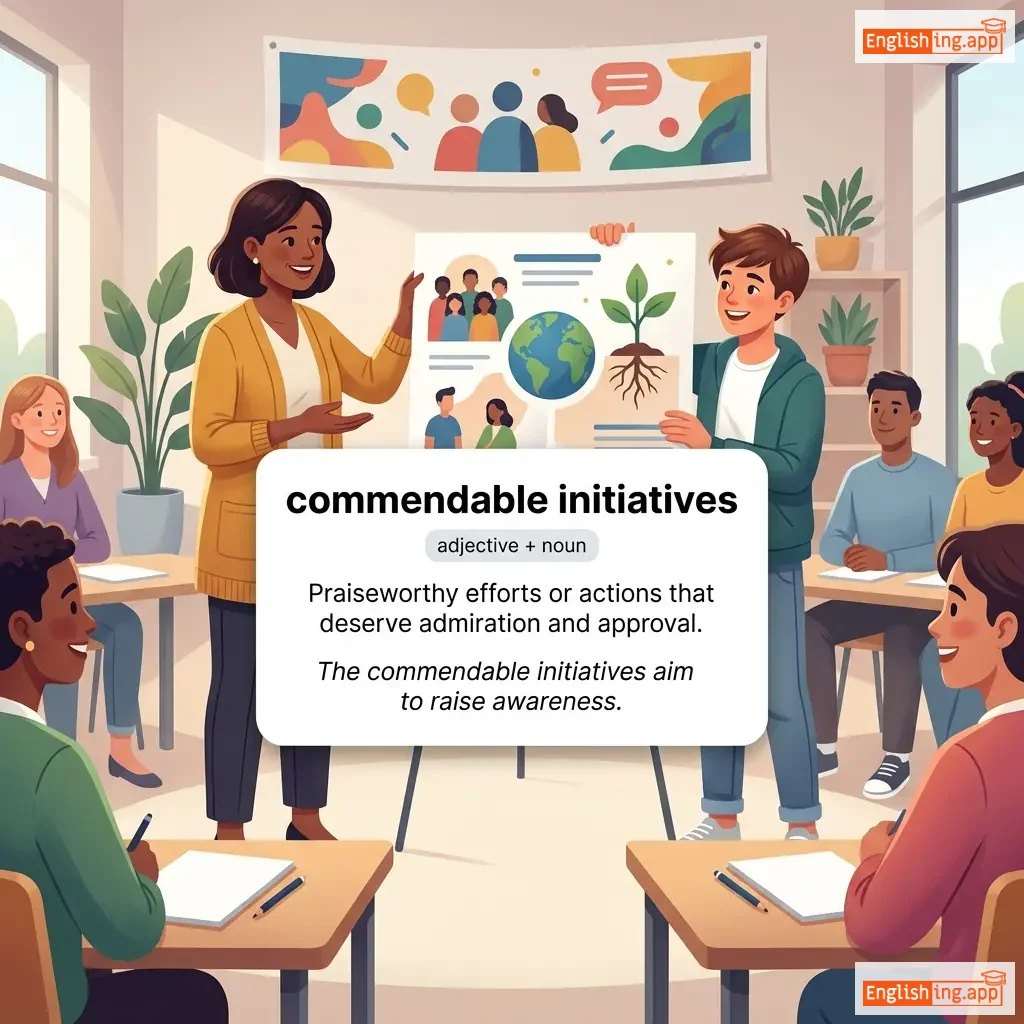
commendable initiatives definition card — visual illustration of the meaning
adjective + noun
kəˈmendəbəl ɪˈnɪʃətɪvz
initiatives louables (initiatives louables)

Praiseworthy efforts or actions that deserve admiration and approval.

"The commendable initiatives aim to raise awareness."

"Les initiatives louables visent à sensibiliser." (Les initiatives louables visent à sensibiliser.)
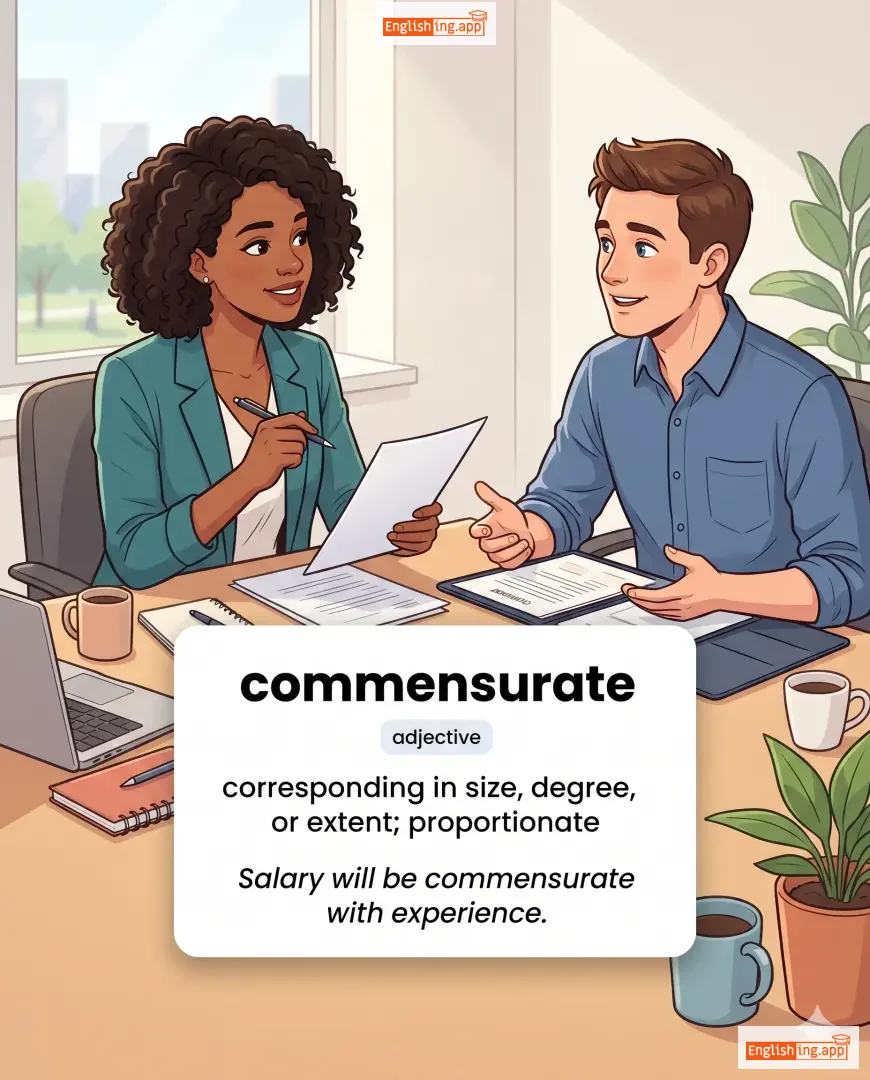
commensurate definition card — visual illustration of the meaning
adjective
/kəˈmɛnʃərət/
proportionnel (proportionnel)

corresponding in size, degree, or extent; proportionate

"Salary will be commensurate with experience."

"Le salaire sera proportionnel à l'expérience." (Le salaire sera proportionnel a l'experience.)
noun
/ˈkɒm.ent/
commentaire (commentaire)

a verbal or written remark expressing an opinion or reaction

"She posted a kind comment on my photo."

"Elle a posté un gentil commentaire sur ma photo." (Elle a posté un gentil commentaire sur ma photo.)
noun
/ˈkɒmənˌtɛri/
commentaire (commentaire)

An expression of opinions or explanations about an event, situation, or text.

"The professor's commentary on the novel was insightful."

"Le commentaire du professeur sur le roman était perspicace." (Le commentaire du professeur sur le roman était perspicace.)
noun
/ˈkɒmənˌteɪtər/
commentateur (commentateur)

a person who reports and discusses events, especially on TV or radio

"The commentator described the football match in detail."

"Le commentateur a décrit le match de football en détail." (Le commentateur a décrit le match de football en détail.)
noun
/ˈkɒmɜːs/
commerce (commerce)

the activity of buying and selling goods and services

"International commerce has expanded significantly in recent years."

"Le commerce international a considérablement augmenté ces dernières années." (Le commerce international a considereablement augmente ces dernieres annees.)
commercial definition card — visual illustration of the meaning
adjective
/kəˈmɜːʃəl/
commercial (commercial)

Concerned with or engaged in commerce; intended to make a profit.

"The company focused on commercial success rather than artistic value."

"L'entreprise s'est concentrée sur le succès commercial plutôt que sur la valeur artistique." (L'entreprise s'est concentree sur le succes commercial plutot que sur la valeur artistique.)
verb
/kəˈmɪŋɡəl/
mélanger (melanger)

To mix or blend different things together.

"The charity does not commingle donations with operational funds."

"La charité ne mélange pas les dons avec les fonds opérationnels." (La charité ne mélange pas les dons avec les fonds opérationnels.)
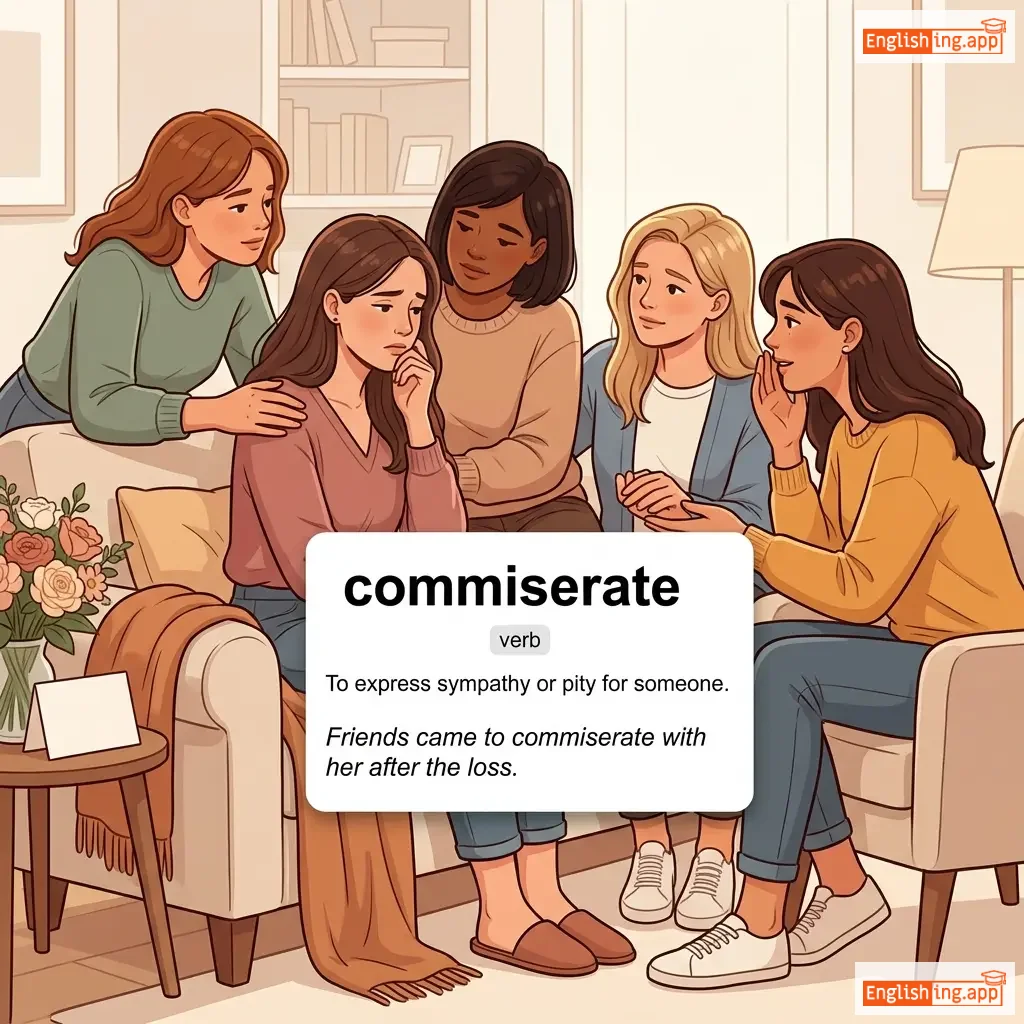
commiserate definition card — visual illustration of the meaning
verb
/kəˈmɪzəˌreɪt/
compatir (compatir)

To express sympathy or pity for someone.

"Friends came to commiserate with her after the loss."

"Les amis sont venus compatir avec elle après la perte." (Les amis sont venus compatir avec elle après la perte.)
noun
/ˌkɒməˈsɛəriət/
service des approvisionnements (service des approvisionnements)

A department responsible for supplying food and equipment, especially in the military.

"The army commissariat ensured that the soldiers had enough supplies."

"Le service des approvisionnements de l'armée s'est assuré que les soldats avaient suffisamment de provisions." (Le service des approvisionnements de l'armée s'est assuré que les soldats avaient suffisamment de provisions.)
commission definition card — visual illustration of the meaning
noun
/kəˈmɪʃən/
commission (commission)

An instruction, command, or duty given to a person or group; also a fee paid to an agent or employee for a transaction.

"The artist received a commission to paint a portrait."

"L'artiste a reçu une commission pour peindre un portrait." (L'artiste a recu une commission pour peindre un portrait.)
noun
/kəˈmɪʃənər/
commissaire (commissaire)

an official in charge of a particular department or area

"The police commissioner addressed the media about the incident."

"Le commissaire de police a informé les médias à propos de l'incident." (Le commissaire de police a informé les médias à propos de l'incident.)
verb
/kəˈmɪt/
commettre / accomplir (commettre / accomplir)

To carry out or perpetrate an act; to pledge or bind to a course of action.

"He committed a serious mistake in the report."

"Il a commis une grave erreur dans le rapport." (Il a commis une grave erreur dans le rapport.)
commitment definition card — visual illustration of the meaning
noun
/kəˈmɪtmənt/
engagement (engagement)

A promise or firm decision to do something; dedication or obligation to a cause or activity.

"She showed great commitment to her studies."

"Elle a montré un grand engagement envers ses études." (Elle a montre un grand engagement envers ses etudes.)
commitments definition card — visual illustration of the meaning
noun
kəˈmɪt.mənts
engagements (engagements)

Formal pledges or promises to do something, especially in terms of obligations or agreements.

"Global commitments to renewable energy are increasing."

"Les engagements mondiaux en matière d'énergie renouvelable augmentent." (Les engagements mondiaux en matière d'énergie renouvelable augmentent.)
noun
/kəˈmɪtl̩/
envoi en prison / détention (envoi en prison / detention)

The action of sending a person to prison or a mental hospital; also the act of committing something to a particular place.

"The judge ordered the committal of the accused to custody."

"Le juge a ordonné l'envoi de l'accusé en détention." (Le juge a ordonné l'envoi de l'accusé en detention.)
adjective
/kəˈmɪtɪd/
engagé (engagé)

Dedicated and loyal to a cause, activity, or relationship.

"She is a committed teacher who cares deeply for her students."

"Elle est une enseignante engagée qui prend profondément soin de ses élèves." (Elle est une enseignante engagée qui prend profondément soin de ses élèves.)
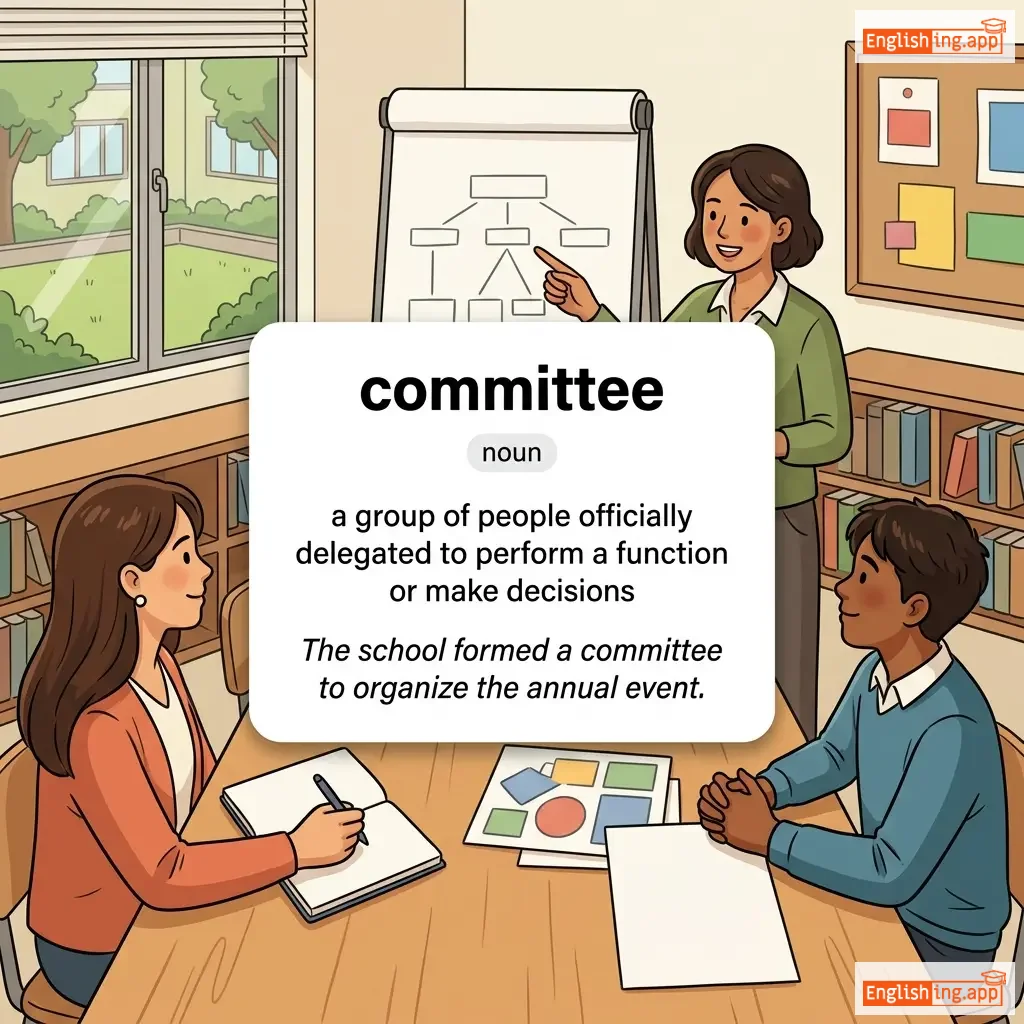
committee definition card — visual illustration of the meaning
noun
/kəˈmɪt.i/
comité (comite)

a group of people officially delegated to perform a function or make decisions

"The school formed a committee to organize the annual event."

"L'école a formé un comité pour organiser l'événement annuel." (L'école a formé un comité pour organiser l'événement annuel.)
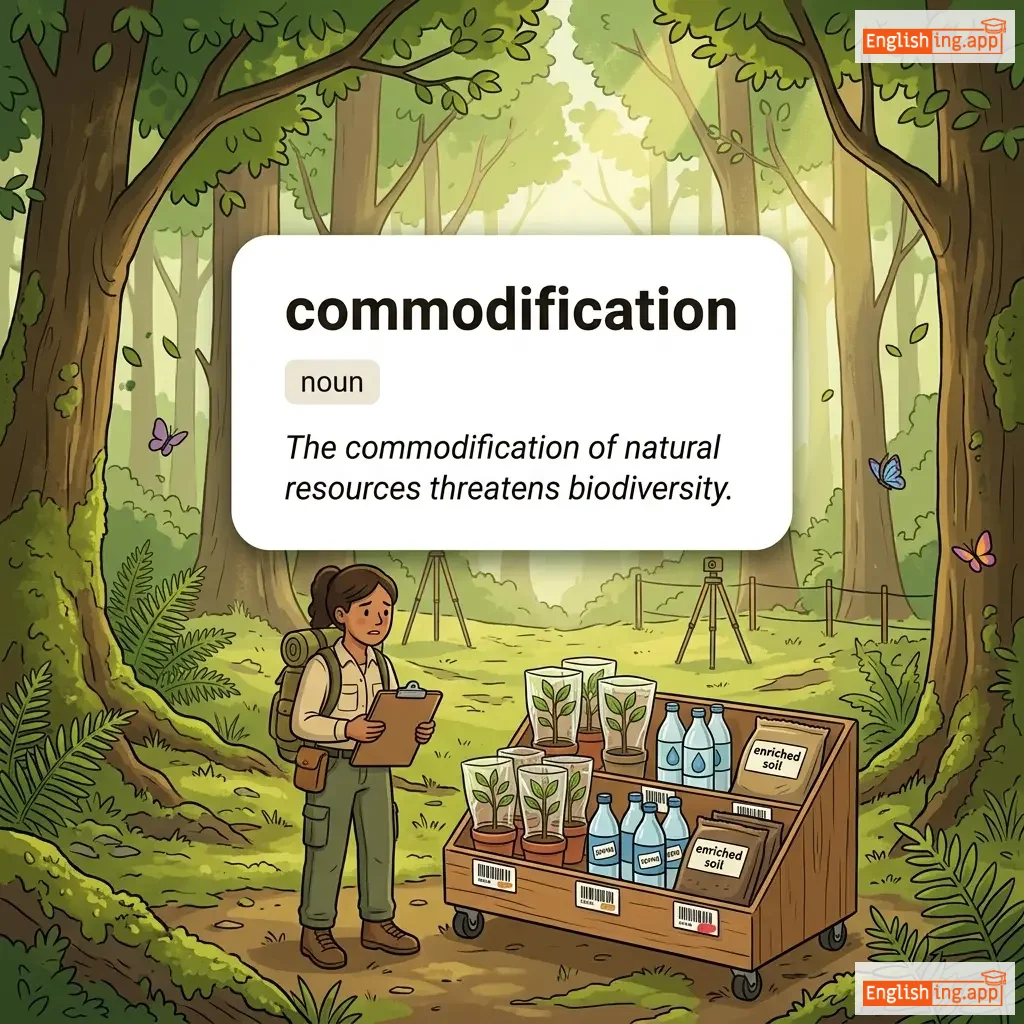
commodification definition card — visual illustration of the meaning
noun
kəˌmɒd.ɪ.fɪˈkeɪ.ʃən
la transformation des biens, services, idées ou autres entités en biens de marché (la transformation des biens, services, idées ou autres entités en biens de marché)

The transformation of goods, services, ideas, or other entities that may not normally be considered goods into market goods.

"The commodification of natural resources threatens biodiversity."

"La commodification des ressources naturelles menace la biodiversité." (La commodification des ressources naturelles menace la biodiversité.)
adjective
/kəˈmoʊdiəs/
spacieux (spacieux)

spacious and comfortable; having plenty of room

"They rented a commodious apartment in the city."

"Ils ont loué un appartement spacieux en ville." (Ils ont loué un appartement spacieux en ville.)
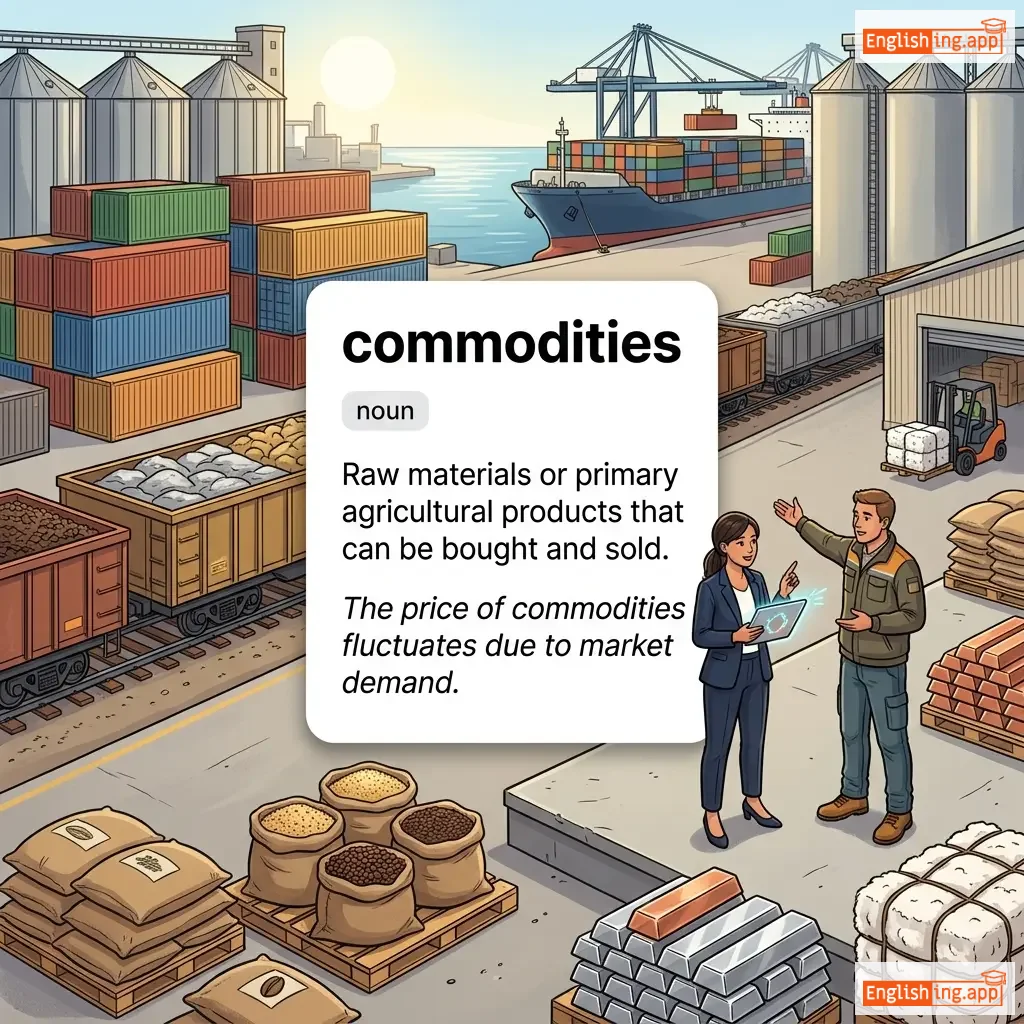
commodities definition card — visual illustration of the meaning
noun
/kəˈmɒd.ə.tiz/
marchandises (marchandises)

Raw materials or primary agricultural products that can be bought and sold.

"The price of commodities fluctuates due to market demand."

"Le prix des marchandises fluctue en fonction de la demande du marché." (Le prix des marchandises fluctue en fonction de la demande du marché.)
commodity definition card — visual illustration of the meaning
noun
/kəˈmɑːdəti/
marchandise (marchandise)

a raw material or primary product that can be bought and sold

"Oil is the most traded commodity in the world."

"Le pétrole est la marchandise la plus échangée au monde." (Le petrole est la marchandise la plus echangee au monde)
adjective
/ˈkɒm.ən/
commun (komun)

occurring frequently or widely; shared by all

"It is common to see traffic in the city during rush hour."

"Il est courant de voir du trafic en ville pendant l'heure de pointe." (Il est courant de voir du trafic en ville pendant l'heure de pointe)
noun
/ˈkɒmən kɑːp/
carpe commune (karp komyun)

A large freshwater fish widely cultivated for food

"Common carp is an important fish in aquaculture."

"La carpe commune est un poisson important en aquaculture." (la karp komyun est un pwason important an akwakultyur)
adverb
/ˈkɒmənli/
commumément (commumement)

usually or by most people

"This phrase is commonly used in everyday speech."

"Cette phrase est communément utilisée dans le langage quotidien." (Cette phrase est communement utilisee dans le langage quotidien.)
adjective, noun
/ˈkɑːmənpleɪs/
banal (banal)

ordinary or unremarkable; something that is usual or commonly found

"Smartphones have become commonplace in modern life."

"Les smartphones sont devenus banals dans la vie moderne." (Le smartphones son devnu banal dan la vi modern.)
adjective
/ˌkɑːmənˈsɛnsɪkəl/
raisonnable (raisonnable)

based on or showing sound practical judgment; sensible

"It was commonsensical to carry an umbrella on a rainy day."

"Il était raisonnable d’emporter un parapluie un jour de pluie." (Il etait raisonnable demporter un paraplui un jour de plui.)
noun
/ˈkɑːmənˌwɛlθ/
Commonwealth (Commonwealth)

an independent community or state, especially one founded for the common good; also an association of nations

"Australia is a member of the Commonwealth of Nations."

"L’Australie est membre du Commonwealth des Nations." (LAustralie est membre du Commonwealth des Nations.)
noun
/kəˈmoʊʃən/
agitation (agitation)

A state of noisy confusion or disturbance.

"The sudden commotion in the market drew everyone's attention."

"L'agitation soudaine au marché a attiré l'attention de tout le monde." (Lagitation soudaine au marche a attire lattention de tout le monde.)
adjective
/ˈkɑːmjənl/
communautaire (komunoter)

Shared by all members of a community; for common use.

"The villagers worked together in the communal garden."

"Les villageois ont travaillé ensemble dans le jardin communautaire." (Le vilajua on travaye ansamble dan le jardin komunitair.)
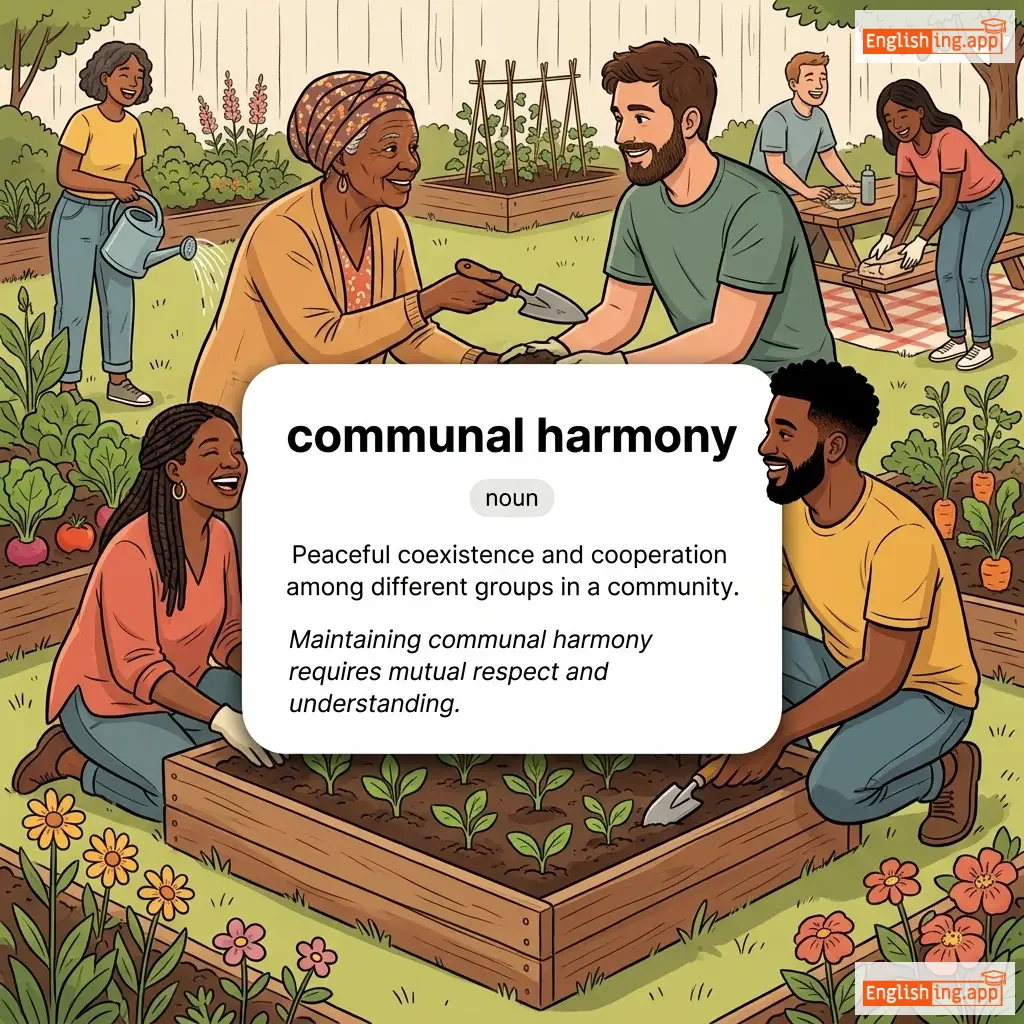
communal harmony definition card — visual illustration of the meaning
noun
kəˈmjunəl ˈhɑrməni
harmonie communautaire (harmonie communautaire)

Peaceful coexistence and cooperation among different groups in a community.

"Maintaining communal harmony requires mutual respect and understanding."

"Maintenir l'harmonie communautaire nécessite le respect et la compréhension mutuels." (maintenir l harmonie communautaire necessite le respect et la comprehension mutuels)
noun, verb
/ˈkɒmjuːn/
commune / communiquer intimement (komyun / komunique intimeman)

Noun: a group of people living together and sharing possessions; Verb: to share one's thoughts or feelings intimately.

"She went to the countryside to commune with nature."

"Elle est allée à la campagne pour communier avec la nature." (El est ale a la kampan pour komunye avek la natyur.)
verb
/kəˈmjuː.nɪ.keɪt/
communiquer (communiquer)

to share or exchange information, ideas, or feelings

"They used gestures to communicate across the noisy room."

"Ils ont utilisé des gestes pour communiquer à travers la pièce bruyante." (Ils ont utilise des gestes pour communiquer a travers la piece bruyante.)
communication definition card — visual illustration of the meaning
noun
/kəˌmjuː.nɪˈkeɪ.ʃən/
communication (communication)

the act or process of sharing information, ideas, or feelings

"Good communication is essential for a strong relationship."

"Une bonne communication est essentielle pour une relation forte." (Une bonne communication est essentielle pour une relation forte.)
noun
/ˈkɒmjʊnɪst/
communiste (komyunist)

a person who supports or believes in the principles of communism

"The communist ideology aims for a classless society."

"L'idéologie communiste vise une société sans classes." (L'ideologie communiste vise une societe sans classes.)
noun
/kəˈmjuː.nə.ti/
communauté (communaute)

a group of people living in the same place or sharing common interests

"The community worked together to clean the park."

"La communauté a travaillé ensemble pour nettoyer le parc." (La communauté a travaillé ensemble pour nettoyer le parc.)
Community Programs definition card — visual illustration of the meaning
noun
kəˈmjuːnɪti ˈprəʊɡræmz
programmes communautaires (programmes communautaires)

Organized activities involving local groups to promote environmental conservation.

"Community programs raise awareness about butterfly conservation."

"Les programmes communautaires sensibilisent à la conservation des papillons." (Les programmes communautaires sensibilisent a la conservation des papillons.)
community service ideals definition card — visual illustration of the meaning
noun
kəˈmjuːnɪti ˈsɜːrvɪs aɪˈdiːəlz
idéaux du service communautaire (idéaux du service communautaire)

Principles and standards of serving the community for social good.

"Community service ideals must be taught in schools."

"Les idéaux du service communautaire doivent être enseignés à l'école." (Les idéaux du service communautaire doivent être enseignés à l'école.)
verb, noun
/kəˈmjuːt/
trajet domicile-travail (trajet domicile travail)

Verb: to travel regularly between home and work; Noun: the journey to and from work.

"He commutes two hours every day to reach his office."

"Il fait deux heures de trajet chaque jour pour rejoindre son bureau." (Il fait deux heures de trajet chaque jour pour rejoindre son bureau)
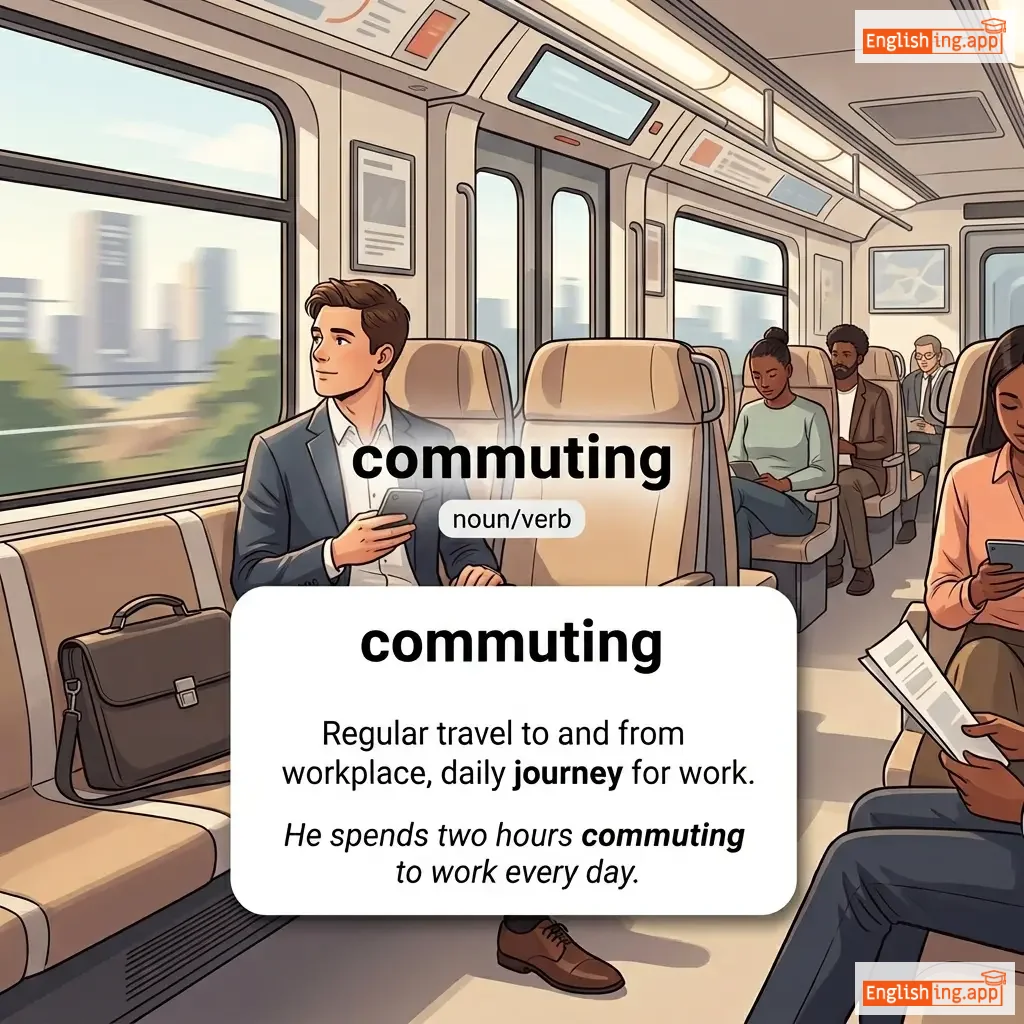
commuting definition card — visual illustration of the meaning
noun/verb
/kəˈmjuː.tɪŋ/
trajet quotidien (trajet quotidien)

Regular travel to and from workplace, daily journey for work.

"He spends two hours commuting to work every day."

"Il passe deux heures à se rendre au travail chaque jour." (Il passe deux heures à se rendre au travail chaque jour.)
adjective, noun, verb
/ˈkɒmpækt/ (adj, n), /kəmˈpækt/ (verb)
compact / petit / accord (compact / petit / accord)

Adjective: closely and neatly packed together; Noun: a small case or agreement; Verb: to pack closely together.

"The car is small and compact, perfect for city driving."

"La voiture est petite et compacte, parfaite pour la conduite en ville." (la voiture est petite et compacte, parfaite pour la conduite en ville.)
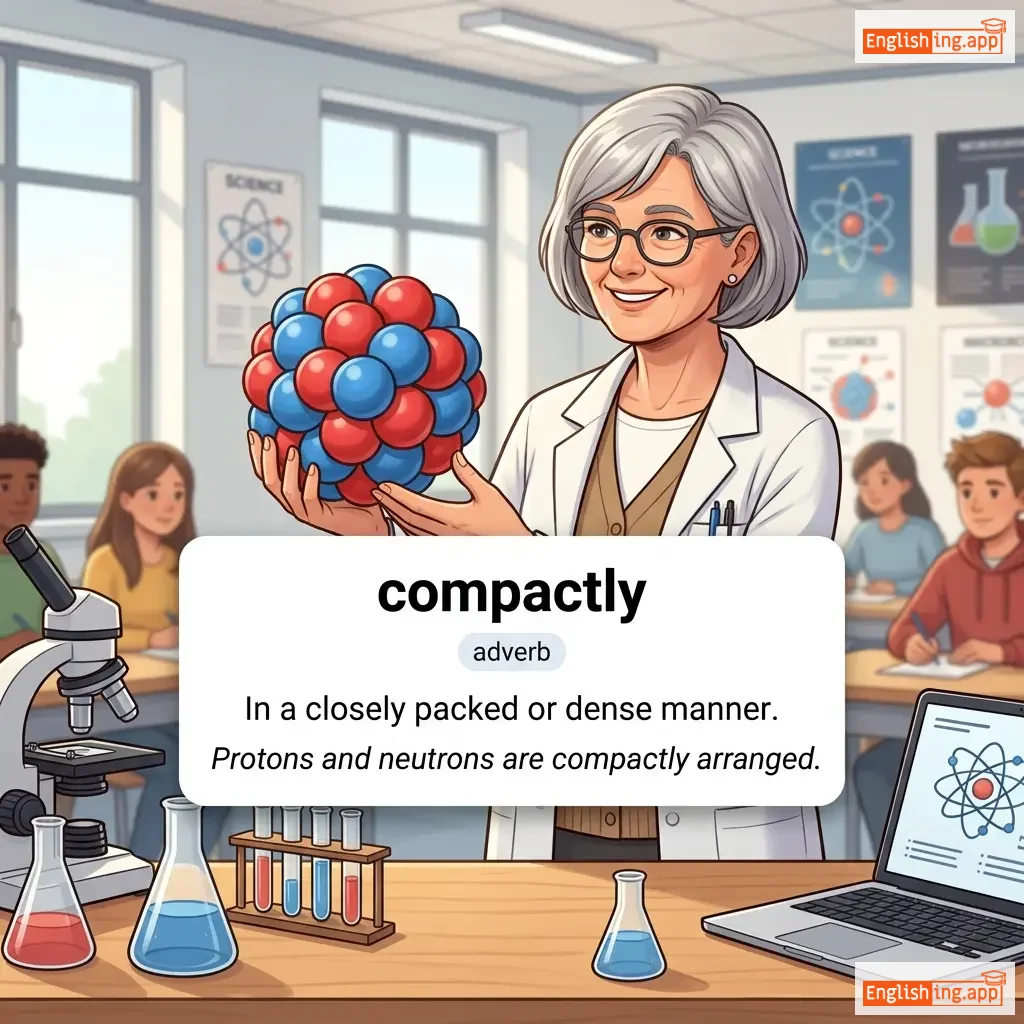
compactly definition card — visual illustration of the meaning
adverb
kəmˈpæktli
compactement (compactement)

In a closely packed or dense manner.

"Protons and neutrons are compactly arranged."

"Les protons et les neutrons sont disposés de manière compacte." (Les protons et les neutrons sont disposés de manière compacte.)